Recognition: no theorem link
CAD-feature enhanced machine learning for manufacturing effort estimation on sheet metal bending parts
Pith reviewed 2026-05-13 06:04 UTC · model grok-4.3
The pith
Enriching CAD graphs with rule-recognized manufacturing features improves machine learning predictions of sheet metal bending effort.
A machine-rendered reading of the paper's core claim, the machinery that carries it, and where it could break.
Core claim
The authors claim that augmenting B-rep attributed adjacency graphs with manufacturing features identified by a rule-based module—such as bend characteristics, flange lengths, and surface roles—allows graph-based models to achieve higher accuracy on manufacturability assessment and effort estimation tasks for sheet metal bending parts, as shown through tests on synthetic data and one of the first validations against genuine industrial production measurements.
What carries the argument
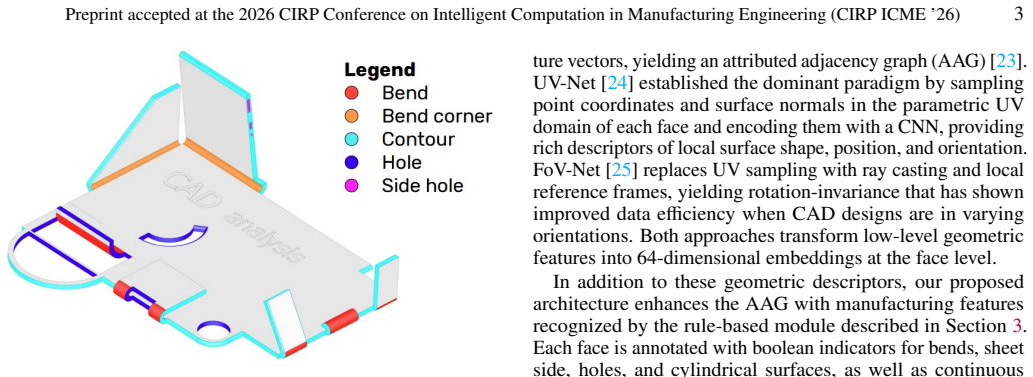
B-rep attributed adjacency graphs enriched with rule-based manufacturing features that supply process semantics missing from shape and topology alone.
If this is right
- The hybrid models deliver higher accuracy on both classification of manufacturability and regression of bending effort.
- The gains hold on both large synthetic benchmarks and real industrial datasets with measured production times.
- The approach provides a workable route to tools that run inside industrial CAD systems for early effort estimation.
- Domain knowledge injected as node attributes concentrates learning on patterns that matter for the bending process.
Where Pith is reading between the lines
- The same enrichment strategy could be tested on other sheet metal operations such as punching or laser cutting.
- Factories might integrate the method to flag high-effort designs during the initial modeling stage rather than after quoting.
- Purely data-driven CAD analysis may continue to need explicit feature recognition steps to reach production-grade reliability.
Load-bearing premise
The rule-based module can reliably detect and correctly label process-specific details like bend characteristics, flange lengths, and surface roles from the CAD geometry.
What would settle it
Run the hybrid model and a pure geometric baseline on a fresh collection of real sheet metal parts with recorded bending times and check whether the hybrid version loses its accuracy advantage.
Figures

read the original abstract
Graph-based machine learning has emerged as a promising approach for manufacturability analysis by learning directly from CAD models represented as Boundary Representations (B-reps), exploiting both surface geometry and topological connectivity. However, purely geometric representations often lack the process-specific semantics required for accurate manufacturability prediction: many manufacturing factors, such as surface roles or bend intent, are not explicitly encoded in shape alone and are difficult for data-driven models to infer reliably. We propose a hybrid approach that addresses this challenge by enriching B-rep attributed adjacency graphs with manufacturing features recognized through a rule-based module. Applied to sheet metal bending, recognized features, such as bend characteristics, flange lengths, and surface roles are integrated as node attributes, concentrating the learning signal on process-relevant geometric patterns. Experiments on both a large-scale synthetic manufacturability benchmark and a real-world industrial dataset with measured bending times, one of the first such validations on genuine production data, demonstrate that combining domain knowledge with graph-based learning improves prediction accuracy across both tasks. The results demonstrate that hybrid modeling offers a feasible and effective path toward deployable tools for manufacturability assessment and effort estimation in industrial CAD environments.
Editorial analysis
A structured set of objections, weighed in public.
Referee Report
Summary. The manuscript proposes a hybrid graph-based machine learning approach for manufacturability analysis and manufacturing effort estimation on sheet metal bending parts. It enriches B-rep attributed adjacency graphs with process-specific features (bend characteristics, flange lengths, surface roles) recognized by a rule-based module and added as node attributes. Experiments on a large-scale synthetic manufacturability benchmark and a real-world industrial dataset with measured bending times are reported to show accuracy improvements over purely geometric models, positioning the hybrid method as a feasible path to deployable CAD tools.
Significance. If the experimental claims hold after validation, the work would provide a concrete demonstration of how rule-based domain knowledge can be integrated into graph neural networks for CAD-derived manufacturing predictions. The use of genuine production data with measured times is a positive aspect that increases relevance to industrial deployment.
major comments (2)
- [Experiments and Results] The central claim requires that the rule-based module supplies semantics (bend characteristics, flange lengths, surface roles) that cannot be reliably inferred from B-rep geometry and topology alone. However, the manuscript provides no independent accuracy metric or validation for the rule-based feature recognition module itself, no ablation that removes the rule-derived attributes while keeping the graph structure and training procedure identical, and no direct comparison against a pure geometric baseline using the same GNN architecture. These omissions leave open the possibility that reported gains arise from model capacity or data artifacts rather than the claimed semantic enrichment.
- [Abstract and §5 (Experiments)] The abstract and results sections assert accuracy gains on both synthetic and real datasets but supply no quantitative metrics (e.g., MAE, RMSE, R²), no baseline methods with reported numbers, no error analysis, and no implementation details (hyperparameters, training protocol, graph construction). Without these, the magnitude and reliability of the claimed improvements cannot be assessed.
minor comments (2)
- [Method] Clarify the exact graph construction pipeline (node/edge features before and after rule enrichment) and the precise definition of 'surface roles' to aid reproducibility.
- [Discussion] Add a dedicated limitations or failure-mode discussion, particularly regarding cases where the rule-based recognizer may produce incorrect attributes.
Simulated Author's Rebuttal
We thank the referee for the constructive and detailed comments. We address each major point below and outline the revisions we will make to strengthen the experimental validation and reporting.
read point-by-point responses
-
Referee: [Experiments and Results] The central claim requires that the rule-based module supplies semantics (bend characteristics, flange lengths, surface roles) that cannot be reliably inferred from B-rep geometry and topology alone. However, the manuscript provides no independent accuracy metric or validation for the rule-based feature recognition module itself, no ablation that removes the rule-derived attributes while keeping the graph structure and training procedure identical, and no direct comparison against a pure geometric baseline using the same GNN architecture. These omissions leave open the possibility that reported gains arise from model capacity or data artifacts rather than the claimed semantic enrichment.
Authors: We agree that independent validation of the rule-based module and targeted ablations are needed to isolate the contribution of the semantic features. In the revised manuscript we will add an accuracy evaluation of the rule-based feature recognition module against manually annotated ground truth on a held-out set of B-rep models. We will also include an ablation that removes only the rule-derived node attributes while preserving the identical graph structure, GNN architecture, and training protocol. Finally, we will report a direct comparison against a pure geometric baseline that uses the same GNN backbone and training procedure, thereby demonstrating that the observed gains arise from the added manufacturing semantics rather than differences in model capacity or data handling. revision: yes
-
Referee: [Abstract and §5 (Experiments)] The abstract and results sections assert accuracy gains on both synthetic and real datasets but supply no quantitative metrics (e.g., MAE, RMSE, R²), no baseline methods with reported numbers, no error analysis, and no implementation details (hyperparameters, training protocol, graph construction). Without these, the magnitude and reliability of the claimed improvements cannot be assessed.
Authors: We acknowledge that the current presentation lacks the quantitative detail required for full assessment. In the revised version we will expand the abstract to include key performance metrics (MAE, RMSE, R²) for the hybrid method and all baselines on both the synthetic and industrial datasets. Section 5 will be augmented with a dedicated error analysis, tables reporting all baseline numbers, and a complete description of implementation details including hyperparameters, training protocol, optimizer settings, and the precise procedure used to construct the attributed adjacency graphs from B-rep data. revision: yes
Circularity Check
No significant circularity; hybrid model is empirically grounded
full rationale
The paper describes an empirical pipeline: a separate rule-based module extracts manufacturing features (bend characteristics, flange lengths, surface roles) from B-rep geometry, these are added as node attributes to attributed adjacency graphs, and graph neural networks are trained to predict manufacturability or effort on held-out synthetic and real industrial datasets. No equations or claims reduce a prediction to a fitted parameter by construction, no self-citation chain supplies the central premise, and the rule-based recognizer is treated as an independent input rather than defined in terms of the learned model. The reported accuracy gains are therefore falsifiable against external benchmarks and do not collapse to the inputs.
Axiom & Free-Parameter Ledger
free parameters (1)
- graph neural network hyperparameters
axioms (1)
- domain assumption Purely geometric B-rep representations lack the process-specific semantics required for accurate manufacturability prediction.
Reference graph
Works this paper leans on
-
[1]
David M Anderson.Design for manufacturability: how to use concurrent engineering to rapidly develop low-cost, high-quality products for lean production. Productivity Press, 2020
work page 2020
-
[2]
Albert E Patterson, Yong Hoon Lee, and James T Al- lison. Generation and enforcement of process-driven manufacturability constraints: A survey of methods and perspectives for product design.Journal of Mechanical Design, 143(11):110801, 2021
work page 2021
-
[3]
I Ferrer, J Rios, J Ciurana, and ML Garcia-Romeu. Methodology for capturing and formalizing dfm knowl- edge.Robotics and Computer-Integrated Manufacturing, 26(5):420–429, 2010
work page 2010
-
[4]
Xingzhi Wang, Ang Liu, and Sami Kara. Machine learn- ing for engineering design toward smart customization: A systematic review.Journal of Manufacturing Systems, 65:391–405, 2022
work page 2022
-
[5]
Sanjay Joshi and Tien-Chien Chang. Graph-based heuris- tics for recognition of machined features from a 3d solid model.Computer-aided design, 20(2):58–66, 1988
work page 1988
-
[6]
Hang Zhang, Wenhu Wang, Shusheng Zhang, Bo Huang, Yajun Zhang, Mingwei Wang, Jiachen Liang, and Zhen Wang. A novel method based on a convolutional graph neural network for manufacturing cost estimation.Jour- nal of Manufacturing Systems, 65:837–852, 2022
work page 2022
-
[7]
Josip Stjepandiˇc, H. Liese, and A. J. Trappey. Intellec- tual property protection.Concurrent engineering in the 21st century: Foundations, developments and challenges, pages 521–551, 2015
work page 2015
-
[8]
Jinjiang Wang, Yulin Ma, Laibin Zhang, Robert X Gao, and Dazhong Wu. Deep learning for smart manufacturing: Methods and applications.Journal of Manufacturing Systems, 48:144–156, 2018
work page 2018
-
[9]
Claudio Favi, Marco Mandolini, Federico Campi, and Michele Germani. A CAD-based design for manufactur- ing method for casted components.Procedia CIRP, 100: 235–240, 2021
work page 2021
-
[10]
Ravi Kumar Gupta and Balan Gurumoorthy. Classifica- tion, representation, and automatic extraction of defor- mation features in sheet metal parts.Computer-Aided Design, 45(11):1469–1484, 2013
work page 2013
-
[11]
Processing of 3d sheet metal components in step ap-203 format
TR Kannan and MS Shunmugam. Processing of 3d sheet metal components in step ap-203 format. part i: feature recognition system.International Journal of Production Research, 47(4):941–964, 2009
work page 2009
-
[12]
Jinfeng Liu, Mian Wu, Yu Chen, Qiukai Ji, and Yang Xie. A manufacturability analysis method for sheet metal based on rule reasoning.CIRP Journal of Manufacturing Science and Technology, 56:76–87, 2025
work page 2025
-
[13]
Feature recognition for structural aerospace sheet metal parts
Seyedmorteza Ghaffarishahri and Louis Rivest. Feature recognition for structural aerospace sheet metal parts. Computer-Aided Design&Applications, 17(1), 2020. Preprint accepted at the 2026 CIRP Conference on Intelligent Computation in Manufacturing Engineering (CIRP ICME ’26)6
work page 2020
-
[14]
Sergey E Slyadnev. Bending simulation framework for rapid feasibility checks of sheet metal parts.Computer- Aided Design&Applications, 23(1), 2026
work page 2026
-
[15]
Liuhuan Ma and Jiong Yang. Adaptive recognition of machining features in sheet metal parts based on a graph class-incremental learning strategy.Scientific Reports, 14 (1):10656, 2024
work page 2024
-
[16]
Feature ex- traction and manufacturability assessment of sheet metal parts
Shailendra Kumar, Rajender Singh, Deepak Panghal, Sachin Salunkhe, and Hussein MA Hussein. Feature ex- traction and manufacturability assessment of sheet metal parts. InAI Applications in Sheet Metal Forming, pages 41–66. Springer, 2016
work page 2016
-
[17]
Johannes Seibold, Maximilian Hentsch, Aleksei Kharitonov, Rainer Eber, and Steffen Schwarzer. Pro- cess automation in the area of manufacturability analysis using machine learning.Procedia Computer Science, 204:196–204, 2022
work page 2022
-
[18]
Soyoung Yoo and Namwoo Kang. Explainable artifi- cial intelligence for manufacturing cost estimation and machining feature visualization.Expert Systems with Applications, 183:115430, 2021
work page 2021
-
[19]
Matteo Ballegeer and Dries F Benoit. Bendfm: A tax- onomy and synthetic cad dataset for manufacturability assessment in sheet metal bending.Journal of Intelligent Manufacturing, pages 1–19, 2026
work page 2026
-
[20]
Hyunwoong Ko, Paul Witherell, Yan Lu, Samyeon Kim, and David W Rosen. Machine learning and knowledge graph based design rule construction for additive manu- facturing.Additive Manufacturing, 37:101620, 2021
work page 2021
-
[21]
Bader Alwoimi Aljabali, Santosh Kumar Parupelli, and Salil Desai. Generalized design for additive manufactur- ing (dfam) expert system using compliance and design rules.Machines, 13(1):29, 2025
work page 2025
-
[22]
A flexi- ble approach for design rule formalization and evaluation
Rob Salaets, Bieke Decraemer, Philip Eyckens, Wim Boudewyns, Ward Van Houdt, and Koen Beyers. A flexi- ble approach for design rule formalization and evaluation. Procedia CIRP, 109:556–561, 2022
work page 2022
-
[23]
Graph repre- sentation of 3d cad models for machining feature recog- nition with deep learning
Weijuan Cao, Trevor Robinson, Yang Hua, Flavien Bous- suge, Andrew R Colligan, and Wanbin Pan. Graph repre- sentation of 3d cad models for machining feature recog- nition with deep learning. InInternational design engi- neering technical conferences and computers and infor- mation in engineering conference, volume 84003, page V11AT11A003. American Society...
work page 2020
-
[24]
Uv-net: Learning from bound- ary representations
Pradeep Kumar Jayaraman, Aditya Sanghi, Joseph G Lambourne, Karl DD Willis, Thomas Davies, Hooman Shayani, and Nigel Morris. Uv-net: Learning from bound- ary representations. InProceedings of the IEEE/CVF Conference on Computer Vision and Pattern Recognition (CVPR), pages 11703–11712, 2021
work page 2021
-
[25]
Fov-net: Rotation- invariant cad b-rep learning via field-of-view ray casting
Matteo Ballegeer and Dries F Benoit. Fov-net: Rotation- invariant cad b-rep learning via field-of-view ray casting. arXiv preprint arXiv:2602.24084, 2026
discussion (0)
Sign in with ORCID, Apple, or X to comment. Anyone can read and Pith papers without signing in.