Representing Higher-Order Networks: A Survey of Graph-Based Frameworks
Pith reviewed 2026-05-19 18:07 UTC · model grok-4.3
The pith
Higher-order networks are unified through a survey of graph formalisms that extend beyond pairwise links.
A machine-rendered reading of the paper's core claim, the machinery that carries it, and where it could break.
Core claim
By surveying foundational concepts, extensional frameworks, and newly introduced formalisms with emphasis on their structural principles, relationships, and modeling roles, the book establishes a unified perspective that helps readers compare diverse higher-order network models and identify appropriate tools for theoretical study and practical applications.
What carries the argument
Higher-order graph formalisms incorporating multiway, hierarchical, temporal, multilayer, recursive, and tensor-based interactions.
If this is right
- Readers obtain a single viewpoint for comparing different higher-order network models.
- Suitable tools become identifiable for specific theoretical investigations of complex systems.
- New formalisms add options for capturing interactions that standard graphs miss.
- Practical applications gain from clearer choices among representation methods.
Where Pith is reading between the lines
- Hybrid models that mix features from several formalisms could address gaps in current representations.
- Adoption of these frameworks might simplify the creation of analysis tools for social or biological networks.
- Empirical tests on datasets from specific domains could show which formalisms perform best in practice.
Load-bearing premise
The collection of surveyed and newly introduced formalisms is sufficiently comprehensive and non-redundant to serve as a reliable reference for model selection across domains.
What would settle it
Identification of a real-world higher-order phenomenon that fits none of the described formalisms or that reveals contradictions in the claimed relationships among them.
Figures














read the original abstract
Many real-world phenomena are naturally modeled by graphs and networks. However, classical graph models are often limited to pairwise interactions and may not adequately capture the richer structures that arise in practice. Higher-order graph formalisms extend this framework by incorporating multiway, hierarchical, temporal, multilayer, recursive, and tensor-based interactions, thereby providing more expressive representations of complex systems. This book presents a comprehensive overview of mathematical notions that can be used to model higher-order networks. It surveys foundational concepts, extensional frameworks, and newly introduced formalisms, with an emphasis on their structural principles, relationships, and modeling roles. The aim is to provide a unified perspective that helps readers compare diverse higher-order network models and identify appropriate tools for theoretical study and practical applications. This book is Edition 2.0. It mainly includes the addition of several concepts, as well as corrections and improvements of typographical errors and explanations.
Editorial analysis
A structured set of objections, weighed in public.
Referee Report
Summary. The manuscript surveys mathematical notions for modeling higher-order networks beyond classical pairwise graphs. It covers foundational concepts, extensional frameworks, and newly introduced formalisms, organized by structural principles and relationships, with the goal of providing a unified perspective to compare models and select appropriate tools for theoretical study and applications. This is Edition 2.0, incorporating additions plus corrections to prior typographical errors and explanations.
Significance. If the coverage is accurate and the relationships among formalisms are clearly articulated, the survey would offer a useful reference in network science and complex systems research. Explicit credit is due for the edition-2.0 updates that expand the collection and for the focus on structural relationships rather than isolated descriptions, which supports the aim of model comparison across domains.
major comments (1)
- [Introduction / Scope] The central claim that the surveyed and newly introduced formalisms form a sufficiently comprehensive and non-redundant set for model comparison and selection (abstract and reader's strongest claim) is load-bearing yet unsupported by any explicit inclusion/exclusion protocol, exhaustive taxonomy of interaction types (pairwise vs. multiway, static vs. temporal, etc.), or gap analysis against the broader literature. Without these, readers cannot verify representativeness versus curation, directly affecting utility as a reference.
minor comments (1)
- [Throughout] Notation for newly introduced formalisms could be cross-referenced more explicitly to prior sections to aid comparison; a short table summarizing key structural distinctions would improve clarity without altering content.
Simulated Author's Rebuttal
We thank the referee for the constructive feedback on the manuscript's scope and central claims. We address the major comment below and will revise the introduction to strengthen the justification for our selection of formalisms.
read point-by-point responses
-
Referee: [Introduction / Scope] The central claim that the surveyed and newly introduced formalisms form a sufficiently comprehensive and non-redundant set for model comparison and selection (abstract and reader's strongest claim) is load-bearing yet unsupported by any explicit inclusion/exclusion protocol, exhaustive taxonomy of interaction types (pairwise vs. multiway, static vs. temporal, etc.), or gap analysis against the broader literature. Without these, readers cannot verify representativeness versus curation, directly affecting utility as a reference.
Authors: We acknowledge the value of making the selection process more transparent. The survey is organized around structural principles to emphasize relationships and minimize redundancy rather than attempting an exhaustive catalog, which is infeasible given the rapidly expanding literature. In the revised manuscript we will add a dedicated subsection to the introduction that explicitly states our inclusion criteria (focusing on models that meaningfully extend pairwise graphs via multiway interactions, temporality, hierarchy, or tensor representations) and exclusion criteria (omitting near-duplicates or purely application-specific variants without new structural insight). We will also include a concise gap analysis noting areas such as certain dynamic hypergraph extensions and quantum-inspired formalisms that fall outside the current scope. These additions will help readers assess representativeness without altering the core comparative framework. revision: yes
Circularity Check
No circularity detected in survey of higher-order network models
full rationale
The manuscript is a survey that collects, organizes, and introduces mathematical notions for higher-order networks without presenting any derivations, predictions, or first-principles results. No equations or formal claims reduce to self-definitions, fitted inputs, or self-citation chains by construction. The central aim of providing a unified perspective rests on referential organization of external concepts rather than any internal reduction, making the work self-contained against the literature it surveys.
Axiom & Free-Parameter Ledger
Lean theorems connected to this paper
-
IndisputableMonolith/Foundation/AbsoluteFloorClosure.leanreality_from_one_distinction unclear?
unclearRelation between the paper passage and the cited Recognition theorem.
This book presents a comprehensive overview of mathematical notions that can be used to model higher-order networks. It surveys foundational concepts, extensional frameworks, and newly introduced formalisms, with an emphasis on their structural principles, relationships, and modeling roles.
-
IndisputableMonolith/Foundation/AlexanderDuality.leanalexander_duality_circle_linking echoes?
echoesECHOES: this paper passage has the same mathematical shape or conceptual pattern as the Recognition theorem, but is not a direct formal dependency.
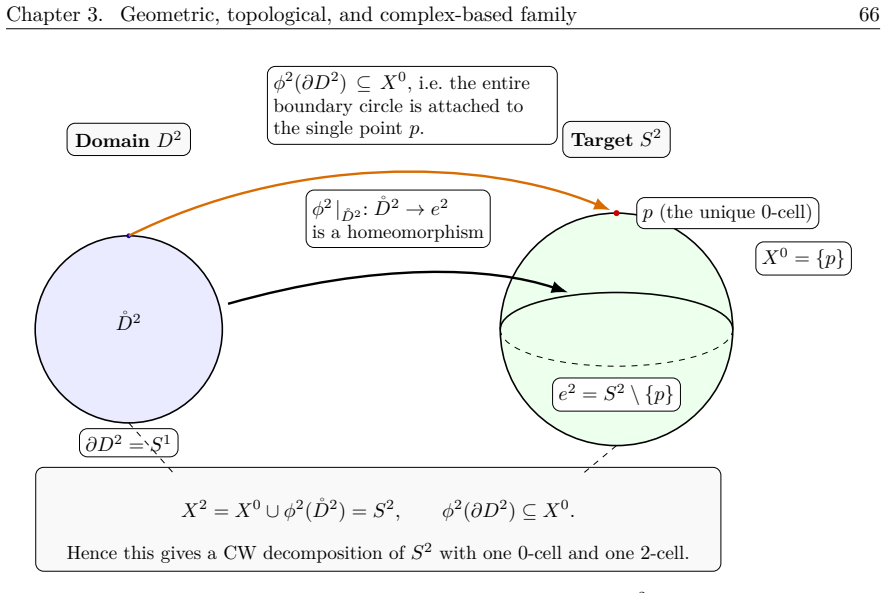
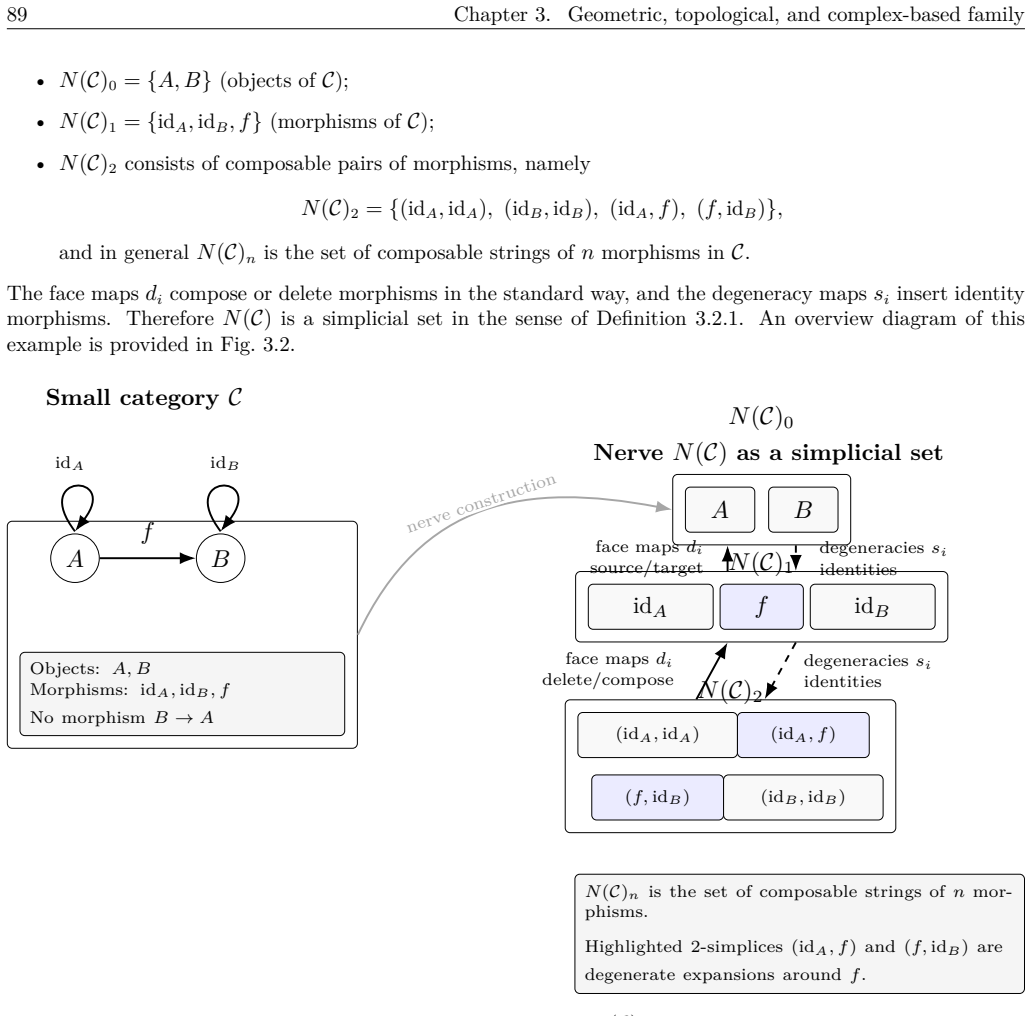
Family II. Geometric, topological, and complex-based family ... Abstract simplicial complex; Simplicial set; Cell complex; CW complex; ... Alexander duality is never invoked.
-
IndisputableMonolith/Cost/FunctionalEquation.leanwashburn_uniqueness_aczel unclear?
unclearRelation between the paper passage and the cited Recognition theorem.
Table 2.2: A concise comparison of graphs, hypergraphs, n-superhypergraphs, and (m;n)-superhypergraphs.
What do these tags mean?
- matches
- The paper's claim is directly supported by a theorem in the formal canon.
- supports
- The theorem supports part of the paper's argument, but the paper may add assumptions or extra steps.
- extends
- The paper goes beyond the formal theorem; the theorem is a base layer rather than the whole result.
- uses
- The paper appears to rely on the theorem as machinery.
- contradicts
- The paper's claim conflicts with a theorem or certificate in the canon.
- unclear
- Pith found a possible connection, but the passage is too broad, indirect, or ambiguous to say the theorem truly supports the claim.
Reference graph
Works this paper leans on
-
[1]
Reinhard Diestel. Graph theory. Springer (print edition); Reinhard Diestel (eBooks), 2024
work page 2024
-
[2]
Graph theory and its applications
Jonathan L Gross, Jay Yellen, and Mark Anderson. Graph theory and its applications . Chapman and Hall/CRC, 2018
work page 2018
-
[3]
Alain Bretto. Hypergraph theory. An introduction. Mathematical Engineering. Cham: Springer , 1, 2013
work page 2013
-
[4]
Florentin Smarandache. Extension of HyperGraph to n-SuperHyperGraph and to Plithogenic n-SuperHyperGraph, and Ex- tension of HyperAlgebra to n-ary (Classical-/Neutro-/Anti-) HyperAlgebra . Infinite Study, 2020
work page 2020
-
[5]
T. Fujita. Metahypergraphs, metasuperhypergdynaraphs, and iterated metagraphs: Modeling graphs of graphs, hypergraphs of hypergraphs, superhypergraphs of superhypergraphs, and beyond. Current Research in Interdisciplinary Studies, 4(5):1–23, 2025
work page 2025
-
[6]
What are higher-order networks? SIAM review, 65(3):686–731, 2023
Christian Bick, Elizabeth Gross, Heather A Harrington, and Michael T Schaub. What are higher-order networks? SIAM review, 65(3):686–731, 2023
work page 2023
-
[7]
Dynamics on higher-order networks: A review
Soumen Majhi, Matjaž Perc, and Dibakar Ghosh. Dynamics on higher-order networks: A review. Journal of the Royal Society Interface, 19(188), 2022
work page 2022
-
[8]
Higher-order networks representation and learning: A survey
Hao Tian and Reza Zafarani. Higher-order networks representation and learning: A survey. ACM SIGKDD Explorations Newsletter, 26(1):1–18, 2024
work page 2024
-
[9]
Triangular alignment (tame): A tensor- based approach for higher-order network alignment
Shahin Mohammadi, David F Gleich, Tamara G Kolda, and Ananth Grama. Triangular alignment (tame): A tensor- based approach for higher-order network alignment. IEEE/ACM transactions on computational biology and bioinformatics , 14(6):1446–1458, 2016
work page 2016
-
[10]
Weisfeiler and leman go neural: Higher-order graph neural networks
Christopher Morris, Martin Ritzert, Matthias Fey, William L Hamilton, Jan Eric Lenssen, Gaurav Rattan, and Martin Grohe. Weisfeiler and leman go neural: Higher-order graph neural networks. In Proceedings of the AAAI conference on artificial intelligence, pages 4602–4609, 2019
work page 2019
-
[11]
Efficient higher-order neural networks for classification and function approximation
Joydeep Ghosh and Yoan Shin. Efficient higher-order neural networks for classification and function approximation. Inter- national Journal of Neural Systems , 3(04):323–350, 1992
work page 1992
-
[12]
Understanding hazardous materials transportation accidents based on higher-order network theory
Cuiping Ren, Bianbian Chen, Fengjie Xie, Xuan Zhao, Jiaqian Zhang, and Xueyan Zhou. Understanding hazardous materials transportation accidents based on higher-order network theory. International journal of environmental research and public health, 19(20):13337, 2022
work page 2022
-
[13]
Actor hypernetworks and urban road hypernetworks with real-life applications
Takaaki Fujita and Arif Mehmood. Actor hypernetworks and urban road hypernetworks with real-life applications. Neutro- sophic Computing and Machine Learning , 41:143–171, 2025
work page 2025
-
[14]
Takaaki Fujita. River network hypergraphs and transportation network hypergraphs: A graph-theoretic approach for geo- scientific and civil applications. Interdisciplinary Studies on Applied Science , 2(1):19–31, 2025
work page 2025
-
[15]
Research on bus route optimization based on a higher-order network model
Fengjie Xie, Jiaxin Huang, Cuiping Ren, and Mengchan Wei. Research on bus route optimization based on a higher-order network model. In Fourth International Conference on Smart City Engineering and Public Transportation (SCEPT 2024) , volume 13160, pages 314–322. SPIE, 2024
work page 2024
-
[16]
Xuhui Lin, Long Chen, Qiuchen Lu, Pengjun Zhao, and Tao Cheng. Revealing higher-order interactions through multimodal irreversibility in flood-affected transportation networks. Reliability Engineering & System Safety , page 111726, 2025
work page 2025
-
[17]
Evolutionary dynamics of higher-order interactions in social networks
Unai Alvarez-Rodriguez, Federico Battiston, Guilherme Ferraz de Arruda, Yamir Moreno, Matjaž Perc, and Vito Latora. Evolutionary dynamics of higher-order interactions in social networks. Nature Human Behaviour , 5(5):586–595, 2021
work page 2021
-
[18]
Temporal properties of higher-order interactions in social networks
Giulia Cencetti, Federico Battiston, Bruno Lepri, and Márton Karsai. Temporal properties of higher-order interactions in social networks. Scientific reports, 11(1):7028, 2021
work page 2021
-
[19]
T. Fujita and F. Smarandache. Competition super-hypergraphs: Revealing hierarchical competition in real-world networks. Journal of Algebra and Applied Mathematics , 23(2):97–116, 2025
work page 2025
-
[20]
Cognitive hypergraphs and superhypergraphs: A novel framework for complex relational modeling
Takaaki Fujita. Cognitive hypergraphs and superhypergraphs: A novel framework for complex relational modeling. Neutro- sophic Computing & Machine Learning , 39, 2025
work page 2025
-
[21]
Predicting higher order links in social interaction networks
Yong-Jian He, Xiao-Ke Xu, and Jing Xiao. Predicting higher order links in social interaction networks. IEEE Transactions on Computational Social Systems , 11(2):2796–2806, 2023
work page 2023
-
[22]
Prediction of social influence in higher-order networks
Hao Peng, Rui Zhang, Bo Zhang, Cheng Qian, Ming Zhong, Shenghong Li, Jianmin Han, Dandan Zhao, and Wei Wang. Prediction of social influence in higher-order networks. Information Sciences , page 123075, 2026
work page 2026
-
[23]
The emergence of higher-order structure in scientific and technological knowledge networks
Thomas Gebhart and Russell James Funk. The emergence of higher-order structure in scientific and technological knowledge networks. In Academy of Management Proceedings . Academy of Management Briarcliff Manor, NY 10510, 2023
work page 2023
-
[24]
Learning directed knowledge using higher-ordered neural networks: Building a predictive framework
Yousra Moh Ousellam, Bikram Pratim Bhuyan, Rachida Fissoune, Galina Ivanova, and Amar Ramdane-Cherif. Learning directed knowledge using higher-ordered neural networks: Building a predictive framework. Applied Sciences, 15(20):11085, 2025
work page 2025
-
[25]
Topology shapes dynamics of higher-order networks
Ana P Millán, Hanlin Sun, Lorenzo Giambagli, Riccardo Muolo, Timoteo Carletti, Joaquín J Torres, Filippo Radicchi, Jürgen Kurths, and Ginestra Bianconi. Topology shapes dynamics of higher-order networks. Nature Physics , 21(3):353–361, 2025
work page 2025
-
[26]
The physics of higher-order interactions in complex systems
Federico Battiston, Enrico Amico, Alain Barrat, Ginestra Bianconi, Guilherme Ferraz de Arruda, Benedetta Franceschiello, Iacopo Iacopini, Sonia Kéfi, Vito Latora, Yamir Moreno, et al. The physics of higher-order interactions in complex systems. Nature physics , 17(10):1093–1098, 2021. 231 Bibliography 232
work page 2021
-
[27]
The mass of simple and higher-order networks
Ginestra Bianconi. The mass of simple and higher-order networks. Journal of Physics A: Mathematical and Theoretical , 57(1):015001, 2024
work page 2024
-
[28]
Higher-order molecular organization as a source of biological function
Thomas Gaudelet, Noel Malod-Dognin, and Nataša Pržulj. Higher-order molecular organization as a source of biological function. Bioinformatics, 34(17):i944–i953, 2018
work page 2018
-
[29]
Takaaki Fujita. Unifying grain boundary networks and crystal graphs: A hypergraph and superhypergraph perspective in material sciences. Asian Journal of Advanced Research and Reports , 19(5):344–379, 2025
work page 2025
-
[30]
Higher order structures in chemistry: hypergraphs reshape the molecule and the reaction
Guillermo Restrepo. Higher order structures in chemistry: hypergraphs reshape the molecule and the reaction. Digital Discovery, 2026
work page 2026
-
[31]
Toward a unified theory of brain hypergraphs and symptom hypernetworks in medicine and neuroscience
Takaaki Fujita and Arkan A Ghaib. Toward a unified theory of brain hypergraphs and symptom hypernetworks in medicine and neuroscience. Advances in Research, 26(3):522–565, 2025
work page 2025
-
[32]
Bengier Ülgen Kilic. Characterizing Dynamics on and of Networks via Higher-Order Interactions: Applications in Compu- tational Neuroscience. State University of New York at Buffalo, 2023
work page 2023
-
[33]
Generalization of back propagation to recurrent and higher order neural networks
Fernando Pineda. Generalization of back propagation to recurrent and higher order neural networks. In Neural information processing systems, 1987
work page 1987
-
[34]
Yifan Feng, Haoxuan You, Zizhao Zhang, Rongrong Ji, and Yue Gao. Hypergraph neural networks. In Proceedings of the AAAI conference on artificial intelligence , pages 3558–3565, 2019
work page 2019
-
[35]
Higher-order explanations of graph neural networks via relevant walks
Thomas Schnake, Oliver Eberle, Jonas Lederer, Shinichi Nakajima, Kristof T Schütt, Klaus-Robert Müller, and Grégoire Montavon. Higher-order explanations of graph neural networks via relevant walks. IEEE transactions on pattern analysis and machine intelligence , 44(11):7581–7596, 2021
work page 2021
-
[36]
Learning, invariance, and generalization in high-order neural networks
C Lee Giles and Tom Maxwell. Learning, invariance, and generalization in high-order neural networks. Applied optics , 26(23):4972–4978, 1987
work page 1987
-
[37]
Multi-order hypergraph convolutional neural network for dynamic social recommendation system
Yu Wang and Qilong Zhao. Multi-order hypergraph convolutional neural network for dynamic social recommendation system. IEEE Access, 10:87639–87649, 2022
work page 2022
-
[38]
Siyue Li, Tian Jin, Hao Luo, Erfan Wang, and Ranting Tao. Recommendation model based on higher-order semantics and node attention in heterogeneous graph neural networks. Mathematics, 13(9):1479, 2025
work page 2025
-
[39]
Hypergraph diffusion for high-order recommender systems
Darnbi Sakong, Thanh Trung Huynh, and Jun Jo. Hypergraph diffusion for high-order recommender systems. arXiv preprint arXiv:2501.16722, 2025
-
[40]
Resilience inference for supply chains with hypergraph neural network
Zetian Shen, Hongjun Wang, Jiyuan Chen, and Xuan Song. Resilience inference for supply chains with hypergraph neural network. arXiv preprint arXiv:2511.06208 , 2025
-
[41]
Telecommunications hypernetwork and telecommunications superhypernetwork
Takaaki Fujita. Telecommunications hypernetwork and telecommunications superhypernetwork. Intelligence Modeling in Electromechanical Systems, 2(1):16–31, 2025
work page 2025
-
[42]
Jules Hedges, Paulo Oliva, Evguenia Shprits, Viktor Winschel, and Philipp Zahn. Higher-order decision theory. In Interna- tional Conference on Algorithmic Decision Theory , pages 241–254. Springer, 2017
work page 2017
-
[43]
Cardiac decision making using higher order spectra
Roshan Joy Martis, U Rajendra Acharya, KM Mandana, Ajoy Kumar Ray, and Chandan Chakraborty. Cardiac decision making using higher order spectra. Biomedical Signal Processing and Control , 8(2):193–203, 2013
work page 2013
-
[44]
Decision Making Based on Valued Fuzzy Super- hypergraphs
Mohammad Hamidi, Florentin Smarandache, and Mohadeseh Taghinezhad. Decision Making Based on Valued Fuzzy Super- hypergraphs. Infinite Study, 2023
work page 2023
-
[45]
William F Weiss IV, John P Gabrielson, Wasfi Al-Azzam, Guodong Chen, Darryl L Davis, Tapan K Das, David B Hayes, Damian Houde, and Satish K Singh. Technical decision making with higher order structure data: perspectives on higher order structure characterization from the biopharmaceutical industry. Journal of Pharmaceutical Sciences , 105(12):3465– 3470, 2016
work page 2016
-
[46]
Application of Superhypergraphs-Based Domination Number in Real World
Mohammad Hamidi and Mohadeseh Taghinezhad. Application of Superhypergraphs-Based Domination Number in Real World. Infinite Study, 2023
work page 2023
-
[47]
An application of fuzzy hypergraphs and hypergraphs in granular computing
Qian Wang and Zengtai Gong. An application of fuzzy hypergraphs and hypergraphs in granular computing. Inf. Sci. , 429:296–314, 2018
work page 2018
-
[48]
Fuzzy hypergraph network for recommending top-k profitable stocks
Xiang Ma, Tianlong Zhao, Qiang Guo, Xue mei Li, and Caiming Zhang. Fuzzy hypergraph network for recommending top-k profitable stocks. Inf. Sci. , 613:239–255, 2022
work page 2022
-
[49]
Fuzzy graphs and fuzzy hypergraphs , volume 46
John N Mordeson and Premchand S Nair. Fuzzy graphs and fuzzy hypergraphs , volume 46. Physica, 2012
work page 2012
-
[50]
Complex neutrosophic hypergraphs: New social network models
Anam Luqman, Muhammad Akram, and Florentin Smarandache. Complex neutrosophic hypergraphs: New social network models. Algorithms, 12:234, 2019
work page 2019
-
[51]
Single-valued neutrosophic hypergraphs
Muhammad Akram, Sundas Shahzadi, and AB Saeid. Single-valued neutrosophic hypergraphs. TWMS Journal of Applied and Engineering Mathematics , 8(1):122–135, 2018
work page 2018
-
[52]
Intuitionistic single-valued neutrosophic hypergraphs
Muhammad Akram and Anam Luqman. Intuitionistic single-valued neutrosophic hypergraphs. OPSEARCH, 54:799 – 815, 2017
work page 2017
-
[53]
Concentric plithogenic hypergraph based on plithogenic hypersoft sets - a novel outlook
Nivetha Martin and Florentin Smarandache. Concentric plithogenic hypergraph based on plithogenic hypersoft sets - a novel outlook. Neutrosophic Sets and Systems , 33:5, 2020
work page 2020
-
[54]
Ehab Roshdy, Marwa Khashaba, and Mariam Emad Ahmed Ali. Neutrosophic super-hypergraph fusion for proactive cyber- attack countermeasures: A soft computing framework. Neutrosophic Sets and Systems , 94:232–252, 2025
work page 2025
-
[55]
Neutrosophic soft n-super-hypergraphs with real-world applications
Takaaki Fujita and Florentin Smarandache. Neutrosophic soft n-super-hypergraphs with real-world applications . Infinite Study, 2025
work page 2025
-
[56]
Eduardo Martín Campoverde Valencia, Jessica Paola Chuisaca Vásquez, and Francisco Ángel Becerra Lois. Multineutrosophic analysis of the relationship between survival and business growth in the manufacturing sector of azuay province, 2020–2023, using plithogenic n-superhypergraphs. Neutrosophic Sets and Systems , 84:341–355, 2025. 233 Bibliography
work page 2020
-
[57]
Integrating smed and industry 4.0 to optimize processes with plithogenic n-superhypergraphs
Julio Cesar Méndez Bravo, Claudia Jeaneth Bolanos Piedrahita, Manuel Alberto Méndez Bravo, and Luis Manuel Pilacuan- Bonete. Integrating smed and industry 4.0 to optimize processes with plithogenic n-superhypergraphs. Neutrosophic Sets and Systems , 84:328–340, 2025
work page 2025
-
[58]
Berrocal Villegas Salomón Marcos, Montalvo Fritas Willner, Berrocal Villegas Carmen Rosa, Flores Fuentes Rivera María Yissel, Espejo Rivera Roberto, Laura Daysi Bautista Puma, and Dante Manuel Macazana Fernández. Using plithogenic n-superhypergraphs to assess the degree of relationship between information skills and digital competencies. Neutrosophic Sets...
work page 2025
-
[59]
A new decision-making method based on bipolar neutrosophic directed hypergraphs
Muhammad Akram and Anam Luqman. A new decision-making method based on bipolar neutrosophic directed hypergraphs. Journal of Applied Mathematics and Computing , 57:547 – 575, 2017
work page 2017
-
[60]
Finding hypernetworks in directed hypergraphs
Daniele Pretolani. Finding hypernetworks in directed hypergraphs. European Journal of Operational Research , 230(2):226– 230, 2013
work page 2013
-
[61]
Review of some superhypergraph classes: Directed, bidirected, soft, and rough
Takaaki Fujita. Review of some superhypergraph classes: Directed, bidirected, soft, and rough. Advancing Uncertain Combinatorics through Graphization, Hyperization, and Uncertainization: Fuzzy, Neutrosophic, Soft, Rough, and Beyond (Second Volume), 2024
work page 2024
-
[62]
Directed superhypertree-width, mixed tree-width, and bidirected tree-width
Takaaki Fujita. Directed superhypertree-width, mixed tree-width, and bidirected tree-width. SuperHyperTopologies and SuperHyper Structures with their Applications , page 114, 2025
work page 2025
-
[63]
Soft directed n-superhypergraphs with some real-world applications
Takaaki Fujita and Florentin Smarandache. Soft directed n-superhypergraphs with some real-world applications. European Journal of Pure and Applied Mathematics , 18(4):6643–6643, 2025
work page 2025
-
[64]
Oriented hypergraphs: balanceability
Lucas J Rusnak, Selena Li, Brian Xu, Eric Yan, and Shirley Zhu. Oriented hypergraphs: balanceability. Discrete Mathematics, 345(6):112832, 2022
work page 2022
-
[65]
Spectral Properties of Oriented Hypergraphs
Nathan Reff. Spectral properties of oriented hypergraphs. arXiv preprint arXiv:1506.05054 , 2015
work page internal anchor Pith review Pith/arXiv arXiv 2015
-
[66]
Lower bounds for the laplacian spectral radius of an oriented hypergraph
Ouail Kitouni and Nathan Reff. Lower bounds for the laplacian spectral radius of an oriented hypergraph. Australas. J Comb., 74:408–422, 2019
work page 2019
-
[67]
Spectra of cycle and path families of oriented hypergraphs
Luke Duttweiler and Nathan Reff. Spectra of cycle and path families of oriented hypergraphs. Linear Algebra and its Applications, 578:251–271, 2019
work page 2019
-
[68]
Takaaki Fujita. Extensions of multidirected graphs: Fuzzy, neutrosophic, plithogenic, rough, soft, hypergraph, and superhy- pergraph variants. International journal of topology , 2(3):11, 2025
work page 2025
-
[69]
HyperGraph and SuperHyperGraph Theory with Applications
Takaaki Fujita and Florentin Smarandache. HyperGraph and SuperHyperGraph Theory with Applications . Neutrosophic Science International Association (NSIA) Publishing House, 2026
work page 2026
-
[70]
Florentin Smarandache. The cardinal of the m-powerset of a set of n elements used in the superhyperstructures and neutro- sophic superhyperstructures. Systems Assessment and Engineering Management , 2:19–22, 2024
work page 2024
-
[71]
Hypergraphs: combinatorics of finite sets , volume 45
Claude Berge. Hypergraphs: combinatorics of finite sets , volume 45. Elsevier, 1984
work page 1984
-
[72]
Introduction to the n-SuperHyperGraph-the most general form of graph today
Florentin Smarandache. Introduction to the n-SuperHyperGraph-the most general form of graph today . Infinite Study, 2022
work page 2022
-
[73]
Maissam Jdid, Florentin Smarandache, and Takaaki Fujita. A linear mathematical model of the vocational training problem in a company using neutrosophic logic, hyperfunctions, and superhyperfunction. Neutrosophic Sets and Systems , 87:1–11, 2025
work page 2025
-
[74]
Florentin Smarandache. SuperHyperFunction, SuperHyperStructure, Neutrosophic SuperHyperFunction and Neutrosophic SuperHyperStructure: Current understanding and future directions . Infinite Study, 2023
work page 2023
-
[75]
Subset Vertex Multigraphs and Neutrosophic Multi- graphs for Social Multi Networks
WB Vasantha Kandasamy, K Ilanthenral, and Florentin Smarandache. Subset Vertex Multigraphs and Neutrosophic Multi- graphs for Social Multi Networks . Infinite Study, 2019
work page 2019
-
[76]
Cycle covers of cubic multigraphs
Brian Alspach and Cun-Quan Zhang. Cycle covers of cubic multigraphs. Discrete mathematics , 111(1-3):11–17, 1993
work page 1993
-
[77]
Convolutional learning on multigraphs
Landon Butler, Alejandro Parada-Mayorga, and Alejandro Ribeiro. Convolutional learning on multigraphs. IEEE Transac- tions on Signal Processing , 71:933–946, 2023
work page 2023
-
[78]
Intuitionistic fuzzy shortest path in a multigraph
Siddhartha Sankar Biswas, Bashir Alam, and MN Doja. Intuitionistic fuzzy shortest path in a multigraph. In International Conference on Recent Developments in Science, Engineering and Technology , pages 533–540. Springer, 2017
work page 2017
-
[79]
Inverse fuzzy multigraphs and planarity with application in decision-making
Rajab Ali Borzooei and R Almallah. Inverse fuzzy multigraphs and planarity with application in decision-making. Soft Computing, 26(4):1531–1539, 2022
work page 2022
-
[80]
On intuitionistic fuzzy multigraphs and their index matrix interpretations
Anthony Shannon and Krassimir Atanassov. On intuitionistic fuzzy multigraphs and their index matrix interpretations. In 2004 2nd International IEEE Conference on ’Intelligent Systems’ . Proceedings (IEEE Cat. No. 04EX791) , volume 2, pages 440–443. IEEE, 2004
work page 2004
discussion (0)
Sign in with ORCID, Apple, or X to comment. Anyone can read and Pith papers without signing in.