Quantum chaos with graphs: a silicon photonics plateform
Pith reviewed 2026-05-14 21:13 UTC · model grok-4.3
The pith
A silicon photonics platform realizes quantum graphs where mixing chaotic networks show spectral statistics matching random matrix theory predictions, unlike ergodic ones.
A machine-rendered reading of the paper's core claim, the machinery that carries it, and where it could break.
Core claim
We provide a versatile platform to investigate wave-particle duality. This photonic waveguide network implements quantum graphs as proposed in the seminal paper by Kottos and Smilansky. We experimentally demonstrated that the spectral statistics of a mixing graph follows the predictions of random matrix theory, contrary to an ergodic graph, in agreement with the Bohigas-Giannoni-Schmit conjecture. This platform also gives access to the wavefunction patterns, which are expected to verify the quantum ergodicity theorem.
What carries the argument
The silicon photonics waveguide network implementing quantum graph topologies, which allows precise measurement of spectral statistics and wavefunction patterns in chaotic versus ergodic regimes.
If this is right
- The distinction in spectral statistics directly confirms that chaos strength determines agreement with random matrix theory in quantum graphs.
- Access to wavefunction patterns enables experimental checks of the quantum ergodicity theorem.
- The platform supports further tests of wave-particle duality in controlled photonic settings.
- Results provide experimental backing for the Bohigas-Giannoni-Schmit conjecture applied to quantum graphs.
Where Pith is reading between the lines
- Similar photonic networks could be scaled or reconfigured to explore transitions between different chaotic regimes in graphs.
- The approach might extend to testing related conjectures on wavefunction scarring or eigenstate thermalization in optical systems.
- This realization could inform designs for larger-scale photonic simulators of quantum chaotic dynamics.
Load-bearing premise
The fabricated photonic waveguide networks precisely realize the intended quantum graph topologies without significant fabrication imperfections affecting the measured spectra.
What would settle it
A measurement showing that the mixing graph's level spacing statistics deviate from random matrix theory predictions, such as lacking the expected level repulsion characteristic of Gaussian orthogonal ensemble statistics.
Figures




read the original abstract
We provide a versatile plateform to investigate wave-particle duality. This photonic waveguide network implements quantum (wave) graphs as proposed in the seminal paper by Kottos \& Smilansky [PRL \textbf{85} 968 (2000)]. We experimentally demonstrated that the spectral statistics of a mixing (i.e. strongly chaotic) graph follows the predictions of random matrix theory, contrary to an ergodic (i.e. less chaotic) graph, in agreement with the Bohigas-Giannoni-Schmit conjecture [PRL \textbf{52} 1 (1984)]. This plateform also gives access to the wavefunction patterns, which are expected to verify the quantum ergodicity theorem.
Editorial analysis
A structured set of objections, weighed in public.
Referee Report
Summary. The paper introduces a silicon photonics platform implementing quantum graphs as proposed by Kottos and Smilansky. It claims to experimentally demonstrate that the spectral statistics of a mixing (strongly chaotic) graph follow random matrix theory predictions, in contrast to an ergodic graph, in agreement with the Bohigas-Giannoni-Schmit conjecture, while also providing access to wavefunction patterns expected to verify the quantum ergodicity theorem.
Significance. If the experimental results hold with proper supporting data, this work would provide a versatile, controllable photonic platform for investigating quantum chaos in graph systems, enabling direct tests of the BGS conjecture and quantum ergodicity in a setting that bridges theory and experiment.
major comments (2)
- [Abstract] Abstract: The central claim of an 'experimental demonstration' that spectral statistics of the mixing graph follow RMT predictions (while the ergodic graph does not) is asserted without any data, figures, error bars, sample details, or analysis methods, leaving the measurements unverifiable.
- [Experimental realization] Experimental section: No quantitative characterization or bounds are given on fabrication tolerances (e.g., waveguide width variations of 10-20 nm or length variations of 1-5%) that could modify effective phase accumulation, vertex scattering, and edge lengths, potentially shifting nearest-neighbor spacing distributions away from the intended Kottos-Smilansky topologies.
minor comments (2)
- [Abstract] Typo: 'plateform' appears twice and should be corrected to 'platform'.
- [Abstract] The phrasing 'contrary to an ergodic (i.e. less chaotic) graph' is imprecise; rephrase for clarity, e.g., 'in contrast to an ergodic graph'.
Simulated Author's Rebuttal
We thank the referee for their careful reading and constructive comments. We address each major comment below and have revised the manuscript to improve clarity and completeness.
read point-by-point responses
-
Referee: [Abstract] Abstract: The central claim of an 'experimental demonstration' that spectral statistics of the mixing graph follow RMT predictions (while the ergodic graph does not) is asserted without any data, figures, error bars, sample details, or analysis methods, leaving the measurements unverifiable.
Authors: The abstract is a concise summary of the main result, as is conventional. The full manuscript presents the supporting experimental data in the Results section, including figures of nearest-neighbor spacing distributions for both graphs with error bars, sample fabrication details, and the statistical analysis methods used to compare against RMT predictions. We have revised the abstract to include explicit references to the relevant figures and sections for easier verification. revision: partial
-
Referee: [Experimental realization] Experimental section: No quantitative characterization or bounds are given on fabrication tolerances (e.g., waveguide width variations of 10-20 nm or length variations of 1-5%) that could modify effective phase accumulation, vertex scattering, and edge lengths, potentially shifting nearest-neighbor spacing distributions away from the intended Kottos-Smilansky topologies.
Authors: We agree that quantitative characterization of fabrication tolerances is necessary. In the revised manuscript we have added this information to the Experimental realization section, reporting measured waveguide width variations of 8-12 nm and length variations of 1-3% from the silicon photonics process. We also include an analysis with supplementary simulations showing that these tolerances preserve the intended Kottos-Smilansky topologies and do not alter the distinction in spectral statistics between the mixing and ergodic graphs. revision: yes
Circularity Check
Experimental comparison to external RMT/BGS predictions; no circularity in derivation chain
full rationale
The paper implements quantum graphs from the external Kottos-Smilansky 2000 reference and measures spectral statistics, then compares them directly to independent random matrix theory predictions and the 1984 Bohigas-Giannoni-Schmit conjecture. No self-citations appear in the load-bearing steps, no parameters are fitted to subsets and relabeled as predictions, and no ansatz or uniqueness theorem is smuggled in via prior author work. The central claim is an experimental match to external theory, which is self-contained against benchmarks outside the paper's own data.
Axiom & Free-Parameter Ledger
axioms (2)
- domain assumption Quantum graphs as proposed by Kottos and Smilansky
- domain assumption Bohigas-Giannoni-Schmit conjecture
Reference graph
Works this paper leans on
-
[1]
It means that 1 is an eigenvalue ofFcorresponding to the eigenvector (V) i = 1 2B
and the uniform distribution is invariant. It means that 1 is an eigenvalue ofFcorresponding to the eigenvector (V) i = 1 2B . If the graph is connected [40], then it is saidergodic, which is a weak form of chaos. A stronger type of chaos, calledmixing, appears if 1 is the only eigenvalue with unit modulus, and all other eigenvalues have a modulus less th...
-
[2]
T. Kottos and U. Smilansky, Quantum chaos on graphs, Phys. Rev. Lett.79, 10.1103/PhysRevLett.79.4794 (1997)
-
[3]
T. Kottos and U. Smilansky, Periodic Orbit Theory and Spectral Statistics for Quantum Graphs, Ann. Phys.274, 76 (1999)
work page 1999
-
[4]
G. Berkolaiko and P. Kuchment,Introduction to Quan- tum Graphs(American Mathematical Society, Provi- dence, RI, 2013)
work page 2013
-
[5]
S. Gnutzmann and U. Smilansky, Quantum graphs: Ap- plications to quantum chaos and universal spectral statis- tics, Adv. Phys.55, 10.1080/00018730600908042 (2006)
-
[6]
C. Texier and G. Montambaux, Scattering theory on graphs, J Phys Math Gen34, 10.1088/0305- 4470/34/47/328 (2001)
-
[7]
O. Bohigas, M. J. Giannoni, and C. Schmit, Characteri- zation of Chaotic Quantum Spectra and Universality of Level Fluctuation Laws, Phys. Rev. Lett.52(1984)
work page 1984
-
[8]
M. L. Mehta,Random Matrices(Academic Press, Lon- don, 1990)
work page 1990
- [9]
-
[10]
H. J. St¨ ochmann and J. Stein, ”Quantum” Chaos in Billiards Studied by Microwave Absorption, Phys. Rev. Lett.64(1990)
work page 1990
-
[11]
H. D. Gr¨ af, H. L. Harney, H. Lengeler, C. H. Lewenkopf, C. Rangacharyulu, A. Richter, P. Schardt, and H. A. Wei- denmller, Distribution of eigenmodes in a superconduct- ing stadium billiard with chaotic dynamics, Phys. Rev. Lett.69, 10.1103/PhysRevLett.69.1296 (1992)
-
[12]
H. J. St¨ ockmann,Quantum Chaos: An Introduction (Cambridge University Press, Cambridge, 2000)
work page 2000
-
[13]
B. Dietz, T. Friedrich, H. L. Harney, M. Miski-Oglu, A. Richter, F. Sch¨ afer, and H. A. Weidenm¨ uller, Quan- tum chaotic scattering in microwave resonators, Phys. Rev. E81, 10.1103/PhysRevE.81.036205 (2010)
-
[14]
C. M. Marcus, A. J. Rimberg, R. M. Westervelt, P. F. Hopkins, and A. C. Gossard, Conductance fluctuations and chaotic scattering in ballistic microstructures, Phys. Rev. Lett.69, 10.1103/PhysRevLett.69.506 (1992)
-
[15]
Z. Pluhaˇ r and H. A. Weidenm¨ uller, Universal chaotic scattering on quantum graphs, Phys. Rev. Lett.110, 10.1103/PhysRevLett.110.034101 (2013)
-
[17]
O. Hul, S. Bauch, P. Pako´ nski, N. Savytskyy, K. ˙Zyczkowski, and L. Sirko, Experimental simulation of quantum graphs by microwave networks, Phys. Rev. E69, 10.1103/PhysRevE.69.056205 (2004)
-
[18]
F. J. Dyson, The threefold way. algebraic structure of symmetry groups and ensembles in quantum mechanics, Journal of Mathematical Physics3, 1199 (1962)
work page 1962
-
[19]
M. Lawniczak, S. Bauch, O. Hul, and L. Sirko, Exper- imental investigation of the enhancement factor for mi- crowave irregular networks with preserved and broken time reversal symmetry in the presence of absorption, Phys. Rev. E81, 10.1103/PhysRevE.81.046204 (2010)
-
[21]
A. Rehemanjiang, M. Allgaier, C. H. Joyner, S. M¨ uller, M. Sieber, U. Kuhl, and H. J. St¨ ockmann, Microwave Realization of the Gaussian Symplectic Ensemble, Phys. Rev. Lett.117, 10.1103/PhysRevLett.117.064101 (2016)
-
[22]
A. M. Mart´ ınez-Arg¨ uello, A. Rehemanjiang, M. Mart´ ınez-Mares, J. A. M´ endez-Berm´ udez, H. J. St¨ ockmann, and U. Kuhl, Transport studies in three- terminal microwave graphs with orthogonal, unitary, and symplectic symmetry, Phys. Rev. B98, 075311 (2018)
work page 2018
-
[23]
J. Lu, J. Che, X. Zhang, and B. Dietz, Experimental and numerical investigation of parametric spectral properties of quantum graphs with unitary or symplectic symmetry, Phys. Rev. E102, 22309 (2020)
work page 2020
-
[24]
J. Che, J. Lu, X. Zhang, B. Dietz, and G. Chai, Missing-level statistics in classically chaotic quantum systems with symplectic symmetry, Phys. Rev. E103, 10.1103/PhysRevE.103.042212 (2021)
-
[25]
A. Altland and M. R. Zirnbauer, Nonstandard symme- try classes in mesoscopic normal-superconducting hybrid structures, Phys. Rev. B55, 1142 (1997)
work page 1997
-
[26]
A. Rehemanjiang, M. Richter, U. Kuhl, and H.-J. St¨ ockmann, Microwave realization of the chiral orthogo- nal, unitary, and symplectic ensembles, Phys. Rev. Lett. 124, 116801 (2020)
work page 2020
- [27]
-
[28]
W. Zhang, X. Zhang, J. Che, J. Lu, M. Miski-Oglu, and B. Dietz, Experimental study of closed and open microwave waveguide graphs with preserved and par- tially violated time-reversal invariance, Phys. Rev. E 106, 10.1103/PhysRevE.106.044209 (2022)
-
[30]
Y. Zeng, I. Roland, X. Checoury, Z. Han, M. El Kurdi, S. Sauvage, B. Gayral, C. Brimont, T. Guillet, F. Se- mond, and P. Boucaud, Imaging of Photonic Crystal Lo- calized Modes through Third-Harmonic Generation, ACS Photonics3, 1240 (2016)
work page 2016
- [31]
- [32]
-
[33]
M. Ehrhardt, R. Keil, L. J. Maczewsky, C. Dittel, M. Heinrich, and A. Szameit, Exploring complex graphs using three-dimensional quantum walks of correlated photons, Sci. Adv.7, 10.1126/sciadv.abc5266 (2021)
-
[34]
X. Qiang, Y. Wang, S. Xue, R. Ge, L. Chen, Y. Liu, A. Huang, X. Fu, P. Xu, T. Yi, F. Xu, M. Deng, J. B. Wang, J. D. Meinecke, J. C. Matthews, X. Cai, X. Yang, and J. Wu, Implementing graph-theoretic quantum al- gorithms on a silicon photonic quantum walk processor, Sci. Adv.7, 10.1126/sciadv.abb8375 (2021)
-
[35]
J. Bao, Z. Fu, T. Pramanik, J. Mao, Y. Chi, Y. Cao, C. Zhai, Y. Mao, T. Dai, X. Chen, X. Jia, L. Zhao, Y. Zheng, B. Tang, Z. Li, J. Luo, W. Wang, Y. Yang, Y. Peng, D. Liu, D. Dai, Q. He, A. L. Muthali, L. K. Oxenløwe, C. Vigliar, S. Paesani, H. Hou, R. Santagati, J. W. Silverstone, A. Laing, M. G. Thompson, J. L. O’Brien, Y. Ding, Q. Gong, and J. Wang, Ve...
work page 2023
-
[37]
X. S. Wang, R. Savo, A. Maeder, F. Kaufmann, J. Kell- ner, A. Morandi, S. Rotter, R. Sapienza, and R. Grange, Graph model for multiple scattering in lithium niobate on insulator integrated photonic networks, Opt. Express 31, 42255 (2023)
work page 2023
-
[38]
R. K. Gupta, S. Chandran, and B. K. Das, Wavelength- Independent Directional Couplers for Integrated Silicon Photonics, J. Lightwave Technol.35, 4916 (2017)
work page 2017
-
[39]
In this context, the finesseFis calculated using the def- inition ’mean spacing / mean linewidth’
-
[40]
A bistochastic matrix is a matrixA= (a ij) such that aij ≥0 and the sum of the coefficients over each line and each column is 1: P i aij = P j aij = 1
-
[41]
A graph is connected if there is a path of bonds between every pair of vertices
-
[42]
S. Lepri, C. Trono, and G. Giacomelli, Complex active optical networks as a new laser concept, Phys. Rev. Lett. 118, 10.1103/PhysRevLett.118.123901 (2017)
-
[43]
S. Gnutzmann, H. Schanz, and U. Smilansky, Topological resonances in scattering on networks (graphs), Phys. Rev. Lett.110, 10.1103/PhysRevLett.110.094101 (2013)
- [44]
-
[45]
N. Anantharaman and M. Sabri, Quantum ergodicity on graphs: From spectral to spatial delocalization, Ann. of Math. (2)189, 10.4007/annals.2019.189.3.3 (2019)
- [46]
-
[47]
Wang, Physical Review B94, 10.1103/phys- revb.94.195105 (2016)
F. Barra and P. Gaspard, Transport and dynamics on open quantum graphs, Phys. Rev. E65, 10.1103/Phys- RevE.65.016205 (2002)
-
[48]
O. Bohigas and M. J. Giannoni, Level density fluctua- tions and random matrix theory, Ann. Phys.89(1975)
work page 1975
-
[49]
O. Hul, P. Sceba, and L. Sirko, Departure of some parameter-dependent spectral statistics of irregular quantum graphs from random matrix theory predictions, Phys. Rev. E79(2009). Appendix A: Graph Topologies
work page 2009
-
[50]
Connectivity and metric structure (a) (b) FIG. 6. Schematic representations of (a) the BTG and (b) the FG. Numbered vertices correspond to actual bidirec- tional couplers, while unnumbered black dots represent aux- iliary vertices introduced for numerical implementation. The incommensurate bond lengthsL b, expressed in microns, are indicated on each segme...
-
[51]
The corresponding Perron–Frobenius operator Fis defined in Eq
Perron–Frobenius operator and classical dynamics In the ray (classical) limit, propagation on the graph is described by a discrete-time Markov process on directed bonds [4]. The corresponding Perron–Frobenius operator Fis defined in Eq. (3). Its spectrum for BTG and FG is shown in Fig. 7. FIG. 7. Spectra of the Perron–Frobenius operatorFfor the BTG (left)...
-
[52]
Theoretical background For our 4-channel coupler,σis a 4×4 matrix. It is symmetric for a bidirectional coupler, and furthermore unitary (i.e.σ †σ=I d) if it is lossless. It reads σ= 0 0 √ 1−C i √ C 0 0i √ C √ 1−C√ 1−C i √ C0 0 i √ C √ 1−C0 0 whereCis the coupling parameter, and is equal to 0.5 for a well-balanced coupler. The factoriarises fro...
-
[53]
Coupled propagating waves In a lossless bidirectional coupler supporting two cou- pled TE supermodes, the transmitted powers at the bar and cross ports can be derived from coupled-mode the- ory [37] as P1→3(λ) = cos2 π∆n eff(λ) λ lDC Pin,(B1) P1→4(λ) = sin2 π∆n eff(λ) λ lDC Pin,(B2) where ∆n(λ) =n (S) eff −n (AS) eff is the effective index dif- ference be...
-
[54]
Experimental characterization Figure 9 shows the experimentally measured transmis- sionsP 1→3 andP 1→4 over a 160 nm bandwidth (1480- 1640 nm). The data are normalized by the transmission of a reference bus waveguide not connected to a network and fabricated on the same chip. 42 1 3 FIG. 9. Experimental normalized transmission of the bidi- rectional coupl...
-
[55]
For wave graphs, the average number of resonances below a wave numberkis given by the Weyl law (Sec
Weyl Law and spectral unfolding The statistical analysis of spectral fluctuations requires separating the smooth part of the density of states from its universal fluctuations. For wave graphs, the average number of resonances below a wave numberkis given by the Weyl law (Sec. 5.1 of [4]): NWeyl(k) = ngLtot π k,(D1) whereL tot =P b Lb is the total geometri...
-
[56]
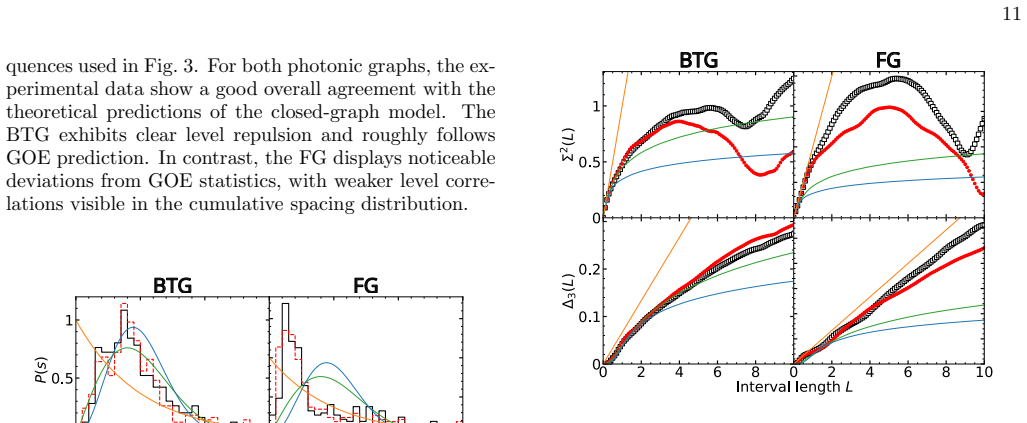
Additional Spectral Statistics Figure 11 presents additional short-range spectral statistics obtained from the same unfolded resonance se- 11 quences used in Fig. 3. For both photonic graphs, the ex- perimental data show a good overall agreement with the theoretical predictions of the closed-graph model. The BTG exhibits clear level repulsion and roughly ...
-
[57]
Normalized Shannon entropy On each bondbof the graph, the optical field is modeled as a superposition of counter-propagating plane waves, as described in Eq. (1). The modal intensity along a given bond is therefore uniform on average, so that each bond can be characterized by a single intensity value. Experimentally, the bond intensities are extracted fro...
-
[58]
Thus, the IPR increases with increasing localization
Inverse Participation Ratio (IPR) As an alternative and widely used localization mea- sure, we compute the inverse participation ratio (IPR), defined as [48] IPR = NX b=1 p2 b.(E4) For a perfectly delocalized state (p b = 1/N), the in- verse participation ratio is IPR = 1/N, whereas for a fully localized state concentrated on a single bondb 0 (pb0 = 1, an...
discussion (0)
Sign in with ORCID, Apple, or X to comment. Anyone can read and Pith papers without signing in.