Recognition: unknown
Light Propagation Prescriptions for Black Hole Movies
Pith reviewed 2026-05-14 20:11 UTC · model grok-4.3
The pith
Fast and slow light prescriptions for black hole movies differ by tens of percent when variability is rapid.
A machine-rendered reading of the paper's core claim, the machinery that carries it, and where it could break.
Core claim
In a controlled semi-analytic setting for a given emitting geometry, black-hole spin, and observer inclination, the coordinate-time delay distributions of Kerr null geodesics, decomposed by image order across lensing bands, show that when the intrinsic variability timescale is comparable to or shorter than the relevant delay spread, the high-inclination mismatch between fast- and slow-light curves reaches several tens of percent. Brisk light is introduced as an intermediate prescription that compresses each lensing-band delay map to its dominant temporal interval rather than collapsing the full image to a single source time.
What carries the argument
Coordinate-time delay distributions of Kerr null geodesics decomposed by image order across lensing bands, compared against source correlation time to decide between light-propagation prescriptions.
If this is right
- High-inclination black-hole movies require slow-light treatment for accurate results if the source variability timescale is short compared to delay spreads.
- Brisk light supplies an efficient middle route that keeps the leading temporal imprint of strong lensing without full slow-light computation.
- The comparison gives a practical criterion based on variability timescale versus delay spread for choosing the right prescription.
- These considerations directly affect the accuracy of photon-ring observables targeted by future space-based VLBI.
Where Pith is reading between the lines
- Brisk light could be added to existing general relativistic ray-tracing codes to improve efficiency for time-dependent black-hole simulations.
- Similar delay-compression ideas might apply to other strongly lensed variable sources outside black-hole imaging.
- At low inclinations the mismatch shrinks, suggesting inclination-dependent choices of prescription may be sufficient.
Load-bearing premise
The mismatch sizes are measured in a specific semi-analytic emitting geometry where delay distributions are directly comparable to the source correlation time.
What would settle it
A full numerical ray-tracing calculation of slow-light and fast-light movies for a rapidly varying source at high inclination that shows a mismatch significantly below several tens of percent.
Figures




read the original abstract
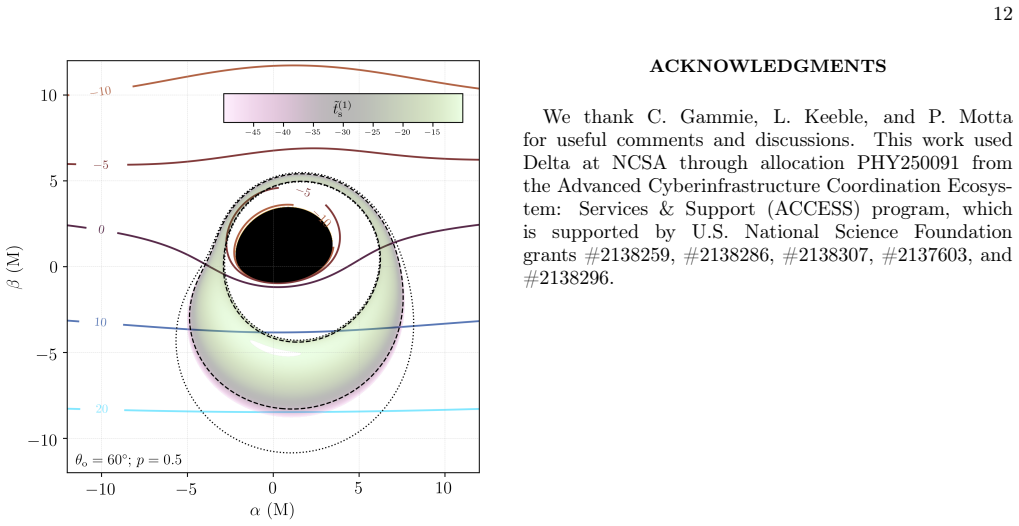
The spatiotemporal content of a black-hole movie is set jointly by source variability and by the distribution of light-travel times across the image. In the slow-light prescription, an image evaluated at fixed observer time contains photons emitted at different source times, whereas in fast light all rays sample a single source emission time. In this work we compare these light-propagation prescriptions through the lensing-band structure of Kerr geodesic delays in a controlled semi-analytic setting. For a given emitting geometry, black-hole spin, and observer inclination, we show how the coordinate-time delay distributions of Kerr null geodesics, decomposed by image order across lensing bands, can be compared with the source correlation time to quantify differences between light-propagation prescriptions. We find that when the intrinsic variability timescale is comparable to, or shorter than, the relevant delay spread, the high-inclination mismatch between fast- and slow-light curves can reach several tens of percent. Motivated by this geometric structure, we introduce brisk light, an intermediate prescription that compresses each lensing-band delay map to its dominant temporal interval rather than collapsing the full image to a single source time. The proposed methodology provides both a practical criterion for when slow light matters and an efficient route to black-hole movies that retain the leading temporal imprint of strong lensing, a regime of direct relevance for future space-based VLBI targeting photon-ring observables.
Editorial analysis
A structured set of objections, weighed in public.
Referee Report
Summary. The manuscript compares slow-light and fast-light prescriptions for generating black-hole movies by analyzing the coordinate-time delay distributions of Kerr null geodesics, decomposed by lensing-band order. In a controlled semi-analytic setting for fixed emitting geometry, spin, and inclination, it shows that when the source variability timescale is comparable to or shorter than the relevant delay spread, the mismatch between fast- and slow-light light curves reaches several tens of percent at high inclinations. Motivated by this structure, the authors introduce a 'brisk light' prescription that compresses each lensing band's delay map to its dominant temporal interval rather than collapsing the full image to a single source time, providing a criterion for when slow light matters and an efficient route to retain leading strong-lensing temporal effects.
Significance. If the central comparison holds, the work supplies a geometrically grounded, practical criterion for assessing when light-propagation effects must be retained in time-variable black-hole imaging and an intermediate prescription that captures the dominant delay imprint without full slow-light overhead. This is directly relevant to future space-based VLBI targeting photon-ring observables. The controlled semi-analytic approach, explicit decomposition by lensing order, and parameter-free geometric framing are notable strengths.
major comments (1)
- [Abstract and §3] Abstract and §3 (semi-analytic delay comparison): the central quantitative claim that the high-inclination mismatch reaches 'several tens of percent' is stated without accompanying error bars, explicit delay-spread formulas, or tabulated numerical values for representative spin/inclination pairs. Because this result is load-bearing for the brisk-light motivation and the practical criterion, the manuscript should include at least one explicit equation for the delay distribution and one figure or table with sample mismatch percentages.
minor comments (3)
- [§4] The brisk-light prescription is introduced in the abstract and §4 as a compression to the 'dominant temporal interval,' but the precise definition of 'dominant' (e.g., mode, median, or peak of the per-band delay histogram) is not stated explicitly; a short equation or one-sentence definition would remove ambiguity.
- [Figures] Figure captions and axis labels should explicitly note the black-hole spin, observer inclination, and emitting geometry used for each panel so that the delay-spread comparison can be reproduced without returning to the main text.
- [Introduction] A brief statement in the introduction or methods clarifying that the analysis is performed in the Kerr metric with standard Boyer-Lindquist coordinates would help readers unfamiliar with the geodesic delay literature.
Simulated Author's Rebuttal
We thank the referee for their constructive assessment and recommendation for minor revision. We have addressed the major comment by adding the requested quantitative details to strengthen the central claims.
read point-by-point responses
-
Referee: [Abstract and §3] Abstract and §3 (semi-analytic delay comparison): the central quantitative claim that the high-inclination mismatch reaches 'several tens of percent' is stated without accompanying error bars, explicit delay-spread formulas, or tabulated numerical values for representative spin/inclination pairs. Because this result is load-bearing for the brisk-light motivation and the practical criterion, the manuscript should include at least one explicit equation for the delay distribution and one figure or table with sample mismatch percentages.
Authors: We agree that the central quantitative claim benefits from explicit support. In the revised manuscript we have added an explicit formula for the delay distribution (now Eq. 3 in §3), defined as the standard deviation of coordinate-time delays for null geodesics within each lensing band. We have also inserted a new Table 1 reporting mismatch percentages (with 1σ uncertainties from the semi-analytic geodesic ensemble) for representative spin values (a = 0, 0.5, 0.998) and inclinations (i = 30°, 60°, 85°), together with the associated delay spreads. The abstract has been updated to cite the range more precisely (up to ~35 % at high inclination for short variability timescales). These additions directly bolster the brisk-light criterion while leaving the overall conclusions unchanged. revision: yes
Circularity Check
No significant circularity; derivation is self-contained in Kerr geodesic geometry
full rationale
The paper performs a controlled semi-analytic comparison of coordinate-time delay distributions from Kerr null geodesics (decomposed by lensing-band order) against source correlation time. For fixed emitting geometry, spin, and inclination, it quantifies mismatches between fast- and slow-light light curves when variability timescale is comparable to delay spread. The brisk-light prescription is introduced as a new intermediate compression of each band's dominant temporal interval, motivated directly by the geometric structure rather than by any fitted parameter, self-definition, or prior self-citation. No load-bearing step reduces to its own inputs by construction; all claims rest on standard properties of Kerr geodesics and explicit delay maps. This is the most common honest finding for a geometry-driven study.
Axiom & Free-Parameter Ledger
axioms (1)
- standard math Kerr spacetime metric governs null geodesics and coordinate-time delays
invented entities (1)
-
brisk light prescription
no independent evidence
Reference graph
Works this paper leans on
-
[1]
S. E. Gralla and A. Lupsasca, “Lensing by Kerr Black Holes,”Phys. Rev. D101(2020) 044031, arXiv:1910.12873 [gr-qc]
-
[2]
PATOKA: Simulating Electromagnetic Observables of Black Hole Accretion,
G. N. Wong, B. S. Prather, V. Dhruv, B. R. Ryan, M. Mościbrodzka, C.-k. Chan, A. V. Joshi, R. Yarza, A. Ricarte, H. Shiokawa, J. C. Dolence, S. C. Noble, J. C. McKinney, and C. F. Gammie, “PATOKA: Simulating Electromagnetic Observables of Black Hole Accretion,”Astrophys. J. Suppl.259(2022) 64, arXiv:2202.11721 [astro-ph.HE]
-
[3]
First M87 Event Horizon Telescope Results. V. Physical Origin of the Asymmetric Ring
E. H. T. Collaboration, “First M87 Event Horizon Telescope Results. V. Physical Origin of the Asymmetric Ring,”Astrophys. J. Lett.875no. 1, (2019) L5,arXiv:1906.11242 [astro-ph.GA]
work page internal anchor Pith review Pith/arXiv arXiv 2019
-
[4]
Akiyamaet al.[Event Horizon Telescope], First Sagittarius A* Event Horizon Telescope Results
E. H. T. Collaboration, “First Sagittarius A* Event Horizon Telescope Results. V. Testing Astrophysical Models of the Galactic Center Black Hole,”Astrophys. J. Lett.930no. 2, (2022) L16,arXiv:2311.09478 [astro-ph.HE]
-
[5]
RAPTOR I: Time-dependent radiative transfer in arbitrary spacetimes
T. Bronzwaer, J. Davelaar, Z. Younsi, M. Mościbrodzka, H. Falcke, M. Kramer, and L. Rezzolla, “RAPTOR I: Time-dependent Radiative Transfer in Arbitrary Spacetimes,”Astron. Astrophys.613(2018) A2, arXiv:1801.10452 [astro-ph.HE]
work page internal anchor Pith review Pith/arXiv arXiv 2018
-
[6]
Rotation in Event Horizon Telescope Movies,
N. S. Conroy, M. Bauböck, V. Dhruv, D. Lee, A. E. Broderick, C.-k. Chan, B. Georgiev, A. V. Joshi, B. S. Prather, and C. F. Gammie, “Rotation in Event Horizon Telescope Movies,”Astrophys. J.951no. 1, (2023) 46,arXiv:2304.03826 [astro-ph.HE]
-
[7]
S. Hadar, M. D. Johnson, A. Lupsasca, and G. N. Wong, “Photon Ring Autocorrelations,”Phys. Rev. D 103(2021) 104038,arXiv:2010.03683 [gr-qc]
-
[8]
Extreme Lensing Induces Spectro-temporal Correlations in Black-hole Signals,
S. Hadar, S. Harikesh, and D. Chelouche, “Extreme Lensing Induces Spectro-temporal Correlations in Black-hole Signals,”Phys. Rev. D107(2023) 124057, arXiv:2305.11247 [gr-qc]
-
[9]
Explanation for the Absence of Secondary Peaks in Black Hole Light Curve Autocorrelations,
A. Cárdenas-Avendaño, C. F. Gammie, and A. Lupsasca, “Explanation for the Absence of Secondary Peaks in Black Hole Light Curve Autocorrelations,”Phys. Rev. Lett.133(2024) 131402, arXiv:2406.04176 [astro-ph.HE]
-
[10]
Measuring Black Hole Light Echoes with Very Long Baseline Interferometry,
G. N. Wong, L. Medeiros, A. Cárdenas-Avendaño, and J. M. Stone, “Measuring Black Hole Light Echoes with Very Long Baseline Interferometry,”Astrophys. J. Lett. 975no. 2, (2024) L40,arXiv:2410.10950 [astro-ph.HE]
-
[11]
The Black Hole Explorer: Using the Photon Ring to Visualize Spacetime Around the Black Hole,
P. Galison, M. D. Johnson, A. Lupsasca, T. Gravely, and R. Berens, “The Black Hole Explorer: Using the Photon Ring to Visualize Spacetime Around the Black Hole,”Proc. SPIE Int. Soc. Opt. Eng.13092(2024) 130926R,arXiv:2406.11671 [gr-qc]
-
[12]
The Black Hole Explorer: Photon Ring Science, Detection and Shape Measurement,
A. Lupsasca, A. Cárdenas-Avendaño, D. C. M. Palumbo, M. D. Johnson, S. E. Gralla, D. P. Marrone, P. Galison, P. Tiede, and L. Keeble, “The Black Hole Explorer: Photon Ring Science, Detection and Shape Measurement,”Proc. SPIE Int. Soc. Opt. Eng.13092 (2024) 130926Q,arXiv:2406.09498 [gr-qc]
-
[13]
Images and Photon Ring Signatures of Thick Disks Around Black Holes,
F. H. Vincent, S. E. Gralla, A. Lupsasca, and M. Wielgus, “Images and Photon Ring Signatures of Thick Disks Around Black Holes,”Astron. Astrophys. 667(2022) A170,arXiv:2206.12066 [astro-ph.HE]
-
[14]
On the Observable Shape of Black Hole Photon Rings,
S. E. Gralla and A. Lupsasca, “On the Observable Shape of Black Hole Photon Rings,”Phys. Rev. D102 (2020) 124003,arXiv:2007.10336 [gr-qc]
-
[15]
Disks as Inhomogeneous, Anisotropic Gaussian Random Fields,
D. Lee and C. F. Gammie, “Disks as Inhomogeneous, Anisotropic Gaussian Random Fields,”Astrophys. J. 906(2021) 39,arXiv:2011.07151 [astro-ph.IM]
-
[16]
Adaptive Analytical Ray Tracing of Black Hole Photon Rings,
A. Cárdenas-Avendaño, A. Lupsasca, and H. Zhu, “Adaptive Analytical Ray Tracing of Black Hole Photon Rings,”Phys. Rev. D107(2023) 043030, arXiv:2211.07469 [gr-qc]
-
[17]
Lensing-band approach to spacetime constraints,
A. Cárdenas-Avendaño and A. Held, “Lensing-band approach to spacetime constraints,”Phys. Rev. D109 no. 6, (2024) 064052,arXiv:2312.06590 [gr-qc]
-
[18]
Multifrequency Models of Black Hole Photon Rings from Low-luminosity Accretion Disks,
T. Desire, A. Cárdenas-Avendaño, and A. Chael, “Multifrequency Models of Black Hole Photon Rings from Low-luminosity Accretion Disks,”Astrophys. J. 980no. 2, (2025) 262,arXiv:2411.17884 [astro-ph.HE]
-
[19]
Simulations of imaging the event horizon of Sagittarius A* from space
F. Roelofset al., “Simulations of imaging the event horizon of Sagittarius A* from space,”Astron. Astrophys.625(2019) A124,arXiv:1904.04934 [astro-ph.HE]
work page internal anchor Pith review Pith/arXiv arXiv 2019
- [20]
-
[21]
Universal Interferometric Signatures of a Black Hole’s Photon Ring,
M. D. Johnson, A. Lupsasca, A. Strominger, G. N. Wong, S. Hadar, D. Kapec, R. Narayan, A. Chael, C. F. Gammie, P. Galison, D. C. M. Palumbo, S. S. Doeleman, L. Blackburn, M. Wielgus, D. W. Pesce, J. R. Farah, and J. M. Moran, “Universal Interferometric Signatures of a Black Hole’s Photon Ring,”Sci. Adv.6(2020) eaaz1310,arXiv:1907.04329 [astro-ph.IM]
-
[22]
Photon Ring Astrometry I: A Simple Spin Measurement Technique for High-Resolution Images of M87*,
D. E. A. Gates, D. O. Chang, A. Held, and D. C. M. Palumbo, “Photon Ring Astrometry I: A Simple Spin Measurement Technique for High-Resolution Images of M87*,”arXiv:2603.24722 [astro-ph.HE]
discussion (0)
Sign in with ORCID, Apple, or X to comment. Anyone can read and Pith papers without signing in.