Recognition: unknown
Yu-Shiba-Rusinov States in Ising Superconductors
Pith reviewed 2026-05-14 19:27 UTC · model grok-4.3
The pith
Magnetic impurities form bound states whose spectra encode the Ising pairing symmetry in 2D superconductors.
A machine-rendered reading of the paper's core claim, the machinery that carries it, and where it could break.
Core claim
In the presence of Ising spin-orbit coupling and an in-plane magnetic field, the Yu-Shiba-Rusinov bound states induced by magnetic impurities exhibit split energies and characteristic tunneling spectra that directly encode the Ising pairing symmetry, distinguishing it from conventional s-wave superconductivity.
What carries the argument
Yu-Shiba-Rusinov bound states formed around magnetic impurities, whose spectral properties under Ising spin-orbit coupling and in-plane field serve as local probes of the superconducting pairing structure.
If this is right
- The bound-state energies split under an in-plane field in a manner set by the Ising spin-orbit strength.
- Tunneling conductance maps display peaks whose positions and heights differ from those in ordinary superconductors.
- These differences supply experimentally accessible signatures that confirm the unconventional character of the pairing.
- Magnetic impurities therefore function as sensitive local probes of the superconducting condensate structure.
Where Pith is reading between the lines
- Scanning tunneling microscopy on deliberately placed impurities in monolayer TMDs could map these signatures directly.
- The same impurity-probe method may extend to other spin-orbit-coupled superconductors where global measurements are ambiguous.
- Accounting for substrate screening or dilute impurity ensembles would be a natural next step to match real-device conditions.
Load-bearing premise
The single-impurity theoretical model with Ising spin-orbit coupling and in-plane field fully captures the relevant physics without additional disorder, multi-impurity interactions, or substrate effects.
What would settle it
Tunneling spectra measured on magnetic impurities in a real Ising superconductor that show no field-induced splitting or no difference from conventional-superconductor predictions would falsify the claim that these states encode the Ising structure.
Figures


read the original abstract
The nature of the superconducting state in two-dimensional transition-metal dichalcogenides remains under active debate. A widely used description invokes so-called Ising superconductivity. In this work, we investigate theoretically this pairing state by employing single magnetic impurities as local probes of the superconducting condensate. We analyze the formation of Yu-Shiba-Rusinov bound states in the presence of Ising spin-orbit coupling and an in-plane magnetic field to study how their spectral properties encode the underlying pairing structure. We identify distinct features in the bound-state spectrum and tunneling response that differentiate this system from conventional superconductors. Our results demonstrate that magnetic impurities provide a sensitive probe of the structure of the superconducting state and yield experimentally accessible signatures of unconventional aspects of Ising superconductivity.
Editorial analysis
A structured set of objections, weighed in public.
Referee Report
Summary. The manuscript theoretically examines Yu-Shiba-Rusinov (YSR) bound states induced by single classical magnetic impurities in Ising superconductors. It incorporates Ising spin-orbit coupling and an in-plane Zeeman field, identifies distinct features in the bound-state energies and tunneling conductance spectra, and argues that these features differentiate the system from conventional s-wave superconductors, thereby positioning magnetic impurities as local probes of the Ising pairing structure in 2D TMDs.
Significance. If the predicted spectral distinctions hold under realistic conditions, the work supplies a concrete, experimentally accessible route to detect unconventional aspects of Ising superconductivity via scanning tunneling spectroscopy. It builds on established YSR physics without introducing new free parameters or ad-hoc entities, offering falsifiable predictions for in-plane field dependence and SOC strength that could be tested in existing TMD devices.
major comments (2)
- [Theoretical Model / Hamiltonian] The central claim that distinct YSR features encode the Ising pairing structure rests on the sufficiency of the single-impurity Hamiltonian (Ising SOC + in-plane field). No robustness analysis against substrate-induced disorder, potential fluctuations, or weak inter-impurity coupling—effects routinely present in real TMD monolayers—is provided; these perturbations can split or broaden YSR levels and erase the claimed differentiation from s-wave spectra.
- [Results / Tunneling Response] The tunneling conductance signatures are asserted to be experimentally resolvable, yet the manuscript does not quantify the required energy resolution, impurity concentration, or temperature range relative to the induced gap and SOC scale; without such estimates the experimental accessibility claim remains unanchored.
minor comments (2)
- [Introduction] Notation for the Ising SOC term and the impurity spin orientation should be defined explicitly at first use to avoid ambiguity with standard Rashba or Dresselhaus forms.
- [Figures] Figure captions for the spectral plots should include the specific parameter values (SOC strength, Zeeman field, impurity coupling) used, rather than referring only to 'typical' values.
Simulated Author's Rebuttal
We thank the referee for the positive evaluation of our manuscript and the constructive comments. We address each major point below and have revised the manuscript to incorporate additional discussion and estimates where appropriate.
read point-by-point responses
-
Referee: The central claim that distinct YSR features encode the Ising pairing structure rests on the sufficiency of the single-impurity Hamiltonian (Ising SOC + in-plane field). No robustness analysis against substrate-induced disorder, potential fluctuations, or weak inter-impurity coupling—effects routinely present in real TMD monolayers—is provided; these perturbations can split or broaden YSR levels and erase the claimed differentiation from s-wave spectra.
Authors: Our analysis is performed in the clean single-impurity limit, which is the standard theoretical framework for YSR states and permits isolation of the effects arising from Ising SOC and the in-plane Zeeman field. The reported spectral distinctions (such as protected level crossings and field-dependent splittings) follow directly from the structure of the Hamiltonian. We agree that a full treatment of disorder and inter-impurity effects lies outside the present scope. In the revised manuscript we have added a dedicated paragraph noting that weak disorder broadening is not expected to eliminate the qualitative differentiation from s-wave spectra, provided the disorder scale remains smaller than the SOC energy; this is consistent with the robustness observed in prior YSR literature on conventional superconductors. revision: partial
-
Referee: The tunneling conductance signatures are asserted to be experimentally resolvable, yet the manuscript does not quantify the required energy resolution, impurity concentration, or temperature range relative to the induced gap and SOC scale; without such estimates the experimental accessibility claim remains unanchored.
Authors: We have added quantitative estimates in the revised discussion section. Using representative TMD parameters (induced gap Δ ≈ 1 meV, Ising SOC λ ≈ 10–100 meV), we show that the distinct YSR features remain resolvable for STM energy resolution better than 0.1 meV, temperatures below 1 K, and impurity densities ≲ 0.1 nm⁻². These requirements align with existing STM capabilities on TMD monolayers and heterostructures. revision: yes
Circularity Check
No circularity: standard single-impurity YSR analysis in Ising model is self-contained
full rationale
The paper performs a theoretical calculation of Yu-Shiba-Rusinov bound states for a single classical magnetic impurity coupled to a 2D superconductor with Ising spin-orbit coupling plus in-plane Zeeman field. No equations, fitting steps, or self-citations appear in the abstract or description that reduce any claimed spectral feature to a fitted input or prior self-result by construction. The model Hamiltonian is stated directly, the bound-state spectrum is solved from it, and the differentiation from conventional s-wave spectra follows from the explicit presence of the Ising term; none of these steps invoke self-definition, renamed empirical patterns, or load-bearing self-citations. The derivation is therefore independent of its target claims.
Axiom & Free-Parameter Ledger
axioms (1)
- domain assumption Standard theoretical treatment of Yu-Shiba-Rusinov states in s-wave superconductors remains valid when Ising spin-orbit coupling is added
Reference graph
Works this paper leans on
-
[1]
Consequently, the spin- structure of the hopping matrix is only restricted by hermiticity
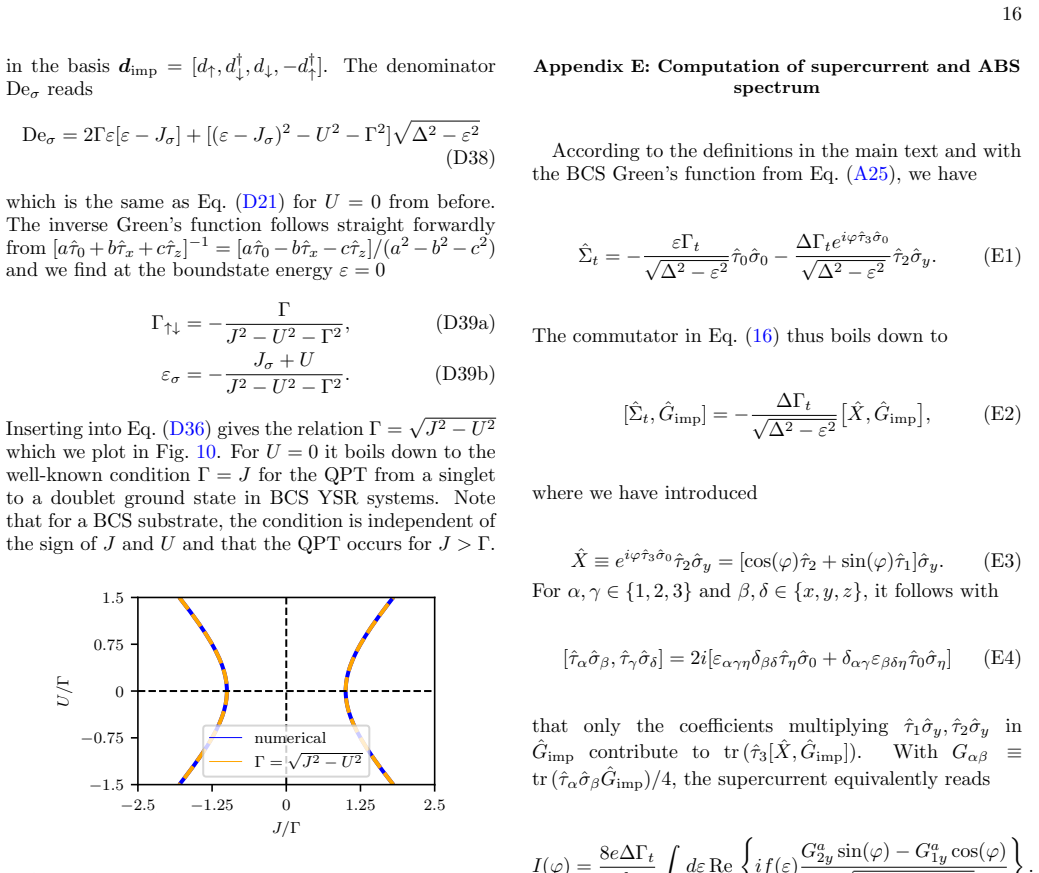
Hybridization with substrate The impurity is coupled to the substrate by the particle number conserving hybridization Hamiltonian Hhyb = X k ψ† S(k) ˆV(k)ψ imp + h.c..(7) In the presence of a uniaxial in-plane fieldB x and a generic impurity momentJwithJ z ̸= 0, time-reversal symmetry, threefold rotation symmetryC 3 and in-plane mirror symmetryσ h are bro...
-
[2]
For the three cases of hybridization, the substrate self-energy ˆΣS(ε) acquires different energy-dependent structures in spin- Nambu space
YSR bound states We extract the bound states from the inverse Green’s function ˆG−1 imp = ˆg−1 imp − ˆΣS,(10) as the solutions of det ( ˆG−1 imp) = 0. For the three cases of hybridization, the substrate self-energy ˆΣS(ε) acquires different energy-dependent structures in spin- Nambu space. To isolate the relevant part of the spec- trum, we project onto th...
-
[3]
Maria de Maeztu
Supercurrent We study the Josephson current between a supercon- ducting STM tip and the YSR impurity by solving the Dyson equation for the dressed impurity Green’s func- tion ˆGimop(φ) in the presence of tip-induced self-energy corrections ˆΣt =V tˆgtV † t according to ˆGimp(φ) = ˆgimp + ˆgimp ˆΣ ˆGimp(φ).(14) with ˆΣ = ˆΣt + ˆΣS. The superconducting tip ...
-
[4]
Bound state energies and effective spin-splitting Bound states follow from det (ˆg−1 − ˆΣ) = 0. Under condition of det ([ ˆG−1]¯τ¯τ)̸= 0, a Schur complement re- duction yields the reduced equation for bound states 0 = det ([ˆGτ τ]−1) (D4) with the Schur-complement [ ˆGτ τ]−1 = [ˆgτ τ]−1 − ˆΣτ τ − ˆΩτ τ (D5) and ˆΩτ τ ≡ ˆΣτ¯τˆΛ¯τ¯τˆΣ¯τ τ, ˆΛτ τ ≡[[ˆgτ τ]−1...
-
[5]
Note that we use the component functions from Eq
Effective spin-splitting in an ISC We compute theτ τ ′-blocks of the self-energies pro- jected onto the impurity spin. Note that we use the component functions from Eq. (D3). We define the tun- neling rates Γ≡πN 0[v2 1 +v 2 2], Γ − ≡πN 0[v2 1 −v 2 2], Γ× ≡πN 0v1v2. Different to the BCS case, we have Στ τ ̸=0in general. More explicitly, according to Eq. (8...
-
[6]
If, in addition the correspond- ing eigenvectors coincide and ˆhee(ε0) and ˆhhh(ε0) are si- multaneously diagonalizable, i.e
Bound state crossings In the subgap regime and forη→0, a bound state at ε0 ∈Rin sectorτfollows fromλ s τ(ε0) = 0 with λs τ(ε) =µ τ(ε)−s|J τ eff(ε)|s∈ {±1}.(D28) An exact crossing at the bound state energy means that there exists, t∈ {±1}such thatλ s e(ε0) = 0 and λt h(ε0) = 0 stating that the two sectors support bound states at the same energy. If, in add...
-
[7]
We then intro- duce the effective single-particle Hamiltonian near the QPT atε= 0 and use it to construct the many-body Hamiltonian
Effective Hamiltonian close to the QPT Since an ISC generally breaks spin-rotation invariance forB x ̸= 0, we introduce ˆUYSR = exp(−iγn· ˆσ/2) with n=g×z/|g×z|, wheregdenotes the normal state spin-vector in the electron block of the 4×4 Green’s function andγis the rotation angle. We then intro- duce the effective single-particle Hamiltonian near the QPT ...
-
[8]
Ajayan, P
P. Ajayan, P. Kim, and K. Banerjee,Two-dimensional van der Waals materials, Physics Today69, 38 (2016)
2016
-
[9]
P. A. Frigeri, D. F. Agterberg, and M. Sigrist,Spin sus- ceptibility in superconductors without inversion symme- try, New J. Phys.6, 115 (2004)
2004
-
[10]
B. T. Zhou, N. F. Q. Yuan, H.-L. Jiang, and K. T. Law,Ising superconductivity and majorana fermions in transition-metal dichalcogenides, Phys. Rev. B93, 180501 (2016)
2016
-
[11]
X. Xi, Z. Wang, W. Zhao, J.-H. Park, K. T. Law, H. Berger, L. Forr´ o, J. Shan, and K. F. Mak,Ising pair- ing in superconducting NbSe2 atomic layers, Nat. Phys. 12, 139 (2016)
2016
-
[12]
Saito, Y
Y. Saito, Y. Nakamura, M. S. Bahramy, Y. Kohama, J. Ye, Y. Kasahara, Y. Nakagawa, M. Onga, M. Toku- naga, T. Nojima, Y. Yanase, and Y. Iwasa,Superconduc- tivity protected by spin–valley locking in ion-gated MoS2, Nature Physics12, 144 (2016)
2016
-
[13]
Xiao, G.-B
D. Xiao, G.-B. Liu, W. Feng, X. Xu, and W. Yao,Cou- pled Spin and Valley Physics in Monolayers ofMoS 2 and Other Group-VI Dichalcogenides, Phys. Rev. Lett.108, 196802 (2012)
2012
-
[14]
Bawden, S
L. Bawden, S. P. Cooil, F. Mazzola, J. M. Riley, L. J. Collins-McIntyre, V. Sunko, K. W. B. Hunvik, M. Le- andersson, C. M. Polley, T. Balasubramanian, T. K. Kim, M. Hoesch, J. W. Wells, G. Balakrishnan, M. S. Bahramy, and P. D. C. King,Spin–valley locking in the normal state of a transition-metal dichalcogenide super- conductor, Nat. Commun.7, 1 (2016)
2016
-
[15]
Nakata, K
Y. Nakata, K. Sugawara, S. Ichinokura, Y. Okada, T. Hi- tosugi, T. Koretsune, K. Ueno, S. Hasegawa, T. Taka- hashi, and T. Sato,Anisotropic band splitting in mono- layer NbSe2: implications for superconductivity and charge density wave, npj 2D Mater. Appl.2, 1 (2018)
2018
-
[16]
J. M. Lu, O. Zheliuk, I. Leermakers, N. F. Q. Yuan, U. Zeitler, K. T. Law, and J. T. Ye,Evidence for two- 17 dimensional ising superconductivity in gated MoS 2, Sci- ence350, 1353 (2015)
2015
-
[17]
M¨ ockli and M
D. M¨ ockli and M. Khodas,Ising superconductors: In- terplay of magnetic field, triplet channels, and disorder, Phys. Rev. B101, 014510 (2020)
2020
-
[18]
M. Haim, D. M¨ ockli, and M. Khodas,Signatures of triplet correlations in density of states of Ising supercon- ductors, Phys. Rev. B102, 214513 (2020)
2020
-
[19]
Kuzmanovi´ c, T
M. Kuzmanovi´ c, T. Dvir, D. LeBoeuf, S. Ili´ c, M. Haim, D. M¨ ockli, S. Kramer, M. Khodas, M. Houzet, J. S. Meyer, M. Aprili, H. Steinberg, and C. H. L. Quay, Tunneling spectroscopy of few-monolayernbse 2 in high magnetic fields: Triplet superconductivity and ising pro- tection, Phys. Rev. B106, 184514 (2022)
2022
-
[20]
G. Tang, C. Bruder, and W. Belzig,Magnetic field- induced “mirage” gap in an ising superconductor, Phys. Rev. Lett.126, 237001 (2021)
2021
-
[21]
Shiba,Classical Spins in Superconductors, Prog
H. Shiba,Classical Spins in Superconductors, Prog. Theor. Phys.40, 435 (1968)
1968
-
[22]
A. I. Rusinov,Superconcductivity near a paramagnetic impurity, JETP Letters9, 146 (1969)
1969
-
[23]
A. V. Balatsky, I. Vekhter, and J.-X. Zhu,Impurity- induced states in conventional and unconventional super- conductors, Rev. Mod. Phys.78, 373 (2006)
2006
-
[24]
D. K. Morr,Impurity nanostructures and quantum inter- ference in superconductors, inSuperconductivity: Con- ventional and Unconventional Superconductors, edited by K. H. Bennemann and J. B. Ketterson (Springer Berlin Heidelberg, Berlin, Heidelberg, 2008) pp. 225–258
2008
-
[25]
Huang, R
H. Huang, R. Drost, J. Senkpiel, C. Padurariu, B. Kubala, A. L. Yeyati, J. C. Cuevas, J. Ankerhold, K. Kern, and C. R. Ast,Quantum phase transitions and the role of impurity-substrate hybridization in Yu-Shiba- Rusinov states, Commun. Phys.3, 1 (2020)
2020
-
[26]
Huang, S
H. Huang, S. Karan, C. Padurariu, B. Kubala, J. C. Cuevas, J. Ankerhold, K. Kern, and C. R. Ast,Univer- sal scaling of tunable Yu-Shiba-Rusinov states across the quantum phase transition, Commun. Phys.6, 1 (2023)
2023
-
[27]
Karan, H
S. Karan, H. Huang, C. Padurariu, B. Kubala, A. Theiler, A. M. Black-Schaffer, G. Morr´ as, A. L. Yeyati, J. C. Cuevas, J. Ankerhold, K. Kern, and C. R. Ast,Supercon- ducting quantum interference at the atomic scale, Nature Physics18, 893 (2022)
2022
-
[28]
von Oppen and K
F. von Oppen and K. J. Franke,Yu-Shiba-Rusinov states in real metals, Phys. Rev. B103, 205424 (2021)
2021
-
[29]
Liu, W.-Y
G.-B. Liu, W.-Y. Shan, Y. Yao, W. Yao, and D. Xiao, Three-band tight-binding model for monolayers of group- vib transition metal dichalcogenides, Phys. Rev. B88, 085433 (2013)
2013
-
[30]
Xiao, G.-B
D. Xiao, G.-B. Liu, W. Feng, X. Xu, and W. Yao, Coupled spin and valley physics in monolayers ofmos 2 and other group-vi dichalcogenides, Phys. Rev. Lett.108, 196802 (2012)
2012
-
[31]
N. B. Kopnin,Theory of Nonequilibrium Superconductiv- ity(Clarendon Press, Oxford, England, UK, 2001)
2001
-
[32]
Belzig, F
W. Belzig, F. K. Wilhelm, C. Bruder, G. Sch¨ on, and A. D. Zaikin,Quasiclassical green’s function approach to mesoscopic superconductivity, Superlattices and Mi- crostructures25, 1251 (1999)
1999
-
[33]
Villas, R
A. Villas, R. L. Klees, H. Huang, C. R. Ast, G. Rastelli, W. Belzig, and J. C. Cuevas,Interplay between Yu-Shiba- Rusinov states and multiple Andreev reflections, Phys. Rev. B101, 235445 (2020)
2020
-
[34]
Villas, R
A. Villas, R. L. Klees, G. Morr´ as, H. Huang, C. R. Ast, G. Rastelli, W. Belzig, and J. C. Cuevas,Tunneling processes between Yu-Shiba-Rusinov bound states, Phys. Rev. B103, 155407 (2021)
2021
-
[35]
E. S. Andriyakhina, S. L. Khortsev, and F. Evers, Fermi-level pinning of Yu-Shiba-Rusinov states in a su- perconductor with weakly broken spin-rotational invari- ance, Phys. Rev. B111, 224501 (2025)
2025
-
[36]
K¨ uster, H
F. K¨ uster, H. Brune,et al.,Correlating josephson super- currents and shiba states in quantum spins coupled to su- perconductors, Nature Communications12, 1108 (2021)
2021
-
[37]
R. C. Dynes, V. Narayanamurti, and J. P. Garno,Di- rect measurement of quasiparticle-lifetime broadening in a strong-coupled superconductor, Phys. Rev. Lett.41, 1509 (1978)
1978
discussion (0)
Sign in with ORCID, Apple, or X to comment. Anyone can read and Pith papers without signing in.