Whitham modulation equations for the regularized Boussinesq equation with cubic nonlinearity
Pith reviewed 2026-06-30 21:42 UTC · model grok-4.3
The pith
Loss of hyperbolicity in the Whitham modulation equations signals modulational instability of periodic traveling waves.
A machine-rendered reading of the paper's core claim, the machinery that carries it, and where it could break.
Core claim
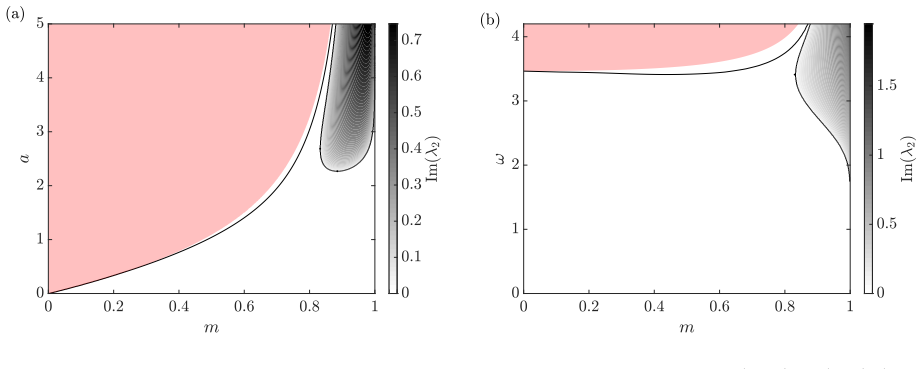
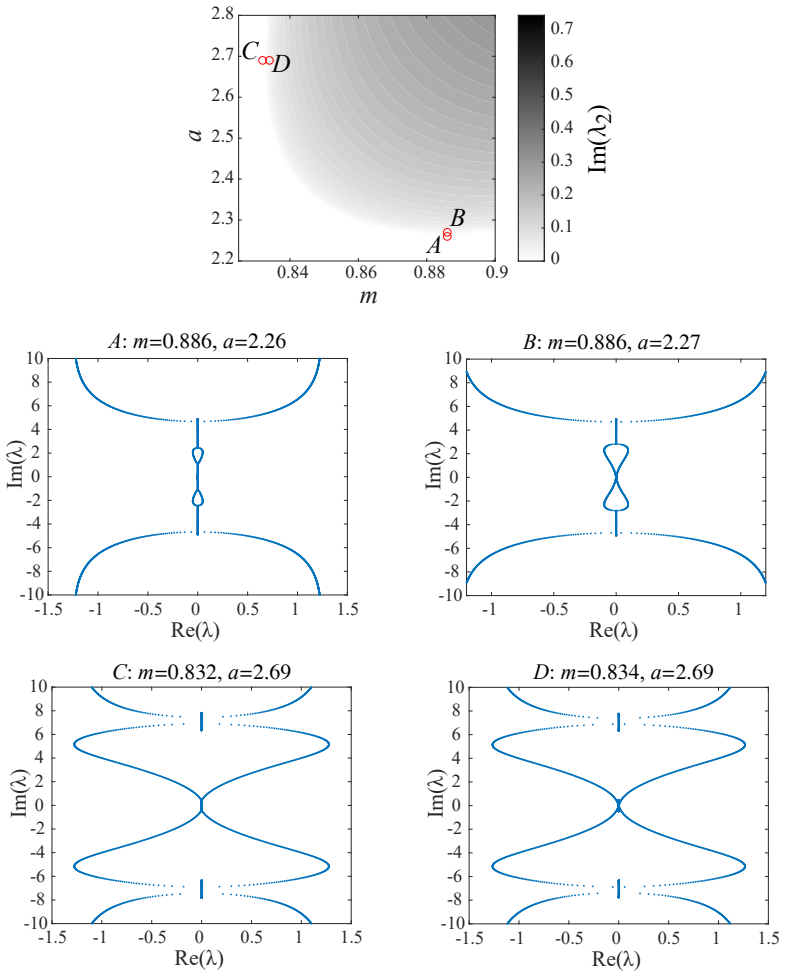
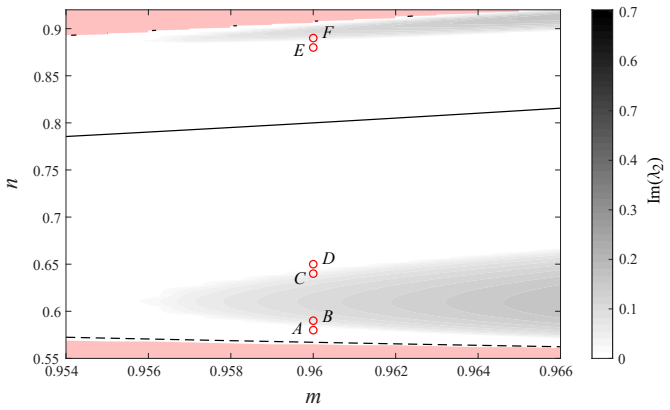
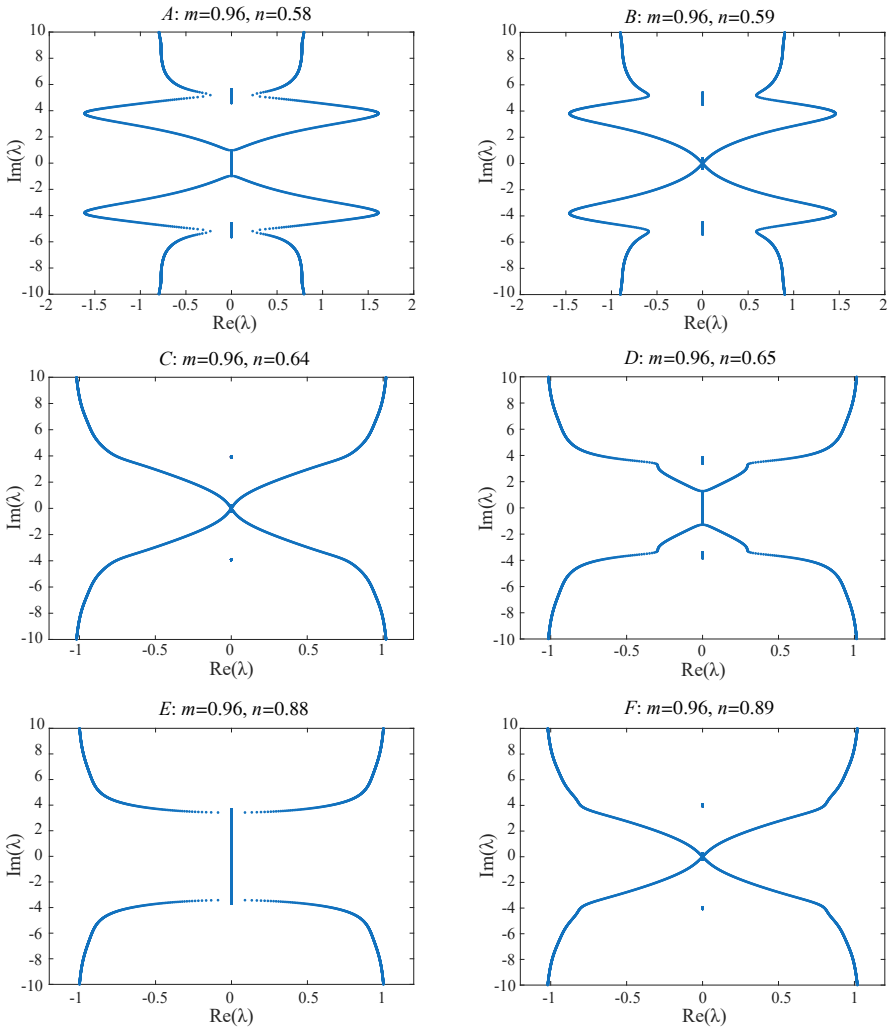
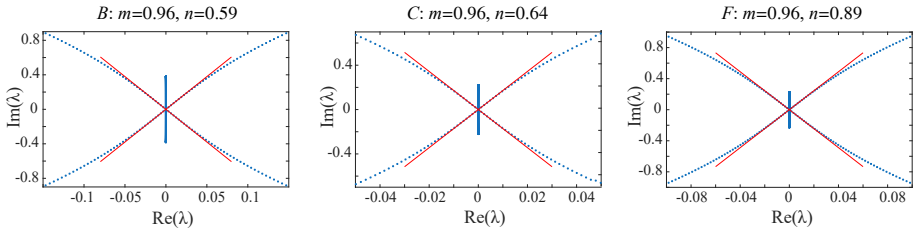
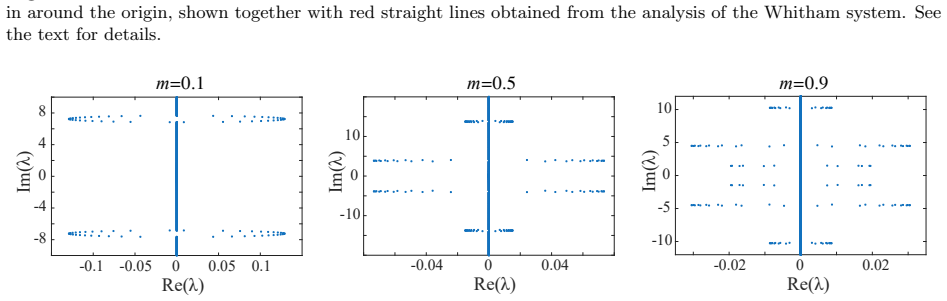
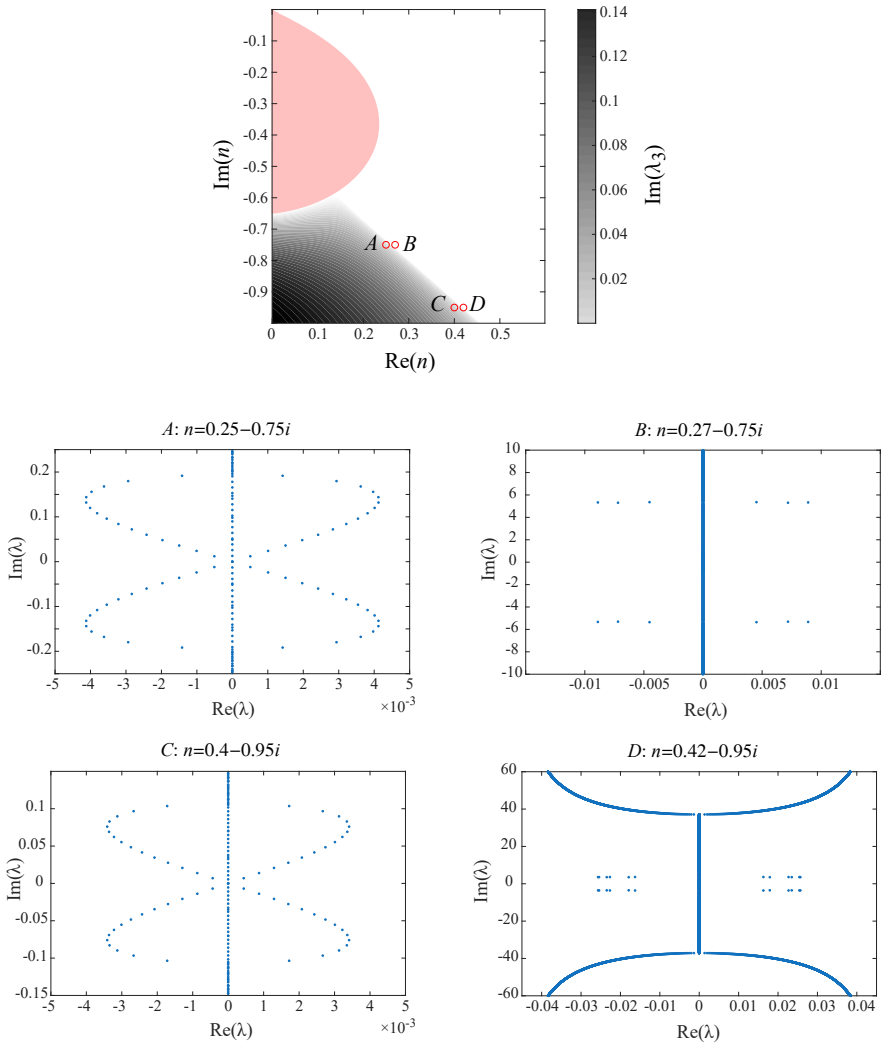
Using an averaged variational principle, the authors obtain the Whitham modulation equations for the regularized Boussinesq equation with cubic nonlinearity. These equations are of hydrodynamic type, and their hyperbolicity properties are examined in detail. The loss of hyperbolicity, manifested as complex conjugate characteristic speeds, is shown to correspond to the modulational instability of the underlying periodic traveling waves. This correspondence is verified through numerical computation of linearized spectra around the waves and through direct simulations of initial-value problems that also uncover additional short-wave instabilities.
What carries the argument
The Whitham modulation equations obtained from the averaged variational principle, whose hyperbolicity or loss thereof determines the linear stability of periodic traveling waves.
If this is right
- In the solitary-wave and harmonic limits the convexity of the modulation system can be established analytically.
- The onset of modulational instability coincides exactly with the transition from real to complex characteristic speeds.
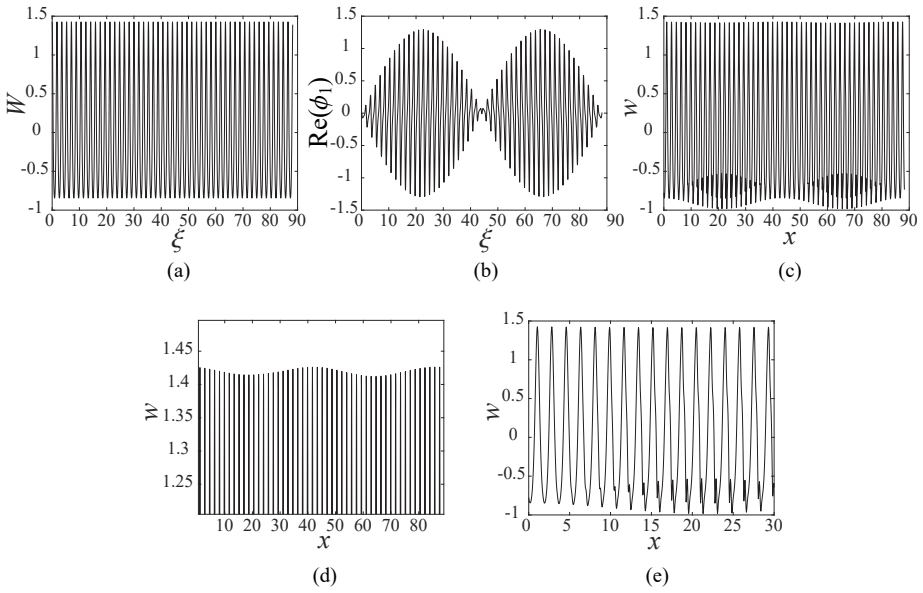
- Initial-value simulations reveal both the predicted modulational instability and additional short-wave instabilities.
- The modulation equations remain strictly hyperbolic or genuinely nonlinear in identified parameter regions.
Where Pith is reading between the lines
- The same averaged-variational approach could be used to assess stability in other dispersive approximations to nonlinear lattices.
- The identified link between hyperbolicity loss and instability may extend to equations with different nonlinearities or higher-order dispersion.
- Stability criteria derived in the solitary-wave limit might be tested against direct simulations of lattice models.
Load-bearing premise
The averaged variational principle produces modulation equations whose hyperbolicity properties correctly capture the linear stability of the underlying periodic traveling waves without requiring higher-order dispersive corrections.
What would settle it
A direct numerical computation of the linearized spectrum for a periodic traveling wave in a regime where the modulation equations have complex characteristic speeds would show no positive real growth rates, or the opposite mismatch would occur.
Figures
read the original abstract
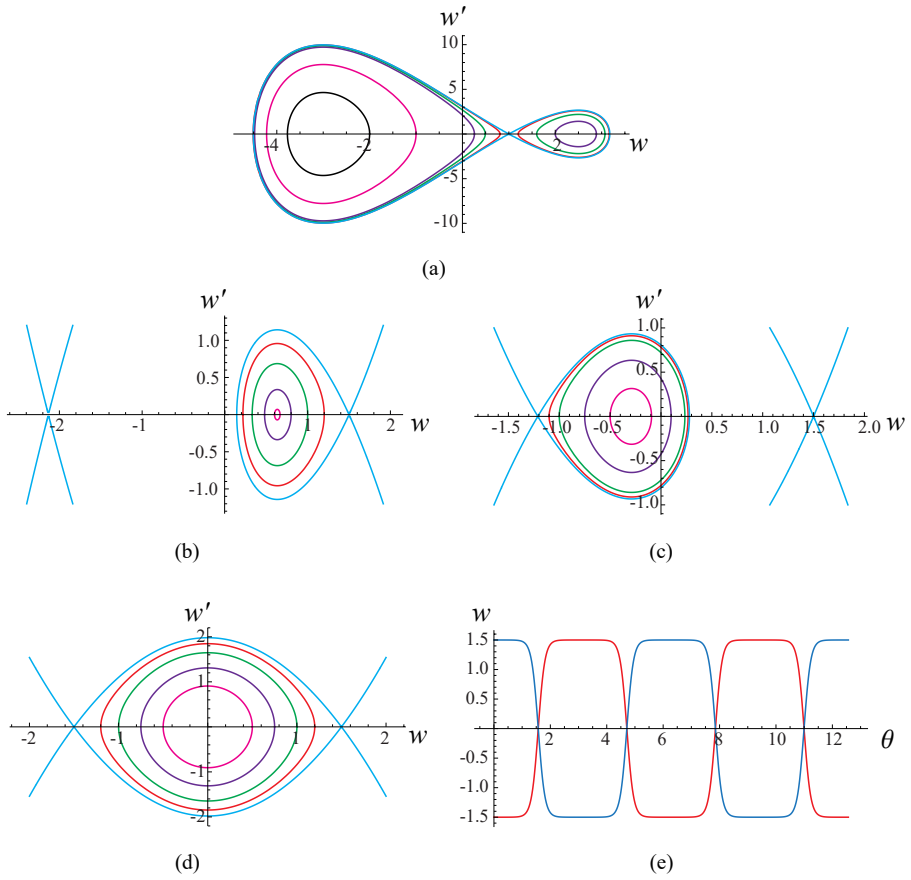
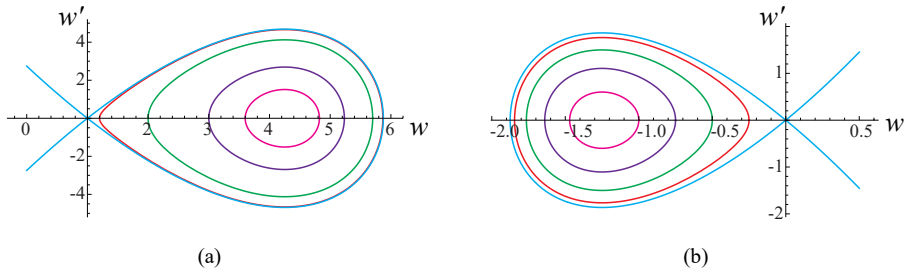
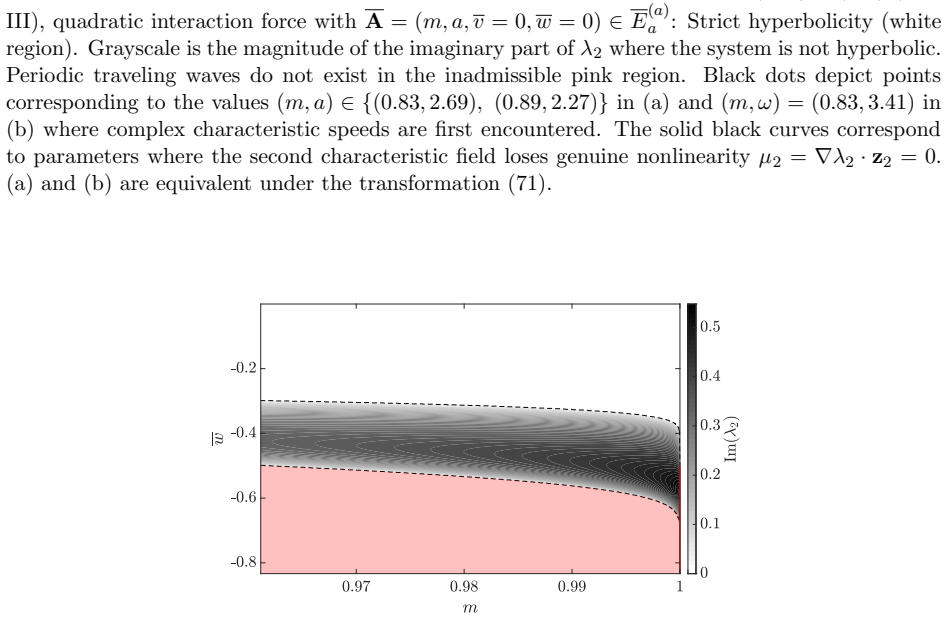
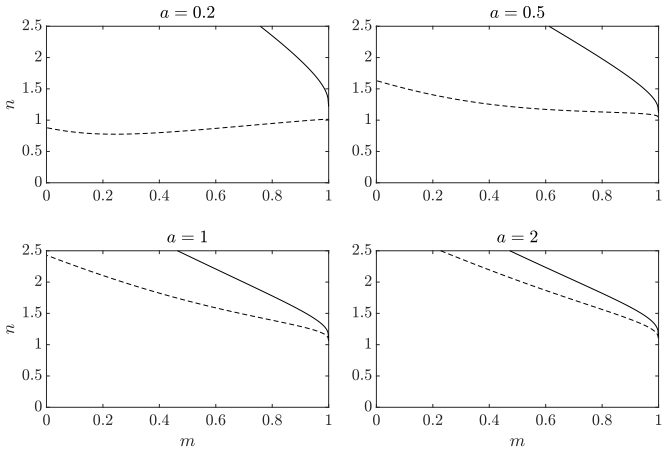
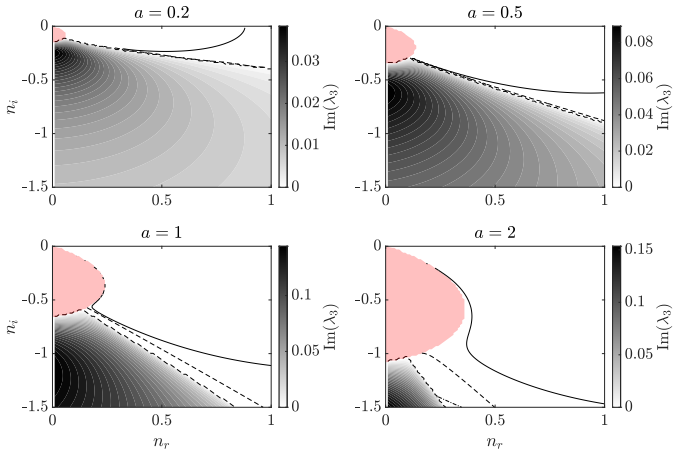
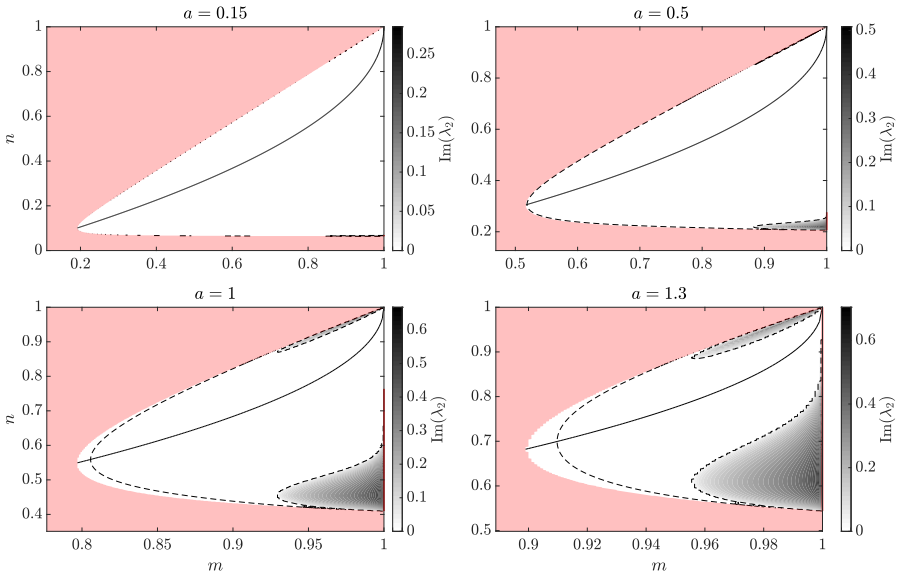
A regularized Boussinesq equation is studied as a dispersive, long-wave (quasicontinuum) approximation of the Fermi-Pasta-Ulam lattice with a general cubic interaction force. Explicit periodic traveling wave solutions in terms of Jacobi elliptic functions are classified, and their solitary-wave, kink, and trigonometric limits are obtained. The Whitham modulation equations describing slow modulations of periodic traveling wave solutions are derived using an averaged variational principle. The convexity (strict hyperbolicity, genuine nonlinearity) of the resulting hydrodynamic-type equations is examined numerically in general and analytically in the solitary-wave and harmonic limits. In particular, the loss of hyperbolicity and the formation of complex conjugate characteristic speeds is shown to lead to modulational instability of periodic traveling waves. The onset of modulational instability is verified by numerical computations of linearized spectra for periodic traveling waves and initial value problems that also reveal additional short-wave instabilities.
Editorial analysis
A structured set of objections, weighed in public.
Referee Report
Summary. The manuscript classifies explicit periodic traveling-wave solutions of the regularized Boussinesq equation (a quasicontinuum model for the Fermi-Pasta-Ulam lattice with cubic nonlinearity) in terms of Jacobi elliptic functions, together with their solitary-wave, kink, and trigonometric limits. It derives the associated Whitham modulation equations via an averaged variational principle, examines the convexity, strict hyperbolicity, and genuine nonlinearity of the resulting hydrodynamic system both numerically in the general case and analytically in the solitary-wave and harmonic limits, and demonstrates that loss of hyperbolicity (complex conjugate characteristic speeds) produces modulational instability. This correspondence is verified by direct numerical computation of linearized spectra around the periodic waves and by initial-value simulations that also identify separate short-wave instabilities.
Significance. If the central correspondence holds, the work supplies a concrete, first-order modulation-theoretic criterion for the onset of modulational instability in a physically motivated dispersive PDE, backed by explicit solutions and a direct numerical check that the hyperbolicity threshold coincides with the spectral instability threshold. The analytic limits and the link to lattice models add utility for long-wave wave dynamics.
minor comments (2)
- The abstract states that the equation approximates the FPU lattice “with a general cubic interaction force,” yet the title specifies “cubic nonlinearity.” A brief clarifying sentence in the introduction would remove any ambiguity about the precise form of the nonlinearity.
- The numerical verification of the hyperbolicity-instability correspondence is described only at the level of the abstract. Adding one or two sentences (or a short subsection) that state the discretization, the range of wave numbers examined, and the tolerance used to detect complex characteristic speeds would improve reproducibility without altering the central claim.
Simulated Author's Rebuttal
We thank the referee for their careful reading, positive assessment of the manuscript's contributions, and recommendation to accept.
Circularity Check
No significant circularity
full rationale
The Whitham modulation equations are derived via an averaged variational principle applied to explicit Jacobi-elliptic periodic traveling waves of the regularized Boussinesq equation. Hyperbolicity loss is then shown to correspond to modulational instability, with the correspondence verified by separate numerical computation of linearized spectra and initial-value problems. These spectral checks constitute an independent external benchmark rather than a fitted quantity or self-referential definition. No load-bearing step reduces by construction to its own inputs, and no self-citation chain is invoked to justify the central claim. The derivation chain is therefore self-contained.
Axiom & Free-Parameter Ledger
Reference graph
Works this paper leans on
-
[1]
Fermi, J
E. Fermi, J. Pasta, and S. Ulam. Studies of nonlinear problems. Technical report, I, Los Alamos Scientific Laboratory Report No. LA-1940, 1955
1940
-
[2]
Pankov.Travelling waves and periodic oscillations in Fermi-Pasta-Ulam lattices
A. Pankov.Travelling waves and periodic oscillations in Fermi-Pasta-Ulam lattices. Imperial College Press, 2005
2005
-
[3]
S. Sen, J. Hong, J. Bang, E. Avalos, and R. Doney. Solitary waves in the granular chain.Phys. Rep., 462(2):21–66, 2008
2008
-
[4]
Flach and A
S. Flach and A. V. Gorbach. Discrete breathers — Advances in theory and applications.Phys. Rep., 467(1):1–116, 2008
2008
-
[5]
P. G. Kevrekidis. Non-linear waves in lattices: past, present, future.IMA J. Appl. Math., 76(3):1–35, 2011
2011
-
[6]
Chong and P
C. Chong and P. G. Kevrekidis.Coherent structures in granular crystals: From experiment and modelling to computation and mathematical analysis. Springer, 2018
2018
-
[7]
Vainchtein
A. Vainchtein. Solitary waves in FPU–type lattices.Physica D, 434:133252, 2022
2022
-
[8]
G. B. Whitham.Linear and Nonlinear Waves. Wiley, New York, 1999
1999
-
[9]
A. M. Kamchatnov.Nonlinear periodic waves and their modulations: an introductory course. World Scientific, 2000
2000
-
[10]
G. A. El and M. A. Hoefer. Dispersive shock waves and modulation theory.Physica D, 333:11–65, 2016
2016
-
[11]
Filip and S
A. Filip and S. Venakides. Existence and modulation of traveling waves in particle chains. Commun. Pure Appl. Math, 51(6):693—-735, 1999
1999
-
[12]
Dreyer, M
W. Dreyer, M. Herrmann, and A. Mielke. Micro–macro transition in the atomic chain via Whitham’s modulation equation.Nonlinearity, 19(2):471, 2005
2005
-
[13]
Dreyer, M
W. Dreyer, M. Herrmann, and J. D. M. Rademacher. Wave trains, solitons and modulation theory in FPU chains. InAnalysis, modeling and simulation of multiscale problems, pages 467–500. Springer, 2006. 41
2006
-
[14]
Dreyer and M
W. Dreyer and M. Herrmann. Numerical experiments on the modulation theory for the non- linear atomic chain.Physica D, 237(2):255–282, 2008
2008
-
[15]
Sprenger, C
P. Sprenger, C. Chong, E. Okyere, M. Herrmann, P. G. Kevrekidis, and M. A. Hoefer. Hydro- dynamics of a discrete conservation law.Stud. Appl. Math., 153(4):e12767, 2024
2024
- [16]
-
[17]
P. D. Lax.Hyperbolic Systems of Conservation Laws and the Mathematical Theory of Shock Waves. SIAM, 1973
1973
-
[18]
Levermore
C.D. Levermore. The hyperbolic nature of the zero dispersion KdV limit.Commun. Part. Diff. Eq., 13(4):495–514, 1988
1988
-
[19]
P. Rosenau. Dynamics of nonlinear mass-spring chains near the continuum limit.Phys. Let. A, 118(5):222–227, 1986
1986
-
[20]
Vainchtein and L
A. Vainchtein and L. Truskinovsky. When discrete fronts and pulses form a single family: FPU chain with hardening-softening springs.Physica D, 464:134187, 2024
2024
-
[21]
G. El, M. Hoefer, and M. Shearer. Dispersive and Diffusive-Dispersive Shock Waves for Non- convex Conservation Laws.SIAM Rev., 59(1):3–61, 2017
2017
-
[22]
Gorbushin, A
N. Gorbushin, A. Vainchtein, and L. Truskinovsky. Transition fronts and their universality classes.Phys. Rev. E, 106(2):024210, 2022
2022
-
[23]
J. C. Bronski and M. A. Johnson. The modulational instability for a generalized Korteweg–de Vries equation.Arch Rat. Mech. Anal., 197(2):357–400, 2010
2010
-
[24]
Benzoni-Gavage, P
S. Benzoni-Gavage, P. Noble, and L. M. Rodrigues. Slow modulations of periodic waves in Hamiltonian PDEs, with application to capillary fluids.J. Nonlin. Sci., 24(4):711–768, 2014
2014
-
[25]
M. A. Johnson and W. R. Perkins. Modulational instability of viscous fluid conduit periodic waves.SIAM J. Math. Anal., 52:277–305, 2020
2020
-
[26]
W. A. Clarke, R. Marangell, and W. R. Perkins. Rigorous justification of the Whitham modulation equations for equations of Whitham type.Stud. Appl. Math., 149(2):297–323, 2022
2022
-
[27]
Deconinck and J
B. Deconinck and J. N. Kutz. Computing spectra of linear operators using the floquet–fourier– hill method.J. Comp. Phys., 219(1):296–321, 2006
2006
-
[28]
J. C. Bronski, V. M. Hur, and S. L. Wester. Superharmonic instability for regularized long-wave models.Nonlinearity, 36(1):133–170, 2023
2023
-
[29]
Gavrilyuk, B
S. Gavrilyuk, B. Nkonga, K.-M. Shyue, and L. Truskinovsky. Stationary shock-like transition fronts in dispersive systems.Nonlinearity, 33(10):5477, 2020
2020
-
[30]
P. F. Byrd and M. D. Friedman.Handbook of elliptic integrals for engineers and physicists, volume 67. Springer, 2013
2013
-
[31]
Vainchtein
A. Vainchtein. Rarefactive lattice solitary waves with high-energy sonic limit.Phys. Rev. E, 102(5):052218, 2020. 42
2020
-
[32]
Chong, M
C. Chong, M. Herrmann, and P. G. Kevrekidis. Dispersive shock waves in lattices: A dimension reduction approach.Physica D, 442:133533, 2022
2022
-
[33]
Hydrodynamics of weakly deformed soliton lattices
B A Dubrovin and S P Novikov. Hydrodynamics of weakly deformed soliton lattices. Differ- ential geometry and Hamiltonian theory.Russ. Math. Surv., 44(6):35–124, 1989
1989
-
[34]
C. C. Chicone.Ordinary differential equations with applications. Springer, 1999
1999
-
[35]
A. Kiper. Fourier series coefficients for powers of the Jacobian elliptic functions.Math. Comp., 43(167):247–259, 1984
1984
-
[36]
J. A. Pava, C. Banquet, J. D. Silva, and F. Oliveira. The regularized Boussinesq equation: instability of periodic traveling waves.J. Diff. Eq., 254(9):3994–4023, 2013
2013
-
[37]
G. A. El. Resolution of a shock in hyperbolic systems modified by weak dispersion.Chaos, 15(3), 2005
2005
-
[38]
Congy, G
T. Congy, G. El, S. Gavrilyuk, M. Hoefer, and K.-M. Shyue. Solitary wave-mean flow interac- tion in strongly nonlinear dispersive shallow water waves.Journal of Nonlinear Waves, 1:e5, 2025. 43
2025
discussion (0)
Sign in with ORCID, Apple, or X to comment. Anyone can read and Pith papers without signing in.