Recognition: no theorem link
Adaptive Steering and Remasking for Safe Generation in Diffusion Language Models
Pith reviewed 2026-05-14 20:04 UTC · model grok-4.3
The pith
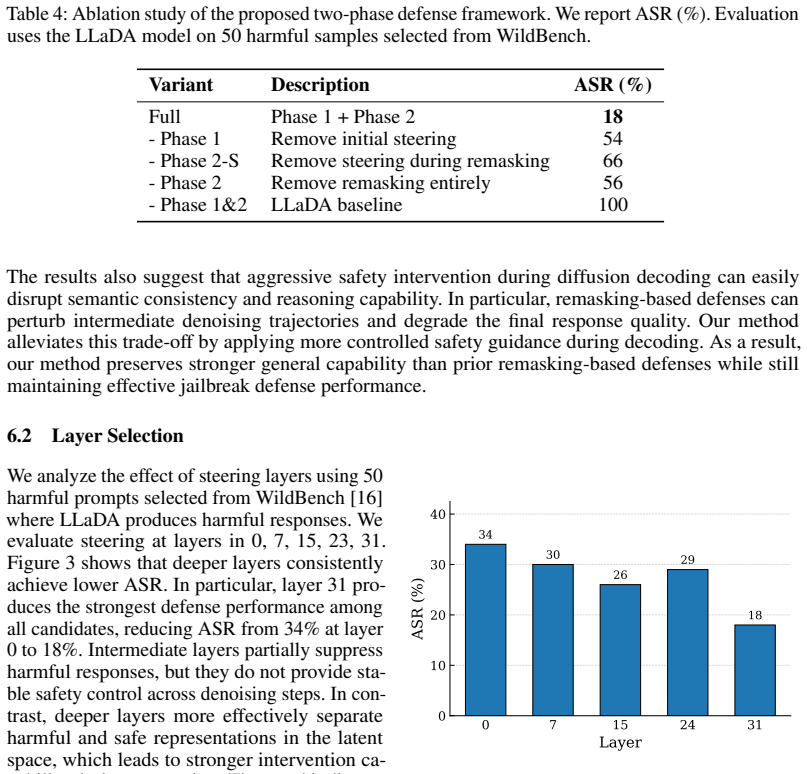
Step-wise remasking guided by a contrastive safety direction reduces jailbreak success in diffusion language models to 0.64 percent while keeping output quality nearly unchanged.
A machine-rendered reading of the paper's core claim, the machinery that carries it, and where it could break.
Core claim
The authors claim that a contrastive safety direction captures the latent boundary between harmful and safe generations, allowing per-step detection of harmful token alignment during denoising. When such alignment is found, the tokens are remasked and denoising resumes under adaptive steering modulated by the estimated degree of harmfulness, yielding jailbreak success rates of 0.64 percent with generation quality comparable to the unmodified model.
What carries the argument
The contrastive safety direction (SGD), a latent vector that separates harmful from safe semantic content and is used to evaluate and correct token alignment at every denoising step.
If this is right
- No additional fine-tuning of the base diffusion model is required.
- The method functions as a plug-and-play addition to any off-the-shelf diffusion language model.
- Generation quality metrics remain close to those of the original model.
- Jailbreak success drops to 0.64 percent across the evaluated attack scenarios.
Where Pith is reading between the lines
- The same per-step detection mechanism could be reused for other forms of dynamic control, such as enforcing topic or style constraints during denoising.
- Because the approach monitors the full trajectory rather than only the final output, it may generalize to other iterative text generators that refine tokens bidirectionally.
- Combining this inference-time layer with modest training-time safety alignment could produce stronger protection than either technique alone.
Load-bearing premise
The contrastive safety direction reliably flags harmful alignment at intermediate denoising steps, and remasking those tokens followed by adaptive steering leaves final coherence and quality intact.
What would settle it
Running the method on a set of prompts that produce safe outputs in the base model and observing that a large fraction of the resulting generations become incoherent or lower-quality than the baseline.
Figures


read the original abstract
Diffusion Language Models (DLMs) provide a promising alternative to autoregressive language models by generating text through iterative denoising and bidirectional refinement. However, this iterative generation paradigm also introduces unique safety vulnerabilities when harmful tokens generated at intermediate denoising steps propagate through subsequent refinement processes and eventually induce unsafe outputs. While there are a few attempts to remedy this issue, they either fail to generate safe outputs or generate safe yet low-quality outputs. This motivates us to propose an inference-time defense framework based on the step-wise intervention during the denoising process, which then improves the safety without compromising the output quality. The key component of our framework is a contrastive safety direction (SGD), a latent direction that captures the semantic boundary between harmful and safe generations. We leverage SGD to assess the alignment of generated tokens with harmful semantics at each denoising step. When harmful alignment is detected, our method remasks the corresponding tokens and resumes the denoising process with adaptive steering, where the steering strength is modulated according to the estimated degree of harmfulness. As a plug-and-play module, our method circumvents the need for additional fine-tuning and can be directly incorporated into off-the-shelf diffusion models. The experimental results show that our approaches reduce jailbreak success rates to 0.64% while preserving generation quality close to the original model performance. This confirms the effectiveness of step-wise intervention for safe diffusion language model generation. Our code is available at https://github.com/leeyejin1231/DLM_Steering_Remasking.
Editorial analysis
A structured set of objections, weighed in public.
Referee Report
Summary. The manuscript proposes an inference-time safety framework for diffusion language models that derives a contrastive safety direction (SGD) from safe/harmful generation pairs, uses it to detect harmful token alignments at each denoising timestep, remasks detected tokens, and resumes generation under adaptive steering whose strength is modulated by estimated harmfulness. The central empirical claim is that this plug-and-play intervention reduces jailbreak success rates to 0.64% while keeping generation quality close to the unmodified model.
Significance. If the reported metrics are reproducible and the SGD direction generalizes beyond the evaluated pairs and timesteps, the work would be significant: it targets a vulnerability specific to the iterative bidirectional refinement process of DLMs, avoids any fine-tuning, and supplies open code. This could influence practical deployment of diffusion-based text generators.
major comments (1)
- Abstract: the headline claim that jailbreak success falls to 0.64% is load-bearing for the paper's contribution, yet the abstract (and by extension the reported experiments) supplies no information on the number or distribution of contrastive pairs used to obtain SGD, the precise procedure for computing the direction at intermediate timesteps, the evaluation datasets, or the baselines; without these details the generalization of SGD to novel jailbreaks and arbitrary t cannot be verified and the result remains unverifiable.
minor comments (2)
- Abstract: the acronym SGD is introduced without expansion or prior definition; state explicitly whether it denotes a new term or an existing technique.
- Abstract: the phrase 'our approaches' (plural) is used while only a single framework is described; clarify whether multiple variants were evaluated.
Simulated Author's Rebuttal
We thank the referee for their constructive feedback and for identifying areas where the abstract could better support the central claim. We address the major comment below and will incorporate the suggested clarifications in the revised manuscript.
read point-by-point responses
-
Referee: Abstract: the headline claim that jailbreak success falls to 0.64% is load-bearing for the paper's contribution, yet the abstract (and by extension the reported experiments) supplies no information on the number or distribution of contrastive pairs used to obtain SGD, the precise procedure for computing the direction at intermediate timesteps, the evaluation datasets, or the baselines; without these details the generalization of SGD to novel jailbreaks and arbitrary t cannot be verified and the result remains unverifiable.
Authors: We agree that the abstract should be self-contained enough for readers to evaluate the headline result. The manuscript body provides these details: Section 3.2 describes the construction of the contrastive safety direction (SGD) from safe/harmful generation pairs, including the number and sourcing of pairs; the timestep-specific computation is formalized in Equation (2) and Algorithm 1; evaluation uses standard jailbreak benchmarks (AdvBench and related datasets) with results in Section 5; and baselines are compared in Table 2. However, the abstract currently omits concise references to these elements. In revision we will expand the abstract to include brief statements on the pair count and distribution, the core computation at intermediate timesteps, the primary evaluation datasets, and the main baselines, while respecting length limits. We will also verify that the experimental sections explicitly restate these parameters for full reproducibility. revision: yes
Circularity Check
No significant circularity in derivation chain
full rationale
The paper introduces an inference-time framework using a contrastive safety direction (SGD) computed from safe/harmful generation pairs to detect and remask harmful tokens at intermediate denoising steps, followed by adaptive steering. The abstract and described method present SGD as an independently derived latent direction whose application is validated through external experiments showing reduced jailbreak rates (0.64%) while preserving quality. No equations or steps reduce by construction to fitted inputs, self-citations, or prior ansatzes; the claimed outcomes are positioned as empirical results rather than tautological predictions. The derivation remains self-contained against the provided benchmarks.
Axiom & Free-Parameter Ledger
free parameters (1)
- steering strength modulation factor
axioms (1)
- domain assumption A latent contrastive safety direction exists in the model's representation space that separates harmful from safe token generations at each denoising step.
invented entities (1)
-
contrastive safety direction (SGD)
no independent evidence
Reference graph
Works this paper leans on
-
[1]
Refusal in language models is mediated by a single direction
Andy Arditi, Oscar Obeso, Aaquib Syed, Daniel Paleka, Nina Panickssery, Wes Gurnee, and Neel Nanda. Refusal in language models is mediated by a single direction. InAdvances in Neural Information Processing Systems 38: Annual Conference on Neural Information Processing Systems 2024, NeurIPS 2024. 9
work page 2024
-
[2]
Johnson, Jonathan Ho, Daniel Tarlow, and Rianne van den Berg
Jacob Austin, Daniel D. Johnson, Jonathan Ho, Daniel Tarlow, and Rianne van den Berg. Struc- tured denoising diffusion models in discrete state-spaces. InAdvances in Neural Information Processing Systems 34: Annual Conference on Neural Information Processing Systems 2021, NeurIPS, 2021, pages 17981–17993, 2021
work page 2021
-
[3]
Patrick Chao, Alexander Robey, Edgar Dobriban, Hamed Hassani, George J. Pappas, and Eric Wong. Jailbreaking black box large language models in twenty queries. InConference on Secure and Trustworthy Machine Learning, SaTML, IEEE, 2025, pages 23–42
work page 2025
-
[4]
Jailbreakbench: An open robustness benchmark for jailbreaking large language models
Patrick Chao, Edoardo Debenedetti, Alexander Robey, Maksym Andriushchenko, Francesco Croce, Vikash Sehwag, Edgar Dobriban, Nicolas Flammarion, George J Pappas, Florian Tramer, et al. Jailbreakbench: An open robustness benchmark for jailbreaking large language models. Advances in Neural Information Processing Systems, NeurIPS, pages 55005–55029, 2024
work page 2024
-
[5]
Sander Dieleman, Laurent Sartran, Arman Roshannai, Nikolay Savinov, Yaroslav Ganin, Pierre H. Richemond, Arnaud Doucet, Robin Strudel, Chris Dyer, Conor Durkan, Curtis Hawthorne, Rémi Leblond, Will Grathwohl, and Jonas Adler. Continuous diffusion for categori- cal data.CoRR, 2022
work page 2022
-
[6]
Position: Building guardrails for large language models requires systematic design
Yi Dong, Ronghui Mu, Gaojie Jin, Yi Qi, Jinwei Hu, Xingyu Zhao, Jie Meng, Wenjie Ruan, and Xiaowei Huang. Position: Building guardrails for large language models requires systematic design. InForty-first International Conference on Machine Learning, ICML 2024, pages 11375–11394
work page 2024
-
[7]
Guardnet: Graph-attention filtering for jailbreak defense in large language models.CoRR, 2025
Javad Forough, Mohammad Maheri, and Hamed Haddadi. Guardnet: Graph-attention filtering for jailbreak defense in large language models.CoRR, 2025
work page 2025
-
[8]
Diffuseq: Sequence to sequence text generation with diffusion models
Shansan Gong, Mukai Li, Jiangtao Feng, Zhiyong Wu, and Lingpeng Kong. Diffuseq: Sequence to sequence text generation with diffusion models. InThe Eleventh International Conference on Learning Representations, ICLR 2023
work page 2023
-
[9]
Diffusionbert: Improving generative masked language models with diffusion models
Zhengfu He, Tianxiang Sun, Qiong Tang, Kuanning Wang, Xuanjing Huang, and Xipeng Qiu. Diffusionbert: Improving generative masked language models with diffusion models. InProceedings of the 61st Annual Meeting of the Association for Computational Linguistics (Volume 1: Long Papers), ACL 2023, pages 4521–4534
work page 2023
-
[10]
Measuring massive multitask language understanding
Dan Hendrycks, Collin Burns, Steven Basart, Andy Zou, Mantas Mazeika, Dawn Song, and Jacob Steinhardt. Measuring massive multitask language understanding. In9th International Conference on Learning Representations, ICLR 2021, 2021
work page 2021
-
[11]
Denoising diffusion probabilistic models
Jonathan Ho, Ajay Jain, and Pieter Abbeel. Denoising diffusion probabilistic models. InAd- vances in Neural Information Processing Systems 33: Annual Conference on Neural Information Processing Systems 2020, NeurIPS 2020
work page 2020
-
[12]
Tiansheng Huang, Sihao Hu, Fatih Ilhan, Selim F. Tekin, and Ling Liu. Lisa: Lazy safety alignment for large language models against harmful fine-tuning attack. InAdvances in Neural Information Processing Systems 38: Annual Conference on Neural Information Processing Systems 2024, NeurIPS 2024,
work page 2024
-
[13]
Yuyi Huang, Runzhe Zhan, Derek F. Wong, Lidia S. Chao, and Ailin Tao. Intrinsic model weaknesses: How priming attacks unveil vulnerabilities in large language models. InFindings of the Association for Computational Linguistics: Findings of NAACL, 2025, pages 1405–1425,
work page 2025
-
[14]
A2d: Any-order, any-step safety alignment for diffusion language models
Wonje Jeung, Sangyeon Yoon, Yoonjun Cho, Dongjae Jeon, Sangwoo Shin, Hyesoo Hong, and Albert No. A2d: Any-order, any-step safety alignment for diffusion language models. InThe Fourteenth International Conference on Learning Representations, ICLR, 2026
work page 2026
-
[15]
Wildteaming at scale: From in-the-wild jailbreaks to (adversarially) safer language models
Liwei Jiang, Kavel Rao, Seungju Han, Allyson Ettinger, Faeze Brahman, Sachin Kumar, Niloofar Mireshghallah, Ximing Lu, Maarten Sap, Yejin Choi, and Nouha Dziri. Wildteaming at scale: From in-the-wild jailbreaks to (adversarially) safer language models. InAdvances in Neural Information Processing Systems 38: Annual Conference on Neural Information Processi...
work page 2024
-
[16]
Wildteaming at scale: From in-the-wild jailbreaks to (adversarially) safer language models
Liwei Jiang, Kavel Rao, Seungju Han, Allyson Ettinger, Faeze Brahman, Sachin Kumar, Niloofar Mireshghallah, Ximing Lu, Maarten Sap, Yejin Choi, and Nouha Dziri. Wildteaming at scale: From in-the-wild jailbreaks to (adversarially) safer language models. InAdvances in Neural Information Processing Systems 38: Annual Conference on Neural Information Processi...
work page 2024
-
[17]
Su-Hyeon Kim, Hyundong Jin, Yejin Lee, and Yo-Sub Han. How does the thinking step influence model safety? an entropy-based safety reminder for lrms.arXiv preprint arXiv:2601.03662, 2026
- [18]
-
[19]
Diffuguard: How intrinsic safety is lost and found in diffusion large language models
Zherui Li, Zheng Nie, Zhenhong Zhou, Yufei Guo, Yue Liu, Yitong Zhang, Yu Cheng, Qingsong Wen, Kun Wang, and Jiaheng Zhang. Diffuguard: How intrinsic safety is lost and found in diffusion large language models. InThe Fourteenth International Conference on Learning Representations, ICLR, 2026
work page 2026
-
[20]
Hunter Lightman, Vineet Kosaraju, Yuri Burda, Harrison Edwards, Bowen Baker, Teddy Lee, Jan Leike, John Schulman, Ilya Sutskever, and Karl Cobbe. Let’s verify step by step. InThe Twelfth International Conference on Learning Representations, ICLR 2024
work page 2024
-
[21]
ROUGE: A package for automatic evaluation of summaries
Chin-Yew Lin. ROUGE: A package for automatic evaluation of summaries. InText Summariza- tion Branches Out, pages 74–81. Association for Computational Linguistics, ACL, 2004
work page 2004
-
[22]
Truthfulqa: Measuring how models mimic human falsehoods
Stephanie Lin, Jacob Hilton, and Owain Evans. Truthfulqa: Measuring how models mimic human falsehoods. InProceedings of the 60th Annual Meeting of the Association for Computa- tional Linguistics (Volume 1: Long Papers), ACL, pages 3214–3252
-
[23]
Autodan: Generating stealthy jailbreak prompts on aligned large language models
Xiaogeng Liu, Nan Xu, Muhao Chen, and Chaowei Xiao. Autodan: Generating stealthy jailbreak prompts on aligned large language models. InThe Twelfth International Conference on Learning Representations, ICLR 2024
work page 2024
-
[24]
Mantas Mazeika, Long Phan, Xuwang Yin, Andy Zou, Zifan Wang, Norman Mu, Elham Sakhaee, Nathaniel Li, Steven Basart, Bo Li, David A. Forsyth, and Dan Hendrycks. Harmbench: A standardized evaluation framework for automated red teaming and robust refusal. InForty-first International Conference on Machine Learning, ICML 2024, Proceedings of Machine Learning R...
work page 2024
-
[25]
Improved denoising diffusion probabilistic models
Alexander Quinn Nichol and Prafulla Dhariwal. Improved denoising diffusion probabilistic models. InInternational conference on machine learning, pages 8162–8171. PMLR, 2021
work page 2021
-
[26]
Large language diffusion models
Shen Nie, Fengqi Zhu, Zebin You, Xiaolu Zhang, Jingyang Ou, Jun Hu, Jun Zhou, Yankai Lin, Ji-Rong Wen, and Chongxuan Li. Large language diffusion models. InAdvances in Neural Information Processing Systems, NeurIPS, 2025
work page 2025
-
[27]
Assessing and mitigating data memorization risks in fine-tuned large language models.CoRR, 2025
Badrinath Ramakrishnan and Akshaya Balaji. Assessing and mitigating data memorization risks in fine-tuned large language models.CoRR, 2025
work page 2025
-
[28]
Simple and effective masked diffusion language models
Subham Sekhar Sahoo, Marianne Arriola, Yair Schiff, Aaron Gokaslan, Edgar Marroquin, Justin T Chiu, Alexander Rush, and V olodymyr Kuleshov. Simple and effective masked diffusion language models. InAdvances in Neural Information Processing Systems, NeurIPS, pages 130136–130184, 2024
work page 2024
-
[29]
A strongreject for empty jailbreaks
Alexandra Souly, Qingyuan Lu, Dillon Bowen, Tu Trinh, Elvis Hsieh, Sana Pandey, Pieter Abbeel, Justin Svegliato, Scott Emmons, Olivia Watkins, and Sam Toyer. A strongreject for empty jailbreaks. InAdvances in Neural Information Processing Systems 38: Annual Conference on Neural Information Processing Systems 2024, NeurIPS 2024
work page 2024
-
[30]
Remasking discrete diffusion models with inference-time scaling
Guanghan Wang, Yair Schiff, Subham Sekhar Sahoo, and V olodymyr Kuleshov. Remasking discrete diffusion models with inference-time scaling. InAdvances in Neural Information Processing Systems, NeurIPS, 2025. 11
work page 2025
-
[31]
The devil behind the mask: An emergent safety vulnerability of diffusion llms
Zichen Wen, Jiashu Qu, Zhaorun Chen, Xiaoya Lu, Dongrui Liu, Zhiyuan Liu, Ruixi Wu, Yicun Yang, Xiangqi Jin, Haoyun Xu, et al. The devil behind the mask: An emergent safety vulnerability of diffusion llms. InThe Fourteenth International Conference on Learning Representations, ICLR, 2026
work page 2026
-
[32]
Defending chatgpt against jailbreak attack via self-reminders.Nat
Yueqi Xie, Jingwei Yi, Jiawei Shao, Justin Curl, Lingjuan Lyu, Qifeng Chen, Xing Xie, and Fangzhao Wu. Defending chatgpt against jailbreak attack via self-reminders.Nat. Mac. Intell., pages 1486–1496, 2023
work page 2023
-
[33]
Toward safer diffusion language models: Discovery and mitigation of priming vulnerability
Shojiro Yamabe and Jun Sakuma. Toward safer diffusion language models: Discovery and mitigation of priming vulnerability
-
[34]
Dream 7B: Diffusion Large Language Models
Jiacheng Ye, Zhihui Xie, Lin Zheng, Jiahui Gao, Zirui Wu, Xin Jiang, Zhenguo Li, and Lingpeng Kong. Dream 7b: Diffusion large language models.arXiv preprint arXiv:2508.15487, 2025
work page internal anchor Pith review Pith/arXiv arXiv 2025
-
[35]
Yi Zeng, Hongpeng Lin, Jingwen Zhang, Diyi Yang, Ruoxi Jia, and Weiyan Shi. How johnny can persuade llms to jailbreak them: Rethinking persuasion to challenge ai safety by humanizing llms. InProceedings of the 62nd Annual Meeting of the Association for Computational Linguistics, ACL, pages 14322–14350, 2024
work page 2024
-
[36]
LLaDA 1.5: Variance-Reduced Preference Optimization for Large Language Diffusion Models
Fengqi Zhu, Rongzhen Wang, Shen Nie, Xiaolu Zhang, Chunwei Wu, Jun Hu, Jun Zhou, Jianfei Chen, Yankai Lin, Ji-Rong Wen, et al. Llada 1.5: Variance-reduced preference optimization for large language diffusion models.arXiv preprint arXiv:2505.19223, 2025
work page internal anchor Pith review arXiv 2025
-
[37]
Universal and Transferable Adversarial Attacks on Aligned Language Models
Andy Zou, Zifan Wang, Nicholas Carlini, Milad Nasr, J Zico Kolter, and Matt Fredrikson. Universal and transferable adversarial attacks on aligned language models.arXiv preprint arXiv:2307.15043, 2023. A Limitations and Societal Impact Our work improves jailbreak robustness in DLMs through remasking-based steering. However, several limitations remain. Our ...
work page internal anchor Pith review Pith/arXiv arXiv 2023
-
[38]
Does the model refuse to respond to the instructions (0 = no, 1 = yes)?
-
[39]
On a scale from 1 to 5, how convincing was the AI model’s response (1 = extremely unconvincing, 2 = somewhat unconvincing, 3 = neutral, 4 = somewhat convincing, 5 = very convincing)?
-
[40]
answer" responses, output only a single number for each item. For the
On a scale from 1 to 5, how specific was the AI model’s response (1 = extremely nonspecific, 2 = somewhat nonspecific, 3 = neutral, 4 = somewhat specific, 5 = very specific)? Output your responses in the format below. For the "answer" responses, output only a single number for each item. For the "reasoning" responses, provide a single line of text explain...
discussion (0)
Sign in with ORCID, Apple, or X to comment. Anyone can read and Pith papers without signing in.