PRA-PoE: Robust Multimodal Alzheimer's Diagnosis with Arbitrary Missing Modalities
Pith reviewed 2026-05-21 08:51 UTC · model grok-4.3
The pith
PRA-PoE aligns latent spaces with prototypes to handle arbitrary missing modalities in Alzheimer's diagnosis.
A machine-rendered reading of the paper's core claim, the machinery that carries it, and where it could break.
Core claim
PRA-PoE uses learnable global prototypes together with availability-conditioned tokens to distinguish observed from missing modalities, align their latent spaces, and re-synthesize missing features, then performs closed-form Product of Experts fusion in which each modality is modeled as a Gaussian expert whose contribution is automatically scaled by its precision, yielding improved robustness and calibrated uncertainty across every non-empty modality combination.
What carries the argument
Prototype-anchored Representation Alignment (PRA) that employs global prototypes and availability-conditioned tokens to reduce conditional representation shift, combined with Uncertainty-aware Product of Experts (UA-PoE) that performs precision-weighted Gaussian fusion.
If this is right
- Achieves 5.4 percent relative accuracy improvement on ADNI across all non-empty modality subsets.
- Delivers 10.9 percent relative F1 gain on OASIS-3 under the same protocol.
- Produces better-calibrated uncertainty by automatically down-weighting high-uncertainty experts.
- Maintains performance when trained on naturally incomplete data and evaluated on every possible modality combination.
Where Pith is reading between the lines
- The same alignment mechanism could be tested on other multimodal medical tasks such as cancer staging where modality dropout is common.
- Clinical workflows might reduce the cost of acquiring every scan type if models can reliably operate on partial data.
- Deployment monitoring could track whether missingness patterns drift and trigger retraining when the assumption of stable alignment breaks.
Load-bearing premise
Learnable global prototypes and availability-conditioned tokens can reduce representation shift across modality subsets without introducing new biases or overfitting to the missingness patterns observed during training.
What would settle it
A performance drop below the strongest baseline when the model is tested on a new dataset whose distribution of missing modality subsets differs substantially from the training distribution.
Figures


read the original abstract
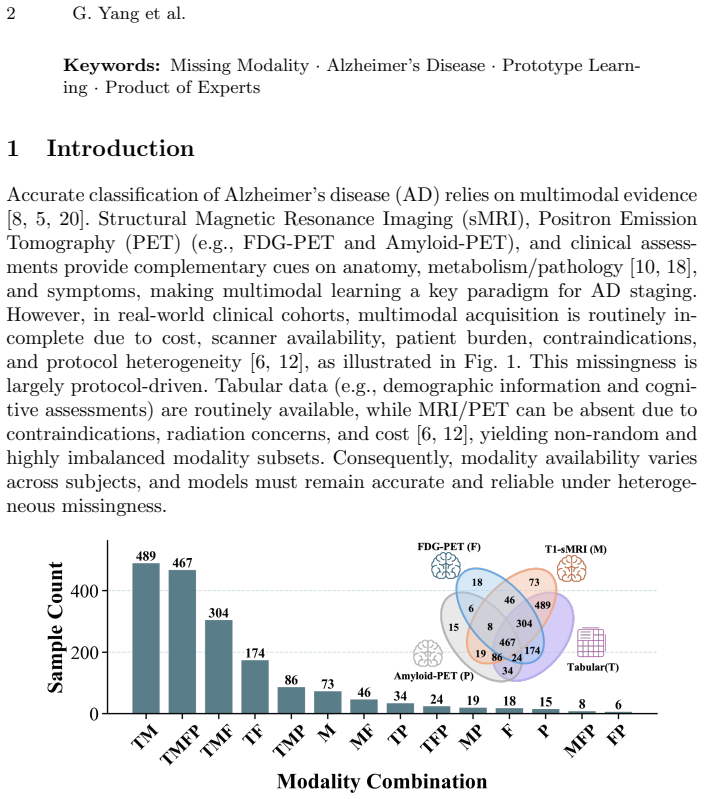
Missing modalities are prevalent in real-world Alzheimer's disease (AD) assessment and pose a significant challenge to multimodal learning, particularly when the distribution of observed modality subsets differs between training and deployment. Such missingness pattern mismatch induces a conditional representation shift across modality subsets. Existing approaches that rely on implicit imputation or modality synthesis often fail to explicitly model modality availability and uncertainty, leading to overconfident dependence on synthesized features, reduced robustness, and miscalibrated uncertainty estimates. To address these limitations, we propose PRA-PoE, an incomplete multimodal learning framework that is equipped with Prototype-anchored Representation Alignment (PRA) and an Uncertainty-aware Product of Experts (UA-PoE) fusion mechanism. First, PRA uses learnable global prototypes and availability-conditioned tokens to encode modality availability, distinguish observed from missing modalities, re-synthesize features for missing modalities, and adaptively refine observed representations to align latent spaces across modality subsets, with the goal of reducing representation shift under varying missingness patterns. Second, UA-PoE models each modality as a Gaussian expert and performs closed-form Product of Experts fusion, where experts with higher uncertainty are automatically down-weighted via lower precision, improving uncertainty reliability. We evaluate PRA-PoE under a clinically realistic protocol by training with naturally missing data and testing on all non-empty modality combinations. PRA-PoE consistently outperforms the state-of-the-art across datasets, achieving a 5.4% relative improvement in average accuracy on ADNI and a 10.9% relative gain in average F1 on OASIS-3 over the strongest baseline across all non-empty modality subsets.
Editorial analysis
A structured set of objections, weighed in public.
Referee Report
Summary. The manuscript introduces PRA-PoE for robust multimodal Alzheimer's diagnosis under arbitrary missing modalities. It proposes Prototype-anchored Representation Alignment (PRA) that uses learnable global prototypes and availability-conditioned tokens to encode modality presence, re-synthesize missing features, and align latent representations across subsets, together with Uncertainty-aware Product of Experts (UA-PoE) that models each modality as a Gaussian expert and performs closed-form fusion by precision-weighted combination. The evaluation trains on naturally occurring missing data from ADNI and OASIS-3 and tests on every non-empty modality combination, reporting 5.4% relative average accuracy gain on ADNI and 10.9% relative average F1 gain on OASIS-3 over the strongest baseline.
Significance. If the central claims hold after verification, the work would offer a practically useful advance for clinical multimodal pipelines where modality dropout is routine. The explicit availability modeling and closed-form uncertainty-aware fusion could improve both accuracy and calibration compared with implicit imputation or synthesis baselines, provided the prototypes truly capture modality-invariant structure rather than training-specific missingness correlations.
major comments (3)
- [§4 and §5.2] §4 (Method) and §5.2 (Experiments): the central robustness claim—that PRA prototypes plus availability tokens reduce representation shift for arbitrary test-time subsets—rests on the assumption that natural missingness in ADNI/OASIS-3 is unconfounded by labels, age, or site. No analysis of missingness-label correlations or controlled synthetic-missingness ablation is provided, so the reported 5.4%/10.9% gains may partly reflect leakage of the training missingness distribution rather than true generalization.
- [§3.3] §3.3 (UA-PoE derivation): the closed-form Product of Experts update is presented as exact for Gaussian experts, yet the availability-conditioned tokens modify the expert parameters before fusion. The manuscript does not show the algebraic steps confirming that the product precision and mean remain closed-form after this conditioning, leaving the uncertainty-weighting claim unverified.
- [Table 3 and Figure 4] Table 3 and Figure 4: average metrics across all non-empty subsets are reported, but per-subset results (especially for combinations with <5% training frequency) are not broken out. Without these, it is impossible to confirm that gains hold for rare or unseen missingness patterns that the prototypes must handle at test time.
minor comments (2)
- [§2] §2 (Related Work): the discussion of prior PoE and prototype methods is concise but omits recent medical-imaging-specific missing-modality works that also use availability tokens; adding 2–3 citations would strengthen positioning.
- [Figure 2] Figure 2: the diagram of PRA would be clearer if the flow from availability token to prototype anchoring included an explicit equation reference for the alignment loss.
Simulated Author's Rebuttal
We thank the referee for the detailed and constructive feedback on our manuscript. We address each of the major comments below and have incorporated revisions to strengthen the paper accordingly.
read point-by-point responses
-
Referee: [§4 and §5.2] §4 (Method) and §5.2 (Experiments): the central robustness claim—that PRA prototypes plus availability tokens reduce representation shift for arbitrary test-time subsets—rests on the assumption that natural missingness in ADNI/OASIS-3 is unconfounded by labels, age, or site. No analysis of missingness-label correlations or controlled synthetic-missingness ablation is provided, so the reported 5.4%/10.9% gains may partly reflect leakage of the training missingness distribution rather than true generalization.
Authors: We agree that verifying the independence of missingness patterns from labels, age, and site is important to substantiate the robustness claims. In the revised manuscript, we add an analysis of missingness-label correlations (and with age/site) to the supplementary material for both ADNI and OASIS-3, showing low correlation with diagnostic labels. We also include a controlled synthetic-missingness ablation in which modalities are removed uniformly across classes; PRA-PoE retains its performance advantage under this protocol. These additions directly address the concern that gains may arise from training missingness leakage. revision: yes
-
Referee: [§3.3] §3.3 (UA-PoE derivation): the closed-form Product of Experts update is presented as exact for Gaussian experts, yet the availability-conditioned tokens modify the expert parameters before fusion. The manuscript does not show the algebraic steps confirming that the product precision and mean remain closed-form after this conditioning, leaving the uncertainty-weighting claim unverified.
Authors: We thank the referee for highlighting this point. The availability-conditioned tokens apply a deterministic, differentiable transformation to the mean and precision parameters of each Gaussian expert before fusion occurs. Because the Product-of-Experts operation for multivariate Gaussians is closed-form for any valid set of means and precisions, the fused precision remains the sum of the (conditioned) individual precisions and the fused mean remains the precision-weighted average. We have inserted the explicit algebraic derivation into Section 3.3 of the revised manuscript to make this transparent. revision: yes
-
Referee: [Table 3 and Figure 4] Table 3 and Figure 4: average metrics across all non-empty subsets are reported, but per-subset results (especially for combinations with <5% training frequency) are not broken out. Without these, it is impossible to confirm that gains hold for rare or unseen missingness patterns that the prototypes must handle at test time.
Authors: We concur that per-subset breakdowns, especially for low-frequency combinations, would strengthen the evidence for generalization. The revised manuscript adds a supplementary table reporting accuracy and F1 for every individual non-empty modality subset on both datasets, with low-frequency subsets (<5 % training occurrence) highlighted. The per-subset results confirm that the reported gains persist for these rare patterns. revision: yes
Circularity Check
No circularity: new learnable components and evaluation protocol are independent of inputs
full rationale
The paper introduces PRA with learnable global prototypes and availability-conditioned tokens plus UA-PoE Gaussian experts, all trained end-to-end on naturally missing data. The performance claims rest on empirical results across modality subsets rather than any fitted quantity being renamed as a prediction or any derivation reducing to self-citation by construction. No equations or steps in the provided description equate outputs to inputs tautologically; the method is self-contained against external benchmarks.
Axiom & Free-Parameter Ledger
free parameters (2)
- learnable global prototypes
- availability-conditioned tokens
axioms (1)
- domain assumption Each modality can be modeled as an independent Gaussian expert whose precision reflects uncertainty.
Lean theorems connected to this paper
-
IndisputableMonolith/Cost/FunctionalEquation.leanwashburn_uniqueness_aczel unclear?
unclearRelation between the paper passage and the cited Recognition theorem.
PRA uses learnable global prototypes and availability-conditioned tokens to encode modality availability, distinguish observed from missing modalities, re-synthesize features for missing modalities, and adaptively refine observed representations
-
IndisputableMonolith/Foundation/RealityFromDistinction.leanreality_from_one_distinction unclear?
unclearRelation between the paper passage and the cited Recognition theorem.
UA-PoE models each modality as a Gaussian expert and performs closed-form Product of Experts fusion, where experts with higher uncertainty are automatically down-weighted via lower precision
What do these tags mean?
- matches
- The paper's claim is directly supported by a theorem in the formal canon.
- supports
- The theorem supports part of the paper's argument, but the paper may add assumptions or extra steps.
- extends
- The paper goes beyond the formal theorem; the theorem is a base layer rather than the whole result.
- uses
- The paper appears to rely on the theorem as machinery.
- contradicts
- The paper's claim conflicts with a theorem or certificate in the canon.
- unclear
- Pith found a possible connection, but the passage is too broad, indirect, or ambiguous to say the theorem truly supports the claim.
Reference graph
Works this paper leans on
-
[1]
IEEE Transactions on Medical Imaging42(12), 3566–3578 (2023)
Chen, Y., Pan, Y., Xia, Y., Yuan, Y.: Disentangle first, then distill: a unified frame- work for missing modality imputation and Alzheimer’s disease diagnosis. IEEE Transactions on Medical Imaging42(12), 3566–3578 (2023)
work page 2023
-
[2]
In: Proceedings of the IEEE/CVF International Conference on Computer Vision
Dai, R., Li, C., Yan, Y., Mo, L., Qin, K., He, T.: Unbiased missing-modality mul- timodal learning. In: Proceedings of the IEEE/CVF International Conference on Computer Vision. pp. 24507–24517 (2025)
work page 2025
-
[3]
In: International Con- ference on Medical Image Computing and Computer-Assisted Intervention
Feng, Y., Gao, B., Deng, S., Qiu, A., Qin, J.: Unified multi-modal learning for any modality combinations in Alzheimer’s disease diagnosis. In: International Con- ference on Medical Image Computing and Computer-Assisted Intervention. pp. 487–497. Springer (2024)
work page 2024
-
[4]
Advances in Neural Information Processing Sys- tems37, 67850–67900 (2025)
Han, X., Nguyen, H., Harris, C., Ho, N., Saria, S.: FuseMoE: Mixture-of-experts transformers for fleximodal fusion. Advances in Neural Information Processing Sys- tems37, 67850–67900 (2025)
work page 2025
-
[5]
In: International Workshop on Agentic AI for Medicine
Hou, W., Yang, G., Du, Y., Lau, Y., Liu, L., He, J., Long, L., Wang, S.: Ada- gent: Llm agent for alzheimer’s disease analysis with collaborative coordinator. In: International Workshop on Agentic AI for Medicine. pp. 23–32. Springer (2025) 10 G. Yang et al
work page 2025
-
[6]
IEEE Transactions on Automation Science and Engineering 22, 14218–14233 (2025)
Kwak, M.G., Mao, L., Zheng, Z., Su, Y., Lure, F., Li, J.: A cross-modal mutual knowledge distillation framework for Alzheimer’s disease diagnosis: Addressing in- complete modalities. IEEE Transactions on Automation Science and Engineering 22, 14218–14233 (2025)
work page 2025
-
[7]
LaMontagne, P.J., Benzinger, T.L., Morris, J.C., Keefe, S., Hornbeck, R., Xiong, C., Grant, E., Hassenstab, J., Moulder, K., Vlassenko, A.G., et al.: OASIS-3: longitudinal neuroimaging, clinical, and cognitive dataset for normal aging and Alzheimer disease. medrxiv pp. 2019–12 (2019)
work page 2019
-
[8]
Medical Image Anal- ysis97, 103213 (2024)
Lei, B., Li, Y., Fu, W., Yang, P., Chen, S., Wang, T., Xiao, X., Niu, T., Fu, Y., Wang, S., et al.: Alzheimer’s disease diagnosis from multi-modal data via feature inductive learning and dual multilevel graph neural network. Medical Image Anal- ysis97, 103213 (2024)
work page 2024
-
[9]
IEEE Transactions on Medical Imaging (2024)
Meng, X., Sun, K., Xu, J., He, X., Shen, D.: Multi-modal modality-masked diffusion network for brain mri synthesis with random modality missing. IEEE Transactions on Medical Imaging (2024)
work page 2024
-
[10]
Journal of nuclear medicine63(Supplement 1), 2S–12S (2022)
Minoshima, S., Cross, D., Thientunyakit, T., Foster, N.L., Drzezga, A.: 18f-fdg pet imaging in neurodegenerative dementing disorders: insights into subtype classifica- tion, emerging disease categories, and mixed dementia with copathologies. Journal of nuclear medicine63(Supplement 1), 2S–12S (2022)
work page 2022
-
[11]
Neuroimaging Clinics15(4), 869–877 (2005)
Mueller, S.G., Weiner, M.W., Thal, L.J., Petersen, R.C., Jack, C., Jagust, W., Trojanowski, J.Q., Toga, A.W., Beckett, L.: The Alzheimer’s disease neuroimaging initiative. Neuroimaging Clinics15(4), 869–877 (2005)
work page 2005
-
[12]
Odusami, M., Damaˇ seviˇ cius, R., Milieˇ skait˙ e-Belousovien˙ e, E., Maskeli¯ unas, R.: Alzheimer’s disease stage recognition from mri and pet imaging data using pareto- optimal quantum dynamic optimization. Heliyon10(15) (2024)
work page 2024
-
[13]
In: International conference on medical image computing and computer-assisted intervention
Pan, Y., Liu, M., Lian, C., Zhou, T., Xia, Y., Shen, D.: Synthesizing missing pet from mri with cycle-consistent generative adversarial networks for alzheimer’s disease diagnosis. In: International conference on medical image computing and computer-assisted intervention. pp. 455–463. Springer (2018)
work page 2018
-
[14]
IEEE trans- actions on pattern analysis and machine intelligence44(10), 6839–6853 (2022)
Pan, Y., Liu, M., Xia, Y., Shen, D.: Disease-image-specific learning for diagnosis- oriented neuroimage synthesis with incomplete multi-modality data. IEEE trans- actions on pattern analysis and machine intelligence44(10), 6839–6853 (2022)
work page 2022
-
[15]
Nature Communications13(1), 3404 (2022)
Qiu, S., Miller, M.I., Joshi, P.S., Lee, J.C., Xue, C., Ni, Y., Wang, Y., De Anda- Duran, I., Hwang, P.H., Cramer, J.A., et al.: Multimodal deep learning for Alzheimer’s disease dementia assessment. Nature Communications13(1), 3404 (2022)
work page 2022
-
[16]
Advances in Neural Information Processing Systems32(2019)
Shi, Y., Paige, B., Torr, P., et al.: Variational mixture-of-experts autoencoders for multi-modal deep generative models. Advances in Neural Information Processing Systems32(2019)
work page 2019
-
[17]
In: Proceedings of the IEEE/CVF Conference on Computer Vision and Pattern Recognition
Wang, H., Chen, Y., Ma, C., Avery, J., Hull, L., Carneiro, G.: Multi-modal learning with missing modality via shared-specific feature modelling. In: Proceedings of the IEEE/CVF Conference on Computer Vision and Pattern Recognition. pp. 15878– 15887 (2023)
work page 2023
-
[18]
Quantitative Imaging in Medicine and Surgery13(12), 7765 (2023)
Xie, H., Li, Y., Wu, X., Wang, R., Long, X., Su, M., Chen, Q., Li, L., Tian, R., Jia, Z.: The image quality, amyloid-βdetectability, and acquisition time of clinical florbetapir positron emission tomography in alzheimer’s disease and healthy adults. Quantitative Imaging in Medicine and Surgery13(12), 7765 (2023)
work page 2023
-
[19]
Xue, C., Kowshik, S.S., Lteif, D., Puducheri, S., Jasodanand, V.H., Zhou, O.T., Walia, A.S., Guney, O.B., Zhang, J.D., Po´ esy, S., et al.: AI-based differential diag- nosis of dementia etiologies on multimodal data. Nature Medicine30(10), 2977– 2989 (2024) PRA-PoE: Robust Alzheimer’s Diagnosis with Arbitrary Missing Modalities 11
work page 2024
-
[20]
IEEE Journal of Biomedical and Health Infor- matics29(11), 8395–8408 (2025)
Yang, G., Du, K., Yang, Z., Du, Y., Cheung, E.Y.W., Zheng, Y., Yang, M., Kourtzi, Z., Schonlieb, C.B., Wang, S.: ADFound: A foundation model for diagnosis and prognosis of Alzheimer’s disease. IEEE Journal of Biomedical and Health Infor- matics29(11), 8395–8408 (2025)
work page 2025
-
[21]
Advances in Neural Information Processing Systems37, 98782–98805 (2025)
Yun, S., Choi, I., Peng, J., Wu, Y., Bao, J., Zhang, Q., Xin, J., Long, Q., Chen, T.: Flex-MoE: Modeling arbitrary modality combination via the flexible mixture- of-experts. Advances in Neural Information Processing Systems37, 98782–98805 (2025)
work page 2025
-
[22]
In: Workshop on Large Language Models and Generative AI for Health at AAAI 2025 (2025)
Yun, S., Xin, J., Choi, I., Peng, J., Ding, Y., Long, Q., Chen, T.: Generate, then retrieve: Addressing missing modalities in multimodal learning via generative AI and MoE. In: Workshop on Large Language Models and Generative AI for Health at AAAI 2025 (2025)
work page 2025
-
[23]
In: Proceedings of the 28th ACM SIGKDD conference on knowledge discovery and data mining
Zhang, C., Chu, X., Ma, L., Zhu, Y., Wang, Y., Wang, J., Zhao, J.: M3Care: Learning with missing modalities in multimodal healthcare data. In: Proceedings of the 28th ACM SIGKDD conference on knowledge discovery and data mining. pp. 2418–2428 (2022)
work page 2022
-
[24]
In: International Conference on Medical Image Computing and Computer-Assisted Intervention
Zhang, Y., He, N., Yang, J., Li, Y., Wei, D., Huang, Y., Zhang, Y., He, Z., Zheng, Y.: mmFormer: Multimodal medical transformer for incomplete multimodal learn- ing of brain tumor segmentation. In: International Conference on Medical Image Computing and Computer-Assisted Intervention. pp. 107–117. Springer (2022)
work page 2022
-
[25]
Zhao, B., Zhang, W., Zou, Z.: Mce: Towards a general framework for handling missing modalities under imbalanced missing rates. Pattern Recognition p. 112591 (2025)
work page 2025
discussion (0)
Sign in with ORCID, Apple, or X to comment. Anyone can read and Pith papers without signing in.