Bayesian Nonparametric Mixed-Effect ODEs with Gaussian Processes
Pith reviewed 2026-05-14 19:44 UTC · model grok-4.3
The pith
A Bayesian nonparametric model decomposes each subject's ODE vector field into a shared population Gaussian process and subject-specific deviations.
A machine-rendered reading of the paper's core claim, the machinery that carries it, and where it could break.
Core claim
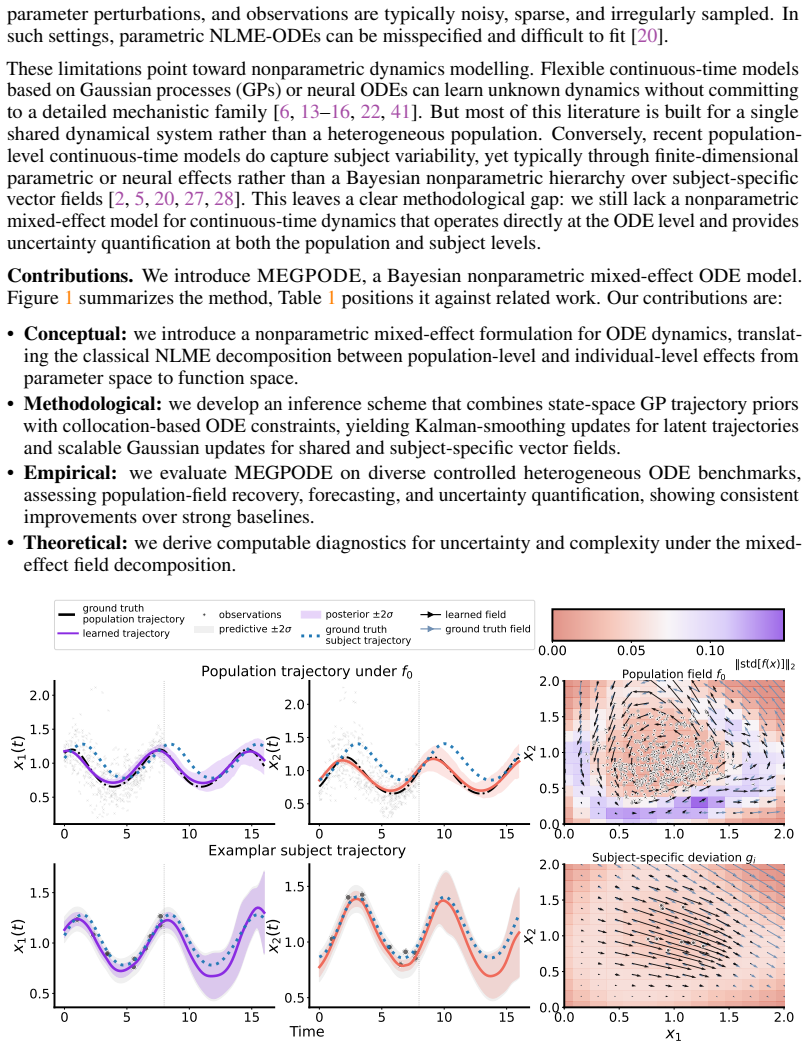
MEGPODE decomposes each subject's vector field into a shared population component and a subject-specific deviation, both endowed with Gaussian process priors, and performs efficient Bayesian inference by combining state-space GP trajectory priors with virtual collocation observations to obtain Kalman-smoothing updates and closed-form vector-field regressions without repeated ODE solves per subject.
What carries the argument
The mixed-effect decomposition of each subject's vector field into a shared population Gaussian process and a subject-specific deviation Gaussian process, combined with state-space trajectory priors and virtual collocation observations for closed-form posterior updates.
If this is right
- Population-level vector fields can be recovered more accurately when subject heterogeneity is modeled explicitly rather than ignored.
- Subject-specific trajectories can be predicted with lower error than under single-system nonparametric ODE models.
- Uncertainty quantification remains available for both the shared population dynamics and the individual deviations.
- The method applies directly to pharmacometrics, systems biology, and epidemiology without requiring a parametric form for the vector field.
Where Pith is reading between the lines
- The same state-space and virtual-observation construction could be applied to other nonparametric priors on vector fields if analogous efficient inference schemes exist.
- Real patient or experimental time-series data with known heterogeneity would provide a direct test of whether the benchmark gains translate to practice.
- Allowing the shared population process to be non-stationary or to depend on covariates would extend the model to time-varying or covariate-driven population dynamics.
Load-bearing premise
That subject vector fields can be usefully decomposed into a shared population component and a subject-specific deviation, both well captured by Gaussian process priors, and that virtual collocation observations suffice for accurate posterior inference without repeated ODE solves.
What would settle it
On the controlled heterogeneous ODE benchmarks, if population-field recovery error or subject-level trajectory prediction error is not lower than that of strong baselines, the claimed performance advantage would not hold.
Figures


read the original abstract
Dynamical modelling is central to many scientific domains, including pharmacometrics, systems biology, physiology, and epidemiology. In these settings, heterogeneity is often intrinsic: different subjects or units follow related but distinct continuous-time dynamics. Classical nonlinear mixed-effects Ordinary Differential Equation (ODE) models address this by combining population-level structure with subject-specific effects, but they rely on a parametric vector field and are therefore vulnerable to structural misspecification and unmodelled mechanisms. This motivates nonparametric approaches that can retain principled uncertainty quantification, yet existing nonparametric ODE methods typically assume a single shared dynamical system rather than an explicit mixed-effect hierarchy over subject-specific dynamics. We propose MEGPODE, a Bayesian nonparametric mixed-effect ODE model in which each subject's vector field is decomposed into a shared population component and a subject-specific deviation, both endowed with Gaussian process (GP) priors. To avoid repeated ODE solves per subject during training, we combine state-space GP trajectory priors with virtual collocation observations, yielding Kalman-smoothing trajectory updates and closed-form regressions for the vector fields. Across controlled heterogeneous ODE benchmarks spanning oscillatory, biomedical systems, MEGPODE improves population-field recovery and subject-level trajectory prediction relative to strong baselines.
Editorial analysis
A structured set of objections, weighed in public.
Referee Report
Summary. The manuscript introduces MEGPODE, a Bayesian nonparametric mixed-effect ODE model in which each subject's vector field decomposes into a shared population component and subject-specific deviation, both endowed with Gaussian process priors. Inference avoids repeated ODE solves by combining state-space GP trajectory priors with virtual collocation observations, yielding Kalman-smoothing trajectory updates and closed-form vector-field regressions. Experiments on controlled heterogeneous ODE benchmarks (oscillatory and biomedical) report improved population-field recovery and subject-level trajectory prediction relative to strong baselines.
Significance. If the central claims hold, the work would supply a computationally tractable nonparametric extension of mixed-effects ODE modeling that retains principled uncertainty quantification, addressing a clear gap between classical parametric nonlinear mixed-effects models and single-system nonparametric ODE methods. The closed-form Kalman-smoothing updates constitute a genuine efficiency gain that could enable broader adoption in pharmacometrics and systems biology.
major comments (2)
- [Methods (virtual collocation and Kalman smoothing)] The virtual collocation approximation that enforces the ODE only at chosen discrete points is load-bearing for the claim of accurate posterior inference without repeated solves. For nonlinear vector fields and heterogeneous subject deviations, the approximation error depends on collocation density and placement; no quantitative bound or sensitivity analysis is provided to show that this surrogate does not systematically bias population-component recovery.
- [Experiments and Results] Benchmark results claim consistent improvements in population-field recovery and subject-level prediction, yet no error bars, standard deviations across random seeds, or explicit data-exclusion rules are reported. This omission prevents assessment of whether the reported gains are statistically reliable or sensitive to experimental choices.
minor comments (2)
- Notation for the state-space GP prior, virtual observations, and the precise form of the mixed-effect decomposition should be introduced with explicit equations on first use to improve readability.
- [Abstract] The abstract refers to 'oscillatory, biomedical systems' without naming the concrete benchmark ODEs; listing them (e.g., Lotka-Volterra variants, pharmacokinetic models) would aid reproducibility.
Simulated Author's Rebuttal
We thank the referee for their constructive comments, which highlight important aspects of our methods and experimental reporting. We address each major comment below and indicate planned revisions to the manuscript.
read point-by-point responses
-
Referee: [Methods (virtual collocation and Kalman smoothing)] The virtual collocation approximation that enforces the ODE only at chosen discrete points is load-bearing for the claim of accurate posterior inference without repeated solves. For nonlinear vector fields and heterogeneous subject deviations, the approximation error depends on collocation density and placement; no quantitative bound or sensitivity analysis is provided to show that this surrogate does not systematically bias population-component recovery.
Authors: We agree that the virtual collocation scheme is central to the efficiency claim and that its approximation quality for nonlinear heterogeneous dynamics merits further scrutiny. While our current experiments show stable recovery across the tested benchmarks, we do not provide a theoretical error bound. In the revised manuscript we will add a dedicated sensitivity study that varies collocation density and placement (including random and uniform grids) and reports the resulting changes in population-field recovery error and subject-level prediction metrics. revision: yes
-
Referee: [Experiments and Results] Benchmark results claim consistent improvements in population-field recovery and subject-level prediction, yet no error bars, standard deviations across random seeds, or explicit data-exclusion rules are reported. This omission prevents assessment of whether the reported gains are statistically reliable or sensitive to experimental choices.
Authors: We acknowledge that the absence of variability measures and explicit data-handling protocols limits the ability to judge statistical reliability. In the revision we will report all metrics with standard deviations computed over multiple random seeds, include error bars in the figures, and add a clear subsection describing the data-generation process, any exclusion criteria, and the precise train/test splits used for each benchmark. revision: yes
Circularity Check
No circularity: derivation uses external GP/Kalman methods and reports empirical gains
full rationale
The paper's core construction decomposes each subject's vector field into a shared population GP component plus subject-specific GP deviation, then applies standard state-space GP trajectory priors together with virtual collocation observations to obtain Kalman-smoothing updates and closed-form vector-field regressions. These building blocks (GP priors, state-space representation, Kalman smoothing, collocation) are standard techniques whose properties are independent of the present work. The reported improvements in population-field recovery and subject-level prediction are measured on external heterogeneous ODE benchmarks against separate baselines; they do not reduce to any quantity defined by the model's own fitted parameters or by a self-citation chain. No step matches the enumerated circularity patterns.
Axiom & Free-Parameter Ledger
Reference graph
Works this paper leans on
-
[1]
Marie Alexandre, Mélanie Prague, Chelsea McLean, Viki Bockstal, Macaya Douoguih, Rodolphe Thiébaut, Thierry Effelterre, Laura Solforosi, and Anna Dari. Prediction of long- term humoral response induced by the two-dose heterologous ad26.zebov, mva-bn-filo vaccine against ebola.npj Vaccines, 2023
work page 2023
-
[2]
An amortized approach to non-linear mixed-effects modeling based on neural posterior estimation
Jonas Arruda, Yannik Schälte, Clemens Peiter, Olga Teplytska, Ulrich Jaehde, and Jan Hase- nauer. An amortized approach to non-linear mixed-effects modeling based on neural posterior estimation. InProceedings of the 41st International Conference on Machine Learning, 2024
work page 2024
-
[3]
Christopher M Bishop and Nasser M Nasrabadi.Pattern recognition and machine learning. Springer, 2006
work page 2006
-
[4]
Cambridge University Press, 2004
Stephen Boyd and Lieven Vandenberghe.Convex Optimization. Cambridge University Press, 2004
work page 2004
-
[5]
Dominic Stefan Bräm, Bernhard Steiert, Marc Pfister, Britta Steffens, and Gilbert Koch. Low- dimensional neural ordinary differential equations accounting for inter-individual variability implemented in monolix and nonmem.CPT: Pharmacometrics & Systems Pharmacology, 2025
work page 2025
-
[6]
Ricky T. Q. Chen, Yulia Rubanova, Jesse Bettencourt, and David Duvenaud. Neural ordinary differential equations. InAdvances in Neural Information Processing Systems, 2018
work page 2018
-
[7]
Ingyo Chung, Saehoon Kim, Juho Lee, Kwang Joon Kim, Sung Ju Hwang, and Eunho Yang. Deep mixed effect model using gaussian processes: A personalized and reliable prediction for healthcare.Proceedings of the AAAI Conference on Artificial Intelligence, 2020
work page 2020
-
[8]
Quentin Clairon, Mélanie Prague, Delphine Planas, Timothée Bruel, Laurent Hocqueloux, Thierry Prazuck, Olivier Schwartz, Rodolphe Thiébaut, and Jérémie Guedj. Modeling the kinet- ics of the neutralizing antibody response against sars-cov-2 variants after several administrations of bnt162b2.PLoS Computational Biology, 2023
work page 2023
-
[9]
Annabelle Collin, Mélanie Prague, and Philippe Moireau. Estimation for dynamical systems using a population-based kalman filter–applications in computational biology.MathematicS In Action, 2022
work page 2022
-
[10]
Emmanuelle Comets, Audrey Lavenu, and Marc Lavielle. Parameter estimation in nonlinear mixed effect models using saemix, an r implementation of the saem algorithm.Journal of Statistical Software, 2017
work page 2017
-
[11]
Ode parameter inference using adaptive gradient matching with gaussian processes
Frank Dondelinger, Dirk Husmeier, Simon Rogers, and Maurizio Filippone. Ode parameter inference using adaptive gradient matching with gaussian processes. InArtificial intelligence and statistics, 2013
work page 2013
-
[12]
Discovering physics laws of dynamical systems via invariant function learning
Shurui Gui, Xiner Li, and Shuiwang Ji. Discovering physics laws of dynamical systems via invariant function learning. InProceedings of the 42nd International Conference on Machine Learning, 2025
work page 2025
-
[13]
Physics-informed variational state- space Gaussian processes
Oliver Hamelijnck, Arno Solin, and Theodoros Damoulas. Physics-informed variational state- space Gaussian processes. InAdvances in Neural Information Processing Systems, 2024
work page 2024
-
[14]
Variational multiple shooting for bayesian odes with gaussian processes
Pashupati Hegde, Ça˘gatay Yıldız, Harri Lähdesmäki, Samuel Kaski, and Markus Heinonen. Variational multiple shooting for bayesian odes with gaussian processes. InUncertainty in Artificial Intelligence, 2022
work page 2022
-
[15]
Learning unknown ODE models with gaussian processes
Markus Heinonen, Cagatay Yildiz, Henrik Mannerstrom, Jukka Intosalmi, and Harri Lahdes- maki. Learning unknown ODE models with gaussian processes. InProceedings of the 35th International Conference on Machine Learning, 2018
work page 2018
-
[16]
Patrick Kidger, James Morrill, James Foster, and Terry Lyons. Neural controlled differential equations for irregular time series.Advances in neural information processing systems, 2020
work page 2020
-
[17]
Generalizing to new physical systems via context-informed dynamics model
Matthieu Kirchmeyer, Yuan Yin, Jérémie Donà, Nicolas Baskiotis, Alain Rakotomamonjy, and Patrick Gallinari. Generalizing to new physical systems via context-informed dynamics model. InInternational conference on machine learning, 2022. 11
work page 2022
-
[18]
Marc Lavielle.Mixed Effects Models for the Population Approach: Models, Tasks, Methods and Tools. CRC press, 2014
work page 2014
-
[19]
Arthur Leroy, Pierre Latouche, Benjamin Guedj, and Servane Gey. MAGMA: inference and prediction using multi-task Gaussian processes with common mean.Machine Learning, 2022
work page 2022
-
[20]
Zhe Li, Mélanie Prague, Rodolphe Thiébaut, and Quentin Clairon. Variational autoencoder for inference of nonlinear mixed effect models based on ordinary differential equations.arXiv preprint arXiv:2601.17400, 2026
-
[21]
Mary J. Lindstrom and Douglas M. Bates. Nonlinear mixed effects models for repeated measures data.Biometrics, 1990
work page 1990
-
[22]
Autoip: A united framework to integrate physics into gaussian processes
Da Long, Zheng Wang, Aditi Krishnapriyan, Robert Kirby, Shandian Zhe, and Michael Mahoney. Autoip: A united framework to integrate physics into gaussian processes. InInternational Conference on Machine Learning, 2022
work page 2022
-
[23]
Constraining the dynamics of deep probabilistic models
Marco Lorenzi and Maurizio Filippone. Constraining the dynamics of deep probabilistic models. InProceedings of the 35th International Conference on Machine Learning, 2018
work page 2018
-
[24]
Modeling formalisms in systems biology.AMB express, 2011
Daniel Machado, Rafael S Costa, Miguel Rocha, Eugénio C Ferreira, Bruce Tidor, and Isabel Rocha. Modeling formalisms in systems biology.AMB express, 2011
work page 2011
-
[25]
Position: Biology is the challenge physics-informed ML needs to evolve
Julien Martinelli. Position: Biology is the challenge physics-informed ML needs to evolve. In The Thirty-Ninth Annual Conference on Neural Information Processing Systems Position Paper Track, 2025
work page 2025
-
[26]
Metaphysica: Improving OOD robustness in physics-informed machine learning
S Chandra Mouli, Muhammad Alam, and Bruno Ribeiro. Metaphysica: Improving OOD robustness in physics-informed machine learning. InThe Twelfth International Conference on Learning Representations, 2024
work page 2024
-
[27]
A variational approximation for analyzing the dynamics of panel data
Jurijs Nazarovs, Rudrasis Chakraborty, Songwong Tasneeyapant, Sathya Ravi, and Vikas Singh. A variational approximation for analyzing the dynamics of panel data. InProceedings of the Thirty-Seventh Conference on Uncertainty in Artificial Intelligence, 2021
work page 2021
-
[28]
Amortized in-context mixed effect transformer models: A zero-shot approach for pharmacokinetics
Cesar Ojeda, Niklas Hartung, Wilhelm Huisinga, and Ramses J Sanchez. Amortized in-context mixed effect transformer models: A zero-shot approach for pharmacokinetics. InThe 29th International Conference on Artificial Intelligence and Statistics, 2026
work page 2026
-
[29]
Random features for large-scale kernel machines
Ali Rahimi and Benjamin Recht. Random features for large-scale kernel machines. InAdvances in Neural Information Processing Systems, 2007
work page 2007
-
[30]
Carl Edward Rasmussen and Christopher K. I. Williams.Gaussian Processes for Machine Learning. MIT Press, 2006
work page 2006
-
[31]
Yulia Rubanova, Ricky T. Q. Chen, and David Duvenaud. Latent ODEs for irregularly-sampled time series. InAdvances in Neural Information Processing Systems, 2019
work page 2019
-
[32]
Cambridge University Press, 2013
Simo Särkkä.Bayesian Filtering and Smoothing. Cambridge University Press, 2013
work page 2013
-
[33]
Cambridge University Press, 2019
Simo Särkkä and Arno Solin.Applied Stochastic Differential Equations. Cambridge University Press, 2019
work page 2019
-
[34]
Variational grey-box dynamics matching
Gurjeet Sangra Singh, Frantzeska Lavda, Giangiacomo Mercatali, and Alexandros Kalousis. Variational grey-box dynamics matching. InProceedings of The 29th International Conference on Artificial Intelligence and Statistics, 2026
work page 2026
-
[35]
Hilbert space methods for reduced-rank Gaussian process regression.Statistics and Computing, 2020
Arno Solin and Simo Särkkä. Hilbert space methods for reduced-rank Gaussian process regression.Statistics and Computing, 2020
work page 2020
-
[36]
Naoya Takeishi and Alexandros Kalousis. Deep grey-box modeling with adaptive data-driven models toward trustworthy estimation of theory-driven models. InProceedings of The 26th International Conference on Artificial Intelligence and Statistics, 2023
work page 2023
-
[37]
American Mathematical Soc., 2012
Gerald Teschl.Ordinary differential equations and dynamical systems. American Mathematical Soc., 2012
work page 2012
-
[38]
Filip Tronarp, Hans Kersting, Simo Särkkä, and Philipp Hennig. Probabilistic solutions to ordinary differential equations as nonlinear bayesian filtering: a new perspective.Statistics and Computing, 2019. 12
work page 2019
-
[39]
Estimating mixed-effects differential equation models.Statistics and Computing, 2014
Liangliang Wang, Jiguo Cao, James O Ramsay, DM Burger, CJL Laporte, and Jürgen K Rockstroh. Estimating mixed-effects differential equation models.Statistics and Computing, 2014
work page 2014
-
[40]
Philippe Wenk, Gabriele Abbati, Michael A Osborne, Bernhard Schölkopf, Andreas Krause, and Stefan Bauer. Odin: Ode-informed regression for parameter and state inference in time- continuous dynamical systems. InProceedings of the AAAI Conference on Artificial Intelligence, 2020
work page 2020
-
[41]
Shihao Yang, Samuel W. K. Wong, and S. C. Kou. Inference of dynamic systems from noisy and sparse data via manifold-constrained gaussian processes.Proceedings of the National Academy of Sciences, 2021
work page 2021
-
[42]
Doubly mixed-effects gaussian process regression
Jun Ho Yoon, Daniel P Jeong, and Seyoung Kim. Doubly mixed-effects gaussian process regression. InInternational Conference on Artificial Intelligence and Statistics, 2022
work page 2022
-
[43]
Ziang Zhang, Alex Stringer, Patrick Brown, and Jamie Stafford. Model-based smoothing with integrated wiener processes and overlapping splines.Journal of Computational and Graphical Statistics, 2024
work page 2024
-
[44]
q(xi,0) Ni−1Y n=1 q(si,n) # . The resulting population ELBO is LGPODE-pop = MX i=1
Bob Junyi Zou, Matthew E Levine, Dessi P. Zaharieva, Ramesh Johari, and Emily Fox. Hybrid2 neural ODE causal modeling and an application to glycemic response. InProceedings of the 41st International Conference on Machine Learning, 2024. 13 Appendix A Supplementary figures 15 B Baselines and hyperparameters 18 B.1 Concurrent baselines . . . . . . . . . . ....
work page 2024
discussion (0)
Sign in with ORCID, Apple, or X to comment. Anyone can read and Pith papers without signing in.