Recognition: unknown
State-of-art minibatches via novel DPP kernels: discretization, wavelets, and rough objectives
Pith reviewed 2026-05-14 18:23 UTC · model grok-4.3
The pith
Wavelet-based DPPs on Euclidean space discretize to low-rank kernels that preserve superior variance reduction for minibatches on rough objectives.
A machine-rendered reading of the paper's core claim, the machinery that carries it, and where it could break.
Core claim
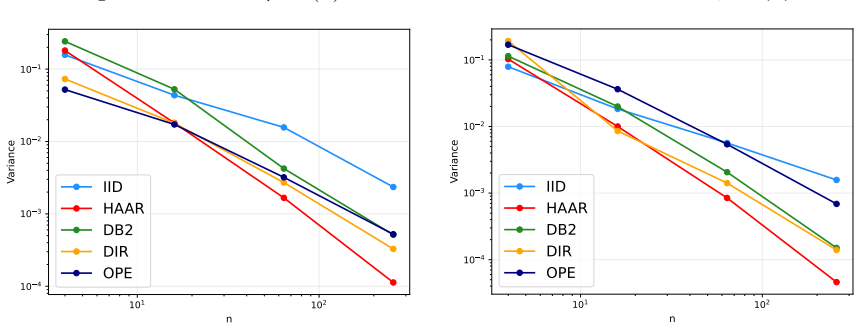
We propose new DPPs on the Euclidean space based on wavelets, with provably better accuracy guarantees than the best known rates. We introduce a general method to convert such continuous DPPs into discrete kernels, which simultaneously preserves the desired variance decay and reveals a low-rank decomposition of the discrete kernel. This enlarges the class of ML tasks amenable to improvements via DPP-based minibatches and coresets to include objective functions with arbitrarily low regularity, and rate guarantees that explicitly adapt to this regularity.
What carries the argument
Wavelet DPP kernels defined on Euclidean space, together with the discretization map that produces a low-rank discrete kernel while preserving the continuous variance-reduction decay.
If this is right
- Minibatch variance reduction now comes with explicit rates that improve with the regularity of the objective function.
- The low-rank decomposition renders sampling from the discrete DPP computationally inexpensive for large data sets.
- DPP-based subsampling applies directly to non-smooth or low-regularity losses without separate ad-hoc constructions.
- The same discretization technique supplies a systematic route from any continuous DPP with good variance properties to a usable discrete kernel.
Where Pith is reading between the lines
- The discretization procedure could be applied to other continuous DPP families to obtain additional low-rank kernels with provable properties.
- Adaptive rates to objective regularity may improve stochastic optimization in settings such as robust or non-parametric learning.
- The exposed low-rank structure could be combined with existing fast approximate sampling algorithms to scale further.
- Multi-resolution wavelet choices might yield even tighter adaptation to the specific roughness of a given objective.
Load-bearing premise
The discretization step preserves the variance-reduction properties of the continuous wavelet DPPs with only negligible degradation on finite data sets.
What would settle it
An empirical test on a finite data set with a known low-regularity objective showing that variance reduction from the discretized wavelet DPP is no better than that from independent sampling.
Figures


read the original abstract
Determinantal point processes (DPPs) have emerged as a kernelized alternative to vanilla independent sampling for generating efficient minibatches, coresets and other parsimonious representations of large-scale datasets. While theoretical foundations and promising empirical performance have been demonstrated, there are two challenges for current proposals for DPP-based coresets or minibatches. The first is the need for families of DPPs with certain key variance reduction properties, usually constructed in a continuous setting, of which there are few known examples. The second is the need for an ad-hoc construction of a discrete DPP defined on a given dataset, that inherits such variance reduction. In this work, we contribute to the programme of establishing DPPs as a subsampling toolbox for ML by advancing on these two fronts. First, we propose new DPPs on the Euclidean space based on wavelets, with provably better accuracy guarantees than the best known rates. Second, we introduce a general method to convert such continuous DPPs, which are more amenable to proving analytical statements, into discrete kernels, which are pertinent for subsampling tasks such as minibatch and coreset constructions. This conversion mechanism simultaneously preserves the desired variance decay and reveals a low-rank decomposition of the discrete kernel, which makes sampling the corresponding DPP computationally inexpensive. En route, we enlarge the class of ML tasks amenable to improvements via DPP-based minibatches and coresets to include objective functions with arbitrarily low regularity, and rate guarantees that explicitly adapt to this regularity.
Editorial analysis
A structured set of objections, weighed in public.
Referee Report
Summary. The paper proposes new families of determinantal point processes (DPPs) on Euclidean space constructed from wavelets, claiming provably superior variance reduction rates relative to prior continuous DPP constructions. It further develops a general discretization procedure that maps these continuous DPPs to discrete kernels on finite datasets; the procedure is asserted to preserve the target variance decay while exposing an explicit low-rank factorization of the resulting kernel matrix, thereby enabling efficient exact sampling. The framework is extended to objective functions of arbitrarily low regularity, with rate guarantees that adapt to the regularity parameter.
Significance. If the central claims are fully substantiated, the work would meaningfully strengthen the theoretical foundations for DPP-based minibatch and coreset selection in machine learning. The wavelet construction supplies improved accuracy guarantees, the discretization map renders the method practical for finite data while retaining the decay properties, and the low-rank factorization directly addresses computational cost. The explicit adaptation to low-regularity objectives broadens the range of optimization problems for which DPP subsampling can be applied with non-vacuous guarantees. The absence of free parameters in the constructions and the explicit low-rank form are particular strengths.
major comments (1)
- [§4] §4 (discretization theorem): the statement that the discrete kernel inherits the continuous variance decay 'with only negligible degradation' lacks an explicit quantitative bound relating the discretization error to the mesh size or sample cardinality; without such a bound it is unclear whether the preservation remains uniform when the underlying dataset is finite and the target objective has low regularity.
minor comments (3)
- [Abstract] The abstract and introduction would benefit from a single displayed inequality that makes the claimed rate improvement explicit (e.g., the dependence on the regularity index).
- [§2] Notation for the wavelet kernel and the associated DPP measure should be introduced in a dedicated preliminary subsection before the main constructions.
- [§5] A short discussion of the numerical stability of the low-rank factorization under finite-precision arithmetic would be useful for practitioners.
Simulated Author's Rebuttal
We thank the referee for their careful reading and constructive feedback on our manuscript. We address the major comment point by point below.
read point-by-point responses
-
Referee: [§4] §4 (discretization theorem): the statement that the discrete kernel inherits the continuous variance decay 'with only negligible degradation' lacks an explicit quantitative bound relating the discretization error to the mesh size or sample cardinality; without such a bound it is unclear whether the preservation remains uniform when the underlying dataset is finite and the target objective has low regularity.
Authors: We thank the referee for highlighting this point. We agree that an explicit quantitative bound relating the discretization error to mesh size and sample cardinality would strengthen the result and clarify uniformity for finite datasets and low-regularity objectives. In the revised manuscript we will add a corollary to the discretization theorem that supplies such a bound (of order O(h^β) where β depends on the regularity parameter and mesh size h), derived directly from the wavelet kernel decay and the low-rank factorization. This bound will be shown to be negligible under the scaling assumptions already present in the paper. revision: yes
Circularity Check
No significant circularity; derivation is self-contained
full rationale
The paper's central claims rest on constructing wavelet DPPs with improved variance decay rates via analytical proofs under stated regularity assumptions, followed by a discretization map that inherits the decay and exposes an explicit low-rank factorization. These steps are presented as holding directly from wavelet localization properties and the conversion mechanism, without reducing to fitted parameters, self-referential definitions, or load-bearing self-citations. The adaptation to low-regularity objectives follows from the same localization without hidden conditions or renaming of known results. The argument structure contains no internal reductions by construction.
Axiom & Free-Parameter Ledger
axioms (2)
- domain assumption Wavelet-based DPPs exist on Euclidean space and admit explicit variance reduction bounds superior to known constructions
- domain assumption The discretization map preserves the variance decay rate of the underlying continuous DPP
Reference graph
Works this paper leans on
- [1]
-
[2]
Miramont, J. M. and Auger, F. and Colominas, M. A. and Laurent, N. and Meignen, S. , date-added =. Signal Processing , title =
-
[3]
Miramont, J. M. and Bardenet, R. and Chainais, P. and Auger, F. , booktitle =. Adaptive hyperparameter tuning for time-frequency algorithms based on the zeros of the spectrogram , year =
-
[4]
and Husz
Lacoste--Julien, S. and Husz. Approximate inference for the loss-calibrated. Proceedings of the Fourteenth International Conference on Artificial Intelligence and Statistics (AISTATS) , organization =
-
[5]
Advances in Neural Information Processing Systems (NeurIPS) , title =
Ku. Advances in Neural Information Processing Systems (NeurIPS) , title =
-
[6]
Pironio, S. and Ac. Random numbers certified by. Nature , number =
-
[7]
and Bourdoncle, B
Fyrillas, A. and Bourdoncle, B. and Ma. Certified randomness in tight space , volume =. PRX Quantum , number =
-
[8]
and Ta-Shma, A
Nisan, N. and Ta-Shma, A. , journal =. Extracting randomness: A survey and new constructions , volume =
-
[9]
, school =
Colbeck, R. , school =. Quantum and relativistic protocols for secure multi-party computation , year =
-
[10]
A convergent hierarchy of semidefinite programs characterizing the set of quantum correlations , volume =
Navascu. A convergent hierarchy of semidefinite programs characterizing the set of quantum correlations , volume =. New Journal of Physics , number =
-
[11]
and Bardenet, R
Lemoine, T. and Bardenet, R. , journal =. Monte
-
[12]
and Bardenet, R
Fanuel, M. and Bardenet, R. , journal =. On the Number of Steps of
-
[13]
Fanuel, M. and Bardenet, R. , title =. arXiv preprint arXiv:2503.05906 , year =
-
[14]
and Bardenet, R
Fanuel, M. and Bardenet, R. , journal =. Cycling in the forest with
-
[15]
and Ghosh, S
Bardenet, R. and Ghosh, S. and Simon-Onfroy, H. and Tran, H.-S. , booktitle =. Small coresets via negative dependence:
-
[16]
, date-added =
Bardenet, R. , date-added =. Turning repulsive point processes into subsampling algorithms , year =
-
[17]
and De Iorio, M
Argiento, R. and De Iorio, M. , date-added =. Is infinity that far? A Bayesian nonparametric perspective of finite mixture models , volume =. The Annals of Statistics , number =
-
[18]
and Argiento, R
Beraha, M. and Argiento, R. and M. Journal of Computational and Graphical Statistics , number =
-
[19]
, date-added =
Pollard, D. , date-added =. A user's guide to measure theoretic probability , year =
-
[20]
and Varadhan, S
Donsker, M. . and Varadhan, S. R. S. , date-added =. Asymptotic evaluation of certain. Communications on pure and applied mathematics , number =
-
[21]
Levi, M. and Marzo, J. and Ortega-Cerd\`a, J. , date-added =. arXiv preprint arXiv:2311.03204 , title =
-
[22]
and Nagaoka, H
Amari, S. and Nagaoka, H. , date-added =. Methods of information geometry , volume =
-
[23]
and Wang, D
Liu, Q. and Wang, D. , date-added =. Advances in Neural Information Processing Systemseural information processing systems , title =
-
[24]
and Giannakis, D
Das, S. and Giannakis, D. , date-added =. Journal of Fourier Analysis and Applications , number =
-
[25]
Giannakis, D. and Montgomery, M. , date-added =. arXiv preprint arXiv:2401.01295 , title =
-
[26]
, date-added =
Bach, F. , date-added =. On the equivalence between kernel quadrature rules and random feature expansions , volume =. The Journal of Machine Learning Research , number =
-
[27]
Murphy, K. P. , date-added =. Probabilistic machine learning: Advanced topics , year =
-
[28]
Miramont, J. M. and Bardenet, R. and Chainais, P. and Auger, F. , journal =. mcsm-benchs: Benchmarking methods for multi-component signal processing , year =
-
[30]
and Bardenet, R
Belhadji, A. and Bardenet, R. and Chainais, P. , journal =. Signal reconstruction using determinantal sampling , year =
-
[31]
Hawat, D. and Bardenet, R. and Lachi. In revision for Scandinavian Journal of Statistics, arXiv preprint arXiv:2308.04825 , title =
-
[32]
and Fanuel, M
Bardenet, R. and Fanuel, M. and Feller, A. , date-added =. Journal of Physics A: Mathematical and Theoretical , title =
-
[33]
, date-added =
Skyrms, B. , date-added =. Dynamic coherence and probability kinematics , volume =. Philosophy of Science , number =
-
[34]
, booktitle =
Alquier, P. , booktitle =. Non-exponentially weighted aggregation: regret bounds for unbounded loss functions , year =
-
[35]
and Jewson, J
Knoblauch, J. and Jewson, J. and Damoulas, T. , date-added =. An optimization-centric view on. Journal of Machine Learning Research , number =
- [36]
-
[37]
Dawid, A. P. , date-added =. The prequential approach , volume =. Journal of the Royal Statistical Society, Series A , pages =
- [38]
-
[39]
, date-added =
Ville, J. , date-added =. \'Etude critique de la notion de collectif , year =
-
[40]
and Vovk, V
Shafer, G. and Vovk, V. , date-added =. Probability and finance: it's only a game! , volume =
-
[41]
and Michel, B
Chazal, F. and Michel, B. , date-added =. An introduction to topological data analysis: fundamental and practical aspects for data scientists , volume =. Frontiers in artificial intelligence , pages =
-
[42]
and Vovk, V
Shafer, G. and Vovk, V. , date-added =. Game-Theoretic Foundations for Probability and Finance , year =
-
[43]
, date-added =
Macchi, O. , date-added =. Point processes and coincidences -- Contributions to the theory, with applications to statistical optics and optical communication, augmented with a scholion by Suren Poghosyan and Hans Zessin , year =
-
[44]
, date-added =
Macchi, O. , date-added =. Processus ponctuels et coincidences -- Contributions
-
[45]
and Sung, K
Jiang, Z. and Sung, K. J. and Kechedzhi, K. and Smelyanskiy, V. N. and Boixo, S. , date-added =. Quantum algorithms to simulate many-body physics of correlated fermions , volume =. Physical Review Applied , number =
-
[46]
Nielsen, M. A. and Chuang, I. L. , date-added =. Quantum computation and quantum information , year =
-
[47]
Nielsen, M. A. , date-added =. The fermionic canonical commutation relations and the
-
[48]
and Rigollet, P
Ghosh, S. and Rigollet, P. , date-added =. Gaussian determinantal processes: A new model for directionality in data , volume =. Proceedings of the National Academy of Sciences , number =
-
[49]
and Bardenet, R
Fanuel, M. and Bardenet, R. , journal =. Sparsification of the regularized magnetic
-
[50]
Eldar, Y. C. , date-added =. Sampling theory:
-
[51]
Limit theory for geometric statistics of point processes having fast decay of correlations , volume =
B. Limit theory for geometric statistics of point processes having fast decay of correlations , volume =. The Annals of Probability , number =
-
[52]
and Brunel, V.-E
Gartrell, M. and Brunel, V.-E. and Dohmatob, E. and Krichene, S. , date-added =. Advances in Neural Information Processing Systems , title =
-
[53]
C. F. Gauss , date-added =. Methodus nova integralium valores per approximationem inveniendi , year =
-
[54]
and Bach, F
Moulines, \'E. and Bach, F. , booktitle =. Non-asymptotic analysis of stochastic approximation algorithms for machine learning , volume =
-
[55]
and Lin, M
Ghosh, S. and Lin, M. and Sun, D. , date-added =. Signal analysis via the stochastic geometry of spectrogram level sets , volume =. IEEE Transactions on Signal Processing , pages =
-
[56]
Kassel, A. and L\'evy, T. , date-added =. arXiv preprint arXiv:1910.06312 , title =
-
[57]
and Gautier, G
Hawat, D. and Gautier, G. and Bardenet, R. and Lachi\`eze-Rey, R. , date-added =. Statistics and Computing , title =
-
[58]
, date-added =
Ghosh, S. , date-added =. Determinantal processes and completeness of random exponentials: the critical case , volume =. Probability Theory and Related Fields , number =
-
[59]
Bass, R. F. and Gr\"ochenig, K. , date-added =. Relevant sampling of band-limited functions , volume =. Illinois Journal of Mathematics , number =
-
[60]
Bardenet, R. and Ghosh, S. , date-added =. arXiv preprint arXiv:2007.04287 , title =
-
[61]
Jaquard, H. and Fanuel, M. and Amblard, P.-O. and Bardenet, R. and Barthelm\'e, S. and Tremblay, N. , booktitle =. arXiv preprint arXiv:2208.14797 , title =
- [62]
-
[63]
and Koliander, G
Holighaus, N. and Koliander, G. and Pr. Characterization of analytic wavelet transforms and a new phaseless reconstruction algorithm , volume =. IEEE Transactions on Signal processing , number =
-
[64]
and Bardenet, R
Mai, X. and Bardenet, R. , booktitle =. Un processus ponctuel d\'eterminantal pour la s\'election de variables supervis\'ee , year =
-
[65]
Miramont, J. M. and Bardenet, R. and Chainais, P. and Auger, F. , booktitle =. A public benchmark for denoising and detection methods , year =
-
[66]
and Bardenet, R
Pascal, B. and Bardenet, R. , booktitle =. Une famille de repr
-
[67]
, date-added =
Belhadji, A. , date-added =. 2020 , bdsk-url-1 =
2020
-
[68]
Rouault, M. and Bardenet, R. and Ma. arXiv preprint arXiv:2508.01392 , title =
-
[69]
Rouault, M. and Bardenet, R. and Ma. In revision for SIAM Journal on the Mathematics of Data Science (SIMODS), arXiv preprint arXiv:2402.11736 , title =
-
[70]
Bardenet, R. and Feller, A. and Bouttier, J. and Degiovanni, P. and Hardy, A. and Ran. arXiv preprint arXiv:2210.05522 , title =
-
[71]
Non-parametric Models for Non-negative Functions , url =
Ulysse Marteau. Non-parametric Models for Non-negative Functions , url =. Advances in Neural Information Processing Systems 33 , date-added =. 2020 , bdsk-url-1 =
2020
-
[72]
Forrester, P. J. , date-added =. Log-gases and random matrices , year =
-
[73]
and Hardy, A
Beltr\'an, C. and Hardy, A. , date-added =. Energy of the. Archive for Rational Mechanics and Analysis , number =
-
[74]
and Rubak, E
Baddeley, A. and Rubak, E. and Turner, R. , date-added =. Spatial point patterns: methodology and applications with
-
[75]
Cunden, F. D. and Majumdar, S. N. and O'Connell, N. , date-added =. Free fermions and -determinantal processes , volume =. Journal of Physics A: Mathematical and Theoretical , number =
-
[76]
and Coeurjolly, J.-F
Mazoyer, A. and Coeurjolly, J.-F. and Amblard, P.-O. , date-added =. Projections of determinantal point processes , volume =. Spatial Statistics , pages =
-
[77]
Couplings for determinantal point processes and their reduced
M. Couplings for determinantal point processes and their reduced. Journal of Applied Probability , number =
-
[78]
Biscio, C. A. N. and Lavancier, F. , date-added =. Quantifying repulsiveness of determinantal point processes , volume =. Bernoulli , number =
-
[79]
, booktitle =
Belhadji, A. , booktitle =. An analysis of
-
[80]
and Bardenet, R
Pascal, B. and Bardenet, R. , date-added =. IEEE Transactions on Signal Processing , title =
-
[81]
and Bardenet, R
Petrovic, V. and Bardenet, R. and Desolneux, A. , journal =. Repulsive
discussion (0)
Sign in with ORCID, Apple, or X to comment. Anyone can read and Pith papers without signing in.