Recognition: unknown
Factorization of denominators as a `fuel' for Feynman integral reduction
Pith reviewed 2026-05-14 18:40 UTC · model grok-4.3
The pith
Factorization patterns in denominators of IBP coefficients can be exploited to lower the cost of rational-function simplification in Feynman integral reductions.
A machine-rendered reading of the paper's core claim, the machinery that carries it, and where it could break.
Core claim
By treating factorized denominators as fuel within the FUEL interface, the workflow extracts these structures from IBP coefficients and exploits them to streamline rational-function simplification, thereby reducing reconstruction costs and improving robustness for large-scale reductions of Feynman integrals.
What carries the argument
Algorithms for extracting and exploiting factorized denominator structure in IBP coefficients, implemented inside the FUEL interface.
If this is right
- Lower time and resources spent on the rational-function simplification step
- Increased stability when reductions involve large numbers of integrals
- Better scalability for multi-loop calculations in particle physics
Where Pith is reading between the lines
- Similar detection methods could be adapted for other symbolic tasks involving rational functions in theoretical physics
- Integration into general reduction packages would allow broader testing across integral families
- Empirical surveys of how often factorization appears in standard benchmark integrals would clarify the practical scope
Load-bearing premise
Denominator factorization patterns occur frequently enough in generic IBP problems and can be detected reliably enough to deliver measurable efficiency gains.
What would settle it
Directly comparing reconstruction time, memory use, and success rate on the same large set of Feynman integrals run once with the factorization exploitation enabled and once disabled.
Figures


read the original abstract
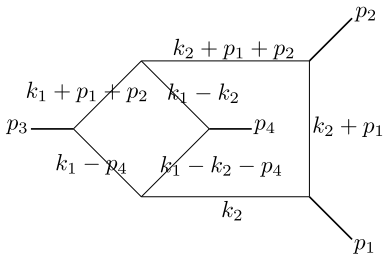
Rational-function simplification is key bottlenecks in integration-by-parts (IBP) reduction of Feynman integrals. We study denominator factorization patterns appearing in IBP coefficients and develop practical algorithms for extracting and exploiting factorized denominator structure within the FUEL interface. The resulting workflow reduces reconstruction cost and improves robustness of large-scale reductions.
Editorial analysis
A structured set of objections, weighed in public.
Referee Report
Summary. The manuscript studies denominator factorization patterns that appear in the rational coefficients generated during integration-by-parts (IBP) reductions of Feynman integrals. It develops practical algorithms to detect and exploit these patterns inside the FUEL interface, producing a workflow that is stated to lower the cost of rational-function reconstruction while increasing robustness for large-scale reductions.
Significance. If the reported gains are reproducible, the work would supply a concrete, pattern-driven improvement to a persistent computational bottleneck in multi-loop calculations. The focus on algorithmic exploitation of existing denominator structure rather than new reduction identities makes the contribution potentially portable to other IBP frameworks.
minor comments (2)
- A quantitative benchmark table (e.g., wall-time or memory usage for a standard set of four-loop integrals with and without the factorization step) would allow readers to judge the magnitude of the claimed cost reduction.
- The manuscript should state the precise criteria used to decide when a detected factorization is retained versus discarded, as this choice directly affects the robustness claim.
Simulated Author's Rebuttal
We thank the referee for the careful reading of the manuscript, the positive assessment of its significance, and the recommendation for minor revision. No specific major comments were raised in the report.
Circularity Check
No significant circularity detected
full rationale
The paper describes an algorithmic workflow for detecting and exploiting denominator factorization patterns in IBP coefficients inside the FUEL interface. No load-bearing derivation step reduces by construction to its own inputs, fitted parameters, or self-citation chains; the central claim is a practical pattern-based improvement whose validity rests on observable algebraic structure rather than self-referential definitions or unverified uniqueness theorems. The abstract and available description present the method as an independent algorithmic contribution without evidence of circular reduction.
Axiom & Free-Parameter Ledger
Reference graph
Works this paper leans on
-
[1]
National Bureau of Stan- dards (1964)
Abramowitz, M., Stegun, I.A.: Handbook of Mathematical Functions. National Bureau of Stan- dards (1964)
1964
-
[2]
Anastasiou, C., Lazopoulos, A.: Automatic integral reduction for higher order perturbative calculations. JHEP 07, 046 (2004). doi:10.1088/1126-6708/2004/07/046
-
[3]
In: Conference on Symbolic and Algebraic Computation (2011)
Authors, V.: Homogeneous multivariate reconstruction methods. In: Conference on Symbolic and Algebraic Computation (2011)
2011
-
[4]
Belitsky, A.V., Smirnov, A.V., Yakovlev, R.V.: Balancing act: Multivariate rational reconstruc- tion for ibp. Nucl. Phys. B 993, 116253 (2023). doi:10.1016/j.nuclphysb.2023.116253
-
[5]
Ben-Or, M., Tiwari, P.: A deterministic algorithm for sparse multivariate polynomial interpo- lation. In: STOC ’88 (1988). doi:10.1145/62212.62241
-
[6]
Chetyrkin, K.G., Tkachov, F.V.: Integrationbyparts: Thealgorithmtocalculatebetafunctions in 4 loops. Nucl. Phys. B 192, 159–204 (1981). doi:10.1016/0550-3213(81)90199-1
-
[7]
Chuvashov, E.: Development and implementation of serialization system for factorized polyno- mials in the universal library for the simplification of multivariate rational functions in FUEL (2025), coursework project, unpublished
2025
-
[8]
Numerical Algorithms (2011)
Cuyt, A., et al.: Sparse interpolation and rational approximation. Numerical Algorithms (2011)
2011
-
[9]
In: Proceedings of ISSAC 1998 (1998)
Díaz, A., Kaltofen, E.: Foxbox: a system for manipulating and solving algebraic differential equations. In: Proceedings of ISSAC 1998 (1998)
1998
-
[10]
In: ISSAC 2017 (2017)
Gao, H.: Sparse polynomial interpolation in various settings. In: ISSAC 2017 (2017)
2017
-
[11]
vonzurGathen, J., Gerhard, J.: ModernComputerAlgebra.CambridgeUniversityPress(2013)
2013
-
[12]
Theoretical Computer Sci- ence (1994)
Grigoriev, D.: Interpolation of sparse polynomials over finite fields. Theoretical Computer Sci- ence (1994)
1994
-
[13]
Pro- ceedings of ISSAC (2003)
Kaltofen, E., Lee, W.s., Lobo, A.: Early termination in sparse polynomial interpolation. Pro- ceedings of ISSAC (2003)
2003
-
[14]
Kant, P., Lorca, A., Plaetzer, S., et al.: Automated generation of helicity amplitudes and differential cross sections (2013), arXiv ID unknown
2013
-
[15]
Klappert, J., Lange, F.: Reconstructing rational functions with firefly. Comput. Phys. Commun. 247, 106951 (2020). doi:10.1016/j.cpc.2019.106951
-
[17]
Klappert, J., Lange, F., Maierhöfer, P., Usovitsch, J.: Kira2.0andfinitefieldmethods.Comput. Phys. Commun. 266, 108024 (2021). doi:10.1016/j.cpc.2021.108024
-
[18]
In: ISSAC 2005 (2005)
Kleine Büning, H., et al.: Further results on sparse interpolation. In: ISSAC 2005 (2005)
2005
-
[19]
Lange, F., Usovitsch, J., Wu, Z.: Kira 3: integral reduction with efficient seeding and optimized equation selection. Comput. Phys. Commun. 322, 109999 (2026). doi:10.1016/j.cpc.2025.109999 11
-
[20]
Laporta, S.: High precision calculation of multiloop feynman integrals by difference equations. Int. J. Mod. Phys. A 15, 5087–5159 (2000). doi:10.1142/S0217751X00002159
-
[21]
Lee, R.N.: Presenting litered: a tool for the loop integrals reduction.https://arxiv.org/abs/ 1212.2685(2012)
work page internal anchor Pith review Pith/arXiv arXiv 2012
-
[22]
Lee, R.N.: Litered2 mathematica package.https://github.com/rnlg/LiteRed2/(2019)
2019
-
[23]
Lee, R.N.: Litered 1.4: a powerful tool for reduction of multiloop integrals. J. Phys. Conf. Ser. 523, 012059 (2014). doi:10.1088/1742-6596/523/1/012059
-
[24]
Maierhöfer, P., Usovitsch, J., Uwer, P.: Kira—a feynman integral reduction program. Comput. Phys. Commun. 230, 99–112 (2018). doi:10.1016/j.cpc.2018.04.012
-
[25]
von Manteuffel, A., Studerus, C.: Reduze 2 – distributed feynman integral reduction.https: //arxiv.org/abs/1201.4330(2012)
work page internal anchor Pith review Pith/arXiv arXiv 2012
-
[26]
von Manteuffel, A., Schabinger, R.M.: A novel approach to integration by parts reduction. Phys. Lett. B 744, 101–104 (2015). doi:10.1016/j.physletb.2015.03.029
-
[27]
Mokrov, K., Smirnov, A., Zeng, M.: Rational Function Simplification for Integration-by-Parts Reduction and Beyond (4 2023). doi:10.26089/NumMet.v24r425
-
[28]
In: Proceedings of ISSAC 2004 (2004)
Monagan, M.: Maximal quotient rational reconstruction: An improved algorithm for rational reconstruction. In: Proceedings of ISSAC 2004 (2004)
2004
-
[29]
Peraro, T.: Scattering amplitudes over finite fields and multivariate functional reconstruction. JHEP 12, 030 (2016). doi:10.1007/JHEP12(2016)030
-
[30]
Peraro, T.: Finiteflow: multivariate functional reconstruction using finite fields and dataflow graphs. JHEP 07, 031 (2019). doi:10.1007/JHEP07(2019)031
-
[31]
Ruijl, B.: Symbolica.https://symbolica.io/(2023)
2023
-
[32]
Smirnov, A.V., Chuharev, F.S.: Fire6: Feynman integral reduction with modular arithmetic. Comput. Phys. Commun. 247, 106877 (2020). doi:10.1016/j.cpc.2019.106877
-
[33]
Smirnov, A.V., Smirnov, V.A.: Fire4, litered and accompanying tools to solve integration by parts relations. Comput. Phys. Commun. 184, 2820–2827 (2013). doi:10.1016/j.cpc.2013.06.016
-
[34]
Smirnov, A.V., Smirnov, V.A.: How to choose master integrals. Nucl. Phys. B 960, 115213 (2020). doi:10.1016/j.nuclphysb.2020.115213
-
[35]
JHEP 10, 107 (2008)
Smirnov, A.V.: Algorithm fire—feynman integral reduction. JHEP 10, 107 (2008)
2008
-
[36]
Smirnov, A.V.: Fire5: a c++ implementation of feynman integral reduction. Comput. Phys. Commun. 189, 182–191 (2015). doi:10.1016/j.cpc.2014.11.024
-
[37]
Numerical Methods and Programming 25(Special issue), 30–45 (2024)
Smirnov, A.V., Zeng, M.: Feynman integral reduction: balanced reconstruction of sparse ra- tional functions and implementation on supercomputers in a co-design approach. Numerical Methods and Programming 25(Special issue), 30–45 (2024). doi:10.26089/NumMet.2024s03
-
[38]
Smirnov, A.V., Zeng, M.: FIRE6.5: Feynmanintegralreductionwithnewsimplificationlibrary. Comput. Phys. Commun. 302, 109261 (2024). doi:10.1016/j.cpc.2024.109261
-
[39]
Smirnov, A.V., Zeng, M.: FIRE 7: Automatic reduction with modular approach. Comput. Phys. Commun.325, 110200 (2026). doi:10.1016/j.cpc.2026.110200 12
-
[40]
Studerus, C.: Reduze—feynman integral reduction in c++. Comput. Phys. Commun. 181, 1293–1300 (2010). doi:10.1016/j.cpc.2010.03.012
-
[41]
The FLINT team: FLINT: Fast Library for Number Theory (2023), version 2.9.0,https: //flintlib.org
2023
-
[42]
Tkachov, F.V.: A theorem on analytical calculability of 4-loop renormalization group functions. Phys. Lett. B 100, 65–68 (1981). doi:10.1016/0370-2693(81)90288-4
- [43]
-
[44]
Proceedings of SYMSAC (1981)
Wang, P.S.: A p-adic algorithm for univariate partial fractions. Proceedings of SYMSAC (1981)
1981
-
[45]
In: Symbolic and Algebraic Com- putation (1979)
Zippel, R.: Probabilistic algorithms for sparse polynomials. In: Symbolic and Algebraic Com- putation (1979)
1979
-
[46]
Journal of Symbolic Computation (1990) 13
Zippel, R.: Interpolating polynomials from their values. Journal of Symbolic Computation (1990) 13
1990
discussion (0)
Sign in with ORCID, Apple, or X to comment. Anyone can read and Pith papers without signing in.