Universal Design and Physical Applications of Non-Uniform Cellular Automata on Translationally Invariant Lattices
Pith reviewed 2026-05-14 18:10 UTC · model grok-4.3
pith:RAI6DYA2 Add to your LaTeX paper
What is a Pith Number?\usepackage{pith}
\pithnumber{RAI6DYA2}
Prints a linked pith:RAI6DYA2 badge after your title and writes the identifier into PDF metadata. Compiles on arXiv with no extra files. Learn more
The pith
A non-uniform cellular automata algorithm generates subsystem symmetry-protected topological states on hyperbolic lattices unattainable on Euclidean ones.
A machine-rendered reading of the paper's core claim, the machinery that carries it, and where it could break.
Core claim
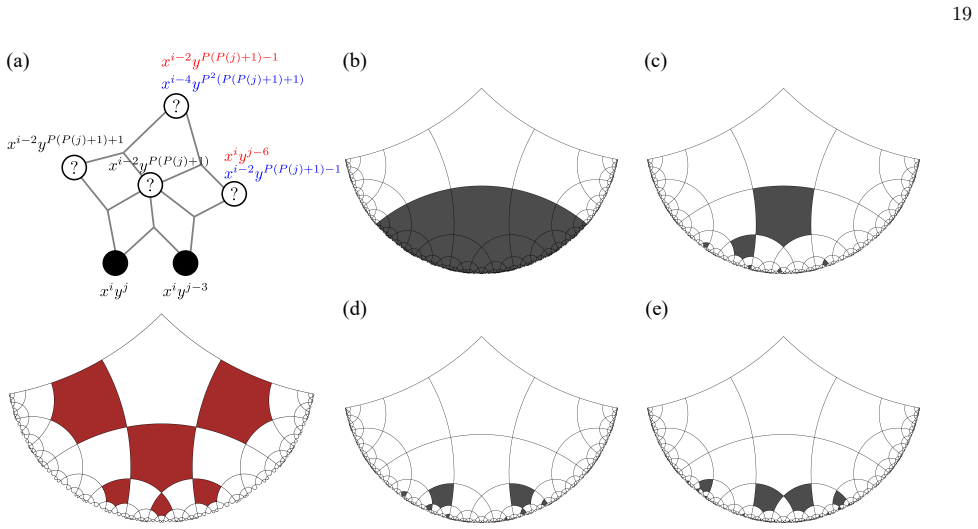
We develop a higher-order non-uniform cellular automata (NUCA) algorithm applicable to both translationally invariant regular Euclidean and hyperbolic lattices. In the algorithm, the non-uniform update rules incorporate nontrivial geometric data through a lattice-deforming procedure. By applying a linear NUCA, we generate subsystem symmetry-protected topological (SSPT) states and spontaneous subsystem symmetry-breaking states associated with regular or irregular subsystem symmetries unattainable on Euclidean lattices.
What carries the argument
The lattice-deforming procedure that incorporates geometric data of the hyperbolic lattice into non-uniform update rules of the cellular automata, preserving translation invariance.
If this is right
- Application of linear NUCA produces SSPT states on the hyperbolic {5,4} lattice.
- Multi-point strange correlators are designed to detect these nontrivial SSPT states.
- A sufficient condition is derived for non-Abelian translationally invariant NUCA-generated models.
- Generalization to non-uniform Clifford quantum cellular automata generates subsystem symmetries in the hyperbolic cluster state.
- Probabilistic NUCA simulates directed percolation on the lattice, allowing estimation of percolation thresholds and phase diagrams.
Where Pith is reading between the lines
- The NUCA framework could be tested on other negatively curved lattices like {7,3} to see if similar symmetry phenomena emerge.
- This approach might inform designs for quantum simulators on hyperbolic lattices in experimental setups using circuit lattices or optical systems.
- Extending the method to time-dependent or inhomogeneous geometries could reveal dynamic phase transitions unique to curved spaces.
- The correspondence between CQCA and subsystem symmetries suggests broader classifications of topological phases in non-Euclidean settings.
Load-bearing premise
The lattice-deforming procedure correctly folds nontrivial geometric data into the non-uniform update rules while preserving the required translation invariance and without introducing spurious correlations or breaking the intended symmetry protection.
What would settle it
If the generated states on the hyperbolic lattice do not satisfy the predicted subsystem symmetries when measured with the multi-point strange correlators, or if the percolation thresholds deviate significantly from expected values due to the treelike structure, the claim would be falsified.
Figures




read the original abstract
Lattice geometry profoundly shapes physical phenomena such as subsystem symmetry and directed percolation (DP). Among various lattice geometries, hyperbolic lattices are characterized by constant negative curvature and non-Abelian translation symmetry, offering a rich platform for investigating this geometry-physics interplay. However, the exponentially growing lattice size and nontrivial translation symmetry make approaches developed for Euclidean lattices incompatible, a limitation particularly evident in uniform cellular automata (CA). To resolve this, we develop a higher-order non-uniform cellular automata (NUCA) algorithm applicable to both translationally invariant regular Euclidean and hyperbolic lattices. In the algorithm, the non-uniform update rules incorporate nontrivial geometric data through a lattice-deforming procedure. We demonstrate the broad applicability of our algorithm to hyperbolic lattices through several applications on the hyperbolic $\{5,4\}$ lattice. By applying a linear NUCA, we generate subsystem symmetry-protected topological (SSPT) states and spontaneous subsystem symmetry-breaking states associated with regular or irregular subsystem symmetries unattainable on Euclidean lattices. We design the multi-point strange correlators to detect nontrivial SSPT states and derive a sufficient condition for non-Abelian translationally invariant NUCA-generated models. Furthermore, by generalizing the NUCA to non-uniform Clifford quantum cellular automata (CQCA), we generate subsystem symmetries of the hyperbolic cluster state, extending the established correspondence between translationally invariant CQCA and subsystem symmetries. Moreover, we simulate the DP process via a probabilistic NUCA that inherits the treelike structure of the lattice, and numerically estimate percolation thresholds and the phase diagram.
Editorial analysis
A structured set of objections, weighed in public.
Referee Report
Summary. The paper develops a higher-order non-uniform cellular automata (NUCA) algorithm for translationally invariant regular Euclidean and hyperbolic lattices. Geometric data is incorporated via a lattice-deforming procedure into the non-uniform update rules. Applications on the hyperbolic {5,4} lattice include generation of SSPT states and spontaneous subsystem symmetry-breaking states (regular or irregular), design of multi-point strange correlators to detect nontrivial SSPT order, derivation of a sufficient condition for non-Abelian translationally invariant NUCA models, extension to non-uniform Clifford quantum cellular automata to generate subsystem symmetries of the hyperbolic cluster state, and probabilistic NUCA simulation of directed percolation to estimate thresholds and the phase diagram.
Significance. If the central claims hold, the work provides a general algorithmic framework for studying subsystem symmetries, topological phases, and percolation phenomena on hyperbolic lattices with non-Abelian translation symmetry, where uniform CA methods fail due to exponential growth. The explicit construction of strange correlators, the sufficient condition for non-Abelian models, and the CQCA extension to cluster states are concrete strengths that could enable new falsifiable predictions in quantum many-body physics on curved spaces.
major comments (2)
- [§3] §3 (Lattice-deforming procedure): The central claim that the procedure maps geometric data of the {5,4} lattice into non-uniform rules while exactly preserving translation invariance under the non-Abelian hyperbolic group action lacks an explicit commutator verification or orbit-stabilizer check with the translation generators. Without this, it is unclear whether the deformed rules remain group-equivariant, risking spurious correlations that would invalidate the SSPT protection and the sufficient condition for non-Abelian NUCA models.
- [§5] §5 (Directed percolation simulation): The numerical estimation of percolation thresholds and the phase diagram is load-bearing for the claim of broad applicability, yet the manuscript provides no system sizes, error bars, finite-size scaling analysis, or convergence diagnostics. This absence prevents assessment of whether the treelike structure inheritance yields reliable results.
minor comments (2)
- [§4.1] §4.1: The multi-point strange correlators are described qualitatively but would benefit from an explicit formula showing their construction and how they distinguish nontrivial SSPT states from trivial ones.
- Notation: The distinction between 'regular' and 'irregular' subsystem symmetries is used repeatedly but is not defined with a precise criterion or example in the main text.
Simulated Author's Rebuttal
We thank the referee for their careful reading of our manuscript and for the constructive comments. We address each of the major comments below and outline the corresponding revisions.
read point-by-point responses
-
Referee: [§3] §3 (Lattice-deforming procedure): The central claim that the procedure maps geometric data of the {5,4} lattice into non-uniform rules while exactly preserving translation invariance under the non-Abelian hyperbolic group action lacks an explicit commutator verification or orbit-stabilizer check with the translation generators. Without this, it is unclear whether the deformed rules remain group-equivariant, risking spurious correlations that would invalidate the SSPT protection and the sufficient condition for non-Abelian NUCA models.
Authors: The lattice-deforming procedure is designed by construction to preserve the translation invariance under the non-Abelian group action, as the geometric data is incorporated in a manner that respects the lattice's symmetry generators. However, we acknowledge that an explicit verification would strengthen the presentation. In the revised version, we will include a commutator check showing that the deformed update rules commute with the translation generators, as well as an orbit-stabilizer argument to confirm group-equivariance. This addition will be placed in §3 and will not change the main results but will address the concern about potential spurious correlations. revision: yes
-
Referee: [§5] §5 (Directed percolation simulation): The numerical estimation of percolation thresholds and the phase diagram is load-bearing for the claim of broad applicability, yet the manuscript provides no system sizes, error bars, finite-size scaling analysis, or convergence diagnostics. This absence prevents assessment of whether the treelike structure inheritance yields reliable results.
Authors: We agree that the numerical details are important for validating the directed percolation results. The current manuscript focuses on the algorithmic framework and the qualitative phase diagram, but to improve clarity, we will add in the revised §5 the specific system sizes employed (hyperbolic lattices up to depth 12), statistical error bars from ensemble averages, finite-size scaling analysis to determine the critical thresholds, and convergence checks as a function of lattice generation. These revisions will demonstrate that the treelike inheritance provides reliable estimates. revision: yes
Circularity Check
No significant circularity detected in algorithmic construction
full rationale
The paper presents a new higher-order NUCA algorithm whose core is a lattice-deforming procedure that encodes geometric data of hyperbolic lattices into non-uniform update rules. No step reduces a claimed prediction or derived quantity to a fitted parameter or self-citation by construction; the sufficient condition for non-Abelian NUCA models, the multi-point strange correlators, and the CQCA generalization are all introduced as independent constructions rather than tautological re-labelings of inputs. The derivation chain is therefore self-contained and does not rely on any of the enumerated circularity patterns.
Axiom & Free-Parameter Ledger
Lean theorems connected to this paper
-
IndisputableMonolith.Constantsphi_golden_ratio echoes?
echoesECHOES: this paper passage has the same mathematical shape or conceptual pattern as the Recognition theorem, but is not a direct formal dependency.
Solving the characteristic polynomial of the splitting matrix Eq. (25) for the {5,4} lattice, whose greatest root is the square of the golden ratio ϕ=(1+√5)/2, gives the number of nodes on each level uk=A_{2k+1}
What do these tags mean?
- matches
- The paper's claim is directly supported by a theorem in the formal canon.
- supports
- The theorem supports part of the paper's argument, but the paper may add assumptions or extra steps.
- extends
- The paper goes beyond the formal theorem; the theorem is a base layer rather than the whole result.
- uses
- The paper appears to rely on the theorem as machinery.
- contradicts
- The paper's claim conflicts with a theorem or certificate in the canon.
- unclear
- Pith found a possible connection, but the passage is too broad, indirect, or ambiguous to say the theorem truly supports the claim.
Reference graph
Works this paper leans on
-
[1]
Applicability of the NUCA algorithm In Sec. III and Appendix D, we develop a lattice- deforming procedure for the hyperbolic lattice based on the splitting method and the language of splitting, to design the deformed lattice. Therefore, we first review which{p, q}lattices the splitting method and the lan- guage of the splitting can be applied to [59]. The...
-
[2]
The splitting method applied to Euclidean square lattice As a simple example of how the splitting method works, we apply it to the Euclidean square lattice and construct the language of the splitting. Consider a quar- terQof an infinite 2d square lattice tessellated by regular rectangles, each of which is labelled as a node. Without loss of generality, we...
-
[3]
∞X k=0 ykrk(x) + ∞X k=n ykrk(x) + n−1X k=0 yk˜rk(x) # =x −iy−j
Consistency of NUCA(4,4)with higher-order cellular automata Next, we elaborate details and properties related to NUCA(4,4)in Sec. IIC, where we defined NUCA(4,4) directly on the square lattice. The unit translation of a site in terms of the polynomial representationxiyj is re- alized by multiplication by monomials in{x, y, x−1, y−1}. The neighboring sites...
-
[4]
Derivation of auxiliary functions First we provide the details of obtaining the neigh- boring relation of nodes. For the{5,4}lattice, we use an alternative Fibonacci representation rather than the standard language of the splitting to simplify calcula- tion [88]. We recall that the generating rule is→ and → in Fig. 5. On the{5,4}spanning tree, if a nodevi...
-
[5]
(39) commute with all the Hamil- tonian terms Eq
Details of NUCA(5,4)-generated Hamiltonians We first verify that the NUCA(5,4)-generated sym- metry elements Eq. (39) commute with all the Hamil- tonian terms Eq. (37). We consider the nontrivial ac- tion of a Hamiltonian termZ(x iyj(1 + ¯fj · ¯y1,¯n))on the same sublattice with the symmetryX(F(x, y)) = X(P k rk(x)yk). We note that the update rule and its...
-
[6]
Translation-invariance of NUCA-generated Hamiltonian We derive a sufficient condition for a NUCA-generated Hamiltonian to be translation-invariant in Sec. III, while we do not discuss in detail why a uniform update rule ¯fj(x)≡ ¯f(x)does not guarantee translation invariance. In this appendix, we discuss the translation invariance condition on a hyperbolic...
-
[7]
Y. You, T. Devakul, F. J. Burnell, and S. L. Sondhi, Subsystem symmetry protected topological order, Phys. Rev. B98, 035112 (2018)
work page 2018
-
[8]
T.Devakul, D.J.Williamson,andY.You,Classification of subsystem symmetry-protected topological phases, Phys. Rev. B98, 235121 (2018)
work page 2018
-
[9]
T. Devakul, Y. You, F. J. Burnell, and S. L. Sondhi, Fractal Symmetric Phases of Matter, SciPost Phys.6, 007 (2019)
work page 2019
-
[10]
Devakul, Classifying local fractal subsystem symmetry-protected topological phases, Phys
T. Devakul, Classifying local fractal subsystem symmetry-protected topological phases, Phys. Rev. B 99, 235131 (2019)
work page 2019
-
[11]
T. Devakul and D. J. Williamson, Universal quantum computation using fractal symmetry-protected cluster phases, Phys. Rev. A98, 022332 (2018)
work page 2018
-
[12]
D. T. Stephen, H. P. Nautrup, J. Bermejo-Vega, J. Eis- ert, and R. Raussendorf, Subsystem symmetries, quan- tum cellular automata, and computational phases of quantum matter, Quantum3, 142 (2019)
work page 2019
-
[13]
A. K. Daniel, R. N. Alexander, and A. Miyake, Com- putational universality of symmetry-protected topologi- callyorderedclusterphaseson2DArchimedeanlattices, Quantum4, 228 (2020)
work page 2020
-
[14]
R. Raussendorf and H. J. Briegel, A one-way quantum computer, Phys. Rev. Lett.86, 5188 (2001)
work page 2001
-
[15]
C. Zhou, M.-Y. Li, Z. Yan, P. Ye, and Z. Y. Meng, De- tectingsubsystemsymmetryprotectedtopologicalorder through strange correlators, Phys. Rev. B106, 214428 (2022)
work page 2022
-
[16]
J.-Y. Zhang, M.-Y. Li, and P. Ye, Higher-order cellu- lar automata generated symmetry-protected topological phases and detection through multi point strange cor- relators, PRX Quantum5, 030342 (2024)
work page 2024
- [17]
- [18]
-
[19]
M. Barkeshli, P. Bonderson, M. Cheng, and Z. Wang, Symmetry fractionalization, defects, and gauging of topological phases, Phys. Rev. B100, 115147 (2019)
work page 2019
-
[20]
D. T. Stephen, J. Garre-Rubio, A. Dua, and D. J. Williamson, Subsystem symmetry enriched topological order in three dimensions, Phys. Rev. Res.2, 033331 40 (2020)
work page 2020
-
[21]
D. T. Stephen, A. Dua, J. Garre-Rubio, D. J. Williamson, and M. Hermele, Fractionalization of sub- system symmetries in two dimensions, Phys. Rev. B 106, 085104 (2022)
work page 2022
-
[22]
J.-Y. Zhang and P. Ye, Programmable anyon mo- bility through higher order cellular automata (2025), arXiv:2508.13961 [quant-ph]
work page internal anchor Pith review Pith/arXiv arXiv 2025
-
[23]
W. Asavanant, Y. Shiozawa, S. Yokoyama, B. Charoen- sombutamon, H. Emura, R. N. Alexander, S. Takeda, J. ichi Yoshikawa, N. C. Menicucci, H. Yonezawa, and A. Furusawa, Generation of time-domain-multiplexed two-dimensional cluster state, Science366, 373 (2019)
work page 2019
-
[24]
M. V. Larsen, X. Guo, C. R. Breum, J. S. Neergaard- Nielsen, and U. L. Andersen, Deterministic generation of a two-dimensional cluster state, Science366, 369 (2019)
work page 2019
-
[25]
B. P. Lanyon, P. Jurcevic, M. Zwerger, C. Hempel, E. A. Martinez, W. Dür, H. J. Briegel, R. Blatt, and C. F. Roos, Measurement-based quantum computation with trapped ions, Phys. Rev. Lett.111, 210501 (2013)
work page 2013
-
[26]
H. K. Janssen, On the nonequilibrium phase transition in reaction-diffusion systems with an absorbing station- ary state, Z. Phys. B42, 151–154 (1981)
work page 1981
-
[27]
Grassberger, On phase transitions in schlögl’s second model, Z
P. Grassberger, On phase transitions in schlögl’s second model, Z. Phys. B47, 365–374 (1982)
work page 1982
-
[28]
H. Hinrichsen, Non-equilibrium critical phenomena and phase transitions into absorbing states, Advances in Physics49, 815 (2000)
work page 2000
-
[29]
E. Domany and W. Kinzel, Equivalence of cellular au- tomata to ising models and directed percolation, Phys. Rev. Lett.53, 311 (1984)
work page 1984
-
[30]
K. A. Takeuchi, M. Kuroda, H. Chaté, and M. Sano, Directed percolation criticality in turbulent liquid crys- tals, Phys. Rev. Lett.99, 234503 (2007)
work page 2007
-
[31]
K. A. Takeuchi, M. Kuroda, H. Chaté, and M. Sano, Ex- perimental realization of directed percolation criticality in turbulent liquid crystals, Phys. Rev. E80, 051116 (2009)
work page 2009
-
[32]
G. Lemoult, L. Shi, K. Avila, S. V. Jalikop, M. Avila, andB.Hof,Directedpercolationphasetransitiontosus- tained turbulence in couette flow, Nature Physics12, 254–258 (2016)
work page 2016
-
[33]
G. Lemoult, V. Mukund, H.-Y. Shih, G. Linga, J. Math- iesen, N. Goldenfeld, and B. Hof, Directed percolation andpuffjammingnearthetransitiontopipeturbulence, Nature Physics20, 1339–1345 (2024)
work page 2024
- [34]
-
[35]
J. Willsher, S.-W. Liu, R. Moessner, and J. Knolle, Measurement-induced phase transition in a chaotic clas- sical many-body system, Phys. Rev. B106, 024305 (2022)
work page 2022
-
[36]
R. C. Brower, C. V. Cogburn, A. L. Fitzpatrick, D. Howarth, and C.-I. Tan, Lattice setup for quantum field theory inads2, Phys. Rev. D103, 094507 (2021)
work page 2021
-
[37]
R. C. Brower, C. V. Cogburn, and E. Owen, Hyperbolic lattice for scalar field theory inads3, Phys. Rev. D105, 114503 (2022)
work page 2022
-
[38]
I. Boettcher, A. V. Gorshkov, A. J. Kollár, J. Maciejko, S. Rayan, and R. Thomale, Crystallography of hyper- bolic lattices, Phys. Rev. B105, 125118 (2022)
work page 2022
-
[39]
F.R.LuxandE.Prodan,Convergingperiodicboundary conditions and detection of topological gaps on regular hyperbolic tessellations, Phys. Rev. Lett.131, 176603 (2023)
work page 2023
-
[40]
J. Maciejko and S. Rayan, Hyperbolic band theory, Sci- ence Advances7, eabe9170 (2021)
work page 2021
-
[41]
J. Maciejko and S. Rayan, Automorphic bloch theo- rems for hyperbolic lattices, Proceedings of the National Academy of Sciences119, e2116869119 (2022)
work page 2022
-
[42]
P. M. Lenggenhager, J. Maciejko, and T. c. v. Bzdušek, Non-abelian hyperbolic band theory from supercells, Phys. Rev. Lett.131, 226401 (2023)
work page 2023
-
[43]
A. J. Kollár, M. Fitzpatrick, and A. A. Houck, Hyper- bolic lattices in circuit quantum electrodynamics, Na- ture571, 45–50 (2019)
work page 2019
-
[44]
P.M.Lenggenhager, A.Stegmaier, L.K.Upreti, T.Hof- mann, T. Helbig, A. Vollhardt, M. Greiter, C. H. Lee, S. Imhof, H. Brand, T. Kießling, I. Boettcher, T. Neu- pert, R. Thomale, and T. Bzdušek, Simulating hyper- bolic space on a circuit board, Nature Communications 13, 4373 (2022)
work page 2022
- [45]
-
[46]
A. Chen, Y. Guan, P. M. Lenggenhager, J. Maciejko, I. Boettcher, and T. c. v. Bzdušek, Symmetry and topol- ogy of hyperbolic haldane models, Phys. Rev. B108, 085114 (2023)
work page 2023
-
[47]
T. Tummuru, A. Chen, P. M. Lenggenhager, T. Ne- upert, J. Maciejko, and T. c. v. Bzdušek, Hyperbolic non-abelian semimetal, Phys. Rev. Lett.132, 206601 (2024)
work page 2024
-
[48]
A. Chen, J. Maciejko, and I. Boettcher, Anderson lo- calization transition in disordered hyperbolic lattices, Phys. Rev. Lett.133, 066101 (2024)
work page 2024
- [49]
-
[50]
P. M. Lenggenhager, S. Dey, T. c. v. Bzdušek, and J. Maciejko, Hyperbolic spin liquids, Phys. Rev. Lett. 135, 076604 (2025)
work page 2025
-
[51]
K. Dutkiewicz, M. Płodzień, A. Rojo-Francàs, B. Juliá- Díaz, M. Lewenstein, and T. Grass, Bose-einstein con- densation in exotic lattice geometries, Phys. Rev. A 113, 013320 (2026)
work page 2026
-
[52]
D. Saraidaris and A. Jahn, Critical spin models from holographic disorder, Quantum9, 1808 (2025)
work page 2025
-
[53]
Yan, Hyperbolic fracton model, subsystem symme- try, and holography, Phys
H. Yan, Hyperbolic fracton model, subsystem symme- try, and holography, Phys. Rev. B99, 155126 (2019)
work page 2019
-
[54]
Yan, Hyperbolic fracton model, subsystem symme- try, and holography
H. Yan, Hyperbolic fracton model, subsystem symme- try, and holography. ii. the dual eight-vertex model, Phys. Rev. B100, 245138 (2019)
work page 2019
-
[55]
Hyperbolic Fracton Model, Subsystem Symmetry and Holography III: Extension to Generic Tessellations
Y. Shokeeb, L. D. C. Jaubert, and H. Yan, Hyper- bolic fracton model, subsystem symmetry and holog- raphy iii: Extension to generic tessellations (2026), arXiv:2510.25994 [cond-mat.str-el]
work page internal anchor Pith review Pith/arXiv arXiv 2026
-
[56]
N. P. Breuckmann and B. M. Terhal, Constructions and noisethresholdofhyperbolicsurfacecodes,IEEETrans- actions on Information Theory62, 3731 (2016)
work page 2016
-
[57]
A. Fahimniya, H. Dehghani, K. Bharti, S. Mathew, A. J. Kollár, A. V. Gorshkov, and M. J. Gullans, Fault- tolerant hyperbolic Floquet quantum error correcting codes, Quantum9, 1849 (2025)
work page 2025
-
[58]
A. A. Mahmoud, K. M. Ali, and S. Rayan, Systematic 41 approach to hyperbolic quantum error correction codes, Phys. Rev. A113, 042426 (2026)
work page 2026
-
[59]
M. Asaduzzaman, S. Catterall, J. Hubisz, R. Nelson, and J. Unmuth-Yockey, Holography on tessellations of hyperbolic space, Phys. Rev. D102, 034511 (2020)
work page 2020
-
[60]
A. Jahn, Z. Zimborás, and J. Eisert, Central charges of aperiodic holographic tensor-network models, Phys. Rev. A102, 042407 (2020)
work page 2020
- [61]
-
[62]
L. Boyle and J. Kulp, Holographic foliations: Self- similar quasicrystals from hyperbolic honeycombs, Phys. Rev. D111, 046001 (2025)
work page 2025
-
[63]
S. Dey, A. Chen, P. Basteiro, A. Fritzsche, M. Gre- iter, M. Kaminski, P. M. Lenggenhager, R. Meyer, R. Sorbello, A. Stegmaier, R. Thomale, J. Erdmenger, andI.Boettcher,Simulatingholographicconformalfield theories on hyperbolic lattices, Phys. Rev. Lett.133, 061603 (2024)
work page 2024
-
[64]
S. Mertens and C. Moore, Percolation thresholds in hy- perbolic lattices, Phys. Rev. E96, 042116 (2017)
work page 2017
-
[65]
M. Margenstern, Cellular automata in hyperbolic spaces, inCellular Automata: A Volume in the Encyclo- pedia of Complexity and Systems Science, Second Edi- tion, edited by A. Adamatzky (Springer US, New York, NY, 2018) pp. 11–27
work page 2018
-
[66]
M. Schrauth, Y. Thurn, F. Goth, J. S. E. Portela, D. Herdt, and F. Dusel, HYPERTILING — a high per- formance Python library for the generation and visual- ization of hyperbolic lattices, SciPost Phys. Codebases , 34 (2024)
work page 2024
-
[67]
Wolfram, Statistical mechanics of cellular automata, Rev
S. Wolfram, Statistical mechanics of cellular automata, Rev. Mod. Phys.55, 601 (1983)
work page 1983
-
[68]
Wolfram, Cellular automata as models of complexity, Nature (London)311, 419 (1984)
S. Wolfram, Cellular automata as models of complexity, Nature (London)311, 419 (1984)
work page 1984
-
[69]
T.Toffoli,Computationandconstructionuniversalityof reversible cellular automata, Journal of Computer and System Sciences15, 213 (1977)
work page 1977
-
[70]
M.Rollier, K.M.Zielinski, A.J.Daly, O.M.Bruno,and J. M. Baetens, A comprehensive taxonomy of cellular automata, Communications in Nonlinear Science and Numerical Simulation140, 108362 (2025)
work page 2025
-
[71]
P.-Y. Louis and F. R. Nardi, eds.,Probabilistic Cellular Automata: Theory, Applications and Future Perspec- tives(Springer International Publishing, 2018)
work page 2018
- [72]
-
[73]
Raussendorf, Quantum cellular automaton for uni- versal quantum computation, Phys
R. Raussendorf, Quantum cellular automaton for uni- versal quantum computation, Phys. Rev. A72, 022301 (2005)
work page 2005
-
[74]
T. J. Osborne, Efficient approximation of the dynamics of one-dimensional quantum spin systems, Phys. Rev. Lett.97, 157202 (2006)
work page 2006
-
[75]
Farrelly, A review of Quantum Cellular Automata, Quantum4, 368 (2020)
T. Farrelly, A review of Quantum Cellular Automata, Quantum4, 368 (2020)
work page 2020
-
[76]
Arrighi, An overview of quantum cellular automata, Natural Computing18, 885–899 (2019)
P. Arrighi, An overview of quantum cellular automata, Natural Computing18, 885–899 (2019)
work page 2019
-
[77]
Pries, Thanailakis, and Card, Group properties of cellu- lar automata and vlsi applications, IEEE Transactions on ComputersC-35, 1013 (1986)
work page 1986
-
[78]
Fuks-acute, Solution of the density classification problem with two cellular automata rules, Phys
H. Fuks-acute, Solution of the density classification problem with two cellular automata rules, Phys. Rev. E55, R2081 (1997)
work page 1997
-
[79]
S. Ghosh and S. Basu, Evolution patterns of some one-dimensional non-uniform cellular automata, inPro- ceedings of First Asian Symposium on Cellular Au- tomata Technology, edited by S. Das and G. J. Mar- tinez (Springer Nature Singapore, Singapore, 2022) pp. 69–77
work page 2022
-
[80]
S. Paul and S. Das, Temporally non-uniform cellular automata: Surjectivity, reversibility and cyclic behavior (2026), arXiv:2411.17421 [cs.FL]
discussion (0)
Sign in with ORCID, Apple, or X to comment. Anyone can read and Pith papers without signing in.