Recognition: no theorem link
Generating synthetic computed tomography for radiotherapy: SynthRAD2025 challenge report
Pith reviewed 2026-05-14 18:09 UTC · model grok-4.3
The pith
Deep learning generates clinically usable synthetic CT from CBCT for radiotherapy dose planning, but MRI conversion remains challenging.
A machine-rendered reading of the paper's core claim, the machinery that carries it, and where it could break.
Core claim
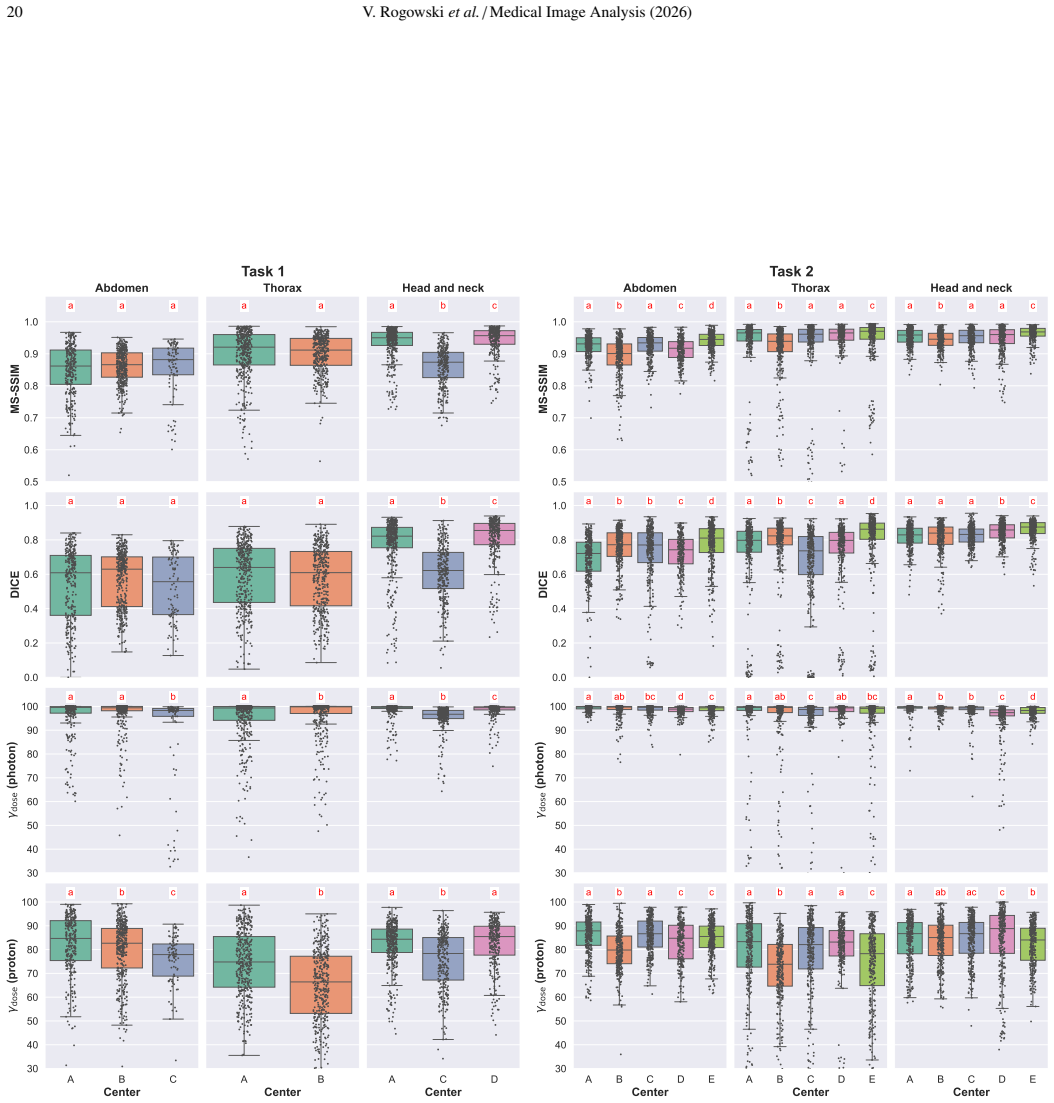
SynthRAD2025 shows that deep learning can produce synthetic CTs with sufficient accuracy for radiotherapy planning from CBCT inputs, reaching MAE of 48.3 HU and photon gamma pass rates above 99%, while MRI-to-CT conversion yields higher variability and proton dose errors around 85-89% pass rates, confirming that dose-based evaluation is required for clinical validation.
What carries the argument
The multi-center SynthRAD2025 dataset with paired MRI/CBCT and CT images, evaluated through combined image similarity metrics, segmentation accuracy, and full dosimetric gamma analysis on photon and proton treatment plans.
If this is right
- CBCT-to-CT synthetic images enable reliable photon dose calculations for adaptive radiotherapy workflows.
- Proton therapy planning remains more sensitive to synthetic CT errors at tissue interfaces.
- Image similarity metrics alone cannot replace dosimetric checks for validating synthetic CT quality.
- Head and neck cases show more consistent performance across models than thorax or abdomen cases.
Where Pith is reading between the lines
- Reducing reliance on daily CT scans could lower cumulative radiation doses for patients undergoing long treatment courses.
- Top challenge models may still require local validation and fine-tuning when deployed on new scanner models or populations.
- Future work could explore combining MRI and CBCT inputs to improve overall synthetic CT accuracy.
Load-bearing premise
That the performance of top models on the fixed challenge test set will translate directly to varied clinical environments with different scanners and patient groups without retraining.
What would settle it
Deploying the winning models on a new independent dataset from a sixth European center with different CT and CBCT scanners and measuring whether the photon gamma pass rates stay above 98%.
Figures




read the original abstract
Radiation therapy (RT) requires precise dose delivery over multiple fractions, with CT fundamental for treatment planning due to its electron density information. Repeated CT acquisitions impose radiation exposure and logistical burdens, MRI lacks electron density, and cone-beam CT (CBCT) requires correction for dose calculation. Synthetic CT (sCT) generation addresses these by converting MRI or CBCT into CT-equivalent images with accurate Hounsfield Unit (HU) values, enabling MRI-only RT and CBCT-based adaptive workflows. Building on SynthRAD2023, SynthRAD2025 benchmarked sCT methods on 2,362 patients from five European centers across head and neck, thorax, and abdomen. Two tasks: MRI-to-CT (890 cases) and CBCT-to-CT (1,472 cases), evaluated via image similarity (MAE, PSNR, MS-SSIM), segmentation (Dice, HD95), and dosimetric metrics from photon and proton plans. With 803 participants and 12/13 valid submissions, Task 1 top performance reached MAE $64.8\pm21.3$ HU, PSNR $\sim$30 dB, MS-SSIM $\sim$0.936, Dice 0.79, photon $\gamma_{2\%/2\text{mm}}>98\%$, proton $\gamma\approx85\%$. Task 2 improved: MAE $48.3\pm13.4$ HU, PSNR 32.6 dB, MS-SSIM 0.968, Dice 0.86, photon $\gamma>99\%$, proton $\gamma\approx89\%$. Strong image--segmentation correlations ($\rho=0.78$--$0.79$) but moderate dose correlations confirmed image quality is insufficient as a dosimetric surrogate. Head-and-neck cases were most consistent; thoracic and abdominal cases showed greater variability. Residual errors at tissue interfaces propagate along beam paths, affecting proton dose more than photon. SynthRAD2025 demonstrates that deep learning yields clinically relevant sCTs, especially for CBCT-to-CT, while identifying persistent MRI-to-CT challenges and underscoring dose-based evaluation as essential for clinical validation.
Editorial analysis
A structured set of objections, weighed in public.
Referee Report
Summary. The manuscript reports the outcomes of the SynthRAD2025 challenge for generating synthetic CT (sCT) from MRI and CBCT using deep learning methods. It describes a dataset of 2,362 patients from five European centers, with separate tasks for MRI-to-CT (890 cases) and CBCT-to-CT (1,472 cases). The evaluation includes image-based metrics (MAE, PSNR, MS-SSIM), segmentation metrics (Dice, HD95), and dosimetric metrics using photon and proton treatment plans. Top submission results are presented, showing better performance for CBCT-to-CT (MAE 48.3 HU, high gamma pass rates) compared to MRI-to-CT, with the conclusion that DL methods can produce clinically relevant sCTs but that dose-based evaluation is essential.
Significance. If the reported results hold, this challenge provides a large-scale, multi-center benchmark that advances the field by quantifying current capabilities in sCT generation for radiotherapy. The emphasis on dosimetric endpoints over pure image metrics is a key strength, as it directly addresses clinical needs. The identification of site-specific variability (e.g., head-and-neck vs. thorax/abdomen) offers actionable insights for future method development.
major comments (1)
- [Abstract] The claim that SynthRAD2025 'demonstrates that deep learning yields clinically relevant sCTs' relies on metrics from test cases drawn from the same five centers as the training data. Given the moderate image-dose correlation (ρ≈0.78) highlighted in the abstract, this setup does not fully address potential domain shifts to new scanners or protocols, which could affect the dosimetric endpoints the paper identifies as essential.
minor comments (2)
- [Abstract] Clarify the exact split of valid submissions between the two tasks, as '12/13 valid submissions' is ambiguous.
- [Abstract] The reported PSNR for Task 1 is given as '~30 dB'; providing more precise values or ranges for all top metrics would improve clarity.
Simulated Author's Rebuttal
We thank the referee for this constructive comment on the scope of our evaluation. We agree that the multi-center but internally held-out test set does not fully address domain shifts to unseen scanners or protocols, and we will revise the abstract and discussion to reflect this limitation more precisely while retaining the emphasis on dosimetric validation.
read point-by-point responses
-
Referee: [Abstract] The claim that SynthRAD2025 'demonstrates that deep learning yields clinically relevant sCTs' relies on metrics from test cases drawn from the same five centers as the training data. Given the moderate image-dose correlation (ρ≈0.78) highlighted in the abstract, this setup does not fully address potential domain shifts to new scanners or protocols, which could affect the dosimetric endpoints the paper identifies as essential.
Authors: We agree that the claim in the abstract should be qualified. The test cases are drawn from held-out patients at the same five centers, providing multi-center internal validation but not external generalization to new scanners or acquisition protocols. This is a genuine limitation of the current challenge design. In the revised version we will change the abstract wording to state that the results demonstrate that deep learning can produce clinically relevant sCTs within the evaluated multi-center setting, while explicitly noting the absence of external validation and the need for future studies on domain shift. We will also expand the discussion to address strategies for improving robustness (e.g., domain adaptation techniques) and will reinforce that the moderate image-dose correlation already underscores why dosimetric endpoints remain essential even under domain shift. revision: yes
Circularity Check
Empirical challenge report: no derivation chain or self-referential steps
full rationale
The manuscript is a challenge report summarizing image, segmentation, and dosimetric metrics from 12 independent participant submissions evaluated on held-out test cases drawn from the same five centers. No equations, fitted parameters, ansatzes, uniqueness theorems, or derivations are invoked; the central claims consist of direct empirical aggregates (e.g., MAE 48.3 HU for CBCT-to-CT) with no reduction to prior self-citations or internal definitions. The reported correlations and variability statements are likewise post-hoc observations on the challenge data, not load-bearing premises that collapse into the inputs.
Axiom & Free-Parameter Ledger
Reference graph
Works this paper leans on
-
[1]
2024 , publisher=
Huijben, Evi MC and Terpstra, Maarten L and Pai, Suraj and Thummerer, Adrian and Koopmans, Peter and Afonso, Manya and Van Eijnatten, Maureen and Gurney-Champion, Oliver and Chen, Zeli and Zhang, Yiwen and others , journal=. 2024 , publisher=
2024
-
[2]
2025 , publisher=
Thummerer, Adrian and van der Bijl, Erik and Galapon, Arthur Jr and Kamp, Florian and Savenije, Mark and Muijs, Christina and Aluwini, Shafak and Steenbakkers, Roel JHM and Beuel, Stephanie and Intven, Martijn PW and others , journal=. 2025 , publisher=
2025
-
[3]
Thummerer, Adrian and van der Bijl, Erik and Galapon Jr, Arthur and Verhoeff, Joost J C and Langendijk, Johannes A and Both, Stefan and van den Berg, Cornelis A T and Maspero, Matteo , journal=. 2023 , volume =. doi:https://doi.org/10.1002/mp.16529 , publisher=
-
[4]
2010 , publisher=
Deasy, Joseph O and Moiseenko, Vitali and Marks, Lawrence and Chao, KS Clifford and Nam, Jiho and Eisbruch, Avraham , journal=. 2010 , publisher=
2010
-
[5]
Radiotherapy and Oncology , volume=
Role of minor salivary glands in developing patient-rated xerostomia and sticky saliva during day and night , author=. Radiotherapy and Oncology , volume=. 2013 , publisher=
2013
-
[6]
International Journal of Radiation Oncology* Biology* Physics , volume=
Use of normal tissue complication probability models in the clinic , author=. International Journal of Radiation Oncology* Biology* Physics , volume=. 2010 , publisher=
2010
-
[7]
Practical radiation oncology , volume=
Consensus quality measures and dose constraints for lung cancer from the veterans affairs radiation oncology quality surveillance program and ASTRO expert panel , author=. Practical radiation oncology , volume=. 2023 , publisher=
2023
-
[8]
Medical physics , volume=
Wieser, Hans-Peter and Cisternas, Eduardo and Wahl, Niklas and Ulrich, Silke and Stadler, Alexander and Mescher, Henning and M. Medical physics , volume=. 2017 , publisher=
2017
-
[9]
2009 , publisher=
Ezzell, Gary A and Burmeister, Jay W and Dogan, Nesrin and LoSasso, Thomas J and Mechalakos, James G and Mihailidis, Dimitris and Molineu, Andrea and Palta, Jatinder R and Ramsey, Chester R and Salter, Bill J and others , journal=. 2009 , publisher=
2009
-
[10]
Radiology: Artificial Intelligence , volume=
TotalSegmentator: robust segmentation of 104 anatomic structures in CT images , author=. Radiology: Artificial Intelligence , volume=. 2023 , publisher=
2023
-
[11]
Edmund, Jens M. and Nyholm, Tufve , year =. A review of substitute CT generation for MRI-only radiation therapy , volume =. Radiation Oncology , publisher =. doi:10.1186/s13014-016-0747-y , number =
-
[12]
International Journal of Radiation Oncology* Biology* Physics , volume=
Adaptive radiation therapy (ART) strategies and technical considerations: a state of the ART review from NRG oncology , author=. International Journal of Radiation Oncology* Biology* Physics , volume=. 2021 , publisher=
2021
-
[13]
Seminars in radiation oncology , volume=
Adaptive radiotherapy for anatomical changes , author=. Seminars in radiation oncology , volume=. 2019 , organization=
2019
-
[14]
Radiotherapy and oncology , volume=
The use of CT in radiotherapy treatment planning , author=. Radiotherapy and oncology , volume=. 1983 , publisher=
1983
-
[15]
Physics in Medicine & Biology , volume=
Radiotherapy planning using MRI , author=. Physics in Medicine & Biology , volume=. 2015 , publisher=
2015
-
[16]
Medical Image Computing and Computer-Assisted Intervention -- MICCAI 2015 , year=
Ronneberger, Olaf and Fischer, Philipp and Brox, Thomas , editor=. Medical Image Computing and Computer-Assisted Intervention -- MICCAI 2015 , year=
2015
-
[17]
Goodfellow, Ian and Pouget-Abadie, Jean and Mirza, Mehdi and Xu, Bing and Warde-Farley, David and Ozair, Sherjil and Courville, Aaron and Bengio, Yoshua , booktitle =
-
[18]
Zhu, Jun-Yan and Park, Taesung and Isola, Phillip and Efros, Alexei A , booktitle =
-
[19]
Isola, Phillip and Zhu, Jun-Yan and Zhou, Tinghui and Efros, Alexei A , journal=
-
[20]
Vaswani, Ashish and Shazeer, Noam and Parmar, Niki and Uszkoreit, Jakob and Jones, Llion and Gomez, Aidan N and Kaiser, ukasz and Polosukhin, Illia , booktitle =
-
[21]
Jonathan Ho and Ajay Jain and Pieter Abbeel , year=
-
[22]
The thrity-seventh asilomar conference on signals, systems & computers, 2003 , volume=
Multiscale structural similarity for image quality assessment , author=. The thrity-seventh asilomar conference on signals, systems & computers, 2003 , volume=. 2003 , organization=
2003
-
[23]
Biometrics Bulletin , year =
Wilcoxon, Frank , title =. Biometrics Bulletin , year =
-
[24]
Spearman , journal =
C. Spearman , journal =. The Proof and Measurement of Association between Two Things , volume =. 1904 , doi =
1904
-
[25]
The annals of mathematical statistics , pages=
On a test of whether one of two random variables is stochastically larger than the other , author=. The annals of mathematical statistics , pages=. 1947 , volume=
1947
-
[26]
Scandinavian journal of statistics , pages=
A simple sequentially rejective multiple test procedure , author=. Scandinavian journal of statistics , pages=. 1979 , publisher=
1979
-
[27]
Medical Physics , volume=
Deep learning based synthetic-CT generation in radiotherapy and PET: A review , author=. Medical Physics , volume=. 2021 , doi=
2021
-
[28]
2025 , howpublished=
SynthRAD2025 Grand Challenge , author=. 2025 , howpublished=
2025
-
[29]
132 , author=
Use of image registration and fusion algorithms and techniques in radiotherapy: Report of the AAPM Radiation Therapy Committee Task Group No. 132 , author=. Medical Physics , volume=. 2017 , doi=
2017
-
[30]
Medical Physics , volume=
A technique for the quantitative evaluation of dose distributions , author=. Medical Physics , volume=. 1998 , doi=
1998
-
[31]
BMC Medical Imaging , volume=
Metrics for evaluating 3D medical image segmentation: analysis, selection, and tool , author=. BMC Medical Imaging , volume=. 2015 , doi=
2015
-
[32]
Nature Communications , volume=
Why rankings of biomedical image analysis competitions should be interpreted with care , author=. Nature Communications , volume=. 2018 , doi=
2018
-
[33]
Physics and Imaging in Radiation Oncology , volume=
Evaluating synthetic computed tomography images for adaptive radiotherapy decision making in head and neck cancer , author=. Physics and Imaging in Radiation Oncology , volume=. 2023 , doi=
2023
-
[34]
Frontiers in Oncology , volume=
Quality assurance for MRI-only radiation therapy: A voxel-wise population-based methodology for image and dose assessment of synthetic CT generation methods , author=. Frontiers in Oncology , volume=. 2022 , doi=
2022
-
[35]
Physica Medica , volume=
Deep learning methods to generate synthetic CT from MRI in radiotherapy: A literature review , author=. Physica Medica , volume=. 2021 , doi=
2021
-
[36]
Medical Physics , volume=
Deep learning methods for enhancing cone-beam CT image quality toward adaptive radiation therapy: A systematic review , author=. Medical Physics , volume=. 2022 , doi=
2022
-
[37]
International Journal of Radiation Oncology* Biology* Physics , volume=
MR-Only Brain Radiation Therapy: Dosimetric Evaluation of Synthetic CTs Generated by a Dilated Convolutional Neural Network , author=. International Journal of Radiation Oncology* Biology* Physics , volume=. 2018 , doi=
2018
-
[38]
Radiotherapy and Oncology , volume=
Comprehensive dose evaluation of a Deep Learning based synthetic Computed Tomography algorithm for pelvic Magnetic Resonance-only radiotherapy , author=. Radiotherapy and Oncology , volume=. 2023 , doi=
2023
-
[39]
Journal of Applied Clinical Medical Physics , volume=
Assessment of CBCT-based synthetic CT generation accuracy for adaptive radiotherapy planning , author=. Journal of Applied Clinical Medical Physics , volume=. 2022 , doi=
2022
-
[40]
Nature Methods , year=
Understanding metric-related pitfalls in image analysis validation , author=. Nature Methods , year=
-
[41]
Radiotherapy and Oncology , volume=
Challenges and opportunities in the development and clinical implementation of artificial intelligence based synthetic computed tomography for magnetic resonance only radiotherapy , author=. Radiotherapy and Oncology , volume=. 2024 , doi=
2024
-
[42]
Physics and Imaging in Radiation Oncology , volume=
Results of 2023 survey on the use of synthetic computed tomography for magnetic resonance Imaging-only radiotherapy: Current status and future steps , author=. Physics and Imaging in Radiation Oncology , volume=. 2024 , doi=
2023
-
[43]
Nature reviews Clinical oncology , volume=
Image-guided radiotherapy: from current concept to future perspectives , author=. Nature reviews Clinical oncology , volume=. 2012 , publisher=
2012
-
[44]
83) , author=
State of the art on dose prescription, reporting and recording in Intensity-Modulated Radiation Therapy (ICRU report No. 83) , author=. Cancer/radioth. 2011 , publisher=
2011
-
[45]
Radiotherapy and Oncology , pages=
Cusumano, Davide and Maspero, Matteo and Vellini, Luca and Alvarez-Michael, Emilie and Barateau, Ana. Radiotherapy and Oncology , pages=. 2026 , publisher=
2026
-
[46]
Thummerer, Adrian and Galapon, Arhur Jr. and Kurz, Christopher and van der Bijl, Erik and Kamp, Florian and Landry, Guillaume and Terpstra, Maarten and Maspero, Matteo and Wahl, Niklas and Rogowski, Viktor , title =. doi:10.5281/zenodo.14051075 , url =
-
[47]
A convnet for the 2020s.arXiv preprint arXiv:2201.03545, 2022
A ConvNet for the 2020s , author=. arXiv preprint arXiv:2201.03545 , year=
-
[48]
Nature methods , volume=
nnU-Net: a self-configuring method for deep learning-based biomedical image segmentation , author=. Nature methods , volume=. 2021 , publisher=
2021
-
[49]
International workshop on deep learning in medical image analysis , pages=
Unet++: A nested u-net architecture for medical image segmentation , author=. International workshop on deep learning in medical image analysis , pages=. 2018 , organization=
2018
-
[50]
Proceedings of the IEEE Conference on Computer Vision and Pattern Recognition , year=
Aggregated Residual Transformations for Deep Neural Networks , author=. Proceedings of the IEEE Conference on Computer Vision and Pattern Recognition , year=
-
[51]
IEEE Transactions on Medical Imaging , volume=
GroupMorph: medical image registration via grouping network with contextual fusion , author=. IEEE Transactions on Medical Imaging , volume=. 2024 , publisher=
2024
-
[52]
arXiv preprint arXiv:2405.19492 , year=
TotalSegmentator MRI: robust sequence-independent segmentation of multiple anatomic structures in MRI , author=. arXiv preprint arXiv:2405.19492 , year=
-
[53]
International conference on medical image computing and computer-assisted intervention , pages=
Tinyu-net: Lighter yet better u-net with cascaded multi-receptive fields , author=. International conference on medical image computing and computer-assisted intervention , pages=. 2024 , organization=
2024
-
[54]
Scientific reports , volume=
Methods and open-source toolkit for analyzing and visualizing challenge results , author=. Scientific reports , volume=. 2021 , publisher=
2021
-
[55]
International Workshop on Simulation and Synthesis in Medical Imaging , pages=
Adapted nnU-Net: a robust baseline for cross-modality synthesis and medical image inpainting , author=. International Workshop on Simulation and Synthesis in Medical Imaging , pages=. 2024 , organization=
2024
-
[56]
Physics in Medicine & Biology , volume=
Anatomical feature-prioritized loss for enhanced MR to CT translation , author=. Physics in Medicine & Biology , volume=. 2025 , publisher=
2025
-
[57]
Incorporating 3D Information in 2.5D Networks: Strategies for MR to CT Synthesis , year=
Longuefosse, Arthur and De Senneville, Baudouin Denis and Dournes, Gaël and Benlala, Ilyes and Desbarats, Pascal and Baldacci, Fabien , booktitle=. Incorporating 3D Information in 2.5D Networks: Strategies for MR to CT Synthesis , year=
-
[58]
2025 , doi =
pyRadPlan , author =. 2025 , doi =
2025
discussion (0)
Sign in with ORCID, Apple, or X to comment. Anyone can read and Pith papers without signing in.