Exclusive dimuon production and coherent charmonium photoproduction at forward rapidity in ultra-peripheral Pb-Pb collisions at mathbf{sqrt{s_(rm NN)}=5.36} TeV
Pith reviewed 2026-06-30 21:16 UTC · model grok-4.3
The pith
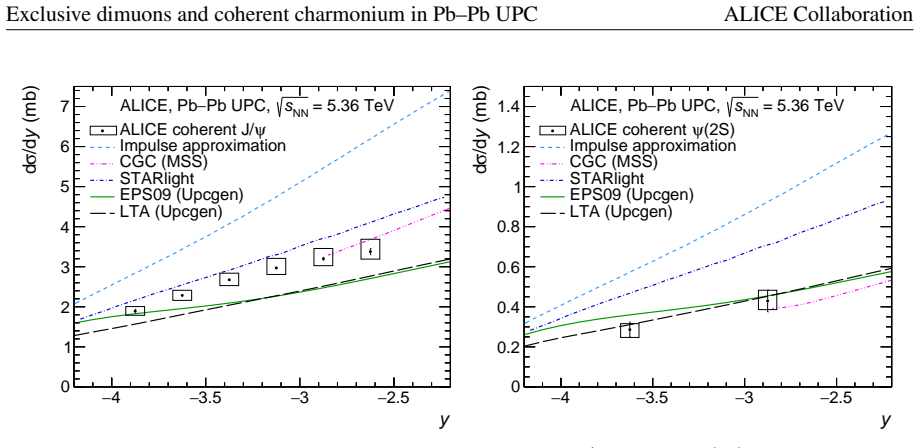
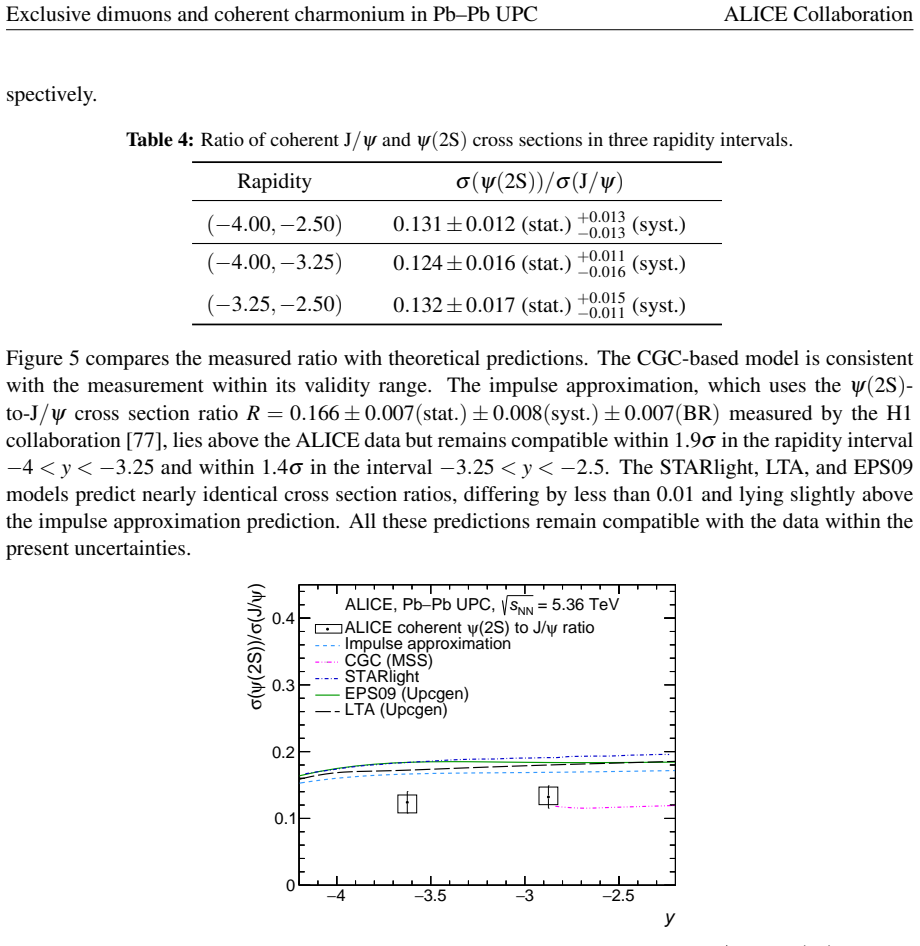
Nuclear shadowing reduces coherent J/ψ and ψ(2S) photoproduction cross sections to roughly 76% and 71% of impulse-approximation predictions at forward rapidity.
A machine-rendered reading of the paper's core claim, the machinery that carries it, and where it could break.
Core claim
The square root of the ratio of the measured quarkonium cross section to the impulse approximation prediction is about 0.76 for J/ψ and 0.71 for ψ(2S), at y ≈ -3, corresponding to typical Bjorken-x values of 10^{-2}. The exclusive dimuon results highlight the sensitivity of such measurements to precise modeling of the photon flux, particularly at impact parameters near the nuclear radius.
What carries the argument
The square root of the ratio of measured coherent photoproduction cross section to the impulse-approximation prediction, which quantifies the nuclear shadowing factor.
If this is right
- Nuclear shadowing must be included in calculations of coherent vector-meson production in heavy-ion collisions.
- The extracted ratios supply direct constraints on nuclear gluon distributions at x ≈ 10^{-2}.
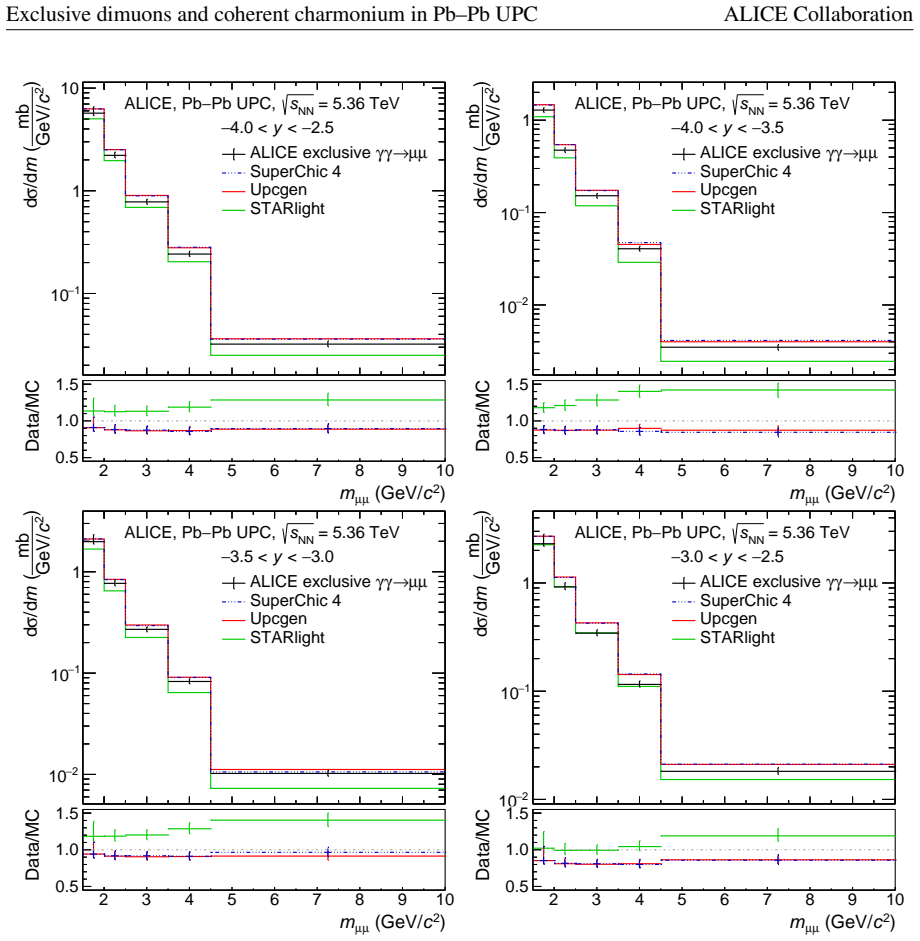
- Exclusive dimuon spectra test the accuracy of photon-flux models near the nuclear surface.
- The results extend existing data to a new collision energy and forward rapidity interval.
Where Pith is reading between the lines
- Similar suppression factors are likely to appear in other vector-meson channels at comparable x.
- The measurements could serve as input for global fits of nuclear parton distributions that also incorporate LHC heavy-ion data.
- Refined photon-flux modeling informed by the dimuon results may affect predictions for electromagnetic dissociation and two-photon processes.
Load-bearing premise
The measured events are assumed to arise purely from coherent photoproduction and the impulse approximation without nuclear effects is taken as the correct reference baseline.
What would settle it
A new measurement at the same kinematics that returns a shadowing ratio consistent with unity would falsify the reported suppression.
Figures
read the original abstract
This Paper presents rapidity-differential measurements of coherent J/$\psi$ and $\psi({\rm 2S})$ photoproduction, as well as rapidity- and mass-differential measurements of exclusive dimuon production, in the forward rapidity region $-4 < y < -2.5$ in ultra-peripheral Pb$-$Pb collisions at $\sqrt{s_{\rm NN}}=5.36$ TeV using data recorded by the ALICE detector at the LHC in 2023, corresponding to an integrated luminosity of $\mathcal{L} = 1170 \pm 50~\mu{\rm b}^{-1}$. The J/$\psi$ and $\psi({\rm 2S})$ results reveal the significant role of nuclear shadowing effects. The square root of the ratio of the measured quarkonium cross section to the impulse approximation prediction is about 0.76 for J/$\psi$ and 0.71 for $\psi({\rm 2S})$, at $y \approx -3$, corresponding to typical Bjorken-$x$ values of $10^{-2}$. The exclusive dimuon results highlight the sensitivity of such measurements to precise modeling of the photon flux, particularly at impact parameters near the nuclear radius.
Editorial analysis
A structured set of objections, weighed in public.
Referee Report
Summary. This manuscript reports rapidity-differential cross sections for coherent J/ψ and ψ(2S) photoproduction as well as rapidity- and mass-differential exclusive dimuon production in the forward region −4 < y < −2.5 in ultra-peripheral Pb–Pb collisions at √s_NN = 5.36 TeV with the ALICE detector (L = 1170 ± 50 μb⁻¹). The central results are the extracted ratios of measured quarkonium cross sections to impulse-approximation predictions, whose square roots are stated to be approximately 0.76 (J/ψ) and 0.71 (ψ(2S)) at y ≈ −3 (x ≈ 10⁻²), interpreted as evidence for nuclear shadowing; the dimuon channel is noted to be sensitive to photon-flux modeling near the nuclear radius.
Significance. If the data selection, background subtraction, and systematic uncertainties are robust, the measurements supply new experimental constraints on coherent photoproduction at a previously unmeasured energy, directly probing nuclear gluon distributions at x ∼ 10⁻². The reported ratios and the explicit sensitivity of the dimuon channel to photon-flux modeling constitute falsifiable inputs for nuclear PDF fits and for modeling of ultra-peripheral collisions.
major comments (2)
- [Abstract] Abstract: the interpretation that the quoted square-root ratios demonstrate nuclear shadowing assumes both (i) that the selected sample is purely coherent photoproduction and (ii) that the impulse approximation without nuclear effects supplies the correct baseline. The manuscript must demonstrate in the analysis section how coherent purity is quantified and how the impulse-approximation prediction is computed (including any references to the specific theoretical calculation employed).
- [Abstract] Abstract: the dimuon results are stated to highlight sensitivity to photon-flux modeling at impact parameters near the nuclear radius, yet no quantitative statement is given on the size of the modeling uncertainty relative to the statistical precision of the measurement. This uncertainty must be evaluated explicitly if the dimuon channel is to be used to validate the photon-flux description underlying the quarkonium ratios.
minor comments (2)
- The integrated luminosity is quoted with a ±50 μb⁻¹ uncertainty; confirm that this uncertainty (and all other systematics) is propagated into the final ratios and their uncertainties.
- Clarify the precise kinematic cuts and invariant-mass windows used for the J/ψ and ψ(2S) signals and for the dimuon continuum.
Simulated Author's Rebuttal
We thank the referee for the positive assessment and the recommendation for minor revision. We address each major comment below.
read point-by-point responses
-
Referee: [Abstract] Abstract: the interpretation that the quoted square-root ratios demonstrate nuclear shadowing assumes both (i) that the selected sample is purely coherent photoproduction and (ii) that the impulse approximation without nuclear effects supplies the correct baseline. The manuscript must demonstrate in the analysis section how coherent purity is quantified and how the impulse-approximation prediction is computed (including any references to the specific theoretical calculation employed).
Authors: The analysis section already specifies the coherent selection via the forward muon spectrometer, neutron emission vetoes, and absence of additional activity to quantify sample purity. The impulse-approximation baseline is obtained from the STARlight Monte Carlo (referenced in the paper) which implements the standard IA without nuclear effects. To address the referee's point directly, we will add explicit cross-references and a short paragraph in the revised analysis section restating the purity quantification and the exact IA implementation used. revision: yes
-
Referee: [Abstract] Abstract: the dimuon results are stated to highlight sensitivity to photon-flux modeling at impact parameters near the nuclear radius, yet no quantitative statement is given on the size of the modeling uncertainty relative to the statistical precision of the measurement. This uncertainty must be evaluated explicitly if the dimuon channel is to be used to validate the photon-flux description underlying the quarkonium ratios.
Authors: We agree that the manuscript does not provide a direct numerical comparison of photon-flux modeling uncertainty to the dimuon statistical precision. In the revised version we will add this evaluation: we will vary the nuclear radius parameter in the photon-flux calculation, propagate the resulting cross-section variation, and quote it relative to the statistical uncertainties in the dimuon rapidity and mass bins. This will be included in the results section and referenced from the abstract. revision: yes
Circularity Check
No significant circularity in experimental measurement paper
full rationale
This is a pure experimental measurement paper reporting cross sections and ratios extracted directly from ALICE detector data in Pb-Pb collisions. The central results (e.g., sqrt(measured cross section / impulse approximation)) are data-driven comparisons to an external theoretical baseline; no derivation chain, parameter fit, or self-citation reduces the quoted numbers to the paper's own inputs by construction. The paper is self-contained against external benchmarks.
Axiom & Free-Parameter Ledger
free parameters (1)
- integrated luminosity =
1170 ± 50 μb^{-1}
axioms (1)
- domain assumption The impulse approximation without nuclear modifications is the appropriate reference for extracting shadowing ratios from photoproduction data.
Reference graph
Works this paper leans on
-
[1]
Physics of Ultra-Peripheral Nuclear Collisions
C. A. Bertulani, S. R. Klein, and J. Nystrand, “Physics of ultra-peripheral nuclear collisions”,Ann. Rev. Nucl. Part. Sci.55(2005) 271–310,arXiv:nucl-ex/0502005
work page internal anchor Pith review Pith/arXiv arXiv 2005
-
[2]
V . Guzey, M. Strikman, and M. Zhalov, “Nucleon dissociation and incoherent J/ψ photoproduction on nuclei in ion ultraperipheral collisions at the Large Hadron Collider”,Phys. Rev. C99(2019) 015201,arXiv:1808.00740 [hep-ph]
work page internal anchor Pith review Pith/arXiv arXiv 2019
-
[3]
Diffractive J/ψelectroproduction in LLA QCD
M. G. Ryskin, “Diffractive J/ψelectroproduction in LLA QCD”,Z. Phys. C57(1993) 89–92
1993
-
[4]
QCD evolution of the gluon density in a nucleus
A. L. Ayala, M. B. Gay Ducati, and E. M. Levin, “QCD evolution of the gluon density in a nucleus”,Nucl. Phys. B493(1997) 305–353,arXiv:hep-ph/9604383
work page internal anchor Pith review Pith/arXiv arXiv 1997
-
[5]
How to include exclusive J/ψproduction data in global PDF analyses
C. A. Flett, S. P. Jones, A. D. Martin, M. G. Ryskin, and T. Teubner, “How to include exclusive J/ψproduction data in global PDF analyses”,Phys. Rev. D101(2020) 094011, arXiv:1908.08398 [hep-ph]
-
[6]
K. J. Eskola, C. A. Flett, V . Guzey, T. Löytäinen, and H. Paukkunen, “Exclusive J/ψ photoproduction in ultraperipheral Pb+Pb collisions at the CERN Large Hadron Collider calculated at next-to-leading order perturbative QCD”,Phys. Rev. C106(2022) 035202, arXiv:2203.11613 [hep-ph]
-
[7]
C. A. Flett, J. P. Lansberg, S. Nabeebaccus, M. Nefedov, P. Sznajder, and J. Wagner, “Exclusive vector-quarkonium photoproduction at NLO inα s in collinear factorisation with evolution of the generalised parton distributions and high-energy resummation”,Phys. Lett. B859(2024) 139117, arXiv:2409.05738 [hep-ph]
-
[8]
V . Guzey, E. Kryshen, M. Strikman, and M. Zhalov, “Evidence for nuclear gluon shadowing from the ALICE measurements of PbPb ultraperipheral exclusive J/ψproduction”,Phys. Lett. B726 (2013) 290–295,arXiv:1305.1724 [hep-ph]
work page internal anchor Pith review Pith/arXiv arXiv 2013
-
[9]
V . Guzey, E. Kryshen, and M. Zhalov, “Coherent photoproduction of vector mesons in ultraperipheral heavy ion collisions: Update for run 2 at the CERN Large Hadron Collider”,Phys. Rev. C93(2016) 055206,arXiv:1602.01456 [nucl-th]
work page internal anchor Pith review Pith/arXiv arXiv 2016
-
[10]
EPS09 - a New Generation of NLO and LO Nuclear Parton Distribution Functions
K. J. Eskola, H. Paukkunen, and C. A. Salgado, “EPS09: a new generation of NLO and LO nuclear parton distribution functions”,JHEP04(2009) 065,arXiv:0902.4154 [hep-ph]. 16 Exclusive dimuons and coherent charmonium in Pb–Pb UPC ALICE Collaboration
work page internal anchor Pith review Pith/arXiv arXiv 2009
-
[11]
Leading twist nuclear shadowing phenomena in hard processes with nuclei
L. Frankfurt, V . Guzey, and M. Strikman, “Leading twist nuclear shadowing phenomena in hard processes with nuclei”,Phys. Rept.512(2012) 255–393,arXiv:1106.2091 [hep-ph]
work page internal anchor Pith review Pith/arXiv arXiv 2012
-
[12]
Energy dependent nuclear suppression from gluon saturation in exclusive vector meson production
H. Mäntysaari, F. Salazar, and B. Schenke, “Energy dependent nuclear suppression from gluon saturation in exclusive vector meson production”,Phys. Rev. D109(2024) L071504, arXiv:2312.04194 [hep-ph]
-
[13]
The Hadronic Final State at HERA
P. Newman and M. Wing, “The Hadronic Final State at HERA”,Rev. Mod. Phys.86(2014) 1037, arXiv:1308.3368 [hep-ex]. [14]ALICECollaboration, B. B. Abelevet al., “Exclusive J/ψphotoproduction off protons in ultra-peripheral p-Pb collisions at √sNN =5.02 TeV”,Phys. Rev. Lett.113(2014) 232504, arXiv:1406.7819 [nucl-ex]. [15]ALICECollaboration, S. Acharyaet al.,...
work page internal anchor Pith review Pith/arXiv arXiv 2014
-
[14]
Collision of two light quanta
G. Breit and J. A. Wheeler, “Collision of two light quanta”,Phys. Rev.46(1934) 1087–1091
1934
-
[15]
Acoplanarity of Lepton Pair to Probe the Electromagnetic Property of Quark Matter
S. Klein, A. H. Mueller, B.-W. Xiao, and F. Yuan, “Acoplanarity of a lepton pair to probe the electromagnetic property of quark matter”,Phys. Rev. Lett.122(2019) 132301, arXiv:1811.05519 [hep-ph]
work page internal anchor Pith review Pith/arXiv arXiv 2019
-
[16]
S. Klein, A. H. Mueller, B.-W. Xiao, and F. Yuan, “Lepton pair production through two photon process in heavy ion collisions”,Phys. Rev. D102(2020) 094013,arXiv:2003.02947 [hep-ph]
-
[17]
Exclusive and inclusive muon pair production in collisions of relativistic nuclei
K. Hencken, E. A. Kuraev, and V . Serbo, “Exclusive and inclusive muon pair production in collisions of relativistic nuclei”,Phys. Rev. C75(2007) 034903,arXiv:hep-ph/0606069
work page internal anchor Pith review Pith/arXiv arXiv 2007
-
[18]
Discovery of higher-order quantum electrodynamics effect for the vacuum pair production
W. Zha and Z. Tang, “Discovery of higher-order quantum electrodynamics effect for the vacuum pair production”,JHEP08(2021) 083,arXiv:2103.04605 [hep-ph]
-
[19]
Two-Photon Interactions with Nuclear Breakup in Relativistic Heavy Ion Collisions
A. J. Baltz, Y . Gorbunov, S. R. Klein, and J. Nystrand, “Two-Photon Interactions with Nuclear Breakup in Relativistic Heavy Ion Collisions”,Phys. Rev. C80(2009) 044902, arXiv:0907.1214 [nucl-ex]
work page internal anchor Pith review Pith/arXiv arXiv 2009
-
[20]
STARlight: A Monte Carlo simulation program for ultra-peripheral collisions of relativistic ions
S. R. Klein, J. Nystrand, J. Seger, Y . Gorbunov, and J. Butterworth, “STARlight: A Monte Carlo simulation program for ultra-peripheral collisions of relativistic ions”,Comput. Phys. Commun. 212(2017) 258–268,arXiv:1607.03838 [hep-ph]
work page internal anchor Pith review Pith/arXiv arXiv 2017
-
[21]
J. D. Jackson,Classical electrodynamics. Wiley, New York, 3rd ed., 2021. ISBN: 9780471309321. 18 Exclusive dimuons and coherent charmonium in Pb–Pb UPC ALICE Collaboration
2021
-
[22]
Exclusive LHC physics with heavy ions: SuperChic 3
L. A. Harland-Lang, V . A. Khoze, and M. G. Ryskin, “Exclusive LHC physics with heavy ions: SuperChic 3”,Eur . Phys. J. C79(2019) 39,arXiv:1810.06567 [hep-ph]
work page internal anchor Pith review Pith/arXiv arXiv 2019
-
[23]
L. A. Harland-Lang, M. Tasevsky, V . A. Khoze, and M. G. Ryskin, “A new approach to modelling elastic and inelastic photon-initiated production at the LHC: SuperChic 4”,Eur . Phys. J. C80 (2020) 925,arXiv:2007.12704 [hep-ph]
-
[24]
N. Burmasov, E. Kryshen, P. Buehler, and R. Lavicka, “Upcgen: A Monte Carlo simulation program for dilepton pair production in ultra-peripheral collisions of heavy ions”,Comput. Phys. Commun.277(2022) 108388,arXiv:2111.11383 [hep-ph]
-
[25]
N. Burmasov and E. Kryshen, “Update on Upcgen, an event generator for two-photon and photoproduction processes in ultraperipheral collisions”,Int. J. Mod. Phys. E.(2026) 2641023. [46]ALICECollaboration, E. Abbaset al., “Charmonium ande +e− pair photoproduction at mid-rapidity in ultra-peripheral Pb–Pb collisions at √sNN=2.76 TeV”,Eur . Phys. J. C73(2013) ...
work page internal anchor Pith review Pith/arXiv arXiv 2026
-
[26]
Elastic photon-initiated production at the LHC: the role of hadron-hadron interactions
L. A. Harland-Lang, V . A. Khoze, and M. G. Ryskin, “Elastic photon-initiated production at the LHC: the role of hadron-hadron interactions”,SciPost Phys.11(2021) 064,arXiv:2104.13392 [hep-ph]. [53]ALICECollaboration, K. Aamodtet al., “The ALICE experiment at the CERN LHC”,JINST3 (2008) S08002. [54]ALICECollaboration, S. Acharyaet al., “ALICE upgrades dur...
-
[27]
The zero degree calorimeters for the ALICE experiment
R. Arnaldiet al., “The zero degree calorimeters for the ALICE experiment”,Nucl. Instrum. Meth. A581(2007) 397–401. [Erratum: Nucl.Instrum.Meth.A 604, 765 (2009)]
2007
-
[28]
Physics performance of the ALICE zero degree calorimeter
C. Oppedisanoet al., “Physics performance of the ALICE zero degree calorimeter”,Nucl. Phys. B Proc. Suppl.197(2009) 206–210
2009
-
[29]
Mutual heavy ion dissociation in peripheral collisions at ultrarelativistic energies
I. A. Pshenichnov, J. P. Bondorf, I. N. Mishustin, A. Ventura, and S. Masetti, “Mutual heavy ion dissociation in peripheral collisions at ultrarelativistic energies”,Phys. Rev. C64(2001) 024903, arXiv:nucl-th/0101035
work page internal anchor Pith review Pith/arXiv arXiv 2001
-
[30]
Electromagnetic excitation and fragmentation of ultrarelativistic nuclei
I. A. Pshenichnov, “Electromagnetic excitation and fragmentation of ultrarelativistic nuclei”, Phys. Part. Nucl.42(2011) 215–250. [62]ALICECollaboration, S. Acharyaet al., “ALICE luminosity determination for Pb–Pb collisions at √sNN =5.02 TeV”,JINST19(2024) P02039,arXiv:2204.10148 [nucl-ex]. [63]ALICECollaboration, S. Acharyaet al., “Neutron emission in u...
-
[31]
Improved version of the PHOBOS Glauber Monte Carlo
C. Loizides, J. Nagle, and P. Steinberg, “Improved version of the PHOBOS Glauber Monte Carlo”,SoftwareX1-2(2015) 13–18,arXiv:1408.2549 [nucl-ex]
work page internal anchor Pith review Pith/arXiv arXiv 2015
-
[32]
Glauber modeling of high-energy nuclear collisions at sub-nucleon level
C. Loizides, “Glauber modeling of high-energy nuclear collisions at the subnucleon level”,Phys. Rev. C94(2016) 024914,arXiv:1603.07375 [nucl-ex]
work page internal anchor Pith review Pith/arXiv arXiv 2016
-
[33]
Improved Monte Carlo Glauber predictions at present and future nuclear colliders
C. Loizides, J. Kamin, and D. d’Enterria, “Improved Monte Carlo Glauber predictions at present and future nuclear colliders”,Phys. Rev. C97(2018) 054910,arXiv:1710.07098 [nucl-ex]. [Erratum: Phys.Rev.C 99, 019901 (2019)]. [68]ALICECollaboration, G. Chabratovaet al., “Development of the Kalman filter for tracking in the forward muon spectrometer of ALICE”,...
work page internal anchor Pith review Pith/arXiv arXiv 2018
-
[34]
Elastic and Proton-Dissociative Photoproduction of J/psi Mesons at HERA
J. E. Gaiser, “Charmonium spectroscopy from radiative decays of the J/ψandψ ′”, SLAC-0255, UMI-83-14449-MC, SLAC-R-0255, SLAC-R-255. [75]Particle Data GroupCollaboration, S. Navaset al., “Review of particle physics”,Phys. Rev. D 110(2024) 030001. 20 Exclusive dimuons and coherent charmonium in Pb–Pb UPC ALICE Collaboration [76]H1Collaboration, C. Alexaet ...
work page internal anchor Pith review Pith/arXiv arXiv 2024
-
[35]
Photon-Photon Physics in Very Peripheral Collisions of Relativistic Heavy Ions
G. Baur, K. Hencken, and D. Trautmann, “Photon-photon physics in very peripheral collisions of relativistic heavy ions”,J. Phys. G24(1998) 1657–1692,arXiv:hep-ph/9804348. [80]ALICECollaboration, J. Adamet al., “Measurement of an excess in the yield of J/ψat very low pT in Pb–Pb collisions at √sNN = 2.76 TeV”,Phys. Rev. Lett.116(2016) 222301, arXiv:1509.08...
work page internal anchor Pith review Pith/arXiv arXiv 1998
-
[36]
Exclusive Vector Meson Production in Relativistic Heavy Ion Collisions
S. Klein and J. Nystrand, “Exclusive vector meson production in relativistic heavy ion collisions”, Phys. Rev. C60(1999) 014903,arXiv:hep-ph/9902259. 21 Exclusive dimuons and coherent charmonium in Pb–Pb UPC ALICE Collaboration A The ALICE Collaboration D.A.H. Abdallah 134, I.J. Abualrob 112, S. Acharya 49, K. Agarwal II,23, G. Aglieri Rinella 32, L. Agli...
work page internal anchor Pith review Pith/arXiv arXiv 1999
discussion (0)
Sign in with ORCID, Apple, or X to comment. Anyone can read and Pith papers without signing in.