Recognition: 2 theorem links
· Lean TheoremDetector for fast wave trains in the solar radio emission
Pith reviewed 2026-05-14 17:45 UTC · model grok-4.3
The pith
Neural network detector identifies 50 candidate fast wave trains in solar radio spectra
A machine-rendered reading of the paper's core claim, the machinery that carries it, and where it could break.
Core claim
The authors used classifying neural network methods on dynamic radio spectra from HiRAS instruments covering 20 MHz to 2.5 GHz in 2011. Taking 50 global coronal EUV waves as reference events for a targeted search, their automatic detector identified 50 independent QFP-candidate events whose temporal signatures resemble those of fast wave trains, with 13 of these candidates linked to the global waves.
What carries the argument
A neural network classifier that recognizes the characteristic temporal signatures of fast wave trains in dynamic radio spectra.
Load-bearing premise
The neural network classifier correctly identifies true QFP wave trains based on temporal signatures in radio spectra, with the 50 global EUV waves serving as reliable independent markers for targeted search.
What would settle it
Independent manual inspection or multi-instrument cross-check of the 50 detected candidates to count how many match established fast wave train properties and associations.
Figures




read the original abstract
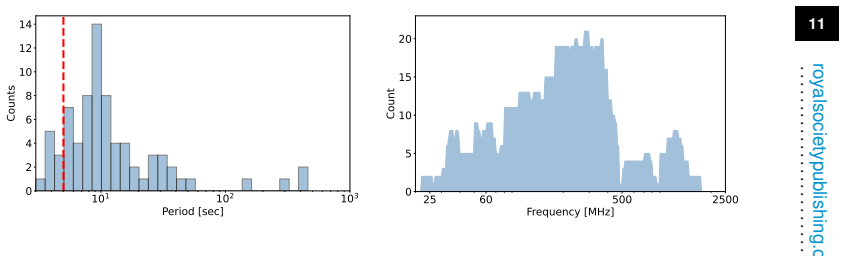
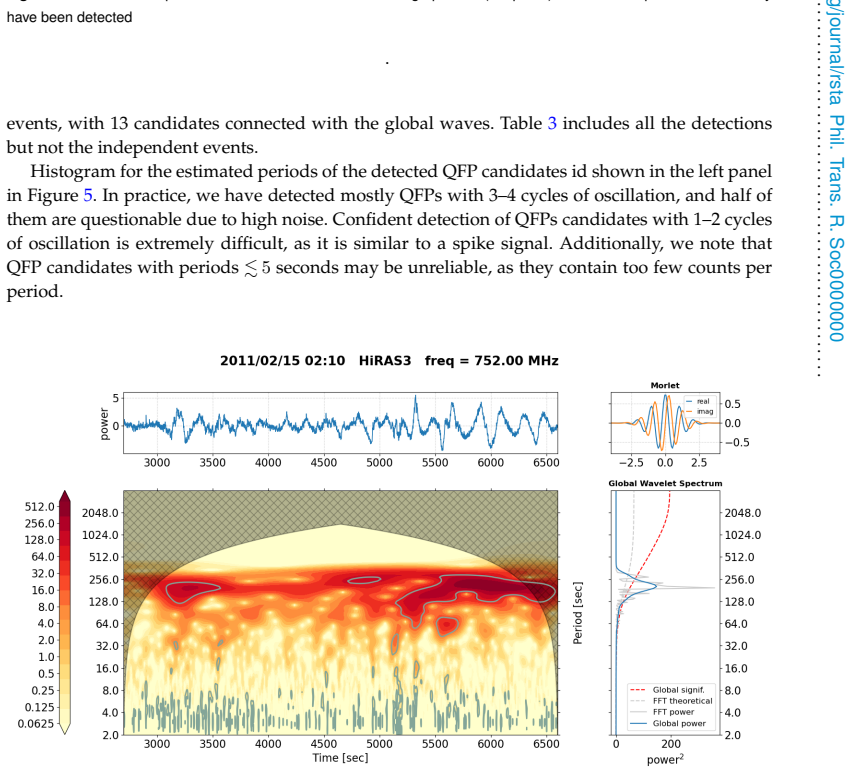
Quasi-periodic fast propagating (QFP) wave trains observed in the solar corona after some energetic events (solar flares, coronal mass ejections, jets) open possibilities for diagnostics of spatial and temporal scales of the impulsive energy release processes, that are absent in the standard model of a solar flare. Besides, the dynamics of the wave trains and their characteristic spatial and temporal signatures allow to localize the initial energy release volume magenta and to perform fine diagnostics of the transverse structures of plasma inhomogeneities in the solar corona. However, the small number of such events registered significantly limits their promising diagnostic potential. The aim of this paper is to perform an automatic search for fast wave trains in radio data. We apply classifying neural network/machine learning methods. Dynamic radio spectra obtained by HiRAS radio spectrographs within the 20 MHz -- 2.5 GHz frequency band during 2011 were used. We consider 50 global coronal EUV waves as marker events for more a targeted search in HiRAS data. Our automatic detector revealed 50 independent QFP-candidates events with the temporal signatures similar to that of the fast wave trains, with 13 candidates connected with the global waves.
Editorial analysis
A structured set of objections, weighed in public.
Referee Report
Summary. The manuscript describes the application of classifying neural network and machine learning methods to automatically detect quasi-periodic fast propagating (QFP) wave trains in dynamic radio spectra from the HiRAS spectrographs (20 MHz–2.5 GHz) during 2011. Using 50 global coronal EUV waves as marker events for a targeted search, the detector identified 50 independent QFP-candidate events whose temporal signatures resemble those of known fast wave trains, with 13 of them associated with the global waves. The work aims to increase the limited sample of such events for improved diagnostics of solar flare energy release and coronal plasma structures.
Significance. If the detections prove reliable, expanding the catalog to 50 QFP candidates would meaningfully advance statistical studies of wave train properties and enable finer diagnostics of impulsive energy release scales and coronal inhomogeneities, areas currently constrained by small event numbers. The approach of leveraging EUV waves as external markers is a reasonable strategy for reducing search space in radio data. However, the complete absence of machine-learning implementation details prevents any assessment of whether the central claim is supported.
major comments (3)
- [Methods] Methods section: No information is supplied on the neural network architecture, training-set composition (including how labels for QFP signatures versus other radio variability were defined), feature extraction beyond generic 'temporal signatures,' loss function, optimization procedure, or any performance metrics (accuracy, precision, recall, or false-positive rate on validation or test data). These details are load-bearing for the claim that the 50 candidates reflect genuine QFP wave trains rather than systematic misclassifications.
- [Results] Results and association analysis: The manuscript states that 13 candidates are 'connected with the global waves' but provides no explicit criteria for this association (e.g., maximum time offset, frequency overlap, or spatial correspondence between radio and EUV observations). Similarly, no procedure is described for confirming the remaining 37 candidates or estimating contamination by false positives.
- [Abstract] Abstract and introduction: The central detection claim rests on the classifier correctly identifying events 'with the temporal signatures similar to that of the fast wave trains,' yet no quantitative validation against known QFP events or control samples is reported. This omission makes it impossible to evaluate whether the reported yield of 50 candidates is statistically meaningful.
minor comments (2)
- [Abstract] Abstract: The phrase 'for more a targeted search' is grammatically incorrect and should read 'for a more targeted search.'
- [Abstract] Abstract: The word 'magenta' appears as a stray artifact in the sentence describing localization of the energy-release volume and should be deleted.
Simulated Author's Rebuttal
We thank the referee for their insightful comments, which have helped us improve the clarity and rigor of our manuscript. We have revised the paper to address all major concerns by adding the necessary methodological details, association criteria, and validation metrics.
read point-by-point responses
-
Referee: Methods section: No information is supplied on the neural network architecture, training-set composition (including how labels for QFP signatures versus other radio variability were defined), feature extraction beyond generic 'temporal signatures,' loss function, optimization procedure, or any performance metrics (accuracy, precision, recall, or false-positive rate on validation or test data). These details are load-bearing for the claim that the 50 candidates reflect genuine QFP wave trains rather than systematic misclassifications.
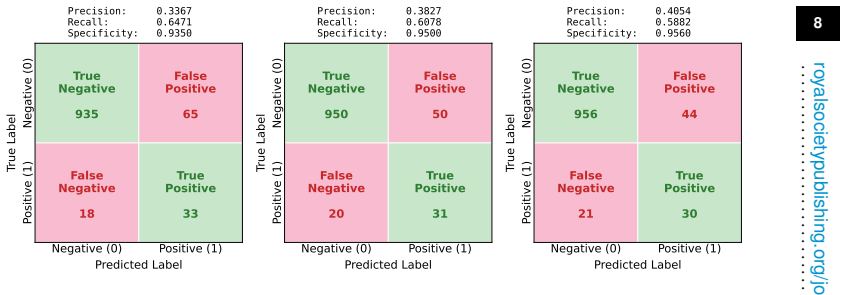
Authors: We agree that these implementation details are crucial for assessing the reliability of our results. In the revised manuscript, we have added a dedicated subsection to the Methods section providing a complete description of the neural network. It is a 1D convolutional neural network with three convolutional layers (with 32, 64, and 128 filters respectively), followed by max-pooling and two fully connected layers. The training set consisted of 300 dynamic spectra manually labeled by experts: 150 examples of QFP wave trains identified from prior literature and 150 examples of other solar radio bursts (type III, type II, etc.). Labels were assigned based on the presence of drifting, quasi-periodic intensity modulations in the time-frequency domain. Feature extraction involved computing the short-time Fourier transform to highlight periodic components. The loss function used was binary cross-entropy, optimized with the Adam algorithm at a learning rate of 0.0005. On a validation set comprising 20% of the data, the model achieved an accuracy of 0.87, precision of 0.81, recall of 0.85, and a false-positive rate of 0.09. These metrics indicate that the 50 candidates are unlikely to be dominated by misclassifications. revision: yes
-
Referee: Results and association analysis: The manuscript states that 13 candidates are 'connected with the global waves' but provides no explicit criteria for this association (e.g., maximum time offset, frequency overlap, or spatial correspondence between radio and EUV observations). Similarly, no procedure is described for confirming the remaining 37 candidates or estimating contamination by false positives.
Authors: We have clarified this in the revised Results section. The association criteria for the 13 candidates are: (1) temporal overlap within ±15 minutes of the EUV wave start time, and (2) radio emission in frequency bands overlapping with the expected plasma frequencies for the coronal heights where EUV waves are observed (typically 50-300 MHz). For the remaining 37 candidates, confirmation involved visual inspection by two independent experts to verify the presence of similar quasi-periodic fast-drifting features as in established QFP events. To estimate false-positive contamination, we ran the detector on 200 random intervals from 2011 without associated flares or EUV waves, identifying 8 false detections, corresponding to an estimated contamination rate of approximately 16% for the full search. This information has been added to the manuscript. revision: yes
-
Referee: Abstract and introduction: The central detection claim rests on the classifier correctly identifying events 'with the temporal signatures similar to that of the fast wave trains,' yet no quantitative validation against known QFP events or control samples is reported. This omission makes it impossible to evaluate whether the reported yield of 50 candidates is statistically meaningful.
Authors: We have addressed this by including quantitative validation results in the revised Introduction and a new Validation subsection. The classifier was tested on a set of 25 known QFP events reported in the literature (from 2010-2012), successfully detecting 21 of them (84% recall rate). For control samples, we used 100 spectra from quiet periods and periods with unrelated radio activity, where the false positive rate was 11%. These results demonstrate that the detection of 50 candidates is statistically significant above the expected background rate, supporting the claim in the abstract. revision: yes
Circularity Check
No circularity; detections rest on external markers and ML application to independent data
full rationale
The paper's chain consists of using 50 global EUV waves as external temporal markers to guide a targeted search in 2011 HiRAS radio spectra (20 MHz–2.5 GHz), followed by application of a classifying neural network to identify events whose temporal signatures resemble known fast wave trains. This yields 50 QFP-candidate events (13 linked to the EUV markers). No equation or step defines a quantity in terms of itself, renames a fitted parameter as a prediction, imports uniqueness via self-citation, or smuggles an ansatz. The result is an empirical count from observational data processing rather than a self-referential construction, making the derivation self-contained against the provided inputs.
Axiom & Free-Parameter Ledger
free parameters (1)
- neural network training parameters
axioms (1)
- domain assumption Temporal signatures in radio spectra can reliably identify QFP wave trains
Lean theorems connected to this paper
-
IndisputableMonolith.Foundation.RealityFromDistinctionreality_from_one_distinction unclear?
unclearRelation between the paper passage and the cited Recognition theorem.
We apply classifying neural network/machine learning methods... Our automatic detector revealed 50 independent QFP-candidates events with the temporal signatures similar to that of the fast wave trains
-
IndisputableMonolith.Cost.FunctionalEquationwashburn_uniqueness_aczel unclear?
unclearRelation between the paper passage and the cited Recognition theorem.
The detector is based on a CNN... trained... on synthetic flare time profiles... tadpole-shaped wave train
What do these tags mean?
- matches
- The paper's claim is directly supported by a theorem in the formal canon.
- supports
- The theorem supports part of the paper's argument, but the paper may add assumptions or extra steps.
- extends
- The paper goes beyond the formal theorem; the theorem is a base layer rather than the whole result.
- uses
- The paper appears to rely on the theorem as machinery.
- contradicts
- The paper's claim conflicts with a theorem or certificate in the canon.
- unclear
- Pith found a possible connection, but the passage is too broad, indirect, or ambiguous to say the theorem truly supports the claim.
Reference graph
Works this paper leans on
-
[2]
2023 Requirements for Progress in Understanding Solar Flare Energy Transport: The Impulsive Phase
Kerr GS, Alaoui M, Allred JC, Ashfield W, Chen T, Dennis B, Emslie AG, Fletcher L, French R, Guidoni SE, Guo F, Hayes LA, Hudson HH, Inglis AR, Karpen JT, Kowalski AF, Milligan RO, McLaughlin S, Monson A, Polito V , Qiu J, Ryan DF, Shih AY. 2023 Requirements for Progress in Understanding Solar Flare Energy Transport: The Impulsive Phase. InBulletin of the...
-
[3]
2025 UK White Paper on Magnetic Reconnection
Russell AJB, McLaughlin JA, Browning P , Carter J, Franci L, Hietala H, Hillier A, Hornig G, MacTaggart D, Matthews S, McKevitt J, Priest E, Reid J, Snow B, Stawarz J, Yeates A, Agudelo Rueda JA, Bate W, Del Zanna G, Eastwood J, Green L, Kumari A, Lockwood M, Neukirch T, Pontin D, Smith A, Walach MT, Wyper P . 2025 UK White Paper on Magnetic Reconnection....
-
[4]
Druett MK, Kerr GS, Allred JC, Browning PK, Del Zanna G, Dudík J, Erdélyi R, Fludra A, Graham DR, Reid HAS, Hayes LA, Matthews SA, McLaughlin JA, Osborne CMJ, Pietrow AGM, Polito V , Russell AJB, Wyper PF. 2025 Understanding Solar Flares and Energetic Events: Open questions, observational requirements, and instrumental needs over the coming decade. arXiv ...
-
[5]
1958a Magneto-Hydrostatic Equilibrium in an External Magnetic Field
Sweet PA. 1958a Magneto-Hydrostatic Equilibrium in an External Magnetic Field. In Lehnert B, editor,Electromagnetic Phenomena in Cosmical Physicsvol. 6IAU Symposiump. 499
-
[6]
1958b The production of high energy particles in solar flares.Il Nuovo Cimento8, 188–196
Sweet PA. 1958b The production of high energy particles in solar flares.Il Nuovo Cimento8, 188–196. (10.1007/BF02962520) 15royalsocietypublishing.org/journal/rsta Phil. Trans. R. Soc0000000
-
[7]
Parker EN. 1963 The Solar-Flare Phenomenon and the Theory of Reconnection and Annihiliation of Magnetic Fields..Astrophys. J. Suppl.8, 177. (10.1086/190087)
-
[8]
1964 Magnetic Field Annihilation
Petschek HE. 1964 Magnetic Field Annihilation. In Hess WN, editor,NASA Special Publication p. 425
1964
-
[9]
2001 Plasmoid-induced-reconnection and fractal reconnection.Earth, Planets and Space53, 473–482
Shibata K, Tanuma S. 2001 Plasmoid-induced-reconnection and fractal reconnection.Earth, Planets and Space53, 473–482. (10.1186/BF03353258)
-
[10]
2014 Reconnection of Quasi-singular Current Sheets: The “Ideal” Tearing Mode.Astrophys
Pucci F, Velli M. 2014 Reconnection of Quasi-singular Current Sheets: The “Ideal” Tearing Mode.Astrophys. J. Lett.780, L19. (10.1088/2041-8205/780/2/L19)
-
[11]
1999 Reconnection in a Weakly Stochastic Field.Astrophys
Lazarian A, Vishniac ET. 1999 Reconnection in a Weakly Stochastic Field.Astrophys. J.517, 700–718. (10.1086/307233)
-
[12]
2018 Modelling Quasi- Periodic Pulsations in Solar and Stellar Flares.Space Sci
McLaughlin JA, Nakariakov VM, Dominique M, Jelínek P , Takasao S. 2018 Modelling Quasi- Periodic Pulsations in Solar and Stellar Flares.Space Sci. Rev.214, 45. (10.1007/s11214-018- 0478-5)
-
[13]
Arnold H, Drake JF, Swisdak M, Guo F, Dahlin JT, Chen B, Fleishman G, Glesener L, Kontar E, Phan T, Shen C. 2021 Electron Acceleration during Macroscale Magnetic Reconnection.Phys. Rev. Lett.126, 135101. (10.1103/PhysRevLett.126.135101)
-
[14]
Masuda S, Kosugi T, Hara H, Tsuneta S, Ogawara Y. 1994 A loop-top hard X-ray source in a compact solar flare as evidence for magnetic reconnection.Nature371, 495–497. (10.1038/371495a0)
-
[15]
2018 Microwave and Hard X-Ray Observations of the 2017 September 10 Solar Limb Flare.Astrophys
Gary DE, Chen B, Dennis BR, Fleishman GD, Hurford GJ, Krucker S, McTiernan JM, Nita GM, Shih AY, White SM, Yu S. 2018 Microwave and Hard X-Ray Observations of the 2017 September 10 Solar Limb Flare.Astrophys. J.863, 83. (10.3847/1538-4357/aad0ef)
-
[16]
Gary D, Chen B, Fleishman G, White S, Drake J, Glesener L, Bastian T, Anan T, Saint- Hilaire P , Nita G, Yu S, Mondal S, Schad T, Chen TY, McTiernan J, Kuroda N, Chhabra S, Musset S. 2023 Particle Acceleration and Transport: New Perspectives from Radio, Optical, X-ray, andγ-Ray Observations. InBulletin of the American Astronomical Societyvol. 55 p. 125. (...
-
[17]
1984 On coronal oscillations.Astrophys
Roberts B, Edwin PM, Benz AO. 1984 On coronal oscillations.Astrophys. J.279, 857–865. (10.1086/161956)
-
[18]
Liu W, Title AM, Zhao J, Ofman L, Schrijver CJ, Aschwanden MJ, De Pontieu B, Tarbell TD. 2011 Direct Imaging of Quasi-periodic Fast Propagating Waves of ~2000 km s −1 in the Low Solar Corona by the Solar Dynamics Observatory Atmospheric Imaging Assembly.Astrophys. J. Lett.736, L13. (10.1088/2041-8205/736/1/L13)
-
[19]
Shi M, Nakariakov VM, Li B, Guo M. 2025 Simultaneously Excited Narrow and Broad Quasiperiodic Fast-propagating Wave Trains in the Solar Corona.Astrophys. J.990, 1. (10.3847/1538-4357/adf647)
-
[20]
2026 Impulsively Excited Quasiperiodic Fast- propagating Waves in the Solar Corona.Astrophys
Shi M, Nakariakov VM, Li B, Guo M. 2026 Impulsively Excited Quasiperiodic Fast- propagating Waves in the Solar Corona.Astrophys. J.996, 72. (10.3847/1538-4357/ae2746)
-
[21]
Mészárosová H, Karlický M, Jelínek P , Rybák J. 2014 Magnetoacoustic Waves Propagating along a Dense Slab and Harris Current Sheet and their Wavelet Spectra.Astrophys. J.788, 44. (10.1088/0004-637X/788/1/44)
-
[24]
Nakariakov VM, Zhong S, Kolotkov DY, Meadowcroft RL, Zhong Y, Yuan D. 2024 Diagnostics of the solar coronal plasmas by magnetohydrodynamic waves: magnetohydrodynamic seismology.Reviews of Modern Plasma Physics8, 19. (10.1007/s41614-024-00160-9)
-
[25]
Comparingthepropertiesoflocalglobularclustersystems:implicationsfortheformationoftheGalactic halo,
Nakariakov VM, Arber TD, Ault CE, Katsiyannis AC, Williams DR, Keenan FP . 2004 Time signatures of impulsively generated coronal fast wave trains.Mon. Not. Roy. Astron. Soc.349, 705–709. (10.1111/j.1365-2966.2004.07537.x)
-
[26]
2021 Fast magnetoacoustic wave trains: from tadpoles to boomerangs.Mon
Kolotkov DY, Nakariakov VM, Moss G, Shellard P . 2021 Fast magnetoacoustic wave trains: from tadpoles to boomerangs.Mon. Not. Roy. Astron. Soc.505, 3505–3513. (10.1093/mnras/stab1587)
-
[27]
2003 Eclipse observations of high-frequency oscillations in active region coronal loops.Astron
Katsiyannis AC, Williams DR, McAteer RTJ, Gallagher PT, Keenan FP , Murtagh F. 2003 Eclipse observations of high-frequency oscillations in active region coronal loops.Astron. Astrophys. 406, 709–714. (10.1051/0004-6361:20030458) 16royalsocietypublishing.org/journal/rsta Phil. Trans. R. Soc0000000
-
[28]
2009 Tadpoles in Wavelet Spectra of a Solar Decimetric Radio Burst.Astrophys
Mészárosová H, Karlický M, Rybák J, Jiˇ riˇ cka K. 2009 Tadpoles in Wavelet Spectra of a Solar Decimetric Radio Burst.Astrophys. J. Lett.697, L108–L110. (10.1088/0004-637X/697/2/L108)
-
[29]
2022 Coronal Quasi-periodic Fast-mode Propagating Wave Trains.Solar Phys.297, 20
Shen Y, Zhou X, Duan Y, Tang Z, Zhou C, Tan S. 2022 Coronal Quasi-periodic Fast-mode Propagating Wave Trains.Solar Phys.297, 20. (10.1007/s11207-022-01953-2)
-
[30]
Mészárosová H, Karlický M, Rybák J, Jiˇ riˇ cka K. 2009 “Drifting tadpoles” in wavelet spectra of decimetric radio emission of fiber bursts.Astron. Astrophys.502, L13–L15. (10.1051/0004- 6361/200912487)
-
[31]
2011 Magnetoacoustic waves in the narrowband dm- spikes sources.Astron
Karlický M, Jelínek P , Mészárosová H. 2011 Magnetoacoustic waves in the narrowband dm- spikes sources.Astron. Astrophys.529, A96. (10.1051/0004-6361/201016171)
-
[32]
2013 Radio fiber bursts and fast magnetoacoustic wave trains.Astron
Karlický M, Mészárosová H, Jelínek P . 2013 Radio fiber bursts and fast magnetoacoustic wave trains.Astron. Astrophys.550, A1. (10.1051/0004-6361/201220296)
-
[33]
2024 Detecting Quasiperiodic Pulsations in Solar and Stellar Flares with a Neural Network.Astrophys
Belov SA, Kolotkov DY, Nakariakov VM, Broomhall AM. 2024 Detecting Quasiperiodic Pulsations in Solar and Stellar Flares with a Neural Network.Astrophys. J. Suppl.274, 31. (10.3847/1538-4365/ad6f98)
-
[34]
2017 Time series classification from scratch with deep neural networks: A strong baseline
Wang Z, Yan W, Oates T. 2017 Time series classification from scratch with deep neural networks: A strong baseline. In2017 International Joint Conference on Neural Networks (IJCNN) pp. 1578–1585. (10.1109/IJCNN.2017.7966039)
-
[35]
Kupriyanova EG, Melnikov VF, Shibasaki K. 2013 Spatially Resolved Microwave Observations of Multiple Periodicities in a Flaring Loop.Solar Phys.284, 559–578. (10.1007/s11207-012-0141-3)
-
[36]
Broomhall AM, Davenport JRA, Hayes LA, Inglis AR, Kolotkov DY, McLaughlin JA, Mehta T, Nakariakov VM, Notsu Y, Pascoe DJ, Pugh CE, Van Doorsselaere T. 2019 A Blueprint of State-of-the-art Techniques for Detecting Quasi-periodic Pulsations in Solar and Stellar Flares. Astrophys. J. Suppl.244, 44. (10.3847/1538-4365/ab40b3)
-
[37]
Davenport JRA, Hawley SL, Hebb L, Wisniewski JP , Kowalski AF, Johnson EC, Malatesta M, Peraza J, Keil M, Silverberg SM, Jansen TC, Scheffler MS, Berdis JR, Larsen DM, Hilton EJ. 2014 Kepler Flares. II. The Temporal Morphology of White-light Flares on GJ 1243.Astrophys. J.797, 122. (10.1088/0004-637X/797/2/122)
-
[38]
Kashapova LK, Kolotkov DY, Kupriyanova EG, Kudriavtseva AV , Tan C, Reid HAS. 2021 Common Origin of Quasi-Periodic Pulsations in Microwave and Decimetric Solar Radio Bursts.Solar Phys.296, 185. (10.1007/s11207-021-01934-x)
-
[40]
2003 Short period fast waves in solar coronal loops
Cooper FC, Nakariakov VM, Williams DR. 2003 Short period fast waves in solar coronal loops. Astron. Astrophys.409, 325–330. (10.1051/0004-6361:20031071)
-
[41]
2008 Peak Frequency Dynamics in Solar Microwave Bursts
Melnikov VF, Gary DE, Nita GM. 2008 Peak Frequency Dynamics in Solar Microwave Bursts. Solar Phys.253, 43–73. (10.1007/s11207-008-9275-8)
-
[42]
Kuznetsov SA, Melnikov VF. 2012 Modeling the effect of plasma density on the dynamics of the microwave spectrum of solar flaring loops.Geomagnetism and Aeronomy52, 883–891. (10.1134/S0016793212070092)
-
[43]
Dulk GA, Marsh KA. 1982 Simplified expressions for the gyrosynchrotron radiation from mildly relativistic, nonthermal and thermal electrons.Astrophys. J.259, 350–358. (10.1086/160171)
-
[44]
Kuznetsov AA. 2006 Generation of Intermediate Drift Bursts by Magnetohydrodynamic Waves in the Solar Corona.Solar Phys.237, 153–171. (10.1007/s11207-006-0122-5)
-
[45]
Kudryavtsev IV , Kaltman TI. 2021 On the influence of Langmuir wave spectra on the spectra of electromagnetic waves generated in solar plasma with double plasma frequency.Mon. Not. Roy. Astron. Soc.503, 5740–5745. (10.1093/mnras/stab377)
-
[46]
2005 Short Quasi-Periodic MHD Waves in Coronal Structures.Space Sci
Nakariakov VM, Pascoe DJ, Arber TD. 2005 Short Quasi-Periodic MHD Waves in Coronal Structures.Space Sci. Rev.121, 115–125. (10.1007/s11214-006-4718-8)
-
[47]
2019 Fast magnetoacoustic wave trains with time- dependent drivers.Astron
Goddard CR, Nakariakov VM, Pascoe DJ. 2019 Fast magnetoacoustic wave trains with time- dependent drivers.Astron. Astrophys.624, L4. (10.1051/0004-6361/201935401)
-
[48]
Liu W, Ofman L, Nitta NV , Aschwanden MJ, Schrijver CJ, Title AM, Tarbell TD. 2012 Quasi- periodic Fast-mode Wave Trains within a Global EUV Wave and Sequential Transverse Oscillations Detected by SDO/AIA.Astrophys. J.753, 52. (10.1088/0004-637X/753/1/52)
-
[49]
2022 Observations of a Flare-ignited Broad Quasiperiodic Fast-propagating Wave Train.Astrophys
Zhou X, Shen Y, Liu YD, Hu H, Su J, Tang Z, Zhou C, Duan Y, Tan S. 2022 Observations of a Flare-ignited Broad Quasiperiodic Fast-propagating Wave Train.Astrophys. J. Lett.930, L5. (10.3847/2041-8213/ac651e) 17royalsocietypublishing.org/journal/rsta Phil. Trans. R. Soc0000000
-
[50]
Miao YH, Liu Y, Shen YD, Li HB, Abidin ZZ, Elmhamdi A, Kordi AS. 2019 A Quasi-periodic Propagating Wave and Extreme-ultraviolet Waves Excited Simultaneously in a Solar Eruption Event.Astrophys. J. Lett.871, L2. (10.3847/2041-8213/aafaf9)
-
[51]
Qu Z, Zhou X, Zheng J, Jiang L, Li H, Yang H. 2023 High-order Harmonics of a Kink Wave and a Narrow Quasiperiodic Fast-propagating Wave Train Excited Simultaneously in a Plasma Resonator.Astrophys. J.955, 89. (10.3847/1538-4357/acef10)
-
[52]
2018 Quasi-periodic Counter-propagating Fast Magnetosonic Wave Trains from Neighboring Flares: SDO/AIA Observations and 3D MHD Modeling.Astrophys
Ofman L, Liu W. 2018 Quasi-periodic Counter-propagating Fast Magnetosonic Wave Trains from Neighboring Flares: SDO/AIA Observations and 3D MHD Modeling.Astrophys. J.860,
2018
-
[53]
(10.3847/1538-4357/aac2e8)
-
[54]
Zhou X, Shen Y, Zhou C, Tang Z, Ibrahim AA. 2024 Consecutive narrow and broad quasi- periodic fast-propagating wave trains associated with a flare.Science China Physics, Mechanics, and Astronomy67, 259611. (10.1007/s11433-023-2309-5)
-
[55]
Shen Y, Liu Y, Song T, Tian Z. 2018 A Quasi-periodic Fast-propagating Magnetosonic Wave Associated with the Eruption of a Magnetic Flux Rope.Astrophys. J.853, 1. (10.3847/1538- 4357/aaa3ff)
-
[56]
Zheng R, Chen Y, Feng S, Wang B, Song H. 2018 An Extreme-ultraviolet Wave Generating Upward Secondary Waves in a Streamer-like Solar Structure.Astrophys. J. Lett.858, L1. (10.3847/2041-8213/aabe87)
-
[57]
Miao Y, Li D, Yuan D, Jiang C, Elmhamdi A, Zhao M, Anfinogentov S. 2021 Diagnosing a Solar Flaring Core with Bidirectional Quasi-periodic Fast Propagating Magnetoacoustic Waves. Astrophys. J. Lett.908, L37. (10.3847/2041-8213/abdfce)
-
[58]
Sun Z, Tian H, Chen PF, Yao S, Hou Z, Chen H, Chen L. 2022 Cross-loop Propagation of a Quasiperiodic Extreme-ultraviolet Wave Train Triggered by Successive Stretching of Magnetic Field Structures during a Solar Eruption.Astrophys. J. Lett.939, L18. (10.3847/2041- 8213/ac9aff)
-
[59]
Li D, Hou Z, Bai X, Li C, Fang M, Zhao H, Wang J, Ning Z. 2024 Simultaneous detection of flare-associated kink oscillations and extreme-ultraviolet waves.Science in China E: T echnological Sciences67, 1592–1601. (10.1007/s11431-023-2534-8)
-
[60]
1997 The New Solar Radio Observation System at Hiraiso.Review of the Communications Research Laboratory43, 231
Kondo T, Isobe T, Igi S, Watari SI, Tokumaru M. 1997 The New Solar Radio Observation System at Hiraiso.Review of the Communications Research Laboratory43, 231
1997
-
[61]
Liu W, Ofman L, Broder B, Karlický M, Downs C. 2016 Quasi-periodic fast-mode magnetosonic wave trains within coronal waveguides associated with flares and CMEs. InSolar Wind 14vol. 1720American Institute of Physics Conference Seriesp. 040010. AIP . (10.1063/1.4943821)
-
[62]
Nitta NV , Liu W, Gopalswamy N, Yashiro S. 2014 The Relation Between Large-Scale Coronal Propagating Fronts and Type II Radio Bursts.Solar Phys.289, 4589–4606. (10.1007/s11207- 014-0602-y)
-
[63]
Kolotkov DY, Nakariakov VM, Kontar EP . 2018 Origin of the Modulation of the Radio Emission from the Solar Corona by a Fast Magnetoacoustic Wave.Astrophys. J.861, 33. (10.3847/1538-4357/aac77e)
-
[64]
Nitta NV , Schrijver CJ, Title AM, Liu W. 2013 Large-scale Coronal Propagating Fronts in Solar Eruptions as Observed by the Atmospheric Imaging Assembly on Board the Solar Dynamics Observatory—an Ensemble Study.Astrophys. J.776, 58. (10.1088/0004-637X/776/1/58)
-
[65]
2001 Turbulent plasma model of the narrowband dm-spikes.Astron
Bárta M, Karlický M. 2001 Turbulent plasma model of the narrowband dm-spikes.Astron. Astrophys.379, 1045–1051. (10.1051/0004-6361:20011375)
-
[66]
Goddard CR, Nisticò G, Nakariakov VM, Zimovets IV , White SM. 2016 Observation of quasi- periodic solar radio bursts associated with propagating fast-mode waves.Astron. Astrophys. 594, A96. (10.1051/0004-6361/201628478)
-
[67]
1987 Current Loop Coalescence Model of Solar Flares.Astrophys
Tajima T, Sakai J, Nakajima H, Kosugi T, Brunel F, Kundu MR. 1987 Current Loop Coalescence Model of Solar Flares.Astrophys. J.321, 1031. (10.1086/165694)
-
[68]
2016 Nonlinear oscillations of coalescing magnetic flux ropes.Phys
Kolotkov DY, Nakariakov VM, Rowlands G. 2016 Nonlinear oscillations of coalescing magnetic flux ropes.Phys. Rev. E93, 053205. (10.1103/PhysRevE.93.053205)
discussion (0)
Sign in with ORCID, Apple, or X to comment. Anyone can read and Pith papers without signing in.