Recognition: 2 theorem links
· Lean TheoremTidal disruption of a low-mass star in an active galactic nucleus as the origin of the PS16dtm outburst
Pith reviewed 2026-05-14 17:30 UTC · model grok-4.3
The pith
The PS16dtm outburst arises from tidal disruption of a low-mass star embedded in an AGN accretion disk and shielded by a gaseous envelope.
A machine-rendered reading of the paper's core claim, the machinery that carries it, and where it could break.
Core claim
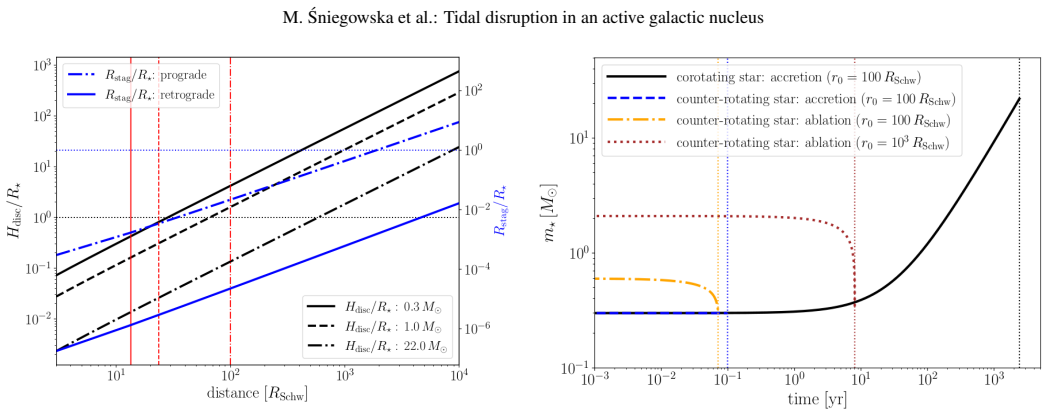
From spectral analysis before and during the event combined with numerical modeling of viscous luminosity evolution, the outburst is interpreted as the tidal disruption of a ~0.3 solar mass main-sequence star (or gradual partial disruption of a low-mass giant star) on a circular, likely counter-rotating orbit embedded in the AGN accretion disk, with the disrupted material and inner disk shielded from view by a gaseous envelope.
What carries the argument
Numerical code for the viscous evolution of the accretion flow combined with spectral modeling of the luminosity profile.
If this is right
- The system is expected to return to its previous narrow-line Seyfert 1 state over time.
- X-ray emission should reappear once the shielding gaseous envelope dissipates.
- Further monitoring can constrain the orbital parameters and the star's properties.
- The event demonstrates how tidal disruptions in active nuclei can produce atypical signatures due to embedding in the disk.
Where Pith is reading between the lines
- Similar embedded disruptions may explain other anomalous outbursts in AGN without requiring new black hole formation.
- Such events could contribute to the growth of supermassive black holes through repeated stellar captures.
- Multi-wavelength observations of returning X-rays would test the shielding mechanism directly.
Load-bearing premise
The star follows a circular counter-rotating orbit embedded in the accretion disk with a gaseous envelope that fully shields the inner regions from direct observation at the large viewing angle.
What would settle it
Detection or non-detection of X-ray emission as the system returns to the original NLS1 state would confirm or refute the shielding by the gaseous envelope.
Figures





read the original abstract
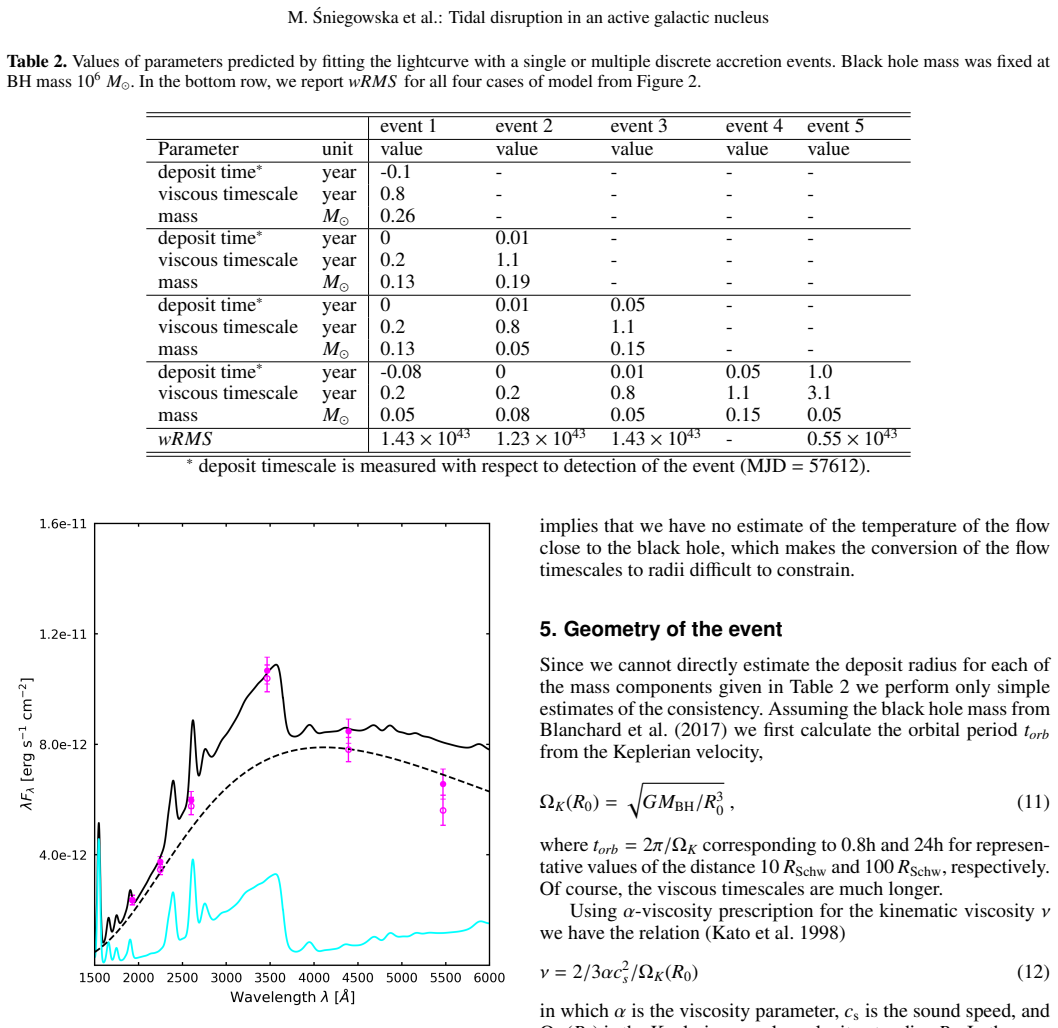
The event PS16dtm, which occured in the center of the Narrow Line Seyfert 1 (NLS1) galaxy SDSS J015804.75-005221.8 (z = 0.080440), is one of the few candidates for a tidal disruption event in an already-acretting active galactic nucleus (AGN). We aim to shed light on the character of the tidal disruption event in this source since it exhibits unusual peculiarities, such as the double-peak optical/UV light curve and a low blackbody temperature with a lack of X-ray emission. We perform spectral analysis of the source before and during the event. We model the time evolution of the luminosity profile using a numerical code that describes the viscous evolution of the flow. From the combined spectral and timing studies, we interpret the event as the disruption of a $\sim 0.3 M_{\odot}$ main-sequence star, or gradual partial disruption of the low-mass giant star. The star is likely on a circular orbit, embedded in the accretion disc. The discussion of the evolution of the star rather suggests that the orbit is counter-rotating. We observe the system at a sufficiently large viewing angle that the actual disruption process is not directly observed. The disrupted star and inner disc are shielded from the observer by a gaseous envelope. Further observations of the system returning to the previous NLS1 state, particularly in the X-ray band, are needed to confirm the proposed scenario and to put constraints on the return to a regular NLS1 state.
Editorial analysis
A structured set of objections, weighed in public.
Referee Report
Summary. The paper interprets the PS16dtm outburst in NLS1 galaxy SDSS J015804.75-005221.8 as the tidal disruption of a ~0.3 M⊙ main-sequence star (or partial disruption of a low-mass giant) on a circular counter-rotating orbit embedded in the AGN accretion disc. Spectral analysis before and during the event combined with numerical viscous evolution modeling of the flow is used to reproduce the double-peaked optical/UV light curve, low blackbody temperature, and absence of X-ray emission, with the inner regions shielded from the observer by a gaseous envelope at large viewing angle.
Significance. If the central interpretation holds, the work offers a concrete model for a rare TDE embedded in an active AGN disc, using numerical viscous evolution to connect the observed light-curve morphology to disc-star interaction. This could inform studies of accretion-state changes in NLS1 galaxies and the role of embedded stellar disruptions. The numerical modeling of viscous flow evolution is a clear strength that grounds the timing analysis.
major comments (2)
- [Abstract] Abstract: The parameters for the disrupted star mass (~0.3 M⊙), circular counter-rotating orbit, and gaseous envelope are selected to reproduce the double-peaked light curve and X-ray non-detection, yet no error bars, alternative orbit configurations, or quantitative envelope column-density constraints from the spectra are reported; this makes the shielding explanation load-bearing but post-hoc.
- [Discussion] The weakest assumption (gaseous envelope fully shielding the inner disc at the adopted viewing angle) is invoked to reconcile the viscous model with absent X-rays and direct TDE signatures, but no independent spectral feature (e.g., absorption lines or continuum shape) or timing prediction is provided to verify the envelope's existence or covering fraction.
minor comments (1)
- [Abstract] The abstract states the star is 'likely on a circular orbit' and 'the discussion of the evolution of the star rather suggests' counter-rotation; these should be tied to specific figures or model outputs showing why prograde or eccentric orbits are disfavored.
Simulated Author's Rebuttal
We thank the referee for their constructive and detailed comments, which help clarify the robustness of our interpretation of PS16dtm. We address each major point below, indicating revisions that will strengthen the manuscript by providing additional context on parameter choices and the envelope assumption.
read point-by-point responses
-
Referee: [Abstract] Abstract: The parameters for the disrupted star mass (~0.3 M⊙), circular counter-rotating orbit, and gaseous envelope are selected to reproduce the double-peaked light curve and X-ray non-detection, yet no error bars, alternative orbit configurations, or quantitative envelope column-density constraints from the spectra are reported; this makes the shielding explanation load-bearing but post-hoc.
Authors: We agree that the specific parameter values were tuned to match the observed double-peaked light curve and X-ray non-detection. The ~0.3 M⊙ mass follows from matching the peak luminosity and viscous timescale in our numerical models for a circular orbit embedded in the disc. In revision we will add a dedicated paragraph discussing the explored parameter space, including approximate uncertainties derived from varying the mass by ±0.1 M⊙ and the resulting changes in light-curve shape. We will also briefly compare prograde versus counter-rotating cases, noting that the latter better reproduces the observed timing without requiring unphysically high viscosities. For the envelope we will extract rough column-density limits from the existing spectral fits by examining the UV continuum slope and absence of strong emission lines, thereby grounding the shielding argument more directly in the data rather than leaving it purely post-hoc. revision: yes
-
Referee: [Discussion] The weakest assumption (gaseous envelope fully shielding the inner disc at the adopted viewing angle) is invoked to reconcile the viscous model with absent X-rays and direct TDE signatures, but no independent spectral feature (e.g., absorption lines or continuum shape) or timing prediction is provided to verify the envelope's existence or covering fraction.
Authors: The envelope is required to explain why neither X-ray emission from the inner disc nor classic TDE spectral features are observed, consistent with a large viewing angle through the AGN disc. We acknowledge that independent verification would be valuable. In the revised discussion we will re-examine the pre- and post-event spectra for any subtle continuum curvature or weak absorption that could be attributed to the envelope, and we will add explicit timing predictions for the expected return of X-ray emission once the envelope disperses. These predictions will be tied to the viscous evolution timescale already modeled. If the current spectra yield only upper limits rather than positive detections, we will state this limitation clearly and frame the envelope as a testable hypothesis for future multi-wavelength monitoring. revision: yes
Circularity Check
Orbital parameters and shielding envelope fitted to match double-peak light curve and X-ray non-detection
specific steps
-
fitted input called prediction
[Abstract]
"From the combined spectral and timing studies, we interpret the event as the disruption of a ∼0.3 M⊙ main-sequence star, or gradual partial disruption of the low-mass giant star. The star is likely on a circular orbit, embedded in the accretion disc. ... We observe the system at a sufficiently large viewing angle that the actual disruption process is not directly observed. The disrupted star and inner disc are shielded from the observer by a gaseous envelope."
The mass, circular counter-rotating orbit, viewing angle, and gaseous envelope are chosen to reproduce the double-peaked light curve (via the viscous code) and to account for the lack of X-ray emission and direct disruption features. These are not outputs of the model but inputs tuned to the observations, rendering the shielding explanation a fit rather than an independent prediction.
full rationale
The paper models the light curve with a standard viscous evolution code but selects the star mass (~0.3 M⊙), circular counter-rotating embedded orbit, large viewing angle, and gaseous envelope specifically to reproduce the observed double-peaked optical/UV profile while explaining the absence of X-rays and direct TDE signatures. These elements are not independently derived or predicted by the model equations; they are adjusted post-hoc to fit the same spectral and timing data used to define the scenario. This creates partial circularity in the central interpretation without reducing the entire derivation to tautology.
Axiom & Free-Parameter Ledger
free parameters (3)
- disrupted star mass =
0.3 M_sun
- orbital inclination / viewing angle
- envelope optical depth and extent
axioms (2)
- standard math The accretion flow follows standard viscous evolution equations for a thin disk
- domain assumption Tidal disruption of a star embedded in an AGN disk produces a double-peaked light curve when viewed at large inclination through an envelope
invented entities (1)
-
gaseous envelope
no independent evidence
Lean theorems connected to this paper
-
IndisputableMonolith/Cost/FunctionalEquation.leanwashburn_uniqueness_aczel (J-cost uniqueness) unclear?
unclearRelation between the paper passage and the cited Recognition theorem.
We model the time evolution of the luminosity profile using a numerical code that describes the viscous evolution of the flow... G_Ṁ(τ) = (2μ²)^μ / Γ(μ) τ^−(1+μ) exp(−2μ²/τ)
-
IndisputableMonolith/Foundation/AlexanderDuality.leanalexander_duality_circle_linking (D=3 forcing) unclear?
unclearRelation between the paper passage and the cited Recognition theorem.
The disrupted star and inner disc are shielded from the observer by a gaseous envelope... R_obsc = 4.7×10^15 cm or 15800 R_Schw
What do these tags mean?
- matches
- The paper's claim is directly supported by a theorem in the formal canon.
- supports
- The theorem supports part of the paper's argument, but the paper may add assumptions or extra steps.
- extends
- The paper goes beyond the formal theorem; the theorem is a base layer rather than the whole result.
- uses
- The paper appears to rely on the theorem as machinery.
- contradicts
- The paper's claim conflicts with a theorem or certificate in the canon.
- unclear
- Pith found a possible connection, but the passage is too broad, indirect, or ambiguous to say the theorem truly supports the claim.
Reference graph
Works this paper leans on
- [1]
- [2]
- [3]
-
[4]
Baldwin, J., Ferland, G., Korista, K., & Verner, D. 1995, ApJ, 455, L119
work page 1995
- [5]
-
[6]
K., Nicholl, M., Berger, E., et al
Blanchard, P. K., Nicholl, M., Berger, E., et al. 2017, ApJ, 843, 106
work page 2017
-
[7]
Carroll, B. W. & Ostlie, D. A. 2017, An introduction to modern astrophysics, Second Edition (Cambridge: Cambridge University Press)
work page 2017
- [8]
-
[9]
Chambers, K. C., Magnier, E. A., Metcalfe, N., et al. 2016, arXiv e-prints, arXiv:1612.05560
work page internal anchor Pith review Pith/arXiv arXiv 2016
-
[10]
Chan, C.-H., Piran, T., Krolik, J. H., & Saban, D. 2019, ApJ, 881, 113
work page 2019
- [11]
- [12]
- [13]
-
[14]
Cracco, V ., Ciroi, S., Berton, M., et al. 2016, MNRAS, 462, 1256
work page 2016
- [15]
-
[16]
Czerny, B., Kunneriath, D., Karas, V ., & Das, T. K. 2013, A&A, 555, A97
work page 2013
-
[17]
J., Cantiello, M., & Jermyn, A
Dittmann, A. J., Cantiello, M., & Jermyn, A. S. 2021, ApJ, 916, 48
work page 2021
-
[18]
Drake, A. J., Djorgovski, S. G., Mahabal, A., et al. 2011, ApJ, 735, 106
work page 2011
- [19]
-
[20]
J., Hu, C., Wang, J.-M., et al
Ferland, G. J., Hu, C., Wang, J.-M., et al. 2009, ApJ, 707, L82
work page 2009
- [21]
-
[22]
Gehrels, N., Chincarini, G., Giommi, P., et al. 2004, ApJ, 611, 1005
work page 2004
- [23]
-
[24]
Gezari, S., Chornock, R., Rest, A., et al. 2012, Nature, 485, 217
work page 2012
-
[25]
Gillessen, S., Eisenhauer, F., Trippe, S., et al. 2009, ApJ, 692, 1075
work page 2009
-
[26]
Goodrich, R. W. 1989, ApJ, 342, 224 GRA VITY+Collaboration, Abd El Dayem, K., Aimar, N., et al. 2026, A&A, 706, A99 GRA VITY Collaboration, Amorim, A., Bourdarot, G., et al. 2024, A&A, 684, A167
work page 1989
-
[27]
Greene, J. E. & Ho, L. C. 2005, ApJ, 630, 122
work page 2005
-
[28]
Greene, J. E. & Ho, L. C. 2007, ApJ, 667, 131
work page 2007
- [29]
-
[30]
Guo, H., Shen, Y ., & Wang, S. 2018, PyQSOFit: Python code to fit the spectrum of quasars, Astrophysics Source Code Library, record ascl:1809.008
work page 2018
-
[31]
2025, arXiv e-prints, arXiv:2504.20148
Guolo, M., Mummery, A., Ingram, A., et al. 2025, arXiv e-prints, arXiv:2504.20148
-
[32]
A Systematic Search for Active Galactic Nucleus Flares in ZTF Data Release 23
He, L., Liu, Z.-Y ., Niu, R., et al. 2025, arXiv e-prints, arXiv:2507.20232
work page internal anchor Pith review Pith/arXiv arXiv 2025
-
[33]
Hills, J. G. 1975, Nature, 254, 295
work page 1975
-
[34]
Hinkle, J. T., Holoien, T. W. S., Shappee, B. J., & Auchettl, K. 2021, ApJ, 910, 83
work page 2021
-
[35]
Hinkle, J. T., Shappee, B. J., Auchettl, K., et al. 2025, Science Advances, 11, eadt0074
work page 2025
-
[36]
Hoogendam, W. B., Hinkle, J. T., Shappee, B. J., et al. 2024, MNRAS, 530, 4501 Ili´c, D., Popovi´c, L. ˇC., La Mura, G., Ciroi, S., & Rafanelli, P. 2012, A&A, 543, A142 Ivezi´c, Ž., Kahn, S. M., Tyson, J. A., et al. 2019, ApJ, 873, 111
work page 2024
-
[37]
Jiang, N., Luo, D., Zhu, J., & Cutri, R. M. 2025, ApJ, 980, L17
work page 2025
- [38]
-
[39]
2017, Nature Astronomy, 1, 865
Kankare, E., Kotak, R., Mattila, S., et al. 2017, Nature Astronomy, 1, 865
work page 2017
- [40]
- [41]
-
[42]
1998, Black-hole accretion disks
Kato, S., Fukue, J., & Mineshige, S. 1998, Black-hole accretion disks
work page 1998
- [43]
-
[44]
Kejriwal, S., Witzany, V ., Zajaˇcek, M., Pasham, D. R., & Chua, A. J. K. 2024, MNRAS, 532, 2143
work page 2024
-
[45]
F., Meiron, Y ., Shukirgaliyev, B., et al
Kennedy, G. F., Meiron, Y ., Shukirgaliyev, B., et al. 2016, MNRAS, 460, 240
work page 2016
-
[46]
2001, MNRAS, 327, 799 Krtiˇcka, J., Benáˇcek, J., Budaj, J., et al
Kotov, O., Churazov, E., & Gilfanov, M. 2001, MNRAS, 327, 799 Krtiˇcka, J., Benáˇcek, J., Budaj, J., et al. 2024, Space Sci. Rev., 220, 24
work page 2001
-
[47]
Kulkarni, S. R., Harrison, F. A., Grefenstette, B. W., et al. 2021, arXiv e-prints, arXiv:2111.15608 Kurfürst, P., Bless, G., Fišák, J., et al. 2026, arXiv e-prints, arXiv:2601.15428 Kurfürst, P., Pejcha, O., & Krtiˇcka, J. 2020, A&A, 642, A214
-
[48]
Leighly, K. M. & Casebeer, D. 2007, in Astronomical Society of the Pacific Conference Series, V ol. 373, The Central Engine of Active Galactic Nuclei, ed. L. C. Ho & J.-W. Wang, 365
work page 2007
-
[49]
Li, G., Naoz, S., Kocsis, B., & Loeb, A. 2015, MNRAS, 451, 1341
work page 2015
-
[50]
Linial, I. & Metzger, B. D. 2024, ApJ, 973, 101 Article number, page 16 of 17 M. ´Sniegowska et al.: Tidal disruption in an active galactic nucleus
work page 2024
- [51]
- [52]
- [53]
-
[54]
Makrygianni, L., Trakhtenbrot, B., Arcavi, I., et al. 2023, ApJ, 953, 32
work page 2023
-
[55]
2004, MNRAS, 351, 169 Márquez, I., Masegosa, J., González-Martin, O., et al
Marconi, A., Risaliti, G., Gilli, R., et al. 2004, MNRAS, 351, 169 Márquez, I., Masegosa, J., González-Martin, O., et al. 2017, Frontiers in Astron- omy and Space Sciences, 4, 34 Mejía-Restrepo, J. E., Trakhtenbrot, B., Koss, M. J., et al. 2022, ApJS, 261, 5
work page 2004
-
[56]
Merloni, A., Dwelly, T., Salvato, M., et al. 2015, MNRAS, 452, 69
work page 2015
- [57]
-
[58]
2026, arXiv e-prints, arXiv:2603.28380
Mondek, M., Zajaˇcek, M., Best, H., et al. 2026, arXiv e-prints, arXiv:2603.28380
-
[59]
Mou, G., Dou, L., Jiang, N., et al. 2021, ApJ, 908, 197 Müller, A. L., Naddaf, M.-H., Zajaˇcek, M., et al. 2022, ApJ, 931, 39
work page 2021
- [60]
- [61]
-
[62]
2000, ApJ, 536, 663 Navarro Navarro, N
Narayan, R. 2000, ApJ, 536, 663 Navarro Navarro, N. & Piran, T. 2025, ApJ, 983, 177
work page 2000
-
[63]
Netzer, H., Elitzur, M., & Ferland, G. J. 1985, ApJ, 299, 752
work page 1985
- [64]
- [65]
- [66]
- [67]
-
[68]
Osterbrock, D. E. 1981, ApJ, 249, 462
work page 1981
-
[69]
Osterbrock, D. E. & Pogge, R. W. 1985, ApJ, 297, 166
work page 1985
-
[70]
Ostriker, E. C. 1999, ApJ, 513, 252
work page 1999
-
[71]
Pandey, A., Martínez-Aldama, M. L., Czerny, B., et al. 2025, ApJS, 277, 36
work page 2025
-
[72]
Pasham, D. R., Zajaˇcek, M., Nixon, C. J., et al. 2024b, Nature, 630, 325 Peißker, F., Eckart, A., Zajaˇcek, M., Ali, B., & Parsa, M. 2020, ApJ, 899, 50
work page 2020
-
[73]
Peters, P. C. 1964, Physical Review, 136, 1224
work page 1964
-
[74]
Petrushevska, T., Leloudas, G., Ili´c, D., et al. 2023, A&A, 669, A140
work page 2023
- [75]
-
[76]
Prasad, C., Wang, Y ., Perna, R., Ford, K. E. S., & McKernan, B. 2024, MNRAS, 531, 1409
work page 2024
-
[77]
Rakshit, S., Stalin, C. S., Chand, H., & Zhang, X.-G. 2017, ApJS, 229, 39
work page 2017
-
[78]
Rauch, K. P. 1995, MNRAS, 275, 628
work page 1995
-
[79]
Rees, M. J. 1988, Nature, 333, 523
work page 1988
- [80]
discussion (0)
Sign in with ORCID, Apple, or X to comment. Anyone can read and Pith papers without signing in.