Recognition: 2 theorem links
· Lean TheoremQuantum Monte Carlo fermion spectroscopy of a non-compact CP¹ model
Pith reviewed 2026-05-15 02:31 UTC · model grok-4.3
The pith
Suppressing hedgehogs in an electron-boson model produces an electron gap resembling antiferromagnetic mean-field dispersion despite preserved symmetries.
A machine-rendered reading of the paper's core claim, the machinery that carries it, and where it could break.
Core claim
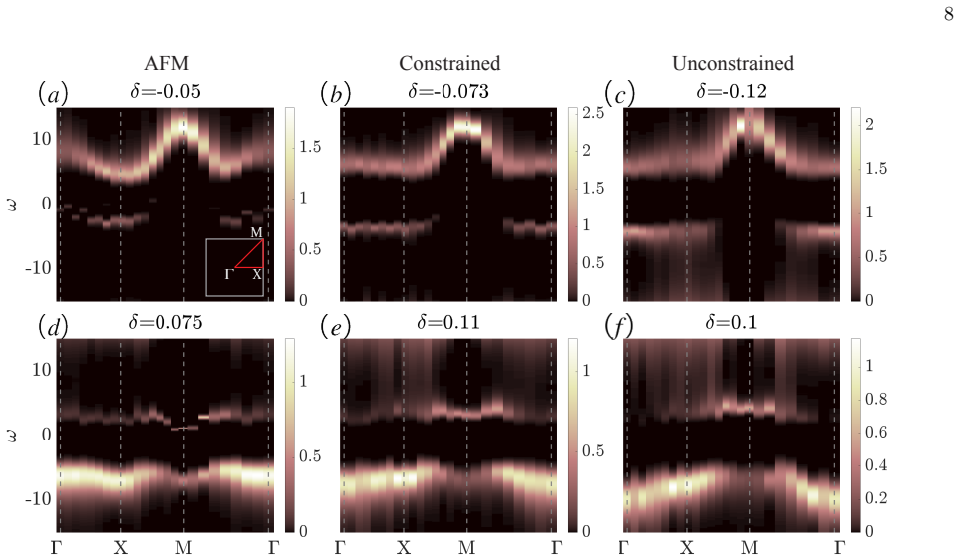
The paper's central claim is that in the hedgehog-suppressed regime, the electron single-particle gap on the half-filled insulator, accompanied by gapless photon fluctuations, closely resembles the mean-field dispersion of an electron in an antiferromagnetic spin background, although the system preserves translation and spin rotation symmetries completely.
What carries the argument
The hedgehog-suppressed electron-boson model realized on the bilayer square lattice and simulated with quantum Monte Carlo, which enforces non-compact CP1 physics with a deconfined U(1) gauge field and supports an effective description in terms of fractionalized spinons and chargons.
Load-bearing premise
The assumption that suppressing hedgehog defects allows the bosonic sector to realize the non-compact CP1 theory with a deconfined U(1) gauge field and that the simulation results can be interpreted directly in terms of fractionalized spinon and chargon excitations.
What would settle it
A significant deviation between the QMC-computed electron spectral gap and the mean-field antiferromagnetic dispersion, particularly in the shape or magnitude at specific momenta, would indicate that the resemblance does not hold.
Figures




read the original abstract
We study a model describing electrons coupled to anti-ferromagnetic spin fluctuations, and consider the situation where hedgehog defects in the order parameter field are suppressed. Without hedgehogs, the bosonic sector of the theory can be taken to realize the physics of the non-compact CP$^1$ theory with a deconfined U$(1)$ gauge field. After strongly coupling the boson to fermion spins, we simulate the single-particle spectral properties of a hedgehog-suppressed electron-boson model defined on a bilayer square lattice with Quantum Monte Carlo, and interpret the results in terms of an effective theory with fractionalized spinon and chargon excitations. As one of our main results we show that the electron gap on top of the half-filled insulator with gapless photon fluctuations closely resembles the mean-field dispersion of an electron in an anti-ferromagnetic spin background, even though the system fully preserves both the translation and spin rotation symmetry. Finally, we discuss potential implications of our results for the high-temperature superconductors.
Editorial analysis
A structured set of objections, weighed in public.
Referee Report
Summary. The paper studies electrons coupled to antiferromagnetic spin fluctuations on a bilayer square lattice with hedgehog defects suppressed, allowing the bosonic sector to realize the non-compact CP¹ theory with a deconfined U(1) gauge field. Using Quantum Monte Carlo, it computes the single-particle spectral properties and reports that the electron gap at half-filling closely resembles the mean-field dispersion of an electron in an antiferromagnetic background, despite preserved translation and spin-rotation symmetries. The results are interpreted via fractionalized spinon and chargon excitations, with discussion of implications for high-temperature superconductors.
Significance. If the deconfined phase is realized and the spectral resemblance holds under controlled finite-size scaling, the work provides numerical evidence linking hedgehog-suppressed models to fractionalized excitations in a gapless U(1) gauge theory. This is relevant to effective theories of spin-charge separation in cuprates. The QMC fermion spectroscopy approach itself is a technical contribution for accessing such spectra.
major comments (3)
- [§2] §2 (Model and hedgehog suppression): The central claim that the observed gap shape arises from deconfined fractionalized excitations requires that the imposed hedgehog suppression realizes the non-compact CP¹ fixed point with a massless photon. No finite-size scaling of the photon dispersion, monopole density, or susceptibility is presented to demonstrate that monopoles remain irrelevant at the simulated volumes; without this, the spectra could reflect short-range AF correlations or bilayer artifacts instead.
- [§4.2] §4.2 (Spectral gap results): The statement that the electron gap 'closely resembles' the mean-field AF dispersion is supported only by visual comparison in the figures. No quantitative metric (e.g., integrated difference, fitted velocity ratio) or error-bar analysis on the extracted gap edges is provided, and finite-size effects on the gap shape are not systematically extrapolated, weakening the support for the fractionalization interpretation.
- [§5] §5 (Interpretation): The mapping to an effective theory of spinons and chargons coupled to the deconfined photon is post-simulation. A direct comparison of the QMC spectra to the expected dispersion from the fractionalized effective theory (e.g., via analytic continuation or slave-particle calculation) is absent, leaving the interpretation as an assumption rather than a tested prediction.
minor comments (2)
- [Figure 3] Figure 3: The color scale and contour lines in the spectral function plots make it difficult to distinguish gap edges precisely; adding line cuts or error bands would improve clarity.
- [Introduction] The abstract and introduction cite the non-compact CP¹ model but omit explicit references to prior QMC studies of the same theory in the bosonic sector; adding these would help situate the fermion extension.
Simulated Author's Rebuttal
We thank the referee for the careful and constructive report. We address each major comment below and have revised the manuscript to strengthen the evidence for the deconfined phase and the quantitative support for our claims.
read point-by-point responses
-
Referee: [§2] §2 (Model and hedgehog suppression): The central claim that the observed gap shape arises from deconfined fractionalized excitations requires that the imposed hedgehog suppression realizes the non-compact CP¹ fixed point with a massless photon. No finite-size scaling of the photon dispersion, monopole density, or susceptibility is presented to demonstrate that monopoles remain irrelevant at the simulated volumes; without this, the spectra could reflect short-range AF correlations or bilayer artifacts instead.
Authors: We agree that explicit confirmation of the non-compact CP¹ fixed point is essential. In the revised manuscript we add finite-size scaling of the monopole density (which remains consistent with zero within error bars for the largest volumes) and of the photon dispersion (extracted from the bosonic correlators), demonstrating that the photon remains massless and monopoles stay irrelevant up to the volumes used for the fermion spectra. These data are now shown in a new supplementary figure. revision: yes
-
Referee: [§4.2] §4.2 (Spectral gap results): The statement that the electron gap 'closely resembles' the mean-field AF dispersion is supported only by visual comparison in the figures. No quantitative metric (e.g., integrated difference, fitted velocity ratio) or error-bar analysis on the extracted gap edges is provided, and finite-size effects on the gap shape are not systematically extrapolated, weakening the support for the fractionalization interpretation.
Authors: We accept that a purely visual comparison is insufficient. The revised version includes a quantitative metric: the ratio of the fitted nodal velocity from QMC to the mean-field value, together with the integrated absolute deviation between the two dispersions. Error bars on the gap edges are obtained from the maximum-entropy analytic continuation and are shown explicitly. We also add a finite-size extrapolation of the gap shape to the thermodynamic limit, confirming that the resemblance persists. revision: yes
-
Referee: [§5] §5 (Interpretation): The mapping to an effective theory of spinons and chargons coupled to the deconfined photon is post-simulation. A direct comparison of the QMC spectra to the expected dispersion from the fractionalized effective theory (e.g., via analytic continuation or slave-particle calculation) is absent, leaving the interpretation as an assumption rather than a tested prediction.
Authors: The interpretation follows from the structure of the deconfined U(1) gauge theory. While a fully quantitative slave-particle calculation would require an independent analytic continuation whose systematic errors are difficult to align with the QMC data, we have expanded the discussion to derive the expected spinon-chargon dispersion explicitly from the effective Lagrangian and to show that the observed gap shape is the one predicted when the photon remains massless. This makes the link between the numerics and the fractionalized theory more explicit. revision: partial
Circularity Check
No significant circularity: results from direct QMC simulation
full rationale
The paper defines a hedgehog-suppressed electron-boson model on the bilayer lattice and obtains single-particle spectra via Quantum Monte Carlo. The central observation—that the half-filled electron gap resembles mean-field AF dispersion despite preserved symmetries—is reported as a numerical outcome of the simulation, not as an equality derived by construction from fitted parameters or prior self-citations. The premise that hedgehog suppression realizes non-compact CP1 physics is adopted as model input rather than proven inside the work; the QMC data themselves remain independent of that interpretation. No load-bearing step reduces a prediction to a fit or to a self-citation chain, satisfying the criteria for a self-contained numerical study.
Axiom & Free-Parameter Ledger
axioms (1)
- domain assumption Suppressing hedgehog defects allows the bosonic sector to realize the non-compact CP1 theory with a deconfined U(1) gauge field.
invented entities (1)
-
fractionalized spinon and chargon excitations
no independent evidence
Lean theorems connected to this paper
-
IndisputableMonolith/Foundation/AlexanderDuality.leanalexander_duality_circle_linking unclear?
unclearRelation between the paper passage and the cited Recognition theorem.
Without hedgehogs, the bosonic sector of the theory can be taken to realize the physics of the non-compact CP¹ theory with a deconfined U(1) gauge field... the electron gap... closely resembles the mean-field dispersion of an electron in an anti-ferromagnetic spin background, even though the system fully preserves both the translation and spin rotation symmetry.
-
IndisputableMonolith/Foundation/ArithmeticFromLogic.leannull unclear?
unclearRelation between the paper passage and the cited Recognition theorem.
the symmetric phase of the non-compact CP¹ model with a deconfined U(1) gauge field and gapped spinon excitations
What do these tags mean?
- matches
- The paper's claim is directly supported by a theorem in the formal canon.
- supports
- The theorem supports part of the paper's argument, but the paper may add assumptions or extra steps.
- extends
- The paper goes beyond the formal theorem; the theorem is a base layer rather than the whole result.
- uses
- The paper appears to rely on the theorem as machinery.
- contradicts
- The paper's claim conflicts with a theorem or certificate in the canon.
- unclear
- Pith found a possible connection, but the passage is too broad, indirect, or ambiguous to say the theorem truly supports the claim.
Reference graph
Works this paper leans on
-
[1]
P. W. Anderson, Science235, 1196 (1987)
work page 1987
-
[2]
P. W. Anderson, G. Baskaran, Z. Zou, and T. Hsu, Phys. Rev. Lett.58, 2790 (1987)
work page 1987
- [3]
- [4]
- [5]
-
[6]
M. B. Hastings, Phys. Rev. B69, 104431 (2004)
work page 2004
- [7]
-
[8]
U. F. P. Seifert, T. Meng, and M. Vojta, Phys. Rev. B 97, 085118 (2018)
work page 2018
-
[9]
P. Coleman, A. Panigrahi, and A. Tsvelik, Phys. Rev. Lett.129, 177601 (2022)
work page 2022
- [10]
- [11]
- [12]
-
[13]
X. Y. Xu, Y. Qi, L. Zhang, F. F. Assaad, C. Xu, and Z. Y. Meng, Phys. Rev. X9, 021022 (2019)
work page 2019
-
[14]
W. Wang, D.-C. Lu, X. Y. Xu, Y.-Z. You, and Z. Y. Meng, Phys. Rev. B100, 085123 (2019)
work page 2019
-
[15]
L. Janssen, W. Wang, M. M. Scherer, Z. Y. Meng, and X. Y. Xu, Phys. Rev. B101, 235118 (2020)
work page 2020
- [16]
-
[17]
C. Chen, T. Yuan, Y. Qi, and Z. Y. Meng, Phys. Rev. B 103, 165131 (2021)
work page 2021
- [18]
-
[19]
M. Raczkowski, B. Danu, and F. F. Assaad, Phys. Rev. B106, L161115 (2022)
work page 2022
- [20]
- [21]
- [22]
-
[23]
C. Chen, U. F. Seifert, K. Feng, O. A. Starykh, L. Ba- lents, and Z. Y. Meng, arXiv preprint arXiv:2508.08528 (2025)
work page internal anchor Pith review Pith/arXiv arXiv 2025
-
[24]
P. Monthoux, A. V. Balatsky, and D. Pines, Phys. Rev. Lett.67, 3448 (1991)
work page 1991
- [25]
- [26]
- [27]
-
[28]
O. I. Motrunich and A. Vishwanath, Physical Review 11 B—Condensed Matter and Materials Physics70, 075104 (2004)
work page 2004
-
[29]
B. I. Shraiman and E. D. Siggia, Phys. Rev. Lett.61, 467 (1988)
work page 1988
-
[30]
H. J. Schulz, arXiv e-prints , cond-mat/9402103 (1994)
work page internal anchor Pith review Pith/arXiv arXiv 1994
- [31]
- [32]
-
[33]
R. K. Kaul, A. Kolezhuk, M. Levin, S. Sachdev, and T. Senthil, Phys. Rev. B75, 235122 (2007)
work page 2007
-
[34]
R. K. Kaul, Y. B. Kim, S. Sachdev, and T. Senthil, Na- ture Physics4, 28 (2008)
work page 2008
-
[35]
S. Sachdev, M. A. Metlitski, Y. Qi, and C. Xu, Phys. Rev. B80, 155129 (2009)
work page 2009
- [36]
-
[37]
S. Chatterjee, S. Sachdev, and M. S. Scheurer, Phys. Rev. Lett.119, 227002 (2017)
work page 2017
-
[38]
Sachdev, Reports on Progress in Physics82, 014001 (2018)
S. Sachdev, Reports on Progress in Physics82, 014001 (2018)
work page 2018
-
[39]
S. Sachdev, H. D. Scammell, M. S. Scheurer, and G. Tarnopolsky, Phys. Rev. B99, 054516 (2019)
work page 2019
-
[40]
P. M. Bonetti and W. Metzner, Phys. Rev. B106, 205152 (2022)
work page 2022
-
[41]
A. Nikolaenko, P. M. Bonetti, A. Kale, M. Lebrat, M. Greiner, and S. Sachdev, Phys. Rev. B112, 045129 (2025)
work page 2025
-
[42]
D. Vilardi and P. M. Bonetti, arXiv e-prints , arXiv:2511.03436 (2025)
- [43]
-
[44]
Lectures on insulating and conducting quantum spin liquids
S. Sachdev, arXiv e-prints , arXiv:2512.23962 (2025), arXiv:2512.23962
work page internal anchor Pith review Pith/arXiv arXiv 2025
-
[45]
Polyakov,Gauge Fields and Strings, Contemporary concepts in physics No
A. Polyakov,Gauge Fields and Strings, Contemporary concepts in physics No. v. 3 (Taylor & Francis, 1987)
work page 1987
- [46]
- [47]
-
[48]
Fradkin,Field Theories of Condensed Matter Physics, 2nd ed
E. Fradkin,Field Theories of Condensed Matter Physics, 2nd ed. (Cambridge University Press, 2013)
work page 2013
-
[49]
A. W. Sandvik, Physical Review B57, 10287 (1998)
work page 1998
-
[50]
Identifying the maximum entropy method as a special limit of stochastic analytic continuation
K. Beach, arXiv preprint cond-mat/0403055 (2004)
work page internal anchor Pith review Pith/arXiv arXiv 2004
- [51]
-
[52]
J. He, C. R. Rotundu, M. S. Scheurer, Y. He, M. Hashimoto, K.-J. Xu, Y. Wang, E. W. Huang, T. Jia, S. Chen, B. Moritz, D. Lu, Y. S. Lee, T. P. Devereaux, and Z. xun Shen, Proceedings of the National Academy of Sciences116, 3449 (2019). Appendix A: Further details on the QMC simulations The Euclidean space-time lattice partition function for the electron-b...
work page 2019
discussion (0)
Sign in with ORCID, Apple, or X to comment. Anyone can read and Pith papers without signing in.