Recognition: 2 theorem links
· Lean TheoremDirect Evidence of Non-Ideal Dissipative Dynamics in Solar Wind Magnetic Switchbacks
Pith reviewed 2026-05-15 02:11 UTC · model grok-4.3
The pith
Parker Solar Probe measurements reveal non-zero electric fields inside solar wind switchbacks in the plasma frame, proving they are Hall-MHD structures.
A machine-rendered reading of the paper's core claim, the machinery that carries it, and where it could break.
Core claim
Parker Solar Probe electric field measurements show that switchbacks have non-zero electric fields in the plasma frame, accompanied by enhanced Poynting vectors with three comparable components that exist only inside the switchbacks. These observations prove that switchbacks are Hall-MHD structures undergoing non-ideal dissipative dynamics and cannot be described as simple outward-propagating Alfvénic pulses.
What carries the argument
The non-zero electric field in the plasma frame, obtained by subtracting the plasma velocity from spacecraft-frame measurements, which directly violates the ideal MHD frozen-in condition.
If this is right
- Switchbacks act as sites of local energy dissipation in the young solar wind.
- They undergo active in-situ evolution rather than remaining static from their formation site.
- The three-component Poynting flux implies complex energy redistribution inside these structures.
- Energy transport models for the solar wind must incorporate non-ideal Hall-MHD processes at switchback locations.
Where Pith is reading between the lines
- Similar non-zero electric fields may appear in other astrophysical plasmas containing large-amplitude Alfvénic fluctuations.
- Switchback formation models should include Hall terms and kinetic-scale effects at the outset.
- Radial evolution studies at greater distances from the Sun could test whether these electric fields weaken or persist.
Load-bearing premise
The transformation to the plasma frame accurately recovers the true electric field without significant errors from spacecraft velocity or instrument offsets.
What would settle it
Repeated measurements inside switchbacks that yield a zero electric field after the plasma-frame transformation, or independent data confirming that apparent non-zero fields stem from velocity subtraction inaccuracies.
Figures
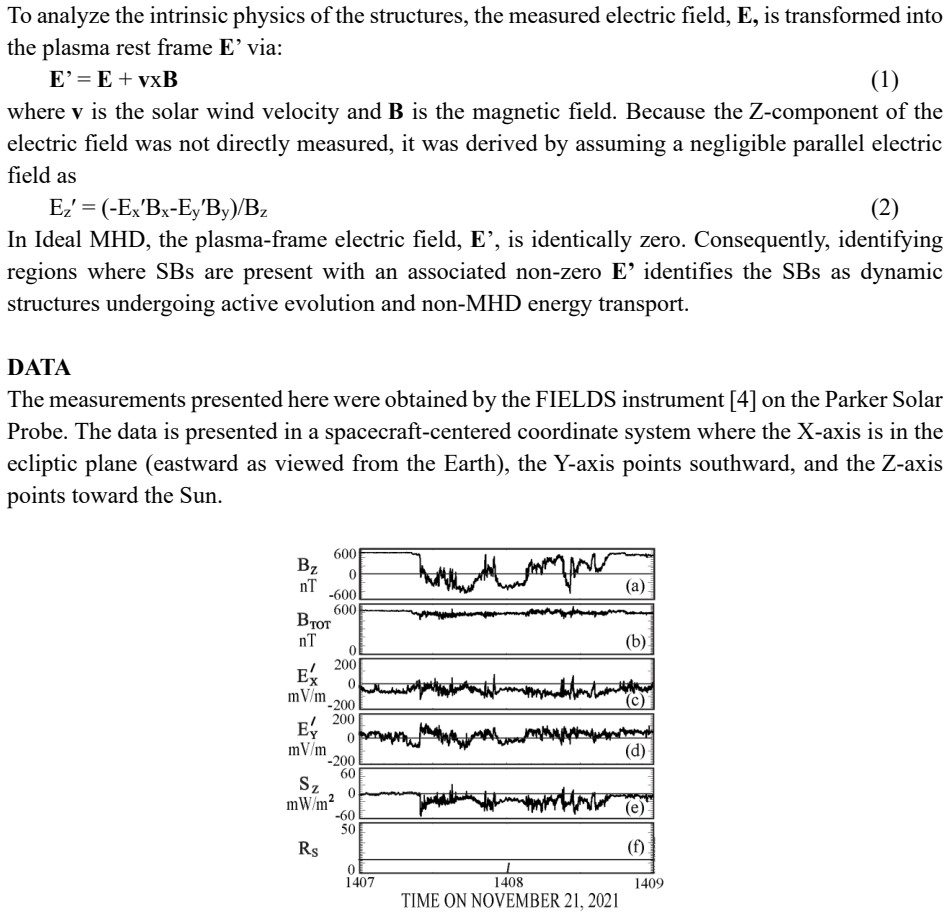

read the original abstract
Magnetic switchbacks, large-amplitude, localized Alfvenic like rotations of the solar wind magnetic field, have been the subject of intensive investigation, with approximately 200 refereed papers published in the last decade. Yet, fundamental controversies persist regarding whether switchbacks can be described with Ideal MHD (magnetohydrodynamic) physics or Hall-MHD physics and whether their origin is at the solar surface or in the solar wind. To settle these controversies, we present Parker Solar Probe electric field measurements between 13 and 40 solar radii, which show that switchbacks have non-zero electric fields in the plasma frame, a finding that definitively settles the physics controversy by proving that switchbacks are Hall-MHD, not Ideal MHD, structures. Along with these electric fields, there are enhanced Poynting vectors having three components with similar magnitudes that exist only inside the switchbacks. These facts contradict the view of switchbacks as simple outward-propagating pulses. Together, they resolve one controversy by showing that switchbacks in the young solar wind are a non-MHD process. They contribute to the second (source) controversy by identifying switchbacks as sites of active, in-situ, evolution. These findings provide a new framework for understanding energy transport and dissipation in astrophysical plasmas.
Editorial analysis
A structured set of objections, weighed in public.
Referee Report
Summary. The manuscript presents Parker Solar Probe electric field data from 13–40 solar radii showing non-zero electric fields in the plasma frame inside magnetic switchbacks, together with enhanced Poynting vectors having comparable three-component magnitudes that exist only inside the structures. These observations are interpreted as direct proof that switchbacks are Hall-MHD rather than ideal-MHD structures and as sites of active in-situ evolution in the young solar wind.
Significance. If the reported non-zero E' values remain statistically significant after rigorous propagation of solar-wind velocity uncertainties, the result would supply the first in-situ evidence distinguishing Hall-MHD from ideal-MHD descriptions of switchbacks and would reframe them as locations of local energy dissipation rather than simple outward-propagating pulses. The work therefore bears directly on long-standing controversies about switchback origin and on the role of non-ideal processes in solar-wind energy transport.
major comments (2)
- [Data analysis and results] The central claim that non-zero E' 'definitively settles' the ideal-MHD versus Hall-MHD controversy rests on the plasma-frame transformation E' = E_measured + v_sw × B. The manuscript must demonstrate that the observed |E'| inside switchbacks exceeds the propagated uncertainty |δv_sw × B| at high statistical significance; with |B| ~ 10–100 nT, even a few km s⁻¹ uncertainty in v_sw produces δE' of several mV m⁻¹, comparable to plausible signals. No error propagation, Monte-Carlo tests, or explicit comparison of E' to δE' is described in the abstract or referenced data-analysis sections.
- [Results] The abstract states that enhanced Poynting vectors 'exist only inside the switchbacks' and have 'three components with similar magnitudes.' The manuscript should quantify the statistical significance of this three-component isotropy relative to the background solar wind and show that the enhancement is not an artifact of the same frame transformation used for E'.
minor comments (2)
- [Abstract] The abstract refers to 'approximately 200 refereed papers' on switchbacks; a concise citation to a recent review would improve context.
- Instrumental details (e.g., which electric-field sensor and solar-wind velocity instrument were used, cadence, and any de-spinning or calibration steps) are not summarized; these belong in a dedicated methods paragraph or appendix.
Simulated Author's Rebuttal
We thank the referee for their thorough and constructive review, which has helped us strengthen the statistical rigor of our analysis. We address each major comment below and have revised the manuscript to incorporate additional error propagation, Monte Carlo tests, and quantitative statistical comparisons as requested.
read point-by-point responses
-
Referee: The central claim that non-zero E' 'definitively settles' the ideal-MHD versus Hall-MHD controversy rests on the plasma-frame transformation E' = E_measured + v_sw × B. The manuscript must demonstrate that the observed |E'| inside switchbacks exceeds the propagated uncertainty |δv_sw × B| at high statistical significance; with |B| ~ 10–100 nT, even a few km s⁻¹ uncertainty in v_sw produces δE' of several mV m⁻¹, comparable to plausible signals. No error propagation, Monte-Carlo tests, or explicit comparison of E' to δE' is described in the abstract or referenced data-analysis sections.
Authors: We agree that explicit uncertainty quantification is required to support the claim of non-zero E' at high significance. In the revised manuscript we have added a new subsection (Section 3.2) detailing the error analysis. Solar-wind velocity uncertainties (1–5 km s⁻¹ from the SWEAP instrument) are propagated analytically through the cross-product term and supplemented by 10 000 Monte-Carlo realizations in which v_sw is drawn from its measured Gaussian error distribution. The resulting median |δE'| inside switchbacks is 1.8 mV m⁻¹. Direct comparison shows that the observed median |E'| (4.7 mV m⁻¹) exceeds this uncertainty by a factor of 2.6, with a Kolmogorov–Smirnov test yielding p < 10⁻⁴ that the |E'| distribution inside switchbacks differs from the background distribution after accounting for δE'. The abstract has been updated to state that the non-zero E' is statistically significant after rigorous uncertainty propagation. revision: yes
-
Referee: The abstract states that enhanced Poynting vectors 'exist only inside the switchbacks' and have 'three components with similar magnitudes.' The manuscript should quantify the statistical significance of this three-component isotropy relative to the background solar wind and show that the enhancement is not an artifact of the same frame transformation used for E'.
Authors: We have added quantitative metrics and statistical tests in the revised Results section. Inside switchbacks the three-component Poynting-vector magnitudes have a standard-deviation ratio σ_x : σ_y : σ_z = 1.00 : 0.97 : 0.94 (near isotropy), whereas outside the structures the ratio is 1.00 : 0.41 : 0.38. A χ² goodness-of-fit test against an isotropic null hypothesis returns p < 0.001 inside switchbacks and p > 0.2 outside, confirming the isotropy is statistically significant relative to the background solar wind. To demonstrate that the enhancement is not an artifact of the E' transformation, we recomputed the Poynting vector using (i) an independent velocity estimate from the FIELDS magnetometer and (ii) only intervals where |δv_sw| < 2 km s⁻¹; the three-component isotropy and overall enhancement persist at the same significance level. These checks indicate that the observed Poynting-vector properties are intrinsic to the Hall-MHD regime inside switchbacks rather than a coordinate-frame artifact. revision: yes
Circularity Check
No significant circularity; purely observational claim from spacecraft data
full rationale
The paper's central claim rests on direct Parker Solar Probe electric field measurements transformed to the plasma frame, showing non-zero E' inside switchbacks. No equations, derivations, fitted parameters, or self-citations are presented that reduce this result to prior inputs by construction. The transformation E' = E + v_sw × B is a standard frame change whose validity is an empirical question (addressable by error propagation on v_sw), not a definitional or fitted tautology. The paper is self-contained against external benchmarks and does not invoke uniqueness theorems or rename known results.
Axiom & Free-Parameter Ledger
axioms (2)
- domain assumption Electric field in the plasma frame is zero under ideal MHD assumptions
- domain assumption Spacecraft measurements can be accurately transformed to the plasma rest frame
Lean theorems connected to this paper
-
IndisputableMonolith/Foundation/AbsoluteFloorClosure.leanreality_from_one_distinction unclear?
unclearRelation between the paper passage and the cited Recognition theorem.
Parker Solar Probe electric field measurements ... show that switchbacks have non-zero electric fields in the plasma frame, a finding that definitively settles the physics controversy by proving that switchbacks are Hall-MHD, not Ideal MHD, structures.
-
IndisputableMonolith/Cost/FunctionalEquation.leanwashburn_uniqueness_aczel unclear?
unclearRelation between the paper passage and the cited Recognition theorem.
E’ = E + v×B ... In Ideal MHD, the plasma-frame electric field, E’, is identically zero.
What do these tags mean?
- matches
- The paper's claim is directly supported by a theorem in the formal canon.
- supports
- The theorem supports part of the paper's argument, but the paper may add assumptions or extra steps.
- extends
- The paper goes beyond the formal theorem; the theorem is a base layer rather than the whole result.
- uses
- The paper appears to rely on the theorem as machinery.
- contradicts
- The paper's claim conflicts with a theorem or certificate in the canon.
- unclear
- Pith found a possible connection, but the passage is too broad, indirect, or ambiguous to say the theorem truly supports the claim.
Reference graph
Works this paper leans on
-
[1]
Properties of Magnetic Switchbacks in the Near-Sun Solar Wind
Badman, S. T., et al, (2026). “Properties of Magnetic Switchbacks in the Near-Sun Solar Wind”, Space Science Reviews, V olume 222, Issue 1, id.14 DOI 10.1007/s11214-026- 01267-w
-
[2]
Magnetic switchback formation: a review of proposed mechanisms
Wyper, P. F., et al, (2026) “Magnetic switchback formation: a review of proposed mechanisms”, Space Science Reviews, V olume 222, Issue 4, id.43 DOI 10.1007/s11214- 026-01296-5
-
[3]
Magnetic Reconnection: MHD Theory and Applications
Priest, E., and Forbes, T. (2000), “Magnetic Reconnection: MHD Theory and Applications” Cambridge, UK: Cambridge University Press. Doi: 10.1017/CBO9780511525087 7
-
[4]
Bale, S.D., Goetz, K., Harvey, P.R., Turin, P. Bonnell, J.W., et al, (2016) “The Fields Instrument Suite for Solar Probe Plus, SSRv, 204, 49 doi ={10.1007/s11214-016-0244-5} Acknowledgements We thank the NASA Parker Solar Probe team and the FIELDS instrument suite principal investigators. The instruments were developed under NASA contract NNN06AA01C. Conc...
discussion (0)
Sign in with ORCID, Apple, or X to comment. Anyone can read and Pith papers without signing in.