Recognition: 2 theorem links
· Lean TheoremA new sample of Little Red Dots at z<0.45 in DESI DR1: Broad Balmer lines, low ionization spectrum and no variability
Pith reviewed 2026-05-15 02:43 UTC · model grok-4.3
The pith
Eight Little Red Dots at z=0.2-0.45 show broad Balmer lines and low-ionization spectra but at a number density 10,000 times lower than at high redshift.
A machine-rendered reading of the paper's core claim, the machinery that carries it, and where it could break.
Core claim
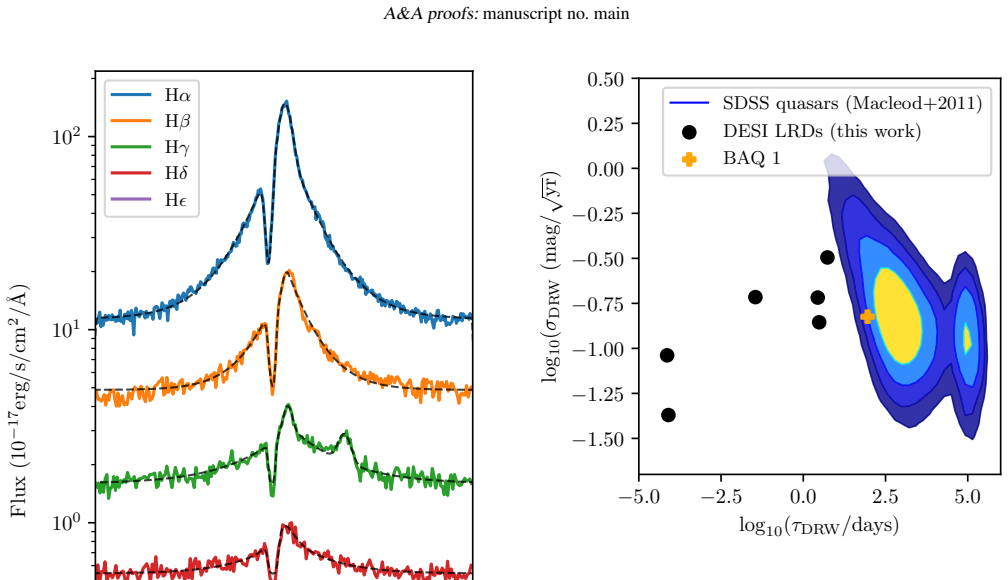
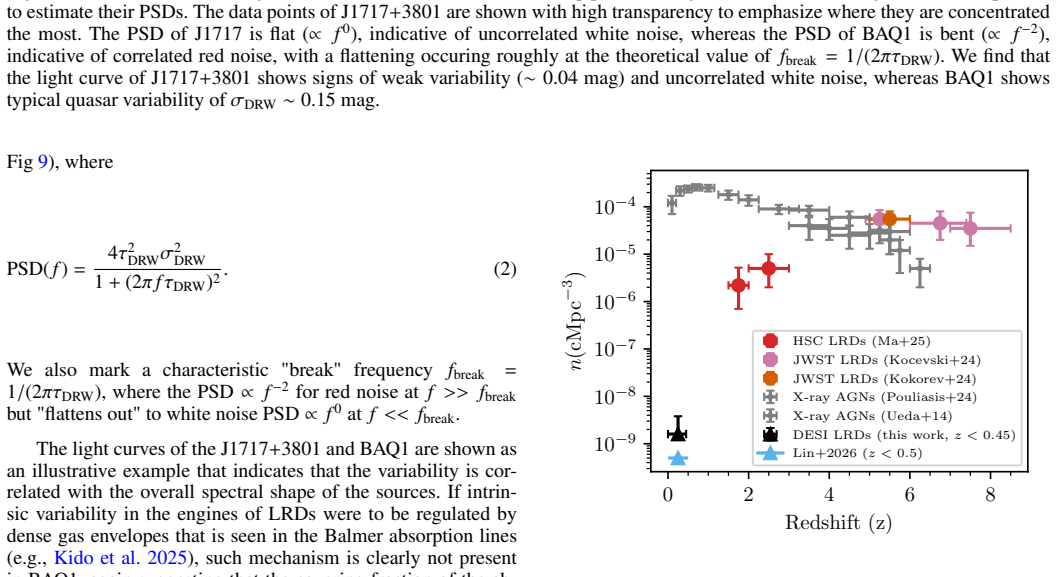
We report the discovery of eight LRDs at z=0.2-0.45 in DESI DR1. The sources display broad Balmer lines, steep Balmer decrements, compact morphologies, Balmer absorption features and/or strong He I emission, yet weak or absent He II, [Ne V] and other high-excitation lines. For most objects, multi-year light curves show weak or no intrinsic variability. Within the 4.9 Gpc^3 effective volume at z<0.45, the sample implies a number density of 1.6 times 10 to the minus 9 per cubic megaparsec, roughly 10,000 times lower than at z greater than 4, consistent with a decline in LRD activity driven by higher metallicities and lower gas feeding rates at later epochs.
What carries the argument
Emission-line selection criteria that isolate broad Balmer lines combined with steep decrements, Balmer absorption or strong He I, and the absence of high-ionization lines such as He II and [Ne V].
If this is right
- LRD activity appears strongly suppressed at z less than 1 compared with the first billion years.
- The lack of variability and high-ionization lines favors a non-standard accretion mode over typical Type I AGN.
- Higher metallicities at lower redshift may reduce the gas supply needed to sustain LRD-like emission.
- Ground-based facilities can now obtain detailed follow-up spectra and imaging of LRD analogs that were previously accessible only at high redshift.
Where Pith is reading between the lines
- The sharp drop in density suggests LRDs trace a transient early-universe phase that largely ends once metallicities rise.
- Mapping the redshift evolution between z=0.45 and z=2 with similar line-based searches could pinpoint when the population declines.
- If the selection remains clean at intermediate redshifts, LRDs may represent a distinct supermassive-black-hole growth channel rather than a short-lived subset of ordinary quasars.
Load-bearing premise
The emission-line criteria cleanly select true LRD analogs without significant contamination from other AGN or star-forming galaxies at these redshifts.
What would settle it
An independent search using photometric compactness plus spectroscopy in the same DESI volume that recovers a number density closer to the high-redshift value would falsify the reported scarcity.
Figures




read the original abstract
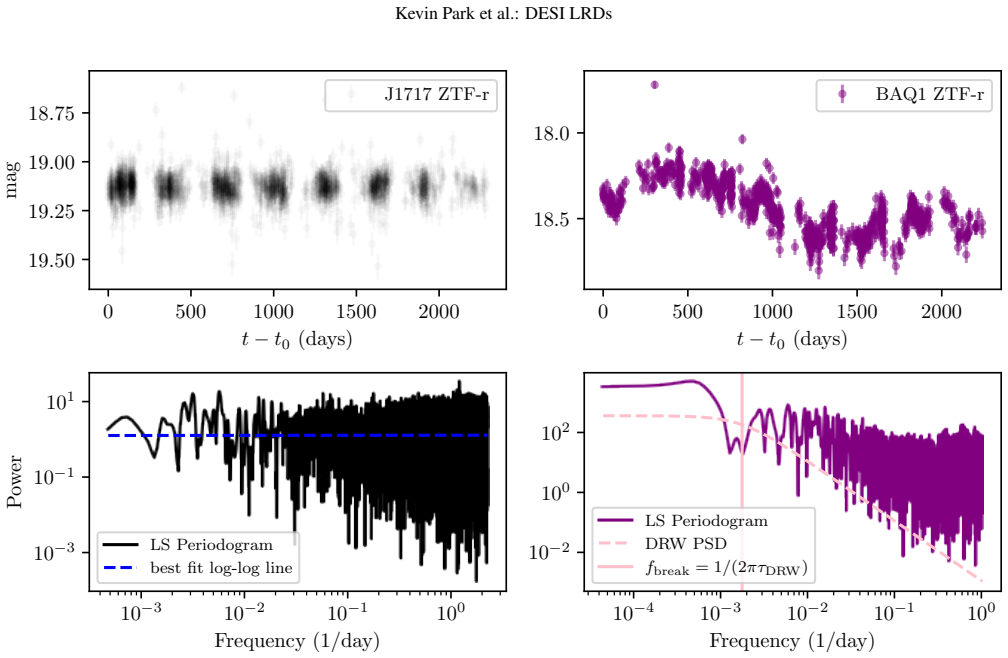
JWST has unveiled an abundant population of compact broad-line emitters largely at $z\gtrsim4$, the Little Red Dots (LRDs), which might represent a previously unprobed supermassive black hole evolution channel predominant at high redshift. However, the LRDs have remained mostly elusive at lower redshift ($z\lesssim2$) where detailed studies are possible from ground-based observatories. We searched for low-redshift LRDs in the Dark Energy Spectroscopic Instrument (DESI) survey. Our search is primarily based on emission line properties, as opposed to earlier approaches that searched for compact sources with specific photometric spectral energy distributions. We report the discovery of eight LRDs at $z=0.2-0.45$, which show spectral features akin to the high-redshift LRDs in the rest-frame optical. The sources are characterized by broad Balmer lines, steep Balmer decrements, compact morphologies, Balmer absorption features and/or strong He I emission, but weak or absent He II, [Ne V] or other high excitation lines typical of Type I AGN. For 7 out of 8 sources, we retrieve dense-cadence light curves from time-domain surveys and for most sources we find weak to no intrinsic variability ($0.0-0.1$ mag) over $4-17$ years in the rest-frame. We also highlight the identification of a quasar with similar Balmer line profiles as LRDs, but shows differences in Balmer decrement, significant variability, and high-ionisation lines. Given the effective volume $4.9{\rm Gpc^3}$ covered by DESI DR1 at $z<0.45$, our sample corresponds to a number density of $1.6\times10^{-9}$Mpc$^{-3}$, indicating a number density $\sim$10,000 times lower than in the first billion years of cosmic time. We find a dearth of luminous and red LRDs at $z<1$ compared to higher-redshift, which could suggest lower gas feeding rates of LRD activity due to higher metallicities at later cosmic epochs.
Editorial analysis
A structured set of objections, weighed in public.
Referee Report
Summary. The paper reports the discovery of eight Little Red Dot (LRD) analogs at z=0.2-0.45 in DESI DR1, selected primarily via emission-line properties (broad Balmer lines, steep decrements, absent high-ionization lines such as He II and [Ne V], plus compact morphologies and low variability). The sample yields a number density of 1.6×10^{-9} Mpc^{-3} over an effective volume of 4.9 Gpc^3, implying a ~10,000-fold drop relative to z>4 LRDs, which the authors attribute to reduced gas feeding rates at later epochs due to higher metallicities.
Significance. If the sample purity holds, the work supplies the first sizable low-redshift LRD analog set accessible to ground-based follow-up, enabling detailed studies of Balmer absorption, He I emission, and host properties that are difficult at high z. The reported density contrast provides a quantitative benchmark for evolutionary models of compact broad-line emitters and suggests a strong redshift dependence in the prevalence of this AGN phase.
major comments (1)
- [Source selection] In the section describing the emission-line selection (criteria for broad Balmer lines, steep decrements, and absent high-ionization lines), the manuscript excludes one quasar on variability and line-strength grounds but does not apply the full set of thresholds to a control sample drawn from the DESI DR1 parent catalog or report a false-positive rate. This omission directly affects the claimed purity of the eight sources and therefore the reliability of the number density 1.6×10^{-9} Mpc^{-3} and the 10,000× contrast with high-z LRDs.
minor comments (2)
- [Variability analysis] The variability amplitudes (0.0-0.1 mag) are stated for 7/8 sources over 4-17 years rest-frame, but the precise time baselines, photometric bands, and error floors for each object are not tabulated, making it difficult to assess consistency with the 'weak to no intrinsic variability' claim.
- [Results] Figure captions and text refer to 'dense-cadence light curves' without specifying the surveys (e.g., ZTF, CRTS) or the exact cadence and depth used for each source.
Simulated Author's Rebuttal
We thank the referee for their thorough review and valuable feedback on our manuscript. We address the major comment point by point below.
read point-by-point responses
-
Referee: In the section describing the emission-line selection (criteria for broad Balmer lines, steep decrements, and absent high-ionization lines), the manuscript excludes one quasar on variability and line-strength grounds but does not apply the full set of thresholds to a control sample drawn from the DESI DR1 parent catalog or report a false-positive rate. This omission directly affects the claimed purity of the eight sources and therefore the reliability of the number density 1.6×10^{-9} Mpc^{-3} and the 10,000× contrast with high-z LRDs.
Authors: We appreciate the referee's concern regarding the purity of our selected sample. Our selection criteria were applied to identify sources with specific emission-line properties characteristic of LRDs, and we manually inspected the spectra of candidates to ensure they match the described features. The exclusion of the one quasar was based on its deviation from the criteria in terms of variability and presence of high-ionization lines. We acknowledge that a quantitative assessment of the false-positive rate by applying the full selection to a control sample from the parent catalog would provide additional confidence in the sample purity. In the revised version of the manuscript, we will add a discussion or appendix estimating the false-positive rate, for example by applying the criteria to a large random subset of DESI spectra at similar redshifts and reporting the number of contaminants. This will help substantiate the reliability of the reported number density and the contrast with high-redshift LRDs. revision: yes
Circularity Check
Observational count of low-z LRD candidates shows no circularity
full rationale
The central result is a direct count of eight sources identified via explicit emission-line criteria in the external DESI DR1 catalog, divided by the stated survey volume of 4.9 Gpc³ to yield the number density 1.6×10^{-9} Mpc^{-3}. This calculation uses no fitted parameters, no self-referential definitions, and no predictions that reduce to the inputs by construction. The comparison to high-z densities draws on independent literature values that are externally falsifiable. Selection criteria are stated explicitly but function as an assumption about sample purity rather than a derivation that loops back on itself. No self-citation chain, ansatz smuggling, or renaming of known results is load-bearing for the reported density or its redshift evolution.
Axiom & Free-Parameter Ledger
axioms (2)
- domain assumption Broad Balmer lines with steep decrements and absent high-ionization lines reliably flag LRD analogs at low redshift
- standard math DESI DR1 provides a well-characterized volume of 4.9 Gpc^3 at z<0.45
Lean theorems connected to this paper
-
IndisputableMonolith/Foundation/RealityFromDistinction.leanreality_from_one_distinction unclear?
unclearRelation between the paper passage and the cited Recognition theorem.
Our search is primarily based on emission line properties... broad Balmer lines, steep Balmer decrements, compact morphologies, Balmer absorption features and/or strong He I emission, but weak or absent He II, [Ne V]
-
IndisputableMonolith/Cost/FunctionalEquation.leanwashburn_uniqueness_aczel unclear?
unclearRelation between the paper passage and the cited Recognition theorem.
Given the effective volume 4.9 Gpc^3... number density of 1.6×10^{-9} Mpc^{-3}
What do these tags mean?
- matches
- The paper's claim is directly supported by a theorem in the formal canon.
- supports
- The theorem supports part of the paper's argument, but the paper may add assumptions or extra steps.
- extends
- The paper goes beyond the formal theorem; the theorem is a base layer rather than the whole result.
- uses
- The paper appears to rely on the theorem as machinery.
- contradicts
- The paper's claim conflicts with a theorem or certificate in the canon.
- unclear
- Pith found a possible connection, but the passage is too broad, indirect, or ambiguous to say the theorem truly supports the claim.
Reference graph
Works this paper leans on
- [1]
-
[2]
Ananna, T. T., Bogdán, Á., Kovács, O. E., Natarajan, P., & Hickox, R. C. 2024, ApJ, 969, L18 Astropy Collaboration, Price-Whelan, A. M., Lim, P. L., et al. 2022, ApJ, 935, 167 Astropy Collaboration, Price-Whelan, A. M., Sip˝ocz, B. M., et al. 2018, AJ, 156, 123 Astropy Collaboration, Robitaille, T. P., Tollerud, E. J., et al. 2013, A&A, 558, A33 Bär, R. E...
work page 2024
-
[3]
Barro, G., Perez-Gonzalez, P. G., Kocevski, D., et al. 2025, arXiv e-prints, arXiv:2512.15853
-
[4]
Barro, G., Perez-Gonzalez, P. G., Kocevski, D. D., et al. 2024, arXiv e-prints, arXiv:2412.01887
- [5]
-
[6]
Berg, D. A., Naidu, R. P., Chisholm, J., et al. 2025a, arXiv e-prints, arXiv:2511.13591
work page internal anchor Pith review Pith/arXiv arXiv
-
[7]
Berg, D. A., Sanders, R. L., Shapley, A. E., et al. 2025b, arXiv e-prints, arXiv:2507.17057
- [8]
-
[9]
Brazzini, M., D’Eugenio, F., Maiolino, R., et al. 2025, MNRAS, 544, L167
work page 2025
- [10]
-
[11]
J., Stone, Z., Shen, Y ., & Jiang, Y .-F
Burke, C. J., Stone, Z., Shen, Y ., & Jiang, Y .-F. 2025, arXiv e-prints, arXiv:2511.16082
- [12]
-
[13]
Casey, C. M., Akins, H. B., Finkelstein, S. L., et al. 2025, ApJ, 990, L61
work page 2025
-
[14]
2025, MN- RAS[arXiv:2508.08768]
Chang, S.-J., Gronke, M., Matthee, J., & Mason, C. 2025, MN- RAS[arXiv:2508.08768]
-
[15]
Chisholm, J., Berg, D. A., Boylan-Kolchin, M., et al. 2026, arXiv e-prints, arXiv:2602.15935 de Graaff, A., Hviding, R. E., Naidu, R. P., et al. 2025a, arXiv e-prints, arXiv:2511.21820 de Graaff, A., Rix, H.-W., Naidu, R. P., et al. 2025b, A&A, 701, A168
-
[16]
Delvecchio, I., Daddi, E., Magnelli, B., et al. 2025, Astronomy and Astrophysics, 704, A313, aDS Bibcode: 2025A&A...704A.313D DESI Collaboration, Abdul Karim, M., Adame, A. G., et al. 2026, AJ, 171, 285 D’Eugenio, F., Juodžbalis, I., Ji, X., et al. 2025a, MNRAS[arXiv:2506.14870] D’Eugenio, F., Maiolino, R., Perna, M., et al. 2025b, arXiv e-prints, arXiv:2...
-
[17]
Ding, W., Kong, X., Guo, W.-J., et al. 2026, arXiv e-prints, arXiv:2604.14551
work page internal anchor Pith review Pith/arXiv arXiv 2026
-
[18]
Drake, A. J., Djorgovski, S. G., Mahabal, A., et al. 2009, ApJ, 696, 870
work page 2009
-
[19]
2026, arXiv e-prints, arXiv:2602.12325
Fei, Q., Fujimoto, S., Brammer, G., et al. 2026, arXiv e-prints, arXiv:2602.12325
-
[20]
J., Olsen, K., Economou, F., et al
Fitzpatrick, M. J., Olsen, K., Economou, F., et al. 2014, in Society of Photo- Optical Instrumentation Engineers (SPIE) Conference Series, V ol. 9149, Ob- servatory Operations: Strategies, Processes, and Systems V , ed. A. B. Peck, C. R. Benn, & R. L. Seaman, 91491T
work page 2014
- [21]
-
[22]
Fujimoto, S., Brammer, G. B., Watson, D., et al. 2022, Nature, 604, 261
work page 2022
-
[23]
Greene, J. E., Labbe, I., Goulding, A. D., et al. 2024, ApJ, 964, 39
work page 2024
-
[24]
Hunter, J. D. 2007, Computing in Science and Engineering, 9, 90
work page 2007
-
[25]
Hviding, R. E., de Graaff, A., Miller, T. B., et al. 2025, A&A, 702, A57
work page 2025
- [26]
- [27]
-
[28]
Inayoshi, K. & Maiolino, R. 2025, ApJ, 980, L27 Ivezi´c, Ž., Connolly, A., Vanderplas, J., & Gray, A. 2014, Statistics, Data Mining and Machine Learning in Astronomy (Princeton University Press)
work page 2025
-
[29]
Izotov, Y . I. & Thuan, T. X. 2008, ApJ, 687, 133
work page 2008
- [30]
-
[31]
2025a, arXiv e-prints, arXiv:2507.23774
Ji, X., D’Eugenio, F., Juodžbalis, I., et al. 2025a, arXiv e-prints, arXiv:2507.23774
-
[32]
2021, Computing in Science and Engineering, 23, 15 Juodžbalis, I., Ji, X., Maiolino, R., et al
Juneau, S., Olsen, K., Nikutta, R., Jacques, A., & Bailey, S. 2021, Computing in Science and Engineering, 23, 15 Juodžbalis, I., Ji, X., Maiolino, R., et al. 2024, MNRAS, 535, 853
work page 2021
-
[33]
Kido, D., Ioka, K., Hotokezaka, K., Inayoshi, K., & Irwin, C. M. 2025, MNRAS, 544, 3407
work page 2025
- [34]
-
[35]
Kocevski, D. D., Finkelstein, S. L., Barro, G., et al. 2025, ApJ, 986, 126
work page 2025
-
[36]
D., Onoue, M., Inayoshi, K., et al
Kocevski, D. D., Onoue, M., Inayoshi, K., et al. 2023, ApJ, 954, L4
work page 2023
- [37]
- [38]
- [39]
- [40]
-
[41]
Labbe, I., Greene, J. E., Bezanson, R., et al. 2025, ApJ, 978, 92
work page 2025
-
[42]
Latif, M. A., Aftab, A., Whalen, D. J., & Mezcua, M. 2025, A&A, 694, L14 Article number, page 15 of 21 A&A proofs:manuscript no. main 3500 3750 4000 4250 4500 4750 5000 5250 100 101 fλ [10□17 erg s □1 cm□2 ˚A□1] [O II] λ3727 H11 λ3770 H10 λ3798 H9 λ3835 [Ne III] λ3869 Hζ λ 3889 Hϵ λ 3970 Hδ λ 4102 Hγ λ 4341 [O III] λ4363 [Fe II] λ4417 He I λ4471 He II λ46...
work page 2025
-
[43]
Leung, G. C. K., Finkelstein, S. L., Pérez-González, P. G., et al. 2025, ApJ, 992, 26
work page 2025
- [44]
-
[45]
2025, arXiv e-prints, arXiv:2507.10659
Lin, X., Fan, X., Cai, Z., et al. 2025, arXiv e-prints, arXiv:2507.10659
-
[46]
2026a, arXiv e-prints, arXiv:2603.02317
Liu, H., Jiang, Y .-F., Quataert, E., et al. 2026a, arXiv e-prints, arXiv:2603.02317
-
[47]
How I Wonder What You Are -- JWST's Little Red Dots do not TWINKLE
Liu, Z., Naidu, R. P., Secunda, A., et al. 2026b, arXiv e-prints, arXiv:2604.13000
work page internal anchor Pith review Pith/arXiv arXiv
- [48]
-
[49]
Lomb, N. R. 1976, Ap&SS, 39, 447
work page 1976
-
[50]
Ma, Y ., Greene, J. E., Setton, D. J., et al. 2025a, arXiv e-prints, arXiv:2504.08032
-
[51]
Ma, Y ., Greene, J. E., V olonteri, M., et al. 2025c, arXiv e-prints, arXiv:2509.02662 Article number, page 16 of 21 Kevin Park et al.: DESI LRDs 3500 3750 4000 4250 4500 4750 5000 5250 10□1 100 101 fλ [10□17 erg s □1 cm□2 ˚A□1] [O II] λ3727 H11 λ3770 H10 λ3798 H9 λ3835 [Ne III] λ3869 Hζ λ 3889 Hϵ λ 3970 Hδ λ 4102 Hγ λ 4341 [O III] λ4363 [Fe II] λ4417 He ...
-
[52]
MacLeod, C. L., Ivezi´c, Ž., Kochanek, C. S., et al. 2010, ApJ, 721, 1014
work page 2010
-
[53]
L., Ivezi´c, Ž., Sesar, B., et al
MacLeod, C. L., Ivezi´c, Ž., Sesar, B., et al. 2012, ApJ, 753, 106
work page 2012
- [54]
-
[55]
Mahabal, A., Stern, D., Bogosavljevi ´c, M., Djorgovski, S. G., & Thompson, D. 2005, ApJ, 634, L9
work page 2005
-
[56]
Maiolino, R., Risaliti, G., Signorini, M., et al. 2025, MNRAS, 538, 1921
work page 2025
-
[57]
Maiolino, R., Scholtz, J., Curtis-Lake, E., et al. 2024, A&A, 691, A145
work page 2024
-
[58]
Masci, F. J., Laher, R. R., Rusholme, B., et al. 2018, Publications of the Astro- nomical Society of the Pacific, 131, 018003
work page 2018
-
[59]
Mathis, J. S. 1957, ApJ, 125, 318
work page 1957
-
[60]
Matthee, J., Naidu, R. P., Brammer, G., et al. 2024, ApJ, 963, 129 Article number, page 17 of 21 A&A proofs:manuscript no. main 3500 3750 4000 4250 4500 4750 5000 5250 10□1 100 101 102 fλ [10□17 erg s □1 cm□2 ˚A□1] [O II] λ3727 H11 λ3770 H10 λ3798 H9 λ3835 [Ne III] λ3869 Hζ λ 3889 Hϵ λ 3970 Hδ λ 4102 Hγ λ 4341 [O III] λ4363 [Fe II] λ4417 He I λ4471 He II ...
work page 2024
-
[61]
2026, arXiv e-prints, arXiv:2603.17667
Matthee, J., Torralba, A., Pezzulli, G., et al. 2026, arXiv e-prints, arXiv:2603.17667
-
[62]
2024, arXiv e-prints, arXiv:2412.04224
Mazzolari, G., Gilli, R., Maiolino, R., et al. 2024, arXiv e-prints, arXiv:2412.04224
-
[63]
Millman, K. J. & Aivazis, M. 2011, Computing in Science & Engineering, 13, 9
work page 2011
-
[64]
D., Moustakas, J., Bailey, S., et al
Myers, A. D., Moustakas, J., Bailey, S., et al. 2023, AJ, 165, 50
work page 2023
-
[65]
P., Matthee, J., Katz, H., et al
Naidu, R. P., Matthee, J., Katz, H., et al. 2025, arXiv e-prints, arXiv:2503.16596
- [66]
-
[67]
Newville, M., Stensitzki, T., Allen, D. B., & Ingargiola, A. 2014, LMFIT: Non- Linear Least-Square Minimization and Curve-Fitting for Python
work page 2014
-
[68]
P., Watson, D., Sneppen, A., et al
Nikopoulos, G. P., Watson, D., Sneppen, A., et al. 2025, arXiv e-prints, arXiv:2510.06362 Article number, page 18 of 21 Kevin Park et al.: DESI LRDs 3500 3750 4000 4250 4500 4750 5000 5250 10□1 100 101 fλ [10□17 erg s □1 cm□2 ˚A□1] [O II] λ3727 H11 λ3770 H10 λ3798 H9 λ3835 [Ne III] λ3869 Hζ λ 3889 Hϵ λ 3970 Hδ λ 4102 Hγ λ 4341 [O III] λ4363 [Fe II] λ4417 ...
-
[69]
Nikutta, R., Fitzpatrick, M., Scott, A., & Weaver, B. A. 2020, Astronomy and Computing, 33, 100411
work page 2020
-
[70]
Oke, J. B. & Gunn, J. E. 1983, ApJ, 266, 713
work page 1983
- [71]
-
[72]
Perger, K., Fogasy, J., Frey, S., & Gabányi, K. É. 2025, A&A, 693, L2
work page 2025
-
[73]
Pouliasis, E., Ruiz, A., Georgantopoulos, I., et al. 2024, A&A, 685, A97
work page 2024
-
[74]
C., Castellanos-Ramírez, A., Esquivel, A., Rodríguez-González, A., & Velázquez, P
Raga, A. C., Castellanos-Ramírez, A., Esquivel, A., Rodríguez-González, A., & Velázquez, P. F. 2015, Rev. Mexicana Astron. Astrofis., 51, 231
work page 2015
- [75]
- [76]
-
[77]
Scargle, J. D. 1982, ApJ, 263, 835
work page 1982
-
[78]
2026, arXiv e-prints, arXiv:2603.22277
Scholtz, J., D’Eugenio, F., Maiolino, R., et al. 2026, arXiv e-prints, arXiv:2603.22277
-
[79]
Secunda, A., Somerville, R. S., Jiang, Y .-F., et al. 2025, arXiv e-prints, arXiv:2509.03571
- [80]
discussion (0)
Sign in with ORCID, Apple, or X to comment. Anyone can read and Pith papers without signing in.