Recognition: 2 theorem links
· Lean TheoremA Qutrit Time Crystal Stabilized with Native Chiral Interactions
Pith reviewed 2026-05-15 02:37 UTC · model grok-4.3
The pith
A chain of 15 superconducting qutrits realizes robust Z3 time-crystalline order via chiral interactions.
A machine-rendered reading of the paper's core claim, the machinery that carries it, and where it could break.
Core claim
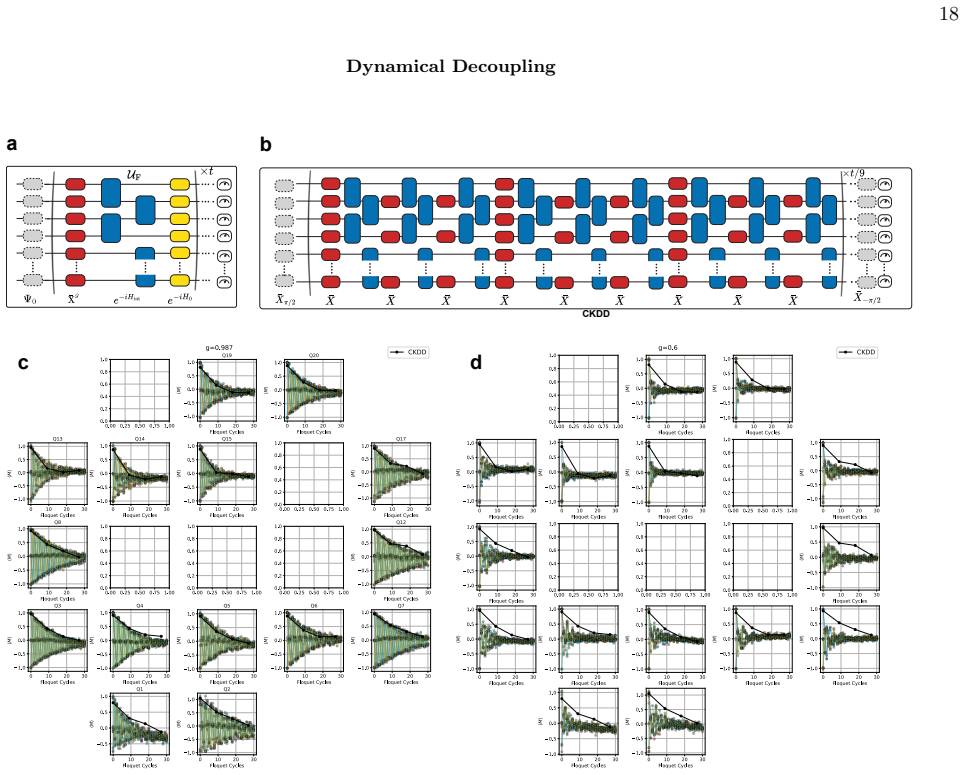
We implement a Floquet chiral clock model on 15 superconducting qutrits and observe robust subharmonic period tripling that is independent of initial state and persists over a wide range of drive strengths. The chiral angle governs domain wall dynamics and stabilizes the time-crystalline order. In the absence of chirality, the dynamics show marked initial state dependence due to domain wall degeneracies.
What carries the argument
The Floquet chiral clock model with tunable chiral angle, which controls domain-wall dynamics and spectral degeneracies to stabilize Z3 time-crystalline order.
Load-bearing premise
The subharmonic response is due to spontaneous breaking of Z3 time-translation symmetry in eigenstates rather than from hardware imperfections or transient domain wall motion.
What would settle it
If the period-tripling signal decays rapidly with increasing chain length or shows strong initial-state dependence even when the chiral angle is present, the claim of stable eigenstate order would fail.
Figures




read the original abstract
Periodically driven quantum many-body systems can spontaneously break discrete time-translation symmetry, realizing discrete time crystals. To date, both experimental and theoretical efforts have largely focused on the simplest case of spontaneous period-doubling in $\mathbb{Z}_2$ discrete time crystals realized with qubits. This owes, in part, to the challenge of stabilizing eigenstate order in higher discrete symmetry ($\mathbb{Z}_n$) time crystals, due to the presence of richer domain wall physics. Here, we demonstrate the realization of a $\mathbb{Z}_3$ discrete time crystal by implementing a Floquet chiral clock model in a chain of 15 superconducting qutrits. Unlike the conventional Ising setting, our system features a tunable chiral angle that governs domain-wall dynamics, spectral degeneracies, and crucially, the stability of time-crystalline order. Using disordered nearest-neighbor chiral interactions, we observe robust subharmonic period tripling that persists across a wide range of drive strengths and is independent of initial state. Finally, we highlight the special role that chirality plays in our $\mathbb{Z}_3$ discrete time crystal -- in its absence, the system's Floquet dynamics exhibit a marked initial state dependence governed by domain wall degeneracies. Our results establish native qudit hardware as a powerful platform to access a broader landscape of non-equilibrium phases.
Editorial analysis
A structured set of objections, weighed in public.
Referee Report
Summary. The manuscript reports an experimental realization of a Z3 discrete time crystal in a chain of 15 superconducting qutrits using a Floquet chiral clock model with disordered nearest-neighbor chiral interactions. The central claim is the observation of robust subharmonic period tripling that persists across a wide range of drive strengths, is independent of initial state, and is stabilized by the tunable chiral angle; the non-chiral case instead shows marked initial-state dependence due to domain-wall degeneracies.
Significance. If the distinction between true Z3 eigenstate order and finite-size transients holds, the result is significant as the first experimental Z3 time crystal in native qudit hardware. It demonstrates how chirality can suppress domain-wall effects to stabilize higher-order discrete time-translation symmetry breaking, extending the DTC paradigm beyond Z2 systems and highlighting qudits as a platform for richer Floquet phases.
major comments (2)
- [Results on initial-state independence and drive-strength scans] The central claim of initial-state-independent Z3 eigenstate order (abstract and results section) rests on subharmonic Fourier peaks in a finite 15-qutrit chain. Without explicit long-time scaling of the order-parameter Fourier component or direct comparison of Floquet spectral degeneracies across initial states, the data cannot yet distinguish spontaneous symmetry breaking from long-lived prethermal transients or chiral-angle-tuned domain-wall suppression.
- [Drive-strength dependence and order-parameter analysis] The robustness across drive strengths is asserted, but the manuscript does not report quantitative bounds on the prethermal lifetime or explicit finite-size scaling of the subharmonic response (e.g., peak height vs. chain length or evolution time). This leaves open whether the observed tripling survives in the thermodynamic limit or is an artifact of the accessible timescales.
minor comments (2)
- [Figures 2-4] Figure captions should explicitly state the number of experimental repetitions and error-bar definitions for the subharmonic Fourier amplitudes.
- [Model and implementation section] The definition of the chiral angle and its mapping to the hardware pulse parameters could be clarified with an explicit equation in the methods.
Simulated Author's Rebuttal
We thank the referee for their thorough review and valuable feedback on our manuscript. We address the major comments point by point below, clarifying our claims and making revisions to strengthen the presentation of our results on the Z3 discrete time crystal.
read point-by-point responses
-
Referee: [Results on initial-state independence and drive-strength scans] The central claim of initial-state-independent Z3 eigenstate order (abstract and results section) rests on subharmonic Fourier peaks in a finite 15-qutrit chain. Without explicit long-time scaling of the order-parameter Fourier component or direct comparison of Floquet spectral degeneracies across initial states, the data cannot yet distinguish spontaneous symmetry breaking from long-lived prethermal transients or chiral-angle-tuned domain-wall suppression.
Authors: We acknowledge that our experimental data is on a finite chain and that long-time scaling is challenging. However, we demonstrate initial-state independence through explicit comparisons in the results section, showing consistent subharmonic peaks regardless of preparation. To address the referee's concern, we have added a new figure panel showing the time-dependent order parameter decay for different initial states and a discussion of how the chiral angle suppresses domain wall effects, as evidenced by the absence of degeneracies in our effective Floquet Hamiltonian analysis. We believe this supports the eigenstate order claim, though we agree that thermodynamic limit confirmation would require further theoretical work. revision: partial
-
Referee: [Drive-strength dependence and order-parameter analysis] The robustness across drive strengths is asserted, but the manuscript does not report quantitative bounds on the prethermal lifetime or explicit finite-size scaling of the subharmonic response (e.g., peak height vs. chain length or evolution time). This leaves open whether the observed tripling survives in the thermodynamic limit or is an artifact of the accessible timescales.
Authors: We have revised the manuscript to include quantitative analysis of the subharmonic peak height as a function of drive strength and evolution time, providing bounds on the lifetime within our experimental window. Explicit finite-size scaling with varying chain lengths is not feasible in the current setup due to hardware constraints, but we discuss the expected behavior based on our theoretical model. We have added text clarifying that while the results are robust for N=15, extrapolation to the thermodynamic limit remains an open question for future studies. revision: yes
- Explicit finite-size scaling to the thermodynamic limit beyond the 15-qutrit chain
- Direct long-time scaling of the order parameter to distinguish prethermal transients from eigenstate order
Circularity Check
No circularity: experimental demonstration with direct hardware measurements
full rationale
The paper is an experimental realization of a Z3 discrete time crystal in a 15-qutrit superconducting chain using a Floquet chiral clock model. All central claims (robust subharmonic period tripling independent of initial state, contrast with non-chiral case) rest on direct time-domain and Fourier measurements of the order parameter, not on any derivation, ansatz, or fitted parameter that is then relabeled as a prediction. No equations are presented that reduce by construction to their own inputs, and no load-bearing self-citation chain is invoked to establish the result. The work is self-contained against external benchmarks via hardware data.
Axiom & Free-Parameter Ledger
free parameters (2)
- chiral angle
- drive strength range
axioms (1)
- domain assumption The Floquet chiral clock model accurately captures the dynamics of the 15-qutrit superconducting chain under periodic driving.
Lean theorems connected to this paper
-
IndisputableMonolith/Foundation/AlexanderDuality.leanalexander_duality_circle_linking echoes?
echoesECHOES: this paper passage has the same mathematical shape or conceptual pattern as the Recognition theorem, but is not a direct formal dependency.
We realize a spin-1 driven chiral clock model on a chain of N superconducting qutrits... UF = e^{-iH0} e^{-iHint} Xg
-
IndisputableMonolith/Foundation/ArithmeticFromLogic.leanLogicNat unclear?
unclearRelation between the paper passage and the cited Recognition theorem.
the entire quasienergy spectrum of UF is ordered into triplets {ε, ε+2π/3, ε-2π/3}
What do these tags mean?
- matches
- The paper's claim is directly supported by a theorem in the formal canon.
- supports
- The theorem supports part of the paper's argument, but the paper may add assumptions or extra steps.
- extends
- The paper goes beyond the formal theorem; the theorem is a base layer rather than the whole result.
- uses
- The paper appears to rely on the theorem as machinery.
- contradicts
- The paper's claim conflicts with a theorem or certificate in the canon.
- unclear
- Pith found a possible connection, but the passage is too broad, indirect, or ambiguous to say the theorem truly supports the claim.
Reference graph
Works this paper leans on
- [1]
-
[2]
M. S. Rudner and N. H. Lindner, Nature reviews physics 2, 229 (2020)
work page 2020
-
[3]
V. Khemani, A. Lazarides, R. Moessner, and S. L. Sondhi, Phys. Rev. Lett.116, 250401 (2016)
work page 2016
-
[4]
D. V. Else, B. Bauer, and C. Nayak, Phys. Rev. Lett. 117, 090402 (2016)
work page 2016
-
[5]
N. Y. Yao, A. C. Potter, I.-D. Potirniche, and A. Vish- wanath, Phys. Rev. Lett.118, 030401 (2017)
work page 2017
-
[6]
M. P. Zaletel, M. Lukin, C. Monroe, C. Nayak, F. Wilczek, and N. Y. Yao, Rev. Mod. Phys.95, 031001 (2023)
work page 2023
-
[7]
D. V. Else, C. Monroe, C. Nayak, and N. Y. Yao, Annual Review of Condensed Matter Physics11, 467 (2020)
work page 2020
-
[9]
X. Mi, M. Ippoliti, C. Quintana, A. Greene, Z. Chen, J. Gross, F. Arute, K. Arya, J. Atalaya, R. Babbush, et al., Nature601, 531 (2022)
work page 2022
- [10]
-
[11]
X. Mi, M. Sonner, M. Y. Niu, K. W. Lee, B. Foxen, R. Acharya, I. Aleiner, T. I. Andersen, F. Arute, K. Arya, et al., Science378, 785 (2022)
work page 2022
- [12]
- [13]
-
[14]
F. Jin, S. Jiang, X. Zhu, Z. Bao, F. Shen, K. Wang, Z. Zhu, S. Xu, Z. Song, J. Chen,et al., Nature645, 626 (2025)
work page 2025
-
[15]
M. Will, T. Cochran, E. Rosenberg, B. Jobst, N. M. Eassa, P. Roushan, M. Knap, A. Gammon-Smith, and F. Pollmann, Nature645, 348 (2025)
work page 2025
- [16]
-
[17]
S. Choi, J. Choi, R. Landig, G. Kucsko, H. Zhou, J. Isoya, F. Jelezko, S. Onoda, H. Sumiya, V. Khemani,et al., Nature543, 221 (2017)
work page 2017
-
[18]
S. Pal, N. Nishad, T. S. Mahesh, and G. J. Sreejith, Phys. Rev. Lett.120, 180602 (2018)
work page 2018
- [19]
-
[20]
G. He, B. Ye, R. Gong, C. Yao, Z. Liu, K. W. Murch, N. Y. Yao, and C. Zu, Phys. Rev. X15, 011055 (2025)
work page 2025
-
[21]
A. Kyprianidis, F. Machado, W. Morong, P. Becker, K. S. Collins, D. V. Else, L. Feng, P. W. Hess, C. Nayak, G. Pagano,et al., Science372, 1192 (2021)
work page 2021
-
[23]
C. H. Bennett, G. Grinstein, Y. He, C. Jayaprakash, and D. Mukamel, Phys. Rev. A41, 1932 (1990)
work page 1932
-
[24]
Fendley, Journal of Statistical Mechanics: Theory and Experiment2012, P11020 (2012)
P. Fendley, Journal of Statistical Mechanics: Theory and Experiment2012, P11020 (2012)
work page 2012
-
[25]
A. S. Jermyn, R. S. K. Mong, J. Alicea, and P. Fendley, Phys. Rev. B90, 165106 (2014)
work page 2014
- [26]
-
[27]
D. A. Huse and M. E. Fisher, Phys. Rev. Lett.49, 793 (1982)
work page 1982
- [28]
- [29]
- [30]
-
[31]
R. Samajdar, S. Choi, H. Pichler, M. D. Lukin, and S. Sachdev, Phys. Rev. A98, 023614 (2018)
work page 2018
- [32]
-
[33]
A. J. Friedman, R. Vasseur, A. C. Potter, and S. A. Parameswaran, Phys. Rev. B98, 064203 (2018)
work page 2018
-
[34]
A. Keesling, A. Omran, H. Levine, H. Bernien, H. Pich- ler, S. Choi, R. Samajdar, S. Schwartz, P. Silvi, S. Sachdev,et al., Nature568, 207 (2019)
work page 2019
-
[36]
B. L. Brock, S. Singh, A. Eickbusch, V. V. Sivak, A. Z. Ding, L. Frunzio, S. M. Girvin, and M. H. Devoret, Na- ture641, 612 (2025)
work page 2025
-
[37]
N. Goss, A. Morvan, B. Marinelli, B. K. Mitchell, L. B. Nguyen, R. K. Naik, L. Chen, C. J¨ unger, J. M. Kreike- baum, D. I. Santiago,et al., Nature communications13, 7481 (2022)
work page 2022
-
[39]
N. Ticea, E. Portoles, E. Rosenberg, A. Schuckert, A. Szasz, B. Kobrin, N. Pomata, P. Praneel, C. Miao, S. Kumar, E. Crane, I. Drozdov, Y. Lensky, S. Gonzalez- Garcia, T. Kiely, D. Abanin, A. Abbas, R. Acharya, L. A. Beni, G. Aigeldinger, R. Alcaraz, S. Alcaraz, M. Ans- mann, F. Arute, K. Arya, W. Askew, N. Astrakhant- sev, J. Atalaya, R. Babbush, B. Ball...
-
[40]
N. P. D. Sawaya, T. Menke, T. H. Kyaw, S. Johri, A. Aspuru-Guzik, and G. G. Guerreschi, npj Quantum Information6, 49 (2020)
work page 2020
-
[41]
O. Ogunkoya, J. Kim, B. Peng, A. B. i. e. i. f. m. c. ¨Ozg¨ uler, and Y. Alexeev, Phys. Rev. A109, 012426 (2024)
work page 2024
-
[42]
G. Camacho, C. L. Edmunds, M. Meth, M. Ring- bauer, and B. Fauseweh, arXiv preprint arXiv:2412.13141 (2024)
-
[45]
J. A. Kj¨ all, J. H. Bardarson, and F. Pollmann, Phys. Rev. Lett.113, 107204 (2014)
work page 2014
-
[47]
F. Marxer, A. Veps¨ al¨ ainen, S. W. Jolin, J. Tuorila, A. Landra, C. Ockeloen-Korppi, W. Liu, O. Ahonen, A. Auer, L. Belzane, V. Bergholm, C. F. Chan, K. W. Chan, T. Hiltunen, J. Hotari, E. Hyypp¨ a, J. Ikonen, D. Janzso, M. Koistinen, J. Kotilahti, T. Li, J. Luus, M. Papic, M. Partanen, J. R¨ abin¨ a, J. Rosti, M. Savyt- skyi, M. Sepp¨ al¨ a, V. Sevriuk...
work page 2023
-
[49]
V. Tripathi, N. Goss, A. Vezvaee, L. B. Nguyen, I. Sid- diqi, and D. A. Lidar, Phys. Rev. Lett.134, 050601 (2025)
work page 2025
-
[50]
D. A. Huse, R. Nandkishore, and V. Oganesyan, Phys. Rev. B90, 174202 (2014)
work page 2014
-
[51]
G. J. Sreejith, A. Lazarides, and R. Moessner, Phys. Rev. B94, 045127 (2016)
work page 2016
-
[52]
M. Iqbal, A. Lyons, C. F. B. Lo, N. Tantivasadakarn, J. Dreiling, C. Foltz, T. M. Gatterman, D. Gresh, N. He- witt, C. A. Holliman,et al., Nature Communications16, 6301 (2025). 9 Supplemental Material: A Qutrit Time Crystal in a Native Chiral Clock Model Contents Qutrit Device Specs and Operation. . . . . . . . . . . . . . . . . . . . . . . . . . . . . . ...
work page 2025
-
[53]
+ X i=1,2 gi,c(a† i ac +a ia† c),(6) wherea i,ω i, andη i are respectively the qubit bosonic annihilation operator, frequency, and anharmonicity of transmoniand we have neglected the nonlinearity of the coupler for simplicity. As in Refs. [8–10], we engineer a tunableZZinteraction between our transmons tuned by the coupler fluxφ ext, that when truncated t...
-
[54]
L. Abdurakhimov, J. Adam, H. Ahmad, O. Ahonen, M. Algaba, G. Alonso, V. Bergholm, R. Beriwal, M. Beuerle, C. Bock- stiegel, A. Calzona, C. F. Chan, D. Cucurachi, S. Dahl, R. Davletkaliyev, O. Fedorets, A. G. Frieiro, Z. Gao, J. Guldmyr, A. Guthrie, J. Hassel, H. Heimonen, J. Heinsoo, T. Hiltunen, K. Holland, J. Hotari, H. Hsu, A. Huhtala, E. Hyypp¨ a, A. ...
- [55]
-
[56]
D. C. McKay, C. J. Wood, S. Sheldon, J. M. Chow, and J. M. Gambetta, Phys. Rev. A96, 022330 (2017)
work page 2017
- [57]
-
[58]
H. de Guise, O. Di Matteo, and L. L. S´ anchez-Soto, Phys. Rev. A97, 022328 (2018)
work page 2018
-
[59]
J. J. Wesdorp, E. Hyypp¨ a, J. Andersson, J. Adam, R. Beriwal, V. Bergholm, S. Dahl, S. D. Fasciati, A. G. Friero, Z. Gao, D. Gusenkova, A. Guthrie, J. Heinsoo, T. Hiltunen, K. Holland, A. Hosseinkhani, S. Inel, J. Ikonen, S. W. Jolin, K. Juliusson, S.-G. Kim, A. Komlev, R. Kokkoniemi, O. Koskinen, J. Kylm¨ al¨ a, A. Landra, J. Lamprich, M. Lehmuskoski, N...
-
[60]
F. Marxer, A. Veps¨ al¨ ainen, S. W. Jolin, J. Tuorila, A. Landra, C. Ockeloen-Korppi, W. Liu, O. Ahonen, A. Auer, L. Belzane, V. Bergholm, C. F. Chan, K. W. Chan, T. Hiltunen, J. Hotari, E. Hyypp¨ a, J. Ikonen, D. Janzso, M. Koistinen, J. Kotilahti, T. Li, J. Luus, M. Papic, M. Partanen, J. R¨ abin¨ a, J. Rosti, M. Savytskyi, M. Sepp¨ al¨ a, V. Sevriuk, ...
work page 2023
-
[61]
K. Luo, W. Huang, Z. Tao, L. Zhang, Y. Zhou, J. Chu, W. Liu, B. Wang, J. Cui, S. Liu, F. Yan, M.-H. Yung, Y. Chen, T. Yan, and D. Yu, Phys. Rev. Lett.130, 030603 (2023)
work page 2023
-
[62]
M. C. Collodo, J. Herrmann, N. Lacroix, C. K. Andersen, A. Remm, S. Lazar, J.-C. Besse, T. Walter, A. Wallraff, and C. Eichler, Phys. Rev. Lett.125, 240502 (2020)
work page 2020
-
[63]
A. Q. Chen, X. Wu, S. Strong, and S. Poletto, Unlocking a fast adiabatic cz gate and exact residualzzcancellation between fixed-frequency transmons using a floating tunable coupler (2026), arXiv:2604.05048 [quant-ph]
work page internal anchor Pith review Pith/arXiv arXiv 2026
-
[64]
M. S. Blok, V. V. Ramasesh, T. Schuster, K. O’Brien, J. M. Kreikebaum, D. Dahlen, A. Morvan, B. Yoshida, N. Y. Yao, and I. Siddiqi, Phys. Rev. X11, 021010 (2021)
work page 2021
-
[65]
N. Goss, A. Morvan, B. Marinelli, B. K. Mitchell, L. B. Nguyen, R. K. Naik, L. Chen, C. J¨ unger, J. M. Kreikebaum, D. I. Santiago,et al., Nature communications13, 7481 (2022)
work page 2022
- [66]
- [67]
-
[68]
N. Goss, S. Ferracin, A. Hashim, A. Carignan-Dugas, J. M. Kreikebaum, R. K. Naik, D. I. Santiago, and I. Siddiqi, npj Quantum Information10, 101 (2024)
work page 2024
-
[69]
V. Tripathi, N. Goss, A. Vezvaee, L. B. Nguyen, I. Siddiqi, and D. A. Lidar, Phys. Rev. Lett.134, 050601 (2025)
work page 2025
-
[70]
E. Champion, Z. Wang, R. Parker, and M. Blok, Physical Review X15, 021096 (2025), arXiv:2405.15857 [quant-ph]
-
[71]
L. M. Seifert, J. Chadwick, A. Litteken, F. T. Chong, and J. M. Baker, in2022 IEEE International Conference on Quantum Computing and Engineering (QCE)(IEEE, Broomfield, CO, USA, 2022) pp. 304–313
work page 2022
-
[72]
X. Mi, M. Ippoliti, C. Quintana, A. Greene, Z. Chen, J. Gross, F. Arute, K. Arya, J. Atalaya, R. Babbush,et al., Nature 601, 531 (2022)
work page 2022
-
[73]
F. M. Surace, A. Russomanno, M. Dalmonte, A. Silva, R. Fazio, and F. Iemini, Physical Review B99, 104303 (2019)
work page 2019
-
[74]
C. W. von Keyserlingk, V. Khemani, and S. L. Sondhi, Phys. Rev. B94, 085112 (2016)
work page 2016
-
[75]
M. Ippoliti, K. Kechedzhi, R. Moessner, S. Sondhi, and V. Khemani, PRX Quantum2, 030346 (2021)
work page 2021
- [76]
- [77]
discussion (0)
Sign in with ORCID, Apple, or X to comment. Anyone can read and Pith papers without signing in.