Ward identities and orbital magnetization in current density functional theory
Pith reviewed 2026-06-30 20:49 UTC · model grok-4.3
The pith
Orbital magnetization of an interacting periodic crystal equals the value from self-consistent Kohn-Sham equations in current density functional theory.
A machine-rendered reading of the paper's core claim, the machinery that carries it, and where it could break.
Core claim
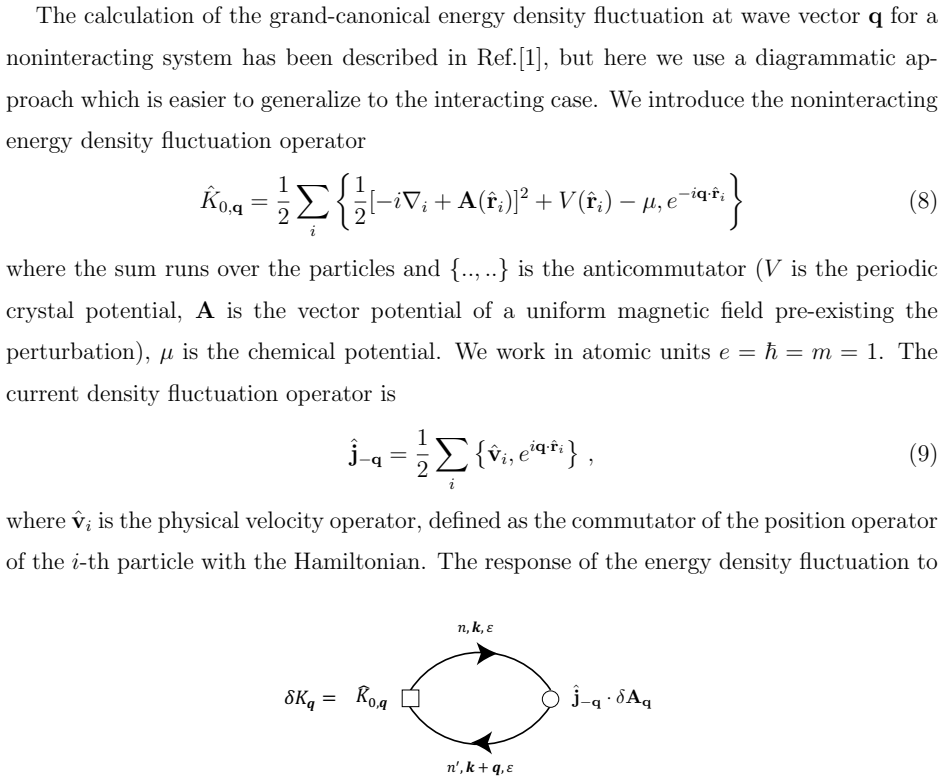
By computing the linear response of the energy density to a periodic magnetic field in the long-wavelength limit and unveiling a Ward identity which connects the current vertex to the derivative of the Kohn-Sham self-energy, the orbital magnetization of the interacting solid can be computed exactly from the self-consistent eigenfunctions and eigenvalues of the Kohn-Sham equation of CDFT.
What carries the argument
The Ward identity connecting the current vertex to the derivative of the Kohn-Sham self-energy, which reduces the interacting response to non-interacting Kohn-Sham quantities.
If this is right
- The orbital magnetization formula derived in Ref. [1] holds for periodic crystals.
- Orbital magnetism is determined solely by the self-consistent Kohn-Sham eigenfunctions and eigenvalues in CDFT.
- The result applies specifically in the long-wavelength limit.
- Standard CDFT codes can be used to compute orbital magnetization without additional many-body corrections.
Where Pith is reading between the lines
- The same linear-response plus Ward-identity approach may extend to spin magnetization or other magnetic response functions.
- Testing the formula on exactly solvable lattice models could verify the reduction in practice.
- Finite-size or non-periodic generalizations might be constructed by relaxing the long-wavelength assumption step by step.
Load-bearing premise
The Ward identity that connects the current vertex to the derivative of the Kohn-Sham self-energy remains valid in the long-wavelength limit for the periodic crystal under consideration.
What would settle it
Numerical evaluation of orbital magnetization from exact many-body theory versus the Kohn-Sham CDFT formula in a small model crystal where the self-energy derivative is independently computable.
Figures
read the original abstract
We revisit the derivation of the orbital magnetization formula for periodic crystals in current density functional theory (CDFT)[1]. Our new derivation computes the linear response of the energy density to a periodic magnetic field in the long-wavelength limit. We unveil a Ward identity which connects the current vertex to the derivative of the Kohn-Sham self-energy. The result of Ref.[1] is confirmed: the orbital magnetization of the interacting solid can be computed exactly (in principle) from the self-consistent eigenfunctions and eigenvalues of the Kohn-Sham equation of CDFT.
Editorial analysis
A structured set of objections, weighed in public.
Referee Report
Summary. The paper re-derives the orbital magnetization formula for periodic crystals within current-density functional theory by computing the linear response of the energy density to a spatially periodic magnetic field in the long-wavelength limit. It introduces a Ward identity relating the current vertex function to the derivative of the Kohn-Sham self-energy and concludes that the interacting orbital magnetization is exactly recoverable from the self-consistent Kohn-Sham eigenfunctions and eigenvalues of CDFT, thereby confirming the earlier result of Ref. [1].
Significance. If the Ward identity is shown to hold without additional lattice corrections, the work supplies a rigorous linear-response justification for the use of KS-CDFT eigenstates in orbital-magnetization calculations, removing reliance on the original derivation and clarifying the role of current-density functionals in periodic systems.
major comments (2)
- [§3] §3 (linear-response derivation): the passage from the periodic vector potential to the q→0 limit of the Ward identity (current vertex = dΣ_KS/dA) must explicitly demonstrate the absence of umklapp-induced corrections; the manuscript states that the identity remains valid but does not display the cancellation of the extra terms that arise from the discrete reciprocal-lattice sum when the magnetic field wave-vector approaches zero while preserving lattice periodicity.
- [Eq. (12)] Eq. (12) and the subsequent Ward-identity statement: the definition of the long-wavelength limit is taken after the periodic boundary conditions are imposed; it is not shown whether the commutator of the limit q→0 with the lattice Fourier transform introduces finite corrections to the vertex function that would alter the final magnetization expression.
minor comments (2)
- The notation for the vector potential and the current operator should be unified between the main text and the appendices to avoid ambiguity when the same symbol is used for both the external perturbation and the KS effective field.
- Reference [1] is cited for the original formula; a brief one-sentence recap of its key assumptions would help readers assess how the new Ward-identity route differs.
Simulated Author's Rebuttal
We thank the referee for the careful reading of our manuscript and the constructive comments, which help clarify the presentation of the long-wavelength limit in the derivation. We address each major comment below and will incorporate additional explicit calculations in the revised version to demonstrate the required cancellations.
read point-by-point responses
-
Referee: [§3] §3 (linear-response derivation): the passage from the periodic vector potential to the q→0 limit of the Ward identity (current vertex = dΣ_KS/dA) must explicitly demonstrate the absence of umklapp-induced corrections; the manuscript states that the identity remains valid but does not display the cancellation of the extra terms that arise from the discrete reciprocal-lattice sum when the magnetic field wave-vector approaches zero while preserving lattice periodicity.
Authors: We agree that an explicit demonstration of the cancellation is needed for rigor. In the revised manuscript we will add an appendix that performs the q→0 limit of the lattice-periodic response functions term by term, showing that the umklapp contributions from the reciprocal-lattice sum vanish identically once the continuity equation for the current vertex and the periodicity of the KS orbitals are imposed. This calculation confirms that no finite corrections survive. revision: yes
-
Referee: [Eq. (12)] Eq. (12) and the subsequent Ward-identity statement: the definition of the long-wavelength limit is taken after the periodic boundary conditions are imposed; it is not shown whether the commutator of the limit q→0 with the lattice Fourier transform introduces finite corrections to the vertex function that would alter the final magnetization expression.
Authors: We acknowledge that the order of limits must be justified explicitly. The revised text around Eq. (12) will include a short derivation demonstrating that the q→0 limit commutes with the lattice Fourier transform; the potential commutator terms are shown to be zero by analyticity of the current-current response in the long-wavelength regime and by the same cancellation of umklapp processes detailed in the new appendix. No corrections to the magnetization formula arise. revision: yes
Circularity Check
No significant circularity; new linear-response derivation with Ward identity stands independently of Ref.[1]
full rationale
The paper derives the orbital magnetization formula via linear response of the energy density to a periodic magnetic field in the long-wavelength limit, explicitly unveiling a Ward identity that links the current vertex to the derivative of the Kohn-Sham self-energy. This step is presented as the key new element that confirms the Ref.[1] result without reducing the final KS-CDFT expression to a fitted parameter, a self-defined quantity, or an unverified self-citation chain. The derivation chain is self-contained against the stated assumptions; the validity of the Ward identity in periodic systems is an external correctness question rather than a definitional reduction. No quoted equation equates the output magnetization to the input by construction.
Axiom & Free-Parameter Ledger
Forward citations
Cited by 1 Pith paper
-
Orbital Magnetization from Uniform and Periodic Magnetic Fields
In a quantum Hall ferromagnet, orbital magnetization computed via periodic-field projector response equals the thermodynamic derivative w.r.t. uniform field, equating both to Středa spectral flow.
Reference graph
Works this paper leans on
-
[1]
This is still given by Eq
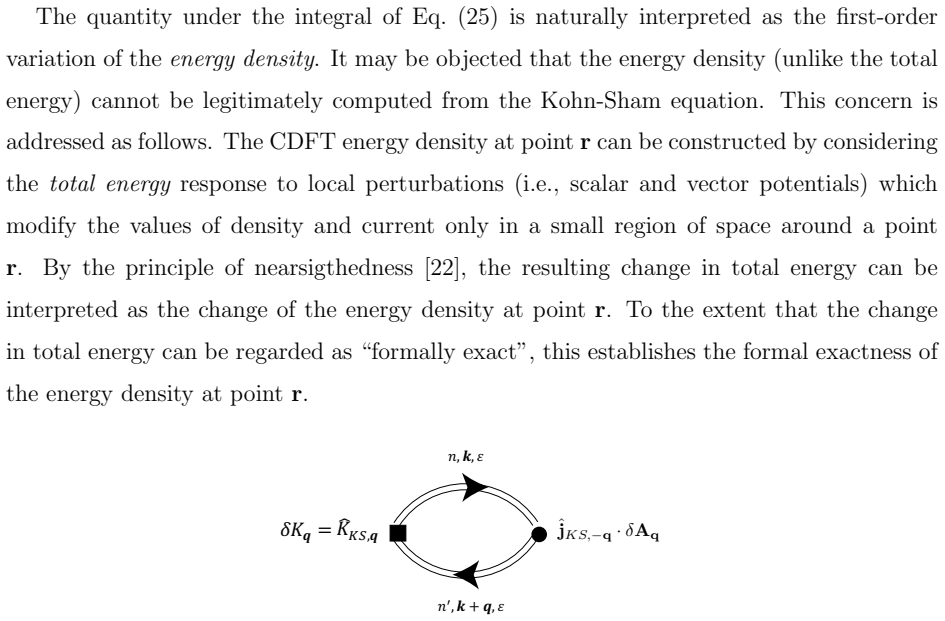
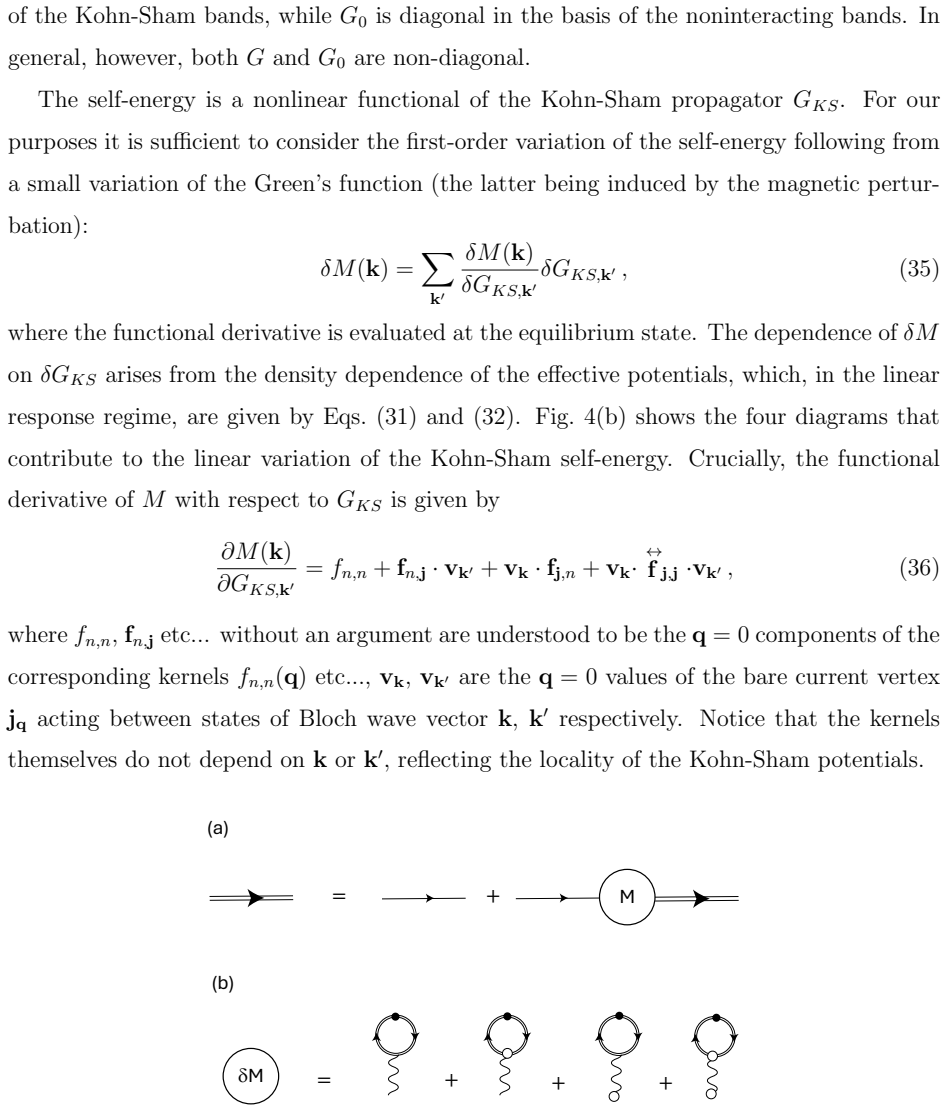
The vertex for the noninteracting energy density fluctuation is replaced by the corre- sponding quantity for the KS energy density fluctuation (black square). This is still given by Eq. (11) except that the band energies and the periodic eigenstates are now obtained self-consistently from the KS equation
-
[2]
The noninteracting Green’s function is replaced by a KS Green’s function (double line): GKS n,k(ε) = 1 ε−ϵ KS n,k +iηsgn(ε−µ) ,(29) whereϵ KS n,k are KS energies
-
[3]
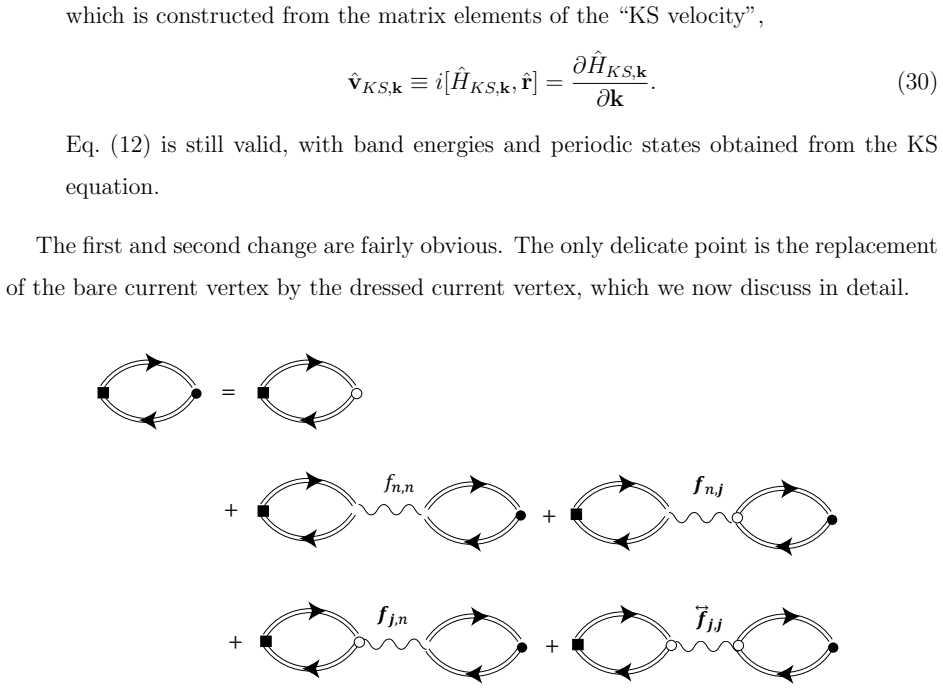
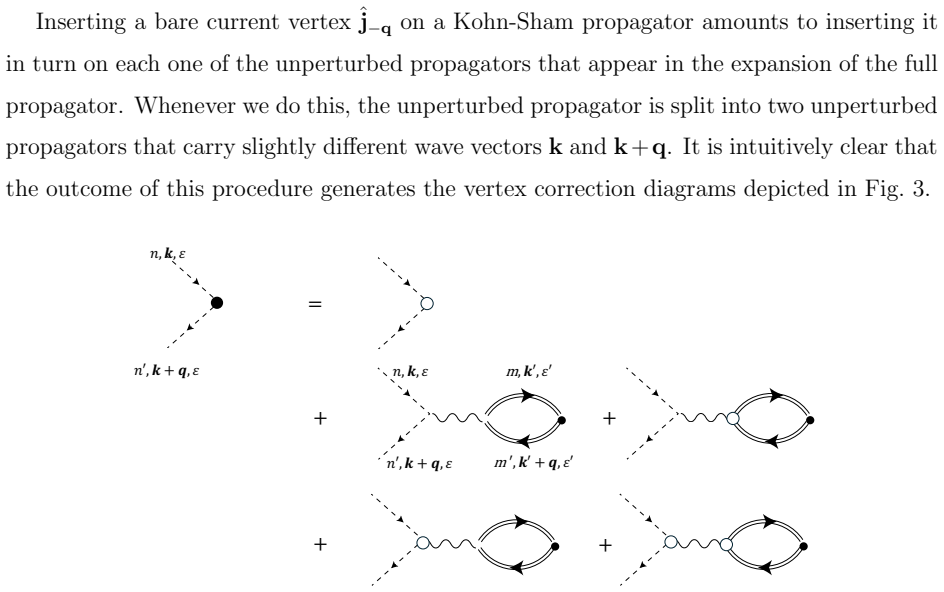
dressed” current vertex (black circle), 9 which is constructed from the matrix elements of the “KS velocity
The bare current vertex is replaced by the “dressed” current vertex (black circle), 9 which is constructed from the matrix elements of the “KS velocity”, ˆvKS,k ≡i[ ˆHKS,k, ˆr] = ∂ ˆHKS,k ∂k .(30) Eq. (12) is still valid, with band energies and periodic states obtained from the KS equation. The first and second change are fairly obvious. The only delicate...
-
[4]
J. Shi, G. Vignale, D. Xiao, and Q. Niu, Phys. Rev. Lett.99, 197202 (2007)
2007
-
[5]
Chang and Q
M.-C. Chang and Q. Niu, Phys. Rev. B53, 7010 (1996)
1996
-
[6]
Thonhauser, D
T. Thonhauser, D. Ceresoli, D. Vanderbilt, and R. Resta, Phys. Rev. Lett.95, 137205 (2005). 17
2005
-
[7]
D. Xiao, J. Shi, and Q. Niu, Phys. Rev. Lett.95, 137204 (2005)
2005
-
[8]
Ceresoli, T
D. Ceresoli, T. Thonhauser, D. Vanderbilt, and R. Resta, Phys. Rev. B74, 024408 (2006)
2006
-
[9]
D. Xiao, Y. Yao, Z. Fang, and Q. Niu, Phys. Rev. Lett.97, 026603 (2006)
2006
-
[10]
Chang and Q
M.-C. Chang and Q. Niu, J. Phys. Condens. Matter20, 193202 (2008)
2008
-
[11]
Xiao, M.-C
D. Xiao, M.-C. Chang, and Q. Niu, Rev. Mod. Phys.82, 1959 (2010)
1959
-
[12]
Vanderbilt,Berry Phases in Electronic Structure Theory: Electric Polarization, Orbital Magnetization and Topological Insulators(Cambridge University Press, 2018)
D. Vanderbilt,Berry Phases in Electronic Structure Theory: Electric Polarization, Orbital Magnetization and Topological Insulators(Cambridge University Press, 2018)
2018
-
[13]
Aryasetiawan and K
F. Aryasetiawan and K. Karlsson, J. Phys. Chem. Solids128, 87 (2019)
2019
- [14]
- [15]
-
[16]
X. Liu, C. Wang, X.-W. Zhang, T. Cao, and D. Xiao, Orbital magnetization in correlated states of twisted bilayer transition metal dichalcogenides (2025), arXiv:2510.01727 [cond-mat.mes- hall]
work page internal anchor Pith review Pith/arXiv arXiv 2025
-
[17]
Hohenberg and W
P. Hohenberg and W. Kohn, Phys. Rev.136, B864 (1964)
1964
-
[18]
Kohn and L
W. Kohn and L. J. Sham, Phys. Rev.140, A1133 (1965)
1965
-
[19]
C. J. Grayce and R. A. Harris, Phys. Rev. A50, 3089 (1994)
1994
-
[20]
Vignale and M
G. Vignale and M. Rasolt, Phys. Rev. Lett.59, 2360 (1987)
1987
-
[21]
Vignale and M
G. Vignale and M. Rasolt, Phys. Rev. B37, 10685 (1988)
1988
-
[22]
Giuliani and G
G. Giuliani and G. Vignale,Quantum theory of the electron liquid(Cambridge University Press, Cambridge, 2005)
2005
-
[23]
Nozi` eres,Theory of Interacting Fermi Systems, Frontiers in physics (W.A
P. Nozi` eres,Theory of Interacting Fermi Systems, Frontiers in physics (W.A. Benjamin, 1964)
1964
-
[24]
Schrieffer,Theory Of Superconductivity(CRC Press, 2018)
J. Schrieffer,Theory Of Superconductivity(CRC Press, 2018)
2018
-
[25]
E. Prodan and W. Kohn, Proceedings of the National Academy of Sciences102, 11635 (2005), https://www.pnas.org/doi/pdf/10.1073/pnas.0505436102
-
[26]
N. D. Mermin, Phys. Rev.137, A1441 (1965)
1965
-
[27]
Kohn and P
W. Kohn and P. Vashishta, General density functional theory, inTheory of the Inhomogeneous Electron Gas, edited by S. Lundqvist and N. H. March (Springer US, Boston, MA, 1983) pp. 79–147
1983
-
[28]
Bianco and R
R. Bianco and R. Resta, Phys. Rev. Lett.110, 087202 (2013). 18
2013
discussion (0)
Sign in with ORCID, Apple, or X to comment. Anyone can read and Pith papers without signing in.