Recognition: no theorem link
A Z₁² framework for rotational-parameter estimation and uncertainty quantification in high-energy pulsars
Pith reviewed 2026-05-15 02:13 UTC · model grok-4.3
The pith
Referencing pulsar frequency to the observation midpoint removes its leading covariance with the frequency derivative in Z_1^2 analyses.
A machine-rendered reading of the paper's core claim, the machinery that carries it, and where it could break.
Core claim
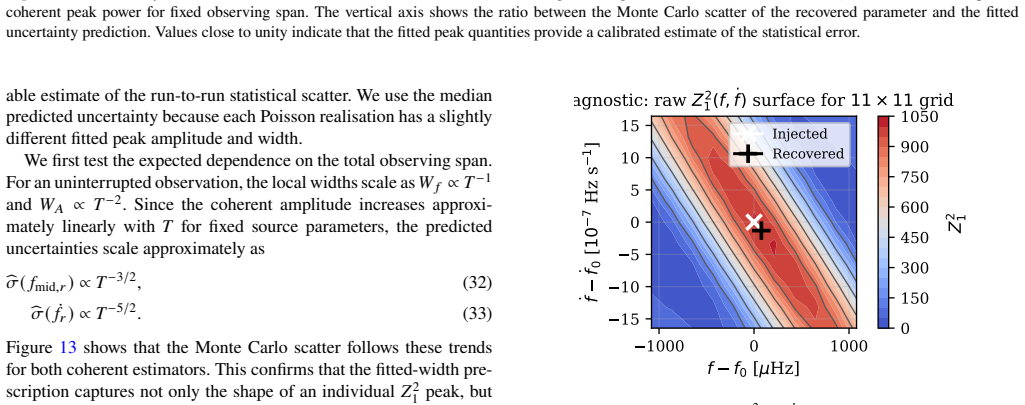
For sinusoidal signals the Z_1^2 statistic near its maximum is locally quadratic in frequency and frequency derivative. Shifting the frequency reference to the precise midpoint of the observation window eliminates the leading-order cross term, leaving a diagonal quadratic whose curvatures yield simple analytic variances for each parameter in terms of peak amplitude and local widths.
What carries the argument
The local quadratic form of the Z_1^2 response after frequency is expressed at the observation midpoint, which diagonalizes the covariance between frequency and frequency derivative.
If this is right
- Uncertainty estimates follow directly from fitted peak amplitude and measured widths without exhaustive Monte Carlo runs for each observation.
- The three tested estimators (segmented regression, coherent derivative scan, and localized two-dimensional fit) all yield consistent results under the midpoint re-referencing.
- The predicted uncertainties reproduce the observed scatter across varied observing spans, signal strengths, and good-time-interval patterns.
- Application to real AstroSat data returns stable rotational parameters for the Crab pulsar, Swift J0243.6+6124, and SAX J1808.4-3658.
Where Pith is reading between the lines
- The midpoint re-referencing device may simplify covariance handling in other coherent search statistics that share the same two-parameter space.
- For sources whose pulse profiles contain strong higher harmonics the local quadratic form would require a fresh derivation from the full multi-harmonic response.
- The same analytic error propagation could be adapted to continuous-wave gravitational searches where frequency and spin-down parameters appear together.
Load-bearing premise
The incoming signal is purely sinusoidal, so that the Z_1^2 surface remains accurately quadratic near its peak.
What would settle it
Monte Carlo trials with non-sinusoidal pulse profiles (for example, those dominated by the second harmonic) would produce parameter scatter that deviates systematically from the analytic uncertainties predicted by peak amplitude and widths.
Figures




read the original abstract
We present a $Z_1^2$-based framework for estimating the spin frequency and frequency derivative of high-energy pulsars from Poisson-limited photon event lists. The key point is that the width of a coherent detection peak is not, by itself, the statistical uncertainty on the recovered rotational parameters. We develop and compare three computationally efficient estimators: segmented frequency regression, a coherent derivative scan, and a localized two-dimensional coherent fit. For sinusoidal signals, we derive the local form of the Z-squared response as a function of frequency and frequency derivative, and show that expressing the frequency at the midpoint of the observation removes the leading-order covariance between the two parameters. This gives simple uncertainty estimates in terms of the fitted peak amplitude and local widths, without requiring an exhaustive Monte Carlo simulation for each observation. We test these estimates with Monte Carlo simulations over a range of observing spans, signal strengths, grid resolutions, and good-time-interval structures, and show that the predicted uncertainties reproduce the run-to-run scatter of the recovered parameters in the tested regimes. We then apply the framework to AstroSat/LAXPC event lists for the Crab pulsar, Swift J0243.6+6124, and SAX J1808.4-3658. The results provide a practical and statistically motivated route to rotational-parameter estimation for targeted high-energy pulsar searches.
Editorial analysis
A structured set of objections, weighed in public.
Referee Report
Summary. The manuscript presents a Z_1^2-based framework for estimating spin frequency and frequency derivative from Poisson-limited photon event lists in high-energy pulsars. It compares three estimators (segmented frequency regression, coherent derivative scan, and localized 2D coherent fit), derives the local quadratic form of the Z_1^2 response for sinusoidal signals, demonstrates that evaluating frequency at the observation midpoint removes leading-order covariance between frequency and derivative, and obtains analytic uncertainty estimates from fitted peak amplitude and local widths. These estimates are validated against Monte Carlo simulations across observing spans, signal strengths, grid resolutions, and GTI structures, showing that predicted uncertainties reproduce run-to-run parameter scatter. The framework is applied to AstroSat/LAXPC data for the Crab pulsar, Swift J0243.6+6124, and SAX J1808.4-3658.
Significance. If the analytic uncertainties remain accurate, the work supplies a computationally efficient route to rotational-parameter estimation and uncertainty quantification for targeted high-energy pulsar searches, avoiding exhaustive per-observation Monte Carlo runs while remaining grounded in the shape of the Z_1^2 statistic itself. The explicit validation against independent simulations and the practical demonstration on real event lists strengthen its utility for missions producing Poisson-limited timing data.
major comments (2)
- [Derivation of local Z_1^2 response and Monte Carlo validation section] The derivation of the local quadratic Z_1^2 form and the midpoint covariance removal (described in the abstract and the section on the coherent 2D fit) is stated to hold for sinusoidal signals. The Monte Carlo validation reproduces scatter in the tested regimes, but the manuscript does not report whether the simulated signals included higher harmonics; real targets such as the Crab and SAX J1808.4-3658 exhibit non-sinusoidal profiles, so cross-harmonic terms could modify the curvature matrix and residual covariance, undermining direct application of the analytic widths.
- [Applications to real data] In the applications to Crab, Swift J0243.6+6124, and SAX J1808.4-3658, the reported uncertainties rely on the sinusoidal-derived formulas. No explicit test is shown confirming that the local quadratic approximation and midpoint decorrelation still reproduce the observed scatter when the Z_1^2 statistic sums multiple harmonics, which is load-bearing for the claim that the framework provides statistically motivated uncertainties for these sources.
minor comments (2)
- [Abstract and methods overview] The abstract lists three estimators but the main text should more clearly indicate which estimator supplies the primary uncertainty formulas used in the applications.
- [Uncertainty estimation subsection] Notation for the local widths and peak amplitude should be defined once with consistent symbols before the uncertainty expressions are introduced.
Simulated Author's Rebuttal
We thank the referee for their thorough and constructive review. We appreciate the recognition of the framework's potential for efficient uncertainty quantification in high-energy pulsar timing. We address the major comments below and outline the revisions we will make to the manuscript.
read point-by-point responses
-
Referee: [Derivation of local Z_1^2 response and Monte Carlo validation section] The derivation of the local quadratic Z_1^2 form and the midpoint covariance removal (described in the abstract and the section on the coherent 2D fit) is stated to hold for sinusoidal signals. The Monte Carlo validation reproduces scatter in the tested regimes, but the manuscript does not report whether the simulated signals included higher harmonics; real targets such as the Crab and SAX J1808.4-3658 exhibit non-sinusoidal profiles, so cross-harmonic terms could modify the curvature matrix and residual covariance, undermining direct application of the analytic widths.
Authors: We thank the referee for highlighting this point. The Z_1^2 statistic is defined exclusively for the fundamental harmonic and does not incorporate or sum higher harmonics; therefore, cross-harmonic terms do not arise within the statistic itself. The local quadratic form of the Z_1^2 surface follows directly from the linear phase model applied to the fundamental Fourier components (sums of cos(2π f t_i) and sin(2π f t_i)), whose curvature in (f, ḟ) space is determined solely by the observation span and photon count, independent of pulse shape. Higher harmonics appear at integer multiples of the trial frequency and do not contribute to the Z_1^2 value or its local curvature at the fundamental. The fitted amplitude A is measured directly from the observed peak height, automatically reflecting the strength of the fundamental component present in any given profile. The Monte Carlo simulations used pure sinusoids to isolate this fundamental response, but the analytic expressions are expected to remain valid for non-sinusoidal signals. In the revised manuscript we will add Monte Carlo experiments using simulated non-sinusoidal profiles (with significant power in the second and third harmonics) to explicitly confirm that the predicted uncertainties continue to match the observed parameter scatter. revision: yes
-
Referee: [Applications to real data] In the applications to Crab, Swift J0243.6+6124, and SAX J1808.4-3658, the reported uncertainties rely on the sinusoidal-derived formulas. No explicit test is shown confirming that the local quadratic approximation and midpoint decorrelation still reproduce the observed scatter when the Z_1^2 statistic sums multiple harmonics, which is load-bearing for the claim that the framework provides statistically motivated uncertainties for these sources.
Authors: We agree that an explicit check on real data strengthens the claim. As noted above, the Z_1^2 statistic does not sum multiple harmonics, so the concern about cross-harmonic terms within the statistic does not apply. In the revised manuscript we will augment the applications section with a direct validation: we will subdivide each real event list (Crab, Swift J0243.6+6124, SAX J1808.4-3658) into independent segments of comparable length, recompute the rotational parameters on each segment, and compare the observed run-to-run scatter against the analytic uncertainties derived from the full-observation peak amplitude and widths. We will also report the results of a bootstrap resampling exercise on the full lists. These additions will demonstrate that the midpoint-decorrelated analytic formulas reproduce the empirical scatter for the actual (non-sinusoidal) profiles of these sources. revision: yes
Circularity Check
No circularity: analytic derivation of local Z_1^2 quadratic form and midpoint covariance removal stands on the statistic definition and is validated by independent Monte Carlo
full rationale
The paper derives the local quadratic form of the Z_1^2 response surface for sinusoidal signals directly from the definition of the statistic, then shows that shifting the frequency reference to the observation midpoint removes leading-order covariance between frequency and frequency derivative. The resulting analytic uncertainty expressions (in terms of peak amplitude and local widths) are presented as consequences of that derivation. These expressions are subsequently tested against fresh Monte Carlo realizations spanning signal strengths, spans, grids, and GTI structures; the simulations are not used to fit or tune the formulas. No load-bearing step reduces to a fitted input renamed as prediction, no self-citation chain is invoked for uniqueness, and the central claim does not equate to its inputs by construction. The framework is therefore self-contained against external benchmarks.
Axiom & Free-Parameter Ledger
axioms (2)
- domain assumption Photon arrival times follow a Poisson process with constant background rate.
- domain assumption The pulsed signal is purely sinusoidal at the fundamental frequency.
Reference graph
Works this paper leans on
-
[1]
A millisecond pulsar in an X-ray binary system , author=. Nature , volume=. 1998 , publisher=
work page 1998
-
[2]
The two-hour orbit of a binary millisecond X-ray pulsar , author=. Nature , volume=. 1998 , publisher=
work page 1998
-
[3]
Accretion powered X-ray millisecond pulsars. arXiv e-prints, art , author=. arXiv preprint arXiv:2010.09005 , year=
-
[4]
The Astrophysical Journal Letters , volume=
NICER Discovery of Millisecond X-ray Pulsations and an Ultracompact Orbit in IGR J17494-3030 , author=. The Astrophysical Journal Letters , volume=. 2021 , publisher=
work page 2021
-
[5]
The Astrophysical Journal Letters , volume=
The discovery of the 528.6 Hz accreting millisecond X-ray pulsar MAXI J1816--195 , author=. The Astrophysical Journal Letters , volume=. 2022 , publisher=
work page 2022
-
[6]
Monthly Notices of the Royal Astronomical Society: Letters , volume=
MAXI J1957+ 032: a new accreting millisecond X-ray pulsar in an ultra-compact binary , author=. Monthly Notices of the Royal Astronomical Society: Letters , volume=. 2022 , publisher=
work page 2022
-
[7]
4--3658 during its 2019 outburst , author=
AstroSat observation of the accreting millisecond X-ray pulsar SAX J1808. 4--3658 during its 2019 outburst , author=. Monthly Notices of the Royal Astronomical Society , volume=. 2023 , publisher=
work page 2019
-
[8]
Hu, Chin‑Ping and Chou, Yi and Chung, Yi‑Ying , title =. arXiv e‑prints , eprint =. 2007 , archivePrefix=
work page 2007
-
[9]
Chou, Yi , title =. arXiv e‑prints , eprint =. 2014 , archivePrefix=
work page 2014
-
[10]
Annual Review of Astronomy and Astrophysics , volume=
Ultraluminous X-ray sources , author=. Annual Review of Astronomy and Astrophysics , volume=. 2017 , publisher=
work page 2017
-
[11]
AstroSat observations of the first Galactic ULX pulsar Swift J0243. 6+ 6124 , author=. Monthly Notices of the Royal Astronomical Society , volume=. 2021 , publisher=
work page 2021
-
[12]
6+ 6124: Swift discovery of an accreting NS transient , author=
Swift J0243. 6+ 6124: Swift discovery of an accreting NS transient , author=. The Astronomer's Telegram , volume=
- [13]
-
[14]
Fermi GBM detects pulsations from Swift J0243. 6+ 6124 , author=. The Astronomer's Telegram , volume=
- [15]
-
[16]
Swift and NuSTAR observations of Swift J0243. 6+ 6124 , author=. The Astronomer's Telegram , volume=
-
[17]
Understanding the spectral and timing behaviour of a newly discovered transient X-ray pulsar Swift J0243. 6+ 6124 , author=. Monthly Notices of the Royal Astronomical Society , volume=. 2018 , publisher=
work page 2018
-
[18]
Bachetti, M. and Harrison, F. A. and Walton, D. J. and others , title =. Nature , year =
-
[19]
Lyne, A. G. and Pritchard, R. S. and Smith, F. G. , title =. Monthly Notices of the Royal Astronomical Society , volume =. 1993 , doi =
work page 1993
-
[20]
Weisskopf, M. C. and O'Dell, S. L. and Paerels, F. and Elsner, R. F. and Becker, W. and Tennant, A. F. and Swartz, D. A. , title =. The Astrophysical Journal , volume =. 2004 , doi =
work page 2004
- [21]
-
[22]
Liu, K. and Verbiest, J. P. W. and Kramer, M. and Stappers, B. W. and van Straten, W. and Cordes, J. M. , title =. arXiv e‑prints , eprint =
-
[23]
Hellings, R. W. and Downs, G. S. , title =. The Astrophysical Journal , volume =
-
[24]
Ge, M.-Y. and Lu, F.-J. and Qu, J.-L. and Zheng, S.-J. and Chen, Y. and Han, D.-W. , title =. arXiv e‑prints , eprint =
-
[25]
Lutovinov, A. A. and Tsygankov, S. S. and Suleimanov, V. F. and Mushtukov, A. A. and Doroshenko, V. and Nagirner, D. I. and Poutanen, J. , title =. Monthly Notices of the Royal Astronomical Society , volume =
-
[26]
arXiv preprint arXiv:2209.07954 , year=
Fourier Domain , author=. arXiv preprint arXiv:2209.07954 , year=
-
[27]
Monthly Notices of the Royal Astronomical Society , volume=
An improved test for periodicity , author=. Monthly Notices of the Royal Astronomical Society , volume=
-
[28]
Astronomy and Astrophysics , volume=
Search for pulsed gamma-ray emission from radio pulsars in the COS-B data , author=. Astronomy and Astrophysics , volume=
-
[29]
The Astronomical Journal , volume=
Fourier techniques for very long astrophysical time-series analysis , author=. The Astronomical Journal , volume=. 2002 , publisher=
work page 2002
-
[30]
Verbiest, J. P. W. and Bailes, M. and van Straten, W. and Hobbs, G. B. and others , title =. Monthly Notices of the Royal Astronomical Society , volume =. 2009 , doi =
work page 2009
-
[31]
The Astrophysical Journal , volume=
Precise timing and phase-resolved spectroscopy of the young pulsar J1617--5055 with NuSTAR , author=. The Astrophysical Journal , volume=. 2021 , publisher=
work page 2021
-
[32]
The Astrophysical Journal , volume=
Stingray: a modern Python library for spectral timing , author=. The Astrophysical Journal , volume=. 2019 , publisher=
work page 2019
-
[33]
Space Telescopes and Instrumentation 2016: Ultraviolet to Gamma Ray , year = 2016, editor =
Space Telescopes and Instrumentation 2016: Ultraviolet to Gamma Ray. Space Telescopes and Instrumentation 2016: Ultraviolet to Gamma Ray , year = 2016, editor =
work page 2016
-
[34]
, year = 2017, month = jul, volume =
Calibration of the Large Area X-Ray Proportional Counter (LAXPC) Instrument on board AstroSat. , year = 2017, month = jul, volume =. doi:10.3847/1538-4365/aa7a0e , archivePrefix =
-
[35]
, year = 2019, month = feb, volume =
Thermonuclear X-ray bursts in rapid succession in 4U 1636-536 with AstroSat-LAXPC. , year = 2019, month = feb, volume =. doi:10.1093/mnras/sty2975 , archivePrefix =
-
[36]
, year = 2020, month = jul, volume =
Timing the Pulsations of the Accreting Millisecond Pulsar SAX J1808.4-3658 during Its 2019 Outburst. , year = 2020, month = jul, volume =. doi:10.3847/1538-4357/ab9827 , archivePrefix =
-
[37]
Space Telescopes and Instrumentation 2014: Ultraviolet to Gamma Ray , year = 2014, editor =
ASTROSAT mission. Space Telescopes and Instrumentation 2014: Ultraviolet to Gamma Ray , year = 2014, editor =
work page 2014
-
[38]
, year = 2010, month = jan, volume =
Absolute Timing of the Crab Pulsar with the INTEGRAL/SPI Telescope. , year = 2010, month = jan, volume =. doi:10.1088/0004-637X/708/1/403 , archivePrefix =
-
[39]
Science , year = 2010, month = jun, volume =
Switched Magnetospheric Regulation of Pulsar Spin-Down. Science , year = 2010, month = jun, volume =
work page 2010
-
[40]
, year = 1983, month = sep, volume =
On searches for periodic pulsed emission - The Rayleigh test compared to epoch folding. , year = 1983, month = sep, volume =
work page 1983
-
[41]
, year = 1975, month = jun, volume =
The period derivatives of pulsars. , year = 1975, month = jun, volume =
work page 1975
-
[42]
, year = 2025, month = feb, volume =
A Method for Estimating X-Ray Pulsar Period and Pulse Time Delay: Applying the Improved <inline-formula> </inline-formula>-test to Complex Profiles. , year = 2025, month = feb, volume =
work page 2025
-
[43]
, year = 2016, month = may, volume =
On More Sensitive Periodogram Statistics. , year = 2016, month = may, volume =. doi:10.3847/0004-637X/822/1/14 , archivePrefix =
-
[44]
Frontiers of Information Technology and Electronic Engineering , year = 2015, volume =
Shen, Li-Rong and Li, Xiao-Ping and Sun, Hai-Feng and Fang, Hai-Yan and Xue, Meng-Fan , title = ". Frontiers of Information Technology and Electronic Engineering , year = 2015, volume =
work page 2015
-
[45]
, year = 1976, month = feb, volume =
Least-Squares Frequency Analysis of Unequally Spaced Data. , year = 1976, month = feb, volume =
work page 1976
-
[46]
Studies in astronomical time series analysis. II. Statistical aspects of spectral analysis of unevenly spaced data. , year = 1982, month = dec, volume =
work page 1982
-
[47]
, year = 1989, month = mar, volume =
Fast Algorithm for Spectral Analysis of Unevenly Sampled Data. , year = 1989, month = mar, volume =
work page 1989
-
[48]
Six signals in the radial velocity data for GJ876
Improved signal detection algorithms for unevenly sampled data. Six signals in the radial velocity data for GJ876. , year = 2014, month = jul, volume =. doi:10.1093/mnras/stu683 , archivePrefix =
-
[49]
D.Antonopoulou and C.M. Espinoza and L. kuiper and N. Andersson , title = ". , year = 2017, month = sep, doi =
work page 2017
-
[50]
Advances in Space Research , year = 2006, month = jan, volume =
A broad spectral band Indian Astronomy satellite Astrosat. Advances in Space Research , year = 2006, month = jan, volume =
work page 2006
-
[51]
Hewish, A. and Bell, S. J. and Pilkington, J. D. H. and Scott, P. F. and Collins, R. A. , title =. Nature , year =
-
[52]
Lattimer, J. M. and Prakash, M. , title =. Science , year =
-
[53]
Kramer, M. and Stairs, I. H. and Manchester, R. N. and others , title =. Science , year =
-
[54]
Manchester, R. N. and Taylor, J. H. , title =. 1977 , address =
work page 1977
-
[55]
Lorimer, D. R. and Kramer, M. , title =. 2005 , address =
work page 2005
-
[56]
Agazie, G. and others , title =. The Astrophysical Journal Letters , year =
-
[57]
Antoniadis, J. and others , title =. Astronomy & Astrophysics , year =
-
[58]
Taylor, J. H. , title =. Philosophical Transactions of the Royal Society A , year =
-
[59]
Hobbs, G. B. and Edwards, R. T. and Manchester, R. N. , title =. Monthly Notices of the Royal Astronomical Society , year =
- [60]
-
[61]
Precise Gamma-Ray Timing and Radio Observations of 17 Fermi Gamma-Ray Pulsars
Precise -ray Timing and Radio Observations of 17 Fermi -ray Pulsars. , keywords =. doi:10.1088/0067-0049/194/2/17 , archivePrefix =. 1011.2468 , primaryClass =
work page internal anchor Pith review Pith/arXiv arXiv doi:10.1088/0067-0049/194/2/17
- [62]
-
[63]
Abdo, A. A. and others , title =. The Astrophysical Journal Supplement Series , year =
-
[64]
Smith, D. A. and others , title =. The Astrophysical Journal , year =
-
[65]
, year = 2009, volume = 697, pages =
The Large Area Telescope on the Fermi Gamma-ray Space Telescope Mission. , year = 2009, volume = 697, pages =
work page 2009
-
[66]
Space Telescopes and Instrumentation 2016: Ultraviolet to Gamma Ray , series =
The Neutron star Interior Composition Explorer (NICER): design and development. Space Telescopes and Instrumentation 2016: Ultraviolet to Gamma Ray , series =
work page 2016
-
[67]
, year = 1978, month = sep, volume =
Period determination using phase dispersion minimization. , year = 1978, month = sep, volume =
work page 1978
-
[68]
XXXI. On the problem of random vibrations, and of random flights in one, two, or three dimensions , journal =. 1919 , volume =
work page 1919
-
[69]
, year = 2018, month = may, volume =
Orbit and intrinsic spin-up of the newly discovered transient X-ray pulsar Swift J0243.6+6124. , year = 2018, month = may, volume =. doi:10.1051/0004-6361/201732208 , archivePrefix =
-
[70]
, year = 2012, month = feb, volume =
Accelerated Orbital Expansion and Secular Spin-down of the Accreting Millisecond Pulsar SAX J1808.4-3658. , year = 2012, month = feb, volume =. doi:10.1088/2041-8205/746/2/L27 , archivePrefix =
-
[71]
AAS/High Energy Astrophysics Division \#10 , year = 2008, series =
The Long-term Timing of Accreting Millisecond Pulsar SAX J1808.4-3658. AAS/High Energy Astrophysics Division \#10 , year = 2008, series =
work page 2008
-
[72]
, year = 1987, month = jun, volume =
Searches for pulsed emission with application to four globular cluster X-ray sources. , year = 1987, month = jun, volume =
work page 1987
-
[73]
, year = 2005, month = jan, volume =
X-ray timing of the accretion-powered millisecond pulsar XTE J1814-338. , year = 2005, month = jan, volume =
work page 2005
-
[74]
, year = 2017, month = oct, volume =
A timing and spectral study of the transient X-ray pulsar. , year = 2017, month = oct, volume =
work page 2017
-
[75]
Fourier Analysis of Time Series: An Introduction
-
[76]
, year = 1981, month = aug, volume =
Fast period-searching in unevenly sampled observational data. , year = 1981, month = aug, volume =
work page 1981
-
[77]
, year = 1996, month = jun, volume =
Parameter estimation in periodograms. , year = 1996, month = jun, volume =
work page 1996
-
[78]
The timing model and precision estimates
TEMPO2, a new pulsar-timing package - II. The timing model and precision estimates. , year = 2006, month = nov, volume =
work page 2006
-
[79]
Bayesian Spectrum Analysis and Parameter Estimation
-
[80]
The Young Pulsar J1357-6429 and Its Pulsar Wind Nebula
X-Ray Observations of the Young Pulsar J1357 6429 and Its Pulsar Wind Nebula. , keywords =. doi:10.1088/0004-637X/744/2/81 , archivePrefix =. 1107.1819 , primaryClass =
work page internal anchor Pith review Pith/arXiv arXiv doi:10.1088/0004-637x/744/2/81
discussion (0)
Sign in with ORCID, Apple, or X to comment. Anyone can read and Pith papers without signing in.