Development of an electrodynamic balance to study single levitated particles exposed to alkali-metal vapor
Pith reviewed 2026-06-30 19:54 UTC · model grok-4.3
The pith
An electrodynamic balance exposes single levitated particles to alkali-metal vapor in a sealed cell without contamination.
A machine-rendered reading of the paper's core claim, the machinery that carries it, and where it could break.
Core claim
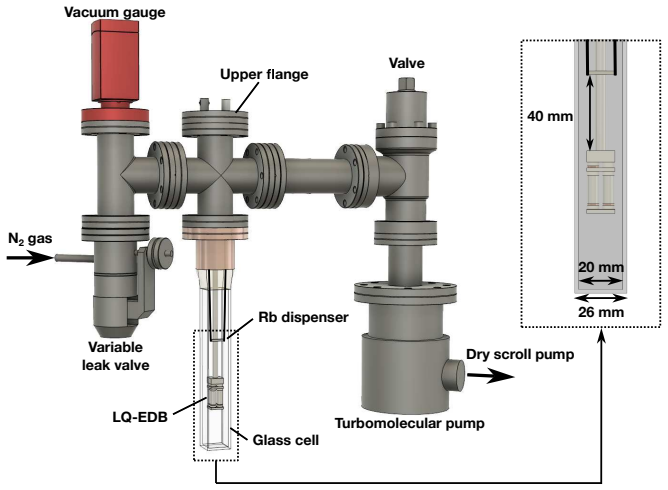
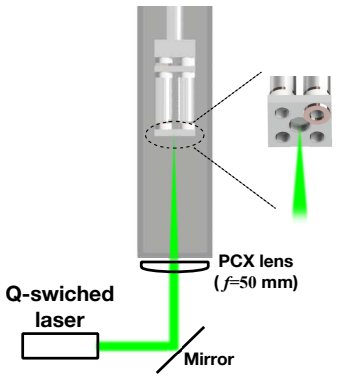
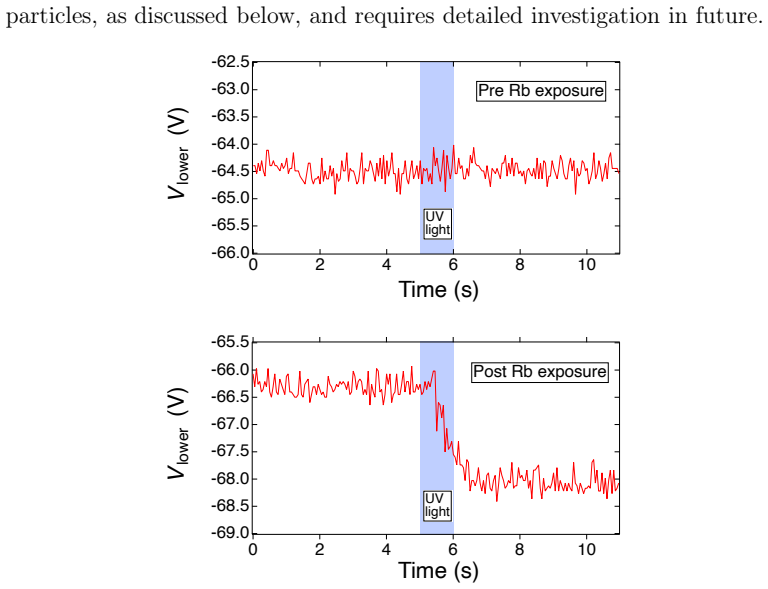
The apparatus places trap electrodes in a vacuum glass cell where particles are loaded via laser launching without venting and alkali-metal vapor is released from a dedicated dispenser. Particles irradiated with ultraviolet light after vapor exposure exhibit changes in their charge-to-mass ratios. These results show that the electrodynamic balance can expose trapped particles to alkali-metal vapor while maintaining cell integrity, enabling studies of vapor interactions with materials such as paraffin coatings.
What carries the argument
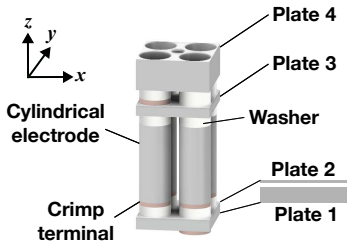
Electrodynamic balance with laser particle loading and dedicated alkali-metal dispenser inside a sealed vacuum glass cell.
If this is right
- The setup permits investigation of alkali vapor effects on particle surfaces without external contamination.
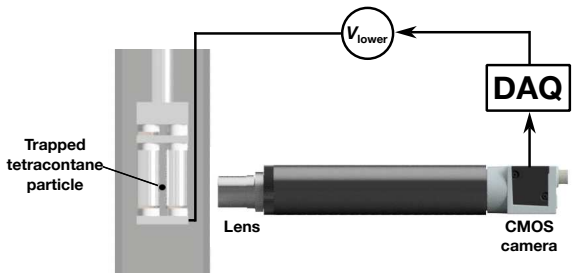
- Charge-to-mass ratio measurements can detect interactions between vapor and levitated particles.
- This method supports testing of spin anti-relaxation coatings for alkali-metal vapor cells.
- Single-particle levitation allows precise tracking of charge changes induced by vapor exposure and UV light.
Where Pith is reading between the lines
- The technique could be extended to quantify adsorption rates of alkali atoms on various particle materials.
- Similar sealed EDBs might study reactions with other reactive vapors in controlled environments.
- Understanding these interactions may improve the longevity of coatings in precision atomic devices.
Load-bearing premise
The observed changes in charge-to-mass ratios result specifically from the alkali-metal vapor exposure combined with ultraviolet irradiation rather than from unrelated factors like residual gases or electrode effects.
What would settle it
If particles show identical charge-to-mass ratio changes when exposed to ultraviolet light without prior alkali vapor exposure, or no changes after vapor exposure, the utility for studying vapor interactions would be questioned.
Figures
read the original abstract
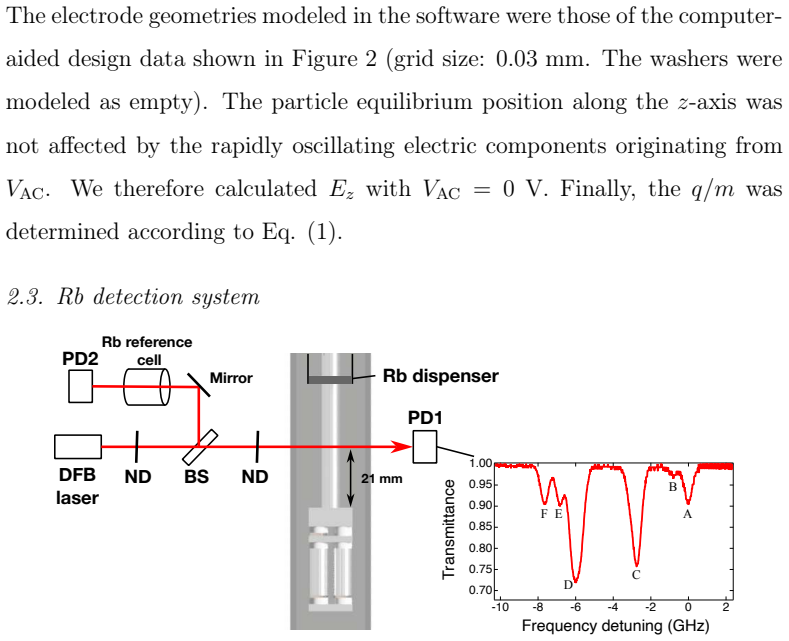
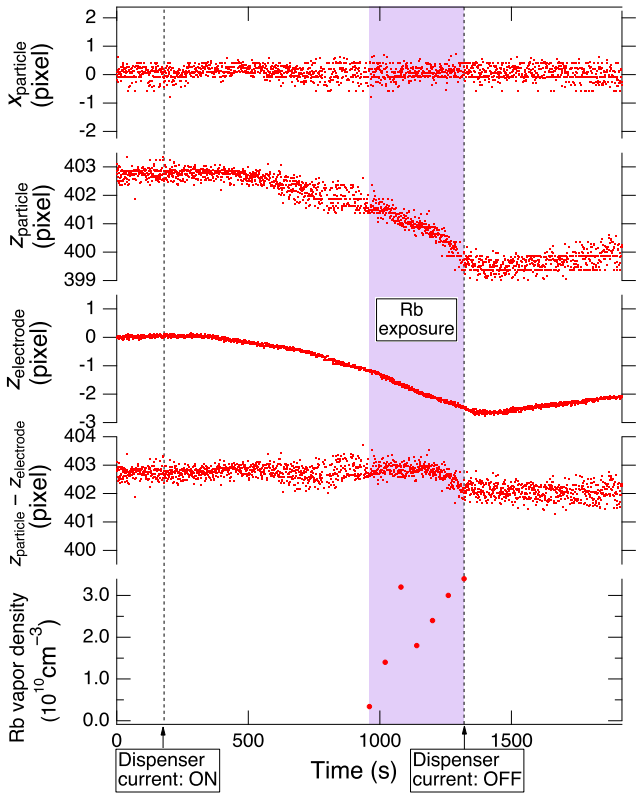
Electrodynamic balances (EDBs) have been widely used to investigate reactions between levitated particles and background gases. In this paper, we report the development of an EDB that exposes trapped particles to alkali-metal vapor. The apparatus was developed principally to investigate the interactions between such vapor and the paraffin used as a spin anti-relaxation coating for alkali-metal vapor cells by atomic physicists. The trap electrodes of the EDB were installed in a vacuum glass cell. Particles were loaded via laser launching, without venting or contaminating the cell. Alkali-metal vapor was released from a dedicated dispenser. We found changes in the charge-to-mass ratios of trapped particles irradiated with ultraviolet light after exposure to alkali-metal vapor. These results demonstrate the utility of the apparatus.
Editorial analysis
A structured set of objections, weighed in public.
Referee Report
Summary. The manuscript reports the development of an electrodynamic balance (EDB) installed inside a vacuum glass cell for exposing single levitated particles to alkali-metal vapor. Particles are loaded by laser launching without venting the cell; vapor is released from a dedicated dispenser. The central claim is that changes in the charge-to-mass ratios of trapped particles were observed after alkali-vapor exposure followed by ultraviolet irradiation, demonstrating the apparatus's utility for studying interactions with paraffin coatings used in atomic-physics vapor cells.
Significance. If the reported q/m changes can be shown to result specifically from the vapor exposure (rather than apparatus artifacts), the instrument would provide a useful platform for controlled studies of surface interactions relevant to spin anti-relaxation coatings. The contamination-free loading and vapor-delivery approach addresses a practical barrier in such experiments. The current manuscript, however, supplies no quantitative results, so the significance cannot yet be evaluated.
major comments (2)
- [Abstract] Abstract: the statement that 'changes in the charge-to-mass ratios of trapped particles' were found after alkali-vapor exposure plus UV irradiation supplies no numerical values, uncertainties, measurement protocol, or time series, rendering the utility demonstration unevaluable.
- [Results] Experimental results section: no control runs (dispenser off, same UV dose, identical vacuum conditions) or diagnostics for electrode charging, residual-gas effects, or particle-mass loss are described, so the observed q/m shifts cannot be attributed to the intended vapor-paraffin interaction rather than unrelated factors.
minor comments (2)
- [Methods] Provide the explicit formula or calibration procedure used to extract charge-to-mass ratio from the observed motion (e.g., secular frequency or amplitude response).
- Figure captions should state the number of particles, exposure times, and whether error bars represent standard deviation or standard error.
Simulated Author's Rebuttal
We thank the referee for the constructive comments on our manuscript describing the development of an electrodynamic balance for alkali-metal vapor exposure studies. We address each major comment below and agree that revisions are needed to strengthen the quantitative demonstration and attribution of the observed effects.
read point-by-point responses
-
Referee: [Abstract] Abstract: the statement that 'changes in the charge-to-mass ratios of trapped particles' were found after alkali-vapor exposure plus UV irradiation supplies no numerical values, uncertainties, measurement protocol, or time series, rendering the utility demonstration unevaluable.
Authors: We agree that the abstract as written provides insufficient quantitative detail to allow evaluation of the utility demonstration. In the revised manuscript we will expand the abstract to include representative numerical values for the observed q/m changes (with uncertainties), a brief outline of the measurement protocol, and a reference to the time-series data shown in the results section. revision: yes
-
Referee: [Results] Experimental results section: no control runs (dispenser off, same UV dose, identical vacuum conditions) or diagnostics for electrode charging, residual-gas effects, or particle-mass loss are described, so the observed q/m shifts cannot be attributed to the intended vapor-paraffin interaction rather than unrelated factors.
Authors: The referee correctly notes that the present manuscript lacks explicit control experiments and artifact diagnostics. We will revise the experimental results section to add control runs (dispenser off under identical UV and vacuum conditions) and to describe available diagnostics for electrode charging, residual-gas effects, and particle-mass loss. These additions will allow readers to assess whether the q/m shifts can be attributed to the vapor-paraffin interaction. revision: yes
Circularity Check
No circularity: experimental apparatus report with no derivation chain
full rationale
The paper is a description of hardware development and empirical observations of an electrodynamic balance. No equations, models, fitted parameters, predictions, or uniqueness theorems are presented. The central claim (q/m changes after vapor exposure + UV) is an experimental result, not a derived quantity that reduces to its inputs by construction. No self-citations, ansatzes, or renamings appear in any load-bearing role. This matches the default expectation of no significant circularity for non-theoretical papers.
Axiom & Free-Parameter Ledger
Reference graph
Works this paper leans on
-
[1]
Birdsall, A. W., Krieger, U. K., & Keutsch, F. N. (2018). E lectrodynamic balance-mass spectrometry of single particles as a new plat form for at- mospheric chemistry research. Atmospheric Measurement Te chniques, 11(1), 33-47. https://doi.org/10.5194/amt-11-33-2018
-
[2]
Kohli, R. K., Davis, R. D., & Davies, J. F. (2023). Tutoria l: Electro- dynamic balance methods for single particle levitation and the physic- ochemical analysis of aerosol. Journal of Aerosol Science, 174, 106255. https://doi.org/10.1016/j.jaerosci.2023.106255 18
-
[3]
Lee, A. K., & Chan, C. K. (2007). Single particle Raman spectroscopy for investigating atmospheric heterogeneou s reactions of organic aerosols. Atmospheric Environment, 41(22), 461 1-4621. https://doi.org/10.1016/j.atmosenv.2007.03.040
-
[4]
Ubukata, S., Karyu, H., Nakagawa, H., Koyama, S., Minami kawa, R., Kuroda, T., Terada, N., & Gen, M. (2025). Uptake of SO 2 into Sulfuric Acid Droplets through the Oxidation by NO 2 under Venus- Analogous Conditions. ACS Earth and Space Chemistry, 9(6), 1525-
2025
-
[5]
https://doi.org/10.1021/acsearthspacechem.5c00016
-
[6]
Plane, J. M., Feng, W., & Dawkins, E. C. (2015). The mesosp here and metals: Chemistry and changes. Chemical reviews, 115(10), 4497-4541. https://doi.org/10.1021/cr500501m
-
[7]
Potter, A., & Morgan, T. (1985). Discovery of sodium in the atmosphere of Mercury. Science, 229(4714), 651-653. https://doi.org/10.1126/science.229.4714.651
-
[8]
Potter, A. E., & Morgan, T. H. (1988). Discovery of sodium and potas- sium vapor in the atmosphere of the Moon. Science, 241(4866) , 675-680. https://doi.org/10.1126/science.241.4866.675
-
[9]
Abbas, M. M., Tankosic, D., Craven, P. D., Spann, J. F., LeClair, A., & West, E. A. (2007). Lunar dust charging by pho- toelectric emissions. Planetary and Space Science, 55(7-8 ), 953-965. https://doi.org/10.1016/j.pss.2006.12.007 19
-
[10]
Jöller, M., Brunner, T., & Obernberger, I. (2007). Model ing of aerosol formation during biomass combustion for various fu rnace and boiler types. Fuel Processing Technology, 88(11-12), 1 136-1147. https://doi.org/10.1016/j.fuproc.2007.06.013
-
[11]
Niu, Y., Tan, H., & Hui, S. E. (2016). Ash-related issues during biomass combustion: Alkali-induced slagging, silicate melt-indu ced slagging (ash fusion), agglomeration, corrosion, ash utilization, and r elated coun- termeasures. Progress in Energy and Combustion Science, 52 , 1-61. https://doi.org/10.1016/j.pecs.2015.09.003
-
[12]
Wu, Z. (2021). Wall interactions of spin-polarized atoms. Reviews of Modern Physics, 93(3), 035006. https://doi.org/10.1103/RevModPhys.93.035006
-
[13]
G., Ensberg, E
Robinson, H. G., Ensberg, E. S., & Dehmelt, H. G. (1958). Preservation of spin state in free atom-inert surface collisions. Bull. A m. Phys. Soc, 3(1), 9
1958
-
[14]
Klein, M., Novikova, I., Phillips, D. F., & Walsworth, R . L. (2006). Slow light in paraffin-coated Rb vapour cells. Journal of Mode rn Optics, 53(16-17), 2583-2591. https://doi.org/10.1080/0950034 0600952135
-
[15]
Peng, P., Cao, W., Shen, C., Qu, W., Wen, J., Jiang, L., & X iao, Y. (2016). Anti-parity-time symmetry with flying atoms. Natur e Physics, 12(12), 1139-1145. https://doi.org/10.1038/nphys3842
-
[16]
Bao, H., Jin, S., Duan, J., Jia, S., Mølmer, K., Shen, H., & Xiao, Y. (2020). Retrodiction beyond the Heisenberg uncertainty re lation. Na- 20 ture communications, 11(1), 5658. https://doi.org/10.10 38/s41467-020- 19495-1
2020
-
[17]
, Xiao, L., Jia, S., Wang, M., & Xiao, Y
Jin, S., Duan, J., Zhang, Y., Zhang, X., Bao, H., Shen, H. , Xiao, L., Jia, S., Wang, M., & Xiao, Y. (2024). Concurrent spin squeezi ng and light squeezing in an atomic ensemble. Physical Review Lett ers, 133(17), 173604. https://doi.org/10.1103/PhysRevLett.133.173604
-
[18]
Budker, D., & Romalis, M. (2007). Optical magnetometry . Nature Physics, 3(4), 227-234. https://doi.org/10.1038/nphys5 66
-
[19]
Bandi, T., Affolderbach, C., & Mileti, G. (2012). Laser- pumped paraffin- coated cell rubidium frequency standard. Journal of Applie d Physics, 111(12), 124906. https://doi.org/10.1063/1.4729570
-
[20]
Alexandrov, E. B., Balabas, M. V., Budker, D., English, D., Kimball, D. F., Li, C. H., & Yashchuk, V. V. (2002). Light-induced deso rption of alkali-metal atoms from paraffin coating. Physical Review A, 66(4), 042903. https://doi.org/10.1103/PhysRevA.66.042903
-
[21]
Sekiguchi, N., & Hatakeyama, A. (2016). Non-negligibl e collisions of alkali atoms with background gas in buffer-gas-free cells co ated with paraffin. Applied Physics B, 122(4), 81. https://doi.org/10 .1007/s00340- 016-6352-9
2016
-
[22]
Seltzer, S. J., Michalak, D. J., Donaldson, M. H., Balab as, M. V., Bar- ber, S. K., Bernasek, S. L., Bouchiat, M.-A., Hexemer, A., Hi bberd, A. M., Jackson Kimball, D. F., Jaye, C., Karaulanov, T., Nard ucci, F. A., Rangwala, S. A., Robinson, H. G., Shmakov, A. K., Voron ov, 21 D. L., Yashchuk, V. V., Pines, A., & Budker, D. (2010). Invest iga- tion of a...
-
[23]
Chi, H., Quan, W., Zhang, J., Zhao, L., & Fang, J. (2020). Advances in anti-relaxation coatings of alkali-metal vapor cells. A pplied Surface Science, 501, 143897. https://doi.org/10.1016/j.apsusc .2019.143897
-
[24]
Kushida, K., Niwano, T., Moriya, T., Shimizu, T., Megur o, K., Nakazawa, H., & Hatakeyama, A. (2015). Relaxation of Cs atom ic polarization at surface coatings characterized by X-ray ph otoelectron spectroscopy. Japanese Journal of Applied Physics, 54(6), 066401. https://doi.org/10.7567/JJAP.54.066401
-
[25]
Davis, E. J. (1997). A history of single aerosol particl e levitation. Aerosol science and technology, 26(3), 212-25 4. https://doi.org/10.1080/02786829708965426
-
[26]
B., Sivaprakasam, V., Eversole, J
Hart, M. B., Sivaprakasam, V., Eversole, J. D., Johnson , L. J., & Czege, J. (2015). Optical measurements from single levitated part icles using a linear electrodynamic quadrupole trap. Applied optics, 54 (31), F174- F181. https://doi.org/10.1364/AO.54.00F174
-
[27]
Walker, J. S., & Bzdek, B. R. (2024). Rapid and sen- sitive chemical analysis of individual picolitre droplets by mass spectrometry. Analytical Chemistry, 97(1), 854-861. https://doi.org/10.5523/bris.1zjrkhdd6cstr2hj6yn4it9jze 22
-
[28]
Xie, J., Attenkofer, K., Demarteau, M., Paramonov, A., Ronzhin, A., Wagner, R., & Yusof, Z. (2020). Large area planar photo- cathode for MCP-based photodetectors. Nuclear Instrument s and Methods in Physics Research Section A: Accelerators, Spec- trometers, Detectors and Associated Equipment, 955, 16323 4. https://doi.org/10.1016/j.nima.2019.163234
-
[29]
M., Ramírez, O., Phirke, H., Elizabeth, A., Mönig, H., & Redinger, A
Lanzoni, E. M., Ramírez, O., Phirke, H., Elizabeth, A., Mönig, H., & Redinger, A. (2022). Impact of metallic potassium post-de position treatment on epitaxial Cu (In, Ga) Se2. Thin Solid Films, 741 , 139002. https://doi.org/10.1016/j.tsf.2021.139002
-
[30]
Fortagh, J., Ott, H., Grossmann, A., & Zimmermann, C. (2 000). Minia- turized magnetic guide for neutral atoms. Applied Physics B , 70(5), 701-708. https://doi.org/10.1007/s003400050884
-
[31]
Bhardwaj, K., Sarkar, S., Ram, S. P., Tiwari, V. B., & Mis hra, S. R. (2023). A method for loading magneto-optical trap in an ultrahigh vacuum environment. AIP Advances, 13(1), 0151 08. https://doi.org/10.1063/5.0106398
-
[32]
Asenbaum, P., Kuhn, S., Nimmrichter, S., Sezer, U., & Ar ndt, M. (2013). Cavity cooling of free silicon nanoparticles in hig h vacuum. Na- ture communications, 4(1), 2743. https://doi.org/10.103 8/ncomms3743
2013
-
[33]
S., Mestres, P., Dania, L., Schmöger, L., & Nor thup, T
Bykov, D. S., Mestres, P., Dania, L., Schmöger, L., & Nor thup, T. E. (2019). Direct loading of nanoparticles under high vacuum i nto a Paul 23 trap for levitodynamical experiments. Applied Physics Let ters, 115(3), 034101. https://doi.org/10.1063/1.5109645
-
[34]
A., Houlihan, R., & Devaney, N
Khorshad, A. A., Houlihan, R., & Devaney, N. (2025). In- vacuum dry launching of silica microparticles using an arra y of custom MEMS devices. Optics Express, 33(4), 7043-7057. https://doi.org/10.1364/OE.547351
-
[35]
Chen, B., Laucks, M. L., & Davis, E. J. (2004). Carbon dio xide uptake by hydrated lime aerosol particles. Aerosol science and tec hnology, 38(6), 588-597. https://doi.org/10.1080/02786820490479897
-
[36]
Steck, D. A. Rubidium 87 D line data. available online at http://steck.us/alkalidata (revision 1.6,14 October 200 3)
-
[37]
Stern, L., Desiatov, B., Goykhman, I., & Levy, U. (2013) . Nanoscale light-matter interactions in atomic cladding waveguides. Nature com- munications, 4(1), 1548. https://doi.org/10.1038/ncomm s2554
-
[38]
Steck, D. A. Rubidium 85 D line data. available online at http://steck.us/alkalidata (revision 2.3.3,28 May 2024)
2024
-
[39]
Corney, A. (1978). Atomic and laser spectroscopy. Oxfo rd: Clarendon Press. 24
1978
discussion (0)
Sign in with ORCID, Apple, or X to comment. Anyone can read and Pith papers without signing in.