Digital Twin Synchronization Over Mobile Embodied AI Network With Agentic Intelligence
Pith reviewed 2026-06-30 20:32 UTC · model grok-4.3
The pith
Agentic AI agents in a mobile embodied network reduce maximum digital twin deviation via a five-stage autonomous workflow and hierarchical resource optimization.
A machine-rendered reading of the paper's core claim, the machinery that carries it, and where it could break.
Core claim
The central claim is that the agentic AI-empowered MEAN architecture, by letting agents autonomously execute the five-stage closed-loop workflow under BS orchestration and solving the resulting optimization via the hierarchical two-layer algorithm, produces substantially lower maximum twin deviation than baseline schemes while respecting heterogeneous sensing and energy constraints.
What carries the argument
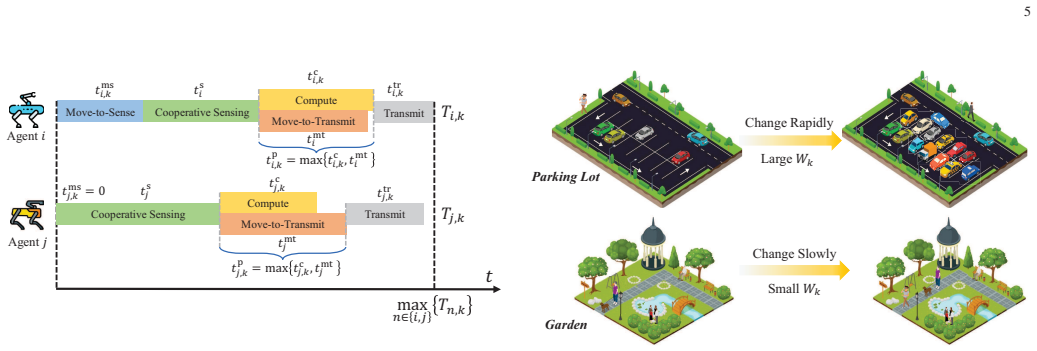
The five-stage closed-loop workflow (move-to-sense, cooperative sensing, onboard semantic processing, channel-aware mobility, uplink transmission) that carries autonomous agent execution and enables the joint optimization of topology and resources.
If this is right
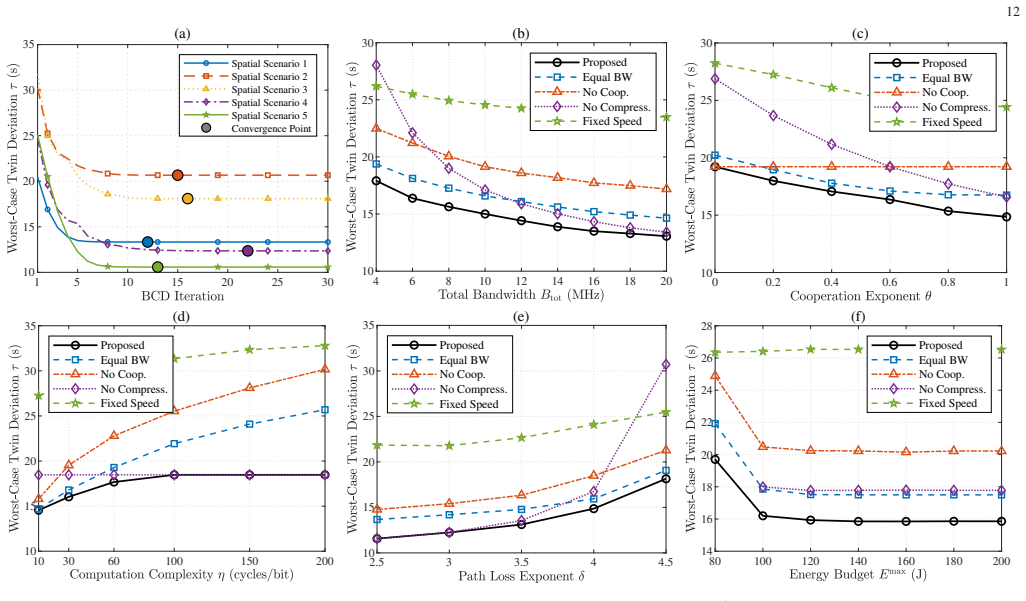
- Semantic compression acts as a direct substitute for channel bandwidth in lowering latency under tight spectrum constraints.
- Autonomous velocity adaptation supplies an additional degree of freedom that resolves the fundamental energy-time trade-off for synchronization tasks.
- The outer-layer dynamic matching game combined with inner-layer continuous optimization yields a convergent solution to the joint assignment and allocation problem.
- The framework delivers lower synchronization deviation than multiple existing baseline schemes across the tested scenarios.
Where Pith is reading between the lines
- The same five-stage agent workflow could be repurposed for other latency-sensitive tasks such as real-time environmental monitoring or distributed mapping where mobility and local processing are available.
- The substitution effect between semantic compression and channel resources suggests that similar rate-distortion trade-offs may appear in non-digital-twin multi-agent systems facing bandwidth limits.
- Dynamic matching for topology dispatching may generalize to other multi-agent wireless problems where both discrete assignment and continuous resource variables must be handled jointly.
Load-bearing premise
The five-stage closed-loop workflow can be executed autonomously by agents while satisfying heterogeneous sensing fidelity and energy budget constraints in the formulated joint topology dispatching and resource allocation problem.
What would settle it
A deployment trial or simulation variant in which the proposed algorithm produces equal or higher maximum twin deviation than the baselines, or in which agents cannot complete the five-stage workflow under the stated energy and fidelity limits, would falsify the superiority claim.
Figures
read the original abstract
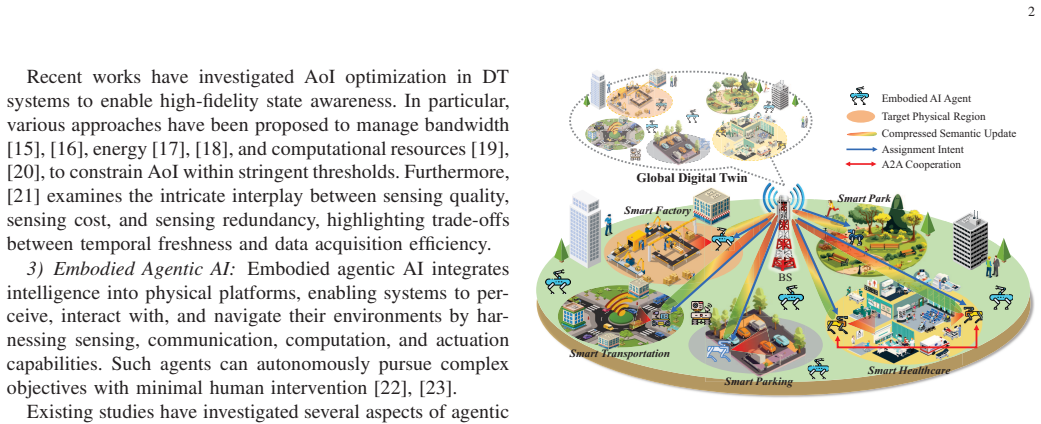
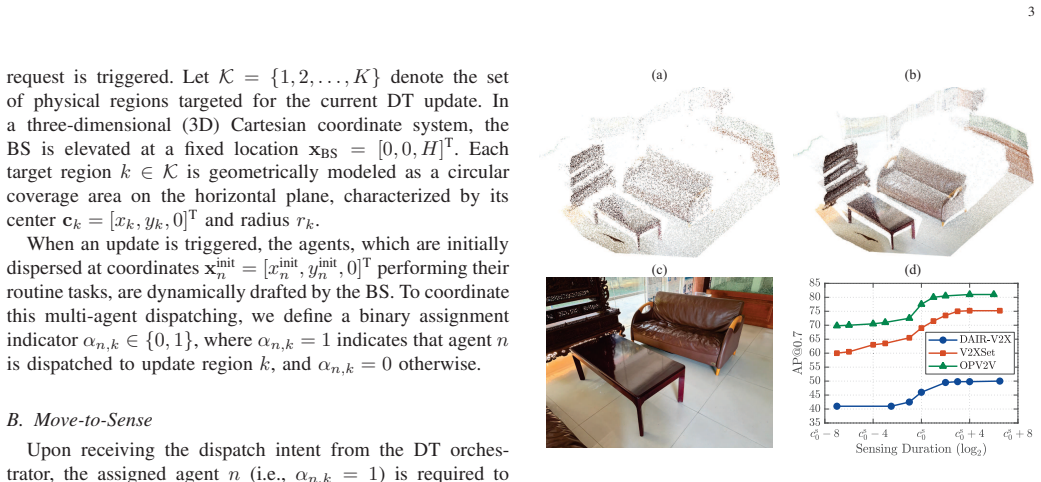
Efficient digital twin (DT) synchronization relies on maintaining high-fidelity virtual representations with minimal age of information (AoI). However, the synergistic potential of cooperative sensing and autonomous mobility of the sensing agent remains underexplored in existing DT synchronization frameworks. In this paper, we propose an agentic AI-empowered mobile embodied AI network (MEAN) framework for DT synchronization. In the proposed hybrid architecture, the base station (BS) conducts global orchestration, while the agents autonomously execute a five-stage closed-loop workflow: move-to-sense, cooperative sensing, onboard semantic processing, channel-aware mobility, and uplink transmission. To optimize synchronization performance, we formulate a joint topology dispatching and multidimensional resource allocation problem aimed at minimizing the maximum twin deviation across regions, subject to heterogeneous sensing fidelity and energy budget constraints. To tackle this, we develop a hierarchical two-layer optimization algorithm, where the outer-layer refines multi-agent assignment via a dynamic matching game, and the inner-layer iteratively optimizes the continuous resources. Extensive simulation results verify the convergence of the proposed algorithm and demonstrate its substantial superiority over multiple baseline schemes in reducing synchronization deviation. Furthermore, the results reveal that semantic compression serves as a vital substitute for channel resources in latency reduction under constrained bandwidth, while autonomous velocity adaptation provides an essential degree of freedom for the system to navigate the fundamental energy-time trade-off.
Editorial analysis
A structured set of objections, weighed in public.
Referee Report
Summary. The manuscript proposes an agentic AI-empowered mobile embodied AI network (MEAN) framework for digital twin (DT) synchronization. In a hybrid architecture, the base station performs global orchestration while agents autonomously execute a five-stage closed-loop workflow (move-to-sense, cooperative sensing, onboard semantic processing, channel-aware mobility, uplink transmission). The authors formulate a joint topology dispatching and multidimensional resource allocation problem that minimizes the maximum twin deviation subject to heterogeneous sensing fidelity and energy budget constraints. They develop a hierarchical two-layer algorithm (outer dynamic matching game for multi-agent assignment; inner iterative continuous resource optimization) and present simulation results claiming convergence of the algorithm together with substantial superiority over multiple baseline schemes, plus insights that semantic compression substitutes for channel resources and autonomous velocity adaptation navigates the energy-time trade-off.
Significance. If the simulation results are robust, the work contributes to the DT synchronization literature by explicitly incorporating cooperative sensing and autonomous mobility of embodied agents, an aspect noted as underexplored. The hierarchical decomposition and the identification of semantic compression and velocity as additional degrees of freedom could inform resource allocation designs in mobile networks supporting real-time digital twins.
minor comments (3)
- The abstract states that simulations verify convergence and superiority but does not name the specific baselines, report quantitative metrics (e.g., deviation reduction percentages), or describe simulation parameters, error bars, or data exclusion criteria; the full manuscript should include these details in the simulation section for reproducibility.
- The five-stage workflow is presented as autonomously executable by agents; the manuscript should explicitly map each stage to the decision variables and constraints of the formulated optimization problem to confirm feasibility under the stated heterogeneous sensing and energy budgets.
- Notation for twin deviation, sensing fidelity, and the matching-game payoff functions should be introduced with a single consistent table or list of symbols to avoid ambiguity when the outer- and inner-layer subproblems are coupled.
Simulated Author's Rebuttal
We thank the referee for the detailed summary of our MEAN framework and the positive assessment of its significance in addressing underexplored aspects of cooperative sensing and autonomous mobility for DT synchronization. We appreciate the recommendation for minor revision. No specific major comments were enumerated in the report, so we have no individual points requiring point-by-point rebuttal or revision at this stage. We remain available to address any additional editor or referee feedback.
Circularity Check
No significant circularity; derivation is self-contained via standard optimization and simulation
full rationale
The paper formulates a joint optimization problem (topology dispatching + resource allocation) to minimize max twin deviation, proposes a hierarchical algorithm (dynamic matching game outer layer + continuous optimization inner layer), and validates via simulations showing convergence and outperformance. No step reduces a claimed result to its own inputs by definition, no fitted parameter is relabeled as prediction, and no load-bearing premise rests solely on self-citation chains. The five-stage workflow and constraints are explicitly stated as modeling choices, not derived outputs. Simulations serve as external verification rather than tautological confirmation. This matches the common case of an independent algorithmic contribution evaluated empirically.
Axiom & Free-Parameter Ledger
Reference graph
Works this paper leans on
-
[1]
Digital twins: A survey on ena bling technologies, challenges, trends and future prospects,
S. Mihai, M. Y aqoob, D. V . Hung, W. Davis, P . Towakel, M. Ra za, M. Karamanoglu, B. Barn, D. Shetve, R. V . Prasad, H. V enkatar aman, R. Trestian, and H. X. Nguyen, “Digital twins: A survey on ena bling technologies, challenges, trends and future prospects,” IEEE Commun. Surveys Tuts., vol. 24, no. 4, pp. 2255–2291, 4th Quart. 2022
2022
-
[2]
Future factories wi th 6G: Agentic AI and cyber-physical digital twins,
H. Li, H. Madhukumar, N. Methley, X. Chen, Y . Wu, J. Parra- Ullauri, V . Sharma, J. Lee, A. R. Koblitz, M. Andrews, S. Liu, Y . Deng, O . Y . Kolawole, A. Tassi, and D. Simeonidou, “Future factories wi th 6G: Agentic AI and cyber-physical digital twins,” IEEE Internet Things J. , 2025
2025
-
[3]
Intelligent resource allocation in joint radar-communication with gra ph neural networks,
J. Lee, Y . Cheng, D. Niyato, Y . L. Guan, and D. Gonz´ alez G., “Intelligent resource allocation in joint radar-communication with gra ph neural networks,” IEEE Trans. V eh. Technol., vol. 71, no. 10, pp. 11 120–11 135, Oct. 2022
2022
-
[4]
Generative AI empowered semantic feature multipl e access (SFMA) over wireless networks,
J. Wang, Y . Y ang, Z. Y ang, C. Huang, M. Chen, Z. Zhang, and M. Shikh- Bahaei, “Generative AI empowered semantic feature multipl e access (SFMA) over wireless networks,” IEEE Trans. Cogn. Commun. Netw. , vol. 11, no. 2, pp. 791–804, Apr. 2025
2025
-
[5]
Energy-efficient probabilistic semantic communication o ver space-air- ground integrated networks,
Z. Zhao, Z. Y ang, M. Chen, C. Zhu, W. Xu, Z. Zhang, and K. Hua ng, “Energy-efficient probabilistic semantic communication o ver space-air- ground integrated networks,” IEEE Trans. Wireless Commun. , vol. 24, no. 10, pp. 8814–8829, Oct. 2025
2025
-
[6]
On transferring, m erging, and splitting task-oriented network digital twins,
Z. Zhang, M. Fang, M. Chen, and Y . Liu, “On transferring, m erging, and splitting task-oriented network digital twins,” in Proc. 2025 Int. Conf. Model. Anal. Simu. Wireless Mobile Syst. (MSWiM) , Oct. 2025, pp. 695–704
2025
-
[7]
Data synchronization in vehicular digital twin network: A game the- oretic approach,
J. Zheng, T. H. Luan, Y . Zhang, R. Li, Y . Hui, L. Gao, and M. D ong, “Data synchronization in vehicular digital twin network: A game the- oretic approach,” IEEE Trans. Wireless Commun. , vol. 22, no. 11, pp. 7635–7647, Nov. 2023
2023
-
[8]
How to synchronize digital twins? a communi cation performance analysis,
L. V . Cakir, S. Al-Shareeda, S. F. Oktug, M. ¨Ozdem, M. Broadbent, and B. Canberk, “How to synchronize digital twins? a communi cation performance analysis,” in Proc. 2023 IEEE 28th Int. W orkshop Comput. Aided Model. Design Commun. Links Netw. (CAMAD) , Nov. 2023, pp. 123–127
2023
-
[9]
Optimizing wir eless resource management and synchronization in digital twin ne tworks,
H. Y u, Y . Liu, Z. Y ang, H. Sun, and M. Chen, “Optimizing wir eless resource management and synchronization in digital twin ne tworks,” IEEE Internet Things J. , vol. 12, no. 15, pp. 29 152–29 163, Aug. 2025
2025
-
[10]
Spectrum shar ing in internet-of-vehicles networks: Digital twin-empowered p roactive inter- ference management approach,
M. Elloumi, M. Z. Hassan, and G. Kaddoum, “Spectrum shar ing in internet-of-vehicles networks: Digital twin-empowered p roactive inter- ference management approach,” IEEE Trans. Netw. Service Manage. , vol. 22, no. 4, pp. 3228–3248, Aug. 2025
2025
-
[11]
Tw o- timescale synchronization and migration for digital twin n etworks: A multi-agent deep reinforcement learning approach,
W. Liu, Y . Fu, Y . Guo, F. Lee Wang, W. Sun, and Y . Zhang, “Tw o- timescale synchronization and migration for digital twin n etworks: A multi-agent deep reinforcement learning approach,” IEEE Trans. Wireless Commun., vol. 23, no. 11, pp. 17 294–17 309, Nov. 2024
2024
-
[12]
UA V- assisted digital-twin synchronization with tiny-machine -learning-based semantic communications,
J. Tang, J. Nie, J. Bai, J. Xu, S. Li, Y . Zhang, and Y . Y uan, “UA V- assisted digital-twin synchronization with tiny-machine -learning-based semantic communications,” IEEE Internet Things J. , vol. 11, no. 17, pp. 28 437–28 451, Sep. 2024
2024
-
[13]
Delay-aware digital tw in synchro- nization in mobile edge networks with semantic communicati ons,
B. Li, H. Cai, L. Liu, and Z. Fei, “Delay-aware digital tw in synchro- nization in mobile edge networks with semantic communicati ons,” IEEE Trans. V eh. Technol., vol. 74, no. 7, pp. 10 974–10 983, Jul. 2025
2025
-
[14]
Age of information: An introduction and survey,
R. D. Y ates, Y . Sun, D. R. Brown, S. K. Kaul, E. Modiano, an d S. Ulukus, “Age of information: An introduction and survey, ” IEEE J. Sel. Areas Commun. , vol. 39, no. 5, pp. 1183–1210, May 2021
2021
-
[15]
Age- of-information-aware digital twin assisted resource mana gement for distributed energy scheduling,
Y . Shu, Z. Wang, H. Liao, Z. Zhou, N. Nasser, and M. Imran, “Age- of-information-aware digital twin assisted resource mana gement for distributed energy scheduling,” in Proc. GLOBECOM 2022 - 2022 IEEE Global Commun. Conf. , Dec. 2022, pp. 5705–5710
2022
-
[16]
I ntegration of 6G signal processing, communication, and computing base d on information timeliness-aware digital twin,
H. Liao, J. Lu, Y . Shu, Z. Zhou, M. Tariq, and S. Mumtaz, “I ntegration of 6G signal processing, communication, and computing base d on information timeliness-aware digital twin,” IEEE J. Sel. Topics Signal Process., vol. 18, no. 1, pp. 98–108, Jan. 2024
2024
-
[17]
Age-of-information and en- ergy optimization in digital twin edge networks,
Y . Guo, Y . Fu, Y . Zhang, and T. Q. S. Quek, “Age-of-information and en- ergy optimization in digital twin edge networks,” in Proc. GLOBECOM 2024 - 2024 IEEE Global Commun. Conf. , Dec. 2024, pp. 3194–3200
2024
-
[18]
Joint sensing and a ge of information optimization for energy constrained UA V-assisted integrated sensing, calculation, and communication,
Z. Liu, X. Liu, W. Y ang, and X. Zhang, “Joint sensing and a ge of information optimization for energy constrained UA V-assisted integrated sensing, calculation, and communication,” IEEE Trans. Wireless Com- mun., vol. 24, no. 5, pp. 4440–4453, May 2025
2025
-
[19]
A ge-of- information-aware hierarchical collaborative inference in digital twin- enabled vehicular edge computing,
X. Chen, H. Xing, Q. Zhang, Z. Xiong, Y . Bi, and X. Wang, “A ge-of- information-aware hierarchical collaborative inference in digital twin- enabled vehicular edge computing,” IEEE Trans. Netw. Sci. Eng., vol. 13, pp. 2388–2404, 2026
2026
-
[20]
Age o f infor- mation in digital twin migration,
K. Noroozi, T. D. Todd, D. Zhao, and G. Karakostas, “Age o f infor- mation in digital twin migration,” IEEE Trans. V eh. Technol. , vol. 74, no. 10, pp. 16 281–16 294, Oct. 2025
2025
-
[21]
Joint op timization of vehicular sensing and vehicle digital twins deployment for DT-assisted IoVs,
L. Tang, Z. Cheng, J. Dai, H. Zhang, and Q. Chen, “Joint op timization of vehicular sensing and vehicle digital twins deployment for DT-assisted IoVs,” IEEE Trans. V eh. Technol. , vol. 73, no. 8, pp. 11 834–11 847, Aug. 2024
2024
-
[22]
From large AI models to agentic AI: A tutorial on future inte lligent communications,
F. Jiang, C. Pan, K. Wang, P . Michiardi, O. A. Dobre, and M . Debbah, “From large AI models to agentic AI: A tutorial on future inte lligent communications,” IEEE J. Sel. Areas Commun. , 2026
2026
-
[23]
Toward edge gener al intelligence with agentic AI and agentification: Concepts, technologies, and future directions,
R. Zhang, G. Liu, Y . Liu, C. Zhao, J. Wang, Y . Xu, D. Niyato , J. Kang, Y . Li, S. Mao, S. Sun, X. Shen, and D. I. Kim, “Toward edge gener al intelligence with agentic AI and agentification: Concepts, technologies, and future directions,” IEEE Commun. Surveys Tuts. , vol. 28, pp. 4285– 4318, 2026
2026
-
[24]
Agentic AI meets edge computing in autonomous UA V swarms,
T. M. Nguyen, V . T. Truong, and L. B. Le, “Agentic AI meets edge computing in autonomous UA V swarms,” IEEE Internet Things Mag. , 2026
2026
-
[25]
Edge general intelligence through world models, large language models, and agentic AI: Fundamentals, solutions, and challenges,
C. Zhao, G. Liu, R. Zhang, Y . Liu, J. Wang, J. Kang, D. Niya to, Z. Li, X. Shen, Z. Han, S. Sun, C. Y uen, and D. I. Kim, “Edge general intelligence through world models, large language models, and agentic AI: Fundamentals, solutions, and challenges,” IEEE Trans. Cogn. Commun. Netw., vol. 12, pp. 5649–5675, 2026
2026
-
[26]
Toward agentic AI: Generative information retriev al inspired intelligent communications and networking,
R. Zhang, S. Tang, Y . Liu, D. Niyato, Z. Xiong, S. Sun, S. M ao, and Z. Han, “Toward agentic AI: Generative information retriev al inspired intelligent communications and networking,” IEEE Commun. Mag. , vol. 64, no. 1, pp. 197–204, Jan. 2026. 14
2026
-
[27]
TaskON: Task-oriente d networking for agentic AI,
B. Du, R. Li, D. Niyato, and Z. Su, “TaskON: Task-oriente d networking for agentic AI,” IEEE Netw., 2026
2026
-
[28]
Wireless agentic AI with retrieval-augmen ted multi- modal semantic perception,
G. Liu, Y . Liu, R. Zhang, H. Du, D. Niyato, Z. Xiong, S. Sun , and A. Jamalipour, “Wireless agentic AI with retrieval-augmen ted multi- modal semantic perception,” IEEE Commun. Mag. , vol. 64, no. 1, pp. 230–236, Jan. 2026
2026
-
[29]
LAMeTA: Intent-aware agentic network optimizatio n via a large AI model-empowered two-stage approach,
Y . Liu, G. Liu, J. Wang, R. Zhang, D. Niyato, G. Sun, Z. Xio ng, and Z. Han, “LAMeTA: Intent-aware agentic network optimizatio n via a large AI model-empowered two-stage approach,” IEEE J. Sel. Areas Commun., 2025
2025
-
[30]
Internet of agents: Fundamentals, applicat ions, and challenges,
Y . Wang, S. Guo, Y . Pan, Z. Su, F. Chen, T. H. Luan, P . Li, J. Kang, and D. Niyato, “Internet of agents: Fundamentals, applicat ions, and challenges,” IEEE Trans. Cogn. Commun. Netw. , vol. 12, pp. 4476– 4501, 2026
2026
-
[31]
Agentic AI-Empowered Wireless Agent Networks With Semantic-Aware Collaboration via ILAC
Z. Zhao, J. Wang, Z. Y ang, K. Y ang, Z. Zhang, M. Chen, and K . Huang, “Agentic AI-empowered wireless agent networks with semant ic-aware collaboration via ILAC,” arXiv preprint arXiv:2604.02381 , 2026
work page internal anchor Pith review Pith/arXiv arXiv 2026
-
[32]
MaLAM4Com: Multi-agent cooperative large AI models for wi reless communications,
Z. Liu, J. Zhang, Y . Zhu, E. Shi, B. Xu, D. Niyato, S. Jin, a nd B. Ai, “MaLAM4Com: Multi-agent cooperative large AI models for wi reless communications,” IEEE J. Sel. Areas Commun. , 2025
2025
-
[33]
Large model-based agents: State-of-the-ar t, cooperation paradigms, security and privacy, and future trends,
Y . Wang, Y . Pan, Z. Su, Y . Deng, Q. Zhao, L. Du, T. H. Luan, J . Kang, and D. Niyato, “Large model-based agents: State-of-the-ar t, cooperation paradigms, security and privacy, and future trends,” IEEE Commun. Surveys Tuts., vol. 28, pp. 1906–1949, 2026
1906
-
[34]
Deployment of mobile robots with energy and timing constraints,
Y . Mei, Y .-H. Lu, Y . Hu, and C. Lee, “Deployment of mobile robots with energy and timing constraints,” IEEE Trans. Robot. , vol. 22, no. 3, pp. 507–522, Jun. 2006
2006
-
[35]
DAIR-V2X: A large-scale dataset for veh icle- infrastructure cooperative 3D object detection,
H. Y u, Y . Luo, M. Shu, Y . Huo, Z. Y ang, Y . Shi, Z. Guo, H. Li, X. Hu, J. Y uan, and Z. Nie, “DAIR-V2X: A large-scale dataset for veh icle- infrastructure cooperative 3D object detection,” in Proc. IEEE/CVF Conf. Comput. Vis. Pattern Recog. (CVPR) , 2022, pp. 21 329–21 338
2022
-
[36]
V2x- vit: V ehicle-to-everything cooperative perception with visio n transformer,
R. Xu, H. Xiang, Z. Tu, X. Xia, M.-H. Y ang, and J. Ma, “V2x- vit: V ehicle-to-everything cooperative perception with visio n transformer,” in Proc. Eur . Conf. Comput. Vis. (ECCV) , 2022, pp. 107–124
2022
-
[37]
OPV2V: An open benchmark dataset and fusion pipeline for perception with v ehicle-to- vehicle communication,
R. Xu, H. Xiang, X. Xia, X. Han, J. Li, and J. Ma, “OPV2V: An open benchmark dataset and fusion pipeline for perception with v ehicle-to- vehicle communication,” in Proc. 2022 Int. Conf. Robot. Auto. (ICRA) , May 2022, pp. 2583–2589
2022
-
[38]
Spatio-temporal domain awareness for multi-agen t collabo- rative perception,
K. Y ang, D. Y ang, J. Zhang, M. Li, Y . Liu, J. Liu, H. Wang, P . Sun, and L. Song, “Spatio-temporal domain awareness for multi-agen t collabo- rative perception,” in Proc. IEEE/CVF Int. Conf. Compu. Vis. (ICCV) , 2023, pp. 23 383–23 392
2023
-
[39]
Toward efficient and privacy-aware eHealth systems: An integrated sensing, computing, and semantic communicatio n approach,
Y . Y ang, Y . Ding, Z. Y ang, C. Huang, Z. Zhang, D. Niyato, a nd M. R. Shikh-Bahaei, “Toward efficient and privacy-aware eHealth systems: An integrated sensing, computing, and semantic communicatio n approach,” IEEE Internet Things J. , vol. 12, no. 24, pp. 55 087–55 105, Dec. 2025
2025
-
[40]
Compression ratio allocation for probabilis tic semantic communication with RSMA,
Z. Zhao, Z. Y ang, Y . Hu, C. Zhu, M. Shikh-Bahaei, W. Xu, Z. Zhang, and K. Huang, “Compression ratio allocation for probabilis tic semantic communication with RSMA,” IEEE Trans. Commun. , vol. 73, no. 9, pp. 7304–7318, Sep. 2025
2025
-
[41]
Mobility diversity-assisted wireless communication for mobile robots,
D. Bonilla Licea, M. Ghogho, D. McLernon, and S. A. R. Zai di, “Mobility diversity-assisted wireless communication for mobile robots,” IEEE Trans. Robot. , vol. 32, no. 1, pp. 214–229, Feb. 2016
2016
-
[42]
Precise and accurate wireless signal strength mappings using gaussian processe s and path loss models,
R. Miyagusuku, A. Y amashita, and H. Asama, “Precise and accurate wireless signal strength mappings using gaussian processe s and path loss models,” Robot. Auto. Systems , vol. 103, pp. 134–150, 2018
2018
-
[43]
F4-CKM : Learning channel knowledge map with radio frequency radiance field re ndering,
K. Zhou, G. Zhang, H. Li, Y . Cai, S. Liu, and G. Y u, “F4-CKM : Learning channel knowledge map with radio frequency radiance field re ndering,” IEEE Trans. Commun. , vol. 74, pp. 5684–5700, 2026
2026
-
[44]
Energy-efficie nt resource allocation for mobile-edge computation offloading,
C. Y ou, K. Huang, H. Chae, and B.-H. Kim, “Energy-efficie nt resource allocation for mobile-edge computation offloading,” IEEE Trans. Wire- less Commun. , vol. 16, no. 3, pp. 1397–1411, Mar. 2016
2016
-
[45]
Study on channel model for frequencies from 0.5 t o 100 GHz,
3GPP, “Study on channel model for frequencies from 0.5 t o 100 GHz,” 3rd Generation Partnership Project (3GPP), Tech. Rep. TR 38 .901, version 17.0.0, Mar. 2022
2022
discussion (0)
Sign in with ORCID, Apple, or X to comment. Anyone can read and Pith papers without signing in.