Adaptive Window Decoding based on Spatiotemporal Complementary Gap
Pith reviewed 2026-06-30 20:43 UTC · model grok-4.3
The pith
An adaptive window decoding scheme based on spatiotemporal complementary gap reduces average buffer size by about 40 percent while keeping the logical error rate unchanged.
A machine-rendered reading of the paper's core claim, the machinery that carries it, and where it could break.
Core claim
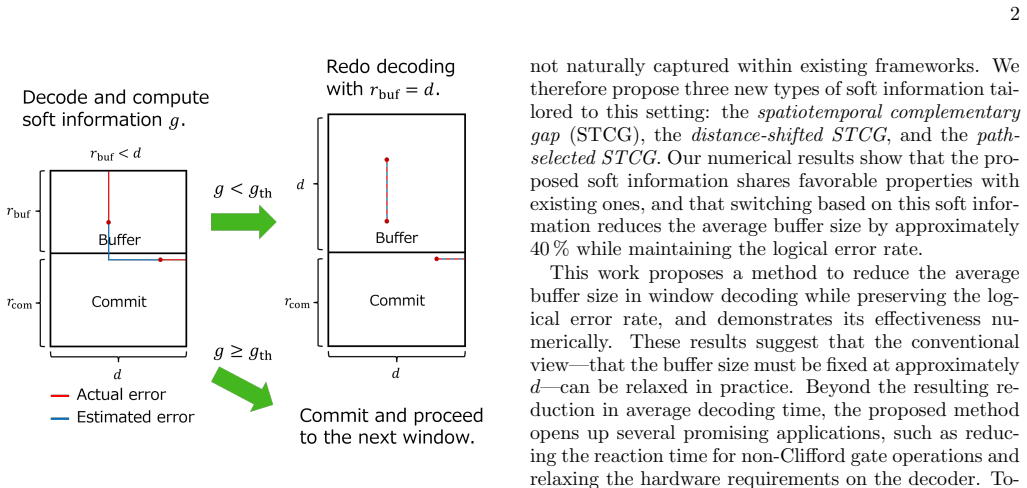
The paper establishes that the spatiotemporal complementary gap provides usable soft information for small-buffer window decoding, enabling an adaptive scheme that starts with a small buffer and enlarges it only when the gap signals insufficient confidence; numerical simulations confirm this cuts the average buffer size by approximately 40 percent while the logical error rate remains the same as in non-adaptive large-buffer decoding.
What carries the argument
The spatiotemporal complementary gap, a new soft-information measure designed for window decoding with small buffers that quantifies decoding confidence to decide whether buffer enlargement is required.
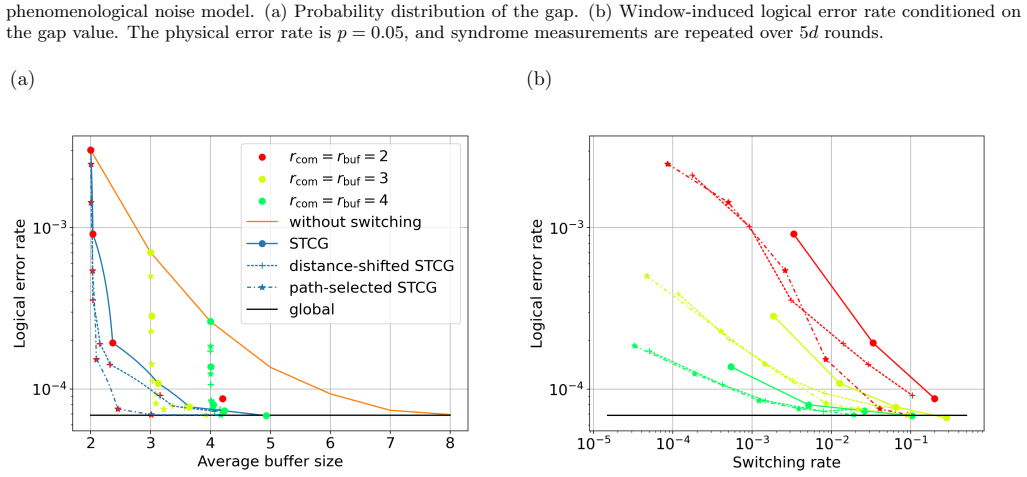
If this is right
- Average decoding time falls because the small buffer handles the majority of shots.
- Logical error rates stay equivalent to those achieved with fixed buffers at least as large as the code distance.
- Window decoding becomes practical at smaller typical sizes without degrading fault tolerance.
- Real-time decoding latency decreases for quantum error correction loops.
Where Pith is reading between the lines
- The gap measure could extend to adaptive strategies in other decoding architectures beyond fixed windows.
- Hardware schedulers might allocate buffer resources dynamically based on per-shot gap values.
- Further tests on varied code distances and noise models would clarify how the 40 percent saving scales.
Load-bearing premise
The spatiotemporal complementary gap reliably flags cases where a small buffer suffices versus cases needing enlargement, without any net increase in logical error rate.
What would settle it
A direct comparison simulation on the same code and noise model where the adaptive scheme produces a higher logical error rate than the fixed large-buffer decoder would falsify the central claim.
Figures
read the original abstract
Real-time decoding plays a crucial role in practical fault-tolerant quantum computing. Window decoding, in which the decoding problem is divided into windows, is a promising approach. While reducing the window size is desirable for faster decoding, each window contains a buffer region whose size must typically be at least the code distance to avoid degrading the logical error rate, which limits how much the window can shrink. In this paper, we propose an adaptive decoding scheme in which window decoding is first performed with a small buffer size and a decoding confidence (soft information) is computed; if the confidence is low, the buffer size is enlarged and decoding is redone. This approach reduces the average decoding time, since most shots are decoded with a small buffer. A central challenge in realizing this scheme is that existing forms of soft information are not directly applicable to window decoding, especially with a small buffer. We address this challenge by introducing a new form of soft information, the spatiotemporal complementary gap, specifically designed for this setting. Numerical simulations demonstrate that the proposed scheme reduces the average buffer size by approximately 40% while maintaining the logical error rate.
Editorial analysis
A structured set of objections, weighed in public.
Referee Report
Summary. The paper proposes an adaptive window decoding scheme for real-time decoding in fault-tolerant quantum computing. Window decoding is performed first with a small buffer; a new soft-information metric called the spatiotemporal complementary gap is computed, and the buffer is enlarged and decoding redone only if confidence is low. The central claim, supported by numerical simulations, is that this reduces average buffer size by approximately 40% while preserving the logical error rate.
Significance. If the empirical result holds under standard surface-code or similar models, the scheme would meaningfully lower average decoding latency without sacrificing error suppression, addressing a practical bottleneck in real-time FTQC. The introduction of a window-specific soft metric is a targeted contribution that could be reusable beyond the adaptive-buffer setting.
major comments (1)
- [Abstract] Abstract: the central empirical claim (approximately 40% average buffer-size reduction while maintaining logical error rate) is stated without any description of the underlying codes, noise models, decoder implementation, number of Monte Carlo shots, error bars, or statistical significance tests. This information is load-bearing for assessing whether the spatiotemporal complementary gap reliably identifies safe small-buffer cases.
Simulated Author's Rebuttal
We thank the referee for their constructive comment on the abstract. We address it point by point below.
read point-by-point responses
-
Referee: [Abstract] Abstract: the central empirical claim (approximately 40% average buffer-size reduction while maintaining logical error rate) is stated without any description of the underlying codes, noise models, decoder implementation, number of Monte Carlo shots, error bars, or statistical significance tests. This information is load-bearing for assessing whether the spatiotemporal complementary gap reliably identifies safe small-buffer cases.
Authors: We agree that the abstract would benefit from a concise statement of the simulation parameters supporting the central claim. Although the full details of the codes, noise models, decoder, Monte Carlo statistics, and error analysis are provided in the numerical simulations section of the manuscript, we acknowledge that the abstract should be more self-contained for this key empirical result. In the revised manuscript we will expand the abstract with a brief description of these elements while respecting length constraints. revision: yes
Circularity Check
No significant circularity detected
full rationale
The paper introduces a new soft-information metric (spatiotemporal complementary gap) for adaptive window decoding and validates it via numerical simulations showing ~40% average buffer-size reduction at fixed logical error rate. No derivation chain, fitted-parameter prediction, or self-citation load-bearing step is present; the central claim is an empirical outcome directly falsifiable by the reported simulations. The work is self-contained against external benchmarks.
Axiom & Free-Parameter Ledger
invented entities (1)
-
spatiotemporal complementary gap
no independent evidence
Reference graph
Works this paper leans on
-
[1]
In this paper, a detector whose value is 1 is referred to as a defect. For the standard syndrome extraction circuits of sur- face codes, even under circuit-level noise, elementary er- ror events can be decomposed in such a way that each error event flips at most two detectors. This allows us to define a graph whose nodes correspond to detectors and whose ...
-
[2]
Therefore, by rerunning MWPM withσ(v b,0) =n 0 ⊕1 andσ(v b,1) =n 1 ⊕1 while keeping all other defect con- figurations unchanged, one obtains the minimum-weight errorE comp(σ) in the different logical class. III. ADAPTIVE WINDOW DECODING A. Key Issue The method we propose in this paper for reducing the size of the decoding problem is as follows (see also F...
-
[3]
The underlying idea is anal- ogous to that of the complementary gap
General Theory In this section, we introduce quantities that serve as indicators of the conditioned logical error rate, given a syndrome measurement outcome within a window under sliding window decoding. The underlying idea is anal- ogous to that of the complementary gap. As discussed in Sec. II C, the complementary gap provides a reliable estimate of the...
-
[4]
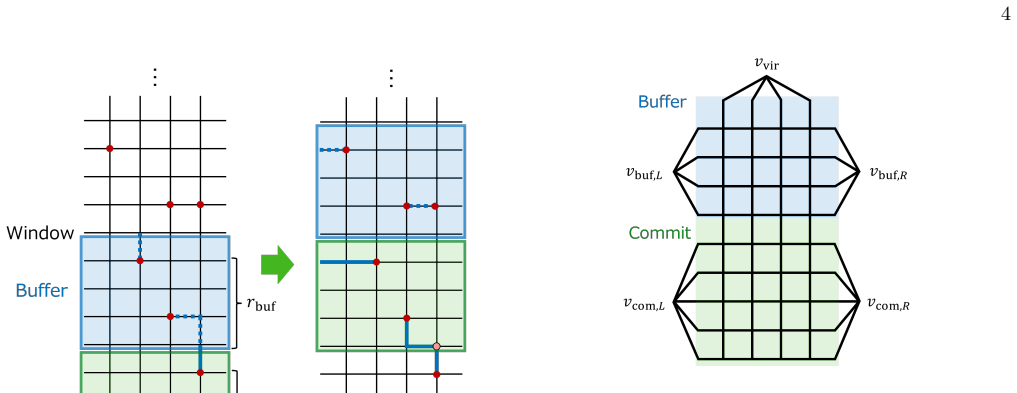
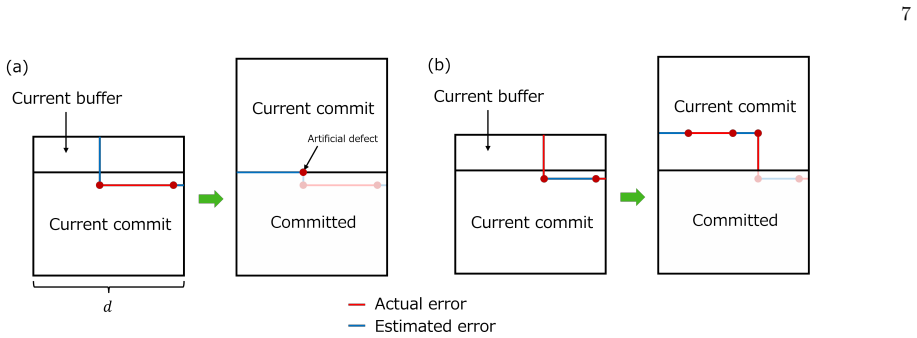
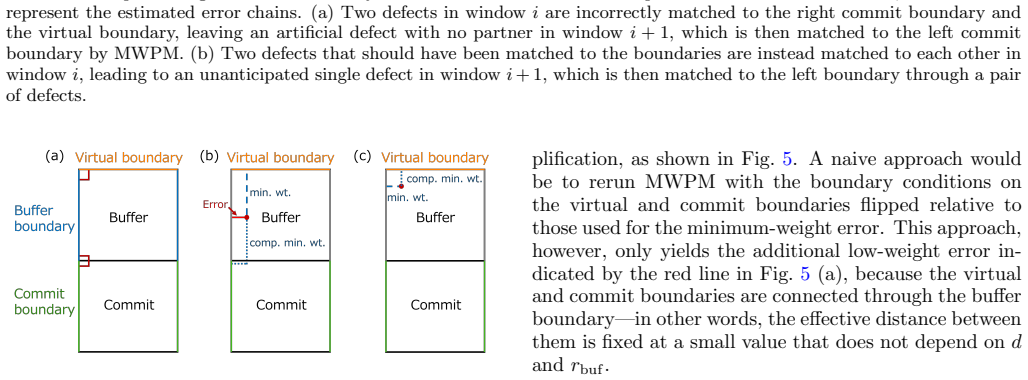
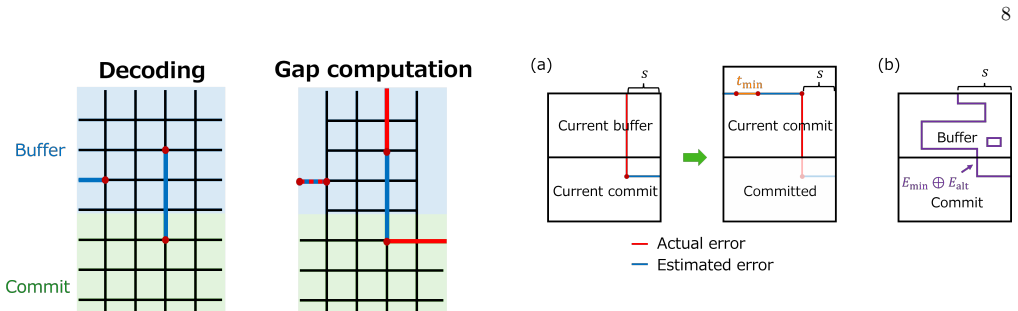
Spatiotemporal Complementary Gap As discussed in Sec. III B 1, the principal mechanism by which a logical error arises is that defects are incorrectly matched to the virtual boundary, leading to the commit- ment of incorrect errors (see Fig. 4). This observation motivates a natural choice ofE alt; namely, the error ob- tained by taking the complementary c...
-
[5]
III B 2, we considered the quantityw alt −w min while neglectingt min
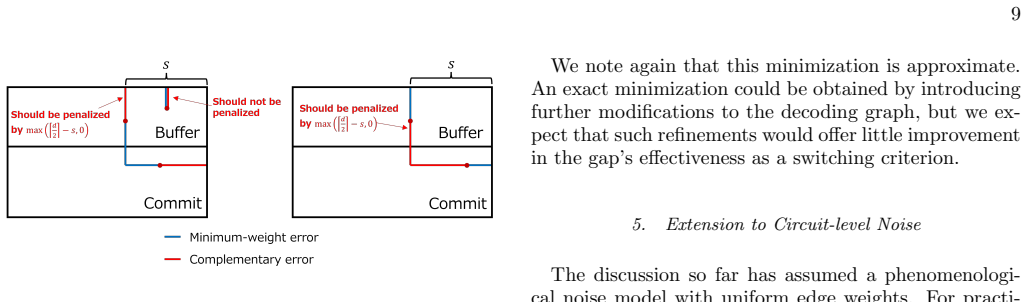
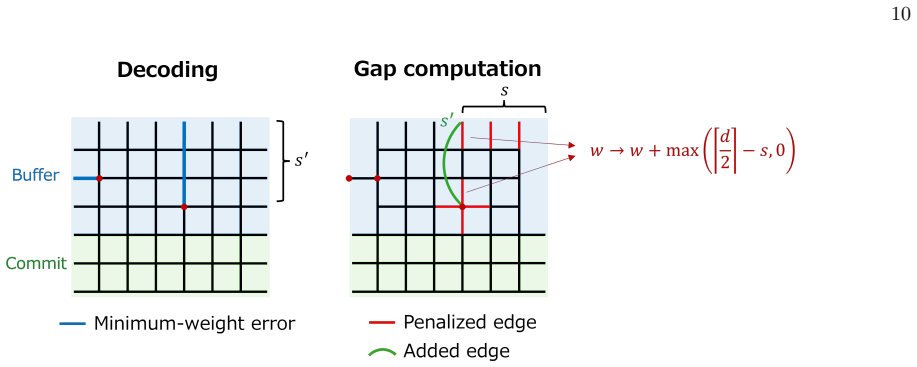
Distance-shifted STCG In Sec. III B 2, we considered the quantityw alt −w min while neglectingt min. As noted there, computing the exact value oft min for general error configurationE min andE alt is difficult. We therefore introduce a simple approximation fort min. We first consider a simple example in which only a single defect is present in the window,...
-
[6]
While this procedure yields anE alt of small weight, the correspondingt min may not be small
Path-selected STCG In computing distance-shifted STCG, we first deter- mineE alt as the complementary error between the virtual and commit boundaries with respect toE min, and then computet min approximately. While this procedure yields anE alt of small weight, the correspondingt min may not be small. In other words, there may exist an alterna- tiveE alt ...
-
[7]
For practi- cal relevance, it is important to extend the soft-output schemes to the circuit-level noise model on the surface code
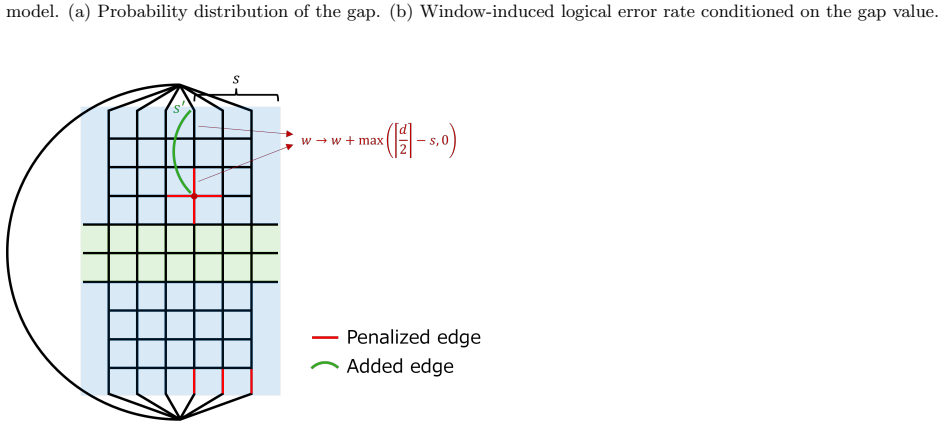
Extension to Circuit-level Noise The discussion so far has assumed a phenomenologi- cal noise model with uniform edge weights. For practi- cal relevance, it is important to extend the soft-output schemes to the circuit-level noise model on the surface code. The main differences from the phenomenological case are twofold: diagonal edges appear in addition ...
-
[8]
We define the window-induced logical error rate as the prob- ability of events in which window decoding leads to a logical error while global decoding does not
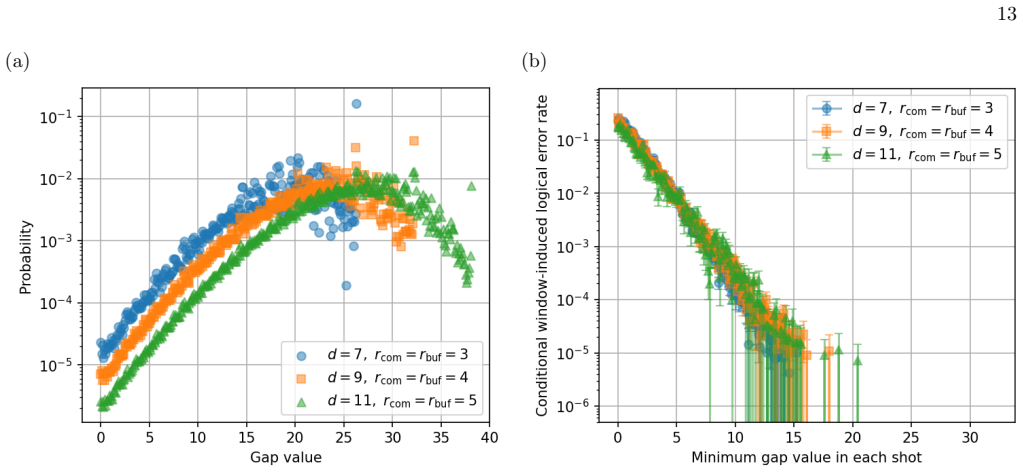
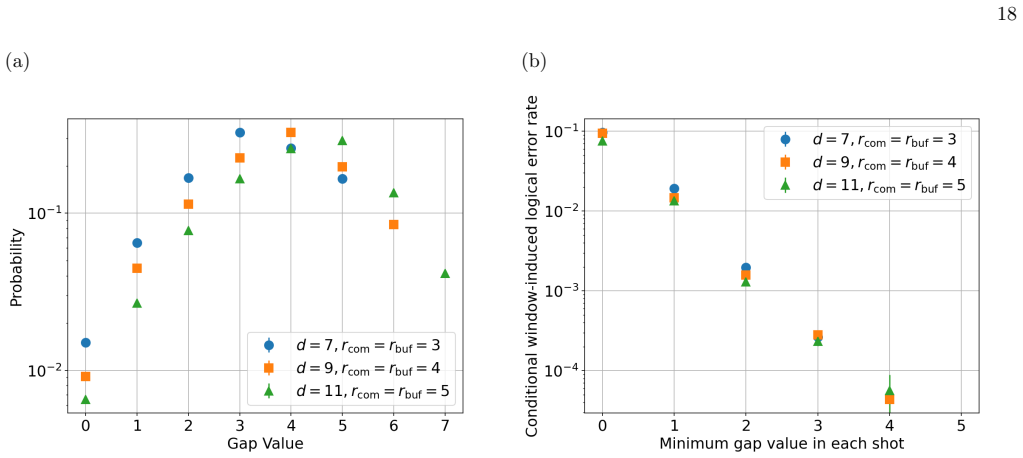
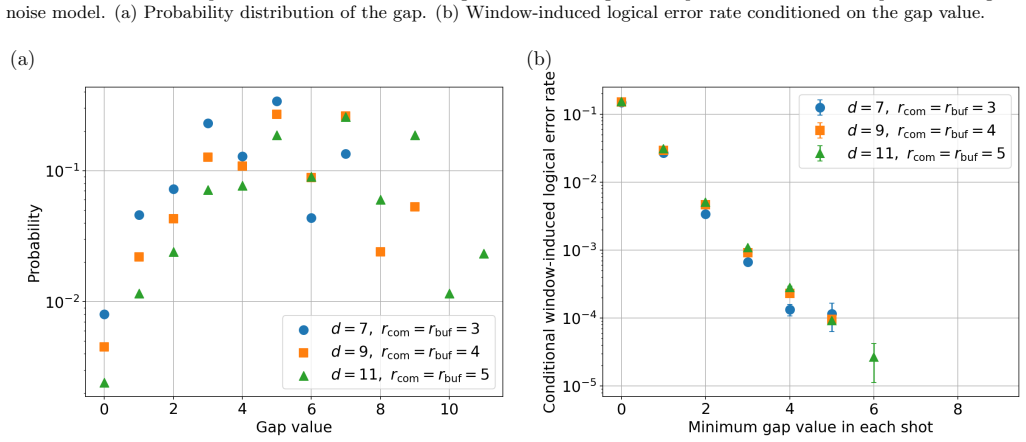
Properties of the Proposed Gaps We first compute the STCG, distance-shifted STCG, and path-selected STCG in sliding window decoding without switching, with the commit and buffer region sizes set to a common valuer com =r buf =⌊d/2⌋. We define the window-induced logical error rate as the prob- ability of events in which window decoding leads to a logical e...
-
[9]
Herer buf denotes the default buffer size used before switching is invoked
Performance of Switching We next apply the adaptive sliding window decoding based on each of the three proposed gaps to the repe- tition code of the code distanced= 13 under the phe- nomenological noise model with the physical error rate p= 0.025. Herer buf denotes the default buffer size used before switching is invoked. Figure 11 (a) shows the logical e...
-
[10]
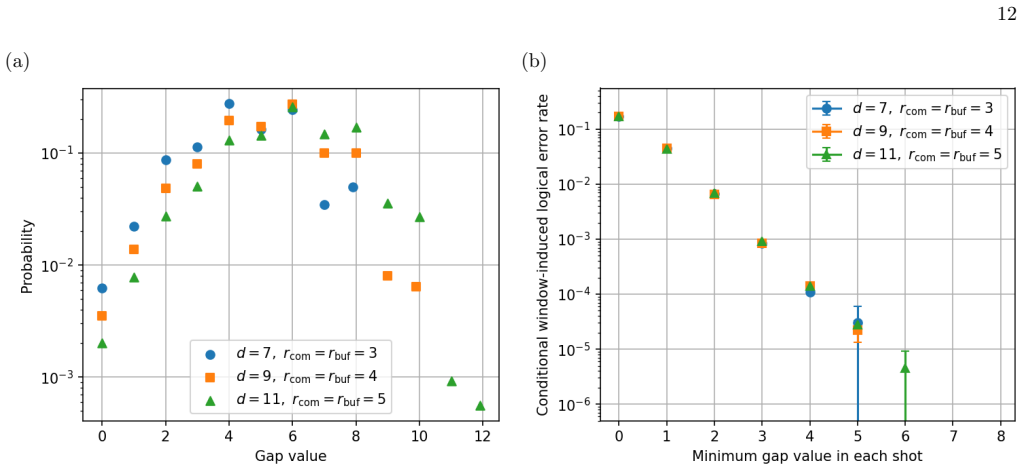
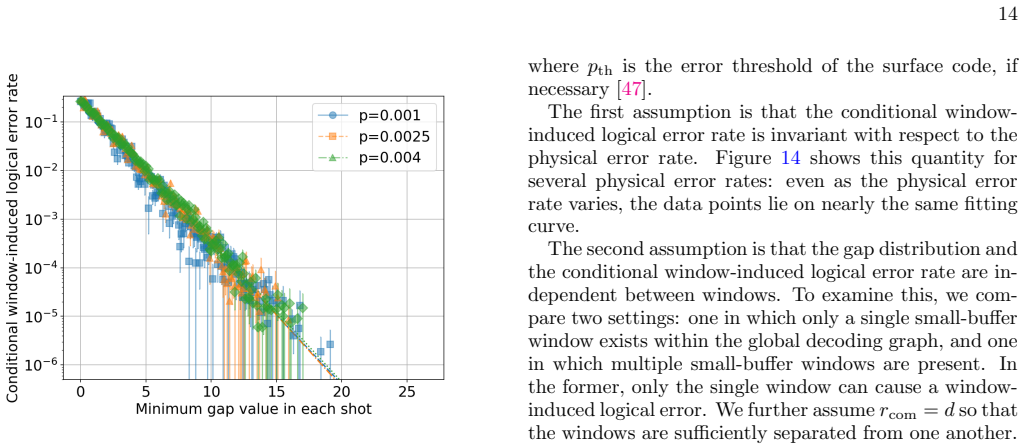
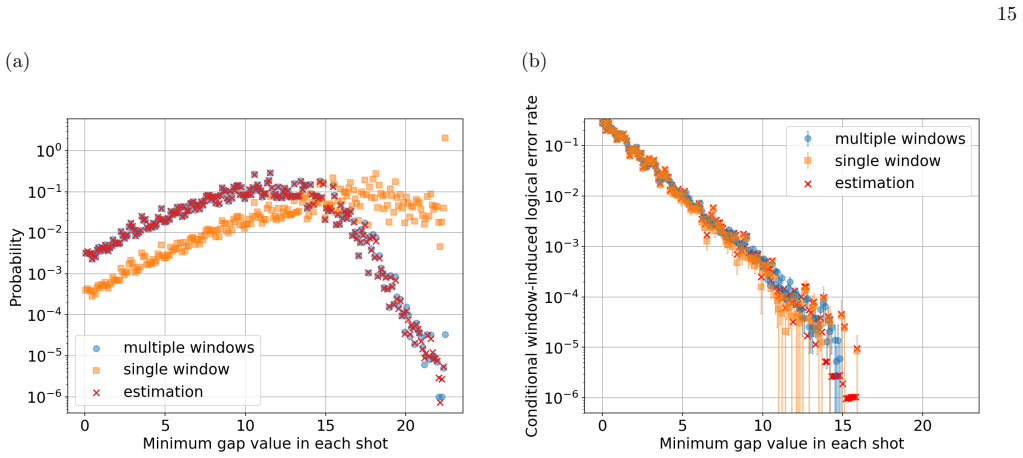
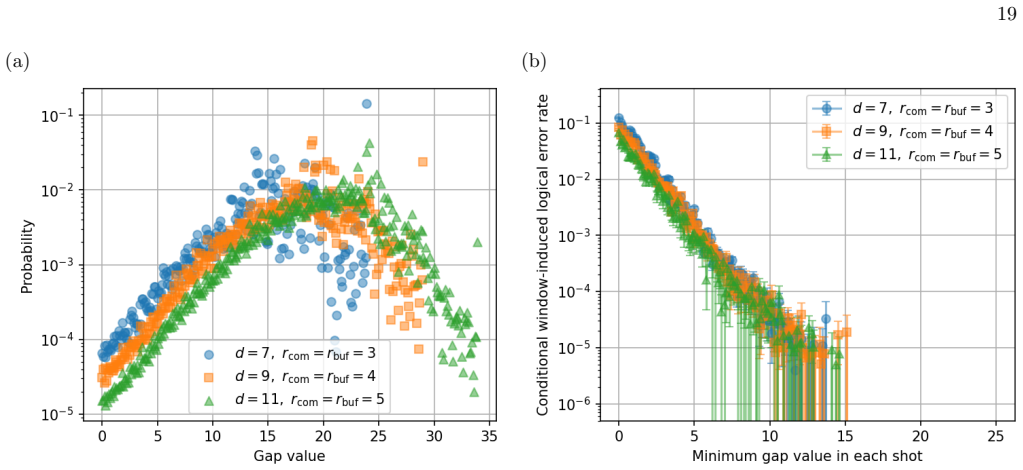
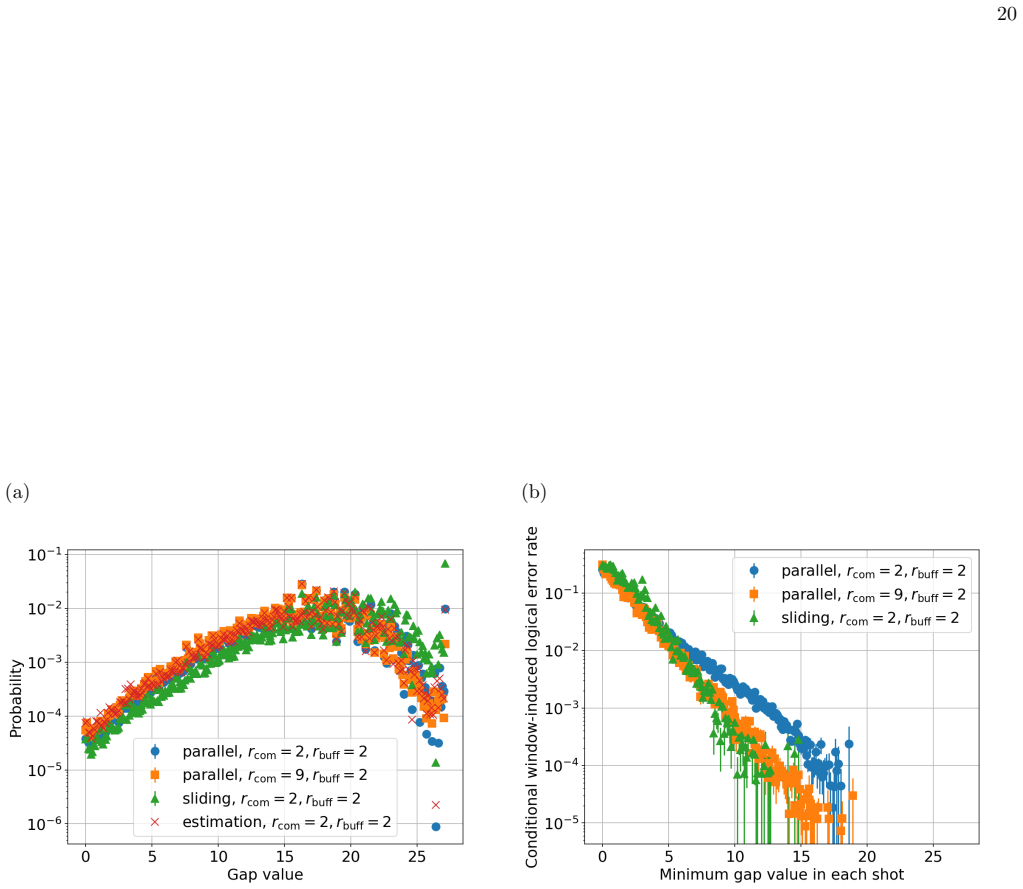
Properties of Proposed Gaps Figure 12 presents the probability distribution of the path-selected STCG and the window-induced logical er- ror rate conditioned on the per-shot minimum gap, evalu- ated for sliding window decoding on the surface code un- der uniform circuit-level noisep= 0.0025. As in the case of the repetition code, the probability distribut...
-
[11]
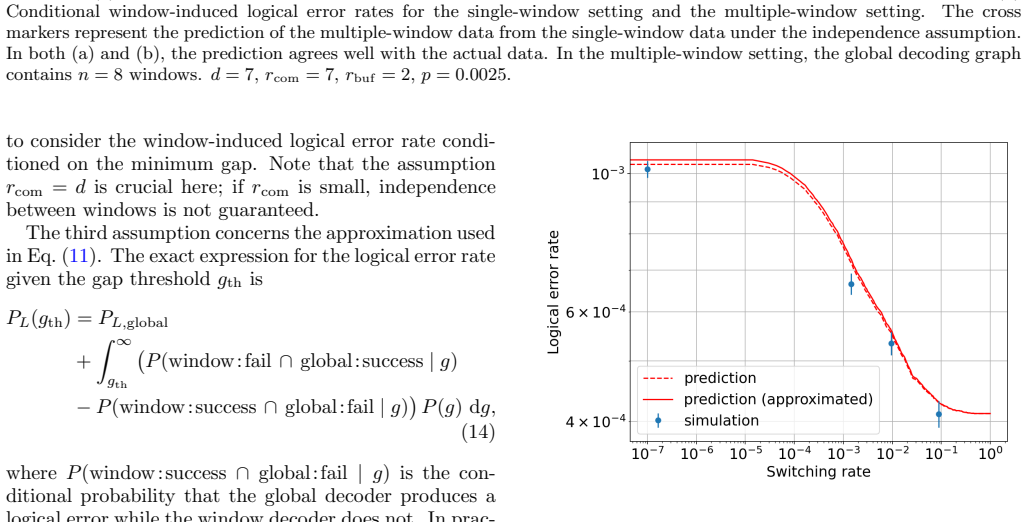
window:fail∩ global:success
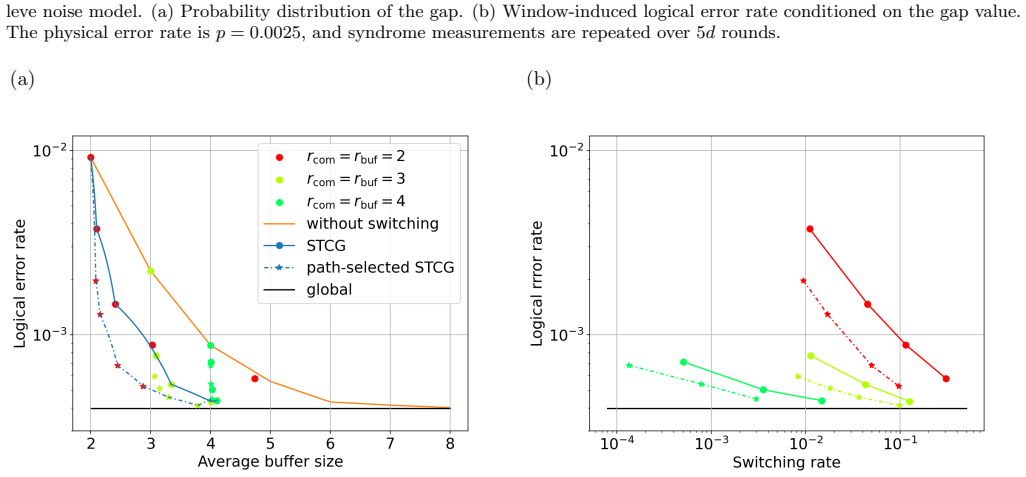
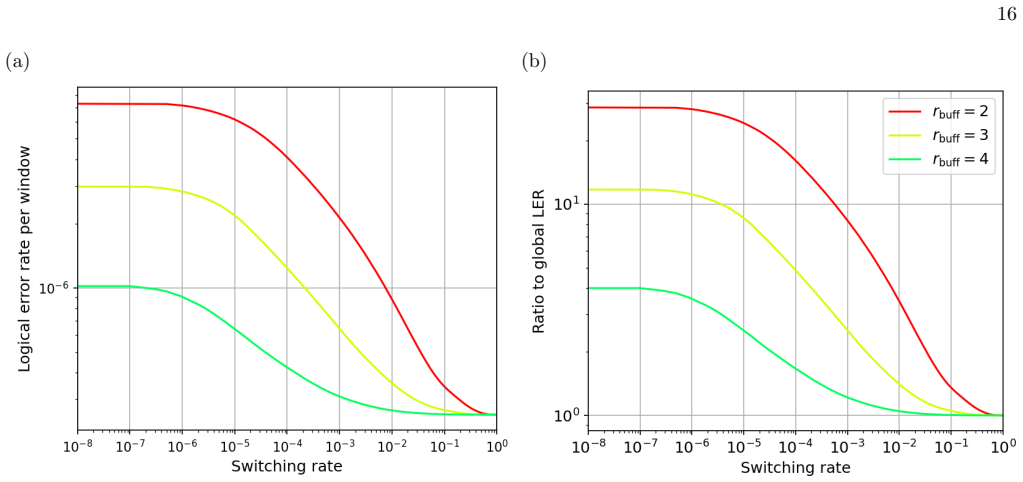
Performance of Switching We also perform adaptive sliding window decoding on the surface code of the code distanced= 11 under circuit- level noise with the physical error ratep= 0.0025. Fig- ure 13 (a) shows the logical error rate as a function of the average buffer size, and Fig. 13 (b) shows the logi- cal error rate as a function of the switching rate. ...
-
[12]
Kitaev, Fault-tolerant quantum computation by anyons, Annals of Physics303, 2 (2003)
A. Kitaev, Fault-tolerant quantum computation by anyons, Annals of Physics303, 2 (2003)
2003
-
[13]
S. B. Bravyi and A. Y. Kitaev, Quantum codes on a lattice with boundary (1998), arXiv:quant-ph/9811052
work page internal anchor Pith review Pith/arXiv arXiv 1998
-
[14]
E. Dennis, A. Kitaev, A. Landahl, and J. Preskill, Topological quantum memory, Jour- nal of Mathematical Physics43, 4452 (2002), https://doi.org/10.1063/1.1499754
-
[15]
Krinner, N
S. Krinner, N. Lacroix, A. Remm, A. Di Paolo, E. Genois, C. Leroux, C. Hellings, S. Lazar, F. Swiadek, J. Her- rmann, G. J. Norris, C. K. Andersen, M. M¨ uller, A. Blais, C. Eichler, and A. Wallraff, Realizing repeated quantum error correction in a distance-three surface code, Nature 605, 669 (2022)
2022
-
[16]
Suppressing quantum errors by scaling a surface code log- ical qubit, Nature614, 676 (2023)
2023
-
[17]
Quantum error correction below the surface code thresh- old, Nature638, 920 (2025)
2025
-
[18]
Horsman, A
C. Horsman, A. G. Fowler, S. Devitt, and R. V. Meter, Surface code quantum computing by lattice surgery, New Journal of Physics14, 123011 (2012)
2012
-
[19]
Litinski, A Game of Surface Codes: Large-Scale Quan- tum Computing with Lattice Surgery, Quantum3, 128 (2019)
D. Litinski, A Game of Surface Codes: Large-Scale Quan- tum Computing with Lattice Surgery, Quantum3, 128 (2019)
2019
-
[20]
deMarti iOlius, P
A. deMarti iOlius, P. Fuentes, R. Or´ us, P. M. Crespo, and J. Etxezarreta Martinez, Decoding algorithms for surface codes, Quantum8, 1498 (2024)
2024
-
[21]
Battistel, C
F. Battistel, C. Chamberland, K. Johar, R. W. J. Over- water, F. Sebastiano, L. Skoric, Y. Ueno, and M. Usman, Real-time decoding for fault-tolerant quantum comput- ing: progress, challenges and outlook, Nano Futures7, 032003 (2023)
2023
-
[22]
B. M. Terhal, Quantum error correction for quantum memories, Rev. Mod. Phys.87, 307 (2015)
2015
-
[23]
H. Bomb´ ın, C. Dawson, Y.-H. Liu, N. Nickerson, F. Pastawski, and S. Roberts, Modular decoding: par- allelizable real-time decoding for quantum computers (2023), arXiv:2303.04846 [quant-ph]
-
[24]
Skoric, D
L. Skoric, D. E. Browne, K. M. Barnes, N. I. Gille- spie, and E. T. Campbell, Parallel window decoding en- ables scalable fault tolerant quantum computation, Na- ture Communications14, 7040 (2023)
2023
-
[25]
X. Tan, F. Zhang, R. Chao, Y. Shi, and J. Chen, Scalable surface-code decoders with parallelization in time, PRX Quantum4, 040344 (2023)
2023
-
[26]
Fuhui Lin, E
S. Fuhui Lin, E. C. Peterson, K. Sankar, and P. Sivarajah, Spatially parallel decoding for multi-qubit lattice surgery, Quantum Science and Technology10, 035007 (2025)
2025
-
[27]
N. Liyanage, Y. Wu, E. Houghton, and L. Zhong, Network-integrated decoding system for real-time quan- tum error correction with lattice surgery (2025), arXiv:2504.11805 [quant-ph]
-
[28]
J. Viszlai, J. D. Chadwick, S. Joshi, G. S. Ravi, Y. Li, and F. T. Chong, Predictive window decoding for fault- tolerant quantum programs (2024), arXiv:2412.05115 [quant-ph]
-
[29]
Chan, Snowflake: A distributed streaming decoder, Quantum10, 2033 (2026)
T. Chan, Snowflake: A distributed streaming decoder, Quantum10, 2033 (2026)
2033
-
[30]
Hutter, J
A. Hutter, J. R. Wootton, and D. Loss, Efficient markov chain monte carlo algorithm for the surface code, Phys. Rev. A89, 022326 (2014)
2014
-
[31]
Bomb´ ın, M
H. Bomb´ ın, M. Pant, S. Roberts, and K. I. Seetharam, Fault-tolerant postselection for low-overhead magic state preparation, PRX Quantum5, 010302 (2024)
2024
-
[32]
Gidney, M
C. Gidney, M. Newman, P. Brooks, and C. Jones, Yoked surface codes, Nature Communications16, 4498 (2025)
2025
-
[33]
N. Meister, C. A. Pattison, and J. Preskill, Effi- cient soft-output decoders for the surface code (2024), arXiv:2405.07433 [quant-ph]
- [34]
- [35]
- [36]
- [37]
-
[38]
Magic state cultivation: growing T states as cheap as CNOT gates
C. Gidney, N. Shutty, and C. Jones, Magic state culti- vation: growing t states as cheap as cnot gates (2024), arXiv:2409.17595 [quant-ph]
work page internal anchor Pith review Pith/arXiv arXiv 2024
-
[39]
S. C. Smith, B. J. Brown, and S. D. Bartlett, Mitigating errors in logical qubits, Communications Physics7, 386 (2024)
2024
-
[40]
M. Dinc˘ a, T. Chan, and S. C. Benjamin, Error mitiga- tion for logical circuits using decoder confidence, arXiv preprint arXiv:2512.15689 (2025)
- [41]
-
[42]
S. Sunami, Y. Hirano, T. Hinokuma, and H. Yamasaki, Entanglement boosting: Low-volume logical bell pair preparation for distributed fault-tolerant quantum com- putation, arXiv preprint arXiv:2511.10729 (2025)
work page internal anchor Pith review Pith/arXiv arXiv 2025
-
[43]
Y. Akahoshi, R. Toshio, J. Fujisaki, H. Oshima, S. Sato, and K. Fujii, Runtime reduction in lattice surgery utiliz- ing time-like soft information (2025), arXiv:2510.21149 [quant-ph]
-
[44]
G. Kishony and A. Fowler, Surface code off-the-hook: diagonal syndrome-extraction scheduling, arXiv preprint arXiv:2602.09099 (2026)
-
[45]
Y. Hirai, S. Ikari, Y. Ueno, and Y. Suzuki, No more hooks in the surface code: Distance-preserving syndrome ex- traction for arbitrary layouts at minimum depth, arXiv preprint arXiv:2603.01628 (2026)
work page internal anchor Pith review Pith/arXiv arXiv 2026
-
[46]
Edmonds, Paths, trees, and flowers, Canadian Journal of Mathematics17, 449–467 (1965)
J. Edmonds, Paths, trees, and flowers, Canadian Journal of Mathematics17, 449–467 (1965)
1965
-
[47]
Wu and L
Y. Wu and L. Zhong, Fusion blossom: Fast mwpm de- coders for qec, in2023 IEEE International Conference on Quantum Computing and Engineering (QCE), Vol. 1 (IEEE, 2023) pp. 928–938
2023
-
[48]
Higgott and C
O. Higgott and C. Gidney, Sparse Blossom: correcting a million errors per core second with minimum-weight matching, Quantum9, 1600 (2025)
2025
-
[49]
A. G. Fowler, Optimal complexity correction of cor- related errors in the surface code, arXiv preprint arXiv:1310.0863 (2013)
work page internal anchor Pith review Pith/arXiv arXiv 2013
-
[50]
Delfosse and J.-P
N. Delfosse and J.-P. Tillich, A decoding algorithm for 22 css codes using the x/z correlations, in2014 IEEE In- ternational Symposium on Information Theory(IEEE,
-
[51]
Delfosse and N
N. Delfosse and N. H. Nickerson, Almost-linear time de- coding algorithm for topological codes, Quantum5, 595 (2021)
2021
-
[52]
Liyanage, Y
N. Liyanage, Y. Wu, S. Tagare, and L. Zhong, Fpga- based distributed union-find decoder for surface codes, IEEE Transactions on Quantum Engineering5, 1 (2024)
2024
-
[53]
Higgott, T
O. Higgott, T. C. Bohdanowicz, A. Kubica, S. T. Flam- mia, and E. T. Campbell, Improved decoding of circuit noise and fragile boundaries of tailored surface codes, Phys. Rev. X13, 031007 (2023)
2023
-
[54]
Bausch, A
J. Bausch, A. W. Senior, F. J. H. Heras, T. Edlich, A. Davies, M. Newman, C. Jones, K. Satzinger, M. Y. Niu, S. Blackwell, G. Holland, D. Kafri, J. Atalaya, C. Gidney, D. Hassabis, S. Boixo, H. Neven, and P. Kohli, Learning high-accuracy error decoding for quantum pro- cessors, Nature635, 834 (2024)
2024
-
[55]
O. Higgott, Pymatching: A python package for de- coding quantum codes with minimum-weight perfect matching, ACM Transactions on Quantum Computing 3, 10.1145/3505637 (2022)
- [56]
-
[57]
Gidney, Stim: a fast stabilizer circuit simulator, Quan- tum5, 497 (2021)
C. Gidney, Stim: a fast stabilizer circuit simulator, Quan- tum5, 497 (2021)
2021
-
[58]
A. G. Fowler, M. Mariantoni, J. M. Martinis, and A. N. Cleland, Surface codes: Towards practical large-scale quantum computation, Phys. Rev. A86, 032324 (2012)
2012
-
[59]
ADaPT: Adaptive-window Decoding for Practical fault-Tolerance
T. Oberoi, J. Viszlai, and F. T. Chong, Adapt: Adaptive- window decoding for practical fault-tolerance, arXiv preprint arXiv:2605.01149 (2026)
work page internal anchor Pith review Pith/arXiv arXiv 2026
discussion (0)
Sign in with ORCID, Apple, or X to comment. Anyone can read and Pith papers without signing in.