MindGap: A Conversational AI Framework for Upstream Neuroplastic Intervention in Post-Traumatic Stress Disorder
Pith reviewed 2026-06-30 20:41 UTC · model grok-4.3
The pith
MindGap uses on-device AI to guide PTSD patients through three layers of observation at the feeling tone gap for upstream pathway dissolution.
A machine-rendered reading of the paper's core claim, the machinery that carries it, and where it could break.
Core claim
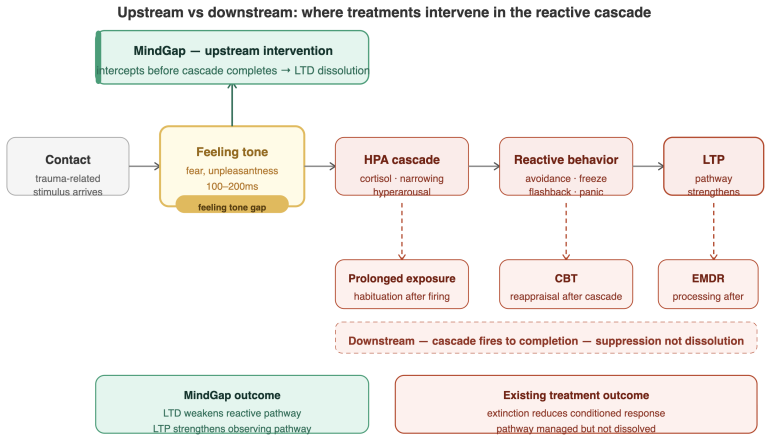
MindGap is a privacy-preserving on-device conversational AI framework that delivers structured neuroplastic rehabilitation for PTSD through the practice of dependent origination, guiding patients through three progressive layers of observation at the feeling tone gap to produce genuine upstream dissolution of reactive pathways rather than downstream suppression.
What carries the argument
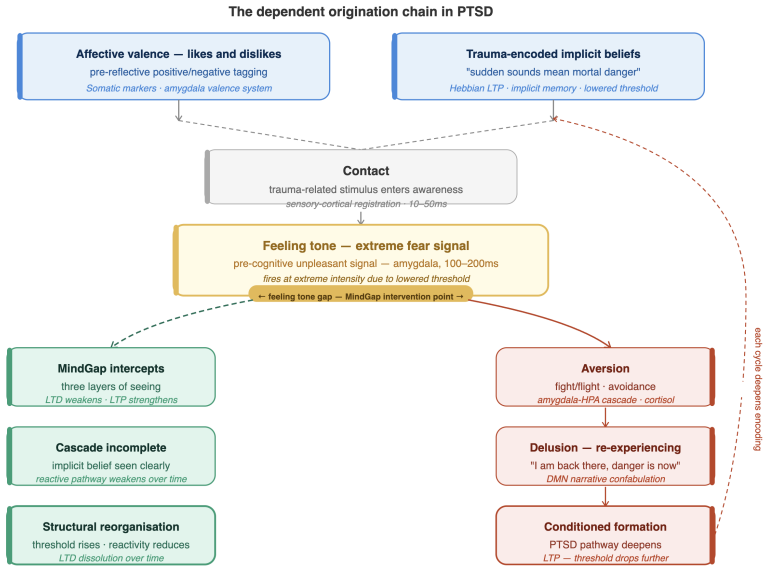
The feeling tone gap as the site between pre-cognitive affective signal and reactive elaboration, addressed via three layers of observation drawn from dependent origination.
Load-bearing premise
The assumption that structured practice of dependent origination delivered via a fine-tuned on-device LLM will produce measurable long-term depression of amygdala-HPA pathways and genuine upstream neural reorganisation rather than merely teaching coping skills.
What would settle it
A controlled study measuring amygdala reactivity via fMRI before and after months of MindGap use that finds no reduction in reactivity or PTSD symptoms compared to a matched control group receiving standard downstream therapy.
Figures
read the original abstract
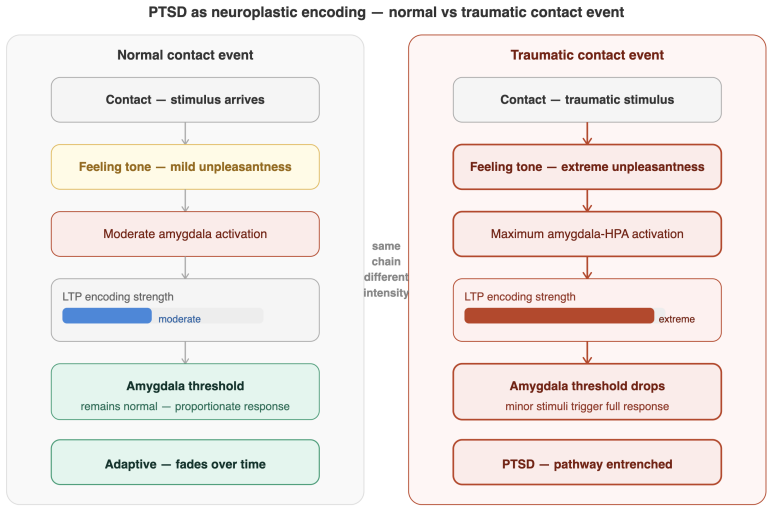
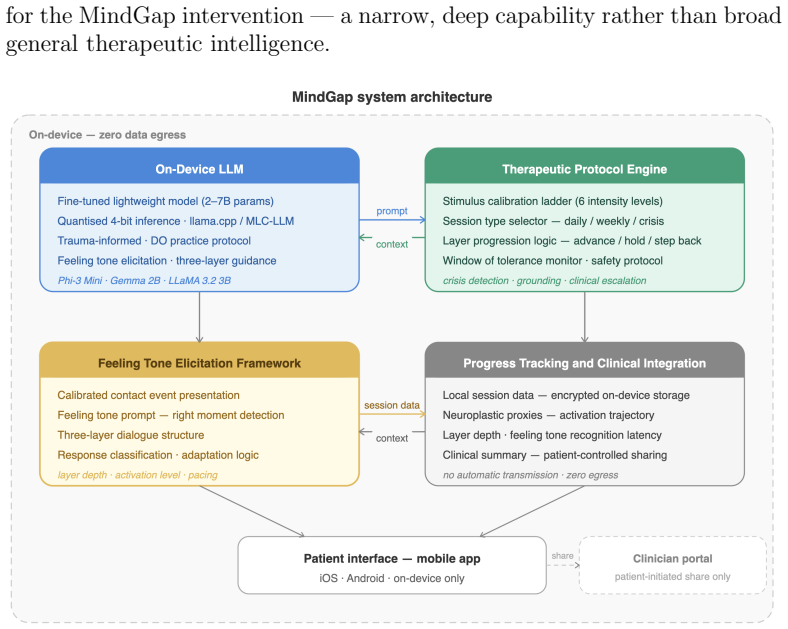
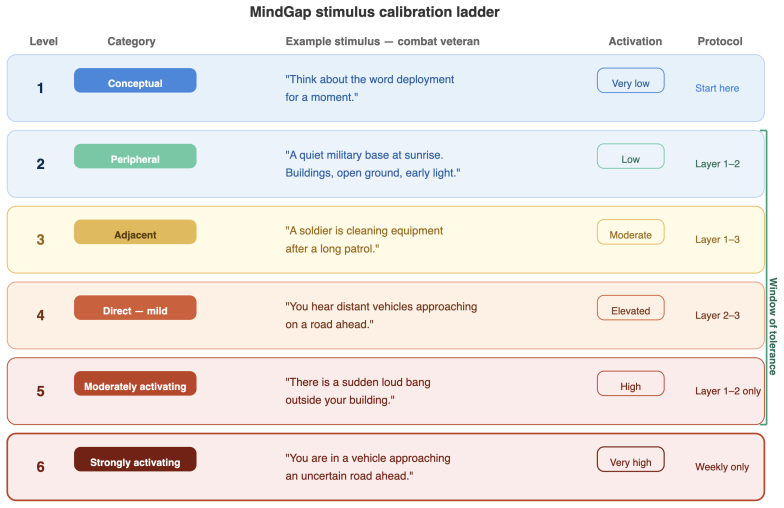
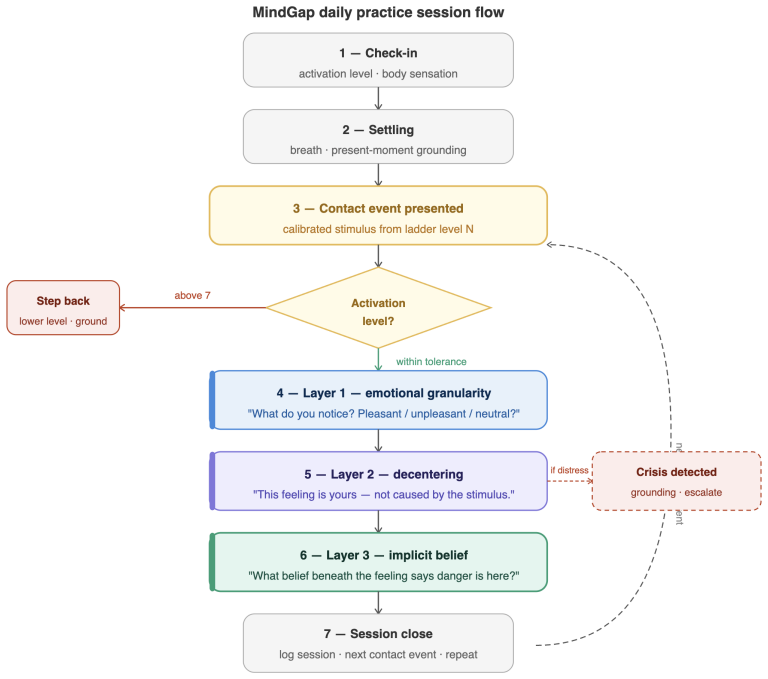
Post-Traumatic Stress Disorder (PTSD) is fundamentally a neuroplastic problem traumatic contact events encode over-reactive neural pathways through Hebbian long-term potentiation, producing hair-triggered amygdala-HPA stress cascades that fire before conscious awareness can intercept them. Existing therapeutic approaches, prolonged exposure, EMDR, cognitive behavioural therapy, operate predominantly downstream of the reactive cascade, teaching patients to tolerate or reframe distress after it has arisen. While clinically valuable, these suppression-based approaches do not produce the upstream pathway dissolution that constitutes lasting structural neural reorganisation. This paper proposes MindGap, a privacy-preserving on-device conversational AI framework that delivers structured neuroplastic rehabilitation for PTSD through the practice of dependent origination, a Buddhist psychological framework that identifies the precise moment between the pre-cognitive affective signal and the reactive elaboration that follows as the site of therapeutic intervention. MindGap guides patients through three progressive layers of observation at this feeling tone gap: noticing the bare affective signal before reactive elaboration, recognising it as self-arising rather than caused by the stimulus, and recognising the conditioned implicit belief beneath the feeling. Each layer corresponds to progressively deeper prefrontal regulatory engagement and progressively deeper long-term depression-mediated weakening of the reactive pathway, producing genuine upstream dissolution rather than downstream suppression. Running entirely on-device with no data egress, MindGap delivers daily calibrated exposure sessions through a fine-tuned lightweight large language model, making it deployable in sensitive clinical and military contexts where cloud-based solutions are not permitted.
Editorial analysis
A structured set of objections, weighed in public.
Referee Report
Summary. The manuscript proposes MindGap, a privacy-preserving on-device conversational AI framework that delivers structured practice of dependent origination to PTSD patients via a fine-tuned lightweight LLM. It claims this guides users through three progressive layers of observation at the 'feeling tone gap' (noticing the bare affective signal, recognizing it as self-arising, and recognizing the conditioned implicit belief), each producing progressively deeper prefrontal engagement and long-term depression-mediated weakening of amygdala-HPA reactive pathways for genuine upstream neural dissolution, unlike downstream suppression in existing therapies such as CBT or exposure.
Significance. If the claimed mapping from LLM-guided conversational practice to measurable LTD and structural reorganization in PTSD-relevant circuits were demonstrated, the framework would represent a significant advance in scalable, privacy-preserving neuroplastic interventions. The on-device constraint is a clear practical strength for clinical and military settings.
major comments (2)
- [Abstract] Abstract: The assertion that the three layers 'correspond to progressively deeper prefrontal regulatory engagement and progressively deeper long-term depression-mediated weakening of the reactive pathway, producing genuine upstream dissolution' is presented without any cited neuroscientific literature, mechanistic model, or proposed biomarker protocol linking the specific practices to amygdala-HPA LTD. This untested causal chain is load-bearing for the paper's central therapeutic claim.
- [Abstract] Abstract, final paragraph: No details are supplied on the fine-tuning procedure, dialogue structures, or fidelity safeguards for the lightweight LLM to deliver the three layers without conversational drift, nor on how 'daily calibrated exposure sessions' would be implemented or evaluated on-device without data egress or external validation.
Simulated Author's Rebuttal
We thank the referee for the constructive feedback highlighting areas where the manuscript's claims and implementation details require clarification and support. We address each major comment below and will incorporate revisions to improve rigor while preserving the conceptual nature of the proposal.
read point-by-point responses
-
Referee: [Abstract] Abstract: The assertion that the three layers 'correspond to progressively deeper prefrontal regulatory engagement and progressively deeper long-term depression-mediated weakening of the reactive pathway, producing genuine upstream dissolution' is presented without any cited neuroscientific literature, mechanistic model, or proposed biomarker protocol linking the specific practices to amygdala-HPA LTD. This untested causal chain is load-bearing for the paper's central therapeutic claim.
Authors: We agree the abstract states the mechanistic mapping without supporting citations or a biomarker protocol, making the causal chain appear stronger than the evidence provided. The manuscript is a conceptual framework proposal rather than an empirical study, drawing on general principles of Hebbian plasticity and prefrontal-amygdala dynamics. In revision we will (1) add citations to established literature on long-term depression in fear extinction circuits and mindfulness-related prefrontal engagement, (2) include a simple mechanistic diagram, and (3) explicitly frame the three-layer progression as a testable hypothesis with an outline of potential future biomarker measures (e.g., local field potential or fMRI protocols). This revision will qualify the therapeutic claim appropriately. revision: yes
-
Referee: [Abstract] Abstract, final paragraph: No details are supplied on the fine-tuning procedure, dialogue structures, or fidelity safeguards for the lightweight LLM to deliver the three layers without conversational drift, nor on how 'daily calibrated exposure sessions' would be implemented or evaluated on-device without data egress or external validation.
Authors: The abstract is a high-level summary and the current manuscript provides only architectural overviews rather than concrete implementation specifications. We acknowledge this gap limits reproducibility and deployment feasibility. In the revised version we will add a dedicated implementation subsection describing: synthetic dialogue datasets grounded in dependent origination scripts, parameter-efficient fine-tuning for on-device models, prompt-engineering and output-filtering safeguards against layer drift, and fully local session calibration using on-device completion metrics and self-report scales with no external data transfer. This will directly address the referee's concerns about fidelity and on-device operation. revision: yes
Circularity Check
No circularity: framework proposal contains no derivations, equations, or fitted parameters that reduce to inputs.
full rationale
The manuscript is a descriptive proposal for an on-device LLM framework implementing dependent origination practices for PTSD. It asserts that three observation layers produce progressively deeper prefrontal engagement and LTD-mediated pathway weakening, but supplies no equations, parameter fits, or derivation chain. No self-citations are used to justify a uniqueness theorem or ansatz; the text does not rename known results or call fitted quantities predictions. The central claim is presented as a hypothesis requiring future empirical validation rather than a result derived from prior steps within the paper. This matches the default case of a self-contained non-mathematical proposal with score 0.
Axiom & Free-Parameter Ledger
axioms (2)
- domain assumption Traumatic contact events encode over-reactive neural pathways through Hebbian long-term potentiation, producing hair-triggered amygdala-HPA stress cascades that fire before conscious awareness.
- domain assumption The precise moment between the pre-cognitive affective signal and the reactive elaboration is the site where upstream pathway dissolution can occur.
invented entities (1)
-
MindGap framework with three observation layers
no independent evidence
Reference graph
Works this paper leans on
-
[1]
R. C. Kessler, et al., Lifetime prevalence and age-of-onset distributions of DSM-IV disorders in the National Comorbidity Survey Replication, Archives of General Psychiatry 62 (2005) 593–602
2005
-
[2]
J. I. Bisson, et al., Post-traumatic stress disorder, BMJ 351 (2015)
2015
-
[3]
R. K. Pitman, et al., Biological studies of post-traumatic stress disorder, Nature Reviews Neuroscience 13 (2012) 769–787
2012
-
[4]
Liberzon, J
I. Liberzon, J. L. Abelson, Context processing and the neuroscience of psychiatric disorders, Neuron 87 (2015) 486–503
2015
-
[5]
D. O. Hebb, The Organization of Behavior: A Neuropsychological The- ory, Wiley, New York, 1949
1949
-
[6]
A. L. Mahan, K. J. Ressler, Fear conditioning, synaptic plasticity and the amygdala, Trends in Neurosciences 35 (2012) 24–35. 42
2012
-
[7]
A. F. T. Arnsten, Stress signalling pathways that impair prefrontal cor- tex structure and function, Nature Reviews Neuroscience 10 (6) (2009) 410–422
2009
-
[8]
R. C. Malenka, M. F. Bear, LTP and LTD: An embarrassment of riches, Neuron 44 (1) (2004) 5–21
2004
-
[9]
Citri, R
A. Citri, R. C. Malenka, Synaptic plasticity: Multiple forms, functions, and mechanisms, Neuropsychopharmacology 33 (1) (2008) 18–41
2008
-
[10]
E. B. Foa, et al., Prolonged exposure therapy for PTSD, Oxford Uni- versity Press (2007)
2007
-
[11]
Shapiro, Eye movement desensitization and reprocessing, Guilford Press (2001)
F. Shapiro, Eye movement desensitization and reprocessing, Guilford Press (2001)
2001
-
[12]
Ehlers, D
A. Ehlers, D. M. Clark, A cognitive model of posttraumatic stress dis- order, Behaviour Research and Therapy 38 (2000) 319–345
2000
-
[13]
Department of Veterans Affairs, PTSD: National Center for PTSD (2017)
U.S. Department of Veterans Affairs, PTSD: National Center for PTSD (2017). URLhttps://www.ptsd.va.gov
2017
-
[14]
M. G. Craske, et al., Maximizing exposure therapy, Behaviour Research and Therapy 58 (2014) 10–23
2014
-
[15]
An¯ alayo, Satipat.t.h¯ ana: The Direct Path to Realization, Windhorse Publications, Birmingham, 2003
B. An¯ alayo, Satipat.t.h¯ ana: The Direct Path to Realization, Windhorse Publications, Birmingham, 2003
2003
-
[16]
J. E. LeDoux, The Emotional Brain: The Mysterious Underpinnings of Emotional Life, Simon and Schuster, New York, 1996
1996
-
[17]
K. N. Ochsner, J. J. Gross, The cognitive control of emotion, Trends in Cognitive Sciences 9 (5) (2005) 242–249
2005
-
[18]
B. K. H¨ olzel, J. Carmody, M. Vangel, C. Congleton, S. M. Yerramsetti, T. Gard, S. W. Lazar, Mindfulness practice leads to increases in regional brain gray matter density, Psychiatry Research: Neuroimaging 191 (1) (2011) 36–43
2011
-
[19]
R. J. Davidson, S. Begley, The Emotional Life of Your Brain, Hudson Street Press, New York, 2012. 43
2012
-
[20]
E. Bandara, R. Gore, P. Foytik, S. Shetty, R. Mukkamala, A. Rahman, X. Liang, S. H. Bouk, A. Hass, S. Rajapakse, et al., A practical guide for designing, developing, and deploying production-grade agentic ai work- flows, arXiv preprint arXiv:2512.08769 (2025)
-
[21]
E. Bandara, R. Gore, S. Shetty, S. Rajapakse, I. Kularathna, P. Karunarathna, R. Mukkamala, P. Foytik, S. H. Bouk, A. Rahman, et al., A practical guide to agentic ai transition in organizations, arXiv preprint arXiv:2602.10122 (2026)
-
[22]
G. M. Lucas, et al., It’s only a computer, Computers in Human Behavior 37 (2014) 94–100
2014
-
[23]
URLhttps://woebot.io
Woebot Health, Woebot: your mental health ally (2017). URLhttps://woebot.io
2017
-
[24]
E. Bandara, A. Hass, R. Gore, S. Shetty, R. Mukkamala, S. H. Bouk, X. Liang, N. W. Keong, K. De Zoysa, A. Withanage, et al., Astride: A security threat modeling platform for agentic-ai applications, arXiv preprint arXiv:2512.04785 (2025)
-
[25]
E. Bandara, R. Gore, A. Yarlagadda, A. H. Clayton, P. Samuel, C. K. Rhea, S. Shetty, Standardization of psychiatric diagnoses–role of fine- tuned llm consortium and openai-gpt-oss reasoning llm enabled decision support system, arXiv preprint arXiv:2510.25588 (2025)
-
[26]
L. F. Barrett, How emotions are made: The secret life of the brain (2017)
2017
-
[27]
D. M. Fresco, et al., Initial psychometric properties of the experiences questionnaire, Behavior Therapy 38 (2007) 234–246
2007
-
[28]
J. D. Teasdale, et al., Metacognitive awareness and prevention of relapse in depression, Journal of Consulting and Clinical Psychology 70 (2002) 275–287
2002
-
[29]
Bodhi, The Connected Discourses of the Buddha: A Translation of the Sam
B. Bodhi, The Connected Discourses of the Buddha: A Translation of the Sam. yutta Nik¯ aya, Wisdom Publications, Boston, 2000
2000
-
[30]
F. J. Varela, E. Thompson, E. Rosch, The Embodied Mind: Cognitive Science and Human Experience, MIT Press, Cambridge, MA, 1991. 44
1991
-
[31]
J. A. Brewer, P. D. Worhunsky, J. R. Gray, Y.-Y. Tang, J. Weber, H. Kober, Meditation experience is associated with differences in default mode network activity and connectivity, Proceedings of the National Academy of Sciences 108 (50) (2011) 20254–20259
2011
-
[32]
J. A. Brewer, H. M. Elwafi, J. H. Davis, Craving to quit: Psychological models and neurobiological mechanisms of mindfulness training as treat- ment for addictions, Psychology of Addictive Behaviors 27 (2) (2013) 366–379
2013
-
[33]
K. K. Fitzpatrick, et al., Delivering cognitive behavior therapy to young adults with symptoms of depression and anxiety using a fully automated conversational agent, JMIR Mental Health 4 (2017)
2017
-
[34]
Inkster, et al., An empathy-driven, conversational ai agent for digital mental well-being, JMIR mHealth and uHealth 6 (2018)
B. Inkster, et al., An empathy-driven, conversational ai agent for digital mental well-being, JMIR mHealth and uHealth 6 (2018)
2018
-
[35]
Skjuve, et al., My chatbot companion, Computers in Human Behav- ior 114 (2021)
M. Skjuve, et al., My chatbot companion, Computers in Human Behav- ior 114 (2021)
2021
-
[36]
A. S. Rizzo, et al., Ptsd and the virtual iraq/afghanistan system, Journal of CyberTherapy and Rehabilitation 3 (2010)
2010
-
[37]
Phi-3 Technical Report: A Highly Capable Language Model Locally on Your Phone
M. Abdin, et al., Phi-3 technical report, arXiv preprint arXiv:2404.14219 (2024)
work page internal anchor Pith review Pith/arXiv arXiv 2024
-
[38]
Gemma Team, Gemma: open models based on gemini research, arXiv preprint arXiv:2403.08295 (2024)
work page internal anchor Pith review Pith/arXiv arXiv 2024
-
[39]
A. Dubey, A. Jauhri, A. Pandey, A. Kadian, A. Al-Dahle, A. Letman, A. Mathur, A. Schelten, A. Yang, A. Fan, et al., The llama 3 herd of models, arXiv preprint arXiv:2407.21783 (2024)
work page internal anchor Pith review Pith/arXiv arXiv 2024
-
[40]
Becattini, R
M. Becattini, R. Verdecchia, E. Vicario, Sallma: A software architecture for llm-based multi-agent systems
-
[41]
Dettmers, et al., Qlora: efficient finetuning of quantized llms, NeurIPS (2023)
T. Dettmers, et al., Qlora: efficient finetuning of quantized llms, NeurIPS (2023)
2023
-
[42]
Bandara, A
E. Bandara, A. Hass, S. Shetty, R. Mukkamala, R. Gore, A. Rahman, S. H. Bouk, Deep-stride: Automated security threat modeling with 45 vision-language models, in: 2025 International Conference on Software, Telecommunications and Computer Networks (SoftCOM), 2025, pp. 1– 7
2025
-
[43]
E. Bandara, A. Gunaratna, R. Gore, A. H. Clayton, C. K. Rhea, S. Rajapakse, I. Kularathna, S. Shetty, R. Mukkamala, X. Liang, et al., Toward zero-egress psychiatric ai: On-device llm deployment for privacy-preserving mental health decision support, arXiv preprint arXiv:2604.18302 (2026)
work page internal anchor Pith review Pith/arXiv arXiv 2026
-
[44]
K. Yang, et al., Mentalllama: interpretable mental health analysis, arXiv preprint arXiv:2309.13567 (2024)
-
[45]
E. Bandara, R. Gore, S. Shetty, R. Mukkamala, C. Rhea, A. Yarlagadda, S. Kaushik, L. De Silva, A. Maznychenko, I. Sokolowska, et al., Stan- dardization of neuromuscular reflex analysis–role of fine-tuned vision- language model consortium and openai gpt-oss reasoning llm enabled decision support system, arXiv preprint arXiv:2508.12473 (2025)
-
[46]
R. B. Zajonc, Feeling and thinking: Preferences need no inferences, American Psychologist 35 (2) (1980) 151–175
1980
-
[47]
R. Gore, E. Bandara, S. Shetty, A. E. Musto, P. Rana, A. Valencia- Romero, C. Rhea, L. Tayebi, H. Richter, A. Yarlagadda, et al., Proof- of-tbi–fine-tuned vision language model consortium and openai-o3 rea- soning llm-based medical diagnosis support system for mild traumatic brain injury (tbi) prediction, arXiv preprint arXiv:2504.18671 (2025)
-
[48]
E. Bandara, T. Hewa, R. Gore, S. Shetty, R. Mukkamala, P. Foytik, A. Rahman, S. H. Bouk, X. Liang, A. Hass, et al., Towards respon- sible and explainable ai agents with consensus-driven reasoning, arXiv preprint arXiv:2512.21699 (2025)
-
[49]
A. R. Damasio, Descartes’ Error: Emotion, Reason, and the Human Brain, Putnam, New York, 1994
1994
-
[50]
E. R. Kandel, J. H. Schwartz, T. M. Jessell, S. A. Siegelbaum, A. J. Hudspeth, Principles of Neural Science, 5th Edition, McGraw-Hill, New York, 2013. 46
2013
-
[51]
M. E. Raichle, A. M. MacLeod, A. Z. Snyder, W. J. Powers, D. A. Gusnard, G. L. Shulman, A default mode of brain function, Proceedings of the National Academy of Sciences 98 (2) (2001) 676–682
2001
-
[52]
Ogden, K
P. Ogden, K. Minton, C. Pain, Trauma and the Body: A Sensorimotor Approach to Psychotherapy, W. W. Norton, 2006
2006
-
[53]
E. Bandara, A. Gunaratna, R. Gore, A. Rahman, R. Mukkamala, S. Shetty, S. Rajapakse, I. Kularathna, P. Foytik, S. H. Bouk, et al., Ai trust os–a continuous governance framework for autonomous ai ob- servability and zero-trust compliance in enterprise environments, arXiv preprint arXiv:2604.04749 (2026). 47
work page internal anchor Pith review Pith/arXiv arXiv 2026
discussion (0)
Sign in with ORCID, Apple, or X to comment. Anyone can read and Pith papers without signing in.