LLM-Enabled Automated Algorithm Design for Multiuser Fluid Antenna Communications
Pith reviewed 2026-06-30 20:30 UTC · model grok-4.3
The pith
Large language models can automatically design optimization algorithms for fluid antenna port selection that achieve near-optimal minimum SINR performance.
A machine-rendered reading of the paper's core claim, the machinery that carries it, and where it could break.
Core claim
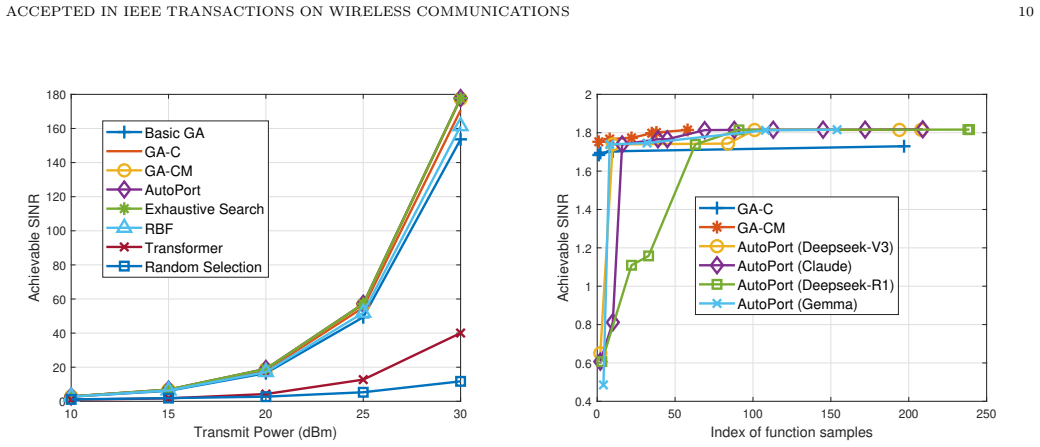
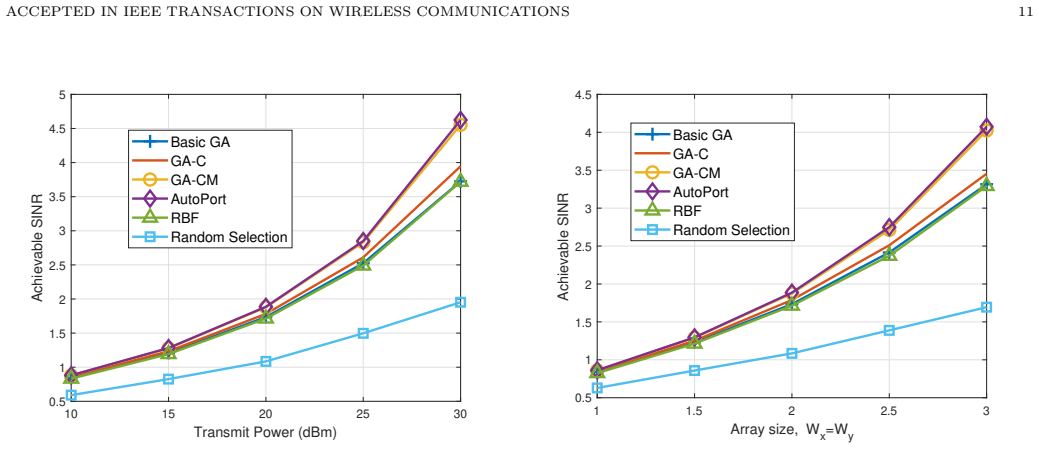
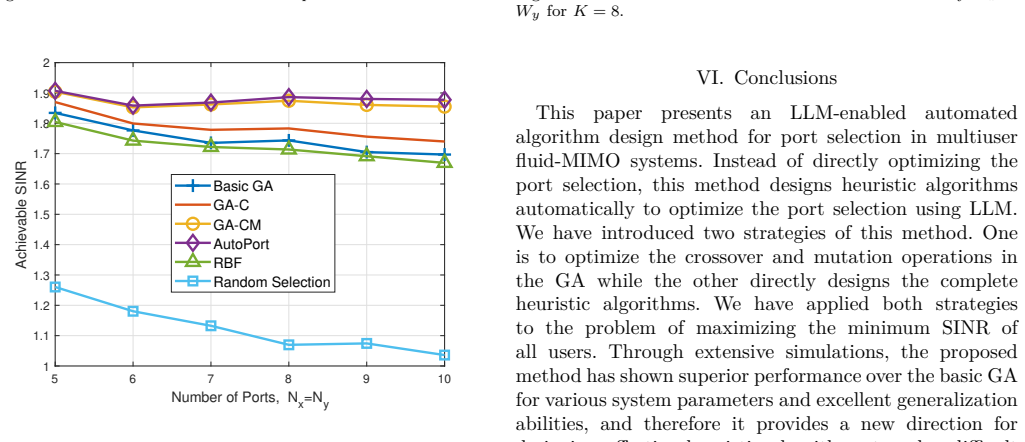
The paper claims that LLM-enabled automated algorithm design, through LLM-optimized genetic algorithm operations or the creation of the AutoPort heuristic, solves the port selection and beamforming problem to maximize minimum SINR in multiuser fluid antenna communications, yielding near-optimal performance with significant gains over conventional genetic algorithms and deep learning approaches in simulations, all without manual hyperheuristic tuning.
What carries the argument
LLM-enabled automated algorithm design, which refines genetic algorithm operations or generates the new AutoPort heuristic to address the combinatorial port selection optimization.
If this is right
- LLM-optimized genetic algorithms deliver better performance than standard genetic algorithms for the SINR maximization task.
- The LLM-generated AutoPort heuristic achieves near-optimal results on the port selection and beamforming problem.
- Both LLM strategies outperform deep learning approaches in the simulated fluid antenna scenarios.
- The algorithms require no manual hyperheuristic tuning to reach their reported performance.
Where Pith is reading between the lines
- The same LLM automation process could be applied to other combinatorial optimization problems in wireless communications such as resource allocation or scheduling.
- If the approach generalizes, it could enable on-demand algorithm adaptation for fluid antenna systems operating in varying channel conditions.
- Hardware validation experiments would be needed to confirm whether simulation gains persist when port switching introduces real-world delays or imperfections.
Load-bearing premise
That the performance gains from LLM-designed algorithms observed in simulations will hold in real fluid antenna hardware without additional manual tuning.
What would settle it
Deploying the LLM-designed algorithms on a physical fluid antenna prototype and measuring that the achieved minimum SINR falls short of near-optimal levels or shows no clear advantage over conventional genetic algorithm or deep learning baselines.
Figures
read the original abstract
Fluid antenna is a new reconfigurable antenna technology that can dynamically adjust the positions or ports of radiating elements and therefore provides a new degree of freedom for wireless communications. However, the associated port selection is a challenging large-scale combinatorial optimization problem and difficult to solve. Existing manually designed heuristic algorithms are not only labor-intensive, but cannot achieve satisfactory performance. In this paper, we propose a novel paradigm that leverages large language models (LLMs) for automated design of optimization algorithms for fluid antenna systems without manual hyperheuristic tuning. Specifically, we study the problem of maximizing the minimum signal-to-interference-plus-noise ratio (SINR) in the downlink to ensure fairness among users by optimizing port selection and beamforming. We investigate two LLM-enabled algorithm optimization strategies. The first is to optimize the crossover and mutation operations to enhance the performance of the well-known genetic algorithm and the second is to design AutoPort, a new heuristic from scratch by LLM, to solve the optimization problem. Simulation results verify that the proposed method can achieve near-optimal performance and significant improvement over the conventional genetic algorithm and the deep learning approach.
Editorial analysis
A structured set of objections, weighed in public.
Referee Report
Summary. The paper proposes leveraging large language models (LLMs) to automate the design of optimization algorithms for port selection in multiuser fluid antenna systems, with the goal of maximizing the minimum SINR under downlink beamforming. Two LLM-enabled strategies are presented: (1) optimizing the crossover and mutation operators of a genetic algorithm (GA), and (2) generating a new heuristic called AutoPort from scratch. Simulation results are claimed to demonstrate near-optimal performance with significant gains over conventional GA and a deep learning baseline.
Significance. If the empirical claims hold under reproducible conditions, the work would introduce a potentially impactful paradigm for automated heuristic design in wireless communications, reducing reliance on manual algorithm engineering for large-scale combinatorial problems such as fluid-antenna port selection. The absence of machine-checked proofs or parameter-free derivations means the contribution rests entirely on the simulation evidence; stronger statistical validation would be needed to elevate its significance.
major comments (3)
- [Methodology (inferred from abstract description of the two strategies)] The manuscript provides no explicit description of the LLM prompts, the precise optimization procedure for GA operators, or the generation process for AutoPort (including any hyperheuristic elements), rendering the central claim of 'LLM-enabled automated design without manual tuning' unverifiable and non-reproducible from the given information.
- [Simulation Results] Simulation results are presented without reported details on the number of independent runs, statistical significance tests, error bars, or sensitivity analysis to prompt variations or random seeds; this undermines the claim of 'near-optimal performance and significant improvement' over baselines.
- [Problem Formulation and Algorithm Design] No complexity analysis, scaling behavior with number of ports/users, or discussion of how the LLM-generated algorithms avoid exponential search in the large-scale combinatorial port-selection problem is provided, leaving open whether the reported gains are artifacts of the specific simulation setups.
minor comments (2)
- [Abstract] The abstract states the problem is 'difficult to solve' with existing heuristics but does not cite specific prior fluid-antenna port-selection references or quantify the performance gap that motivates the LLM approach.
- [Introduction / System Model] Notation for the min-SINR objective, port-selection variables, and beamforming vectors should be introduced with explicit mathematical definitions early in the paper to aid clarity.
Simulated Author's Rebuttal
We thank the referee for the constructive comments, which highlight important aspects for improving the clarity, reproducibility, and rigor of our work on LLM-enabled automated algorithm design for fluid antenna systems. We address each major comment point by point below, agreeing where revisions are warranted to strengthen the manuscript while defending the core contributions based on the presented simulation evidence.
read point-by-point responses
-
Referee: The manuscript provides no explicit description of the LLM prompts, the precise optimization procedure for GA operators, or the generation process for AutoPort (including any hyperheuristic elements), rendering the central claim of 'LLM-enabled automated design without manual tuning' unverifiable and non-reproducible from the given information.
Authors: We acknowledge that the absence of explicit LLM prompts and procedural details limits reproducibility. In the revised manuscript, we will add a dedicated appendix containing the exact prompts employed for GA operator optimization and AutoPort generation, along with a precise description of the iterative optimization procedure and any hyperheuristic elements. This addition will enable verification of the automated design process while maintaining that the approach requires no manual hyperheuristic tuning beyond the problem statement provided to the LLM. revision: yes
-
Referee: Simulation results are presented without reported details on the number of independent runs, statistical significance tests, error bars, or sensitivity analysis to prompt variations or random seeds; this undermines the claim of 'near-optimal performance and significant improvement' over baselines.
Authors: We agree that enhanced statistical reporting is essential to substantiate the performance claims. The revised version will report averages and standard deviations over 100 independent runs with varied random seeds, include error bars on all performance plots, conduct paired t-tests for significance against baselines, and incorporate sensitivity analysis to prompt variations. These updates will provide robust support for the near-optimal performance and improvements observed. revision: yes
-
Referee: No complexity analysis, scaling behavior with number of ports/users, or discussion of how the LLM-generated algorithms avoid exponential search in the large-scale combinatorial port-selection problem is provided, leaving open whether the reported gains are artifacts of the specific simulation setups.
Authors: We will incorporate a new subsection on computational complexity and scaling. The LLM-generated heuristics exhibit per-iteration complexity that scales linearly with the number of ports and users due to fitness evaluations, enabling practical solutions for instances where exhaustive search is infeasible. Scaling curves from additional simulations with varying port and user counts will be added. While a rigorous theoretical guarantee on avoiding exponential search is not feasible (as the behavior emerges from LLM knowledge), we will discuss how the guided search mitigates this in practice and note that results are empirical for the evaluated setups. revision: partial
Circularity Check
No significant circularity; empirical simulation claims are independent of inputs
full rationale
The paper presents an empirical methodology: LLMs are prompted to generate or refine algorithmic operators (crossover/mutation for GA, or a new heuristic AutoPort), which are then evaluated via simulation on min-SINR port-selection instances. Performance is reported as direct numerical comparisons against conventional GA and a DL baseline. No equations, fitted parameters, or predictions are defined in terms of the target metrics; the central claims rest on external simulation outcomes rather than self-referential constructions or load-bearing self-citations. The derivation chain is therefore self-contained against the reported benchmarks.
Axiom & Free-Parameter Ledger
Reference graph
Works this paper leans on
-
[1]
Y. Shen et al., “Design and implementation of mmWave surface wave enabled fluid antennas and experimental results for fluid antenna multiple access,” arXiv preprint, arXiv:2405.09663, May 2024
-
[2]
A novel pixel-based reconfigurable antenna applied in fluid antenna systems with high switching speed,
J. Zhang et al., “A novel pixel-based reconfigurable antenna applied in fluid antenna systems with high switching speed,” IEEE Open J. Antennas & Propag., vol. 6, no. 1, pp. 212-228, Feb. 2025
2025
-
[3]
Programmable meta-fluid antenna for spatial multiplexing in fast fluctuating radio channels,
B. Liu, K.-F. Tong, K. K. Wong, C.-B. Chae, and H. Wong, “Programmable meta-fluid antenna for spatial multiplexing in fast fluctuating radio channels,” Optics Express, vol. 33, no. 13, pp. 28898–28915, 2025. ACCEPTED IN IEEE TRANSACTIONS ON WIRELESS COMMUNICATIONS 13
2025
-
[4]
Fluid antenna systems,
K.-K. Wong, A. Shojaeifard, K.-F. Tong, and Y. Zhang, “Fluid antenna systems,” IEEE Trans. Wireless Commun., vol. 20, no. 3, pp. 1950–1962, Mar. 2021
1950
-
[5]
Bruce Lee-inspired fluid antenna system: Six research topics and the potentials for 6G,
K.-K. Wong, K.-F. Tong, Y. Shen, Y. Chen, and Y. Zhang, “Bruce Lee-inspired fluid antenna system: Six research topics and the potentials for 6G,” Frontiers in Communications and Networks, vol. 3, pp. 1–31, Mar. 2022
2022
-
[6]
Fluid antenna system: New insights on outage probability and diversity gain,
W. K. New, K.-K. Wong, H. Xu, K.-F. Tong, and C.-B. Chae, “Fluid antenna system: New insights on outage probability and diversity gain,” IEEE Trans. Wireless Commun., vol. 23, no. 1, pp. 128–140, Jan. 2024
2024
-
[7]
An information-theoretic characterization of MIMO- F AS: Optimization, diversity-multiplexing tradeoff andq-outage capacity,
W. K. New, K.-K. Wong, H. Xu, K. F. Tong and C.-B. Chae, “An information-theoretic characterization of MIMO- F AS: Optimization, diversity-multiplexing tradeoff andq-outage capacity,” IEEE Trans. Wireless Commun., vol. 23, no. 6, pp. 5541–5556, Jun. 2024
2024
-
[8]
Port selection for fluid antenna systems,
Z. Chai, K.-K. Wong, K.-F. Tong, Y. Chen and Y. Zhang, “Port selection for fluid antenna systems,” IEEE Commun. Lett., vol. 26, no. 5, pp. 1180-1184, May 2022
2022
-
[9]
Online learning-induced port selection for fluid antenna in dynamic channel environment,
J. Zou, S. Sun and C. Wang, “Online learning-induced port selection for fluid antenna in dynamic channel environment,” IEEE Wireless Commun. Lett., vol. 13, no. 2, pp. 313-317, Feb. 2024
2024
-
[10]
Optimizing reconfigurable antenna MIMO systems with coherent Ising machines,
I. Krikidis, A. K. Singh and K. Jamieson, “Optimizing reconfigurable antenna MIMO systems with coherent Ising machines,” Proc. IEEE Int. Conf. on Commun. (ICC), June 2024, pp. 1-5
2024
-
[11]
Transmit and receive antenna port selection for channel capacity maximization in fluid-MIMO systems,
C. Efrem and I. Krikidis, “Transmit and receive antenna port selection for channel capacity maximization in fluid-MIMO systems,” IEEE Wireless Commun. Lett., vol. 13, no. 11, pp. 3202-3206, Nov. 2024
2024
-
[12]
Joint port selection and beamforming design for fluid antenna assisted integrated data and energy transfer,
L. Zhang, H. Yang, Y. Zhao, and J. Hu, “Joint port selection and beamforming design for fluid antenna assisted integrated data and energy transfer,” IEEE Wireless Commun. Lett., vol. 13, no. 7, pp. 1833–1837, Jul. 2024
2024
-
[13]
Fluid antenna-aided robust secure transmission for RSMA-ISAC systems,
C. Zhang, Y. Xu, S. Peng, X. Guo, X. Ou, H. Hong, D. He, and W. Zhang, “Fluid antenna-aided robust secure transmission for RSMA-ISAC systems,” arXiv preprint, arXiv:2503.05515, Mar. 2025
-
[14]
Fluid antenna system liberating multiuser MIMO for ISAC via deep reinforcement learning,
C. Wang, G. Li, K.-K. Wong, Z. Li, D. W. Kwan, and C.-B. Chae, “Fluid antenna system liberating multiuser MIMO for ISAC via deep reinforcement learning,” IEEE Trans. Wireless Commun., vol. 23, no. 9, pp. 10879–10894, Sept. 2024
2024
-
[15]
Deep learning enabled slow fluid antenna multiple access,
N. Waqar, K.-K. Wong, K.-F. Tong, A. Sharples, and Y. Zhang, “Deep learning enabled slow fluid antenna multiple access,” IEEE Commun. Lett., vol. 27, no. 3, pp. 861–865, Mar. 2023
2023
-
[16]
Graph neural network enabled fluid antenna systems: A two- stage approach,
C. He, Y. Lu, and W. Chen, B. Ai, K. -K. Wong and D. Niyato “Graph neural network enabled fluid antenna systems: A two- stage approach,” IEEE Trans. Veh. Technol., early access, doi: 10.1109/TVT.2025.3570319
-
[17]
Port- LLM: A port prediction method for fluid antenna based on large language models,
Y. Zhang, H. Yin, W. Li, E. Bjornson, M. Debbah, “Port- LLM: A port prediction method for fluid antenna based on large language models,” arXiv preprint, arXiv:2502.09857, 2025
-
[18]
C. Wang, K.-K. Wong, Z. Li, et al. “Large Language Model Empowered Design of Fluid Antenna Systems: Challenges, Frameworks, and Case Studies for 6G”, arXiv preprint arXiv:2506.14288, 2025
-
[19]
A systematic survey on large language models for algorithm design,
F. Liu et al., “A systematic survey on large language models for algorithm design,” ACM Computing Surveys, vol. 58, no. 8, pp. 1-32, Feb. 2026
2026
-
[20]
Algorithm evolution using large language model,
F. Liu, X. Tong, M. Yuan, and Q. Zhang, “Algorithm evolution using large language model,” arXiv preprint arXiv:2311.15249, 2023
-
[21]
Evolution of heuristics: Towards efficient automatic algorithm design using large language model,
F. Liu et al., “Evolution of heuristics: Towards efficient automatic algorithm design using large language model,” in Proc. Int. Conf. Machine Learning, 2024, pp. 32201–32223, Vienna, Austria, 21-27 July 2024
2024
-
[22]
Mathematical discoveries from program search with large language models,
B. Romera-Paredes et al., “Mathematical discoveries from program search with large language models,” Nature, vol. 625, no. 7995, pp. 468–475, Jan. 2024
2024
-
[23]
LLM-assisted automatic memetic algorithm for lot-streaming hybrid job shop scheduling with variable sublots,
R. Li, L. Wang, H. Sang, L. Yao, and L. Pan, “LLM-assisted automatic memetic algorithm for lot-streaming hybrid job shop scheduling with variable sublots,” IEEE Trans. Evol. Comput., early access, 2025
2025
-
[24]
Large language model-driven large neighborhood search for large-scale MILP problems,
H. Ye, H. Xu, A. Yan, and Y. Cheng, “Large language model-driven large neighborhood search for large-scale MILP problems,” in Proc. Int. Conf. Machine Learning, Vancouver, Canada, 13- 19 July 2025
2025
-
[25]
Evolve cost-aware acquisition functions using large language models,
Y. Yao, F. Liu, J. Cheng, and Q. Zhang, “Evolve cost-aware acquisition functions using large language models,” in Proc. Int. Conf. Parallel Problem Solving from Nature, 2024, pp. 374–390, Hagenberg, Austria, 14-18 Sept. 2024
2024
-
[26]
Zhang, J
H. Zhang, J. Wang, C. Wang, C. Wang, K. K. Wong, B. Wang, and C. B. Chae, “Learning-induced channel extrapolation for fluid antenna systems using asymmetric graph masked autoencoder, IEEE Wireless Communications Letters, vol. 13, no. 6, pp. 1665-1669, June 2024
2024
-
[27]
Solution of the multiuser downlink beamforming problem with individual SINR constraints,
M. Schubert and H. Boche, “Solution of the multiuser downlink beamforming problem with individual SINR constraints,” IEEE Trans. Veh. Technol., vol. 53, no. 1, pp. 18–28, Jan. 2004
2004
-
[28]
W. C. Jakes, Microwave mobile communications, Wiley, New York, 1974
1974
-
[29]
Modeling and Performance Anal- ysis for Movable Antenna Enabled Wireless Communications,
L. Zhu, W. Ma and R. Zhang, “Modeling and Performance Anal- ysis for Movable Antenna Enabled Wireless Communications,” IEEE Trans. Wireless Commun., vol. 23, no. 6, pp. 6234-6250, June 2024
2024
-
[30]
T. H. Cormen, C. E. Leiserson, R. L. Rivest, and C. Stein, Introduction to algorithms, MIT press, 2022
2022
-
[31]
The General Combinatorial Optimization Problem: Towards Automated Algorithm Design,
R. Qu, G. Kendall and N. Pillay, “The General Combinatorial Optimization Problem: Towards Automated Algorithm Design,” IEEE Computational Intelligence Magazine, vol. 15, no. 2, pp. 14-23, May 2020
2020
-
[32]
LLM4AD: Large Language Model for Algorithm Design,
“LLM4AD: Large Language Model for Algorithm Design,” https://github.com/Optima-CityU/LLM4AD
-
[33]
Lower bounds and reduction procedures for the bin packing problem. Discrete applied mathematics,
S. Martello, and P. Toth, “Lower bounds and reduction procedures for the bin packing problem. Discrete applied mathematics,”, vol. 28, no. 1, pp. 59–70, July 1990
1990
-
[34]
A probabilistic heuristic for a computationally difficult set covering problem,
T. A. Feo and M. G. C. Resende, “A probabilistic heuristic for a computationally difficult set covering problem,” Operations Research Letters, vol. 8, no. 2, pp. 67–71, April 1989
1989
-
[35]
RBFOpt: an open-source library for black-box optimization with costly function evaluations,
A. Costa, and G. Nannicini, “RBFOpt: an open-source library for black-box optimization with costly function evaluations,” Math. Prog. Comp., vol. 10, no. 1, pp. 597–629, Aug. 2018
2018
-
[36]
Attention is all you need,
A. Vaswani et al., “Attention is all you need,” in Proc. Conf. Neural Inf. Process. Syst., vol. 30, pp. 1–15, 2017
2017
-
[37]
LLM-Based Port Selection and Beamforming for Multiuser MISO With Fluid Antenna Systems,
W. Guo et al., “LLM-Based Port Selection and Beamforming for Multiuser MISO With Fluid Antenna Systems,” IEEE Transactions on Network Science and Engineering, vol. 13, pp. 4026-4042, 2026
2026
-
[38]
Hong et al., “F AS Meets OFDM: Enabling Wideband 5G NR, IEEE Transactions on Communications, vol
H. Hong et al., “F AS Meets OFDM: Enabling Wideband 5G NR, IEEE Transactions on Communications, vol. 73, no. 11, pp. 12884-12898, Nov. 2025
2025
-
[39]
UA V- Enabled Passive 6D Movable Antennas: Joint Deployment and Beamforming Optimization,
C. Liu, W. Mei, P. Wang, Y. Meng, Z. Chen and B. Ning, “UA V- Enabled Passive 6D Movable Antennas: Joint Deployment and Beamforming Optimization,” IEEE Trans. Wireless Commun., vol. 25, pp. 9765-9781, 2026
2026
-
[40]
Rotata ble antenna-empowered wireless networks: A tutorial,
B. Zheng et al., “Rotatable Antenna-Empowered Wireless Networks: A Tutorial,” https://arxiv.org/abs/2603.25559
-
[41]
6D Movable Antenna Based on User Distribution: Modeling and Optimization,
X. Shao, Q. Jiang and R. Zhang, “6D Movable Antenna Based on User Distribution: Modeling and Optimization,” IEEE Trans. Wireless Commun., vol. 24, no. 1, pp. 355-370, Jan. 2025
2025
discussion (0)
Sign in with ORCID, Apple, or X to comment. Anyone can read and Pith papers without signing in.