Fourth order correlation of baryon number and electric charge as a better magnetometer of QCD
Pith reviewed 2026-06-30 20:06 UTC · model grok-4.3
The pith
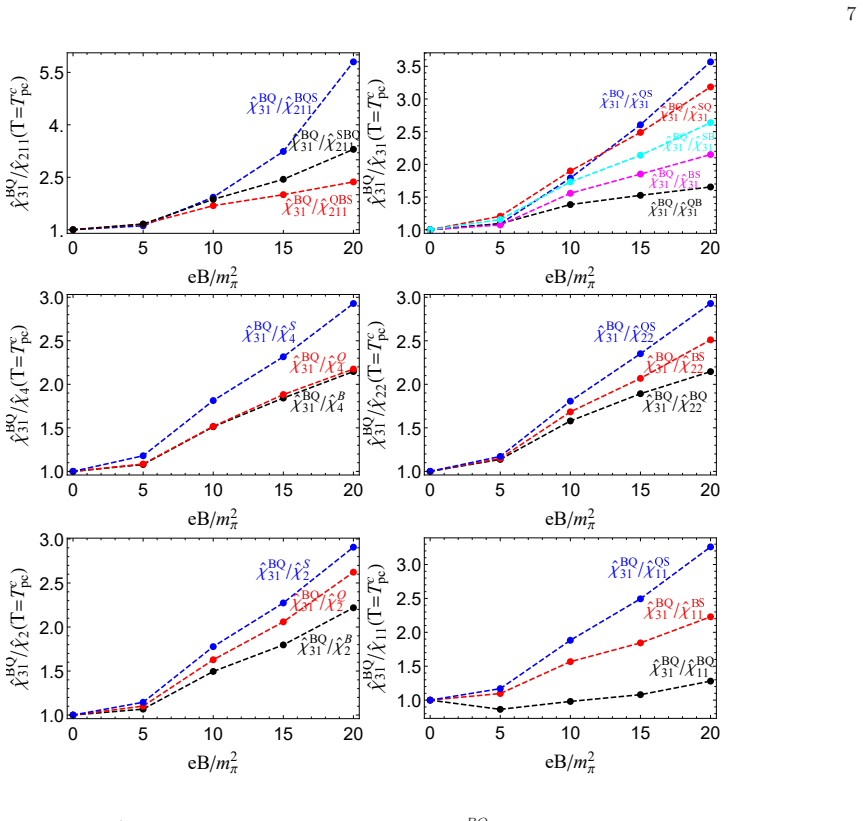
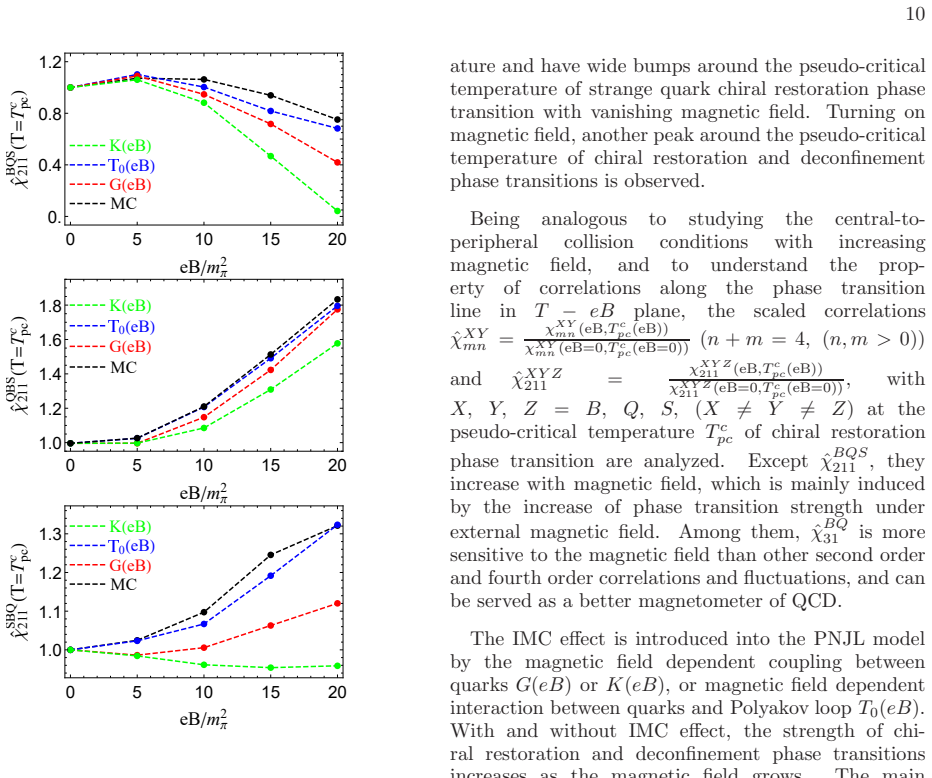
The fourth-order baryon-electric charge correlation χ^{BQ}_{31} is more sensitive to magnetic fields near the QCD chiral transition than other correlations.
A machine-rendered reading of the paper's core claim, the machinery that carries it, and where it could break.
Core claim
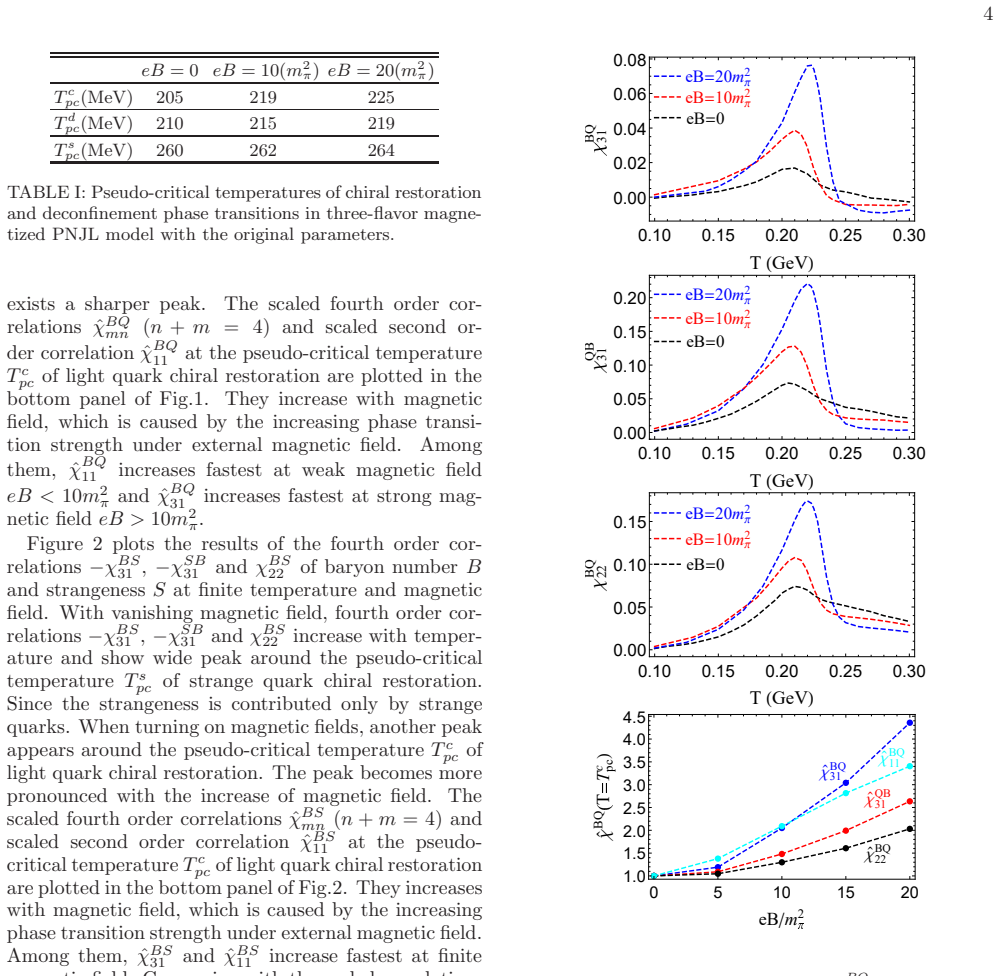
Within the three-flavor PNJL model, the fourth order correlation χ^{BQ}_{31} demonstrates higher sensitivity to the magnetic field at the chiral restoration phase transition than other considered correlations and fluctuations, positioning it as a more effective magnetometer of QCD.
What carries the argument
The fourth-order mixed susceptibility χ^{BQ}_{31} computed in the PNJL model, which measures the correlated fluctuations of baryon number and electric charge under varying magnetic fields.
Load-bearing premise
The three-flavor PNJL model accurately reproduces the dependence of QCD thermodynamics on magnetic fields near the chiral transition.
What would settle it
A lattice QCD calculation or heavy-ion collision measurement showing that the magnetic field dependence of χ^{BQ}_{31} is comparable to or weaker than that of quantities such as χ^{BQ}_{22} or second-order fluctuations would falsify the central claim.
Figures
read the original abstract
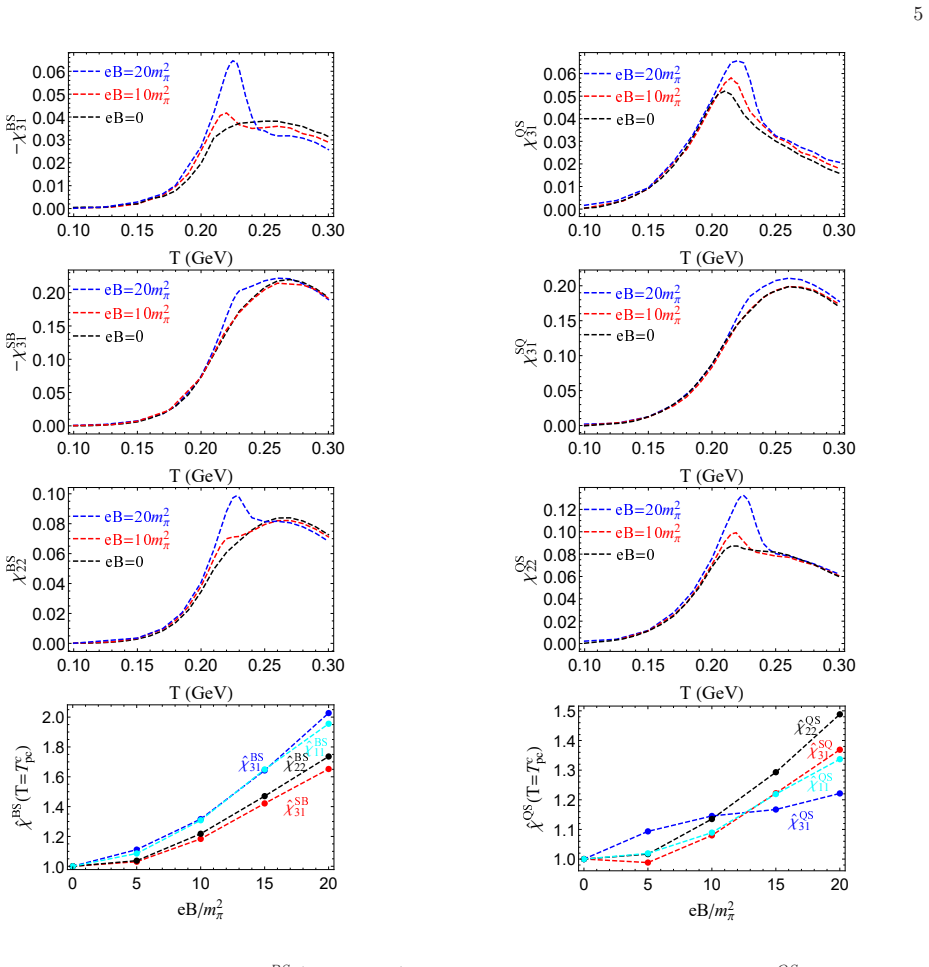
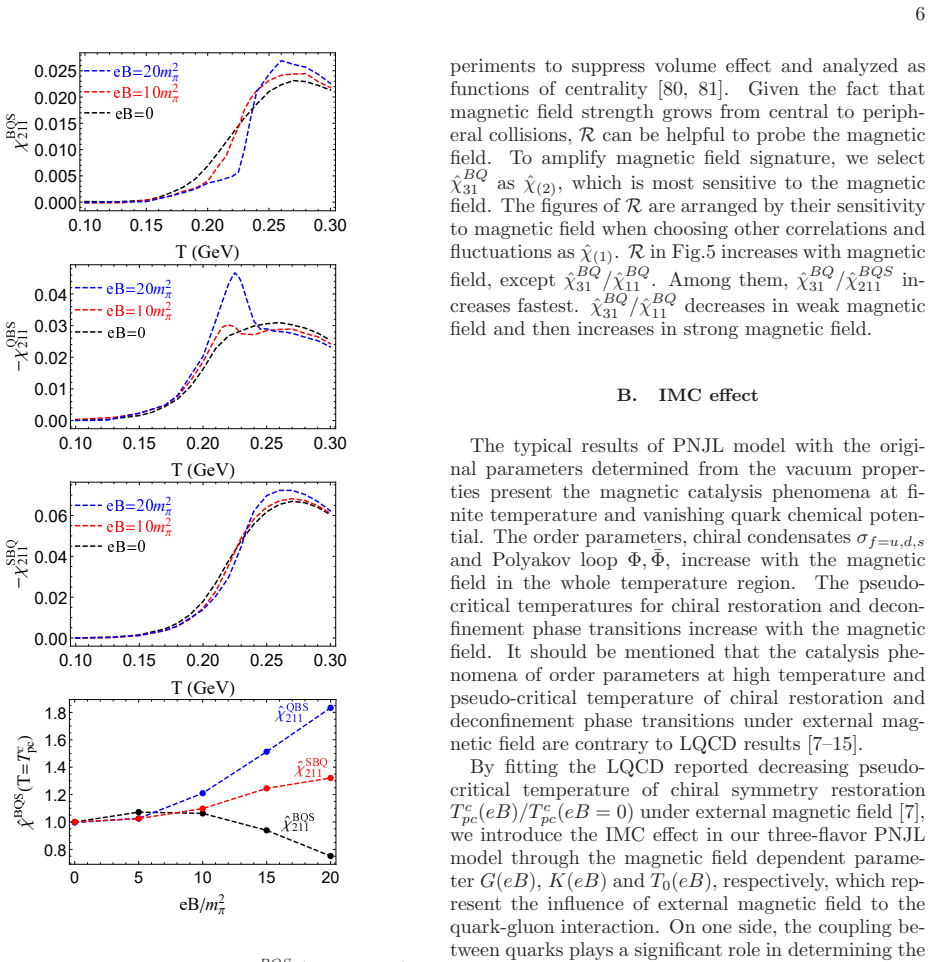
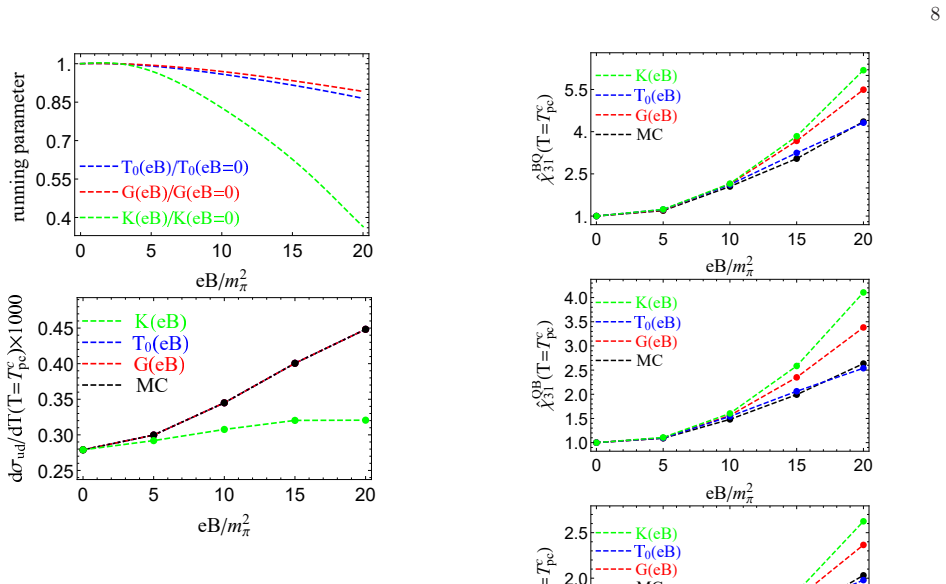
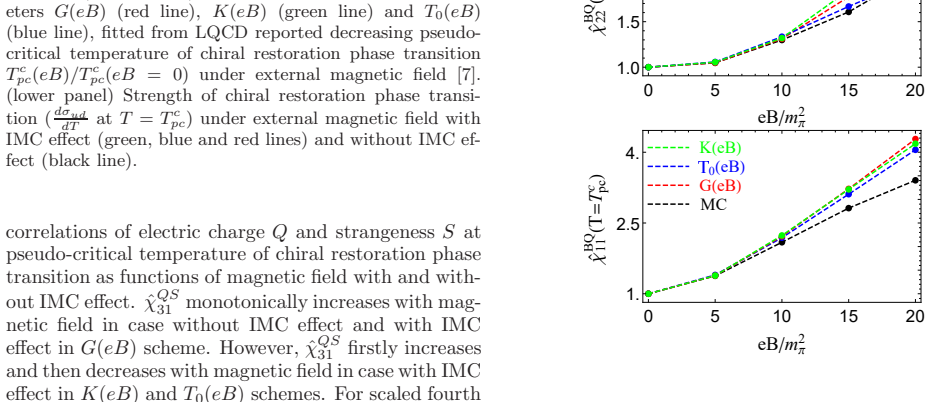
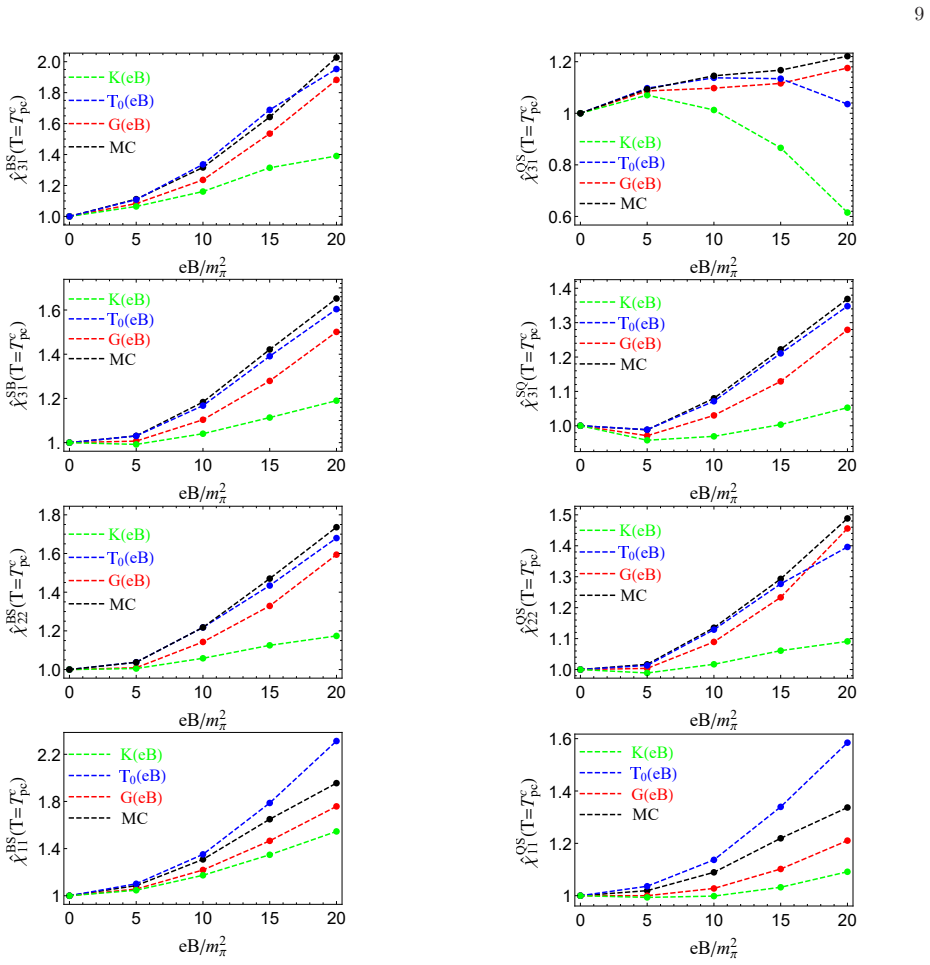
This work focuses on the fourth order correlations $\chi^{BQ}_{31}$, $\chi^{QB}_{31}$, $\chi^{BQ}_{22}$, $\chi^{BS}_{31}$, $\chi^{SB}_{31}$, $\chi^{BS}_{22}$, $\chi^{QS}_{31}$, $\chi^{SQ}_{31}$, $\chi^{QS}_{22}$, $\chi^{BQS}_{211}$, $\chi^{QBS}_{211}$, $\chi^{SBQ}_{211}$ of baryon number $B$, electric charge $Q$ and strangeness $S$ at finite temperature, magnetic field and vanishing quark chemical potential. The study is carried out in the framework of a three-flavor PNJL model, considering both cases with and without inverse magnetic catalysis effect. We find that, fourth order correlations $\chi^{BQ}_{31}$ at chiral restoration phase transition is more sensitive to the magnetic field than other second order and fourth order correlations and fluctuations, and can be served as a more effective magnetometer of QCD.
Editorial analysis
A structured set of objections, weighed in public.
Referee Report
Summary. The manuscript computes a suite of second- and fourth-order mixed susceptibilities (χ^{BQ}_{31}, χ^{BQ}_{22}, χ^{BS}_{31}, χ^{QS}_{31}, χ^{BQS}_{211} and their permutations) of baryon number, electric charge and strangeness in a three-flavor PNJL model at μ=0, both with and without an inverse-magnetic-catalysis term. It reports that χ^{BQ}_{31} displays the largest relative change with eB near the pseudocritical temperature and therefore proposes this correlator as a superior magnetometer for QCD.
Significance. A model-independent identification of a higher-order mixed correlator that is especially sensitive to magnetic fields would be valuable for heavy-ion phenomenology. The present work systematically surveys many correlators inside one effective model and isolates one candidate; this computational effort is useful, but the significance remains provisional until the model dependence is quantified or the result is corroborated by lattice QCD.
major comments (2)
- [Abstract and §IV] Abstract and §IV (results): the central claim that χ^{BQ}_{31} is 'more sensitive' and 'a more effective magnetometer' rests entirely on the ordering of |∂χ/∂(eB)| extracted from the PNJL model; no error bands, parameter-variation tests, or comparison to other models or lattice data are shown to establish that the ordering is robust rather than an artifact of the fitted couplings.
- [§II] §II (model): the PNJL parameters (G, K, T0, etc.) are fixed exclusively to vacuum meson masses and decay constants at B=0; the inverse-magnetic-catalysis term is inserted by hand. Because the magnetic response of the fourth-order BQ correlators is generated by these same parameters, the reported ranking reduces to an output of the vacuum fit rather than an independent prediction of QCD thermodynamics.
minor comments (2)
- [§II] The notation χ^{BQ}_{31} versus χ^{QB}_{31} is introduced without an explicit definition of the ordering of derivatives; a short clarifying sentence in §II would remove ambiguity.
- [Figures] Figure captions should state whether the curves include statistical or systematic uncertainties from the numerical solution of the gap equations.
Simulated Author's Rebuttal
We thank the referee for the careful reading of the manuscript and the constructive comments. We address each major comment below and indicate the revisions we will make.
read point-by-point responses
-
Referee: [Abstract and §IV] Abstract and §IV (results): the central claim that χ^{BQ}_{31} is 'more sensitive' and 'a more effective magnetometer' rests entirely on the ordering of |∂χ/∂(eB)| extracted from the PNJL model; no error bands, parameter-variation tests, or comparison to other models or lattice data are shown to establish that the ordering is robust rather than an artifact of the fitted couplings.
Authors: The manuscript presents a systematic computation of multiple mixed susceptibilities within the three-flavor PNJL model and identifies χ^{BQ}_{31} as the correlator exhibiting the largest relative variation with eB near the pseudocritical temperature. This ordering is indeed a result obtained inside the model. We will revise the abstract and the concluding section to state explicitly that the proposed magnetometer role is a finding of the PNJL framework and that independent confirmation in other models or lattice QCD is required to assess robustness. No parameter scans or error bands were included because the couplings are fixed by the standard vacuum fit; we will add a brief remark on this point in §IV. revision: partial
-
Referee: [§II] §II (model): the PNJL parameters (G, K, T0, etc.) are fixed exclusively to vacuum meson masses and decay constants at B=0; the inverse-magnetic-catalysis term is inserted by hand. Because the magnetic response of the fourth-order BQ correlators is generated by these same parameters, the reported ranking reduces to an output of the vacuum fit rather than an independent prediction of QCD thermodynamics.
Authors: The parameters are determined from vacuum phenomenology at B=0, which is the conventional procedure for PNJL studies. The inverse-magnetic-catalysis term is introduced phenomenologically to reproduce the lattice trend of decreasing T_c with eB. While the magnetic-field dependence of the susceptibilities therefore inherits the model’s vacuum calibration, the explicit evaluation of the fourth-order mixed correlators at finite T and B constitutes a dynamical prediction of the effective theory. We will expand the model-description paragraph in §II to clarify the phenomenological status of the IMC term and the consequent model dependence of the reported ordering. revision: partial
Circularity Check
No significant circularity; explicit model computation with transparent assumptions.
full rationale
The paper performs a numerical study of susceptibilities inside the three-flavor PNJL model (with and without inverse magnetic catalysis) at μ=0. The central claim is a comparative statement about which correlator shows the largest variation with eB at the pseudocritical temperature, obtained directly from the model's partition function and its derivatives. No step equates a fitted parameter to a predicted observable by construction, renames a known result, or invokes a self-citation chain whose only support is the present work. The model parameters and the inverse-catalysis implementation are stated as inputs; the ordering of sensitivities is an output of those inputs rather than a tautology. Because the derivation chain consists of explicit thermodynamic derivatives inside a specified effective model, it is self-contained and does not reduce to its own fitted values.
Axiom & Free-Parameter Ledger
free parameters (1)
- PNJL coupling constants and Polyakov-loop parameters
axioms (1)
- domain assumption The PNJL model provides a reliable approximation to QCD thermodynamics in a magnetic field near the chiral transition.
Forward citations
Cited by 1 Pith paper
-
Isospin-Driven Splitting of Chemical Potentials in Isobar Collisions from Lattice QCD
Lattice QCD yields first-principles splitting ratios for chemical potentials in Ru+Ru vs Zr+Zr collisions that are comparable in size to Bayesian STAR extractions, with Δμ_Q negative, Δμ_S positive, and only moderate ...
Reference graph
Works this paper leans on
-
[1]
Notes Phys
F.Preis, A.Rebhan and A.Schmitt, Lect. Notes Phys. 871, 51(2013)
2013
-
[2]
Notes Phys
R.Gatto and M.Ruggieri, Lect. Notes Phys. 871, 87(2013)
2013
-
[3]
V.A.Miransky and I.A.Shovkovy, Phys. Rep. 576, 1(2015)
2015
-
[4]
J.O.Anderson and W.R.Naylor, Rev. Mod. Phys. 88, 025001(2016)
2016
-
[5]
G.Q.Cao, Eur. Phys. J. A57, 264(2021)
2021
-
[6]
Notes Phys
M.D’Elia, Lect. Notes Phys. 871, 181(2013)
2013
-
[7]
High Energy Phys
G.S.Bali, F.Bruckmann, G.Endr¨ odi, Z.Fodor, S.D.Katz, S.Krieg, A.Schaefer and K.K.Szabo, J. High Energy Phys. 02, 044(2012)
2012
-
[8]
G.S.Bali, F.Bruckmann, G.Endr¨ odi, Z.Fodor, S.D.Katz and A.Schaefer, Phys. Rev. D86, 071502(2012). 11
2012
-
[9]
High Energy Phys
G.S.Bali, F.Bruckmann, G.Endr¨ odi, Z.Fodor, S.D.Katz and A.Schaefer, J. High Energy Phys. 08, 177(2014)
2014
-
[10]
High Energy Phys
F.Bruckmann, G.Endr¨odi and T.G.Kovacs, J. High Energy Phys. 04, 112(2013)
2013
-
[11]
V.G.Bornyakov, P.V.Buividovich, N.Cundy, O.A.Kochetkov and A.Schaefer, Phys. Rev. D90, 034501(2014)
2014
-
[12]
High Energy Phys
G.Endr¨odi, J. High Energy Phys. 07, 173(2015)
2015
-
[13]
High Energy Phys
G.Endr¨odi, M.Giordano, S.D.Katz, T.G.Kovacs and F.Pittler, J. High Energy Phys. 07, 009(2019)
2019
-
[14]
H.T.Ding, S.T.Li, J.H.Liu and X.D.Wang, Phys. Rev. D 105 , 034514(2022)
2022
-
[15]
H.T.Ding, J.B.Gu, A.Kumar and S.T.Li, Phys. Rev. D 111 , 114522 (2025)
2025
-
[16]
M.D’Elia, F.Manigrasso, F.Negro and F.Sanfilippo, Phys. Rev. D98, 054509(2018)
2018
-
[17]
K.Fukushima and Y.Hidaka, Phys. Rev. Lett 110, 031601(2013)
2013
-
[18]
S.J.Mao, Phys. Lett. B758, 195(2016)
2016
-
[19]
S.J.Mao, Phys. Rev. D94, 036007(2016)
2016
-
[20]
S.J.Mao, Phys. Rev. D97, 011501(R)(2018)
2018
-
[21]
S.J.Mao, Chin. Phys. C45, 021004(2021)
2021
-
[22]
S.J.Mao, Phys. Rev. D106, 034018(2022)
2022
-
[23]
High Energy Phys
K.Kamikado and T.Kanazawa, J. High Energy Phys. 03, 009(2014)
2014
-
[24]
J.Y.Chao, P.C.Chu and M.Huang, Phys. Rev. D88, 054009(2013)
2013
-
[25]
J.Braun, W.A.Mian and S.Rechenberger, Phys. Lett. B755, 265(2016)
2016
-
[26]
N.Mueller and J.M.Pawlowski, Phys. Rev. D91, 116010(2015)
2015
-
[27]
T.Kojo and N.Su, Phys. Lett. B720, 192(2013)
2013
-
[28]
A.Ayala, M.Loewe, A.J.Mizher and R.Zamora, Phys. Rev. D90, 036001(2014)
2014
-
[29]
A.Ayala, L.A.Hernandez, A.J.Mizher, J.C.Rojas and C.Villavicencio, Phys. Rev. D89, 116017(2014)
2014
-
[30]
A.Ayala, C.A.Dominguez, L.A.Hernandez, M.Loewe and R.Zamora, Phys. Rev. D92, 096011(2015)
2015
-
[31]
R.L.S.Farias, K.P.Gomes, G.Krein, and M.B.Pinto, Phys. Rev. C90, 025203(2014)
2014
-
[32]
M.Ferreira, P.Costa, O.Lourenco, T.Frederico, and C.Providˆencia, Phys. Rev. D89, 116011(2014)
2014
-
[33]
High Energy Phys
F.Preis, A.Rebhan and A.Schmitt, J. High Energy Phys. 1103, 033(2011)
2011
-
[34]
E.S.Fraga and A.J.Mizher, Phys. Rev. D78, 025016(2008)
2008
-
[35]
E.S.Fraga and A.J.Mizher, Nucl. Phys. A820, 103C(2009)
2009
-
[36]
K.Fukushima, M.Ruggieri and R.Gatto, Phys. Rev. D81, 114031(2010)
2010
-
[37]
High Energy Phys
C.V.Johnson and A.Kundu, J. High Energy Phys. 12, 053(2008)
2008
-
[38]
V.Skokov, Phys. Rev. D85, 034026(2012)
2012
-
[39]
E.S.Fraga, J.Noronha and L.F.Palhares, Phys. Rev. D87, 114014(2013)
2013
-
[40]
R.Gatto and M.Ruggieri, Phys. Rev. D82, 054027(2010)
2010
-
[41]
R.Gatto and M.Ruggieri, Phys. Rev. D83, 034016(2011)
2011
-
[42]
M.Ferreira, P.Costa and C.Providˆ encia, Phys. Rev. D89, 036006(2014)
2014
-
[43]
M.Ferreira, P.Costa, D.P.Menezes, C.Providˆencia and N.N.Scoccola, Phys. Rev. D89, 016002(2014)
2014
-
[44]
P.Costa, M.Ferreira, H.Hansen, D.P.Menezes and C.Providˆencia, Phys. Rev. D89, 056013(2014)
2014
-
[45]
A.J.Mizher, M.N.Chernodub and E.S.Fraga, Phys. Rev. D82, 105016(2010)
2010
-
[46]
Mintz and J.Schaffner-Bielich, Phys
E.S.Fraga, B.W. Mintz and J.Schaffner-Bielich, Phys. Lett B731, 154-158(2014)
2014
-
[47]
E.J.Ferrer, V.de la Incera, I.Portillo and M.Quiroz, Phys. Rev. D89, 085034(2014)
2014
-
[48]
E.J.Ferrer, V.de la Incera, and X.J.Wen, Phys. Rev. D91, 054006(2015)
2015
-
[49]
J.Mei and S.J.Mao, Phys. Rev. D102, 114035(2020)
2020
-
[50]
K.Xu, J.Y.Chao and M.Huang, Phys. Rev. D103, 076015(2021)
2021
-
[51]
J.Mei, R.Wen, S.J.Mao, M.Huang and K.Xu, Phys. Rev. D110, 034024(2024)
2024
-
[52]
S.J.Mao, Phys. Rev. D110, 054002(2024)
2024
-
[53]
G.Cao and X.G.Huang, Phys. Rev. D93, 016007(2016)
2016
-
[54]
W.R.Tavares, R.L.S.Farias and S.S.Avancini, Phys. Rev. D101, 016017(2020)
2020
-
[55]
W.R.Tavares, S.S.Avancini and R.L.S.Farias, Phys. Rev. D108, 016017(2023)
2023
-
[56]
G.Endr¨odi and G.Marko, Phys. Rev. D109, 034506(2024)
2024
-
[57]
S.J.Mao and S.Yang, Phys. Rev. D112, 014026(2025)
2025
-
[58]
Z.Y.Qin, B.Feng, Y.H.Hou, H.Y.Song, W.C.Zhang, H.Zheng, S.J.Mao, arXiv:2602.11713
work page internal anchor Pith review Pith/arXiv arXiv
-
[59]
H.T.Ding, S.T.Li, Q.Shi, and X.D.Wang, Eur. Phys. J. A57, 202(2021)
2021
- [60]
-
[61]
H.T.Ding, J.B.Gu, A.Kumar, S.T.Li and J.H.Liu, Phys. Rev. Lett. 132, 201903(2024)
2024
-
[62]
K.Fukushima and Y.Hidaka, Phys. Rev. Lett. 117, 102301(2016)
2016
-
[63]
A.Bhattacharyya, S.K.Ghosh, R.Ray, and S.Samanta, Eur. Phys. Lett. 115, 62003(2016)
2016
-
[64]
G.Kadam, S.Pal, and A.Bhattacharyya, J. Phys. G 47, 125106(2020)
2020
-
[65]
W.J.Fu, Phys. Rev. D88, 014009(2013)
2013
-
[66]
N.Chahal, S.Dutt, and A.Kumar, Phys. Rev. C107, 045203(2023)
2023
-
[67]
Mao, Chin
S.J. Mao, Chin. Phys. C49, 063106(2025)
2025
-
[68]
Rafelski and B
J. Rafelski and B. Muller, Phys. Rev. Lett. 36, 517 (1976)
1976
-
[69]
D. E. Kharzeev, L. D. McLerran and H. J. Warringa, Nucl. Phys. A803, 227 (2008)
2008
-
[70]
Skokov, A
V. Skokov, A. Y. Illarionov and T. Toneev, Int. J. Mod. Phys. A24, 5925 (2009)
2009
-
[71]
W. T. Deng and X. G. Huang, Phys. Rev. C85, (2012) 044907; Phys. Lett. B742, 296 (2015)
2012
-
[72]
Tuchin, Adv
K. Tuchin, Adv. High Energy Phys. 490495 (2013)
2013
-
[73]
H.T.Ding, F.Karsch and S.Mukherjee, Int. J. Mod. Phys. E24, 1530007(2015)
2015
-
[74]
W.J.Fu, Commun. Theor. Phys. 74, 097304(2022)
2022
-
[75]
X.Luo and N.Xu, Nucl. Sci. Tech. 28, 112(2017)
2017
-
[76]
A.Pandav, D.Mallic and B.Mohanty, Prog. Part. Nucl. Phys. 125, 103960(2022)
2022
-
[77]
276, 01007(2023)
A.Rustanmov, EPJ Web Conf. 276, 01007(2023)
2023
-
[78]
Nonaka, Acta Phys
T. Nonaka, Acta Phys. Pol. B Proc. Suppl. 16, 1- A14(2023)
2023
-
[79]
H.S.Ko(STAR Collaboration), Acta Phys. Pol. B Proc. Suppl. 16, 1-A87(2023)
2023
-
[80]
STAR Collaboration, Phys. Rev. C100, 12 014902(2019)
2019
discussion (0)
Sign in with ORCID, Apple, or X to comment. Anyone can read and Pith papers without signing in.