Discovery of a Compact Hub-Filament System in G286.21+0.17 with JWST and ALMA: Insights into Protocluster Formation and Competitive Accretion
Pith reviewed 2026-06-30 20:38 UTC · model grok-4.3
The pith
Observations of protocluster G286 reveal steep power-law increases in core density and mass toward the hub center that match a competitive accretion model.
A machine-rendered reading of the paper's core claim, the machinery that carries it, and where it could break.
Core claim
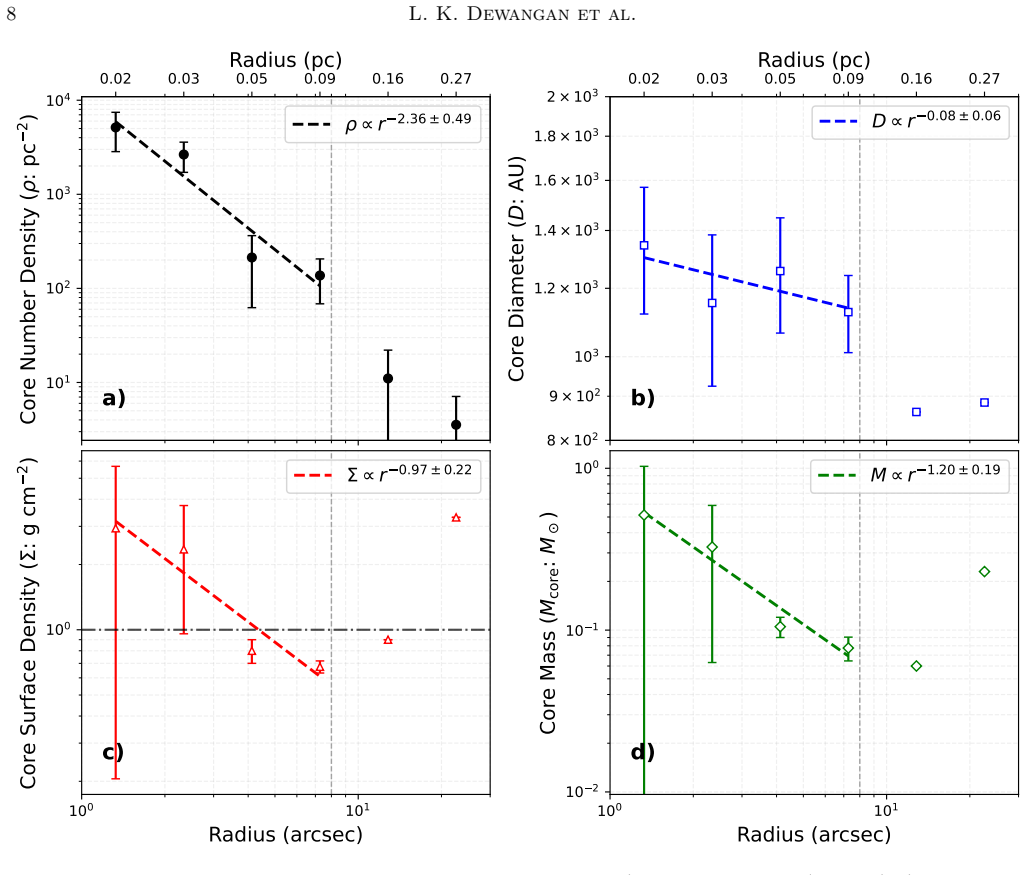
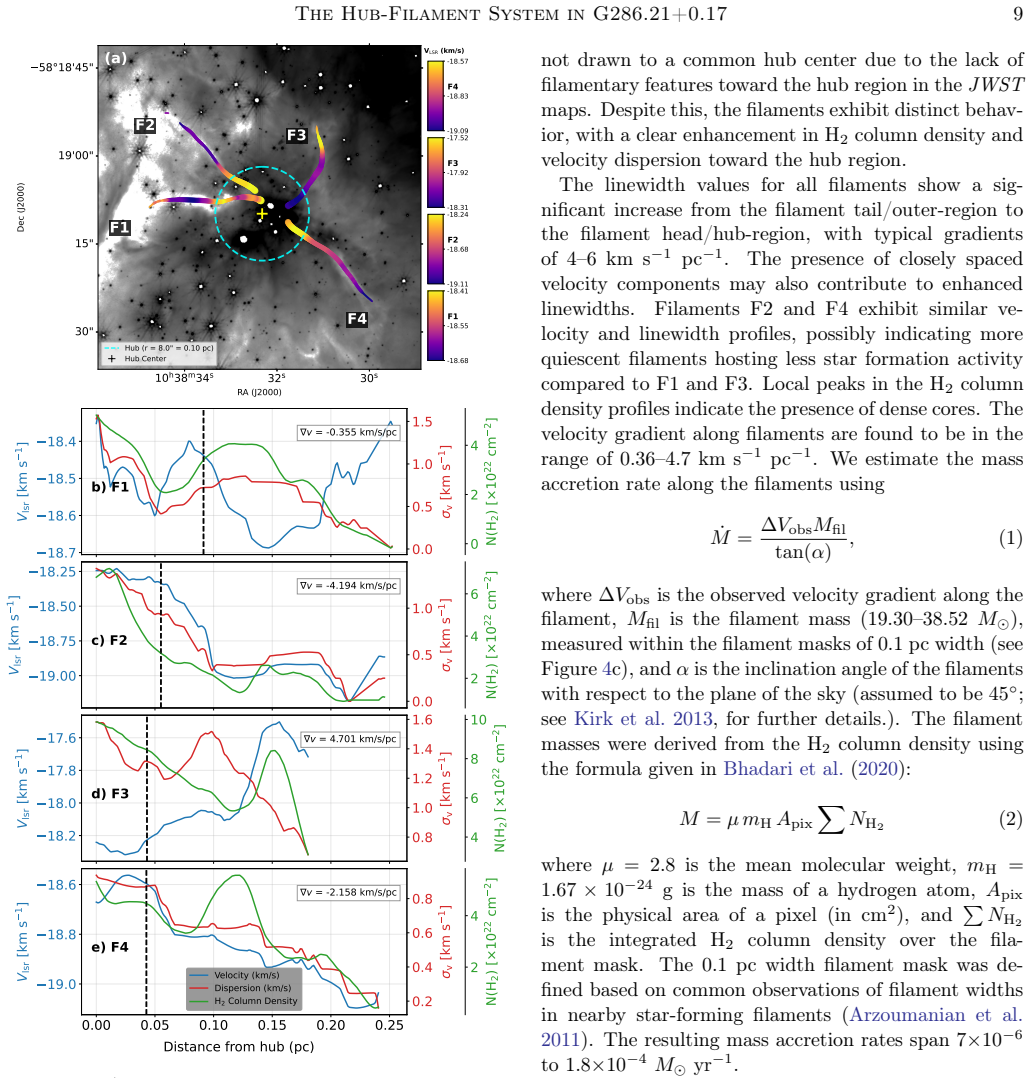
The paper discovers a compact hub-filament system in G286.21+0.17 consisting of a dense central hub connected by at least four filaments visible in absorption, with the hub containing dense core G286c1. ALMA H13CO+ emission confirms the structure over a narrow velocity range. The radial profiles of ALMAGAL 1.38 mm cores inside r less than 8 arcseconds show core number density rho proportional to r to the -2.4 plus or minus 0.5, surface density Sigma proportional to r to the -1.0 plus or minus 0.2, and enclosed core mass M_core proportional to r to the -1.2 plus or minus 0.2, while core diameters stay roughly constant. These relations plus filament accretion rates of 7 times 10 to the -6 to 1
What carries the argument
The steep radial power-law distributions of core number density, surface density, and enclosed mass toward the hub center, which are interpreted as the signature of gravitational focusing that accelerates core growth.
If this is right
- Filamentary accretion supplies the mass reservoir that feeds competitive core growth inside the hub.
- Gravity-driven turbulence is traced by the observed increase in filament linewidths from outer regions to the hub.
- The hub-filament system formed through large-scale gas layer interactions followed by compression from the neighboring H II region.
- Star formation in the region is shaped by the combination of filamentary accretion, competitive core growth, and stellar feedback.
Where Pith is reading between the lines
- The same power-law indices could be searched for in other compact hub-filament systems to test whether the slopes are characteristic of the competitive accretion phase.
- Hydrodynamic simulations of protocluster assembly could be checked against these specific radial profiles to see whether competitive accretion alone reproduces the observed exponents.
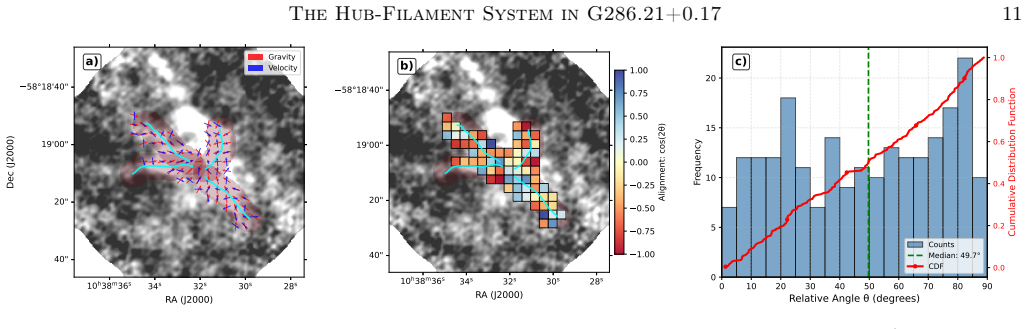
- The reported lack of alignment between velocity gradients and gravitational force vectors may mark a later evolutionary stage that could be compared with younger hub-filament systems.
Load-bearing premise
The measured power-law indices and accretion rates indicate competitive accretion rather than projection effects, incomplete sampling of cores, or other dynamical processes.
What would settle it
A similar hub-filament system observed at comparable resolution whose core number density, surface density, and enclosed mass profiles show power-law indices flatter than -1.5, -0.5, and -0.7 respectively, or whose filament linewidths do not increase toward the hub.
Figures
read the original abstract
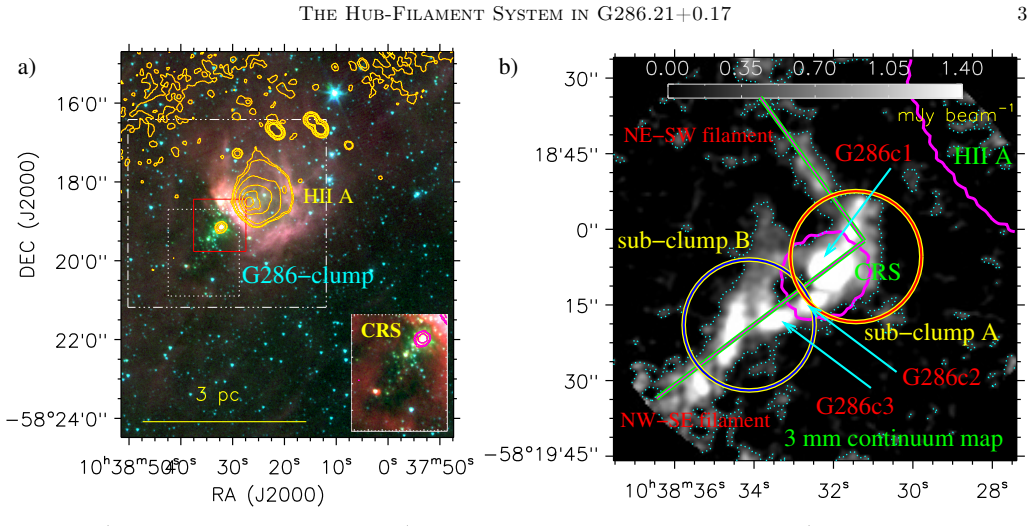
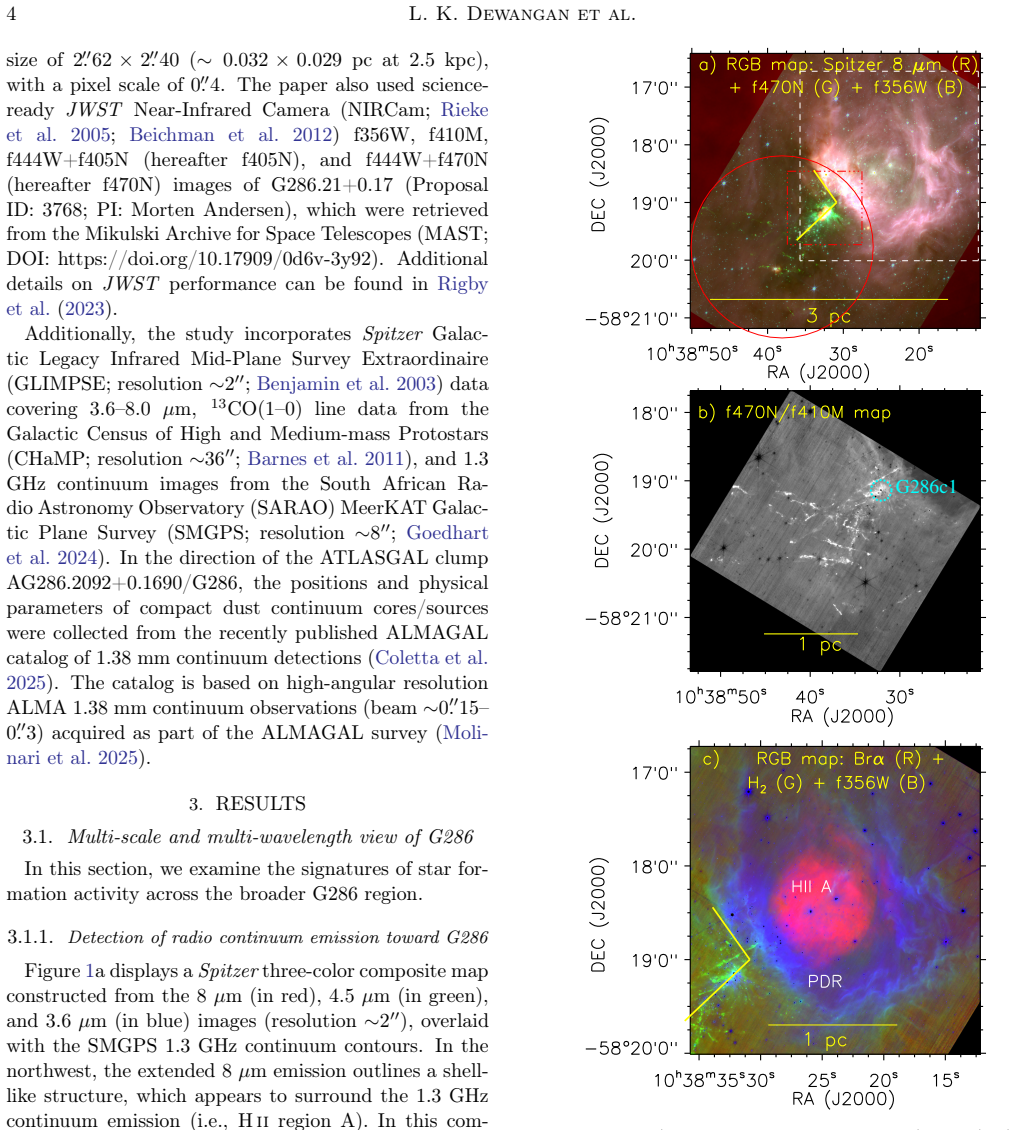
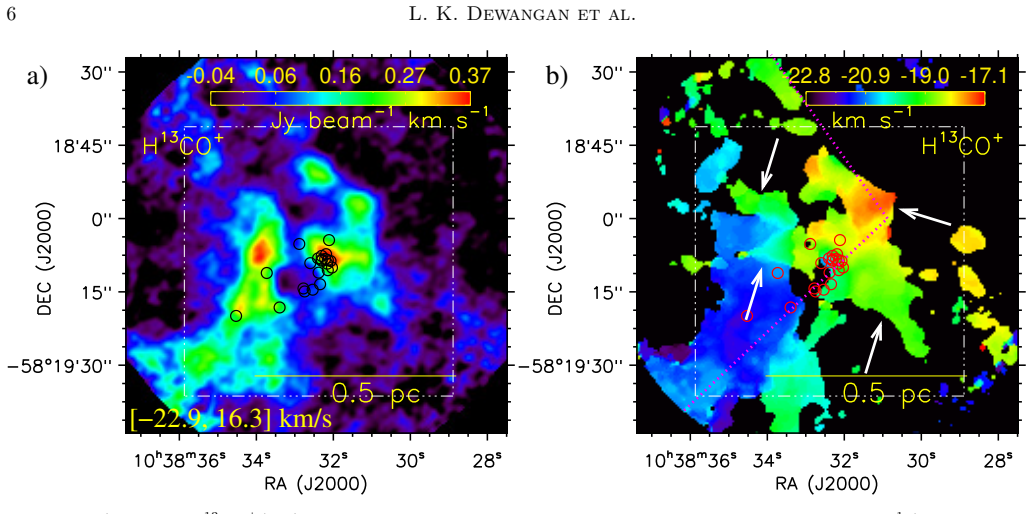
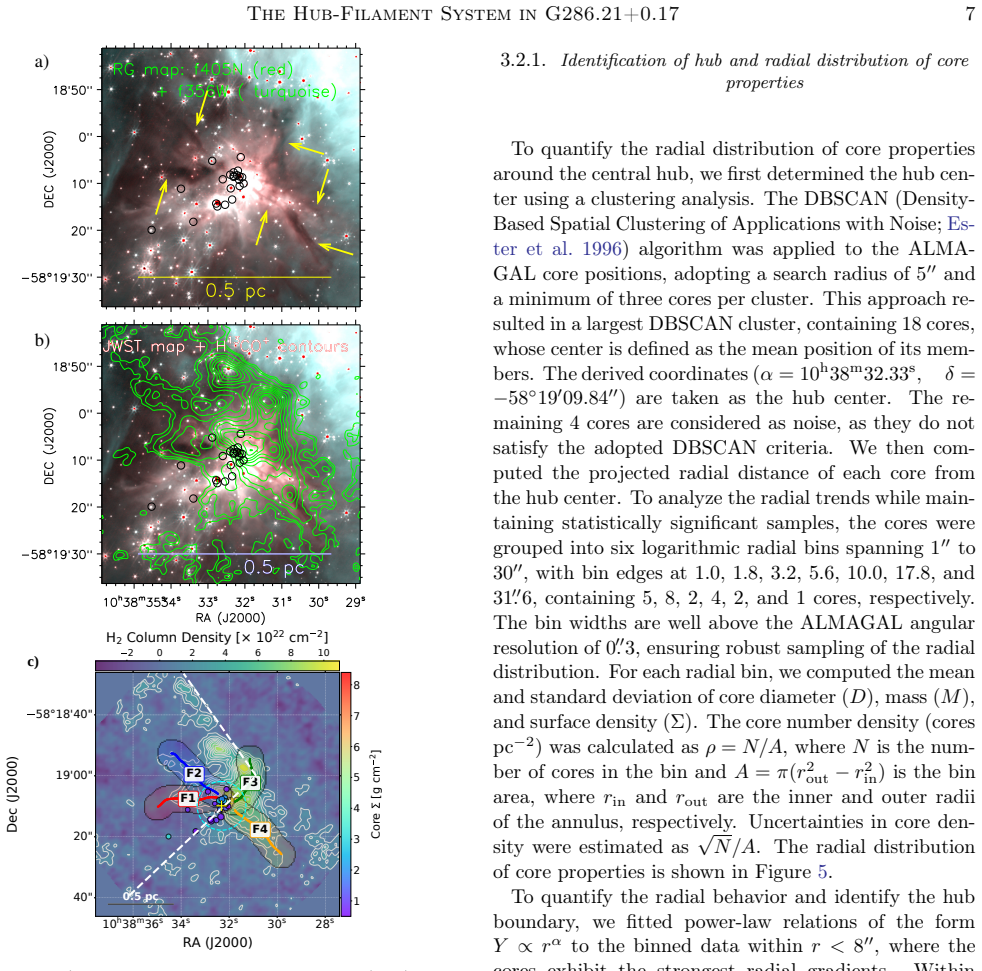
We present a multi-wavelength study of the massive protocluster G286.21+0.17 (G286) using \emph{JWST} near-infrared imaging and ALMA H$^{13}$CO$^{+}$(1--0) observations. The \emph{JWST} images uncover a compact ($\sim$0.5 pc) hub-filament system (HFS), comprising a dense central hub connected by at least four converging filaments seen in absorption, along with multiple H$_2$ protostellar jets/outflows. The hub hosts dense core G286c1. The H$^{13}$CO$^{+}$ emission confirms this HFS over [$-$19.2, $-$16.4]~km~s$^{-1}$. The \emph{JWST} images further trace prominent photodissociation regions around the H\,{\sc ii}~region~A, powered by a B-type star. The radial distribution of ALMAGAL 1.38 mm core properties reveals steep power-law slopes toward the hub center. Within the inner hub (r < 8'', $\sim0.1$~pc), the core number density follows $\rho~[\rm pc^{-2}] \propto r^{-2.4\pm0.5}$, the surface density scales as $\Sigma~[\rm g~cm^{-2}] \propto r^{-1.0\pm0.2}$, and the enclosed core mass varies as $M_{\rm core}~[M_{\odot}] \propto r^{-1.2\pm0.2}$, while core diameters remain approximately constant ($D_{\rm core}~[\rm AU] \propto r^{-0.1\pm0.1}$). These trends, along with filament mass accretion rates of $7\times10^{-6}$--$1.8\times10^{-4}$~$M_\odot$~yr$^{-1}$, support a competitive accretion scenario in which gravitational focusing enhances core growth toward the hub center. Filament linewidths increase from tail/outer-region to head/hub-region, consistent with gravity-driven turbulence. However, the absence of a preferred alignment between velocity gradients and gravitational force directions may indicate a dynamically evolved system. The HFS likely formed through large-scale gas layer interactions and compression by the adjacent H\,{\sc ii} region. Overall, star formation in G286 appears regulated by filamentary accretion, competitive core growth in the hub, and stellar feedback.
Editorial analysis
A structured set of objections, weighed in public.
Referee Report
Summary. The paper presents JWST near-IR and ALMA H13CO+(1-0) observations of the massive protocluster G286.21+0.17, identifying a compact (~0.5 pc) hub-filament system with converging filaments, a central dense core, H2 jets, and PDRs around an adjacent HII region. Within r < 8'' (~0.1 pc), ALMAGAL 1.38 mm cores show radial power laws: number density ρ [pc^{-2}] ∝ r^{-2.4±0.5}, surface density Σ [g cm^{-2}] ∝ r^{-1.0±0.2}, enclosed mass M_core [M_⊙] ∝ r^{-1.2±0.2} (with roughly constant diameters), plus filament accretion rates of 7×10^{-6}–1.8×10^{-4} M_⊙ yr^{-1}; these trends plus increasing linewidths toward the hub are interpreted as evidence for competitive accretion via gravitational focusing, with the HFS formed by large-scale interactions and HII compression.
Significance. If the reported radial trends can be shown to be free of dominant projection or completeness biases, the work would supply a useful multi-wavelength case study of hub-filament geometry and core growth in a young massive protocluster, adding to the observational basis for competitive accretion models.
major comments (2)
- [Abstract] Abstract: the claim that the measured power-law indices (ρ ∝ r^{-2.4±0.5}, Σ ∝ r^{-1.0±0.2}, M_core ∝ r^{-1.2±0.2}) and filament accretion rates directly support competitive accretion via gravitational focusing is not accompanied by quantitative tests against projected null models, line-of-sight effects in a filamentary geometry, or radially dependent detection completeness for the ALMAGAL cores.
- [radial distribution of ALMAGAL 1.38 mm core properties] The section on radial core properties: no error analysis details, baseline comparisons to alternative dynamical models, or completeness simulations are supplied, so the interpretive step from the observed 2D distributions to 3D dynamical enhancement remains unverified.
minor comments (2)
- [Abstract] The physical scale corresponding to r < 8'' (~0.1 pc) should be stated with an explicit adopted distance to the source.
- [radial distribution section] Notation for the power-law indices could be clarified by specifying whether the fits are performed in linear or log space and how uncertainties are derived.
Simulated Author's Rebuttal
We thank the referee for their constructive comments, which have helped us clarify the presentation and interpretation of our results. We address each major comment below and have revised the manuscript to incorporate additional caveats, error details, and discussion of potential biases.
read point-by-point responses
-
Referee: [Abstract] Abstract: the claim that the measured power-law indices (ρ ∝ r^{-2.4±0.5}, Σ ∝ r^{-1.0±0.2}, M_core ∝ r^{-1.2±0.2}) and filament accretion rates directly support competitive accretion via gravitational focusing is not accompanied by quantitative tests against projected null models, line-of-sight effects in a filamentary geometry, or radially dependent detection completeness for the ALMAGAL cores.
Authors: We agree that the original abstract wording presented the interpretation too strongly without explicit qualification. The power-law indices are measured quantities in projection, and the link to competitive accretion via gravitational focusing is based on the observed steep slopes combined with the hub-filament morphology seen in JWST data. In the revised version we have changed the abstract to state that the trends 'are consistent with' competitive accretion, added a sentence noting the 2D nature of the measurements, and inserted a short paragraph in the discussion section addressing line-of-sight effects qualitatively using the observed filament convergence. Full quantitative null-model tests and completeness simulations remain outside the scope of this primarily observational study. revision: yes
-
Referee: [radial distribution of ALMAGAL 1.38 mm core properties] The section on radial core properties: no error analysis details, baseline comparisons to alternative dynamical models, or completeness simulations are supplied, so the interpretive step from the observed 2D distributions to 3D dynamical enhancement remains unverified.
Authors: We have expanded Section 3.2 to include the details of the least-squares fitting procedure used to obtain the quoted uncertainties. A baseline comparison to a uniform radial distribution has been added, demonstrating that the observed indices are steeper than expected for a non-focused distribution. We acknowledge the lack of dedicated completeness simulations for the ALMAGAL catalog in this field and have inserted a caveat stating that the reported trends apply to the detected cores; higher central background emission could in principle affect completeness. The multi-wavelength context (converging filaments and increasing linewidths toward the hub) is used to support the dynamical interpretation, but we agree that a full 3D verification would require additional modeling. revision: partial
Circularity Check
No circularity: purely observational power-law fits to ALMAGAL core data with direct interpretation
full rationale
The paper measures radial distributions of observed ALMAGAL 1.38 mm cores and directly fits the reported power-law indices (ρ ∝ r^{-2.4±0.5}, Σ ∝ r^{-1.0±0.2}, M_core ∝ r^{-1.2±0.2}) to the binned data within r < 8''. These are empirical results from the observations, not quantities derived from the paper's own equations or prior self-citations that reduce to the inputs by construction. Filament accretion rates are likewise computed from measured quantities. The link to competitive accretion is an interpretive statement in the abstract and text, not a self-definitional or fitted-input prediction. No self-citation load-bearing steps, uniqueness theorems, or ansatzes appear in the derivation chain. The study is self-contained as an observational report against external benchmarks.
Axiom & Free-Parameter Ledger
axioms (1)
- domain assumption Molecular line emission in the stated velocity range traces the physical hub-filament structure without significant contamination or optical depth effects
Reference graph
Works this paper leans on
-
[1]
Andersen, M., Barnes, P. J., Tan, J. C., Kainulainen, J., & de Marchi, G. 2017, ApJ, 850, 12, doi: 10.3847/1538-4357/aa9072 André, P., Di Francesco, J., Ward-Thompson, D., et al. 2014, in Protostars and Planets VI, ed. H. Beuther, R. S
-
[2]
Klessen, C. P. Dullemond, & T. Henning, 27, doi: 10.2458/azu_uapress_9780816531240-ch002
-
[3]
Arce, H. G., Borkin, M. A., Goodman, A. A., Pineda, J. E., & Beaumont, C. N. 2011, ApJ, 742, 105, doi: 10.1088/0004-637X/742/2/105
-
[4]
2011, A&A, 529, L6, doi: 10.1051/0004-6361/201116596
Arzoumanian, D., André, P., Didelon, P., et al. 2011, A&A, 529, L6, doi: 10.1051/0004-6361/201116596
-
[5]
Barnes, P. J., Yonekura, Y., Ryder, S. D., et al. 2010, MNRAS, 402, 73, doi: 10.1111/j.1365-2966.2009.15890.x
-
[6]
J., Yonekura, Y., Fukui, Y., et al
Barnes, P. J., Yonekura, Y., Fukui, Y., et al. 2011, ApJS, 196, 12, doi: 10.1088/0067-0049/196/1/12
-
[7]
A., Rieke, M., Eisenstein, D., et al
Beichman, C. A., Rieke, M., Eisenstein, D., et al. 2012, in Society of Photo-Optical Instrumentation Engineers (SPIE) Conference Series, Vol. 8442, Space Telescopes and Instrumentation 2012: Optical, Infrared, and Millimeter Wave, ed. M. C. Clampin, G. G. Fazio, H. A. MacEwen, & J. Oschmann, Jacobus M., 84422N, doi: 10.1117/12.925447
-
[8]
Benjamin, R. A., Churchwell, E., Babler, B. L., et al. 2003, PASP, 115, 953, doi: 10.1086/376696
-
[9]
Bhadari, N. K., Dewangan, L. K., Ojha, D. K., Pirogov, L. E., & Maity, A. K. 2022, ApJ, 930, 169, doi: 10.3847/1538-4357/ac65e9
-
[10]
Bhadari, N. K., Dewangan, L. K., Pirogov, L. E., & Ojha, D. K. 2020, ApJ, 899, 167, doi: 10.3847/1538-4357/aba2c6
-
[11]
Bhadari, N. K., Dewangan, L. K., Jadhav, O. R., et al. 2025, A&A, 694, L18, doi: 10.1051/0004-6361/202452189
-
[12]
Bonnell, I. A., Bate, M. R., Clarke, C. J., & Pringle, J. E. 2001, MNRAS, 323, 785, doi: 10.1046/j.1365-8711.2001.04270.x
-
[13]
Bonnell, I. A., Vine, S. G., & Bate, M. R. 2004, MNRAS, 349, 735, doi: 10.1111/j.1365-2966.2004.07543.x
-
[14]
2020a, ApJ, 897, 51, doi: 10.3847/1538-4357/ab93bc
Cheng, Y., Andersen, M., & Tan, J. 2020a, ApJ, 897, 51, doi: 10.3847/1538-4357/ab93bc
-
[15]
C., Liu, M., Lim, W., & Andersen, M
Cheng, Y., Tan, J. C., Liu, M., Lim, W., & Andersen, M. 2020b, ApJ, 894, 87, doi: 10.3847/1538-4357/ab879f
-
[16]
Cheng, Y., Tan, J. C., Tobin, J. J., et al. 2022, ApJ, 940, 124, doi: 10.3847/1538-4357/ac9b54
-
[17]
Churchwell, E., Povich, M. S., Allen, D., et al. 2006, ApJ, 649, 759, doi: 10.1086/507015
-
[18]
2025, A&A, 696, A151, doi: 10.1051/0004-6361/202452706
Coletta, A., Molinari, S., Schisano, E., et al. 2025, A&A, 696, A151, doi: 10.1051/0004-6361/202452706
-
[19]
Deharveng, L., Schuller, F., Anderson, L. D., et al. 2010, A&A, 523, A6, doi: 10.1051/0004-6361/201014422
-
[20]
Dewangan, L. K., Bhadari, N. K., Maity, A. K., et al. 2024a, MNRAS, 527, 5895, doi: 10.1093/mnras/stad3384
-
[21]
Dewangan, L. K., Maity, A. K., Mayya, Y. D., et al. 2023, ApJ, 958, 51, doi: 10.3847/1538-4357/ad004b
-
[22]
Dewangan, L. K., Ojha, D. K., Zinchenko, I., Janardhan, P., & Luna, A. 2017, ApJ, 834, 22, doi: 10.3847/1538-4357/834/1/22
-
[23]
Dewangan, L. K., Yadav, R. K., Sharma, S., et al. 2026, AJ, 171, 69, doi: 10.3847/1538-3881/ae25e7
-
[24]
Dewangan, L. K., Jadhav, O. R., Maity, A. K., et al. 2024b, MNRAS, 528, 3909, doi: 10.1093/mnras/stae150
-
[25]
E., & Williams, D
Dyson, J. E., & Williams, D. A. 1980, Physics of the interstellar medium (New York, Halsted Press), 204
1980
-
[26]
1996, in Second International Conference on Knowledge Discovery and Data Mining (KDD’96)
Ester, M., Kriegel, H.-P., Sander, J., & Xu, X. 1996, in Second International Conference on Knowledge Discovery and Data Mining (KDD’96). Proceedings of a conference held August 2-4, ed. D. W. Pfitzner & J. K. Salmon, 226–331 Faúndez, S., Bronfman, L., Garay, G., et al. 2004, A&A, 426, 97, doi: 10.1051/0004-6361:20035755
-
[27]
Federrath, C., & Klessen, R. S. 2012, ApJ, 761, 156, doi: 10.1088/0004-637X/761/2/156
-
[28]
Georgatos, T., & Whitworth, A. P. 2026, arXiv e-prints, arXiv:2601.09794, doi: 10.48550/arXiv.2601.09794
work page internal anchor Pith review Pith/arXiv arXiv doi:10.48550/arxiv.2601.09794 2026
-
[29]
Goedhart, S., Cotton, W. D., Camilo, F., et al. 2024, Monthly Notices of the Royal Astronomical Society, 531, 649, doi: 10.1093/mnras/stae1166
-
[30]
2026, arXiv e-prints, arXiv:2602.01238, doi: 10.48550/arXiv.2602.01238
Gupta, S., Baug, T., Soam, A., et al. 2026, arXiv e-prints, arXiv:2602.01238, doi: 10.48550/arXiv.2602.01238
-
[31]
Jadhav, O. R., Dewangan, L. K., Verma, A., et al. 2025, ApJ, 980, 133, doi: 10.3847/1538-4357/ada388
-
[32]
Kirk, H., Myers, P. C., Bourke, T. L., et al. 2013, ApJ, 766, 115, doi: 10.1088/0004-637X/766/2/115
-
[33]
Krumholz, M. R., & McKee, C. F. 2008, Nature, 451, 1082, doi: 10.1038/nature06620
-
[34]
Inutsuka, S. I. 2020, A&A, 642, A87, doi: 10.1051/0004-6361/202038232 16L. K. Dew angan et al. 0.0 2.2 4.4 6.6 8.9 11.1 13.3 c) HII A DEC(J2000) DEC(J2000) RA(J2000) a) b) d) CRS Figure B2.a) SMGPS 1.3 GHz continuum contours (blue) overlaid on the ChaMPS 13CO moment-0 map integrated over [−23.2,−16.4] km s −1. b) Mean 13CO spectrum extracted from the circ...
-
[35]
Liu, T., Evans, N. J., Kim, K.-T., et al. 2020a, MNRAS, 496, 2790, doi: 10.1093/mnras/staa1577 —. 2020b, MNRAS, 496, 2821, doi: 10.1093/mnras/staa1501
-
[36]
Maity, A. K., Dewangan, L. K., Bhadari, N. K., et al. 2023, MNRAS, 523, 5388, doi: 10.1093/mnras/stad1644
-
[37]
Maity, A. K., Dewangan, L. K., Jadhav, O. R., et al. 2025, AJ, 169, 325, doi: 10.3847/1538-3881/adcedd
-
[38]
K., Inoue, T., Fukui, Y., et al
Maity, A. K., Inoue, T., Fukui, Y., et al. 2024, ApJ, 974, 229, doi: 10.3847/1538-4357/ad7098
-
[39]
2015, Publications of the Astronomical Society of the Pacific, 127, 266, doi: 10.1086/680323
Mangum, J., & Shirley, Y. 2015, Publications of the Astronomical Society of the Pacific, 127, 266, doi: 10.1086/680323
-
[40]
2010, Astrophysical Journal, 714, 680, doi: 10.1088/0004-637X/714/1/680
Kitamura, Y. 2010, Astrophysical Journal, 714, 680, doi: 10.1088/0004-637X/714/1/680
-
[41]
Matsakis, D. N., Evans, N. J., I., Sato, T., & Zuckerman, B. 1976, AJ, 81, 172, doi: 10.1086/111871
-
[42]
2025, A&A, 696, A149, doi: 10.1051/0004-6361/202452702
Molinari, S., Schilke, P., Battersby, C., et al. 2025, A&A, 696, A149, doi: 10.1051/0004-6361/202452702
-
[43]
2025, ApJ, 979, 233, doi: 10.3847/1538-4357/ada27f
Morii, K., Sanhueza, P., Csengeri, T., et al. 2025, ApJ, 979, 233, doi: 10.3847/1538-4357/ada27f
-
[44]
2018, ARA&A, 56, 41, doi: 10.1146/annurev-astro-091916-055235
Motte, F., Bontemps, S., & Louvet, F. 2018, ARA&A, 56, 41, doi: 10.1146/annurev-astro-091916-055235
-
[45]
Myers, P. C. 2009, ApJ, 700, 1609, doi: 10.1088/0004-637X/700/2/1609 Müller, H. S. P., Schlöder, F., Stutzki, J., & Winnewisser, G. 2005, Journal of Molecular Structure, 742, 215, doi: 10.1016/j.molstruc.2005.01.027
-
[46]
2013, A&A, 552, A14, doi: 10.1051/0004-6361/201220218
Ohlendorf, H., Preibisch, T., Gaczkowski, B., et al. 2013, A&A, 552, A14, doi: 10.1051/0004-6361/201220218
-
[47]
2011, ApJ, 730, 40, doi: 10.1088/0004-637X/730/1/40
Padoan, P., & Nordlund, Å. 2011, ApJ, 730, 40, doi: 10.1088/0004-637X/730/1/40
-
[48]
2020, ApJ, 900, 82, doi: 10.3847/1538-4357/abaa47
Padoan, P., Pan, L., Juvela, M., Haugbølle, T., & Nordlund, Å. 2020, ApJ, 900, 82, doi: 10.3847/1538-4357/abaa47
-
[49]
1973, AJ, 78, 929, doi: 10.1086/111498
Panagia, N. 1973, AJ, 78, 929, doi: 10.1086/111498
-
[50]
Peretto, N., Fuller, G. A., André, P., et al. 2014, A&A, 561, A83, doi: 10.1051/0004-6361/201322172
-
[51]
Pineda, J. E., Goodman, A. A., & Arce, H. G. 2010, Astrophysical Journal Letters, 712, L116, doi: 10.1088/2041-8205/712/1/L116
-
[52]
Rieke, M. J., Kelly, D., & Horner, S. 2005, in Society of Photo-Optical Instrumentation Engineers (SPIE) Conference Series, Vol. 5904, Cryogenic Optical Systems and Instruments XI, ed. J. B. Heaney & L. G. Burriesci, 1–8, doi: 10.1117/12.615554
-
[53]
Rigby, J., Perrin, M., McElwain, M., et al. 2023, PASP, 135, 048001, doi: 10.1088/1538-3873/acb293
-
[54]
Sanhueza, P., Girart, J. M., Padovani, M., et al. 2021, ApJL, 915, L10, doi: 10.3847/2041-8213/ac081c
-
[55]
2025, ApJ, 980, 87, doi: 10.3847/1538-4357/ad9d40
Sanhueza, P., Liu, J., Morii, K., et al. 2025, ApJ, 980, 87, doi: 10.3847/1538-4357/ad9d40
-
[56]
2024, AJ, 167, 106, doi: 10.3847/1538-3881/ad19cd Tigé, J., Motte, F., Russeil, D., et al
Sharma, S., Verma, A., Mallick, K., et al. 2024, AJ, 167, 106, doi: 10.3847/1538-3881/ad19cd Tigé, J., Motte, F., Russeil, D., et al. 2017, A&A, 602, A77, doi: 10.1051/0004-6361/201628989 Vázquez-Semadeni, E., Gómez, G. C., Jappsen, A. K.,
-
[57]
Ballesteros-Paredes, J., & Klessen, R. S. 2009, ApJ, 707, 1023, doi: 10.1088/0004-637X/707/2/1023 Vázquez-Semadeni, E., González-Samaniego, A., & Colín, P. 2017, MNRAS, 467, 1313, doi: 10.1093/mnras/stw3229 Vázquez-Semadeni, E., Palau, A., Ballesteros-Paredes, J., Gómez, G. C., & Zamora-Avilés, M. 2019, MNRAS, 490, 3061, doi: 10.1093/mnras/stz2736
-
[58]
Wang, J.-W., Koch, P. M., Tang, Y.-W., et al. 2022, ApJ, 931, 115, doi: 10.3847/1538-4357/ac6872
-
[59]
Wells, M. R. A., Pillsworth, R., Beuther, H., Pudritz, R. E., & Koch, E. W. 2025, A&A, 704, A64, doi: 10.1051/0004-6361/202555118
-
[60]
Williams, J. P., de Geus, E. J., & Blitz, L. 1994, ApJ, 428, 693, doi: 10.1086/174279
-
[61]
2023, MNRAS, 520, 3259, doi: 10.1093/mnras/stad012
Xu, F.-W., Wang, K., Liu, T., et al. 2023, MNRAS, 520, 3259, doi: 10.1093/mnras/stad012
-
[62]
2023, ApJ, 953, 40, doi: 10.3847/1538-4357/acdf42
Yang, D., Liu, H.-L., Tej, A., et al. 2023, ApJ, 953, 40, doi: 10.3847/1538-4357/acdf42
-
[63]
2018, ApJ, 852, 12, doi: 10.3847/1538-4357/aa9d40
Yuan, J., Li, J.-Z., Wu, Y., et al. 2018, ApJ, 852, 12, doi: 10.3847/1538-4357/aa9d40
-
[64]
2021, MNRAS, 508, 4639, doi: 10.1093/mnras/stab2801
Zhou, J.-W., Liu, T., Li, J.-Z., et al. 2021, MNRAS, 508, 4639, doi: 10.1093/mnras/stab2801
-
[65]
Zhou, J.-W., Liu, T., Evans, N. J., et al. 2022, MNRAS, 514, 6038, doi: 10.1093/mnras/stac1735
-
[66]
Zucker, C., Speagle, J. S., Schlafly, E. F., et al. 2020, A&A, 633, A51, doi: 10.1051/0004-6361/201936145
discussion (0)
Sign in with ORCID, Apple, or X to comment. Anyone can read and Pith papers without signing in.