Wide parameter-space O3 search for continuous gravitational waves from unknown neutron stars in binary systems
Pith reviewed 2026-06-30 20:32 UTC · model grok-4.3
The pith
No continuous gravitational wave signals from unknown binary neutron stars detected in O3 data, setting new upper limits on amplitudes.
A machine-rendered reading of the paper's core claim, the machinery that carries it, and where it could break.
Core claim
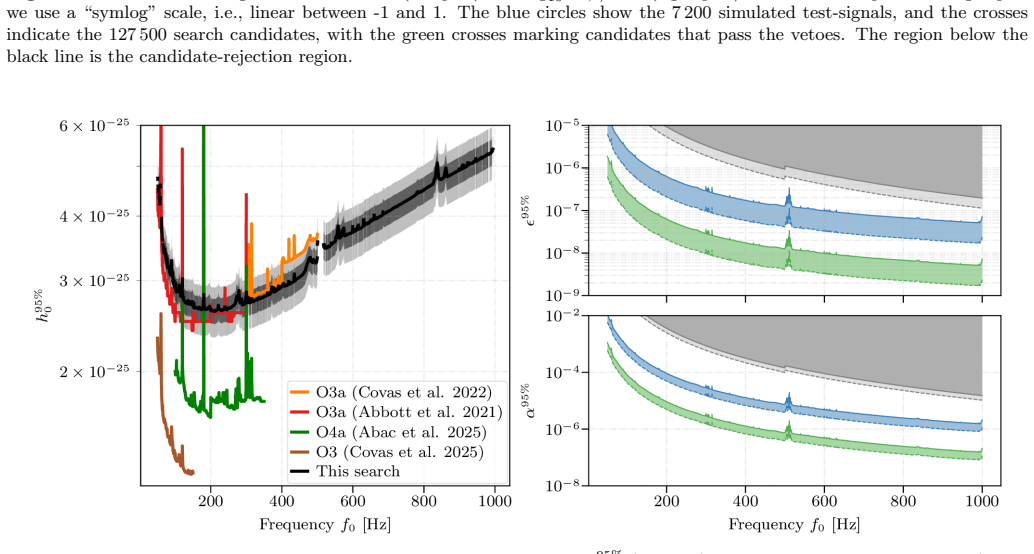
The search of the O3 dataset finds no evidence for continuous gravitational waves from unknown neutron stars in binary systems. It excludes with 95% confidence that neutron stars within 100 pc rotating faster than approximately 495 Hz have ellipticities above 5.2 × 10^{-8}. Similarly, it excludes r-mode amplitudes above 1.5 × 10^{-6} for stars rotating faster than approximately 740 Hz within the same distance.
What carries the argument
The matched-filtering search over a large template bank covering frequency, frequency derivative, and binary orbital parameters.
Load-bearing premise
The template bank and analysis pipeline are complete enough to detect any signal above the reported amplitude thresholds without significant losses from approximations or data quality issues.
What would settle it
A confirmed detection of a continuous gravitational wave from a neutron star in a binary system within 100 pc, with rotation frequency above 495 Hz and ellipticity exceeding 5.2×10^{-8}, would contradict the exclusion limits.
Figures
read the original abstract
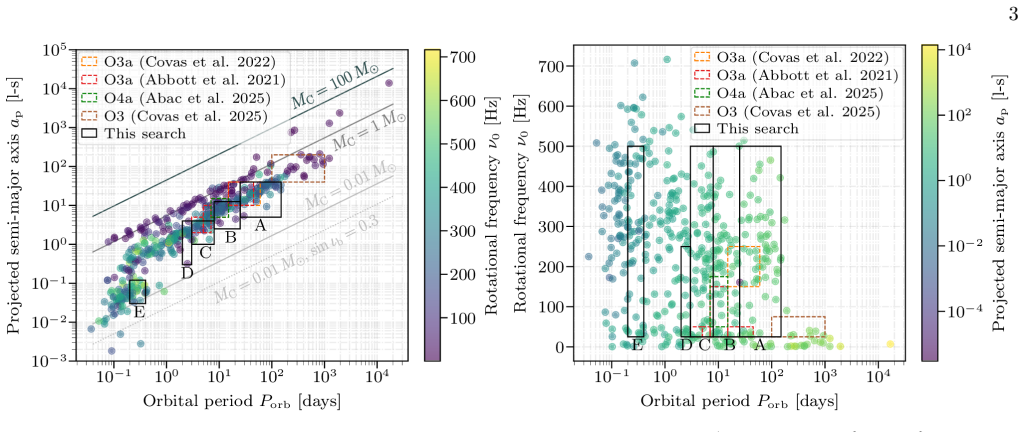
Continuous gravitational waves, i.e., persistent and nearly-monochromatic signals emitted by asymmetric spinning neutron stars, remain elusive. Searches for these signals from unknown binary systems are the most computationally challenging, but they are essential, given that binary accretion provides a natural mechanism for creating the required asymmetry, and around half of the known pulsars rotating above 25 Hz are part of a binary system. Here we report on a search of a large uncharted parameter-space region: for the first time we cover gravitational-wave frequencies above 520 Hz (from 50 to 1000 Hz), and, for the first time with advanced detectors, orbital periods lower than 3 days are explored. No signal is detected, and we set the most stringent constraints to date on the amplitude of signals of this kind. Our results exclude with $95\%$ confidence neutron stars within 100 pc and rotating faster than $\sim$ 495 Hz from having ellipticities above $5.2 \times 10^{-8}$. Within the same distance our results also exclude r-mode amplitudes above $1.5 \times 10^{-6}$ for stars rotating faster than $\sim$ 740 Hz.
Editorial analysis
A structured set of objections, weighed in public.
Referee Report
Summary. The manuscript reports results from a wide parameter-space search for continuous gravitational waves from unknown neutron stars in binary systems using LIGO O3 data. It covers gravitational-wave frequencies from 50 to 1000 Hz and, for the first time with advanced detectors, orbital periods shorter than 3 days. No signals are detected. The authors set the most stringent constraints to date, excluding with 95% confidence neutron stars within 100 pc rotating faster than ~495 Hz from having ellipticities above 5.2×10^{-8}, and excluding r-mode amplitudes above 1.5×10^{-6} for stars rotating faster than ~740 Hz.
Significance. If the search completeness and sensitivity are validated, the work provides the tightest limits to date on continuous-wave signals from binary neutron stars by extending coverage into previously unexplored high-frequency and short-orbital-period regimes. This is valuable for constraining neutron-star asymmetries and accretion mechanisms. The computational scope of the search is a notable strength.
major comments (1)
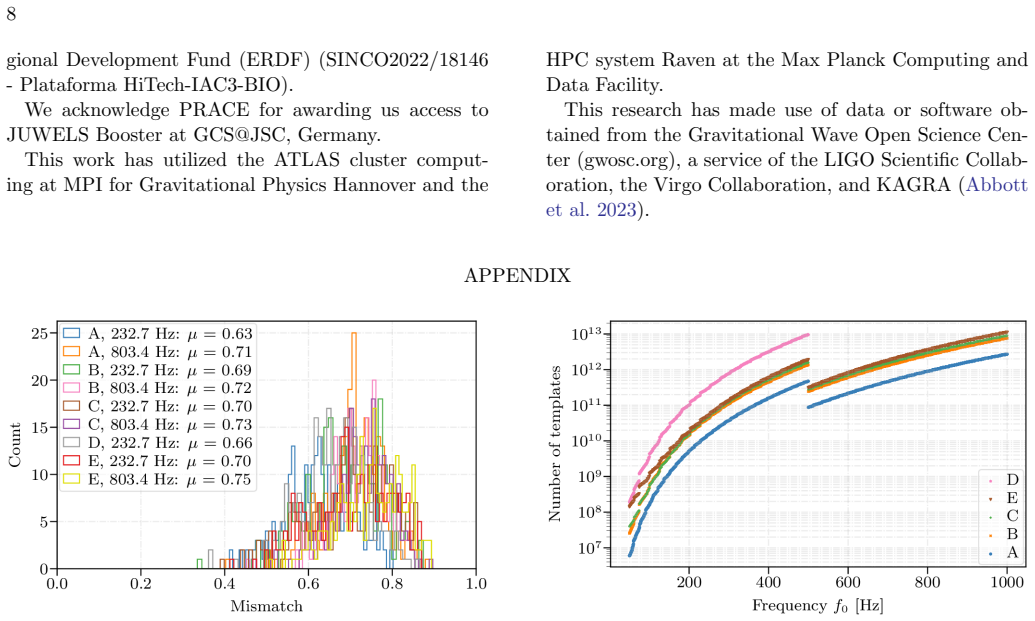
- [Results and Methods sections (validation of template bank and sensitivity)] The 95% confidence exclusion limits on ellipticity and r-mode amplitude (stated in the abstract and results) rest on the assumption that the template bank and pipeline are complete and sensitive across the full 50-1000 Hz range and all orbital periods down to <3 days with low mismatch. The manuscript must include explicit validation (e.g., mismatch calculations or recovery fractions from injections) specifically for the newly explored regimes above 520 Hz and below 3-day periods; without this, the robustness of the quoted thresholds cannot be verified and the central claim is not fully supported.
Simulated Author's Rebuttal
We thank the referee for their careful reading of the manuscript and for highlighting the need for explicit validation in the newly explored parameter space. We address the comment below.
read point-by-point responses
-
Referee: [Results and Methods sections (validation of template bank and sensitivity)] The 95% confidence exclusion limits on ellipticity and r-mode amplitude (stated in the abstract and results) rest on the assumption that the template bank and pipeline are complete and sensitive across the full 50-1000 Hz range and all orbital periods down to <3 days with low mismatch. The manuscript must include explicit validation (e.g., mismatch calculations or recovery fractions from injections) specifically for the newly explored regimes above 520 Hz and below 3-day periods; without this, the robustness of the quoted thresholds cannot be verified and the central claim is not fully supported.
Authors: We agree that explicit validation for the high-frequency and short-orbital-period regimes is essential to support the quoted limits. Although the Methods section describes the general construction of the template bank with mismatch bounds and the sensitivity estimation procedure, we acknowledge that specific demonstrations for the new regimes (f > 520 Hz and P_orb < 3 days) were not included. In the revised version, we will add a dedicated paragraph or subsection presenting mismatch histograms and injection recovery fractions for representative points in these regimes, confirming that the pipeline performs as designed. revision: yes
Circularity Check
Observational matched-filter search yields data-driven upper limits with no circular derivation.
full rationale
This is a standard gravitational-wave search paper that applies matched filtering to real LIGO O3 detector data over an expanded parameter space (50-1000 Hz, orbital periods <3 days). The central results—no detected signals and 95% confidence exclusion limits on ellipticity (5.2e-8) and r-mode amplitude (1.5e-6) for d<100 pc—are extracted empirically from the lack of candidates above threshold. No equations, predictions, or uniqueness claims reduce by construction to fitted inputs, self-citations, or ansatzes; the pipeline completeness assumption is an external methodological claim, not a self-referential loop. The derivation chain is self-contained against external data.
Axiom & Free-Parameter Ledger
axioms (2)
- domain assumption LIGO O3 strain data can be searched for continuous-wave signals via matched filtering after standard noise subtraction and vetoes.
- domain assumption Neutron stars in binaries can sustain the ellipticities or r-modes needed to produce detectable continuous gravitational waves.
Forward citations
Cited by 1 Pith paper
-
First Constraints on the Ellipticities of Self-Interacting Fermionic Dark Matter Admixed Neutron Stars from Continuous Gravitational-Wave Searches
Using LIGO O3 continuous-wave search data, the authors place the first constraints on ellipticities of self-interacting fermionic dark matter admixed neutron stars and exclude regions of the DM parameter space for mas...
Reference graph
Works this paper leans on
-
[1]
Aasi, J., Abbott, B. P., Abbott, R., et al. 2014, Phys. Rev. D, 90, 062010, doi: 10.1103/PhysRevD.90.062010
-
[2]
G., Abouelfettouh, I., Acernese, F., et al
Abac, A. G., Abouelfettouh, I., Acernese, F., et al. 2025, arXiv, 2511.16863, doi: 10.48550/arXiv.2511.16863
-
[3]
Abbott, B., Abbott, R., Adhikari, R., et al. 2007, Phys. Rev. D, 76, 042001, doi: 10.1103/PhysRevD.76.042001
-
[4]
Abbott, R., Abbott, T. D., Abraham, S., et al. 2021, Phys. Rev. D, 103, 064017, doi: 10.1103/PhysRevD.103.064017
-
[5]
Abbott, R., Abe, H., Acernese, F., et al. 2022, Phys. Rev. D, 106, 102008, doi: 10.1103/PhysRevD.106.102008 —. 2023, Astrophys. J. Supplement Series, 267, 29, doi: 10.3847/1538-4365/acdc9f
-
[6]
2004, Tech
Allen, B., & Mendell, G. 2004, Tech. Rep. T040164. https://dcc.ligo.org/LIGO-T040164/public
2004
-
[7]
Ashton, G., Jones, D. I., & Prix, R. 2015, Phys. Rev. D, 91, 062009, doi: 10.1103/PhysRevD.91.062009
-
[8]
Ashton, G., Prix, R., & Jones, D. I. 2017, Phys. Rev. D, 96, 063004, doi: 10.1103/PhysRevD.96.063004
-
[9]
Ashton, G., H¨ ubner, M., Lasky, P. D., et al. 2019, Astrophys. J. Supplement Series, 241, 27, doi: 10.3847/1538-4365/ab06fc
-
[10]
Behnke, B., Papa, M. A., & Prix, R. 2015, Phys. Rev. D, 91, 064007, doi: 10.1103/PhysRevD.91.064007
-
[11]
Biwer, C., Barker, D., Batch, J. C., et al. 2017, Phys. Rev. D, 95, 062002, doi: 10.1103/PhysRevD.95.062002
-
[12]
Gravitational waves from pulsars: emission by the magnetic field induced distortion
Bonazzola, S., & Gourgoulhon, E. 1996, A&A, 312, 675, doi: 10.48550/arXiv.astro-ph/9602107
work page internal anchor Pith review Pith/arXiv arXiv doi:10.48550/arxiv.astro-ph/9602107 1996
-
[13]
Bondarescu, R., Teukolsky, S. A., & Wasserman, I. 2007, Phys. Rev. D, 76, 064019, doi: 10.1103/PhysRevD.76.064019
-
[14]
Buikema, A., Cahillane, C., Mansell, G. L., et al. 2020, Phys. Rev. D, 102, 062003, doi: 10.1103/PhysRevD.102.062003
-
[15]
Chugunov, A. I., Gusakov, M. E., & Kantor, E. M. 2014, MNRAS, 445, 385, doi: 10.1093/mnras/stu1772
-
[16]
Covas, P. B., Papa, M. A., & Prix, R. 2025, Astrophys. J., 985, 192, doi: 10.3847/1538-4357/adcc2b —. 2026, https: //www.aei.mpg.de/continuouswaves/O3AllSkyBinary2
-
[17]
Covas, P. B., Papa, M. A., Prix, R., & Owen, B. J. 2022, Astrophys. J. Lett., 929, L19, doi: 10.3847/2041-8213/ac62d7
-
[18]
Covas, P. B., & Prix, R. 2022a, Phys. Rev. D, 106, 084035, doi: 10.1103/PhysRevD.106.084035 —. 2022b, Phys. Rev. D, 105, 124007, doi: 10.1103/PhysRevD.105.124007 10
-
[19]
Covas, P. B., Prix, R., & Martins, J. 2024, Phys. Rev. D, 110, 024053, doi: 10.1103/PhysRevD.110.024053
-
[20]
Covas, P. B., & Sintes, A. 2020, Phys. Rev. Lett., 124, 191102, doi: 10.1103/PhysRevLett.124.191102
-
[21]
Covas, P. B., & Sintes, A. M. 2019, Phys. Rev. D, 99, 124019, doi: 10.1103/PhysRevD.99.124019
-
[22]
B., Effler, A., Goetz, E., et al
Covas, P. B., Effler, A., Goetz, E., et al. 2018, Phys. Rev. D, 97, 082002, doi: 10.1103/PhysRevD.97.082002
-
[23]
Dreissigacker, C., Prix, R., & Wette, K. 2018, Phys. Rev. D, 98, 084058, doi: 10.1103/PhysRevD.98.084058
-
[24]
Fantina, A. F., Zdunik, J. L., Chamel, N., et al. 2022, A&A, 665, A74, doi: 10.1051/0004-6361/202243715
-
[25]
2019, MNRAS, 488, 99–110, doi: 10.1093/mnras/stz1719 —
Gittins, F., & Andersson, N. 2019, MNRAS, 488, 99–110, doi: 10.1093/mnras/stz1719 —. 2021, MNRAS, 507, 116, doi: 10.1093/mnras/stab2048
-
[26]
Gusakov, M. E., Chugunov, A. I., & Kantor, E. M. 2014a, Phys. Rev. Lett., 112, 151101, doi: 10.1103/PhysRevLett.112.151101 —. 2014b, Phys. Rev. D, 90, 063001, doi: 10.1103/PhysRevD.90.063001
-
[27]
Horowitz, C. J. 2010, Phys. Rev. D, 81, 103001, doi: 10.1103/PhysRevD.81.103001
-
[28]
Hutchins, T. J., & Jones, D. I. 2023, MNRAS, 522, 226, doi: 10.1093/mnras/stad967
-
[29]
Jaranowski, P., Kr´ olak, A., & Schutz, B. F. 1998, Phys. Rev. D, 58, 063001, doi: 10.1103/PhysRevD.58.063001
-
[30]
Jones, D. I., & Riles, K. 2025, Class. Quant. Grav., 42, 033001, doi: 10.1088/1361-6382/ada244
-
[31]
Keitel, D. 2016, Phys. Rev. D, 93, 084024, doi: 10.1103/PhysRevD.93.084024
-
[32]
Leaci, P., & Prix, R. 2015, Phys. Rev. D, 91, 102003, doi: 10.1103/PhysRevD.91.102003
-
[33]
Manchester, R. N., Hobbs, G. B., Teoh, A., & Hobbs, M. 2005, Astronom. J., 129, 1993–2006, doi: 10.1086/428488
work page internal anchor Pith review doi:10.1086/428488 2005
-
[34]
Mukherjee, A., Messenger, C., & Riles, K. 2018, Phys. Rev. D, 97, 043016, doi: 10.1103/PhysRevD.97.043016
-
[35]
Owen, B. J. 2005, Phys. Rev. Lett., 95, 211101, doi: 10.1103/PhysRevLett.95.211101 —. 2010, Phys. Rev. D, 82, 104002, doi: 10.1103/PhysRevD.82.104002
-
[36]
Patruno, A., & Watts, A. L. 2020, Accreting Millisecond X-ray Pulsars (Springer Berlin Heidelberg), 143–208, doi: 10.1007/978-3-662-62110-3 4
-
[37]
Riles, K. 2023, Liv. Rev. in Relat., 26, 1, doi: 10.1007/s41114-023-00044-3
-
[38]
Rossetto, P. H. B., Frauendiener, J., & Melatos, A. 2025, Astrophys. J., 979, 10, doi: 10.3847/1538-4357/ada276
-
[39]
2020, MNRAS, 493, 3866, doi: 10.1093/mnras/staa442
Singh, N., Haskell, B., Mukherjee, D., & Bulik, T. 2020, MNRAS, 493, 3866, doi: 10.1093/mnras/staa442
-
[40]
Steltner, B., Papa, M., & Eggenstein, H. 2022, Phys. Rev. D, 105, 022005, doi: 10.1103/PhysRevD.105.022005
-
[41]
Steltner, B., Papa, M. A., Eggenstein, H.-B., et al. 2021, Astrophys. J., 909, 79, doi: 10.3847/1538-4357/abc7c9
-
[42]
Tenorio, R., Keitel, D., & Sintes, A. M. 2021, Universe, 7, 474, doi: 10.3390/universe7120474
-
[43]
2023, Astroparticle Physics, 153, 102880, doi: 10.1016/j.astropartphys.2023.102880
Wette, K. 2023, Astroparticle Physics, 153, 102880, doi: 10.1016/j.astropartphys.2023.102880
discussion (0)
Sign in with ORCID, Apple, or X to comment. Anyone can read and Pith papers without signing in.