Thermal expansion of FeWO₄ (Ferberite) and FeWO₄:Fe₂WO₆ (7:1): a comparative X-ray and neutron diffraction study
Pith reviewed 2026-06-30 20:24 UTC · model grok-4.3
The pith
The FeWO4:Fe2WO6 mixture shows a thermal expansion coefficient roughly 40 percent smaller than pure ferberite, with a reduced reference volume.
A machine-rendered reading of the paper's core claim, the machinery that carries it, and where it could break.
Core claim
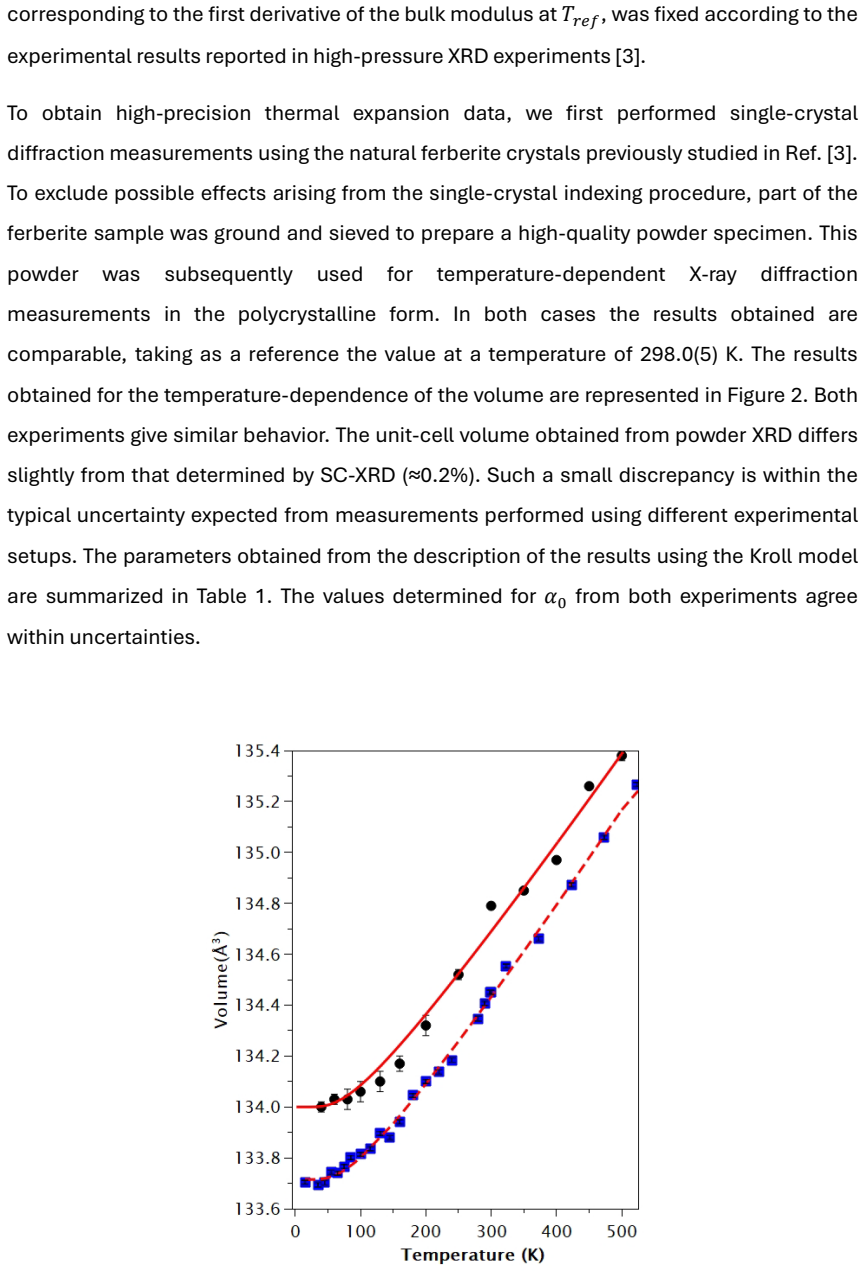
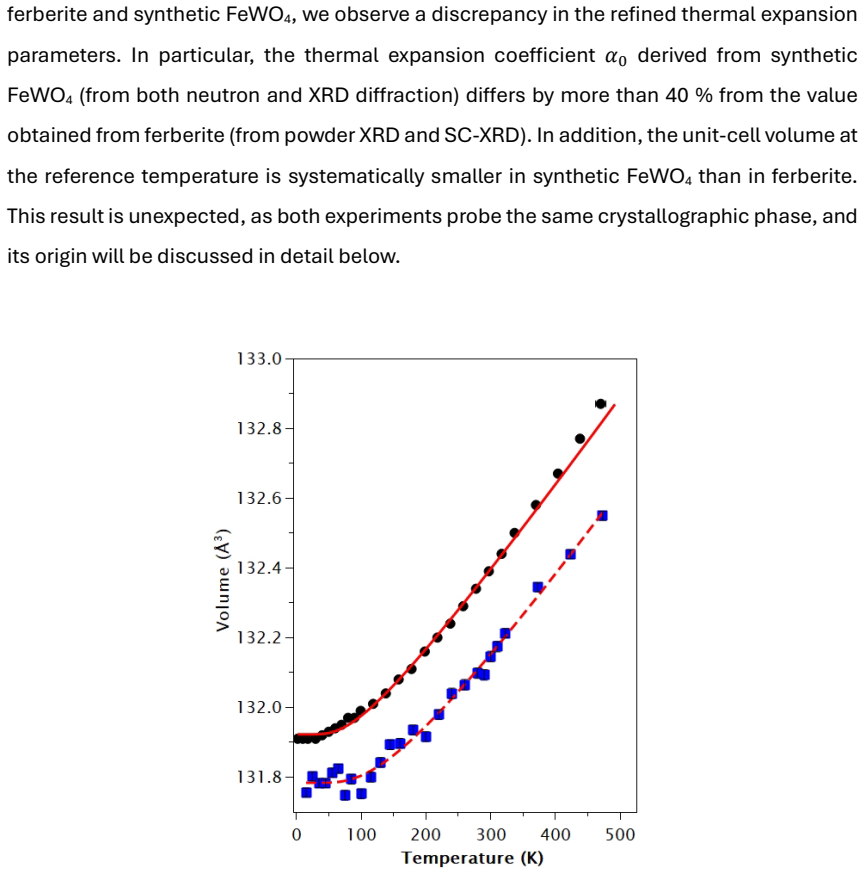
Significant differences are observed between the behavior of ferberite and FeWO4:Fe2WO6, which has a ~40% smaller thermal expansion coefficient and a reduced reference volume. All datasets are well reproduced within their respective temperature intervals by the Kroll and Berman approaches as implemented in EoSFit7.
What carries the argument
High-precision lattice parameters obtained from combined single-crystal X-ray, powder X-ray, and neutron powder diffraction, fitted to physically based thermodynamic models for unit-cell volume versus temperature.
If this is right
- The Kroll and Berman models describe the temperature dependence of the unit-cell volume for both phases across the full measured range.
- Phase coexistence inside the mixed sample produces a measurably lower thermal expansion coefficient and smaller reference volume.
- The results supply a complete set of lattice-parameter data for FeWO4-based materials from cryogenic to above 1100 K.
- Microstructural features can alter the effective thermal expansion of tungsten-based compounds without changing the average composition.
Where Pith is reading between the lines
- Controlling the ratio of Fe2WO6 could offer a route to tune the thermal expansion of related iron-tungsten oxides for high-temperature use.
- Natural ferberite samples may show different expansion behavior depending on their geological history of phase mixing or defect density.
- Repeating the measurements on other mixture ratios would test whether the 40 percent reduction scales continuously with Fe2WO6 content.
Load-bearing premise
The measured differences in expansion and volume arise from intrinsic microstructural or phase-coexistence effects in the samples rather than from experimental artifacts, impurities, or unmodeled temperature-dependent changes in diffraction conditions.
What would settle it
Performing identical diffraction measurements on a pure synthetic FeWO4 crystal or powder and checking whether its thermal expansion coefficient matches the natural ferberite value or the smaller mixed-phase value.
Figures
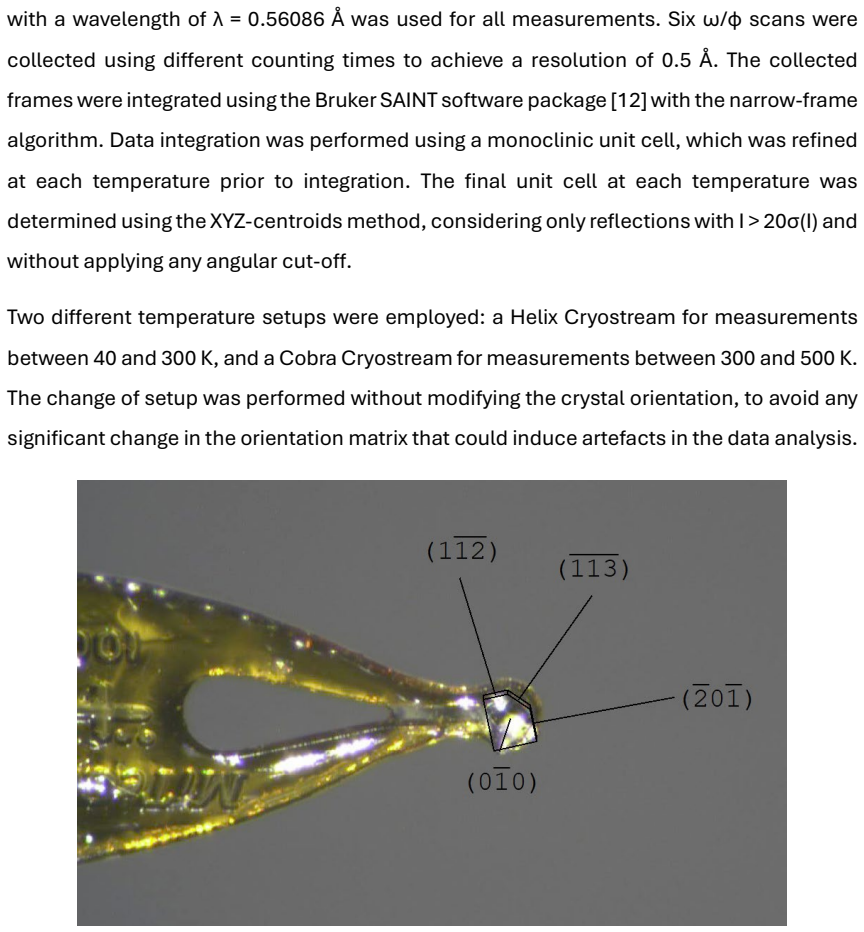
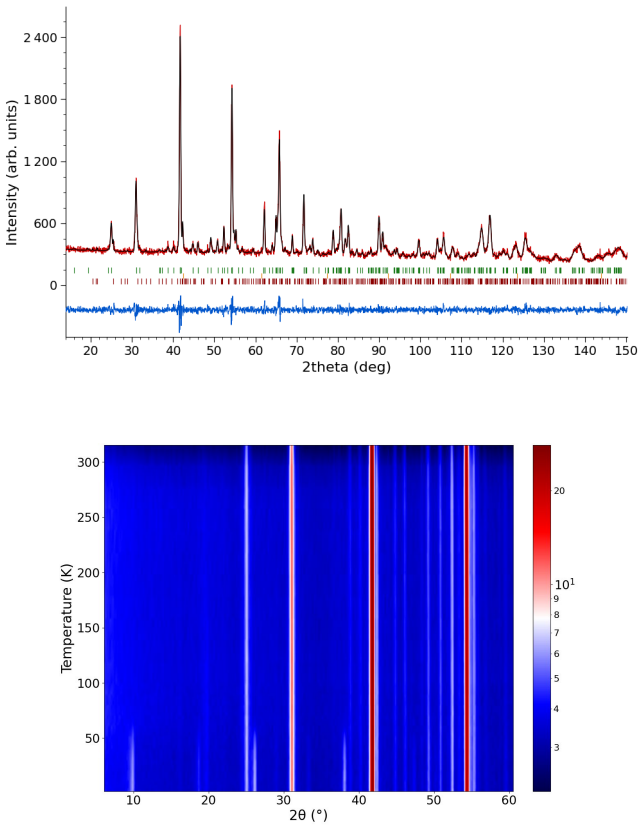
read the original abstract
The thermal expansion of natural FeWO$_4$ (ferberite) and synthetic FeWO$_4$:Fe$_2$WO$_6$ (7:1) was investigated over the 2-1123 K temperature range combining single-crystal and powder X-ray diffraction together with neutron powder diffraction. High-precision lattice parameters were obtained for both samples. The temperature dependence of the unit-cell volume was analysed using physically based thermodynamic models, including the Kroll and Berman approaches as implemented in EoSFit7. All datasets are well reproduced within their respective temperature intervals. However, significant differences are observed between the behavior of ferberite and FeWO$_4$:Fe$_2$WO$_6$, which has a \~40% smaller thermal expansion coefficient and a reduced reference volume. Possible origins, including microstructural and phase-coexistence effects, are discussed. The results provide a comprehensive description of the thermal expansion behavior of FeWO$_4$ across a wide temperature range.
Editorial analysis
A structured set of objections, weighed in public.
Referee Report
Summary. The manuscript reports a comparative study of the thermal expansion of natural FeWO₄ (ferberite) and synthetic FeWO₄:Fe₂WO₆ (7:1) over 2–1123 K, using single-crystal and powder X-ray diffraction together with neutron powder diffraction. High-precision lattice parameters are extracted for both samples and fitted to the Kroll and Berman thermodynamic models as implemented in EoSFit7. The synthetic mixture is reported to exhibit a ~40% smaller thermal expansion coefficient and a reduced reference volume relative to natural ferberite; possible microstructural and phase-coexistence origins are discussed.
Significance. If the reported differences are confirmed to be intrinsic, the work supplies a wide-temperature-range experimental dataset on FeWO₄ thermal expansion obtained by complementary diffraction methods and physically motivated model fits. Such data are useful for mineralogical and materials applications where phase coexistence or microstructure may modulate thermal response.
major comments (1)
- [Abstract] Abstract: the central claim of a ~40% smaller thermal expansion coefficient for the synthetic sample is stated without error bars, tabulated raw lattice parameters, sample-purity characterization, or explicit data-reduction steps. These omissions make the magnitude and statistical significance of the difference only partially verifiable from the information provided.
Simulated Author's Rebuttal
We thank the referee for the positive assessment and the helpful comment on the abstract. We address the point below and agree that a minor revision to the abstract will improve standalone clarity while preserving the manuscript's focus.
read point-by-point responses
-
Referee: [Abstract] Abstract: the central claim of a ~40% smaller thermal expansion coefficient for the synthetic sample is stated without error bars, tabulated raw lattice parameters, sample-purity characterization, or explicit data-reduction steps. These omissions make the magnitude and statistical significance of the difference only partially verifiable from the information provided.
Authors: The detailed lattice parameters (with e.s.d.s from the refinements), sample synthesis and purity characterization (via chemical analysis and phase identification), and data-reduction procedures are fully described in the Experimental Methods and Results sections, with all fitted coefficients and uncertainties reported in the tables and figures. The abstract follows standard practice as a concise summary of the key finding. To improve verifiability of the central claim directly from the abstract, we will revise it to include approximate uncertainties on the thermal expansion coefficients and the percentage difference (derived from the Kroll/Berman model fits), while directing readers to the full datasets and supplementary tables for raw values. revision: yes
Circularity Check
No significant circularity; results are direct experimental observations
full rationale
The paper's central claims consist of high-precision lattice parameters measured via combined XRD and neutron diffraction over 2-1123 K, followed by post-hoc fitting of standard Kroll and Berman models (implemented in EoSFit7) to the volume-temperature data. The reported ~40% difference in thermal expansion coefficient and reduced reference volume between the two samples is an empirical observation from the measured datasets, with no feedback from the fits into the raw measurements or reported differences. No self-citations, ansatzes, or uniqueness theorems are invoked to derive or justify the load-bearing results; the models are applied after data collection and serve only for parameterization. The derivation chain is therefore self-contained against external benchmarks (diffraction data), with no reduction of predictions or claims to fitted inputs by construction.
Axiom & Free-Parameter Ledger
free parameters (1)
- reference volume and thermal-expansion coefficients
axioms (1)
- domain assumption The Kroll and Berman models, as coded in EoSFit7, correctly capture the temperature dependence of unit-cell volume for these materials.
Reference graph
Works this paper leans on
-
[1]
(2026) J
Muñoz, A., Radescu, S., Mujica, A., & Errandonea, D. (2026) J. Phys. Chem. 130, 9, 3201– 3225
2026
-
[2]
(1968) Zeitschrift für Kristallographie 127, 61-72
Cid-Dresdner, H. (1968) Zeitschrift für Kristallographie 127, 61-72
1968
-
[3]
E., López-Moreno, S., Turnbull, R., Manjón, F
Diaz-Anichtchenko, D., Aviles-Coronado, J. E., López-Moreno, S., Turnbull, R., Manjón, F . J., Popescu, C., & Errandonea D. (2024) Inorg. Chem. 63, 6898-6908
2024
-
[4]
A., Lorenz, T., & Khomskii, D
Heyer, O., Hollmann, N., Klassen, I., Jodlauk, S., Bohatý, L., Becker, P ., Mydosh, J. A., Lorenz, T., & Khomskii, D. (2006= J. Phys.: Condens. Matter 18, L471−L475
2006
-
[5]
(2003) Eur
García-Matres, E., Stüßer, N., Hofmann, M., & Reehuis, M. (2003) Eur. Phys. J. B 32, 35−42
2003
-
[6]
I., Daou, R., Chang, C
Maignan, A., Schmidt, M., Prots, Y ., Lebedev, O. I., Daou, R., Chang, C. F ., Kuo, C. Y ., Hu, Z., Chen, C. T ., Weng, C. C., Altendorf , S. G., Tjeng, L. H., & Grin, Y . (2022) Chem. Mat. 34, 789-797
2022
-
[7]
(2012) Eur
Kroll H., Kirfel A., Heinemann R., & Barbier B. (2012) Eur. J. Miner. 24, 935-956
2012
-
[8]
Salje E. K. H., Wruck B., & Thomas H. (1991) Zeitschrift für Physik B 82, 399-404
1991
-
[9]
Berman R. G. (1988) J. Petrol. 29, 445-522
1988
-
[10]
(2024) J
Fabelo, O., Gonzalez-Platas, J., Savvin, S., Botella, P ., & Errandonea, D. (2024) J. Appl. Phys. 136, 175901
2024
-
[11]
Gonzalez-Platas, J., Alvaro, M., Nestola, F ., Angel, R. 2016, J. Appl. Cryst, 49, 1377-1382
2016
-
[12]
Bruker. SAINT. Version 8.34a. Bruker AXS Inc. Madison, Wisconsin, EEUU (2014)
2014
-
[13]
Le Bail, A., Duroy, H., & Fourquet, J. L. (1998) Mater. Res. Bull. 23, 447-452
1998
-
[14]
(1993) Physica B 192, 55-69
Rodríguez-Carvajal, J. (1993) Physica B 192, 55-69
1993
-
[15]
T. C. Hansen, P . F . Henry, H. E. Fischer, J. Torregrossa, and P . Convert, Meas. Sci. Technol., 2008, 19, 034001
2008
-
[16]
W., Cox, D
Finger, L. W., Cox, D. E., & Jephcoat, A. P . (1994) J. Appl. Cryst. 27, 892–900
1994
-
[17]
Available in the online ILL repository, https://code.ill.fr/fabelo/panda
-
[18]
Qin, W., Nagase, T., Umakoshi, Y ., & Szpunar, J. A. (2008) Phil. Mag. Letters 88, 169–179
2008
-
[19]
Akhlaghi, M., Steiner, T., Meka, S. R. & Mittemeijer, E. J. (2016) J. Appl. Cryst. 49, 69-77
2016
-
[20]
L., & Tuan, W.H
Hsieh, C. L., & Tuan, W.H. & Mater. Sci. Eng. A 425, 349–360
-
[21]
(2009) Mat
Takeda, M., Onishi, T., Nakakubo, S., & Fujimoto, S. (2009) Mat. Trans. 50, 2242-2246
2009
-
[22]
Zou, Y ., Wang, P ., Li, Y ., Chen, H., Zhou, C., & Irifune, T, (2025) iScience 28, 111905
2025
-
[23]
(2018) Ceram
Yang, G., Liu, X., Sun, X., Liang, E., & Zhang, W. (2018) Ceram. Int. 44, 22032-22035
2018
-
[24]
Shannon, R. D. (1976) Acta Crystallogr. A 32, 751–767
1976
-
[25]
Errandonea, D., & Manjon, F . J. (2008) Progress in Materials Science 53, 711-773. 20
2008
-
[26]
A., Dubrovinsky, L
Dubrovinskaia, N. A., Dubrovinsky, L. S., Saxena, S. K., & Sundman, B. (1997) Calphad 21, 497-508
1997
-
[27]
Drebushchak, V . A. (2020) J. Thermal Anal. Calor. 142, 1097–1113. S1 SUPPORTING INFORMATION Thermal expansion of FeWO₄ (Ferberite) and FeWO4:Fe2WO6 (7:1): a comparative X-ray and neutron diffraction study O. Fabelo 1, L. Cañadillas -Delgado1, D. Vie 2, E. Matesanz 3, J. Gonzalez- Platas4, and D. Errandonea5,* 1 Institut Laue-Langevin, 71 avenue des Marty...
2020
discussion (0)
Sign in with ORCID, Apple, or X to comment. Anyone can read and Pith papers without signing in.