GenAI for Energy-Efficient and Interference-Aware Compressed Sensing of GNSS Signals on a Google Edge TPU
Pith reviewed 2026-06-30 21:32 UTC · model grok-4.3
The pith
Variational autoencoders compress GNSS signals more than 42 times while classifying about 72 interference types on reconstructed data with near-original accuracy.
A machine-rendered reading of the paper's core claim, the machinery that carries it, and where it could break.
Core claim
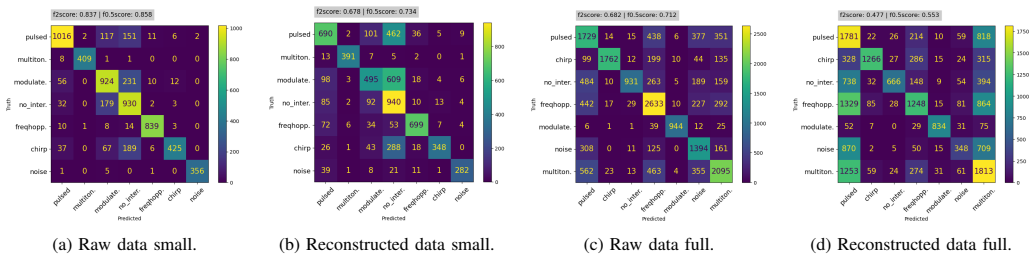
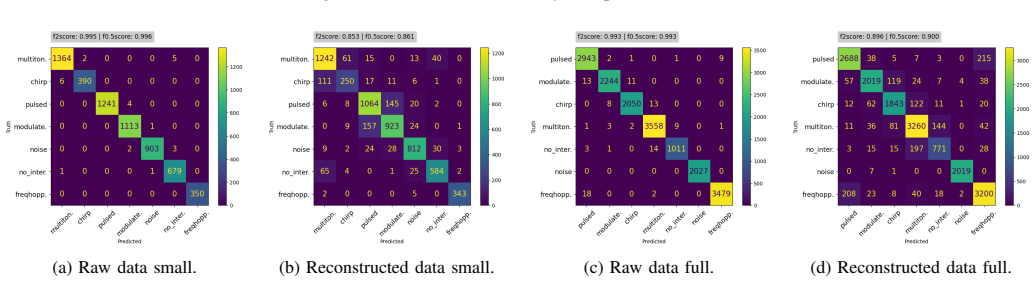
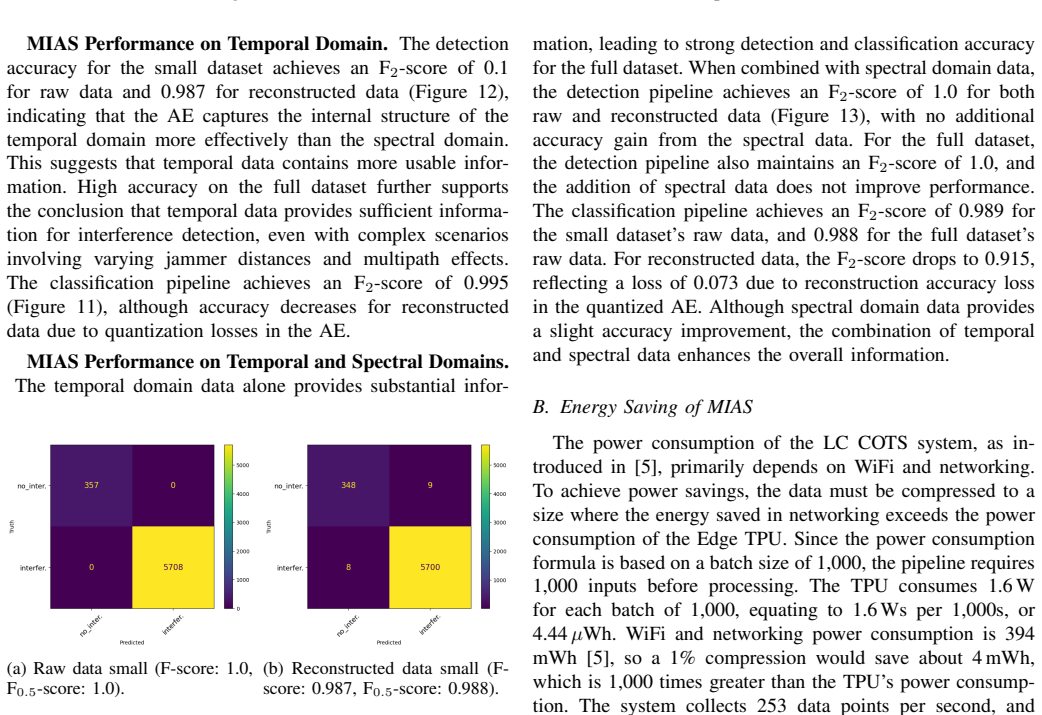
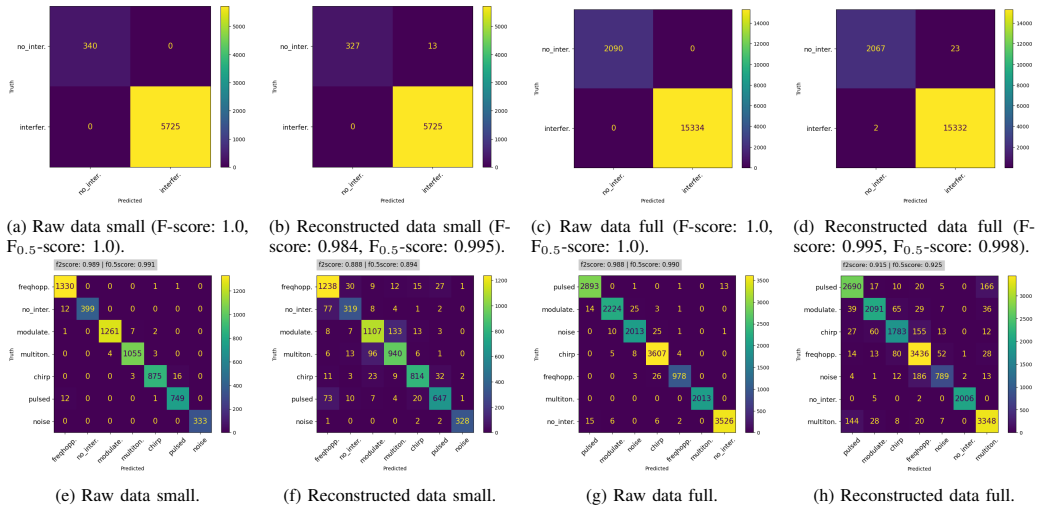
The central claim is that variational autoencoders, after 8-bit quantization for edge deployment, perform compressed sensing of GNSS signals while preserving the signal features needed to classify roughly 72 interference types; tests across raw IQ, FFT, and feature inputs yield compression factors exceeding 42 times and classification F2-scores on reconstructed signals that closely match those obtained from the original signals.
What carries the argument
Variational autoencoders with 8-bit quantization, used for simultaneous compression, reconstruction, and interference classification of GNSS signals on edge hardware.
If this is right
- Real-time classification of jamming and spoofing attacks becomes possible near the receiver without transmitting raw data streams.
- Transmission costs for interference signals are substantially reduced by the reported compression factor.
- Classification performance on reconstructed signals stays close to the performance on original signals across multiple input representations.
- Ablation results on conditional and factorized variational autoencoders indicate that latent feature disentanglement improves model interpretability for interference applications.
Where Pith is reading between the lines
- The same compression-plus-classification pipeline could be tested on other radio-frequency signals that require low-power, on-device analysis.
- If the quantization step generalizes, similar autoencoder deployments might reduce bandwidth needs in additional edge sensing scenarios.
- The disentanglement properties explored in the factorized models could support generation of synthetic training data for more robust interference detectors.
Load-bearing premise
The 8-bit quantization of the variational autoencoder models preserves the interference signal characteristics sufficiently for the reported classification performance to hold across the tested data representations.
What would settle it
An experiment in which the F2-score on reconstructed signals falls well below 0.915 while the score on the corresponding original signals remains near 0.923, or in which the achieved compression ratio drops substantially below 42 times without preserving classification accuracy, would falsify the central claim.
Figures


read the original abstract
Traditional methods for classifying global navigation satellite system (GNSS) jamming signals typically involve post-processing raw or spectral data streams, requiring complex and costly data transmission to cloud-based interference classification systems. In contrast, our proposed approach efficiently compresses GNSS data streams directly at the hardware receiver while simultaneously classifying jamming and spoofing attacks in real time. Given the growing prevalence of GNSS jamming, there is a critical need for real-time solutions suitable for power-constrained environments. This paper introduces a novel method for compressing and classifying GNSS jamming threats using generative artificial intelligence (GenAI), specifically variational autoencoders (VAEs), deployed on Google Edge tensor processing units (TPUs). The study evaluates various autoencoder (AE) architectures to compress and reconstruct GNSS signals, focusing on preserving interference characteristics while minimizing data size near the receiver hardware. The pipeline adapts large-scale AE models for Google Edge TPUs through 8-bit quantization to ensure energy-efficient deployment. Tests on raw in-phase and quadrature-phase (IQ) data, Fast Fourier Transform (FFT) data, and handcrafted features show the system achieves significant compression (>42x) and accurate classification of approximately 72 interference types on reconstructed signals (F2-score 0.915), closely matching the original signals (F2-score 0.923). The hardware-centric GenAI approach also substantially reduces jammer signal transmission costs, offering a practical solution for interference mitigation. Ablation studies on conditional and factorized VAEs (i.e., FactorVAE) explore latent feature disentanglement for data generation, enhancing model interpretability and fostering trust in machine learning (ML) solutions for sensitive interference applications.
Editorial analysis
A structured set of objections, weighed in public.
Referee Report
Summary. The manuscript proposes using variational autoencoders (VAEs) deployed on Google Edge TPUs to compress GNSS signals at the receiver while performing real-time classification of approximately 72 interference types. It reports >42x compression ratios with F2-scores of 0.915 on reconstructed signals versus 0.923 on originals after 8-bit quantization, evaluated on raw IQ data, FFT data, and handcrafted features; ablation studies on conditional and factorized VAEs are mentioned for latent disentanglement.
Significance. If the empirical results hold under scrutiny, the work could enable practical on-device, energy-efficient GNSS interference mitigation in power-constrained settings, reducing reliance on cloud transmission of jammer signals.
major comments (2)
- [Abstract] Abstract: The headline metrics (>42x compression, F2 0.915 on reconstructed vs. 0.923 on original for 72 classes) are presented without any description of experimental setup, dataset characteristics, number of samples, baselines, or statistical error analysis, preventing assessment of whether the compression retains the interference features used by the downstream classifier.
- [Hardware deployment and quantization] The central claim that 8-bit quantization for Edge TPU deployment preserves interference signal characteristics sufficiently for near-identical F2 performance is unsupported by any explicit ablation comparing full-precision versus quantized reconstruction quality or classification scores on the same IQ/FFT/feature inputs.
minor comments (1)
- [Abstract] The abstract references ablation studies on conditional and factorized VAEs but provides no quantitative outcomes or connection to the main compression/classification results.
Simulated Author's Rebuttal
We thank the referee for the constructive feedback on the abstract and the quantization claims. We address each major comment below and will revise the manuscript accordingly to provide the requested details and supporting analyses.
read point-by-point responses
-
Referee: [Abstract] Abstract: The headline metrics (>42x compression, F2 0.915 on reconstructed vs. 0.923 on original for 72 classes) are presented without any description of experimental setup, dataset characteristics, number of samples, baselines, or statistical error analysis, preventing assessment of whether the compression retains the interference features used by the downstream classifier.
Authors: We agree that the abstract would benefit from additional context on the experimental setup. In the revised manuscript, we will expand the abstract to briefly note the evaluation across raw IQ data, FFT data, and handcrafted features for classifying 72 interference types, and we will ensure the methods and results sections explicitly describe the dataset characteristics, sample counts, baselines, and any statistical error analysis (e.g., standard deviations across runs) to allow readers to assess feature preservation. revision: yes
-
Referee: [Hardware deployment and quantization] The central claim that 8-bit quantization for Edge TPU deployment preserves interference signal characteristics sufficiently for near-identical F2 performance is unsupported by any explicit ablation comparing full-precision versus quantized reconstruction quality or classification scores on the same IQ/FFT/feature inputs.
Authors: We acknowledge that the current manuscript does not include an explicit ablation study isolating the effects of 8-bit quantization. We will add this comparison in the revised version, reporting reconstruction metrics (such as MSE) and downstream F2-scores for full-precision versus quantized models on identical IQ, FFT, and feature inputs to directly support the claim of near-identical performance after quantization. revision: yes
Circularity Check
No circularity; purely empirical measurements with no derivation chain
full rationale
The manuscript reports experimental results from training and deploying VAEs (including conditional and FactorVAE variants) on GNSS IQ/FFT/feature data for compression and 72-class interference classification, followed by 8-bit quantization for Edge TPU. All performance numbers (F2 0.915 on reconstructions vs 0.923 on originals, >42x compression) are presented as direct measurements from ablation studies and hardware tests. No equations, first-principles derivations, uniqueness theorems, or parameter-fitting steps are described that could reduce predictions to inputs by construction. The work is therefore self-contained as an empirical pipeline evaluation.
Axiom & Free-Parameter Ledger
Reference graph
Works this paper leans on
-
[2]
Low-Cost COTS GNSS Interference Monitoring, Detection, and Classification System,
J. R. van der Merwe, D. C. Franco, J. Hansen, T. Brieger, T. Feigl, F. Ott, D. Jdidi, A. R ¨ugamer, and W. Felber, “Low-Cost COTS GNSS Interference Monitoring, Detection, and Classification System,” inMDPI Sensors, vol. 23(7), 3452, Mar. 2023
2023
-
[3]
Evaluation of (Un-)Supervised Machine Learning Methods for GNSS Interference Classification with Real-World Data Discrepancies,
L. Heublein, N. L. Raichur, T. Feigl, T. Brieger, F. Heuer, L. Asbach, A. R ¨ugamer, and F. Ott, “Evaluation of (Un-)Supervised Machine Learning Methods for GNSS Interference Classification with Real-World Data Discrepancies,” inION GNSS+, Baltimore, MD, Sep. 2024
2024
-
[4]
Few-Shot Learning with Uncertainty-based Quadruplet Selection for Interference Classification in GNSS Data,
F. Ott, L. Heublein, N. L. Raichur, T. Feigl, J. Hansen, A. R ¨ugamer, and C. Mutschler, “Few-Shot Learning with Uncertainty-based Quadruplet Selection for Interference Classification in GNSS Data,” inICL-GNSS, Antwerp, Belgium, Jun. 2024
2024
-
[5]
Low-Cost COTS GNSS Interference Detection and Clas- sification Platform: Initial Results,
J. R. van der Merwe, D. C. Franco, D. Jdidi, T. Feigl, A. Ruegamer, and W. Felber, “Low-Cost COTS GNSS Interference Detection and Clas- sification Platform: Initial Results,” inICL-GNSS, Tampere, Finnland, 2022
2022
-
[6]
Federated Learning with MMD-based Early Stopping for Adaptive GNSS Interference Classification,
N. S. Gaikwad, L. Heublein, N. L. Raichur, T. Feigl, C. Mutschler, and F. Ott, “Federated Learning with MMD-based Early Stopping for Adaptive GNSS Interference Classification,” inarXiv:2410.15681v2, Dec. 2024
-
[7]
Evaluating ML Robustness in GNSS Interference Classification, Characterization & Localization,
L. Heublein, T. Feigl, T. Nowak, A. R ¨ugamer, C. Mutschler, and F. Ott, “Evaluating ML Robustness in GNSS Interference Classification, Characterization & Localization,” inarXiv:2409.15114, Feb. 2025
-
[8]
H. Manjunath, L. Heublein, T. Feigl, and F. Ott, “Multimodal-to-Text Prompt Engineering in Large Language Models Using Feature Embed- dings for GNSS Interference Characterization,” inarXiv:2501.05079, Jan. 2025
-
[9]
Achieving Generaliza- tion in Orchestrating GNSS Interference Monitoring Stations Through Pseudo-Labeling,
L. Heublein, T. Feigl, A. R ¨ugamer, and F. Ott, “Achieving Generaliza- tion in Orchestrating GNSS Interference Monitoring Stations Through Pseudo-Labeling,” inDGON POSNAV, Oct. 2024
2024
-
[10]
Worldwide Mobile Data Pricing 2022,
D. Howdle, “Worldwide Mobile Data Pricing 2022,” 2022. [Online]. Available: https://www.cable.co.uk/mobiles/worldwide-data-pricing
2022
-
[11]
Benchmarking Performance and Power of USB Accelerators for Infer- ence with MLPerf,
L. Libutti, F. D. Igual, L. Pi ˜nuel, L. C. D. Giusti, and M. R. Naiouf, “Benchmarking Performance and Power of USB Accelerators for Infer- ence with MLPerf,” inICL-GNSS, Edinburgh, UK, 2020, pp. 1–15
2020
-
[12]
Comparison of Lossless Data Compression Algorithms for Text Data,
S. Kodituwakku and S. U, “Comparison of Lossless Data Compression Algorithms for Text Data,” inIndian Jo. of Computer Science and Engineering, vol. 12, no. 3, 2010, pp. 1–10
2010
-
[13]
Disentangling by Factorising,
H. Kim and A. Mnih, “Disentangling by Factorising,” inICML, vol. 80, 2018, pp. 2649–2658
2018
-
[14]
An Evaluation of Edge TPU Accelerators for Convolutional Neural Networks,
A. Yazdanbakhsh, K. Seshadri, B. Akin, J. Laudon, and R. Narayanaswami, “An Evaluation of Edge TPU Accelerators for Convolutional Neural Networks,” 2021
2021
-
[15]
Experimental Comparison and Survey of Twelve Time Series Anomaly Detection Algorithms,
C. Freeman, J. Merriman, I. Beaver, and A. Mueen, “Experimental Comparison and Survey of Twelve Time Series Anomaly Detection Algorithms,” inJo. Artif. Int. Res., vol. 72, no. 13, 2022, p. 849–899
2022
-
[16]
Fast Fourier Transforms: A Tutorial Review and a Atate of the Art,
P. Duhamel and M. Vetterli, “Fast Fourier Transforms: A Tutorial Review and a Atate of the Art,” inSignal Processing J., 1990
1990
-
[17]
Autoencoders on Field-Programmable Gate Arrays for Real-time, Unsupervised New Physics Detection at 40 MHz at the Large Hadron Collider,
E. Govorkova et al., “Autoencoders on Field-Programmable Gate Arrays for Real-time, Unsupervised New Physics Detection at 40 MHz at the Large Hadron Collider,” inNature Machine Intelligence J., 2022
2022
-
[18]
OutlierNets: Highly Compact Deep Autoencoder Network Architectures for On- Device Acoustic Anomaly Detection,
S. Abbasi, M. Famouri, M. J. Shafiee, and A. Wong, “OutlierNets: Highly Compact Deep Autoencoder Network Architectures for On- Device Acoustic Anomaly Detection,” inSensors, 2021
2021
-
[19]
What is the State of Neural Network Pruning?
D. Blalock, J. J. Gonzalez Ortiz, J. Frankle, and J. Guttag, “What is the State of Neural Network Pruning?” inMLSys, Austin, TX, 2020
2020
-
[20]
Quantization Networks,
J. Yang, X. Shen, J. Xing, X. Tian, H. Li, B. Deng, J. Huang, and X.-s. Hua, “Quantization Networks,” inCVPR, Long Beach, CA, 2019
2019
-
[21]
A Survey on Model Compression for Natural Language Processing,
C. Xu and J. McAuley, “A Survey on Model Compression for Natural Language Processing,” inarXiv:2202.07105, 2022
-
[22]
GNSS-R Delay/Doppler Map Compression Method Using a Denoising Convolutional Autoencoder,
H. Du, R. Min, and W. Guo, “GNSS-R Delay/Doppler Map Compression Method Using a Denoising Convolutional Autoencoder,” inGNSS+R, Beijing, China, Sep. 2021
2021
-
[23]
Raw GNSS Data Compression Using Compressive Sensing for Reflectometry Applications,
B. Ansari, V . Kaushik, and S. K. Biswas, “Raw GNSS Data Compression Using Compressive Sensing for Reflectometry Applications,” inURSI GASS, Rome, Italy, Sep. 2020
2020
-
[24]
An FD-DEFLATE Data Compression Scheme for C/N0 Estimation in GNSS Interference Monitoring,
W. Li, L. Wang, M. Zhong, M. Lu, and H. Li, “An FD-DEFLATE Data Compression Scheme for C/N0 Estimation in GNSS Interference Monitoring,” inION GNSS+, Baltimore, MD, Sep. 2024
2024
-
[25]
PySDR: A Guide to SDR and DSP using Python,
M. Lichtman, “PySDR: A Guide to SDR and DSP using Python,”
-
[26]
Available: https://pysdr.org/index.html
[Online]. Available: https://pysdr.org/index.html
-
[27]
GNSS Site Unmodeled Error Prediction Based on Machine Learning,
N. Shen, L. Chen, L. Wang, and R. Chen, “GNSS Site Unmodeled Error Prediction Based on Machine Learning,” inGPS Solutions, vol. 27(77), Feb. 2023
2023
-
[28]
Multimodal Learning for Reliable Interference Classification in GNSS Signals,
T. Brieger, N. L. Raichur, D. Jdidi, F. Ott, T. Feigl, J. R. van der Merwe, A. R ¨ugamer, and W. Felber, “Multimodal Learning for Reliable Interference Classification in GNSS Signals,” inION GNSS+, Denver, CO, Sep. 2022, pp. 3210–3234
2022
-
[29]
MFFNet: Multimodel Feature Fusion Networks for GNSS Interference Identification,
Q. Jia, L. Zhang, and R. Wu, “MFFNet: Multimodel Feature Fusion Networks for GNSS Interference Identification,” inION GNSS+, 2024
2024
-
[30]
A Hybrid Method for Interference Mitigation in GNSS Signals,
N. A. Khan and L. E. Aguado, “A Hybrid Method for Interference Mitigation in GNSS Signals,” inION GNSS+, Sep. 2024
2024
-
[31]
Machine Learning- assisted GNSS Interference Monitoring Through Crowdsourcing,
N. L. Raichur, T. Brieger, D. Jdidi, T. Feigl, J. R. van der Merwe, B. Ghimire, F. Ott, A. R ¨ugamer, and W. Felber, “Machine Learning- assisted GNSS Interference Monitoring Through Crowdsourcing,” in ION GNSS+, Denver, CO, Sep. 2022, pp. 1151–1175
2022
-
[32]
Jammer Localization: From Crowdsourcing to Synthetic Detection,
D. Borio, C. Gioia, A. ˘Stern, F. Dimc, and G. Baldini, “Jammer Localization: From Crowdsourcing to Synthetic Detection,” inION GNSS+, Portland, Oregon, Sep. 2016, pp. 3107–3116
2016
-
[33]
Bayesian Learning-driven Prototypical Contrastive Loss for Class-Incremental Learning,
N. L. Raichur, L. Heublein, T. Feigl, A. R ¨ugamer, C. Mutschler, and F. Ott, “Bayesian Learning-driven Prototypical Contrastive Loss for Class-Incremental Learning,” inTrans. on Machine Learning Research (TMLR), Apr. 2025
2025
-
[34]
Dual- Stage Deep Learning Approach for Efficient Interference Detection and Classification in GNSS,
I. E. Mehr, O. Savolainen, L. Ruotsalainen, and F. Dovis, “Dual- Stage Deep Learning Approach for Efficient Interference Detection and Classification in GNSS,” inION GNSS+, Baltimore, MD, Sep. 2024
2024
-
[35]
A GNSS Interference Signal Iden- tification Scheme Based on Meta-Learning for Few-Shot Conditions,
Y . Liu, S. Han, C. Guo, and J. Chen, “A GNSS Interference Signal Iden- tification Scheme Based on Meta-Learning for Few-Shot Conditions,” in ION GNSS+, Baltimore, MD, Sep. 2024, pp. 2970–2983
2024
-
[36]
D. Bank, N. Koenigstein, and R. Giryes, “Autoencoders,” in arXiv:2003.05991, 2020
-
[37]
A Tutorial on Deep Learning Part 2: Autoencoders, Convo- lutional Neural Networks and Recurrent Neural Networks,
Q. V . Le, “A Tutorial on Deep Learning Part 2: Autoencoders, Convo- lutional Neural Networks and Recurrent Neural Networks,” 2015
2015
-
[38]
Deep Learning,
I. Goodfellow, Y . Bengio, and A. Courville, “Deep Learning,” inMIT Press, 2016, http://www.deeplearningbook.org
2016
-
[39]
D. P. Kingma and M. Welling, “An Introduction to Variational Autoen- coders,” inarXiv:1906.02691, 2019
-
[40]
DevBoard Mini,
“DevBoard Mini,” 2020. [Online]. Available: https://coral.ai/products/ dev-board-mini
2020
-
[41]
Dev Board Mini datasheet,
Coral.ai and Google LLC., “Dev Board Mini datasheet,” 2020. [Online]. Available: https://www.coral.ai/docs/dev-board-mini/datasheet/
2020
-
[42]
ONNX: Open Neural Network Exchange,
ONNX, “ONNX: Open Neural Network Exchange,” 2023. [Online]. Available: https://github.com/onnx/onnx
2023
-
[43]
Random Forests: From Early Developments to Recent Advancements,
K. Fawagreh, M. M. Gaber, and E. Elyan, “Random Forests: From Early Developments to Recent Advancements,” inSystems Science & Control Engineering: An Open Access Journal, vol. 2, no. 1, 2014, pp. 602–609
2014
-
[44]
Edge TPU Compiler,
E. TPU, “Edge TPU Compiler,” 2023. [Online]. Available: https: //coral.ai/docs/edgetpu/compiler/
2023
-
[45]
torch.onnx.export,
“torch.onnx.export,” 2023. [Online]. Available: https://pytorch.org/docs/ stable/onnx.html#torch.onnx.export
2023
-
[46]
tf.Graph,
tfGraph, “tf.Graph,” 2023. [Online]. Available: https://www.tensorflow. org/api docs/python/tf/Graph
2023
-
[47]
TensorFlow Backend for ONNX,
O. TensorFlow, “TensorFlow Backend for ONNX,” 2023. [Online]. Available: https://github.com/onnx/onnx-tensorflow
2023
-
[48]
Edge TPU Performance Benchmarks,
Coral.ai — Google LLC., “Edge TPU Performance Benchmarks,” 2020. [Online]. Available: https://coral.ai/docs/edgetpu/benchmarks/
2020
-
[49]
Usb accelerator,
“Usb accelerator,” 2020. [Online]. Available: https://coral.ai/products/ accelerator
2020
-
[50]
MLPerf Inference Benchmark,
V . J. Reddi et al., “MLPerf Inference Benchmark,” 2019
2019
discussion (0)
Sign in with ORCID, Apple, or X to comment. Anyone can read and Pith papers without signing in.