Unified study of scalar, vector and tensor two-meson form factors in U(3) resonance chiral theory
Pith reviewed 2026-06-30 20:22 UTC · model grok-4.3
The pith
Two-meson form factors of scalar, vector, and tensor types display distinct resonance structures across channels in U(3) resonance chiral theory.
A machine-rendered reading of the paper's core claim, the machinery that carries it, and where it could break.
Core claim
Within the U(3) resonance chiral theory the complete perturbative form factors are constructed by adding one-loop pseudoscalar contributions to tree-level resonance exchanges; unitarization via meson-meson final-state interactions then yields form factors whose resonance content differs markedly between scalar, vector, and tensor types and between strangeness-conserving and strangeness-changing channels.
What carries the argument
Unitarized form factors built from one-loop pseudoscalar meson loops, tree-level resonance exchanges, and meson-meson final-state interactions inside U(3) resonance chiral theory.
If this is right
- The same parameter set yields concrete predictions for form factors in all three tensor types and both strangeness sectors.
- Resonance structures differ by form-factor type, so vector form factors cannot be assumed to mirror scalar ones.
- Strangeness-changing channels exhibit resonance patterns distinct from strangeness-conserving ones.
- The unitarized expressions provide a unified description that can be compared directly with data on meson pair production.
Where Pith is reading between the lines
- The framework could be applied to related observables such as meson decay constants or electromagnetic transitions without new fits.
- Discrepancies between predicted and measured form factors would indicate the need for additional resonance contributions or higher-order loops.
- The channel-dependent resonance patterns suggest that different form-factor types probe overlapping but non-identical sets of intermediate states.
Load-bearing premise
Values of the low-energy constants fitted to meson-meson scattering data can be transferred without readjustment to predict the corresponding form factors.
What would settle it
A set of precise experimental measurements of two-meson form factors that deviate systematically from the resonance patterns predicted by the unitarized expressions would falsify the direct transfer of scattering parameters.
Figures
read the original abstract
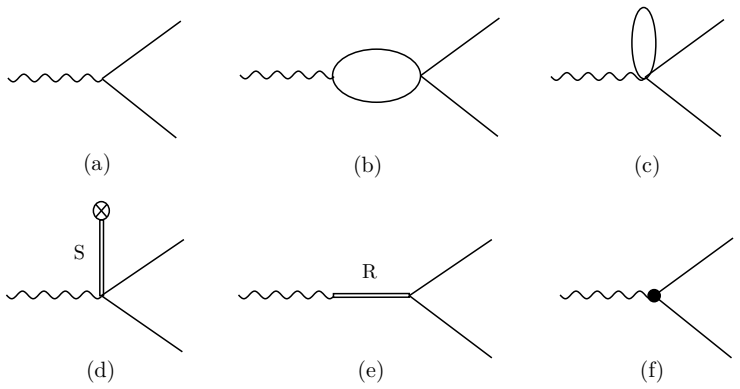
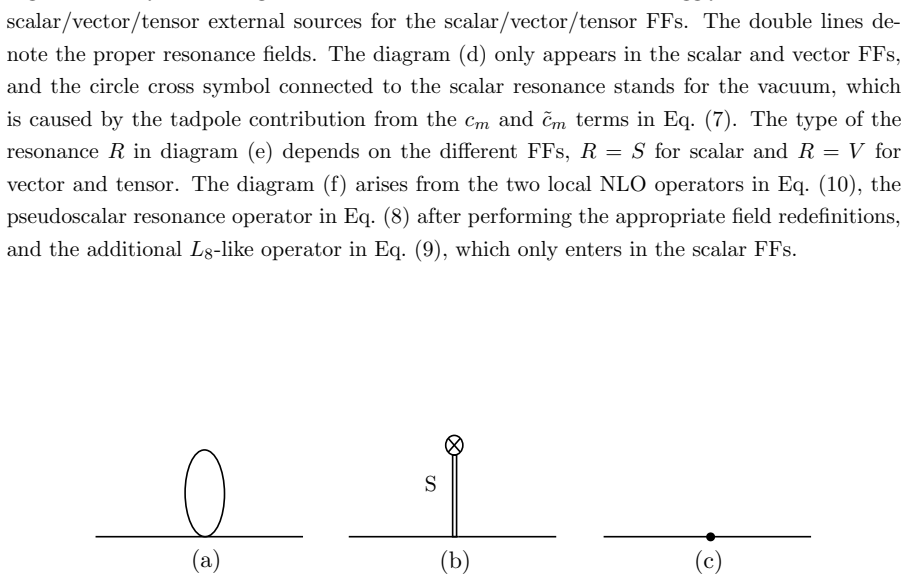
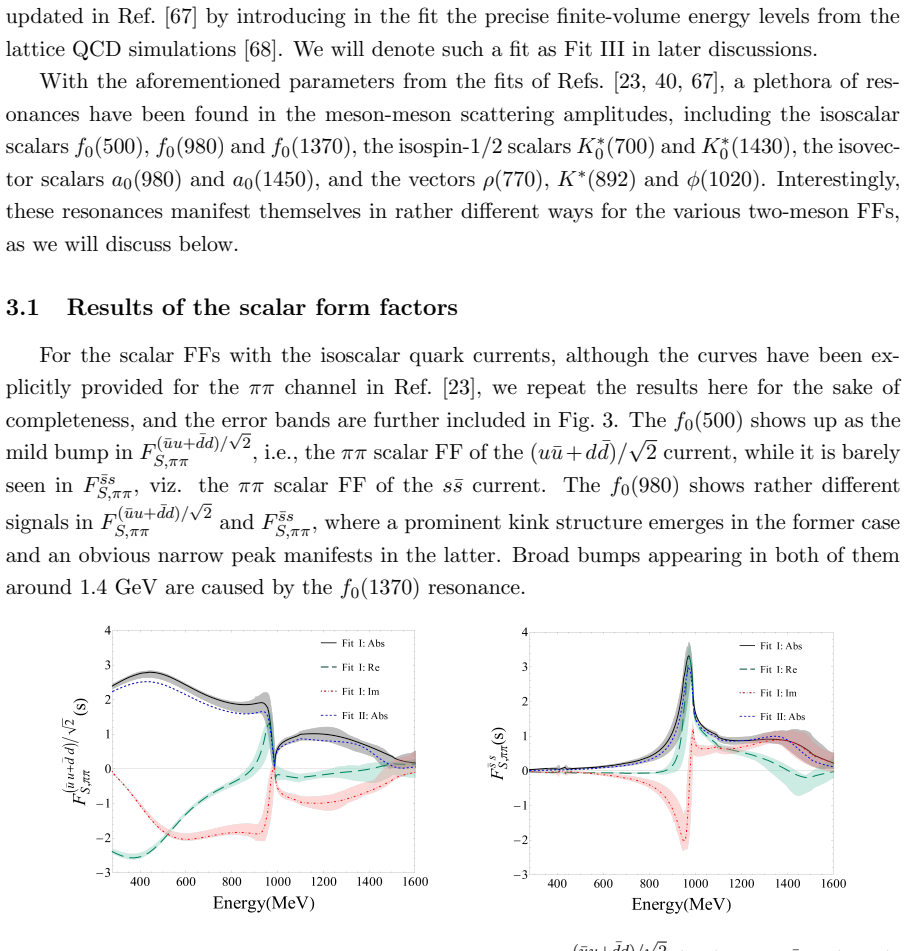
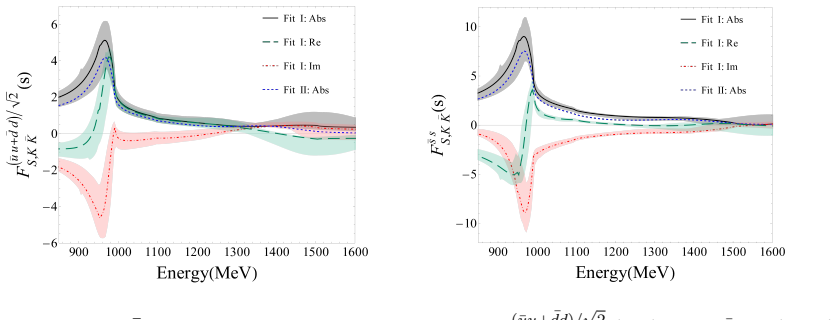
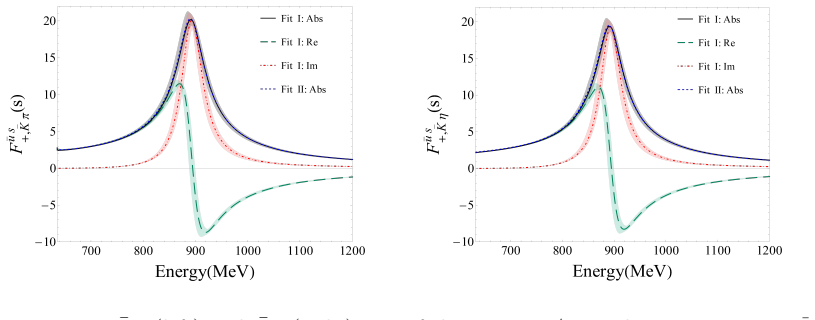
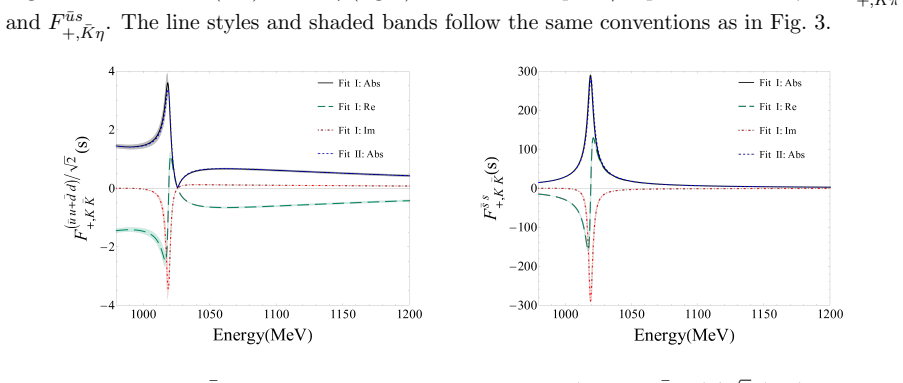
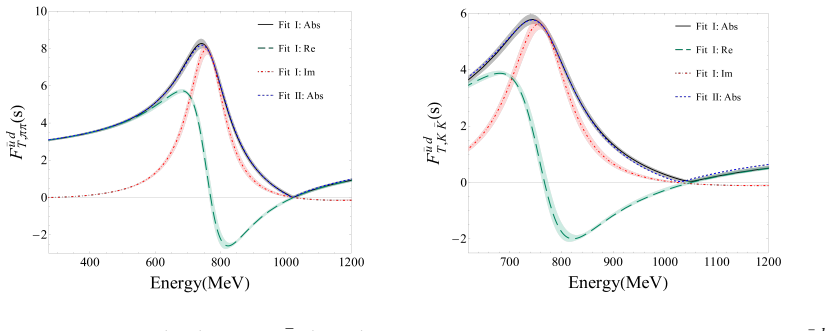
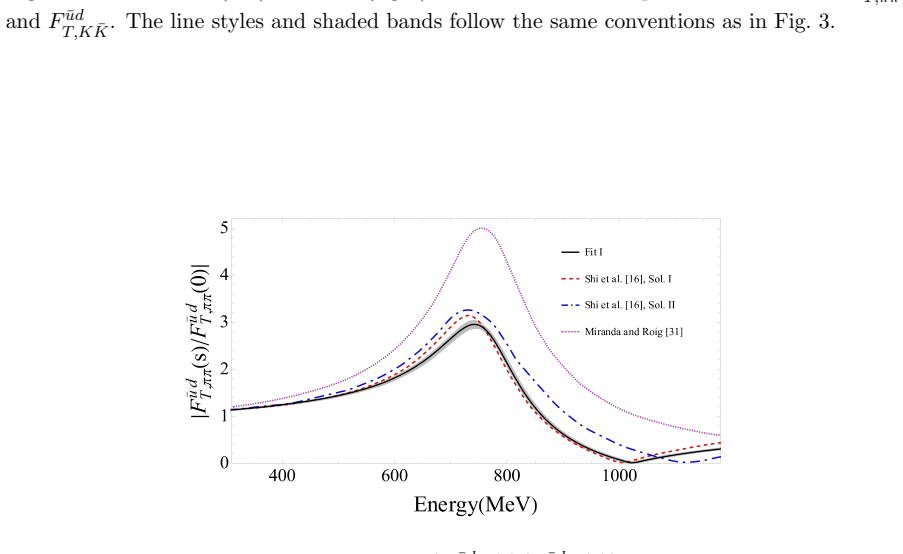
We perform a systematic study of two-meson form factors of the scalar, vector, and anti-symmetric tensor types within the framework of the $U(3)$ resonance chiral theory. The complete perturbative form factors in both the strangeness-conserving and strangeness-changing channels are calculated by incorporating one-loop light-flavor pseudoscalar meson contributions and tree-level resonance exchanges. With these newly calculated chiral results, we construct the corresponding unitarized form factors by incorporating meson-meson final-state interactions. The parameter values obtained in previous meson-meson scattering studies are then exploited to predict the corresponding form factors. Different types of form factors are found to exhibit rather distinct resonance structures across channels.
Editorial analysis
A structured set of objections, weighed in public.
Referee Report
Summary. The paper performs a systematic study of scalar, vector, and anti-symmetric tensor two-meson form factors in U(3) resonance chiral theory. It calculates the complete perturbative expressions incorporating one-loop light-flavor pseudoscalar contributions and tree-level resonance exchanges in both strangeness-conserving and strangeness-changing channels, constructs unitarized versions that include meson-meson final-state interactions, and uses parameter values fixed in prior meson-meson scattering analyses to generate predictions. The central result is that the different types of form factors exhibit rather distinct resonance structures across channels.
Significance. If the parameter transfer is validated, the work supplies a unified, resonance-saturated framework for form factors that re-uses the same LECs and couplings already constrained by scattering, potentially allowing consistent predictions for electromagnetic and weak processes. The inclusion of tensor form factors alongside scalar and vector ones is a methodological strength not commonly found in the literature.
major comments (1)
- [Abstract] Abstract (and the corresponding numerical section): the headline claim of distinct resonance structures rests on inserting scattering-fit parameters unchanged into the new form-factor expressions. No comparison of the resulting form factors to experimental data (e.g., electromagnetic or weak form-factor measurements) or sensitivity study on parameter variations is reported; this directly affects whether the observed structures are genuine predictions or artifacts of the imported values.
minor comments (1)
- [Abstract] The abstract states that 'complete perturbative form factors' are calculated but does not indicate whether the one-loop integrals are evaluated in dimensional regularization or with a cutoff; explicit expressions or a reference to the regularization scheme would improve reproducibility.
Simulated Author's Rebuttal
We thank the referee for the detailed review and valuable comments on our manuscript. We provide a point-by-point response to the major comment below.
read point-by-point responses
-
Referee: [Abstract] Abstract (and the corresponding numerical section): the headline claim of distinct resonance structures rests on inserting scattering-fit parameters unchanged into the new form-factor expressions. No comparison of the resulting form factors to experimental data (e.g., electromagnetic or weak form-factor measurements) or sensitivity study on parameter variations is reported; this directly affects whether the observed structures are genuine predictions or artifacts of the imported values.
Authors: The referee correctly observes that the manuscript does not include direct comparisons of the predicted form factors to experimental data nor a sensitivity analysis on the imported parameters. Our study is designed to explore the implications of transferring the resonance parameters and low-energy constants fixed in meson-meson scattering analyses to the calculation of scalar, vector, and tensor form factors within the same U(3) resonance chiral theory framework. The observed distinct resonance structures arise from the different Lorentz structures and resonance contributions in each channel. We agree that including a sensitivity study would help confirm the robustness of these structures. In the revised manuscript, we will add an analysis of the dependence on parameter variations within the ranges determined by the scattering fits. Direct comparisons to data are beyond the present scope as they would necessitate additional modeling of electromagnetic and weak currents, which we intend to pursue separately. revision: partial
Circularity Check
No circularity: scattering-fit parameters serve as external inputs for independent form-factor predictions
full rationale
The paper calculates complete perturbative form factors (one-loop light pseudoscalars plus tree-level resonances) in U(3) RChT for scalar, vector and tensor channels, then unitarizes them via final-state interactions. It states that 'parameter values obtained in previous meson-meson scattering studies are then exploited to predict the corresponding form factors.' These parameters originate from separate scattering analyses and are not re-fitted or adjusted here against form-factor data. No equation reduces a form-factor quantity to itself by construction, no fitted input is relabeled as a prediction within this manuscript, and no self-citation chain supplies a load-bearing uniqueness theorem. The derivation remains self-contained against external scattering benchmarks; the reported distinct resonance structures are outputs of the theory evaluated at those fixed external values.
Axiom & Free-Parameter Ledger
free parameters (1)
- meson-meson scattering parameters
axioms (2)
- domain assumption U(3) resonance chiral theory is the appropriate framework for both perturbative and unitarized two-meson form factors
- domain assumption One-loop pseudoscalar contributions plus tree-level resonance exchanges suffice for the perturbative form factors
Reference graph
Works this paper leans on
-
[1]
Gasser and H
J. Gasser and H. Leutwyler, Nucl. Phys. B250, 517 (1985)
1985
-
[2]
Weinberg, Physica A96, 327 (1979)
S. Weinberg, Physica A96, 327 (1979)
1979
-
[3]
Gasser and H
J. Gasser and H. Leutwyler, Annals Phys.158, 142 (1984)
1984
-
[4]
Gasser and H
J. Gasser and H. Leutwyler, Nucl. Phys. B250, 465 (1985)
1985
-
[5]
Gasser and U
J. Gasser and U. G. Meissner, Nucl. Phys. B357, 90 (1991)
1991
-
[6]
The Vector and Scalar Form Factors of the Pion to Two Loops
J. Bijnens, G. Colangelo, and P. Talavera, JHEP05, 014, arXiv:hep-ph/9805389
work page internal anchor Pith review Pith/arXiv arXiv
-
[7]
Pion and Kaon Electromagnetic Form Factors
J. Bijnens and P. Talavera, JHEP03, 046, arXiv:hep-ph/0203049
work page internal anchor Pith review Pith/arXiv arXiv
-
[8]
Scalar Form Factors in SU(3) Chiral Perturbation Theory
J. Bijnens and P. Dhonte, JHEP10, 061, arXiv:hep-ph/0307044
work page internal anchor Pith review Pith/arXiv arXiv
-
[9]
Ecker, J
G. Ecker, J. Gasser, A. Pich, and E. de Rafael, Nucl. Phys. B321, 311 (1989)
1989
-
[10]
J. R. Pelaez, Phys. Rept.658, 1 (2016), arXiv:1510.00653 [hep-ph]
work page internal anchor Pith review Pith/arXiv arXiv 2016
- [11]
- [12]
- [13]
-
[14]
Omnes, Nuovo Cim.8, 316 (1958)
R. Omnes, Nuovo Cim.8, 316 (1958)
1958
-
[15]
K. M. Watson, Phys. Rev.88, 1163 (1952)
1952
- [16]
-
[17]
L. Von Detten, F. No¨ el, C. Hanhart, M. Hoferichter, and B. Kubis, Eur. Phys. J. C81, 420 (2021), arXiv:2103.01966 [hep-ph]
- [18]
- [19]
-
[20]
J. A. Oller and E. Oset, Nucl. Phys. A629, 739 (1998), arXiv:hep-ph/9706487
work page internal anchor Pith review Pith/arXiv arXiv 1998
-
[21]
J. A. Oller, Phys. Lett. B426, 7 (1998), arXiv:hep-ph/9803214 . 30
work page internal anchor Pith review Pith/arXiv arXiv 1998
-
[22]
Z.-H. Guo, J. A. Oller, and J. Ruiz de Elvira, Phys. Lett. B712, 407 (2012), arXiv:1203.4381 [hep-ph]
work page internal anchor Pith review Pith/arXiv arXiv 2012
-
[23]
Z.-H. Guo, J. A. Oller, and J. Ruiz de Elvira, Phys. Rev. D86, 054006 (2012), arXiv:1206.4163 [hep-ph]
work page internal anchor Pith review Pith/arXiv arXiv 2012
- [24]
-
[25]
Quantum Loops in the Resonance Chiral Theory: The Vector Form Factor
I. Rosell, J. J. Sanz-Cillero, and A. Pich, JHEP08, 042, arXiv:hep-ph/0407240
work page internal anchor Pith review Pith/arXiv arXiv
-
[26]
A. Pich, I. Rosell, and J. J. Sanz-Cillero, JHEP02, 109, arXiv:1011.5771 [hep-ph]
work page internal anchor Pith review Pith/arXiv arXiv
-
[27]
Strangeness-changing scalar form factors
M. Jamin, J. A. Oller, and A. Pich, Nucl. Phys. B622, 279 (2002), arXiv:hep-ph/0110193
work page internal anchor Pith review Pith/arXiv arXiv 2002
-
[28]
Bethe-Salpeter Approach for Unitarized Chiral Perturbation Theory
J. Nieves and E. Ruiz Arriola, Nucl. Phys. A679, 57 (2000), arXiv:hep-ph/9907469
work page internal anchor Pith review Pith/arXiv arXiv 2000
-
[29]
Chiral Perturbation Theory with tensor sources
O. Cata and V. Mateu, JHEP09, 078, arXiv:0705.2948 [hep-ph]
work page internal anchor Pith review Pith/arXiv arXiv
-
[30]
A no-go theorem for non-standard explanations of the $\tau\to K_S\pi\nu_\tau$ CP asymmetry
V. Cirigliano, A. Crivellin, and M. Hoferichter, Phys. Rev. Lett.120, 141803 (2018), arXiv:1712.06595 [hep-ph]
work page internal anchor Pith review Pith/arXiv arXiv 2018
-
[31]
J. A. Miranda and P. Roig, JHEP11, 038, arXiv:1806.09547 [hep-ph]
work page internal anchor Pith review Pith/arXiv arXiv
- [32]
-
[33]
F.-Z. Chen, X.-Q. Li, Y.-D. Yang, and X. Zhang, Phys. Rev. D100, 113006 (2019), arXiv:1909.05543 [hep-ph]
-
[34]
F.-Z. Chen, X.-Q. Li, S.-C. Peng, Y.-D. Yang, and H.-H. Zhang, JHEP01, 108, arXiv:2107.12310 [hep-ph]
-
[35]
M. Hoferichter, B. Kubis, J. Ruiz de Elvira, and P. Stoffer, Phys. Rev. Lett.122, 122001 (2019), [Erratum: Phys.Rev.Lett. 124, 199901 (2020)], arXiv:1811.11181 [hep-ph]
-
[36]
J. A. Oller and E. Oset, Nucl. Phys. A620, 438 (1997), [Erratum: Nucl.Phys.A 652, 407–409 (1999)], arXiv:hep-ph/9702314
work page internal anchor Pith review Pith/arXiv arXiv 1997
-
[37]
J. A. Oller and E. Oset, Phys. Rev. D60, 074023 (1999), arXiv:hep-ph/9809337
work page internal anchor Pith review Pith/arXiv arXiv 1999
-
[38]
J. A. Oller and U. G. Meissner, Phys. Lett. B500, 263 (2001), arXiv:hep-ph/0011146
work page internal anchor Pith review Pith/arXiv arXiv 2001
-
[39]
S-wave Kpi scattering in chiral perturbation theory with resonances
M. Jamin, J. A. Oller, and A. Pich, Nucl. Phys. B587, 331 (2000), arXiv:hep-ph/0006045
work page internal anchor Pith review Pith/arXiv arXiv 2000
-
[40]
Resonances from meson-meson scattering in U(3) CHPT
Z.-H. Guo and J. A. Oller, Phys. Rev. D84, 034005 (2011), arXiv:1104.2849 [hep-ph] . 31
work page internal anchor Pith review Pith/arXiv arXiv 2011
-
[41]
Large-Nc Properties of the rho and f0(600) Mesons from Unitary Resonance Chiral Dynamics
J. Nieves, A. Pich, and E. Ruiz Arriola, Phys. Rev. D84, 096002 (2011), arXiv:1107.3247 [hep-ph]
work page internal anchor Pith review Pith/arXiv arXiv 2011
-
[42]
Large-$N_c$ naturalness in coupled-channel meson-meson scattering
T. Ledwig, J. Nieves, A. Pich, E. Ruiz Arriola, and J. Ruiz de Elvira, Phys. Rev. D90, 114020 (2014), arXiv:1407.3750 [hep-ph]
work page internal anchor Pith review Pith/arXiv arXiv 2014
-
[43]
Y. Mao, X.-G. Wang, O. Zhang, H. Q. Zheng, and Z. Y. Zhou, Phys. Rev. D79, 116008 (2009), arXiv:0904.1445 [hep-ph]
work page internal anchor Pith review Pith/arXiv arXiv 2009
-
[44]
L.-Y. Dai and M. R. Pennington, Phys. Rev. D90, 036004 (2014), arXiv:1404.7524 [hep- ph]
work page internal anchor Pith review Pith/arXiv arXiv 2014
-
[45]
S. Arteaga, L.-Y. Dai, A. Guevara, and P. Roig, Phys. Rev. D106, 096016 (2022), arXiv:2209.15537 [hep-ph]
-
[46]
S. Gonz` alez-Sol´ ıs, A. Miranda, J. Rend´ on, and P. Roig, Phys. Rev. D101, 034010 (2020), arXiv:1911.08341 [hep-ph]
-
[47]
Predictions on the second-class current decays $\tau^{-}\to\pi^{-}\eta^{(\prime)}\nu_{\tau}$
R. Escribano, S. Gonzalez-Solis, and P. Roig, Phys. Rev. D94, 034008 (2016), arXiv:1601.03989 [hep-ph]
work page internal anchor Pith review Pith/arXiv arXiv 2016
-
[48]
$\tau^-\to K^-\eta^{(\prime)}\nu_\tau$ decays in Chiral Perturbation Theory with Resonances
R. Escribano, S. Gonzalez-Solis, and P. Roig, JHEP10, 039, arXiv:1307.7908 [hep-ph]
work page internal anchor Pith review Pith/arXiv arXiv
-
[49]
J. J. Sanz-Cillero and O. Shekhovtsova, JHEP12, 080, arXiv:1707.01137 [hep-ph]
work page internal anchor Pith review Pith/arXiv arXiv
-
[50]
Spectral distribution for the decay tau -> nu_tau K pi
M. Jamin, A. Pich, and J. Portoles, Phys. Lett. B640, 176 (2006), arXiv:hep-ph/0605096
work page internal anchor Pith review Pith/arXiv arXiv 2006
-
[51]
Effective Field Theory Description of the Pion Form Factor
F. Guerrero and A. Pich, Phys. Lett. B412, 382 (1997), arXiv:hep-ph/9707347
work page internal anchor Pith review Pith/arXiv arXiv 1997
-
[52]
C. Chen, C.-G. Duan, and Z.-H. Guo, JHEP08, 144, arXiv:2201.12764 [hep-ph]
-
[53]
Study of tau- --> V P- nu(tau) in the framework of resonance chiral theory
Z.-H. Guo, Phys. Rev. D78, 033004 (2008), arXiv:0806.4322 [hep-ph]
work page internal anchor Pith review Pith/arXiv arXiv 2008
-
[54]
One meson radiative tau decays
Z.-H. Guo and P. Roig, Phys. Rev. D82, 113016 (2010), arXiv:1009.2542 [hep-ph]
work page internal anchor Pith review Pith/arXiv arXiv 2010
-
[55]
Z.-X. Li, A. Li, J. Hao, C.-G. Duan, and Z.-H. Guo, Phys. Rev. D113, 014005 (2026), arXiv:2510.04172 [hep-ph]
work page internal anchor Pith review Pith/arXiv arXiv 2026
-
[56]
J. Hao, C.-G. Duan, and Z.-H. Guo, Front. Phys. (Beijing)21, 076201 (2026), arXiv:2507.00383 [hep-ph]
work page internal anchor Pith review Pith/arXiv arXiv 2026
-
[57]
L. Y. Dai, J. Portoles, and O. Shekhovtsova, Phys. Rev. D88, 056001 (2013), arXiv:1305.5751 [hep-ph]
work page internal anchor Pith review Pith/arXiv arXiv 2013
- [58]
- [59]
-
[60]
Chiral Effective Lagrangian in the large-Nc limit: the nonet case
P. Herrera-Siklody, J. I. Latorre, P. Pascual, and J. Taron, Nucl. Phys. B497, 345 (1997), arXiv:hep-ph/9610549
work page internal anchor Pith review Pith/arXiv arXiv 1997
-
[61]
Large N_c in chiral perturbation theory
R. Kaiser and H. Leutwyler, Eur. Phys. J. C17, 623 (2000), arXiv:hep-ph/0007101
work page internal anchor Pith review Pith/arXiv arXiv 2000
-
[62]
Witten, Nucl
E. Witten, Nucl. Phys. B156, 269 (1979)
1979
-
[63]
S. R. Coleman and E. Witten, Phys. Rev. Lett.45, 100 (1980)
1980
-
[64]
Di Vecchia and G
P. Di Vecchia and G. Veneziano, Nucl. Phys. B171, 253 (1980)
1980
-
[65]
Kawarabayashi and N
K. Kawarabayashi and N. Ohta, Nucl. Phys. B175, 477 (1980)
1980
- [66]
-
[67]
Z.-H. Guo, L. Liu, U.-G. Meißner, J. A. Oller, and A. Rusetsky, Phys. Rev. D95, 054004 (2017), arXiv:1609.08096 [hep-ph]
work page internal anchor Pith review Pith/arXiv arXiv 2017
-
[68]
J. J. Dudek, R. G. Edwards, and D. J. Wilson (Hadron Spectrum), Phys. Rev. D93, 094506 (2016), arXiv:1602.05122 [hep-ph] . 33
work page internal anchor Pith review Pith/arXiv arXiv 2016
discussion (0)
Sign in with ORCID, Apple, or X to comment. Anyone can read and Pith papers without signing in.