Generative reconstruction of 2D and 3D polycrystalline microstructures using symmetrized hyperspherical harmonics
Pith reviewed 2026-06-30 20:17 UTC · model grok-4.3
The pith
A framework reconstructs 3D polycrystalline microstructures from 2D orientation data using quaternion-based symmetrized hyperspherical harmonics.
A machine-rendered reading of the paper's core claim, the machinery that carries it, and where it could break.
Core claim
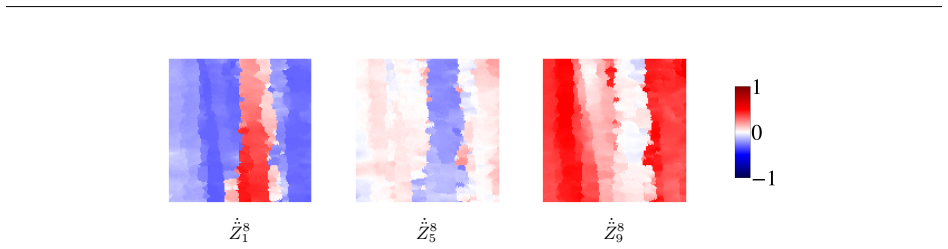
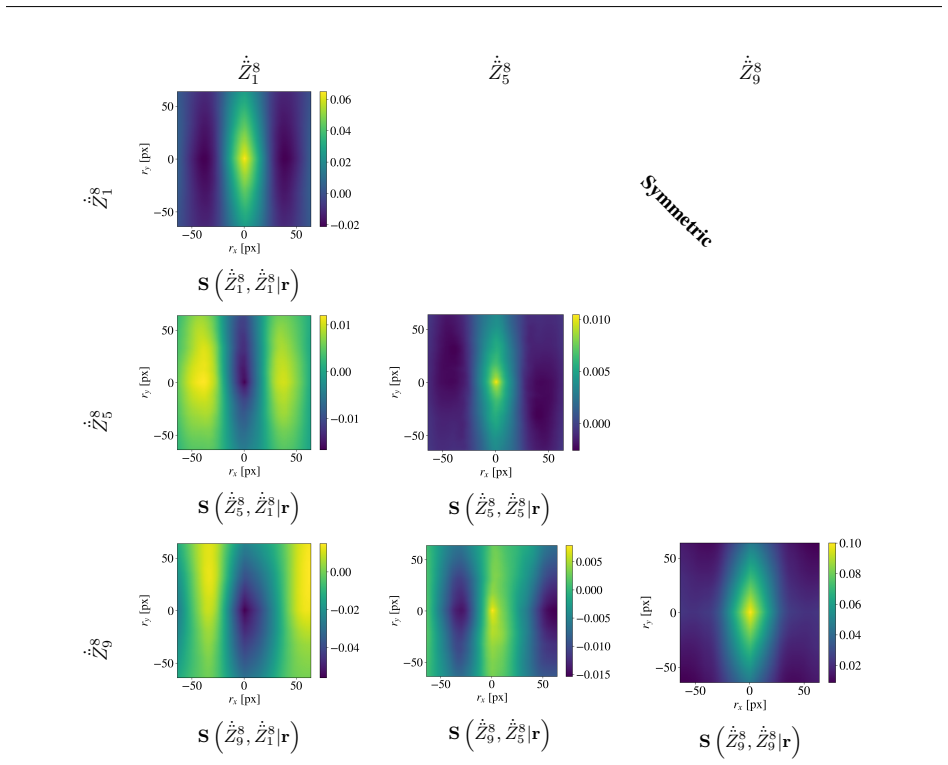
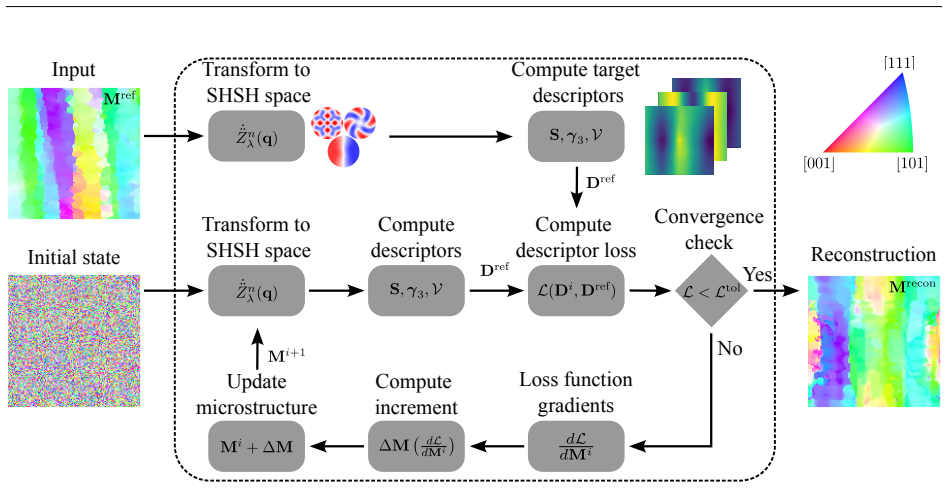
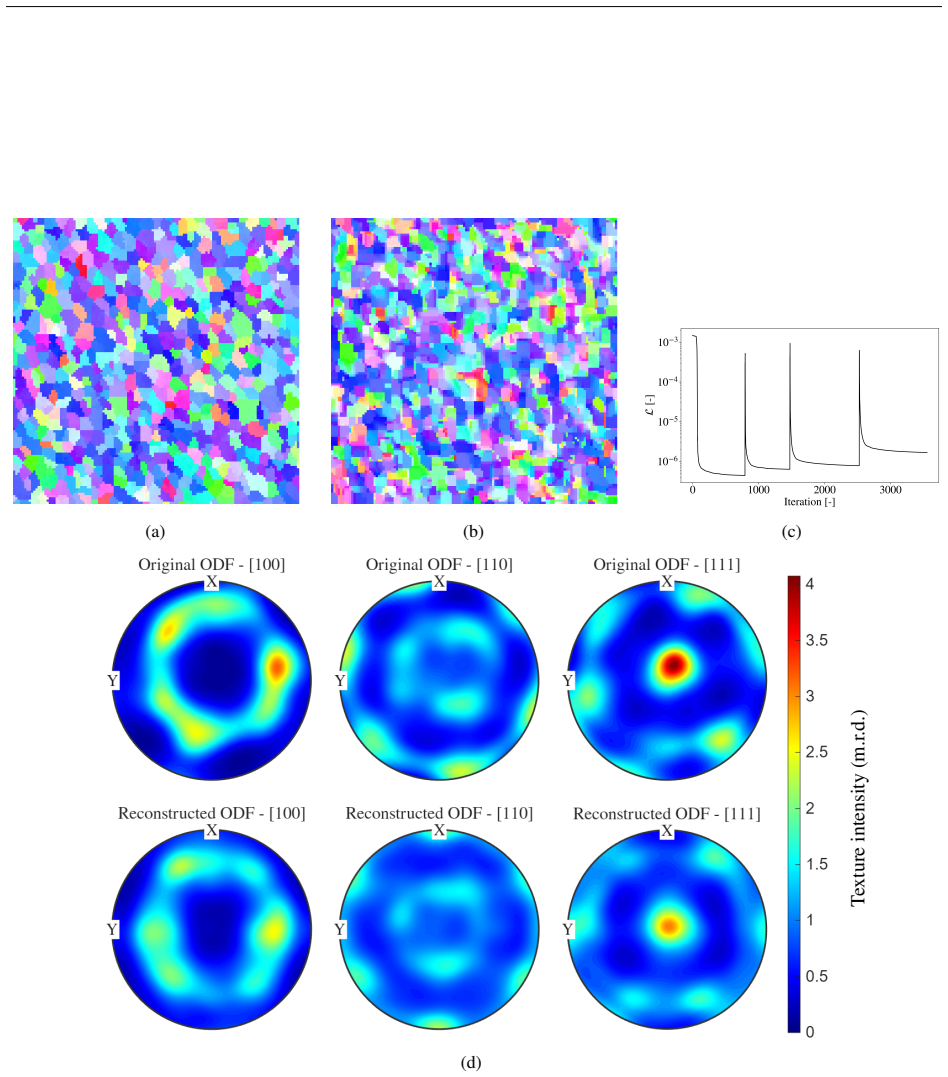
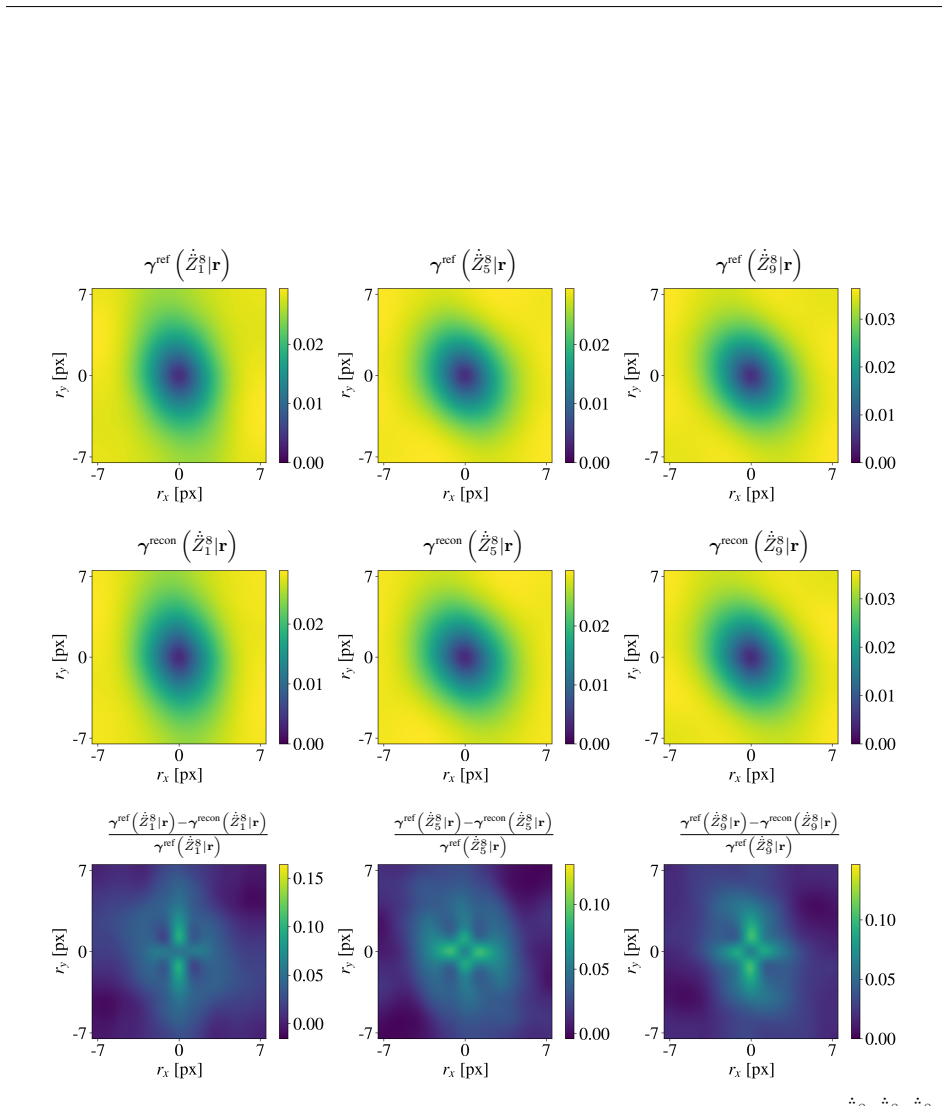
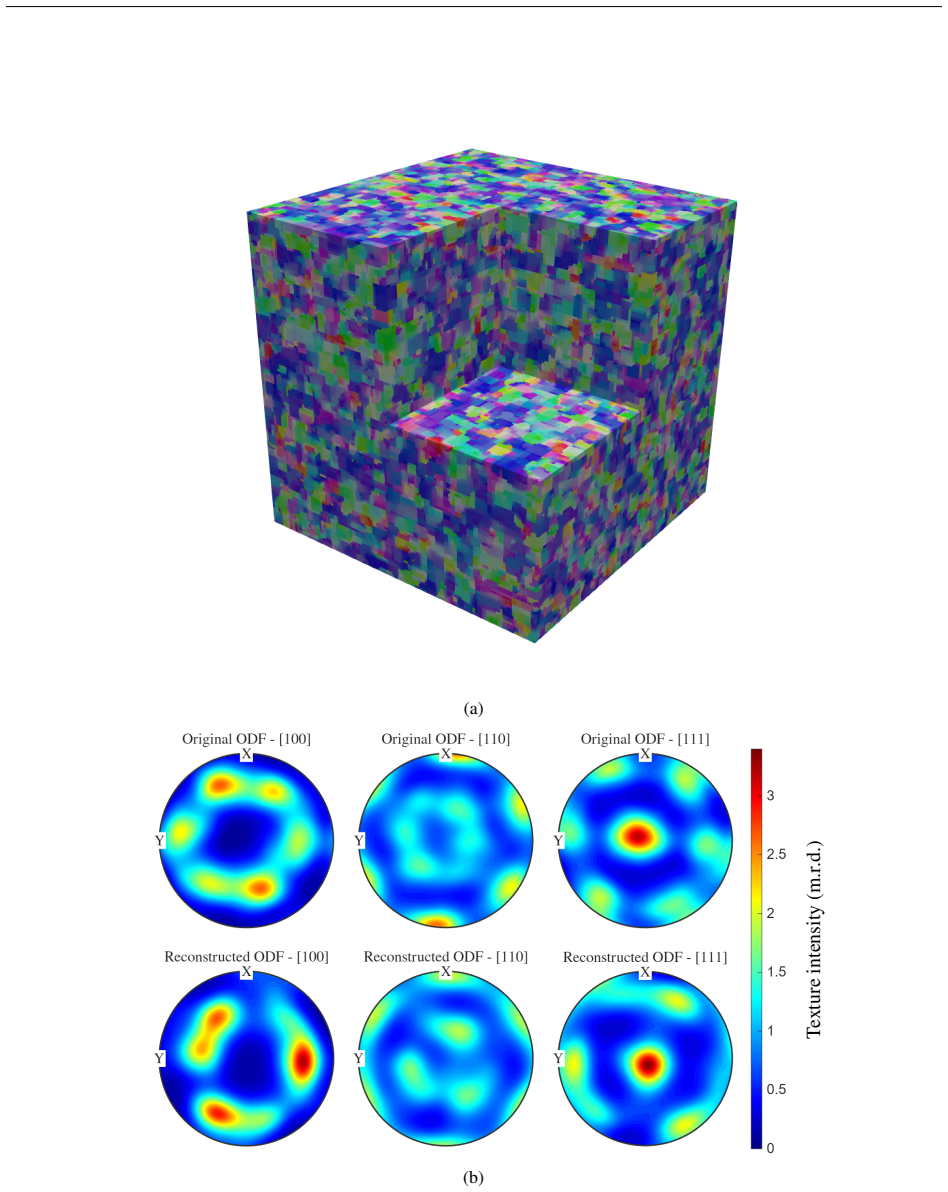
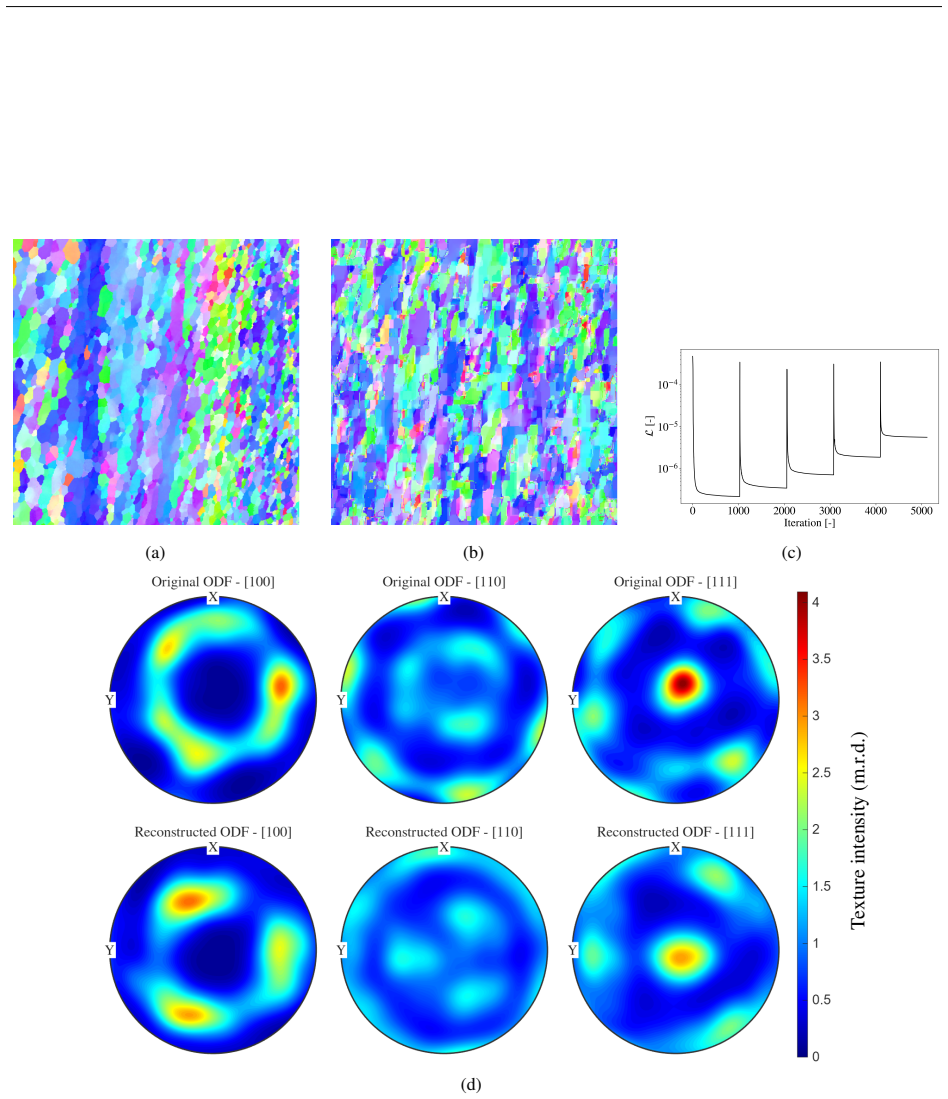
Unit quaternions combined with symmetrized hyperspherical harmonics supply a continuous, symmetry-invariant orientation field that drives descriptor-based reconstruction. The loss is formed from two-point spatial correlations, a novel hybrid three-point variogram, and a mean-variation regularizer. When applied to two-dimensional orientation data of a thermo-mechanically processed aluminum alloy, second-order gradient optimization with L-BFGS-B produces three-dimensional realizations whose morphological features and crystallographic distributions match the reference statistics.
What carries the argument
Symmetrized hyperspherical harmonics on unit quaternions, which furnish a continuous symmetry-invariant orientation descriptor inside an optimization loop that matches two-point correlations, a hybrid three-point variogram, and a mean-variation regularizer.
If this is right
- Three-dimensional representative volume elements can be synthesized directly from two-dimensional EBSD maps for use in full-field simulations.
- The combined descriptors preserve both global texture and local interfacial topology.
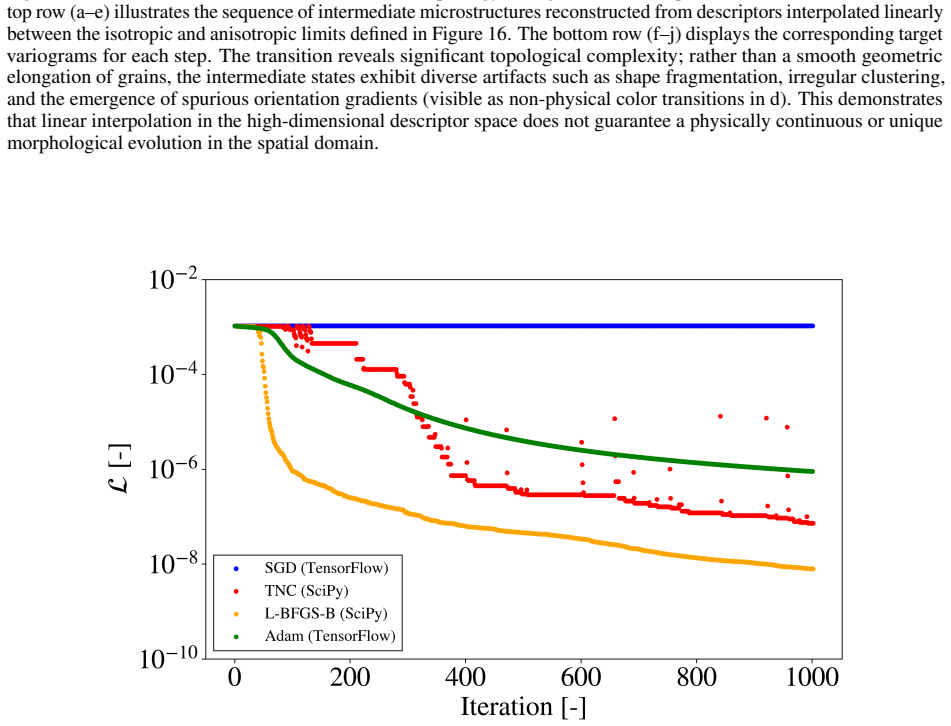
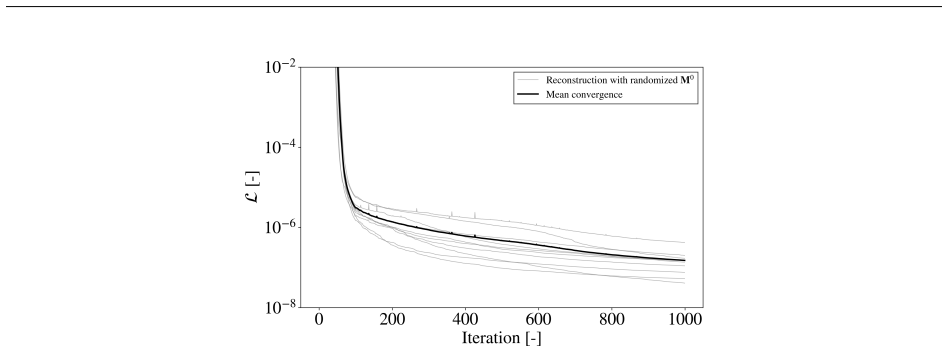
- Gradient-based optimization with L-BFGS-B reaches low residuals on the complex loss landscape.
- An open-source implementation supplies a practical tool for generating microstructure inputs in materials design workflows.
Where Pith is reading between the lines
- The descriptor set may generalize to other alloy systems or processing routes if the same correlation functions remain sufficient.
- Successful 3D recovery from 2D sections could reduce reliance on serial-sectioning or tomography experiments.
- The method supplies a route to couple microstructure generation directly with property-prediction pipelines.
- If the regularizer proves robust, similar differentiable pipelines could be adapted to reconstruct other heterogeneous media such as porous or composite materials.
Load-bearing premise
The chosen two-point correlations, hybrid three-point variogram, and mean-variation regularizer together capture the full statistical ensemble required for faithful reconstruction.
What would settle it
A set of reconstructed volumes that satisfy the reported descriptors yet deviate measurably from independent higher-order spatial statistics or from measured mechanical response of the same aluminum alloy.
Figures
read the original abstract
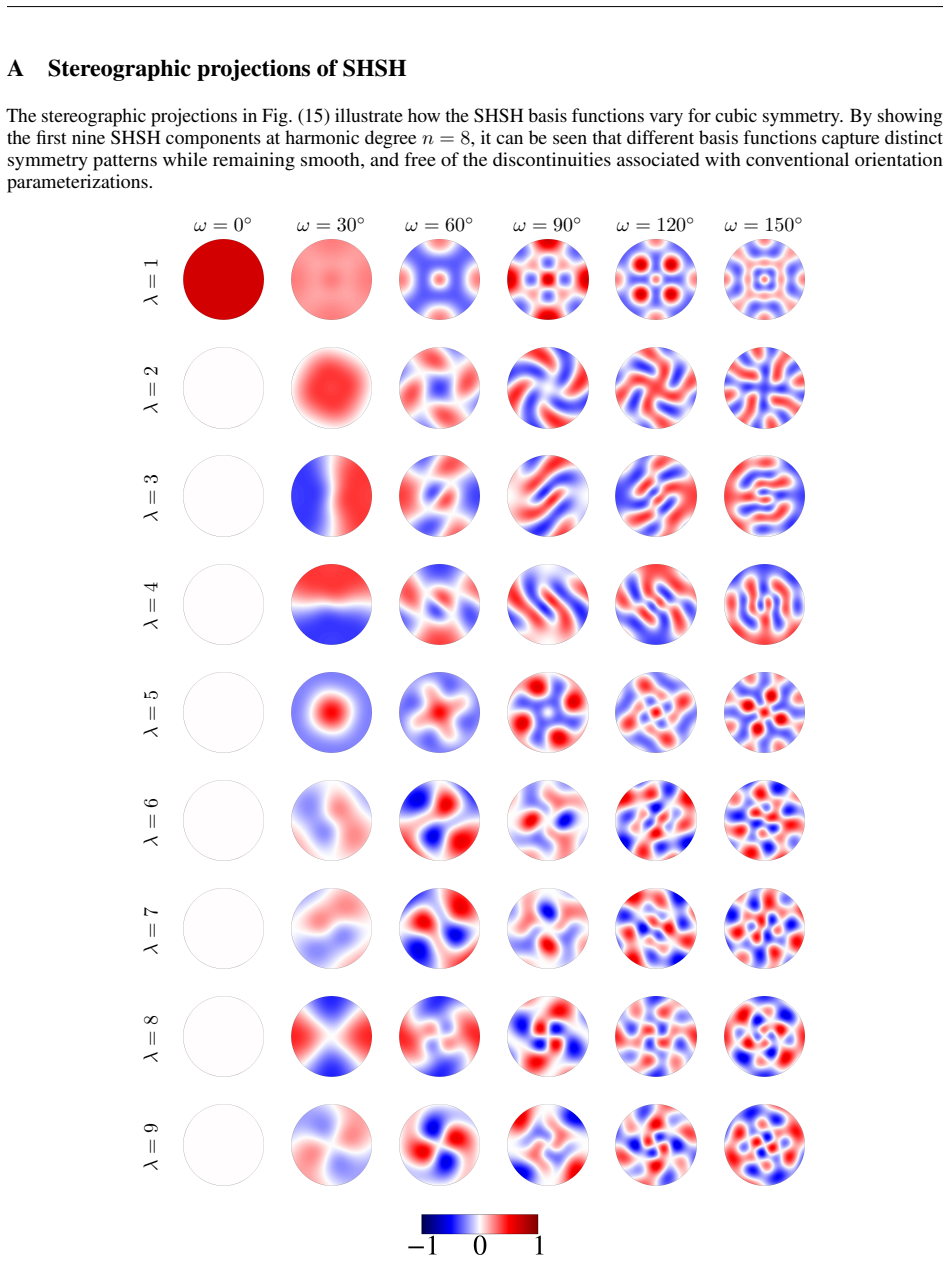
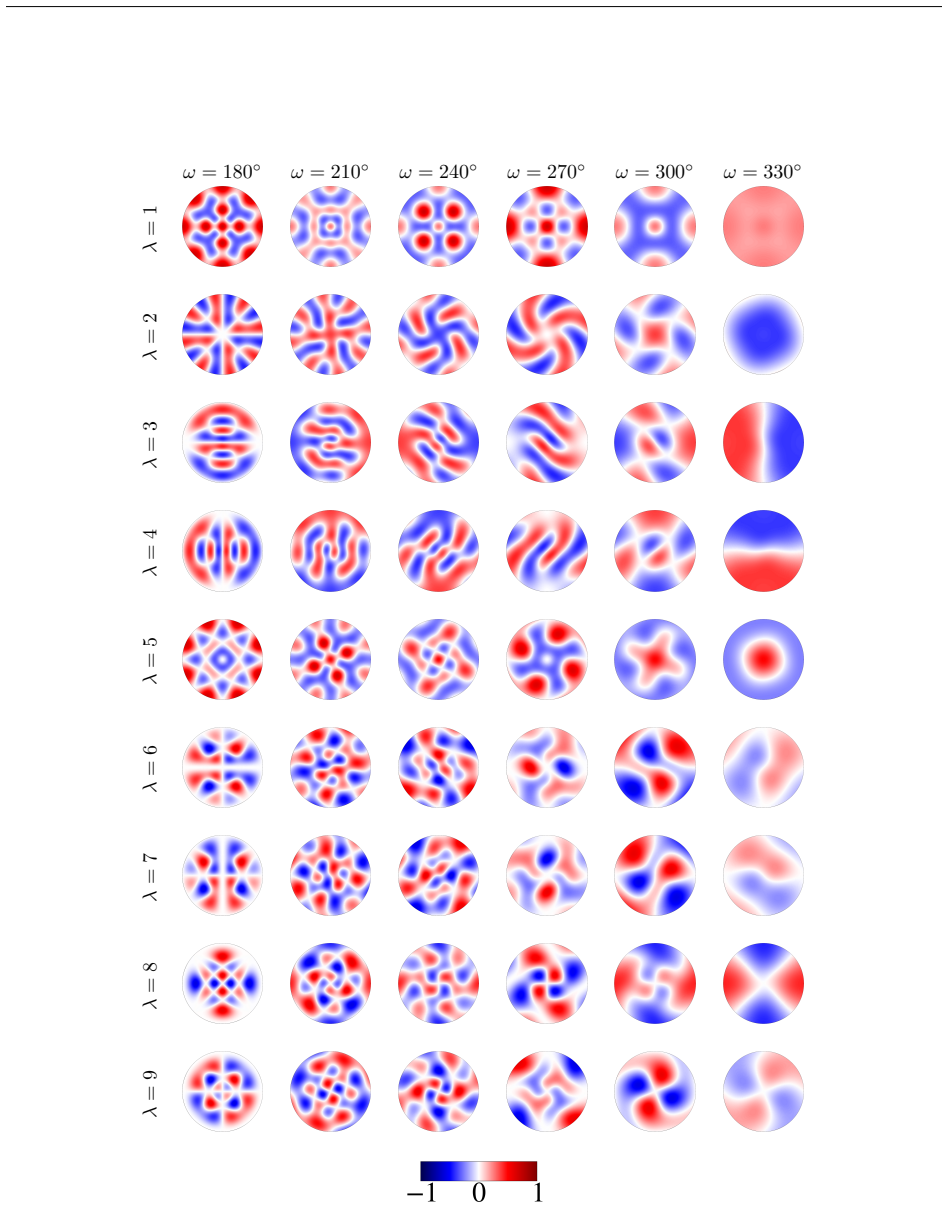
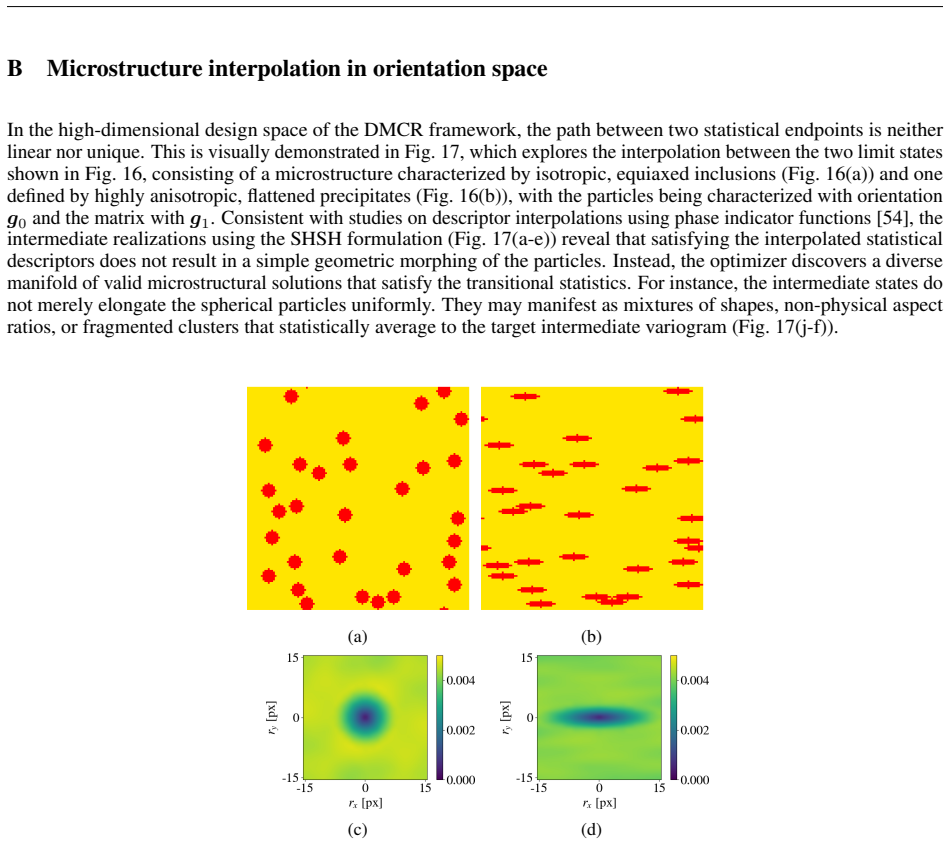
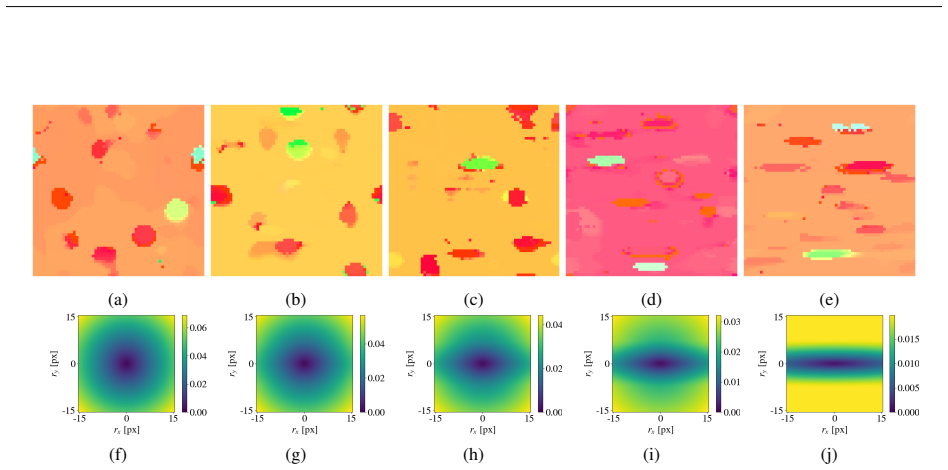
Establishing structure-property linkages in polycrystalline materials requires representative two- (2D) and three- (3D) dimensional microstructural inputs for full-field simulations. A core objective of microstructure characterization and reconstruction is the generative synthesis of 2D and 3D microstructures that reflect a target statistical ensemble using limited 2D data as a reference. This work introduces an orientation-based differentiable microstructure characterization and reconstruction framework, implemented in MCRpy, to perform reconstructions of voxelized images. Unit quaternions in combination with symmetrized hyperspherical harmonics are utilized to derive a continuous, symmetry-invariant representation of crystallographic orientations to overcome the numerical singularities and discontinuities associated with traditional Euler-based methods. The descriptor-based reconstructions are driven by a set combining two-point spatial correlations, a novel hybrid three-point variogram, and a mean variation regularizer to capture both global texture and local interfacial topology. The framework's efficiency is demonstrated by reconstructing 3D realizations from 2D orientation data of an aluminum alloy after thermo-mechanical processing, successfully recovering both morphological features and crystallographic distribution. Systematic benchmarking indicates that second-order gradient-based optimization, utilizing the L-BFGS-B algorithm, effectively navigates the complex loss landscape to generate high-fidelity realizations with minimal residuals. This methodology provides a versatile, open-source framework for the digital synthesis of polycrystalline representative volume elements to facilitate the rapid development of microstructure-informed materials design workflows.
Editorial analysis
A structured set of objections, weighed in public.
Referee Report
Summary. The paper introduces an orientation-based differentiable microstructure characterization and reconstruction framework implemented in MCRpy. It employs unit quaternions combined with symmetrized hyperspherical harmonics to obtain a continuous, symmetry-invariant representation of crystallographic orientations, avoiding singularities associated with Euler angles. Reconstructions of voxelized 2D and 3D images are driven by a combined descriptor set consisting of two-point spatial correlations, a novel hybrid three-point variogram, and a mean variation regularizer. The framework is demonstrated by generating 3D realizations from 2D orientation data of a thermo-mechanically processed aluminum alloy, with the claim that both morphological features and crystallographic distributions are recovered. Systematic benchmarking shows that L-BFGS-B optimization effectively minimizes the loss to produce high-fidelity realizations. The work provides an open-source tool for synthesizing polycrystalline representative volume elements.
Significance. If the central claims hold, the work offers a meaningful contribution to microstructure reconstruction by supplying a differentiable, symmetry-aware pipeline that directly addresses limitations of Euler-angle representations. The open-source release in MCRpy and the emphasis on gradient-based optimization of a composite loss are concrete strengths that could accelerate microstructure-informed materials design. The hybrid three-point variogram is presented as a targeted addition for interfacial topology, which, if validated, would extend the utility of descriptor-based methods beyond standard two-point statistics.
major comments (2)
- [Abstract] Abstract: The claim that the framework 'successfully recover[s] both morphological features and crystallographic distribution' and produces 'high-fidelity realizations with minimal residuals' is presented without any quantitative error metrics (e.g., L2 norms on the two-point correlations or three-point variogram residuals), baseline comparisons to existing reconstruction algorithms, or explicit description of how residuals were computed. This quantitative gap is load-bearing for the central claim of faithful ensemble recovery.
- [Results / descriptor section] Results / descriptor section: The assertion that the combination of two-point spatial correlations, the novel hybrid three-point variogram, and the mean variation regularizer is sufficient to determine the full 3D statistical ensemble from 2D data is not accompanied by an ablation study (e.g., reconstruction quality with the three-point term removed) or comparison against independent 3D ground-truth statistics. Without such evidence, it remains unclear whether higher-order spatial correlations or long-range orientation correlations are truly redundant for the aluminum alloy case.
minor comments (2)
- [Methods] Notation for the symmetrized hyperspherical harmonics and the precise definition of the hybrid three-point variogram should be given explicitly with equations in the methods section to allow reproducibility.
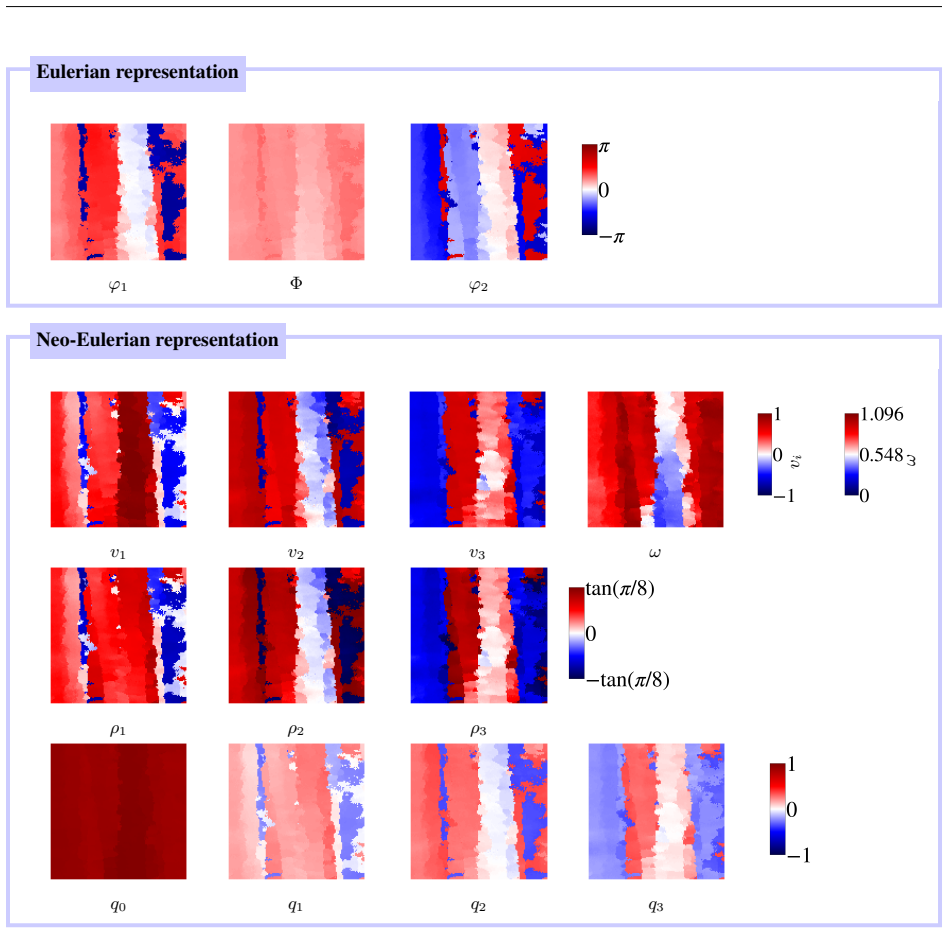
- [Figures] Figure captions should include the specific aluminum alloy composition, processing conditions, and voxel resolution to contextualize the qualitative demonstrations.
Simulated Author's Rebuttal
We thank the referee for the thoughtful and constructive report. The two major comments highlight opportunities to strengthen the quantitative presentation and validation of our claims. We address each point below and will revise the manuscript accordingly.
read point-by-point responses
-
Referee: [Abstract] Abstract: The claim that the framework 'successfully recover[s] both morphological features and crystallographic distribution' and produces 'high-fidelity realizations with minimal residuals' is presented without any quantitative error metrics (e.g., L2 norms on the two-point correlations or three-point variogram residuals), baseline comparisons to existing reconstruction algorithms, or explicit description of how residuals were computed. This quantitative gap is load-bearing for the central claim of faithful ensemble recovery.
Authors: We agree that the abstract would benefit from explicit quantitative metrics. In the revised version we will insert concise statements of the L2 residuals on the two- and three-point descriptors (computed as the Euclidean norm between target and reconstructed correlation functions, normalized by the number of bins) together with a brief description of the residual evaluation. Baseline comparisons to other reconstruction algorithms lie outside the scope of the present methodological contribution but can be noted as future work. revision: yes
-
Referee: [Results / descriptor section] Results / descriptor section: The assertion that the combination of two-point spatial correlations, the novel hybrid three-point variogram, and the mean variation regularizer is sufficient to determine the full 3D statistical ensemble from 2D data is not accompanied by an ablation study (e.g., reconstruction quality with the three-point term removed) or comparison against independent 3D ground-truth statistics. Without such evidence, it remains unclear whether higher-order spatial correlations or long-range orientation correlations are truly redundant for the aluminum alloy case.
Authors: We acknowledge that an ablation study would provide additional support for the sufficiency of the chosen descriptor set. We will add a targeted ablation (removing the hybrid three-point term) to the revised results section and report the resulting increase in descriptor mismatch. Independent 3D ground-truth volumes are not available for this thermo-mechanically processed alloy; the reconstruction is performed from 2D sections precisely because only planar data exist. We will clarify this limitation and note that the low residuals achieved with the composite descriptor set constitute the primary evidence of sufficiency for the reported case. revision: partial
- Independent 3D ground-truth statistics are unavailable for the aluminum alloy specimen, precluding direct comparison to full 3D ensemble measures.
Circularity Check
No circularity: independent descriptors and external validation
full rationale
The paper defines new independent components (quaternion + symmetrized hyperspherical harmonics representation, novel hybrid three-point variogram, mean-variation regularizer) and drives L-BFGS-B optimization against external 2D reference data from an aluminum alloy. Reconstructions are evaluated for morphological and crystallographic fidelity on held-out statistics; no equation reduces a claimed prediction to a fitted input by construction, and no load-bearing premise rests on a self-citation chain. The central claim therefore remains falsifiable against independent 3D ground truth.
Axiom & Free-Parameter Ledger
axioms (2)
- domain assumption Unit quaternions combined with symmetrized hyperspherical harmonics yield a continuous, symmetry-invariant representation of crystallographic orientations that avoids singularities of Euler angles.
- domain assumption Two-point correlations plus a hybrid three-point variogram plus mean variation regularizer are sufficient to drive faithful generative reconstruction of the target statistical ensemble.
Reference graph
Works this paper leans on
-
[1]
R. A. Lebensohn, C. N. Tomé, A self-consistent anisotropic approach for the simulation of plastic deformation and texture development of polycrystals: Application to zirconium alloys, Acta Metallurgica et Materialia 41 (9) (1993) 2611–2624.doi:10.1016/0956-7151(93)90130-K. URLhttps://www.sciencedirect.com/science/article/pii/095671519390130K
-
[2]
I. Steinbach, F. Pezzolla, A generalized field method for multiphase transformations using interface fields, Physica D 134 (4) (1999) 385–393.doi:10.1016/S0167-2789(99)00129-3. URLhttps://linkinghub.elsevier.com/retrieve/pii/S0167278999001293
-
[3]
Chen, Phase-Field Models for Microstructure Evolution, Annu
L.-Q. Chen, Phase-Field Models for Microstructure Evolution, Annu. Rev. Mater. Res. 32 (V olume 32, 2002) (2002) 113–140, publisher: Annual Reviews.doi:10.1146/annurev.matsci.32.112001.132041. URL https://www.annualreviews.org/content/journals/10.1146/annurev.matsci.32.112001. 132041
-
[4]
F. Roters, M. Diehl, P. Shanthraj, P. Eisenlohr, C. Reuber, S. L. Wong, T. Maiti, A. Ebrahimi, T. Hochrainer, H. O. Fabritius, S. Nikolov, M. Friák, N. Fujita, N. Grilli, K. G. F. Janssens, N. Jia, P. J. J. Kok, D. Ma, F. Meier, E. Werner, M. Stricker, D. Weygand, D. Raabe, DAMASK – The Düsseldorf Advanced Material Simulation Kit for modeling multi-physic...
-
[5]
M. Yaghoobi, S. Ganesan, S. Sundar, A. Lakshmanan, S. Rudraraju, J. E. Allison, V . Sundararaghavan, PRISMS- Plasticity: An open-source crystal plasticity finite element software, Computational Materials Science 169 (2019) 109078.doi:10.1016/j.commatsci.2019.109078. URLhttps://www.sciencedirect.com/science/article/pii/S0927025619303696
-
[6]
J. M. Hestroffer, J.-C. Stinville, M.-A. Charpagne, M. P. Miller, T. M. Pollock, I. J. Beyerlein, Subsurface microstructure effects on surface resolved slip activity, Journal of the Mechanics and Physics of Solids 196 (2025) 106023.doi:10.1016/j.jmps.2024.106023. URLhttps://www.sciencedirect.com/science/article/pii/S0022509624004897
-
[7]
M. A. Groeber, B. K. Haley, M. D. Uchic, D. M. Dimiduk, S. Ghosh, 3D reconstruction and characterization of polycrystalline microstructures using a FIB–SEM system, Materials Characterization 57 (4) (2006) 259–273. doi:10.1016/j.matchar.2006.01.019. URLhttps://www.sciencedirect.com/science/article/pii/S1044580306000623 21
-
[8]
R. Wirth, Focused Ion Beam (FIB) combined with SEM and TEM: Advanced analytical tools for studies of chemical composition, microstructure and crystal structure in geomaterials on a nanometre scale, Chemical Geology 261 (3) (2009) 217–229.doi:10.1016/j.chemgeo.2008.05.019. URLhttps://www.sciencedirect.com/science/article/pii/S0009254108001940
-
[9]
M. Calcagnotto, D. Ponge, E. Demir, D. Raabe, Orientation gradients and geometrically necessary dislocations in ultrafine grained dual-phase steels studied by 2D and 3D EBSD, Materials Science and Engineering: A 527 (10) (2010) 2738–2746.doi:10.1016/j.msea.2010.01.004. URLhttps://www.sciencedirect.com/science/article/pii/S0921509310000195
-
[10]
S. F. Li, J. Lind, C. M. Hefferan, R. Pokharel, U. Lienert, A. D. Rollett, R. M. Suter, Three-dimensional plastic response in polycrystalline copper via near-field high-energy X-ray diffraction microscopy, Journal of Applied Crystallography 45 (6) (2012) 1098–1108, publisher: International Union of Crystallography. doi: 10.1107/S0021889812039519. URL//jou...
-
[11]
Gustafson, W
S. Gustafson, W. Ludwig, P. Shade, D. Naragani, D. Pagan, P. Cook, C. Yildirim, C. Detlefs, M. D. Sangid, Quantifying microscale drivers for fatigue failure via coupled synchrotron X-ray characterization and simu- lations, Nature Communications 11 (1) (2020) 3189, publisher: Nature Publishing Group. doi:10.1038/ s41467-020-16894-2. URLhttps://www.nature.c...
2020
-
[12]
D. C. Pagan, C. R. Pash, A. R. Benson, M. P. Kasemer, Graph neural network modeling of grain-scale anisotropic elastic behavior using simulated and measured microscale data, npj Computational Materials 8 (1) (2022) 259, publisher: Nature Publishing Group.doi:10.1038/s41524-022-00952-y. URLhttps://www.nature.com/articles/s41524-022-00952-y
-
[13]
W. Yi Wang, J. Li, W. Liu, Z.-K. Liu, Integrated computational materials engineering for advanced materials: A brief review, Computational Materials Science 158 (2019) 42–48. doi:10.1016/j.commatsci.2018.11.001. URLhttps://www.sciencedirect.com/science/article/pii/S0927025618307171
-
[14]
C. L. Y . Yeong, S. Torquato, Reconstructing random media, Physical Review E 57 (1) (1998) 495–506, publisher: American Physical Society.doi:10.1103/PhysRevE.57.495. URLhttps://link.aps.org/doi/10.1103/PhysRevE.57.495
-
[15]
S. Torquato, Optimal Design of Heterogeneous Materials, Annual Review of Materials Research 40 (1) (2010) 101–129.doi:10.1146/annurev-matsci-070909-104517. URLhttps://www.annualreviews.org/doi/10.1146/annurev-matsci-070909-104517
-
[16]
R. Bostanabad, Y . Zhang, X. Li, T. Kearney, L. C. Brinson, D. W. Apley, W. K. Liu, W. Chen, Computational microstructure characterization and reconstruction: Review of the state-of-the-art techniques, Progress in Materials Science 95 (2018) 1–41.doi:10.1016/j.pmatsci.2018.01.005. URLhttps://linkinghub.elsevier.com/retrieve/pii/S0079642518300112
-
[17]
S. Bargmann, B. Klusemann, J. Markmann, J. E. Schnabel, K. Schneider, C. Soyarslan, J. Wilmers, Generation of 3D representative volume elements for heterogeneous materials: A review, Prog. Mater Sci. 96 (2018) 322–384. doi:10.1016/j.pmatsci.2018.02.003. URLhttps://linkinghub.elsevier.com/retrieve/pii/S0079642518300161
-
[18]
S. Ghosh, D. Dimiduk, D. Furrer, Statistically equivalent representative volume elements (SERVE) for material behaviour analysis and multiscale modelling, International Materials Reviews 68 (8) (2023) 1158–1191, publisher: SAGE Publications.doi:10.1080/09506608.2023.2246766. URLhttps://doi.org/10.1080/09506608.2023.2246766
-
[19]
M. Groeber, A framework for automated analysis and simulation of 3D polycrystalline microstructures.Part 1: Statistical characterization, Acta Materialia 56 (6) (2008) 1257–1273.doi:10.1016/j.actamat.2007.11.041. URLhttps://linkinghub.elsevier.com/retrieve/pii/S1359645407007914
-
[20]
M. A. Groeber, M. A. Jackson, DREAM.3D: A Digital Representation Environment for the Analysis of Mi- crostructure in 3D, Integrating Materials and Manufacturing Innovation 3 (1) (2014) 56–72. doi:10.1186/ 2193-9772-3-5. URLhttps://link.springer.com/10.1186/2193-9772-3-5
-
[21]
R. Quey, P. Dawson, F. Barbe, Large-scale 3D random polycrystals for the finite element method: Generation, meshing and remeshing, Computer Methods in Applied Mechanics and Engineering 200 (17-20) (2011) 1729– 1745.doi:10.1016/j.cma.2011.01.002. URLhttps://linkinghub.elsevier.com/retrieve/pii/S004578251100003X 22
-
[22]
M. Prasad, N. Vajragupta, A. Hartmaier, Kanapy: A Python package for generating complex synthetic polycrys- talline microstructures, Journal of Open Source Software 4 (43) (2019) 1732.doi:10.21105/joss.01732. URLhttps://joss.theoj.org/papers/10.21105/joss.01732
-
[23]
M. Henrich, F. Pütz, S. Münstermann, M. Henrich, F. Pütz, S. Münstermann, A Novel Approach to Discrete Rep- resentative V olume Element Automation and Generation-DRAGen, Materials 13 (8), company: Multidisciplinary Digital Publishing Institute Distributor: Multidisciplinary Digital Publishing Institute Institution: Multidisciplinary Digital Publishing Ins...
-
[24]
M. Henrich, N. Fehlemann, F. Bexter, M. Neite, L. Kong, F. Shen, M. Könemann, M. Dölz, S. Münstermann, DRAGen – A deep learning supported RVE generator framework for complex microstructure models, Heliyon 9 (8), publisher: Elsevier (Aug. 2023).doi:10.1016/j.heliyon.2023.e19003. URLhttps://www.cell.com/heliyon/abstract/S2405-8440(23)06211-4
-
[25]
O. Furat, L. Petrich, D. P. Finegan, D. Diercks, F. Usseglio-Viretta, K. Smith, V . Schmidt, Artificial generation of representative single Li-ion electrode particle architectures from microscopy data, npj Computational Materials 7 (1) (2021) 105, publisher: Nature Publishing Group.doi:10.1038/s41524-021-00567-9. URLhttps://www.nature.com/articles/s41524-...
-
[26]
L. Fuchs, O. Furat, D. P. Finegan, J. Allen, F. L. E. Usseglio-Viretta, B. Ozdogru, P. J. Weddle, K. Smith, V . Schmidt, Generating multi-scale Li-ion battery cathode particles with radial grain architectures using stereological generative adversarial networks, Communications Materials 6 (1) (2025) 4, publisher: Nature Publishing Group. doi: 10.1038/s4324...
-
[27]
S. Yadegari, S. Turteltaub, A. S. J. Suiker, P. J. J. Kok, Analysis of banded microstructures in multiphase steels assisted by transformation-induced plasticity, Computational Materials Science 84 (2014) 339–349. doi: 10.1016/j.commatsci.2013.12.002. URLhttps://www.sciencedirect.com/science/article/pii/S0927025613007519
-
[28]
F. J. Humphreys, M. Hatherly, Recrystallization and related annealing phenomena, 1st Edition, Pergamon, Oxford, OX, UK ; Tarrytown, N.Y ., U.S.A, 1995
1995
-
[29]
U. F. Suhuddin, L. Rath, R. M. Halak, B. Klusemann, Microstructure evolution and texture development during production of homogeneous fine-grained aluminum wire by friction extrusion, Materials Characterization 205 (2023) 113252.doi:10.1016/j.matchar.2023.113252. URLhttps://linkinghub.elsevier.com/retrieve/pii/S1044580323006113
-
[30]
S. A. H. Motaman, F. Roters, C. Haase, Anisotropic polycrystal plasticity due to microstructural heterogeneity: A multi-scale experimental and numerical study on additively manufactured metallic materials, Acta Materialia 185 (2020) 340–369, publisher: Elsevier. URLhttps://www.sciencedirect.com/science/article/pii/S1359645419308298
2020
-
[31]
V . Sundararaghavan, N. Zabaras, Classification and reconstruction of three-dimensional microstructures using support vector machines, Computational Materials Science 32 (2) (2005) 223–239.doi:10.1016/j.commatsci. 2004.07.004. URLhttps://www.sciencedirect.com/science/article/pii/S0927025604001934
-
[32]
S. Kench, S. J. Cooper, Generating three-dimensional structures from a two-dimensional slice with generative adversarial network-based dimensionality expansion, Nature Machine Intelligence 3 (4) (2021) 299–305. doi: 10.1038/s42256-021-00322-1. URLhttps://www.nature.com/articles/s42256-021-00322-1
-
[33]
Y . Zhang, P. Seibert, A. Otto, A. Raßloff, M. Ambati, M. Kästner, DA-VEGAN: Differentiably Augmenting V AE-GAN for microstructure reconstruction from extremely small data sets, Computational Materials Science 232 (2024) 112661.doi:10.1016/j.commatsci.2023.112661. URLhttps://www.sciencedirect.com/science/article/pii/S0927025623006559
-
[34]
B. Murgas, J. Stickel, S. Ghosh, Generative adversarial network (GAN) enabled Statistically equivalent virtual microstructures (SEVM) for modeling cold spray formed bimodal polycrystals, npj Computational Materials 10 (1) (2024) 32, publisher: Nature Publishing Group.doi:10.1038/s41524-024-01219-4. URLhttps://www.nature.com/articles/s41524-024-01219-4
-
[35]
C. Düreth, P. Seibert, D. Rücker, S. Handford, M. Kästner, M. Gude, Conditional diffusion-based microstructure reconstruction, Materials Today Communications 35 (2023) 105608. doi:10.1016/j.mtcomm.2023.105608. URLhttps://www.sciencedirect.com/science/article/pii/S2352492823002982 23
-
[36]
K.-H. Lee, G. J. Yun, Denoising diffusion-based synthetic generation of three-dimensional (3D) anisotropic mi- crostructures from two-dimensional (2D) micrographs, Computer Methods in Applied Mechanics and Engineering 423 (2024) 116876.doi:10.1016/j.cma.2024.116876. URLhttps://www.sciencedirect.com/science/article/pii/S0045782524001324
-
[37]
K.-H. Lee, G. J. Yun, Multi-plane denoising diffusion-based dimensionality expansion for 2D-to-3D reconstruction of microstructures with harmonized sampling, npj Computational Materials 10 (1) (2024) 99, publisher: Nature Publishing Group.doi:10.1038/s41524-024-01280-z. URLhttps://www.nature.com/articles/s41524-024-01280-z
-
[38]
M. O. Buzzy, A. E. Robertson, S. R. Kalidindi, Statistically conditioned polycrystal generation using denoising diffusion models, Acta Materialia 267 (2024) 119746.doi:10.1016/j.actamat.2024.119746. URLhttps://www.sciencedirect.com/science/article/pii/S1359645424000995
-
[39]
Very Deep Convolutional Networks for Large-Scale Image Recognition
K. Simonyan, A. Zisserman, Very Deep Convolutional Networks for Large-Scale Image Recognition, arXiv:1409.1556 [cs] (Apr. 2015).doi:10.48550/arXiv.1409.1556. URLhttp://arxiv.org/abs/1409.1556
work page internal anchor Pith review Pith/arXiv arXiv doi:10.48550/arxiv.1409.1556 2015
-
[40]
K. He, X. Zhang, S. Ren, J. Sun, Deep Residual Learning for Image Recognition, arXiv:1512.03385 [cs] (Dec. 2015).doi:10.48550/arXiv.1512.03385. URLhttp://arxiv.org/abs/1512.03385
work page internal anchor Pith review Pith/arXiv arXiv doi:10.48550/arxiv.1512.03385 2015
-
[41]
X. Li, Y . Zhang, H. Zhao, C. Burkhart, L. C. Brinson, W. Chen, A Transfer Learning Approach for Microstructure Reconstruction and Structure-property Predictions, Scientific Reports 8 (1) (2018) 13461, publisher: Nature Publishing Group.doi:10.1038/s41598-018-31571-7. URLhttps://www.nature.com/articles/s41598-018-31571-7
-
[42]
N. Lubbers, T. Lookman, K. Barros, Inferring low-dimensional microstructure representations using convolutional neural networks, Physical Review E 96 (5) (2017) 052111, publisher: American Physical Society. doi:10.1103/ PhysRevE.96.052111. URLhttps://link.aps.org/doi/10.1103/PhysRevE.96.052111
-
[43]
R. Bostanabad, Reconstruction of 3D Microstructures from 2D Images via Transfer Learning, Computer-Aided Design 128 (2020) 102906.doi:10.1016/j.cad.2020.102906. URLhttps://www.sciencedirect.com/science/article/pii/S0010448520300993
-
[44]
Ben Britton, Tea-Sung Jun, Weimin Gan, Michael Hofmann, Fionn P.E
P. Seibert, A. Raßloff, M. Ambati, M. Kästner, Descriptor-based reconstruction of three-dimensional microstruc- tures through gradient-based optimization, Acta Materialia 227 (2022) 117667. doi:10.1016/j.actamat. 2022.117667. URLhttps://www.sciencedirect.com/science/article/pii/S1359645422000520
-
[45]
V . Blümer, A. R. Safi, C. Soyarslan, B. Klusemann, T. van den Boogaard, Generative 3D reconstruction of Ti-6Al- 4V basketweave microstructures by optimization of differentiable microstructural descriptors, Acta Materialia 291 (2025) 120947.doi:10.1016/j.actamat.2025.120947. URLhttps://www.sciencedirect.com/science/article/pii/S1359645425002393
-
[46]
J. Kopf, C.-W. Fu, D. Cohen-Or, O. Deussen, D. Lischinski, T.-T. Wong, Solid texture synthesis from 2D exemplars, in: ACM SIGGRAPH 2007 papers, SIGGRAPH ’07, Association for Computing Machinery, New York, NY , USA, 2007, pp. 2–es.doi:10.1145/1275808.1276380. URLhttps://dl.acm.org/doi/10.1145/1275808.1276380
-
[47]
X. Liu, V . Shapiro, Random heterogeneous materials via texture synthesis, Computational Materials Science 99 (2015) 177–189.doi:10.1016/j.commatsci.2014.12.017. URLhttps://www.sciencedirect.com/science/article/pii/S0927025614008647
-
[48]
A. E. Robertson, S. R. Kalidindi, Efficient Generation of Anisotropic N-Field Microstructures From 2-Point Statistics Using Multi-Output Gaussian Random Fields, SSRN Electronic Journal (2021). doi:10.2139/ssrn. 3949516. URLhttps://www.ssrn.com/abstract=3949516
-
[49]
A. Senthilnathan, P. Acar, M. De Graef, Markov Random Field based microstructure reconstruction using the principal image moments, Materials Characterization 178 (2021) 111281. doi:10.1016/j.matchar.2021. 111281. URLhttps://www.sciencedirect.com/science/article/pii/S1044580321004034
-
[50]
I. Javaheri, V . Sundararaghavan, Polycrystalline Microstructure Reconstruction Using Markov Random Fields and Histogram Matching, Computer-Aided Design 120 (2020) 102806.doi:10.1016/j.cad.2019.102806. URLhttps://www.sciencedirect.com/science/article/pii/S001044851930538X 24
-
[51]
P. Seibert, M. Ambati, A. Raßloff, M. Kästner, Reconstructing random heterogeneous media through differen- tiable optimization, Computational Materials Science 196 (2021) 110455. doi:10.1016/j.commatsci.2021. 110455. URLhttps://www.sciencedirect.com/science/article/pii/S0927025621001804
-
[52]
P. Seibert, A. Raßloff, K. Kalina, M. Ambati, M. Kästner, Microstructure Characterization and Reconstruction in Python: MCRpy, Integrating Materials and Manufacturing Innovation 11 (3) (2022) 450–466. doi:10.1007/ s40192-022-00273-4. URLhttps://link.springer.com/10.1007/s40192-022-00273-4
-
[53]
P. Seibert, A. Raßloff, K. A. Kalina, J. Gussone, K. Bugelnig, M. Diehl, M. Kästner, Two-stage 2D-to-3D reconstruction of realistic microstructures: Implementation and numerical validation by effective properties, Computer Methods in Applied Mechanics and Engineering 412 (2023) 116098. doi:10.1016/j.cma.2023. 116098. URLhttps://linkinghub.elsevier.com/ret...
-
[54]
Seibert, Microstructure Reconstruction from Differentiable Descriptors - A General Framework and Adapted Algorithms, Ph.D
P. Seibert, Microstructure Reconstruction from Differentiable Descriptors - A General Framework and Adapted Algorithms, Ph.D. thesis, Technische Universität Dresden, Dresden (Apr. 2025). URLhttps://nbn-resolving.org/urn:nbn:de:bsz:14-qucosa2-963503
2025
-
[55]
N. H. Paulson, M. W. Priddy, D. L. McDowell, S. R. Kalidindi, Reduced-order structure-property linkages for polycrystalline microstructures based on 2-point statistics, Acta Materialia 129 (2017) 428–438. doi: 10.1016/j.actamat.2017.03.009. URLhttps://www.sciencedirect.com/science/article/pii/S135964541730188X
-
[56]
S. Benito, G. Egels, A. Hartmaier, S. Weber, Statistical characterization of segregation-driven inhomogeneities in metallic microstructures employing fast first-order variograms, Materials Today Communications 34 (2023) 105016.doi:10.1016/j.mtcomm.2022.105016. URLhttps://www.sciencedirect.com/science/article/pii/S2352492822018578
-
[57]
M. D. Rintoul, S. Torquato, Reconstruction of the Structure of Dispersions, Journal of Colloid and Interface Science 186 (2) (1997) 467–476.doi:10.1006/jcis.1996.4675. URLhttps://www.sciencedirect.com/science/article/pii/S0021979796946755
-
[58]
Bunge, Texture Analysis in Materials Science: Mathematical Methods, Elsevier, 2013, google-Books-ID: wAQcBQAAQBAJ
H.-J. Bunge, Texture Analysis in Materials Science: Mathematical Methods, Elsevier, 2013, google-Books-ID: wAQcBQAAQBAJ
2013
-
[59]
E. G. Hemingway, O. M. O’Reilly, Perspectives on Euler angle singularities, gimbal lock, and the orthogonality of applied forces and applied moments, Multibody System Dynamics 44 (1) (2018) 31–56. doi:10.1007/ s11044-018-9620-0. URLhttps://doi.org/10.1007/s11044-018-9620-0
-
[60]
C. Frank, Orientation Mapping: 1987 MRS Fall Meeting V on Hippel Award Lecture, MRS Bulletin 13 (3) (1988) 24–31.doi:10.1557/S0883769400066112. URLhttp://link.springer.com/10.1557/S0883769400066112
-
[61]
P. Neumann, Representation of Orientations of Symmetrical Objects by Rodrigues Vectors, Texture, Stress, and Microstructure 14 (1) (1991) 301034, _eprint: https://onlinelibrary.wiley.com/doi/pdf/10.1155/TSM.14-18.53. doi:10.1155/TSM.14-18.53. URLhttps://onlinelibrary.wiley.com/doi/abs/10.1155/TSM.14-18.53
-
[62]
S. L. Altmann, Rotations, Quaternions, and Double Groups, Courier Corporation, 2005, google-Books-ID: Qo7NJ2kawPIC
2005
-
[63]
W. R. Hamilton, On a New Species of Imaginary Quantities, Connected with the Theory of Quaternions, Proceed- ings of the Royal Irish Academy (1836-1869) 2 (1840) 424–434, publisher: Royal Irish Academy. URLhttps://www.jstor.org/stable/20520177
-
[64]
J. Mason, C. Schuh, Hyperspherical harmonics for the representation of crystallographic texture, Acta Materialia 56 (20) (2008) 6141–6155.doi:10.1016/j.actamat.2008.08.031. URLhttps://linkinghub.elsevier.com/retrieve/pii/S1359645408005880
-
[65]
J. Mason, C. Schuh, Expressing Crystallographic Textures through the Orientation Distribution Function: Con- version between Generalized Spherical Harmonic and Hyperspherical Harmonic Expansions, Metallurgical and Materials Transactions A 40 (11) (2009) 2590–2602.doi:10.1007/s11661-009-9936-8. URLhttps://link.springer.com/10.1007/s11661-009-9936-8
-
[66]
Mason, Quaternionic Harmonic Analysis of Texture (2012)
J. Mason, Quaternionic Harmonic Analysis of Texture (2012). URLhttps://www.osti.gov/biblio/1231624 25
arXiv 2012
-
[67]
Y . Jiao, F. H. Stillinger, S. Torquato, Modeling heterogeneous materials via two-point correlation functions: Basic principles, Physical Review E 76 (3) (2007) 031110.doi:10.1103/PhysRevE.76.031110. URLhttps://link.aps.org/doi/10.1103/PhysRevE.76.031110
-
[68]
Y . Jiao, F. H. Stillinger, S. Torquato, Modeling heterogeneous materials via two-point correlation functions. II. Algorithmic details and applications, Physical Review E 77 (3) (2008) 031135. doi:10.1103/PhysRevE.77. 031135. URLhttps://link.aps.org/doi/10.1103/PhysRevE.77.031135
-
[69]
J. Chilès, P. Delfiner, Geostatistics: Modeling Spatial Uncertainty, 1st Edition, Wiley Series in Probability and Statistics, Wiley, 1999.doi:10.1002/9780470316993. URLhttps://onlinelibrary.wiley.com/doi/book/10.1002/9780470316993
-
[70]
A. Chambolle, P.-L. Lions, Image recovery via total variation minimization and related problems, Numerische Mathematik 76 (2) (1997) 167–188.doi:10.1007/s002110050258. URLhttps://doi.org/10.1007/s002110050258
-
[71]
Fletcher, Practical Methods of Optimization, 1st Edition, Wiley, 2000.doi:10.1002/9781118723203
R. Fletcher, Practical Methods of Optimization, 1st Edition, Wiley, 2000.doi:10.1002/9781118723203. URLhttps://onlinelibrary.wiley.com/doi/book/10.1002/9781118723203
-
[72]
F. Bachmann, R. Hielscher, H. Schaeben, Texture Analysis with MTEX – Free and Open Source Software Toolbox, Solid State Phenomena 160 (2010) 63–68, publisher: Trans Tech Publications Ltd. doi:10.4028/www. scientific.net/SSP.160.63. URLhttps://www.scientific.net/SSP.160.63
work page doi:10.4028/www 2010
-
[73]
F. H. Stillinger, S. Torquato, Pair correlation function realizability: Lattice model implications, The Journal of Physical Chemistry B 108 (51) (2004) 19589–19594, publisher: American Chemical Society. doi:10.1021/ jp0478155. URLhttps://doi.org/10.1021/jp0478155
-
[74]
S. Torquato, Necessary Conditions on Realizable Two-Point Correlation Functions of Random Media, Industrial & Engineering Chemistry Research 45 (21) (2006) 6923–6928, publisher: American Chemical Society. doi: 10.1021/ie058082t. URLhttps://doi.org/10.1021/ie058082t
-
[75]
J. Barziali, J. M. Borwein, Two-Point Step Size Gradient Methods, IMA Journal of Numerical Analysis 8 (1) (1988) 141–148.doi:10.1093/imanum/8.1.141. URLhttps://doi.org/10.1093/imanum/8.1.141
-
[76]
M. Krause, T. Böhlke, M. Schneider, Generating high-fidelity microstructures of polycrystalline materials with prescribed higher-order texture tensors, Computer Methods in Applied Mechanics and Engineering 452 (2026) 118690.doi:10.1016/j.cma.2025.118690. URLhttps://www.sciencedirect.com/science/article/pii/S0045782525009624
-
[77]
D. P. Kingma, J. Ba, Adam: A Method for Stochastic Optimization, arXiv:1412.6980 [cs] (Jan. 2017). doi: 10.48550/arXiv.1412.6980. URLhttp://arxiv.org/abs/1412.6980
work page internal anchor Pith review Pith/arXiv arXiv doi:10.48550/arxiv.1412.6980 2017
-
[78]
R. S. Dembo, T. Steihaug, Truncated-Newton algorithms for large-scale unconstrained optimization, Mathematical Programming 26 (2) (1983) 190–212.doi:10.1007/BF02592055. URLhttps://doi.org/10.1007/BF02592055
-
[79]
H. Robbins, S. Monro, A Stochastic Approximation Method, The Annals of Mathematical Statistics 22 (3) (1951) 400–407, publisher: Institute of Mathematical Statistics.doi:10.1214/aoms/1177729586. URL https://projecteuclid.org/journals/annals-of-mathematical-statistics/volume-22/ issue-3/A-Stochastic-Approximation-Method/10.1214/aoms/1177729586.full 26 A St...
discussion (0)
Sign in with ORCID, Apple, or X to comment. Anyone can read and Pith papers without signing in.