Chrono-Gymnasium: An Open-Source, Gymnasium-Compatible Distributed Simulation Framework
Pith reviewed 2026-06-30 20:39 UTC · model grok-4.3
The pith
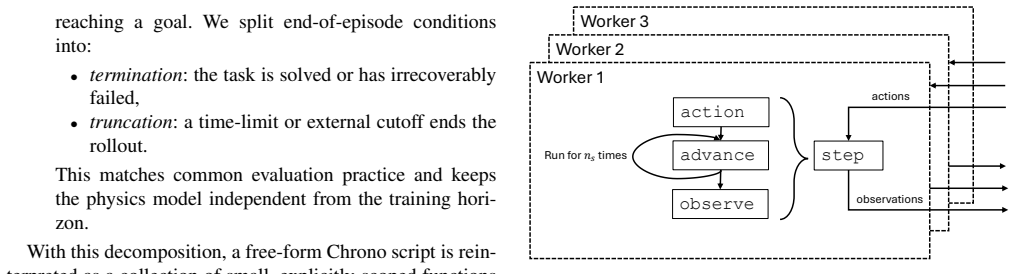
Chrono-Gymnasium scales high-fidelity physics simulations across clusters using a standard Gymnasium interface.
A machine-rendered reading of the paper's core claim, the machinery that carries it, and where it could break.
Core claim
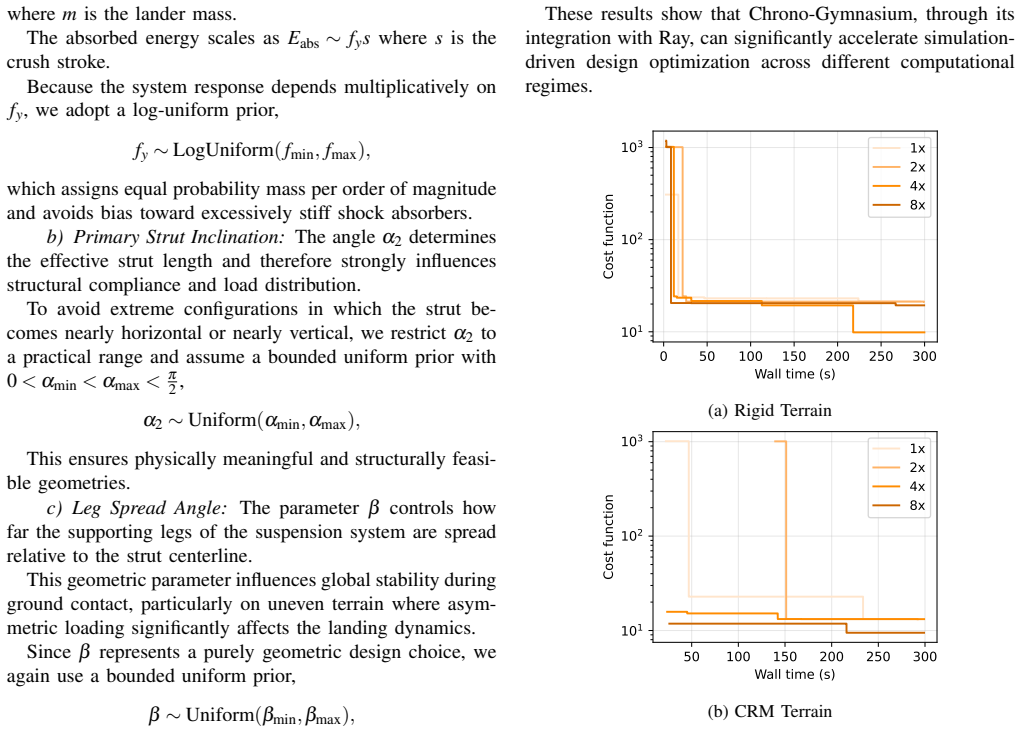
Chrono-Gymnasium is an open-source framework that combines the Ray distributed computing system with Project Chrono's multi-body dynamics engine and exposes it through the Gymnasium API. The framework supplies synchronization and messaging tools needed for running simulations in parallel across computing clusters. Case studies demonstrate its use in reinforcement learning for autonomous navigation and Bayesian optimization for planetary lander parameters, with results indicating reduced wall-clock time and preserved physical fidelity.
What carries the argument
Ray-based distributed execution wrapped in a Gymnasium-compatible interface that handles synchronization for parallel simulation runs.
If this is right
- RL agents for robotic tasks can train on higher-fidelity terrain and dynamics models at larger scales.
- Design parameters for complex mechanical systems can be optimized using more accurate simulations in less time.
- Existing machine learning pipelines gain access to distributed high-fidelity engines without custom integration code.
- Simulation of multi-agent or long-horizon scenarios becomes more practical for robotics research.
Where Pith is reading between the lines
- This setup could support simulation of entire vehicle fleets or swarms that exceed single-machine limits.
- Similar wrappers might be applied to other physics engines to broaden access to distributed high-fidelity modeling.
- Reduced simulation time could shift practice toward using detailed models even in initial design phases rather than simplified approximations.
Load-bearing premise
The distributed execution via Ray and the Gymnasium wrapper do not alter the numerical outputs or stability properties of the original Chrono solver.
What would settle it
Running identical simulation scenarios on both the original Chrono and Chrono-Gymnasium and finding differences in final states, forces, or stability indicators.
Figures



read the original abstract
High-fidelity physics simulation is essential for closing the sim-to-real gap in robotics and complex mechanical systems. However, the computational overhead of high-fidelity engines often limits their use in data-intensive tasks like Reinforcement Learning (RL) and global optimization. We introduce Chrono-Gymnasium, a distributed computing framework that scales the high-fidelity multi-body dynamics of Project Chrono across large-scale computing clusters. Built upon the Ray framework, Chrono-Gymnasium provides a standardized Gymnasium interface, enabling seamless integration with modern machine learning libraries while providing built-in synchronization and messaging primitives for distributed execution. We demonstrate the framework's capabilities through two distinct case studies: (1) the training of an RL agent for autonomous robotic navigation in complex terrains, and (2) the Bayesian Optimization of a planetary lander's design parameters to ensure landing stability. Our results show that Chrono-Gymnasium reduces wall-clock time for high-fidelity simulations without sacrificing physical accuracy, offering a scalable path for the design and control of complex robotic systems.
Editorial analysis
A structured set of objections, weighed in public.
Referee Report
Summary. The manuscript introduces Chrono-Gymnasium, an open-source framework that provides a Gymnasium-compatible interface to Project Chrono's high-fidelity multi-body dynamics engine and distributes simulations via the Ray framework for cluster-scale execution. It describes two case studies—an RL agent for robotic terrain navigation and Bayesian optimization of planetary lander parameters—and asserts that the approach reduces wall-clock time while preserving physical accuracy.
Significance. If the performance and numerical-equivalence claims are substantiated with quantitative evidence, the work would supply a practical tool for scaling high-fidelity physics simulations inside modern RL and optimization pipelines in robotics. The open-source release, standard Gymnasium interface, and built-in synchronization primitives constitute concrete strengths that could improve reproducibility and adoption.
major comments (2)
- [Abstract] Abstract: the central claims that the framework 'reduces wall-clock time for high-fidelity simulations without sacrificing physical accuracy' rest on two case studies, yet the text supplies no quantitative timings, error metrics, baseline comparisons, or statistical results, rendering the claims unevaluable.
- [Case Studies] Case Studies section: no numerical equivalence tests, trajectory comparisons, contact-force consistency checks, or stability-margin verifications are reported between single-process Chrono runs and distributed Ray actors. This directly bears on the accuracy-preservation claim and on the stress-test concern regarding floating-point ordering, contact-resolution determinism, and timestep synchronization.
Simulated Author's Rebuttal
We thank the referee for their thorough review and constructive suggestions. We address the major comments below and will revise the manuscript accordingly to strengthen the quantitative support for our claims.
read point-by-point responses
-
Referee: [Abstract] Abstract: the central claims that the framework 'reduces wall-clock time for high-fidelity simulations without sacrificing physical accuracy' rest on two case studies, yet the text supplies no quantitative timings, error metrics, baseline comparisons, or statistical results, rendering the claims unevaluable.
Authors: We agree that the abstract claims require supporting quantitative evidence to be fully evaluable. The case studies in the manuscript describe the applications but do not include explicit numerical results. In the revised manuscript, we will add wall-clock time comparisons, error metrics between distributed and single-process runs, baseline timings, and statistical summaries to substantiate the performance improvements and accuracy preservation. revision: yes
-
Referee: [Case Studies] Case Studies section: no numerical equivalence tests, trajectory comparisons, contact-force consistency checks, or stability-margin verifications are reported between single-process Chrono runs and distributed Ray actors. This directly bears on the accuracy-preservation claim and on the stress-test concern regarding floating-point ordering, contact-resolution determinism, and timestep synchronization.
Authors: We acknowledge the importance of verifying numerical equivalence to address potential issues with distributed execution such as floating-point ordering and determinism. The current manuscript relies on the design of the synchronization primitives in Chrono-Gymnasium to maintain consistency, but does not report explicit tests. We will incorporate numerical equivalence tests, including trajectory comparisons, contact-force checks, and stability-margin verifications in the revised case studies section. These additions will directly test the concerns raised. revision: yes
Circularity Check
No circularity: software integration framework with no derivations or fitted parameters
full rationale
The paper introduces a distributed simulation framework by wrapping existing Chrono and Ray libraries with a Gymnasium interface. No mathematical derivations, equations, or parameter-fitting steps are present in the abstract or described structure. Claims of reduced wall-clock time without loss of accuracy rest on external library behavior and case-study demonstrations rather than any internal self-definition, renamed predictions, or self-citation chains that reduce the result to its inputs. The work is self-contained as an engineering integration whose validity is externally falsifiable via the cited open-source components.
Axiom & Free-Parameter Ledger
Reference graph
Works this paper leans on
-
[1]
Chrono: An open source framework for the physics- based simulation of dynamic systems,
Project Chrono, “Chrono: An open source framework for the physics- based simulation of dynamic systems,” http://projectchrono.org, 2020, accessed: 2020-03-03
2020
-
[2]
Ray: A distributed framework for emerging{AI}applications,
P. Moritz, R. Nishihara, S. Wang, A. Tumanov, R. Liaw, E. Liang, M. Elibol, Z. Yang, W. Paul, M. I. Jordanet al., “Ray: A distributed framework for emerging{AI}applications,” in13th USENIX sym- posium on operating systems design and implementation (OSDI 18), 2018, pp. 561–577
2018
-
[3]
Gymnasium: A Standard Interface for Reinforcement Learning Environments
M. Towers, A. Kwiatkowski, J. Terry, J. U. Balis, G. De Cola, T. Deleu, M. Goul ˜ao, A. Kallinteris, M. Krimmel, A. KGet al., “Gymnasium: A standard interface for reinforcement learning environments,”arXiv preprint arXiv:2407.17032, 2024
work page internal anchor Pith review Pith/arXiv arXiv 2024
-
[4]
Design and use paradigms for gazebo, an open-source multi-robot simulator,
N. Koenig and A. Howard, “Design and use paradigms for gazebo, an open-source multi-robot simulator,” in2004 IEEE/RSJ international conference on intelligent robots and systems (IROS)(IEEE Cat. No. 04CH37566), vol. 3. Ieee, 2004, pp. 2149–2154
2004
-
[5]
Coppeliasim (formerly v-rep): a versatile and scalable robot simulation framework,
E. Rohmer, S. P. N. Singh, and M. Freese, “Coppeliasim (formerly v-rep): a versatile and scalable robot simulation framework,” inProc. of The International Conference on Intelligent Robots and Systems (IROS), 2013, www.coppeliarobotics.com
2013
-
[6]
Bullet physics simulation,
E. Coumans, “Bullet physics simulation,” inACM SIGGRAPH 2015 Courses, 2015, p. 1
2015
-
[7]
Sphinxsys: An open-source multi-physics and multi-resolution library based on smoothed particle hydrodynamics,
C. Zhang, M. Rezavand, Y . Zhu, Y . Yu, D. Wu, W. Zhang, J. Wang, and X. Hu, “Sphinxsys: An open-source multi-physics and multi-resolution library based on smoothed particle hydrodynamics,”Computer Physics Communications, vol. 267, p. 108066, 2021
2021
-
[8]
Drake: Model-based design and verification for robotics,
R. Tedrake and the Drake Development Team, “Drake: Model-based design and verification for robotics,” 2019. [Online]. Available: https://drake.mit.edu
2019
-
[9]
Isaac Lab: A GPU-Accelerated Simulation Framework for Multi-Modal Robot Learning
M. Mittal, P. Roth, J. Tigue, A. Richard, O. Zhang, P. Du, A. Serrano- Munoz, X. Yao, R. Zurbr ¨ugg, N. Rudinet al., “Isaac lab: A gpu- accelerated simulation framework for multi-modal robot learning,” arXiv preprint arXiv:2511.04831, 2025
work page internal anchor Pith review Pith/arXiv arXiv 2025
-
[10]
Brax–a differentiable physics engine for large scale rigid body simulation,
C. D. Freeman, E. Frey, A. Raichuk, S. Girgin, I. Mordatch, and O. Bachem, “Brax–a differentiable physics engine for large scale rigid body simulation,”arXiv preprint arXiv:2106.13281, 2021
-
[11]
Genesis: A generative and universal physics engine for robotics and beyond,
G. Authors, “Genesis: A generative and universal physics engine for robotics and beyond,” December 2024. [Online]. Available: https://github.com/Genesis-Embodied-AI/Genesis
2024
-
[12]
Chrono: An open source multi-physics dynamics engine,
A. Tasora, R. Serban, H. Mazhar, A. Pazouki, D. Melanz, J. Fleis- chmann, M. Taylor, H. Sugiyama, and D. Negrut, “Chrono: An open source multi-physics dynamics engine,” inHigh Performance Computing in Science and Engineering, T. Kozubek, R. Blaheta, J. ˇS´ıstek, M. Rozlo ˇzn´ık, and M. ˇCerm´ak, Eds. Cham: Springer International Publishing, 2016, pp. 19–49
2016
-
[13]
A physics-based continuum model for ver- satile, scalable, and fast terramechanics simulation,
H. Unjhawala, L. Bakke, H. Zhang, M. Taylor, G. Arivoli, R. Ser- ban, and D. Negrut, “A physics-based continuum model for ver- satile, scalable, and fast terramechanics simulation,”arXiv preprint arXiv:2507.05643, 2025
-
[14]
Functional mock-up interface support in Chrono,
R. Serban and D. Mangoni, “Functional mock-up interface support in Chrono,”Multibody System Dynamics, sep 2025. [Online]. Available: https://doi.org/10.1007/s11044-025-10106-9
-
[15]
W. Hu, P. Li, A. Rogg, A. Schepelmann, S. Chandler, K. Kamrin, and D. Negrut, “A study demonstrating that using gravitational offset to prepare extraterrestrial mobility missions is misleading,”Journal of Field Robotics, vol. 42, no. 7, pp. 3772–3794, 2025. [Online]. Available: https://onlinelibrary.wiley.com/doi/abs/10.1002/rob.22597
-
[16]
An overview of tire-ground contact modeling approaches for surface mobility applications,
A. Schepelmann, C. M. Creager, M. P. Proctor, K. A. Johnson, J. R. Breckenridge, A. Elmland, P. N. Ghezeljeh, and H. A. Oravec, “An overview of tire-ground contact modeling approaches for surface mobility applications,”NASA Technical Memorandum, 2025
2025
-
[17]
Investigating the geotechnical properties of the lunar south pole with NASA VIPER’s mobility system,
E. Rezich, V . T. Bickel, P. L. Francis, A. Rogg, A. Tardy, C. Creager, H. A. Oravec, A. Schepelmann, K. Ennico-Smith, A. Deutsch, and M. Hirabayashi, “Investigating the geotechnical properties of the lunar south pole with NASA VIPER’s mobility system,”The Planetary Science Journal, vol. 6, no. 7, p. 169, jul 2025. [Online]. Available: https://doi.org/10....
-
[18]
Syn- chrono: A scalable, physics-based simulation platform for testing groups of autonomous vehicles and/or robots,
J. Taves, A. Elmquist, A. Young, R. Serban, and D. Negrut, “Syn- chrono: A scalable, physics-based simulation platform for testing groups of autonomous vehicles and/or robots,” in2020 IEEE/RSJ International Conference on Intelligent Robots and Systems (IROS). IEEE, 2020, pp. 2251–2256
2020
-
[19]
Data-driven bulldozer blade control for autonomous terrain leveling,
H. Zhang, G. Arivoli, H. Unjhawala, L. Bakke, R. Serban, and D. Ne- grut, “Data-driven bulldozer blade control for autonomous terrain leveling,”Advanced Robotics Research, p. e202500180, 2026
2026
-
[20]
Pychrono and gym-chrono: A deep reinforcement learning framework leveraging multibody dynamics to control autonomous vehicles and robots,
S. Benatti, A. Young, A. Elmquist, J. Taves, R. Serban, D. Mangoni, A. Tasora, and D. Negrut, “Pychrono and gym-chrono: A deep reinforcement learning framework leveraging multibody dynamics to control autonomous vehicles and robots,” inAdvances in Nonlinear Dynamics: Proceedings of the Second International Nonlinear Dy- namics Conference (NODYCON 2021), V...
2021
-
[21]
Open mpi: A flexible high performance mpi,
R. L. Graham, T. S. Woodall, and J. M. Squyres, “Open mpi: A flexible high performance mpi,” inInternational conference on parallel processing and applied mathematics. Springer, 2005, pp. 228–239
2005
-
[22]
Proximal Policy Optimization Algorithms
J. Schulman, F. Wolski, P. Dhariwal, A. Radford, and O. Klimov, “Proximal policy optimization algorithms,”arXiv preprint arXiv:1707.06347, 2017
work page internal anchor Pith review Pith/arXiv arXiv 2017
-
[23]
Learning to walk in minutes using massively parallel deep reinforcement learning,
N. Rudin, D. Hoeller, P. Reist, and M. Hutter, “Learning to walk in minutes using massively parallel deep reinforcement learning,” inPro- ceedings of the 5th Conference on Robot Learning, ser. Proceedings of Machine Learning Research, vol. 164. PMLR, 2022, pp. 91–100
2022
-
[24]
Learning robust perceptive locomotion for quadrupedal robots in the wild,
T. Miki, J. Lee, J. Hwangbo, L. Wellhausen, V . Koltun, and M. Hutter, “Learning robust perceptive locomotion for quadrupedal robots in the wild,”Science Robotics, 2022
2022
-
[25]
Isaac gym: High performance GPU-based physics simulation for robot learning,
V . Makoviychuk, L. Wawrzyniak, Y . Guo, M. Lu, K. Storey, M. Mack- lin, D. Hoeller, N. Rudin, A. Allshire, A. Handa, and G. State, “Isaac gym: High performance GPU-based physics simulation for robot learning,” inAdvances in Neural Information Processing Systems (NeurIPS), Datasets and Benchmarks Track, 2021
2021
-
[26]
ANYmal parkour: Learning agile navigation for quadrupedal robots,
D. Hoeller, N. Rudin, D. Sako, and M. Hutter, “ANYmal parkour: Learning agile navigation for quadrupedal robots,”Science Robotics, 2024
2024
-
[27]
Modeling granular material dynamics and its two-way coupling with moving solid bodies using a continuum representation and the SPH method,
W. Hu, M. Rakhsha, L. Yang, K. Kamrin, and D. Negrut, “Modeling granular material dynamics and its two-way coupling with moving solid bodies using a continuum representation and the SPH method,” Computer Methods in Applied Mechanics and Engineering, vol. 385, p. 114022, 2021
2021
-
[28]
Optuna: A next-generation hyperparameter optimization framework,
T. Akiba, S. Sano, T. Yanase, T. Ohta, and M. Koyama, “Optuna: A next-generation hyperparameter optimization framework,” inPro- ceedings of the 25th ACM SIGKDD International Conference on Knowledge Discovery and Data Mining, 2019
2019
-
[29]
Algorithms for hyper-parameter optimization,
J. Bergstra, R. Bardenet, Y . Bengio, and B. K ´egl, “Algorithms for hyper-parameter optimization,”Advances in neural information pro- cessing systems, vol. 24, 2011
2011
discussion (0)
Sign in with ORCID, Apple, or X to comment. Anyone can read and Pith papers without signing in.