Exploring the CMB in Anisotropic Universes
Pith reviewed 2026-06-30 20:08 UTC · model grok-4.3
The pith
Perturbations of the Friedmann equations in Bianchi models reduce to a single PDE that can generate CMB power spectra for anisotropic but homogeneous universes.
A machine-rendered reading of the paper's core claim, the machinery that carries it, and where it could break.
Core claim
In Bianchi models, the Newtonian-gauge perturbations of the Friedmann equations, obtained by the same methodology used for FLRW models, can be combined into one characteristic partial differential equation. This equation is solved to simulate the CMB temperature map of a toy Bianchi V universe and to compute the corresponding power spectrum.
What carries the argument
The single characteristic partial differential equation formed by combining the Newtonian-gauge perturbations of the Friedmann equations across Bianchi models.
If this is right
- The method produces CMB power spectra for specific anisotropic models such as Bianchi V while preserving spatial homogeneity.
- Observable signatures of broken isotropy become calculable within a unified treatment of Bianchi models.
- The framework assembles earlier results on anisotropic cosmologies into a single simulation pipeline for the CMB.
Where Pith is reading between the lines
- The same PDE could be applied to other Bianchi types to generate a catalog of distinct anisotropy signatures.
- Direct comparison of the simulated spectra against Planck or future CMB data could place quantitative limits on the allowed level of early-universe anisotropy.
- Coupling the equation to late-time observables such as supernova distances would test consistency across multiple probes.
Load-bearing premise
Spatial homogeneity continues to hold exactly while isotropy is relaxed, and the Newtonian-gauge perturbation equations can be derived and merged into one PDE by the same steps that work for isotropic FLRW models.
What would settle it
A full numerical integration of the Einstein equations for a perturbed Bianchi V spacetime that yields a CMB spectrum differing from the one obtained by solving the single PDE.
Figures
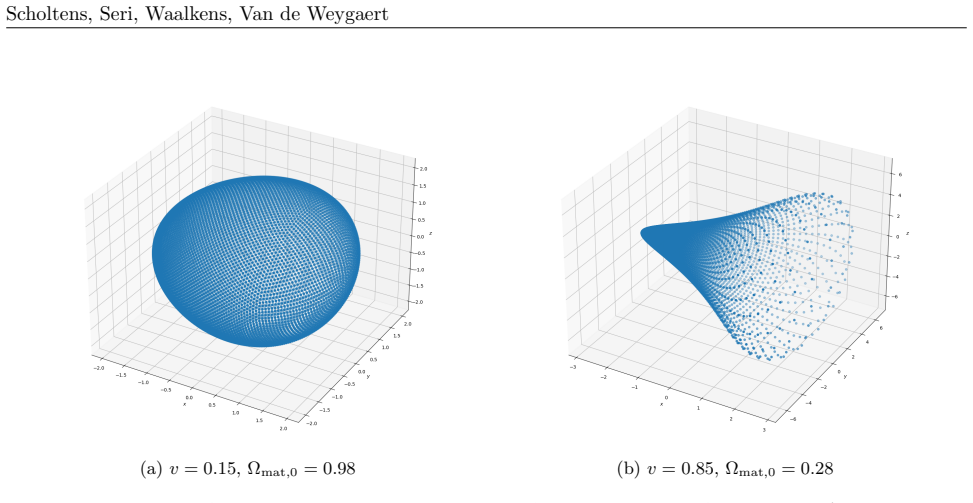
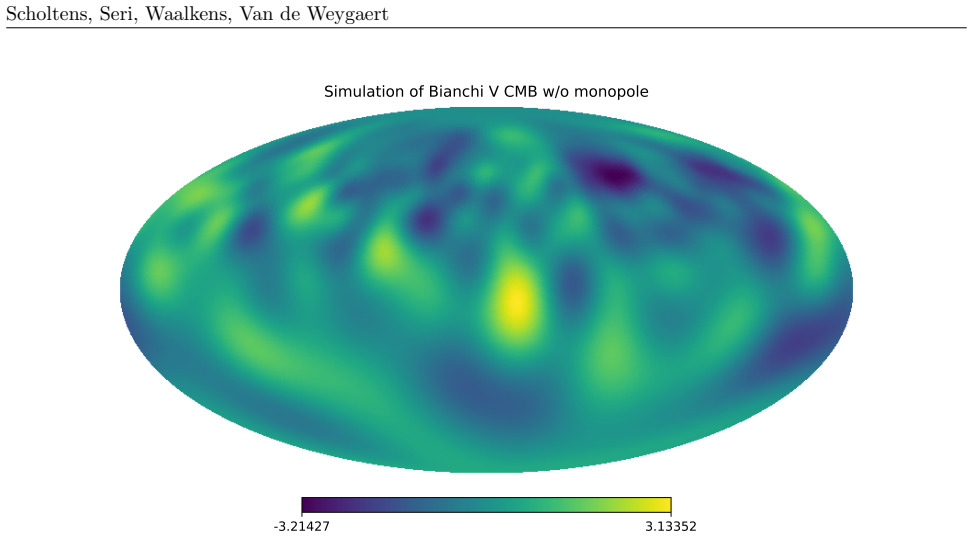
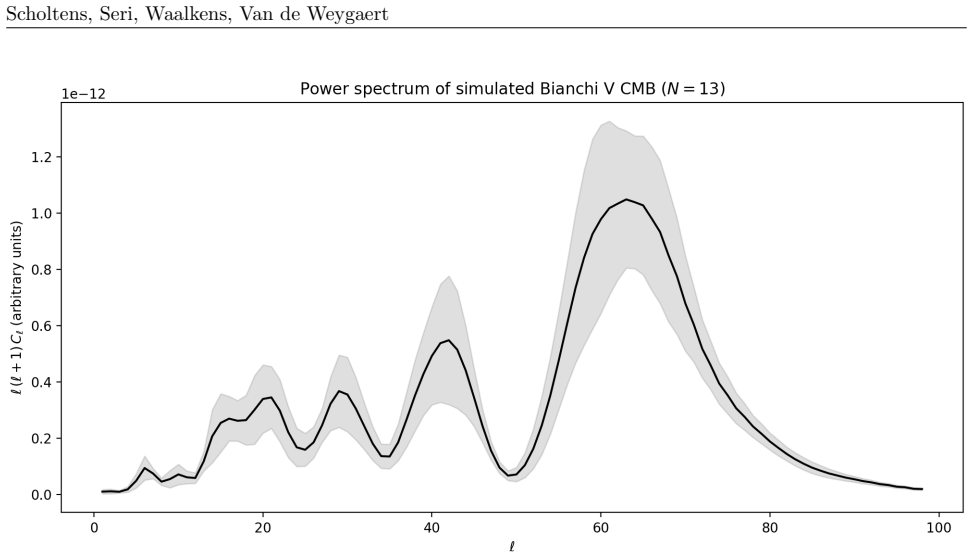
read the original abstract
In recent years, there have been increasing challenges to the cosmological principle, based on new observations of e.g. supernovae and the cosmic bulk flow. As a result, the cosmological community is speaking their concern for the cosmological principle, and from which scales onwards it should apply. In this context, there is a desire to understand more fully the properties and signatures of cosmologies not obeying the cosmological principle. In this article, we let go of the demand of cosmic isotropy, and instead assume only spatial homogeneity in our cosmological models. We follow the results of our previous works [see citations in the list of references], and here bring these together into one unified picture, with the goal of describing the signature(s) of anisotropy in anisotropic cosmological models. We first introduce the Bianchi models -- a particular instance of spatially homogeneous cosmologies -- and show that a metric can be constructed for them when an appropriate collection of desired Killing vector fields is supplied. Then, we give the perturbations of the Friedmann equations in such Bianchi models, in the Newtonian gauge, derived using much the same methodology as applicable to the FLRW models. We show these can be combined into one characteristic partial differential equation. Finally, we use this equation in order to simulate the CMB of a toy Bianchi V example and produce its power spectrum. We close with a discussion, and suggestions for further research.
Editorial analysis
A structured set of objections, weighed in public.
Referee Report
Summary. The manuscript explores anisotropic cosmologies by relaxing the isotropy assumption while maintaining spatial homogeneity in Bianchi models. It constructs metrics using Killing vector fields, derives perturbations to the Friedmann equations in the Newtonian gauge following FLRW methodology, combines these into a single characteristic partial differential equation, and applies this to simulate the CMB power spectrum in a toy Bianchi V example.
Significance. If the derivation of the characteristic PDE is correct and the simulation produces reliable results, this could offer a new framework for modeling and detecting anisotropy signatures in the CMB, addressing current challenges to the cosmological principle. The unification of prior results into one picture is a noted strength.
major comments (1)
- [Abstract] Abstract: The abstract describes the approach at a high level but lacks specific details on the derivation of the PDE, error analysis, validation methods, or explicit equations, making it difficult to assess the soundness of the central claim that the perturbations can be combined into one characteristic PDE.
minor comments (1)
- The manuscript should include at least a brief self-contained summary of the key steps from prior works to allow readers to follow the unification without external references.
Simulated Author's Rebuttal
We thank the referee for their review. We address the single major comment below and are happy to revise the abstract for improved clarity while preserving its conventional brevity.
read point-by-point responses
-
Referee: [Abstract] Abstract: The abstract describes the approach at a high level but lacks specific details on the derivation of the PDE, error analysis, validation methods, or explicit equations, making it difficult to assess the soundness of the central claim that the perturbations can be combined into one characteristic PDE.
Authors: Abstracts are conventionally high-level overviews; the full derivation of the unified characteristic PDE (combining the Newtonian-gauge perturbations of the Friedmann equations), the explicit equations, the numerical implementation of the Bianchi V toy model, and associated validation steps are all presented in the main text (Sections 3 and 4). The central claim is therefore substantiated within the manuscript itself. That said, we agree the abstract could better signal these elements and will expand it with one or two concise sentences referencing the PDE unification and the toy-model power-spectrum computation. revision: yes
Circularity Check
No significant circularity in derivation chain
full rationale
The paper derives perturbations of the Friedmann equations for Bianchi models in Newtonian gauge using the same methodology as FLRW models, combines them into one characteristic PDE, and applies it to simulate a toy Bianchi V CMB power spectrum. The abstract notes following prior works to unify results, but provides no equations or explicit reductions showing any central step (such as the PDE combination) equals its inputs by construction, fitted parameters renamed as predictions, or load-bearing self-citations that are themselves unverified. The spatial homogeneity assumption is standard for Bianchi models and does not create circularity. The derivation is self-contained against external benchmarks with no quoted evidence of the forbidden patterns.
Axiom & Free-Parameter Ledger
axioms (1)
- domain assumption The universe is spatially homogeneous but not necessarily isotropic.
Reference graph
Works this paper leans on
-
[1]
Is the observable Universe consistent with the cosmological principle?
Pavan K. Aluri et al. “Is the observable Universe consistent with the cosmological principle?” In:Classical and Quantum Gravity40.9 (May 2023), p. 094001.issn: 0264-9381, 1361-6382.doi:10 . 1088 / 1361 - 6382/acbefc.url:https://iopscience.iop.org/article/10.1088/1361-6382/acbefc(visited on 03/05/2025)
-
[2]
Hyperbolic universes with a horned topology and the cosmic microwave background anisotropy
Ralf Aurich et al. “Hyperbolic universes with a horned topology and the cosmic microwave background anisotropy”. In:Class. Quantum grav.21 (2004), pp. 4901–4925.doi:10.1088/0264-9381/21/21/010
-
[3]
Universal rotation: how large can it be?
John D. Barrow, R Juszkiewicz, and D.H. Sonoda. “Universal rotation: how large can it be?” In:Monthly Notices of the Royal Astronomical Society213 (1985), pp. 917–943.doi:10.1093/mnras/213.4.917
-
[4]
Nine-yearWilkinson Microwave Anisotropy Probe(WMAP) Observations: Final Maps and Results
C. L. Bennett et al. “Nine-yearWilkinson Microwave Anisotropy Probe(WMAP) Observations: Final Maps and Results”. In:The Astrophysical Journal Supplement Series208.2 (Sept. 2013), p. 20.issn: 0067-0049, 1538-4365.doi:10 . 1088 / 0067 - 0049 / 208 / 2 / 20.url:https : / / iopscience . iop . org / article/10.1088/0067-0049/208/2/20(visited on 02/27/2026). 6 ...
-
[5]
On the Three-Dimensional Spaces Which Admit a Continuous Group of Motions
Luigi Bianchi. “On the Three-Dimensional Spaces Which Admit a Continuous Group of Motions”. en. In: General Relativity and Gravitation33.12 (Dec. 2001), pp. 2171–2253.issn: 0001-7701, 1572-9532.doi: 10.1023/A:1015357132699.url:http://link.springer.com/10.1023/A:1015357132699(visited on 01/10/2025)
work page doi:10.1023/a:1015357132699.url:http://link.springer.com/10.1023/a:1015357132699(visited 2001
-
[6]
Jacques Colin et al. “Probing the anisotropic local Universe and beyond with SNe Ia data: Probing the anisotropic Universe with SNe Ia”. en. In:Monthly Notices of the Royal Astronomical Society414.1 (June 2011), pp. 264–271.issn: 00358711.doi:10.1111/j.1365- 2966.2011.18402.x.url:https: //academic.oup.com/mnras/article-lookup/doi/10.1111/j.1365-2966.2011....
-
[7]
A Class of Homogeneous Cosmological Models. II. Observa- tions
G. F. R. Ellis and M. A. H. MacCallum. “A Class of Homogeneous Cosmological Models. II. Observa- tions”. In:Comm. Math. Phys19 (1970), pp. 31–64.url:https://projecteuclid.org/journals/ communications - in - mathematical - physics / volume - 19 / issue - 1 / A - class - of - homogeneous - cosmological-models-II-Observations/cmp/1103842615.full
-
[8]
The Bianchi models: Then and now
G.F.R. Ellis. “The Bianchi models: Then and now”. In:General Relativistic Gravity38 (2006), pp. 1003– 1015.doi:10.1007/s10714-006-0283-4
-
[9]
Ellis, Roy Maartens, and M.A.H
G.F.R. Ellis, Roy Maartens, and M.A.H. MacCallum.Relativistic Cosmology. Cambridge University Press, 2012.isbn: 978-0-521-38115-4
2012
-
[10]
A Class of Homogeneous Cosmological Models
G.F.R. Ellis and M.A.H. MacCallum. “A Class of Homogeneous Cosmological Models”. In:Comm. Math. Phys12 (1969), pp. 108–141
1969
-
[11]
Bianchi type VII h models and theWMAP3-year data
T. R. Jaffe et al. “Bianchi type VII h models and theWMAP3-year data”. In:Astronomy & Astrophysics 460.2 (Dec. 2006), pp. 393–396.issn: 0004-6361, 1432-0746.doi:10.1051/0004-6361:20065748.url: http://www.aanda.org/10.1051/0004-6361:20065748(visited on 02/27/2026)
-
[12]
T. R. Jaffe et al. “Evidence of Vorticity and Shear at Large Angular Scales in theWMAPData: A Violation of Cosmological Isotropy?” en. In:The Astrophysical Journal629.1 (Aug. 2005), pp. L1–L4. issn: 0004-637X, 1538-4357.doi:10.1086/444454.url:https://iopscience.iop.org/article/10. 1086/444454(visited on 02/27/2026)
work page doi:10.1086/444454.url:https://iopscience.iop.org/article/10 2005
-
[13]
The Dynamical Degrees of Freedom in Spatially Homogeneous Cosmology
Robert T. Jantzen. “The Dynamical Degrees of Freedom in Spatially Homogeneous Cosmology”. In: Comm. Math. Phys64 (1979), pp. 211–232
1979
-
[14]
Exploring the cosmic microwave background dipole direction using gamma-ray bursts
Orlando Luongo, Marco Muccino, and Francesco Sorrenti. “Exploring the cosmic microwave background dipole direction using gamma-ray bursts”. In:Astronomy & Astrophysics703 (Nov. 2025), A115.issn: 0004-6361, 1432-0746.doi:10.1051/0004-6361/202556806.url:https://www.aanda.org/10.1051/ 0004-6361/202556806(visited on 05/01/2026). 7 Scholtens, Seri, Waalkens, V...
work page doi:10.1051/0004-6361/202556806.url:https://www.aanda.org/10.1051/ 2025
-
[15]
Larger H 0 values in the CMB dipole direction
Orlando Luongo et al. “Larger H 0 values in the CMB dipole direction”. en. In:Physical Review D 105.10 (May 2022), p. 103510.issn: 2470-0010, 2470-0029.doi:10.1103/PhysRevD.105.103510.url: https://link.aps.org/doi/10.1103/PhysRevD.105.103510(visited on 05/01/2026)
-
[16]
Cosmological models from a geometric point of view
M. A. H. MacCallum. “Cosmological models from a geometric point of view”. In:Carg` ese Lectures in Physics6 (1973), pp. 61–173.doi:10.48550/arXiv.2001.11387
-
[17]
K. Nakamura. “Construction of gauge-invariant variables of linear metric perturbations on an arbitrary background spacetime”. en. In:Progress of Theoretical and Experimental Physics2013.4 (Apr. 2013), 43E02–.issn: 2050-3911.doi:10.1093/ptep/ptt006.url:https://academic.oup.com/ptep/article- lookup/doi/10.1093/ptep/ptt006(visited on 08/07/2025)
work page doi:10.1093/ptep/ptt006.url:https://academic.oup.com/ptep/article- 2013
-
[18]
P. J. E. Peebles.The Large-Scale Structure of the Universe. Princeton University Press, 1980.isbn: 0-691-08239-1
1980
-
[19]
Theory of cosmological perturbations in an anisotropic universe
Thiago S. Pereira, Cyril Pitrou, and Jean-Philippe Uzan. “Theory of cosmological perturbations in an anisotropic universe”. In:JCAP9 (2007).doi:10.1088/1475-7516/2007/09/006
-
[21]
Observations and analysis of phase scintillation of spacecraft signal on the interplanetary plasma,
Planck Collaboration et al. “Planck2015 results: XVIII. Background geometry and topology of the Universe”. In:Astronomy & Astrophysics594 (Oct. 2016), A18.issn: 0004-6361, 1432-0746.doi:10. 1051/0004- 6361/201525829.url:http://www.aanda.org/10.1051/0004- 6361/201525829(visited on 10/28/2025)
-
[22]
Planck Collaboration et al. “Planck2018 results: I. Overview and the cosmological legacy ofPlanck”. In: Astronomy & Astrophysics641 (Sept. 2020), A1.issn: 0004-6361, 1432-0746.doi:10.1051/0004-6361/ 201833880.url:https://www.aanda.org/10.1051/0004-6361/201833880(visited on 02/27/2026)
-
[23]
Rogues’ gallery: The full freedom of the Bianchi CMB anomalies
Andrew Pontzen. “Rogues’ gallery: The full freedom of the Bianchi CMB anomalies”. In:Physical Review D79 (2009).doi:10.1103/PhysRevD.79.103518
-
[24]
Michael P. Ryan Jr. and Lawrence C. Shepley.Homogeneous Relativistic Cosmologies. Princeton Univer- sity Press, 1975
1975
-
[25]
Anisotropy in Pantheon+ supernovae
Animesh Sah et al. “Anisotropy in Pantheon+ supernovae”. en. In:The European Physical Journal C 85.5 (May 2025), p. 596.issn: 1434-6052.doi:10 . 1140 / epjc / s10052 - 025 - 14222 - w.url:https : //link.springer.com/10.1140/epjc/s10052-025-14222-w(visited on 06/02/2025)
-
[26]
Robbert W. Scholtens et al.Fundamental Cosmic Anisotropy and its Ramifications I: Killing vector fields and constructing their metric. arXiv:2408.04938 [gr-qc]. Oct. 2025.doi:10.48550/arXiv.2408.04938. url:http://arxiv.org/abs/2408.04938(visited on 10/23/2025)
-
[27]
Robbert W. Scholtens et al.Fundamental Cosmic Anisotropy and its Ramifications II: Perturbations in Bianchi spacetimes, and fixed in the Newtonian gauge. arXiv:2604.19706 [gr-qc]. Apr. 2026.doi:10 . 48550/arXiv.2604.19706.url:http://arxiv.org/abs/2604.19706(visited on 05/12/2026)
work page internal anchor Pith review Pith/arXiv arXiv 2026
-
[28]
Scholtens et al.Fundamental Cosmic Anisotropy and its Ramifications III
Robbert W. Scholtens et al.Fundamental Cosmic Anisotropy and its Ramifications III. in prep. 2026
2026
-
[29]
Nathan Secrest et al.Colloquium: The Cosmic Dipole Anomaly. arXiv:2505.23526 [astro-ph]. May 2025. doi:10.48550/arXiv.2505.23526.url:http://arxiv.org/abs/2505.23526(visited on 06/02/2025)
work page doi:10.48550/arxiv.2505.23526.url:http://arxiv.org/abs/2505.23526(visited 2025
-
[30]
Nathan J. Secrest et al. “A Test of the Cosmological Principle with Quasars”. In:The Astrophysical Journal Letters908 (2021).doi:10.3847/2041-8213/abdd40
-
[31]
Hans Stephani et al.Exact Solutions of Einstein’s Field Equations. 2nd ed. Cambridge University Press, 2003.isbn: 978-0-511-06548-4
2003
-
[32]
Empty Space-times admitting a three parameter group of motions
A.H. Taub. “Empty Space-times admitting a three parameter group of motions”. In:Annals of Mathe- matics53 (1951), pp. 472–490
1951
-
[33]
The cosmic radio dipole: Bayesian estimators on new and old radio surveys
J. D. Wagenveld, H.-R. Kl¨ ockner, and D. J. Schwarz. “The cosmic radio dipole: Bayesian estimators on new and old radio surveys”. In:Astronomy & Astrophysics675 (2023).doi:10.1051/0004-6361/202346210
-
[34]
Wald.General Relativity
Robert M. Wald.General Relativity. University of Chicago Press, 1984.isbn: 0-226-87033-2
1984
-
[35]
Richard Watkins and Hume A. Feldman.The Origins of the Bulk flow. arXiv:2512.03168 [astro-ph]. Dec. 2025.doi:10 . 48550 / arXiv . 2512 . 03168.url:http : / / arxiv . org / abs / 2512 . 03168(visited on 12/05/2025)
-
[36]
Richard Watkins et al. “Analysing the large-scale bulk flow using cosmicflows4: increasing tension with the standard cosmological model”. In:Monthly Notices of the Royal Astronomical Society524 (2023). doi:10.1093/mnras/stad1984. 8 Scholtens, Seri, Waalkens, Van de Weygaert
-
[37]
healpy: equal area pixelization and spherical harmonics transforms for data on the sphere in Python
Andrea Zonca et al. “healpy: equal area pixelization and spherical harmonics transforms for data on the sphere in Python”. In:Journal of Open Source Software4.35 (Mar. 2019), p. 1298.issn: 2475-9066.doi: 10.21105/joss.01298.url:http://joss.theoj.org/papers/10.21105/joss.01298(visited on 02/23/2026). Robbert W. Scholtens (contact author) Kapteyn Astronomic...
work page doi:10.21105/joss.01298.url:http://joss.theoj.org/papers/10.21105/joss.01298(visited 2019
discussion (0)
Sign in with ORCID, Apple, or X to comment. Anyone can read and Pith papers without signing in.