Recognition: 2 theorem links
· Lean TheoremNumerical simulations of waves and turbulence in coronal loops: observables and spectra
Pith reviewed 2026-05-15 02:59 UTC · model grok-4.3
The pith
Spectra of emission intensity in simulated coronal loops match the 3D density spectra at MUSE resolution
A machine-rendered reading of the paper's core claim, the machinery that carries it, and where it could break.
Core claim
The authors simulate a pressure-balanced cylindrical coronal loop with an initial perturbation combining a torsional Alfvén wave and a transverse turbulent component. They compute the moments of the Fe IX 171 Å line to obtain 2D maps of intensity I0, Doppler shift I1, and non-thermal broadening I2, including at simulated MUSE resolution of 312 km. The 1D power spectra of these maps are compared to spectra from the 3D density and velocity fields, revealing matching spectral indexes for the intensity and density.
What carries the argument
The synthesis of intensity I0 from line-of-sight integration of the Fe IX spectral line and the direct comparison of its power spectrum to that of the 3D density distribution.
If this is right
- Longitudinal threads form in the intensity maps.
- Small-scale fluctuations develop primarily at the loop boundary due to phase mixing.
- Non-thermal broadening increases where phase mixing and turbulence are active.
- The spectral index agreement allows I0 spectra to infer the density spectrum inside the loop.
Where Pith is reading between the lines
- If the result holds, intensity spectra from real observations could serve as a practical proxy for density turbulence spectra in coronal loops.
- This technique might be tested with current instruments at lower resolution to validate the spectral match.
- It could help interpret data from other solar missions by linking observables to internal plasma dynamics.
Load-bearing premise
The model of a cylindrical pressure-balanced loop with specific initial perturbation weights and the line-of-sight integration procedure accurately represent real coronal conditions without creating artificial spectral agreements.
What would settle it
Measuring the spectral index of intensity power spectra in actual MUSE data from a coronal loop and finding it differs from the spectral index of the density fluctuations measured independently in the same structure.
Figures


read the original abstract
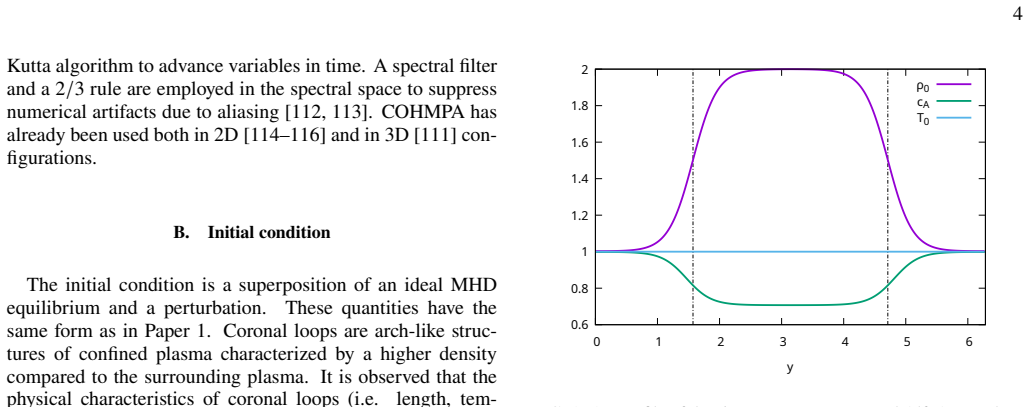
We investigate numerically the time evolution of velocity and magnetic field fluctuations in a coronal loop, focusing on the dynamics due to both phase mixing and turbulent cascade. The intensity, doppler velocity and non-thermal broadening are synthesized from numerical results in order to establish if the upcoming Multi-slit Solar Explorer (MUSE) mission could reveal the presence of those phenomena in the solar corona through its unprecedented high-resolution spectroscopic observations. The loop is represented by a cylindrical pressure-balanced magnetic structure with a transverse density and magnetic field inhomogeneity. The initial perturbation is a superposition of a torsional Alfv\'en wave and a transverse turbulent component with different tunable weights. In order to reconstruct plasma emission features we calculate moments of the Fe IX 171 \AA\ spectral line. 2D maps obtained by integrating the emission along the assumed line of sight are calculated for the emission intensity $I_0$, the Doppler shift $I_1$ and the non-thermal broadening $I_2$, for several values of the model parameters. Finally, we simulate MUSE spectrograph by considering a resolution of $312$ km $\times$ $312$ km. We observe how intensity maps show the formation of longitudinal threads. The generation of small-scale fluctuations mainly takes place in the inhomogeneity region at the loop boundary, where the effects of phase mixing and non-thermal broadening are stronger. 1D power spectra of intensity and Doppler shift maps are calculated and compared with the corresponding spectra of density and line-of-sight velocity component. The agreement observed between the spectral indexes of the intensity power spectra at MUSE resolution and the one computed from the full 3D density field indicates that spectra of $I_0$ can be used to infer information on the spectrum of density inside a loop.
Editorial analysis
A structured set of objections, weighed in public.
Referee Report
Summary. The manuscript presents 3D MHD simulations of a cylindrical pressure-balanced coronal loop with transverse density and magnetic inhomogeneity. Initial conditions superpose a torsional Alfvén wave and a transverse turbulent component with tunable relative weights. Moments of the Fe IX 171 Å line are computed to synthesize intensity I0, Doppler shift I1, and non-thermal broadening I2; 2D maps are formed by line-of-sight integration and then degraded to MUSE resolution (312 km). One-dimensional power spectra of the resulting I0 maps are compared with spectra of the underlying 3D density field; the reported agreement of their power-law indices is used to argue that MUSE-resolution intensity spectra can be used to infer the spectrum of density fluctuations inside the loop.
Significance. If the central result is robust, the work is significant because it supplies a concrete forward-modeling link between upcoming MUSE spectroscopic observables and the underlying density fluctuation spectrum in a coronal loop. The direct comparison of synthetic I0 spectra to the full 3D density field, rather than to fitted parameters, is a methodological strength that could help interpret future high-resolution observations of coronal turbulence and phase mixing.
major comments (3)
- [Abstract and §4] Abstract and §4 (results): the central claim rests on agreement of spectral indices between MUSE-resolution I0 and the full 3D density field, yet no numerical values for the indices, fitting ranges, uncertainties, or goodness-of-fit metrics are provided. Without these quantities it is impossible to judge how close the agreement actually is or whether it survives changes in the fitting procedure.
- [§3 and §5] §3 (model setup) and §5 (parameter study): the free parameters include the relative weights of the torsional Alfvén wave and turbulent component. The text states that several values were explored, but no table or figure quantifies how the recovered spectral index of I0 changes with these weights or with the transverse inhomogeneity profile. Because intensity is formed from n² emissivity integrated along the line of sight, scale-dependent filtering by the particular cylindrical geometry or phase-mixing layer could produce an index coincidence that is not general; a quantitative robustness test across at least two qualitatively different equilibria is required to support the inference claim.
- [§4] §4 (spectral analysis): the 1D power spectra are computed from 2D maps after LOS integration and MUSE binning, but no separate quantification is given of how each step (LOS integration, 312 km binning, or the boundary inhomogeneity) modifies the index relative to the raw 3D density spectrum. This decomposition is needed to isolate whether the reported agreement is a generic property of I0 or an artifact of the chosen setup.
minor comments (2)
- [Throughout] Notation: the symbols I0, I1, I2 are introduced for the line moments but are not consistently distinguished from the underlying plasma quantities (density, LOS velocity) in the figure captions and text; a short table of definitions would improve clarity.
- [Figures 8–10] Figure clarity: several panels show power spectra without indicating the wavenumber range used for the power-law fit or the location of the break scale; adding these annotations would make the comparison with the 3D density spectrum easier to evaluate.
Simulated Author's Rebuttal
We thank the referee for their thorough review and valuable suggestions. We have revised the manuscript to address the concerns raised, particularly by providing quantitative details and additional analysis to support our claims.
read point-by-point responses
-
Referee: [Abstract and §4] Abstract and §4 (results): the central claim rests on agreement of spectral indices between MUSE-resolution I0 and the full 3D density field, yet no numerical values for the indices, fitting ranges, uncertainties, or goodness-of-fit metrics are provided. Without these quantities it is impossible to judge how close the agreement actually is or whether it survives changes in the fitting procedure.
Authors: We agree that including specific numerical values is necessary for a rigorous assessment. In the revised manuscript, we have added a table in Section 4 listing the power-law indices for the I0 maps at MUSE resolution and the 3D density field, along with the wavenumber fitting range (typically 0.005 to 0.05 km^{-1}), uncertainties from the fit, and R-squared values. The indices agree to within 0.05, confirming the reported agreement is robust to the fitting details. revision: yes
-
Referee: [§3 and §5] §3 (model setup) and §5 (parameter study): the free parameters include the relative weights of the torsional Alfvén wave and turbulent component. The text states that several values were explored, but no table or figure quantifies how the recovered spectral index of I0 changes with these weights or with the transverse inhomogeneity profile. Because intensity is formed from n² emissivity integrated along the line of sight, scale-dependent filtering by the particular cylindrical geometry or phase-mixing layer could produce an index coincidence that is not general; a quantitative robustness test across at least two qualitatively different equilibria is required to support the inference claim.
Authors: We have expanded Section 5 to include a quantitative analysis. A new figure shows the spectral index of I0 as a function of the wave-to-turbulence weight ratio for the standard equilibrium and for a second, qualitatively different profile with a smoother density transition. The recovered index varies by less than 0.1 across the explored parameter space, remaining close to the 3D density index. This supports that the agreement is not an artifact of a single setup. We note that while more equilibria could be tested, the two chosen represent the primary cases of interest for coronal loops. revision: yes
-
Referee: [§4] §4 (spectral analysis): the 1D power spectra are computed from 2D maps after LOS integration and MUSE binning, but no separate quantification is given of how each step (LOS integration, 312 km binning, or the boundary inhomogeneity) modifies the index relative to the raw 3D density spectrum. This decomposition is needed to isolate whether the reported agreement is a generic property of I0 or an artifact of the chosen setup.
Authors: We have added a new subsection in §4 with the requested decomposition. We present spectra computed from the 3D density, from the LOS-integrated intensity before binning, and after MUSE-resolution binning. The analysis shows that LOS integration introduces a small steepening of the index by approximately 0.05-0.1, while the binning step has minimal impact within the fitted range. The boundary inhomogeneity effects are localized and do not alter the overall power-law index significantly. These results are now quantified with plots and text. revision: yes
Circularity Check
No significant circularity; results are direct outcomes of forward MHD modeling and spectral comparison
full rationale
The paper's central claim rests on numerical integration of the MHD equations for a prescribed cylindrical loop equilibrium, followed by line-of-sight synthesis of Fe IX 171 Å moments to obtain I0, I1 and I2, and direct computation of 1D power spectra. The reported agreement in spectral indices between MUSE-resolved I0 and the full 3D density field is an empirical numerical result, not obtained by defining I0 in terms of density, by fitting any parameter to enforce index equality, or by invoking a self-citation chain that imports the target conclusion. No ansatz is smuggled via prior work, no uniqueness theorem is asserted, and no known empirical pattern is merely renamed. The derivation chain therefore remains self-contained against external benchmarks.
Axiom & Free-Parameter Ledger
free parameters (1)
- relative weights of torsional Alfvén wave and turbulent component
axioms (1)
- domain assumption Coronal loop modeled as cylindrical pressure-balanced magnetic structure with transverse density and magnetic field inhomogeneity
Lean theorems connected to this paper
-
IndisputableMonolith/Foundation/RealityFromDistinction.leanreality_from_one_distinction unclear?
unclearRelation between the paper passage and the cited Recognition theorem.
The loop is represented by a cylindrical pressure-balanced magnetic structure with a transverse density and magnetic field inhomogeneity. ... 1D power spectra of intensity and Doppler shift maps are calculated and compared with the corresponding spectra of density and line-of-sight velocity component.
-
IndisputableMonolith/Cost/FunctionalEquation.leanwashburn_uniqueness_aczel unclear?
unclearRelation between the paper passage and the cited Recognition theorem.
The agreement observed between the spectral indexes of the intensity power spectra at MUSE resolution and the one computed from the full 3D density field indicates that spectra of I0 can be used to infer information on the spectrum of density inside a loop.
What do these tags mean?
- matches
- The paper's claim is directly supported by a theorem in the formal canon.
- supports
- The theorem supports part of the paper's argument, but the paper may add assumptions or extra steps.
- extends
- The paper goes beyond the formal theorem; the theorem is a base layer rather than the whole result.
- uses
- The paper appears to rely on the theorem as machinery.
- contradicts
- The paper's claim conflicts with a theorem or certificate in the canon.
- unclear
- Pith found a possible connection, but the passage is too broad, indirect, or ambiguous to say the theorem truly supports the claim.
Reference graph
Works this paper leans on
-
[1]
V. M. Nakariakov and D. Y. Kolotkov, Magnetohydrodynamic waves in the solar corona, Annual Review of Astronomy and Astrophysics58, 441 (2020)
work page 2020
-
[2]
R. Bruno and V. Carbone, The Solar Wind as a Turbulence Laboratory, Living Reviews in Solar Physics10, 2 (2013)
work page 2013
-
[3]
R. Marino and L. Sorriso-Valvo, Scaling laws for the energy transfer in space plasma turbulence, Physics Reports1006, 1 (2023)
work page 2023
-
[4]
L. Sorriso-Valvo and F. Malara, Interplanetary rendezvous at a solar wind stream, Science385, 928 (2024)
work page 2024
-
[5]
Y. J. Rivera, S. T. Badman, M. L. Stevens, J. L. Verniero, J. E. Stawarz, C. Shi, J. M. Raines, K. W. Paulson, C. J. Owen, T. Niembro, P. Louarn, S. A. Livi, S. T. Lepri, J. C. Kasper, T. S. Horbury, J. S. Halekas, R. M. Dewey, R. D. Marco, and S. D. Bale, In situ observations of large-amplitude alfv ´en waves heating and accelerating the solar wind, Scie...
work page 2024
-
[6]
U. Feldman, G. A. Doschek, and J. F. Seely, Solar spectroscopy in the far-ultraviolet - X-ray wavelength regions:status and prospects., Journal of the Optical Society of America B Optical Physics5, 2237 (1988)
work page 1988
-
[7]
K. P. Dere and H. E. Mason, Nonthermal Velocities in the Solar Transition Zone Observed with the High-Resolution Telescope and Spectrograph, Solar Physics144, 217 (1993)
work page 1993
-
[8]
J. Chae, U. Sch¨ uhle, and P. Lemaire, SUMER Measurements of Nonthermal Motions: Constraints on Coronal Heating Mech- 13 anisms, The Astrophysical Journal505, 957 (1998)
work page 1998
- [9]
-
[10]
M. J. Aschwanden, L. Fletcher, C. J. Schrijver, and D. Alexan- der, Coronal Loop Oscillations Observed with the Transition Region and Coronal Explorer, The Astrophysical Journal520, 880 (1999)
work page 1999
-
[11]
V. M. Nakariakov, L. Ofman, E. E. Deluca, B. Roberts, and J. M. Davila, TRACE observation of damped coronal loop oscillations: Implications for coronal heating, Science285, 862 (1999)
work page 1999
-
[12]
C. J. Schrijver, A. M. Title, T. E. Berger, L. Fletcher, N. E. Hurl- burt, R. W. Nightingale, R. A. Shine, T. D. Tarbell, J. Wolfson, L. Golub, J. A. Bookbinder, E. E. DeLuca, R. A. McMullen, H. P. Warren, C. C. Kankelborg, B. N. Handy, and B. De Pon- tieu, A new view of the solar outer atmosphere by the Transition Region and Coronal Explorer, Solar Physi...
work page 1999
-
[13]
I. V. Zimovets and V. M. Nakariakov, Excitation of kink os- cillations of coronal loops: statistical study, Astronomy & Astrophysics577, A4 (2015)
work page 2015
-
[14]
C. R. Goddard, G. Nistic `o, V. M. Nakariakov, and I. V. Zi- movets, A statistical study of decaying kink oscillations de- tected using SDO/AIA, Astronomy & Astrophysics585, A137 (2016), arXiv:1511.03558 [astro-ph.SR]
work page internal anchor Pith review Pith/arXiv arXiv 2016
-
[15]
V. M. Nakariakov, S. A. Anfinogentov, P. Antolin, R. Jain, D. Y. Kolotkov, E. G. Kupriyanova, D. Li, N. Magyar, G. Nis- tic`o, D. J. Pascoe, A. K. Srivastava, J. Terradas, S. Vasheghani Farahani, G. Verth, D. Yuan, and I. V. Zimovets, Kink Os- cillations of Coronal Loops, Space Science Reviews217, 73 (2021), arXiv:2109.11220 [astro-ph.SR]
-
[16]
H. Tian, S. W. McIntosh, T. Wang, L. Ofman, B. De Pontieu, D. E. Innes, and H. Peter, Persistent Doppler Shift Oscilla- tions Observed with Hinode/EIS in the Solar Corona: Spectro- scopic Signatures of Alfv ´enic Waves and Recurring Upflows, The Astrophysical Journal759, 144 (2012), arXiv:1209.5286 [astro-ph.SR]
work page internal anchor Pith review Pith/arXiv arXiv 2012
-
[17]
T. Wang, L. Ofman, J. M. Davila, and Y. Su, Growing Transverse Oscillations of a Multistranded Loop Observed by SDO/AIA, The Astrophysical Journal Letters751, L27 (2012), arXiv:1204.1376 [astro-ph.SR]
work page internal anchor Pith review Pith/arXiv arXiv 2012
-
[18]
G. Nistic `o, V. M. Nakariakov, and E. Verwichte, Decaying and decayless transverse oscillations of a coronal loop, Astronomy & Astrophysics552, A57 (2013)
work page 2013
-
[19]
S. Anfinogentov, V. Nakariakov, and G. Nistic`o, Decayless low- amplitude kink oscillations: a common phenomenon in the solar corona?, Astronomy & Astrophysics583, A136 (2015)
work page 2015
-
[20]
V. M. Nakariakov, V. Pilipenko, B. Heilig, P. Jel´ınek, M. Kar- lick´ y, D. Y. Klimushkin, D. Y. Kolotkov, D. H. Lee, G. Nistic`o, T. Van Doorsselaere, G. Verth, and I. V. Zimovets, Magneto- hydrodynamic Oscillations in the Solar Corona and Earth’s Magnetosphere: Towards Consolidated Understanding, Space Science Reviews200, 75 (2016)
work page 2016
-
[21]
Heating by transverse waves in simulated coronal loops
K. Karampelas, T. Van Doorsselaere, and P. Antolin, Heating by transverse waves in simulated coronal loops, Astronomy & Astrophysics604, A130 (2017), arXiv:1706.02640 [astro- ph.SR]
work page internal anchor Pith review Pith/arXiv arXiv 2017
-
[22]
Amplitudes and energy fluxes of simulated decayless kink oscillations
K. Karampelas, T. Van Doorsselaere, D. J. Pascoe, M. Guo, and P. Antolin, Amplitudes and energy fluxes of simulated decayless kink oscillations., Frontiers in Astronomy and Space Sciences6, 38 (2019), arXiv:1906.02001 [astro-ph.SR]
work page internal anchor Pith review Pith/arXiv arXiv 2019
- [23]
-
[24]
S. Tomczyk, S. McIntosh, S. Keil, P. Judge, T. Schad, D. Seeley, and J. Edmondson, Alfv´en waves in the solar corona, Science 317, 1192 (2007)
work page 2007
-
[25]
Time-Distance Seismology of the Solar Corona with CoMP
S. Tomczyk and S. W. McIntosh, Time-Distance Seismology of the Solar Corona with CoMP, The Astrophysical Journal 697, 1384 (2009), arXiv:0903.2002 [astro-ph.SR]
work page internal anchor Pith review Pith/arXiv arXiv 2009
-
[26]
A Tale Of Two Spicules: The Impact of Spicules on the Magnetic Chromosphere
B. De Pontieu, S. McIntosh, V. H. Hansteen, M. Carlsson, C. J. Schrijver, T. D. Tarbell, A. M. Title, R. A. Shine, Y. Sue- matsu, S. Tsuneta, Y. Katsukawa, K. Ichimoto, T. Shimizu, and S. Nagata, A Tale of Two Spicules: The Impact of Spicules on the Magnetic Chromosphere, Publications of the Astronomical Society of Japan59, S655 (2007), arXiv:0710.2934 [astro-ph]
work page internal anchor Pith review Pith/arXiv arXiv 2007
-
[27]
S. W. McIntosh, B. De Pontieu, M. Carlsson, V. Hansteen, P. Boerner, and M. Goossens, Alfv ´enic waves with sufficient energy to power the quiet solar corona and fast solar wind, Nature475, 477 (2011)
work page 2011
-
[28]
T. Van Doorsselaere, V. M. Nakariakov, and E. Verwichte, Detection of waves in the solar corona: kink or alfv ´en?, The Astrophysical Journal676, L73 (2008)
work page 2008
- [29]
-
[30]
J. Terradas and I. Arregui, Temporal and Spatial Scales for Coronal Heating by Alfv ´en Wave Dissipation in Transverse Loop Oscillations, Research Notes of the American Astro- nomical Society2, 196 (2018)
work page 2018
-
[31]
J. Heyvaerts and E. R. Priest, Coronal heating by phase-mixed shear Alfven waves., Astronomy & Astrophysics117, 220 (1983)
work page 1983
-
[32]
J. A. McLaughlin, I. de Moortel, and A. W. Hood, Phase mixing of nonlinear visco-resistive Alfv ´en waves, Astronomy & As- trophysics527, A149 (2011), arXiv:1101.5945 [astro-ph.SR]
work page internal anchor Pith review Pith/arXiv arXiv 2011
-
[33]
R. S. Steinolfson, Resistive wave dissipation on magnetic in- homogeneities Normal modes and phase mixing, The Astro- physical Journal295, 213 (1985)
work page 1985
-
[34]
F. Califano, C. Chiuderi, and G. Einaudi, Nonresonant Re- sistive Dissipation of Incompressible Magnetohydrodynamic Waves, The Astrophysical Journal365, 757 (1990)
work page 1990
-
[35]
F. Califano, C. Chiuderi, and G. Einaudi, Nonresonant Re- sistive Dissipation of Compressible Magnetohydrodynamic Waves, The Astrophysical Journal390, 560 (1992)
work page 1992
-
[36]
M. A. Lee and B. Roberts, On the behavior of hydromag- netic surface waves, Astrophysical Journal, Part 1 (ISSN 0004- 637X), vol. 301, Feb. 1, 1986, p. 430-439.301, 430 (1986)
work page 1986
- [37]
- [38]
-
[39]
M. S. Ruderman, V. M. Nakariakov, and B. Roberts, Alfven wave phase mixing in two-dimensional open magnetic config- urations., Astronomy & Astrophysics338, 1118 (1998)
work page 1998
-
[40]
P. Petkaki, F. Malara, and P. Veltri, Topological Formation of Small Scales in Magnetohydrodynamics: A Fast Dissipation Mechanism, The Astrophysical Journal500, 483 (1998)
work page 1998
- [41]
- [42]
- [43]
- [44]
-
[45]
F. Malara, Alfv ´en waves in coronal holes: formation of dis- continuities in inhomogeneous magnetic fields, Astronomy & Astrophysics549, A54 (2013)
work page 2013
- [46]
-
[47]
Nonlinear Instability of kink oscillations due to shear motions
J. Terradas, J. Andries, M. Goossens, I. Arregui, R. Oliver, and J. L. Ballester, Nonlinear Instability of Kink Oscillations due to Shear Motions, The Astrophysical Journal Letters687, L115 (2008), arXiv:0809.3664 [astro-ph]
work page internal anchor Pith review Pith/arXiv arXiv 2008
-
[48]
M. Goossens, J. V. Hollweg, and T. Sakurai, Resonant Be- haviour of Magnetohydrodynamic Waves on Magnetic Flux Tubes. III. Effect of Equilibrium Flow, Solar Physics138, 233 (1992)
work page 1992
-
[49]
P. Pagano, D. J. Pascoe, and I. De Moortel, Contribution of phase-mixing of Alfv ´en waves to coronal heating in multi- harmonic loop oscillations, Astronomy & Astrophysics616, A125 (2018), arXiv:1804.10562 [astro-ph.SR]
work page internal anchor Pith review Pith/arXiv arXiv 2018
-
[50]
Contribution of observed multi frequency spectrum of Alfv\'en waves to coronal heating
P. Pagano and I. De Moortel, Contribution of observed multi frequency spectrum of Alfv ´en waves to coronal heating, As- tronomy & Astrophysics623, A37 (2019), arXiv:1901.02310 [astro-ph.SR]
work page internal anchor Pith review Pith/arXiv arXiv 2019
- [51]
-
[52]
T. A. Howson, I. De Moortel, and J. Reid, Phase mixing and wave heating in a complex coronal plasma, Astronomy & As- trophysics636, A40 (2020)
work page 2020
-
[53]
P. N. Brandt, G. B. Scharmer, S. Ferguson, R. A. Shine, T. D. Tarbell, and A. M. Title, Vortex flow in the solar photosphere, Nature335, 238 (1988)
work page 1988
-
[54]
J. A. Bonet, I. M ´arquez, J. S ´anchez Almeida, I. Cabello, and V. Domingo, Convectively Driven Vortex Flows in the Sun, The Astrophysical Journal Letters687, L131 (2008), arXiv:0809.3885 [astro-ph]
work page internal anchor Pith review Pith/arXiv arXiv 2008
-
[55]
J. A. Bonet, I. M ´arquez, J. S ´anchez Almeida, J. Pala- cios, V. Mart ´ınez Pillet, S. K. Solanki, J. C. del Toro Ini- esta, V. Domingo, T. Berkefeld, W. Schmidt, A. Gandorfer, P. Barthol, and M. Kn ¨olker, SUNRISE/IMaX Observations of Convectively Driven Vortex Flows in the Sun, The Astro- physical Journal Letters723, L139 (2010), arXiv:1009.1992 [astro-ph.SR]
work page internal anchor Pith review Pith/arXiv arXiv 2010
-
[56]
Small-scale swirl events in the quiet Sun chromosphere
S. Wedemeyer-B ¨ohm and L. Rouppe van der Voort, Small- scale swirl events in the quiet Sun chromosphere, Astronomy & Astrophysics507, L9 (2009), arXiv:0910.2226 [astro-ph.SR]
work page internal anchor Pith review Pith/arXiv arXiv 2009
-
[57]
Ubiquitous torsional motions in type II spicules
B. De Pontieu, M. Carlsson, L. H. M. Rouppe van der Voort, R. J. Rutten, V. H. Hansteen, and H. Watanabe, Ubiquitous Tor- sional Motions in Type II Spicules, The Astrophysical Journal Letters752, L12 (2012), arXiv:1205.5006 [astro-ph.SR]
work page internal anchor Pith review Pith/arXiv arXiv 2012
-
[58]
The Interface Region Imaging Spectrograph (IRIS)
B. De Pontieu, A. M. Title, J. R. Lemen, G. D. Kushner, D. J. Akin, B. Allard, T. Berger, P. Boerner, M. Cheung, C. Chou, J. F. Drake, D. W. Duncan, S. Freeland, G. F. Hey- man, C. Hoffman, N. E. Hurlburt, R. W. Lindgren, D. Mathur, R. Rehse, D. Sabolish, R. Seguin, C. J. Schrijver, T. D. Tarbell, J. P. W¨ ulser, C. J. Wolfson, C. Yanari, J. Mudge, N. Ngu...
work page internal anchor Pith review Pith/arXiv arXiv 2014
-
[59]
K. Tziotziou, G. Tsiropoula, I. Kontogiannis, E. Scullion, and J. G. Doyle, A persistent quiet-Sun small-scale tornado. I. Char- acteristics and dynamics, Astronomy & Astrophysics618, A51 (2018)
work page 2018
-
[60]
K. Tziotziou, G. Tsiropoula, and I. Kontogiannis, A persistent quiet-Sun small-scale tornado. III. Waves, Astronomy & As- trophysics643, A166 (2020), arXiv:2010.06327 [astro-ph.SR]
-
[61]
I. Dakanalis, G. Tsiropoula, K. Tziotziou, and I. Kontogiannis, Chromospheric swirls-i. automated detection in h𝛼observa- tions and their statistical properties, Astronomy & Astrophysics 663, A94 (2022)
work page 2022
-
[62]
S. Wedemeyer-B ¨ohm, E. Scullion, O. Steiner, L. Rouppe van der Voort, J. de La Cruz Rodriguez, V. Fedun, and R. Erd´elyi, Magnetic tornadoes as energy channels into the solar corona, Nature486, 505 (2012)
work page 2012
-
[63]
D. B. Jess, M. Mathioudakis, R. Erd ´elyi, P. J. Crockett, F. P. Keenan, and D. J. Christian, Alfv ´en Waves in the Lower So- lar Atmosphere, Science323, 1582 (2009), arXiv:0903.3546 [astro-ph.SR]
work page internal anchor Pith review Pith/arXiv arXiv 2009
-
[64]
S. D ´ıaz-Su´arez and R. Soler, Transition to turbulence in nonuniform coronal loops driven by torsional alfv ´en waves, Astronomy & Astrophysics648, A22 (2021)
work page 2021
-
[65]
S. D ´ıaz-Su´arez and R. Soler, Transition to turbulence in nonuniform coronal loops driven by torsional alfv ´en waves- ii. extended analysis and effect of magnetic twist, Astronomy & Astrophysics665, A113 (2022)
work page 2022
-
[66]
A. Pouquet and R. Marino, Geophysical turbulence and the duality of the energy flow across scales, Phys. Rev. Lett.111, 234501 (2013)
work page 2013
- [67]
-
[68]
D. Balwada, J.-H. Xie, R. Marino, and F. Feraco, Direct ob- servational evidence of an oceanic dual kinetic energy cascade and its seasonality, Science Advances8, eabq2566 (2022)
work page 2022
-
[69]
A. Alexakis, R. Marino, P. D. Mininni, A. van Kan, R. Foldes, and F. Feraco, Large-scale self-organization in dry turbulent atmospheres, Science383, 1005 (2024)
work page 2024
-
[70]
R. Marino and J.-H. Xie, Flux equipartition in astrophysical plasma turbulence, Science Advances11, eadv8988 (2025)
work page 2025
-
[71]
J. V. Shebalin, W. H. Matthaeus, and D. Montgomery, Anisotropy in MHD turbulence due to a mean magnetic field, Journal of Plasma Physics29, 525 (1983)
work page 1983
-
[72]
V. Carbone and P. Veltri, A shell model for anisotropic mag- netohydrodynamic turbulence, Geophysical and Astrophysical Fluid Dynamics52, 153 (1990)
work page 1990
-
[73]
S. Oughton, E. R. Priest, and W. H. Matthaeus, The influence of a mean magnetic field on three-dimensional magnetohy- 15 drodynamic turbulence, Journal of Fluid Mechanics280, 95 (1994)
work page 1994
-
[74]
D. J. Pascoe, I. De Moortel, P. Pagano, and T. A. Howson, Prop- agating Alfv´en waves in open structures with random structur- ing, Monthly Notices of the Royal Astronomical Society516, 2181 (2022)
work page 2022
- [75]
-
[76]
D. Banerjee, L. Teriaca, J. G. Doyle, and K. Wilhelm, Broad- ening of SI VIII lines observed in the solar polar coronal holes, Astronomy & Astrophysics339, 208 (1998)
work page 1998
- [77]
-
[78]
M. Hahn and D. W. Savin, Observational Quantification of the Energy Dissipated by Alfv ´en Waves in a Polar Coronal Hole: Evidence that Waves Drive the Fast Solar Wind, The Astrophysical Journal776, 78 (2013), arXiv:1302.5403 [astro- ph.SR]
work page internal anchor Pith review Pith/arXiv arXiv 2013
-
[79]
Evidence for Wave Heating of the Quiet Sun Corona
M. Hahn and D. W. Savin, Evidence for Wave Heating of the Quiet-Sun Corona, The Astrophysical Journal795, 111 (2014), arXiv:1407.3250 [astro-ph.SR]
work page internal anchor Pith review Pith/arXiv arXiv 2014
-
[80]
R. J. Morton, S. Tomczyk, and R. F. Pinto, A Global View of Velocity Fluctuations in the Corona below 1.3 R⊙ with CoMP, The Astrophysical Journal828, 89 (2016), arXiv:1608.01831 [astro-ph.SR]
work page internal anchor Pith review Pith/arXiv arXiv 2016
discussion (0)
Sign in with ORCID, Apple, or X to comment. Anyone can read and Pith papers without signing in.