Natural Synthesis: Outperforming Reactive Synthesis Tools with Large Reasoning Models
Pith reviewed 2026-06-30 21:05 UTC · model grok-4.3
The pith
Large reasoning models paired with model checkers solve more reactive synthesis benchmarks than dedicated tools and handle parameterized systems.
A machine-rendered reading of the paper's core claim, the machinery that carries it, and where it could break.
Core claim
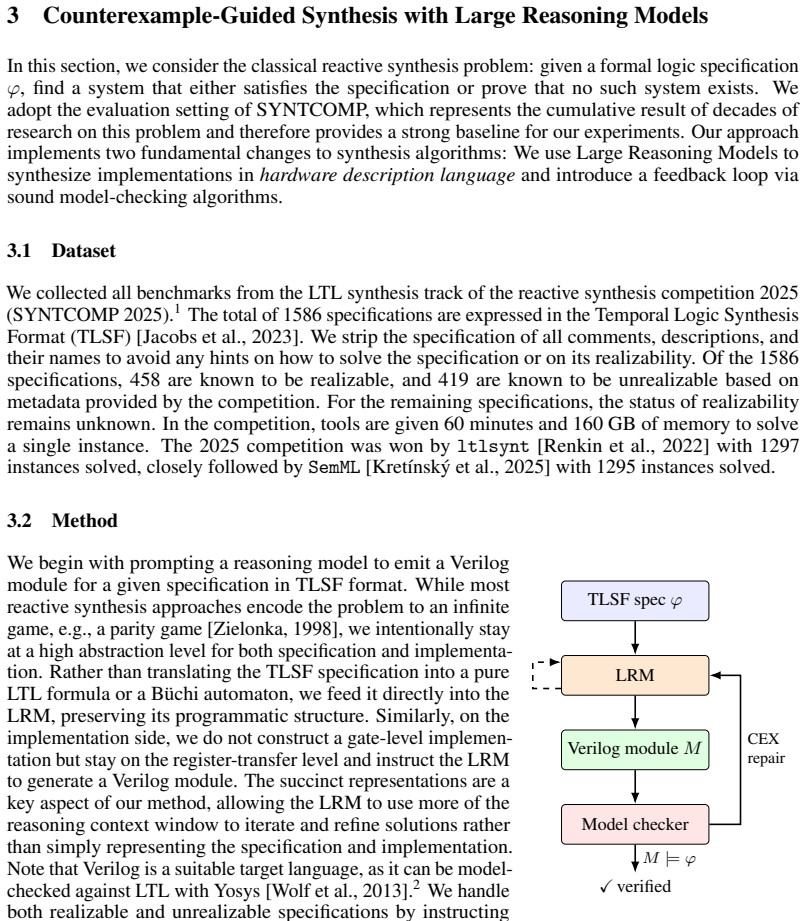
By coupling large reasoning models with model checkers to iteratively repair synthesized Verilog implementations via sound symbolic feedback, the approach solves more benchmarks than the best dedicated tools in the annual synthesis competition and extends to constructing parameterized systems. An autoformalization step shifts the specification task from temporal logic to natural language by introducing a hand-authored dataset, establishing performance comparable to that of starting from formal specifications.
What carries the argument
iterative repair loop between large reasoning model and model checker that uses sound symbolic feedback to correct Verilog implementations
If this is right
- The method solves more benchmarks than the best dedicated reactive synthesis tools.
- It produces correct implementations for parameterized systems despite the undecidability of the general problem.
- Natural-language specifications achieve performance comparable to formal temporal-logic specifications.
Where Pith is reading between the lines
- The same repair-loop pattern could be tested on other synthesis or verification tasks that combine generation with symbolic checking.
- Autoformalization might lower the expertise barrier for applying synthesis tools in practice.
- Improvements in initial model outputs would reduce the number of repair iterations required.
Load-bearing premise
The iterative repair loop between the large reasoning model and the model checker will converge to a correct implementation for the majority of specifications that the model initially produces incorrectly.
What would settle it
An evaluation showing that the method solves fewer benchmarks than the top dedicated tool on the annual synthesis competition set, or that it fails to produce correct implementations for a representative collection of parameterized system specifications.
Figures
read the original abstract
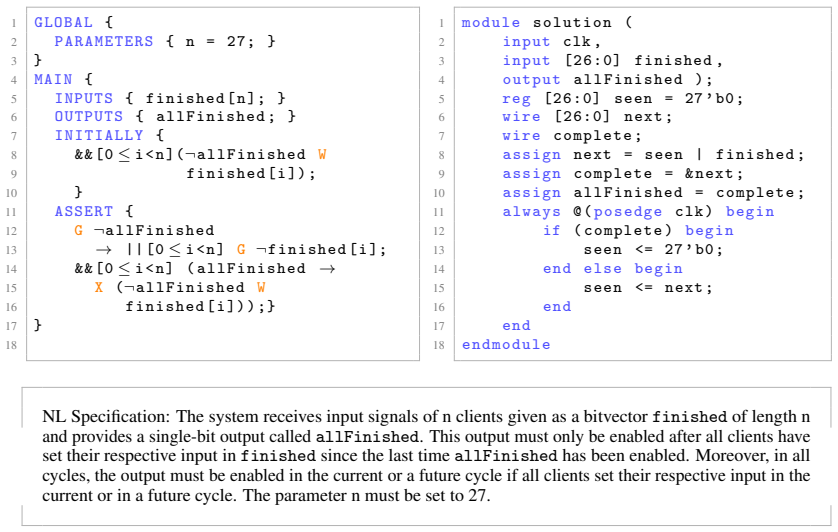
Reactive synthesis, the problem of automatically constructing a hardware circuit from a logical specification, is a long-standing challenge in formal verification. It is elusive for two reasons: It is algorithmically hard, and writing formal specifications by hand is notoriously difficult. In this paper, we tackle both sides of the problem. For the algorithmic side, we present a neuro-symbolic approach to reactive synthesis that couples large reasoning models with model checkers to iteratively repair a synthesized Verilog implementation via sound symbolic feedback. Our approach solves more benchmarks than the best dedicated tools in the annual synthesis competition and extends to constructing parameterized systems, a problem known to be undecidable. On the specification side, we introduce an autoformalization step that shifts the specification task from temporal logic to natural language by introducing a hand-authored dataset of natural-language specifications for evaluation. We demonstrate performance comparable to that of starting from formal specifications, establishing natural synthesis as a viable end-to-end workflow.
Editorial analysis
A structured set of objections, weighed in public.
Referee Report
Summary. The paper presents a neuro-symbolic method for reactive synthesis that pairs large reasoning models with model checkers to generate and iteratively repair Verilog implementations from specifications. It claims to solve more benchmarks than the top tools from the annual synthesis competition, to extend the approach to parameterized systems (known to be undecidable), and to support an end-to-end workflow via autoformalization from natural-language specifications that performs comparably to starting from formal temporal-logic specs.
Significance. If the empirical claims are supported by detailed per-benchmark statistics and convergence analysis, the work would be significant for demonstrating that LLM-driven repair loops can outperform specialized synthesis algorithms on standard benchmarks and can address undecidable variants, thereby opening a practical path for neuro-symbolic formal methods.
major comments (3)
- [§3] §3: The iterative repair loop is presented as using sound counterexample feedback from the model checker, yet the manuscript supplies neither a termination argument nor quantitative statistics on (a) the fraction of initial LLM outputs that are incorrect, (b) the number of repairs that succeed within the iteration budget, or (c) cases of divergence or false acceptance; because the headline performance claims rest on reliable convergence of this loop, the absence of such data is load-bearing.
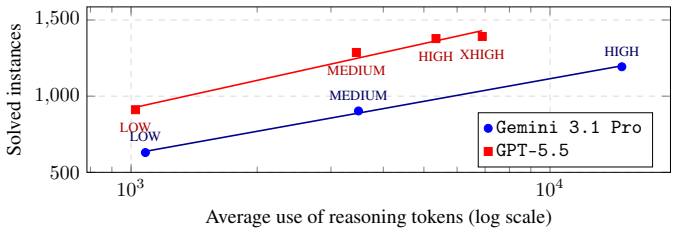
- [§4] §4 (results section): The claim that the approach “solves more benchmarks than the best dedicated tools” is stated without a table or list of the specific benchmarks, the exact counts for each competing tool, or an error breakdown showing how many instances required repair and how many repairs succeeded; without these numbers the outperformance assertion cannot be evaluated.
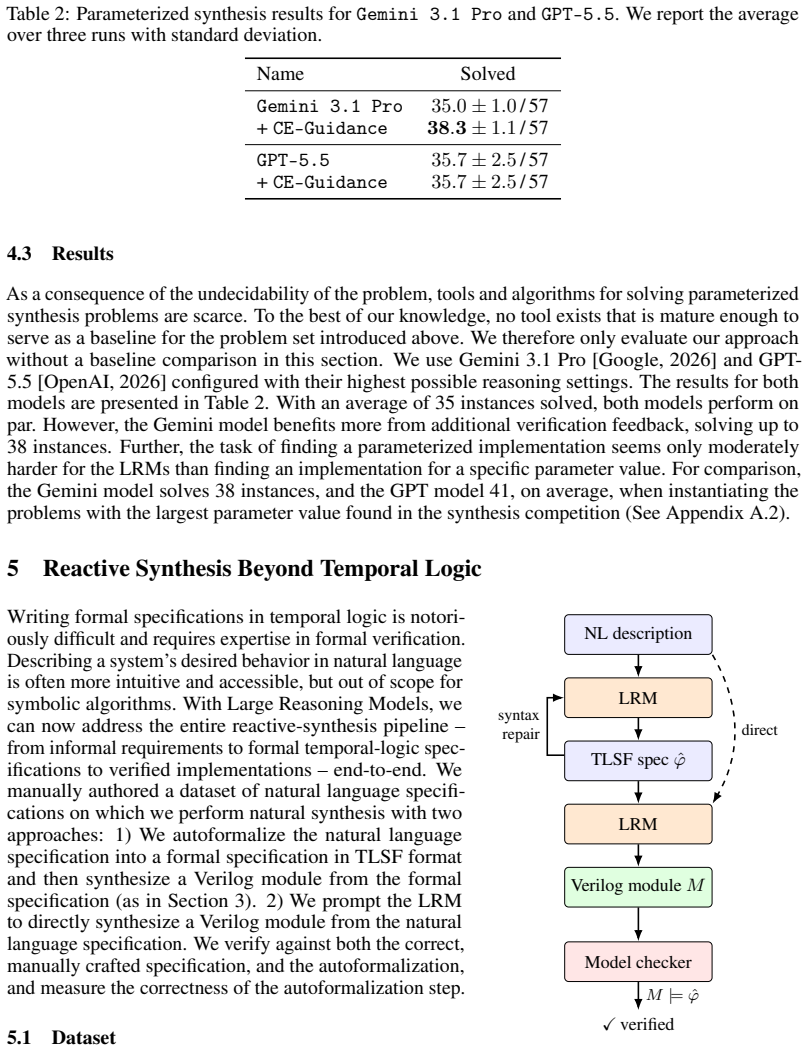
- [Parameterized-synthesis experiments] Parameterized-synthesis experiments: The extension to constructing parameterized systems is asserted to succeed on an undecidable problem, but the manuscript does not report the specific parameterized instances attempted, the success rate of the repair loop on those instances, or any comparison against the (necessarily incomplete) baselines; this leaves the undecidability-handling claim unsupported.
minor comments (2)
- [Abstract] The abstract reports outperforming results but contains no quantitative numbers, benchmark identifiers, or error rates; moving a concise summary table or key statistics into the abstract would improve readability.
- [§3] Notation for the feedback loop (e.g., how counterexamples are encoded back into the LLM prompt) is introduced informally; a small pseudocode block or explicit equation would clarify the interface between the neural and symbolic components.
Simulated Author's Rebuttal
We thank the referee for the careful reading and constructive major comments. We agree that the empirical claims require more granular supporting data to be fully evaluable. Below we respond point-by-point and commit to adding the requested statistics, tables, and analysis in a revised manuscript.
read point-by-point responses
-
Referee: [§3] §3: The iterative repair loop is presented as using sound counterexample feedback from the model checker, yet the manuscript supplies neither a termination argument nor quantitative statistics on (a) the fraction of initial LLM outputs that are incorrect, (b) the number of repairs that succeed within the iteration budget, or (c) cases of divergence or false acceptance; because the headline performance claims rest on reliable convergence of this loop, the absence of such data is load-bearing.
Authors: We agree that quantitative characterization of the repair loop is necessary. In the revision we will add a dedicated subsection (or appendix table) reporting: (a) the fraction of initial LLM-generated Verilog modules that fail model checking, (b) the distribution of successful repairs within the iteration budget, and (c) any observed divergence or false-acceptance cases. We will also include an explicit statement that the loop is deliberately bounded by a fixed iteration limit for practicality and will discuss the empirical convergence behavior observed across the benchmark set. revision: yes
-
Referee: [§4] §4 (results section): The claim that the approach “solves more benchmarks than the best dedicated tools” is stated without a table or list of the specific benchmarks, the exact counts for each competing tool, or an error breakdown showing how many instances required repair and how many repairs succeeded; without these numbers the outperformance assertion cannot be evaluated.
Authors: We accept that a per-benchmark breakdown is required. The revised results section will contain a table enumerating every benchmark from the synthesis competition, the outcome for our method, the outcomes for the top competing tools, and an error breakdown indicating which instances needed repair and how many repairs succeeded. This will make the outperformance claim directly verifiable. revision: yes
-
Referee: [Parameterized-synthesis experiments] Parameterized-synthesis experiments: The extension to constructing parameterized systems is asserted to succeed on an undecidable problem, but the manuscript does not report the specific parameterized instances attempted, the success rate of the repair loop on those instances, or any comparison against the (necessarily incomplete) baselines; this leaves the undecidability-handling claim unsupported.
Authors: We will expand the parameterized-synthesis experiments section to list the concrete parameterized instances used, report the success rate of the repair loop on those instances, and include comparisons against the best available (necessarily incomplete) baselines. While the general problem is undecidable, the revision will document the practical instances on which the neuro-symbolic loop succeeded and the conditions under which it was applied. revision: yes
Circularity Check
No significant circularity; empirical claims rest on external benchmarks
full rationale
The paper describes an empirical neuro-symbolic workflow that couples LLMs with model checkers for iterative repair of Verilog implementations, evaluated via direct comparison against external reactive synthesis competition tools and a hand-authored natural-language dataset. No equations, fitted parameters, or self-citation chains appear in the provided text. The central performance claims are presented as experimental outcomes rather than derivations that reduce to their own inputs by construction, satisfying the self-contained criterion.
Axiom & Free-Parameter Ledger
Reference graph
Works this paper leans on
-
[1]
A. Biere. The AIGER and-inverter graph ( AIG ) format version 20071012. FMV Reports Series, Institute for Formal Models and Verification, Johannes Kepler University, Altenbergerstr, 69: 0 4040, 2007
2007
-
[2]
Bloem, S
R. Bloem, S. J. Galler, B. Jobstmann, N. Piterman, A. Pnueli, and M. Weiglhofer. Interactive presentation: Automatic hardware synthesis from specifications: a case study. In R. Lauwereins and J. Madsen, editors, 2007 Design, Automation and Test in Europe Conference and Exposition, DATE 2007, Nice, France, April 16-20, 2007 , pages 1188--1193. EDA Consorti...
2007
-
[3]
R. Bloem, S. Jacobs, A. Khalimov, I. Konnov, S. Rubin, H. Veith, and J. Widder. Decidability of Parameterized Verification. Synthesis Lectures on Distributed Computing Theory. Morgan & Claypool Publishers, 2015. ISBN 978-3-031-00883-2. doi:10.2200/S00658ED1V01Y201508DCT013. URL https://doi.org/10.2200/S00658ED1V01Y201508DCT013
-
[4]
R. Bloem, K. Chatterjee, and B. Jobstmann. Graph games and reactive synthesis. In E. M. Clarke, T. A. Henzinger, H. Veith, and R. Bloem, editors, Handbook of Model Checking, pages 921--962. Springer, 2018. doi:10.1007/978-3-319-10575-8\_27. URL https://doi.org/10.1007/978-3-319-10575-8\_27
-
[5]
A. R. Bradley. Sat-based model checking without unrolling. In R. Jhala and D. A. Schmidt, editors, Verification, Model Checking, and Abstract Interpretation - 12th International Conference, VMCAI 2011, Austin, TX, USA, January 23-25, 2011. Proceedings , Lecture Notes in Computer Science, pages 70--87. Springer, 2011. doi:10.1007/978-3-642-18275-4\_7. URL ...
-
[6]
J. R. Buchi and L. H. Landweber. Solving sequential conditions by finite-state strategies. Transactions of the American Mathematical Society, 138: 0 295--311, 1969. URL https://api.semanticscholar.org/CorpusID:4568478
1969
-
[7]
R. Cavada, A. Cimatti, M. Dorigatti, A. Griggio, A. Mariotti, A. Micheli, S. Mover, M. Roveri, and S. Tonetta. The nuxmv symbolic model checker. In A. Biere and R. Bloem, editors, Computer Aided Verification - 26th International Conference, CAV 2014, Held as Part of the Vienna Summer of Logic, VSL 2014, Vienna, Austria, July 18-22, 2014. Proceedings , Lec...
-
[8]
Y. Chen, R. Gandhi, Y. Zhang, and C. Fan. NL2TL: transforming natural languages to temporal logics using large language models. In H. Bouamor, J. Pino, and K. Bali, editors, Proceedings of the 2023 Conference on Empirical Methods in Natural Language Processing, EMNLP 2023, Singapore, December 6-10, 2023 , pages 15880--15903. Association for Computational ...
-
[9]
A. B. Chowdhury, M. Romanelli, B. Tan, R. Karri, and S. Garg. Retrieval-guided reinforcement learning for boolean circuit minimization. In The Twelfth International Conference on Learning Representations, ICLR 2024, Vienna, Austria, May 7-11, 2024 . OpenReview.net, 2024. URL https://openreview.net/forum?id=0t1O8ziRZp
2024
-
[10]
A. Church. Applications of recursive arithmetic to the problem of circuit synthesis. In Summaries of the Summer Institute of Symbolic Logic, volume 1, pages 3--50. Cornell Univ., Ithaca, NY, 1957
1957
-
[11]
E. M. Clarke, O. Grumberg, D. Kroening, D. A. Peled, and H. Veith. Model checking, 2nd Edition. MIT Press, 2018. ISBN 978-0-262-03883-6. URL https://mitpress.mit.edu/books/model-checking-second-edition
2018
-
[12]
M. Cosler, C. Hahn, D. Mendoza, F. Schmitt, and C. Trippel. nl2spec: Interactively translating unstructured natural language to temporal logics with large language models. In C. Enea and A. Lal, editors, Computer Aided Verification - 35th International Conference, CAV 2023, Paris, France, July 17-22, 2023, Proceedings, Part II , Lecture Notes in Computer ...
-
[13]
Cosler, F
M. Cosler, F. Schmitt, C. Hahn, and B. Finkbeiner. Iterative circuit repair against formal specifications. In The Eleventh International Conference on Learning Representations, ICLR 2023, Kigali, Rwanda, May 1-5, 2023 . OpenReview.net, 2023 b . URL https://openreview.net/forum?id=SEcSahl0Ql
2023
-
[14]
M. Cosler, C. Hahn, A. Omar, and F. Schmitt. NeuroSynt : A Neuro-symbolic Portfolio Solver for Reactive Synthesis . In B. Finkbeiner and L. Kov \'a cs, editors, Tools and Algorithms for the Construction and Analysis of Systems , pages 45--67, Cham, 2024. Springer Nature Switzerland. ISBN 978-3-031-57256-2. doi:10.1007/978-3-031-57256-2_3
-
[15]
X. Deng, S. Zhong, A. G. Veneris, F. Long, and X. Si. Verifythisbench: Generating code, specifications, and proofs all at once. CoRR, abs/2505.19271, 2025. doi:10.48550/ARXIV.2505.19271. URL https://doi.org/10.48550/arXiv.2505.19271
-
[16]
A. Duret - Lutz, E. Renault, M. Colange, F. Renkin, A. G. Aisse, P. Schlehuber - Caissier, T. Medioni, A. Martin, J. Dubois, C. Gillard, and H. Lauko. From spot 2.0 to spot 2.10: What's new? In S. Shoham and Y. Vizel, editors, Computer Aided Verification - 34th International Conference, CAV 2022, Haifa, Israel, August 7-10, 2022, Proceedings, Part II , Le...
-
[17]
D. Egolf, Y. Zhou, and S. Tripakis. Can llms perform synthesis? CoRR, abs/2603.20264, 2026. doi:10.48550/ARXIV.2603.20264. URL https://doi.org/10.48550/arXiv.2603.20264
-
[18]
W. H. English, D. Simon, S. K. Jha, and R. Ewetz. Grammar-forced translation of natural language to temporal logic using llms. In A. Singh, M. Fazel, D. Hsu, S. Lacoste - Julien, F. Berkenkamp, T. Maharaj, K. Wagstaff, and J. Zhu, editors, Forty-second International Conference on Machine Learning, ICML 2025, Vancouver, BC, Canada, July 13-19, 2025 , Proce...
2025
-
[19]
P. Faymonville, B. Finkbeiner, and L. Tentrup. Bosy: An experimentation framework for bounded synthesis. In R. Majumdar and V. Kuncak, editors, Computer Aided Verification - 29th International Conference, CAV 2017, Heidelberg, Germany, July 24-28, 2017, Proceedings, Part II , volume 10427 of Lecture Notes in Computer Science, pages 325--332. Springer, 201...
-
[20]
F. Fuggitti and T. Chakraborti. NL2LTL - a python package for converting natural language (NL) instructions to linear temporal logic (LTL) formulas. In B. Williams, Y. Chen, and J. Neville, editors, Thirty-Seventh AAAI Conference on Artificial Intelligence, AAAI 2023, Thirty-Fifth Conference on Innovative Applications of Artificial Intelligence, IAAI 2023...
-
[21]
Giacobbe, D
M. Giacobbe, D. Kroening, A. Pal, and M. Tautschnig. Neural model checking. In A. Globersons, L. Mackey, D. Belgrave, A. Fan, U. Paquet, J. M. Tomczak, and C. Zhang, editors, Advances in Neural Information Processing Systems 38: Annual Conference on Neural Information Processing Systems 2024, NeurIPS 2024, Vancouver, BC, Canada, December 10 - 15, 2024, 20...
2024
-
[22]
Gemini 3.1 Pro Preview , Feb
Google . Gemini 3.1 Pro Preview , Feb. 2026. URL https://deepmind.google/models/model-cards/gemini-3-1-pro/
2026
-
[23]
The 2022 Wilson research group functional verification study , 2022
Harry Foster . The 2022 Wilson research group functional verification study , 2022. URL https://blogs.sw.siemens.com/verificationhorizons/2022/10/10/prologue-the-2022-wilson-research-group-functional-verification-study/
2022
-
[24]
Hubert, R
T. Hubert, R. Mehta, L. Sartran, M. Z. Horváth, G. Žužić, E. Wieser, A. Huang, J. Schrittwieser, Y. Schroecker, H. Masoom, O. Bertolli, T. Zahavy, A. Mandhane, J. Yung, I. Beloshapka, B. Ibarz, V. Veeriah, L. Yu, O. Nash, P. Lezeau, S. Mercuri, C. Sönne, B. Mehta, A. Davies, D. Zheng, F. Pedregosa, Y. Li, I. von Glehn, M. Rowland, S. Albanie, A. Velingker...
2025
-
[25]
Ieee standard for verilog hardware description language
IEEE. Ieee standard for verilog hardware description language. IEEE Std 1364-2005 (Revision of IEEE Std 1364-2001), pages 1--590, 2006. doi:10.1109/IEEESTD.2006.99495
-
[26]
S. Jacobs and R. Bloem. Parameterized synthesis. Log. Methods Comput. Sci., 10 0 (1), 2014. doi:10.2168/LMCS-10(1:12)2014. URL https://doi.org/10.2168/LMCS-10(1:12)2014
-
[27]
The Temporal Logic Synthesis Format TLSF v1.2
S. Jacobs, G. A. P \' e rez, and P. Schlehuber - Caissier. The temporal logic synthesis format TLSF v1.2. CoRR, abs/2303.03839, 2023. doi:10.48550/ARXIV.2303.03839. URL https://doi.org/10.48550/arXiv.2303.03839
work page internal anchor Pith review Pith/arXiv arXiv doi:10.48550/arxiv.2303.03839 2023
-
[28]
S. Jacobs, G. A. P \' e rez, R. Abraham, V. Bruy \` e re, M. Cadilhac, M. Colange, C. Delfosse, T. van Dijk, A. Duret - Lutz, P. Faymonville, B. Finkbeiner, A. Khalimov, F. Klein, M. Luttenberger, K. J. Meyer, T. Michaud, A. Pommellet, F. Renkin, P. Schlehuber - Caissier, M. Sakr, S. Sickert, G. Staquet, C. Tamines, L. Tentrup, and A. Walker. The reactive...
- [29]
-
[30]
A. Q. Jiang, S. Welleck, J. P. Zhou, T. Lacroix, J. Liu, W. Li, M. Jamnik, G. Lample, and Y. Wu. Draft, sketch, and prove: Guiding formal theorem provers with informal proofs. In The Eleventh International Conference on Learning Representations, ICLR 2023, Kigali, Rwanda, May 1-5, 2023 . OpenReview.net, 2023. URL https://openreview.net/forum?id=SMa9EAovKMC
2023
-
[31]
J. Kret \' nsk \' y , T. Meggendorfer, M. Prokop, and A. Zarkhah. Semml: Enhancing automata-theoretic LTL synthesis with machine learning. In A. Gurfinkel and M. Heule, editors, Tools and Algorithms for the Construction and Analysis of Systems - 31st International Conference, TACAS 2025, Held as Part of the International Joint Conferences on Theory and Pr...
-
[32]
J. X. Liu, Z. Yang, I. Idrees, S. Liang, B. Schornstein, S. Tellex, and A. Shah. Grounding complex natural language commands for temporal tasks in unseen environments. In J. Tan, M. Toussaint, and K. Darvish, editors, Conference on Robot Learning, CoRL 2023, 6-9 November 2023, Atlanta, GA, USA , Proceedings of Machine Learning Research, pages 1084--1110. ...
2023
-
[33]
D. Mendoza, C. Hahn, and C. Trippel. Translating natural language to temporal logics with large language models and model checkers. In N. Narodytska and P. R \" u mmer, editors, Formal Methods in Computer-Aided Design, FMCAD 2024, Prague, Czech Republic, October 15-18, 2024 , pages 1--11. IEEE , 2024. doi:10.34727/2024/ISBN.978-3-85448-065-5\_17. URL http...
-
[34]
P. J. Meyer, S. Sickert, and M. Luttenberger. Strix: Explicit reactive synthesis strikes back! In H. Chockler and G. Weissenbacher, editors, Computer Aided Verification - 30th International Conference, CAV 2018, Held as Part of the Federated Logic Conference, FloC 2018, Oxford, UK, July 14-17, 2018, Proceedings, Part I , Lecture Notes in Computer Science,...
-
[35]
A. Mirhoseini, A. Goldie, M. Yazgan, J. W. Jiang, E. M. Songhori, S. Wang, Y. Lee, E. Johnson, O. Pathak, A. Nazi, J. Pak, A. Tong, K. Srinivasa, W. Hang, E. Tuncer, Q. V. Le, J. Laudon, R. Ho, R. Carpenter, and J. Dean. A graph placement methodology for fast chip design. Nat., 594 0 (7862): 0 207--212, 2021. doi:10.1038/S41586-021-03544-W. URL https://do...
-
[36]
Murphy, K
L. Murphy, K. Yang, J. Sun, Z. Li, A. Anandkumar, and X. Si. Autoformalizing euclidean geometry. In R. Salakhutdinov, Z. Kolter, K. A. Heller, A. Weller, N. Oliver, J. Scarlett, and F. Berkenkamp, editors, Forty-first International Conference on Machine Learning, ICML 2024, Vienna, Austria, July 21-27, 2024 , Proceedings of Machine Learning Research, page...
2024
-
[37]
arXiv preprint arXiv:2406.07400 , year=
W. Murphy, N. Holzer, N. Koenig, L. Cui, R. Rothkopf, F. Qiao, and M. Santolucito. Guiding LLM temporal logic generation with explicit separation of data and control. CoRR, abs/2406.07400, 2024 b . doi:10.48550/ARXIV.2406.07400. URL https://doi.org/10.48550/arXiv.2406.07400
-
[38]
W. L. Neto, M. T. Moreira, L. G. Amar \` u , C. Yu, and P. Gaillardon. Read your circuit: Leveraging word embedding to guide logic optimization. In ASPDAC '21: 26th Asia and South Pacific Design Automation Conference, Tokyo, Japan, January 18-21, 2021 , pages 530--535. ACM , 2021. doi:10.1145/3394885.3431560. URL https://doi.org/10.1145/3394885.3431560
-
[39]
GPT-5.5 , Apr
OpenAI . GPT-5.5 , Apr. 2026. URL https://openai.com/index/gpt-5-5-system-card/. Snapshot gpt-5.5-2026-04-23
2026
-
[40]
H. Pearce, B. Tan, and R. Karri. DAVE: deriving automatically verilog from english. In U. Schlichtmann, R. Gal, H. Amrouch, and H. H. Li, editors, MLCAD '20: 2020 ACM/IEEE Workshop on Machine Learning for CAD, Virtual Event, Iceland, November 16-20, 2020 , pages 27--32. ACM , 2020. doi:10.1145/3380446.3430634. URL https://doi.org/10.1145/3380446.3430634
-
[41]
A. Pnueli. The temporal logic of programs. In 18th Annual Symposium on Foundations of Computer Science, Providence, Rhode Island, USA, 31 October - 1 November 1977, pages 46--57. IEEE Computer Society, 1977. doi:10.1109/SFCS.1977.32. URL https://doi.org/10.1109/SFCS.1977.32
-
[42]
A. Pnueli and R. Rosner. On the synthesis of a reactive module. In Conference Record of the Sixteenth Annual ACM Symposium on Principles of Programming Languages, Austin, Texas, USA, January 11-13, 1989 , pages 179--190. ACM Press, 1989. doi:10.1145/75277.75293. URL https://doi.org/10.1145/75277.75293
-
[43]
F. Renkin, P. Schlehuber - Caissier, A. Duret - Lutz, and A. Pommellet. Dissecting ltlsynt. Formal Methods Syst. Des., 61 0 (2): 0 248--289, 2022. doi:10.1007/S10703-022-00407-6. URL https://doi.org/10.1007/s10703-022-00407-6
-
[44]
Schmitt, C
F. Schmitt, C. Hahn, M. N. Rabe, and B. Finkbeiner. Neural circuit synthesis from specification patterns. In M. Ranzato, A. Beygelzimer, Y. N. Dauphin, P. Liang, and J. W. Vaughan, editors, Advances in Neural Information Processing Systems 34: Annual Conference on Neural Information Processing Systems 2021, NeurIPS 2021, December 6-14, 2021, virtual, page...
2021
-
[45]
S. Thakur, B. Ahmad, H. Pearce, B. Tan, B. Dolan - Gavitt, R. Karri, and S. Garg. Verigen: A large language model for verilog code generation. ACM Trans. Design Autom. Electr. Syst. , 29 0 (3): 0 46:1--46:31, 2024. doi:10.1145/3643681. URL https://doi.org/10.1145/3643681
-
[46]
Trippel, K
T. Trippel, K. G. Shin, A. Chernyakhovsky, G. Kelly, D. Rizzo, and M. Hicks. Fuzzing hardware like software. In K. R. B. Butler and K. Thomas, editors, 31st USENIX Security Symposium, USENIX Security 2022, Boston, MA, USA, August 10-12, 2022 , pages 3237--3254. USENIX Association, 2022. URL https://www.usenix.org/conference/usenixsecurity22/presentation/trippel
2022
-
[47]
Vasudevan, W
S. Vasudevan, W. Jiang, D. Bieber, R. Singh, H. Shojaei, R. Ho, and C. Sutton. Learning semantic representations to verify hardware designs. In M. Ranzato, A. Beygelzimer, Y. N. Dauphin, P. Liang, and J. W. Vaughan, editors, Advances in Neural Information Processing Systems 34: Annual Conference on Neural Information Processing Systems 2021, NeurIPS 2021,...
2021
-
[48]
Z. Wang, J. Wang, Q. Yang, Y. Bai, X. Li, L. Chen, J. Hao, M. Yuan, B. Li, Y. Zhang, and F. Wu. Towards next-generation logic synthesis: A scalable neural circuit generation framework. In A. Globersons, L. Mackey, D. Belgrave, A. Fan, U. Paquet, J. M. Tomczak, and C. Zhang, editors, Advances in Neural Information Processing Systems 38: Annual Conference o...
2024
-
[49]
C. Wolf, J. Glaser, and J. Kepler. Yosys-a free verilog synthesis suite. In Proceedings of the 21st Austrian Workshop on Microelectronics (Austrochip), volume 97, pages 1--6, 2013
2013
-
[50]
Y. Wu, A. Q. Jiang, W. Li, M. N. Rabe, C. Staats, M. Jamnik, and C. Szegedy. Autoformalization with large language models. In S. Koyejo, S. Mohamed, A. Agarwal, D. Belgrave, K. Cho, and A. Oh, editors, Advances in Neural Information Processing Systems 35: Annual Conference on Neural Information Processing Systems 2022, NeurIPS 2022, New Orleans, LA, USA, ...
2022
-
[51]
Zheng, S
Z. Zheng, S. Huang, J. Zhong, Z. Shi, G. Dai, N. Xu, and Q. Xu. Deepgate4: Efficient and effective representation learning for circuit design at scale. In The Thirteenth International Conference on Learning Representations, ICLR 2025, Singapore, April 24-28, 2025 . OpenReview.net, 2025. URL https://openreview.net/forum?id=b10lRabU9W
2025
-
[52]
Y. Zhu, D. Huang, H. Lyu, X. Zhang, C. Li, W. Shi, Y. Wu, J. Mu, J. Wang, Y. Zhao, P. Jin, S. Cheng, S. Liang, X. Zhang, R. Zhang, Z. Du, Q. Guo, X. Hu, and Y. Chen. Codev-r1: Reasoning-enhanced verilog generation. CoRR, abs/2505.24183, 2025. doi:10.48550/ARXIV.2505.24183. URL https://doi.org/10.48550/arXiv.2505.24183
-
[53]
W. Zielonka. Infinite games on finitely coloured graphs with applications to automata on infinite trees. Theor. Comput. Sci., 200 0 (1-2): 0 135--183, 1998. doi:10.1016/S0304-3975(98)00009-7. URL https://doi.org/10.1016/S0304-3975(98)00009-7
discussion (0)
Sign in with ORCID, Apple, or X to comment. Anyone can read and Pith papers without signing in.