Recognition: 2 theorem links
· Lean TheoremAutomating Bitvector and Finite Field Equivalence Proofs in Lean
Pith reviewed 2026-05-15 02:46 UTC · model grok-4.3
The pith
Lean tactic automates finite field to bitvector translations and solves 19% more ZKP benchmarks than SMT solvers
A machine-rendered reading of the paper's core claim, the machinery that carries it, and where it could break.
Core claim
The BitModEq tactic leverages range lemmas and case analysis to produce verified translations from finite fields to bitvectors. This enables automated proofs for quantifier-free statements mixing bitvector and finite field operations. When paired with bit-blasting, the tactic outperforms state-of-the-art SMT solvers by solving 19% more ZKP arithmetization benchmarks.
What carries the argument
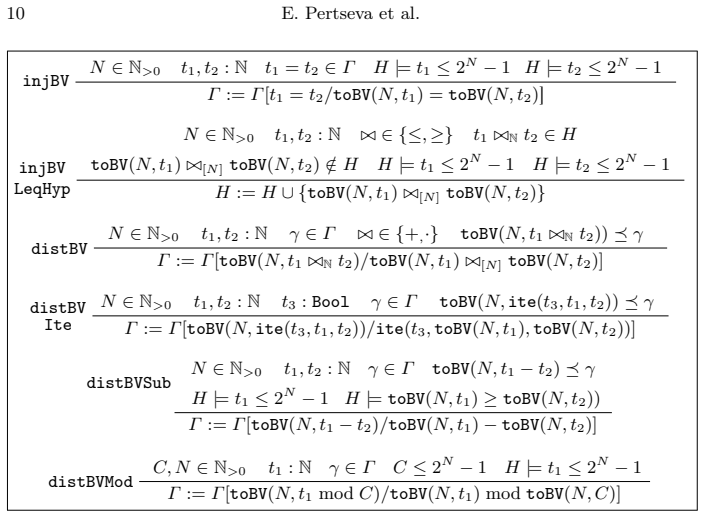
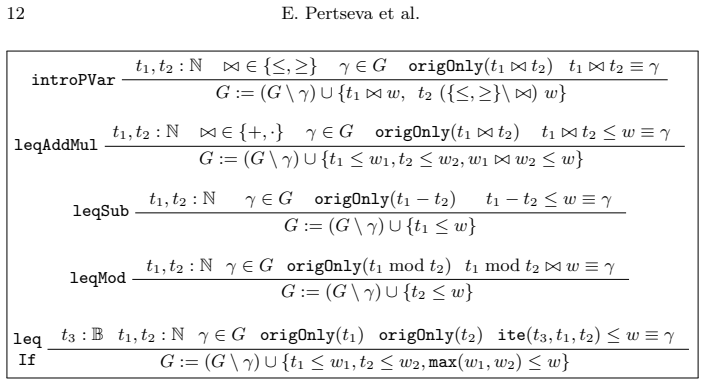
BitModEq tactic that applies range lemmas and case analysis to produce verified translations from finite fields to bitvectors
If this is right
- More zero-knowledge proof circuit encodings can be verified automatically.
- Verification workflows gain scalability for statements involving both bitvectors and finite fields.
- Bit-blasting becomes applicable after the automated translation step.
- Reliance on manual proofs or direct SMT solving decreases for these mixed arithmetic problems.
Where Pith is reading between the lines
- The tactic may extend to other interactive theorem provers for similar arithmetic translation tasks.
- Hybrid verification systems could use this tactic as a preprocessing step before calling SMT solvers.
- The approach could support verification of additional cryptographic protocols that rely on modular arithmetic conversions.
Load-bearing premise
The range lemmas and case analysis in BitModEq produce sound translations for all relevant cases in ZKP arithmetization without missing edge cases or introducing incorrect equivalences.
What would settle it
A specific ZKP arithmetization benchmark where BitModEq fails to produce a correct verified translation that a manual proof or SMT solver can handle.
Figures





read the original abstract
Efforts to verify Zero-Knowledge Proof circuit encodings have highlighted the challenge of proving the correctness of quantifier-free statements that make use of both bitvector and finite field operations. Existing verification workflows are either manual or rely on SMT solvers, which scale poorly on some classes of problems for reasons that include difficulties with conversion operators and challenges reasoning about inequalities. To address these limitations, we present a novel Lean tactic BitModEq that leverages range lemmas and case analysis to produce verified translations from finite fields to bitvectors. Our approach, combined with bit-blasting, outperforms state-of-the-art SMT solvers, solving 19% more ZKP arithmetization benchmarks.
Editorial analysis
A structured set of objections, weighed in public.
Referee Report
Summary. The paper introduces a Lean tactic BitModEq that employs range lemmas and case analysis to generate verified translations from finite-field to bitvector representations, enabling automation of quantifier-free equivalence proofs that mix both domains. When combined with bit-blasting, the tactic is reported to solve 19% more ZKP arithmetization benchmarks than state-of-the-art SMT solvers.
Significance. If the soundness of the translations holds, the work would provide a practical advance in mechanized verification of zero-knowledge proof circuits by mitigating known SMT weaknesses with conversion operators and inequalities. The empirical benchmark improvement and the use of a verified tactic in Lean constitute a concrete contribution to the intersection of formal methods and cryptographic verification.
major comments (2)
- [BitModEq tactic and range lemmas] The central performance claim rests on BitModEq producing sound translations, yet the manuscript provides no machine-checked proof or exhaustive case analysis establishing that the range lemmas and case splits cover all alignments between bitvector widths and field moduli (including modular reduction cases typical in ZKP arithmetization). This directly affects the validity of the SMT comparison.
- [Experimental evaluation] Benchmark results are presented without details on selection criteria, total number of instances, timeout settings, or how soundness of the tactic was validated on the solved instances; the 19% figure therefore lacks the supporting data needed to assess reproducibility and robustness.
minor comments (2)
- [Introduction] The abstract and introduction use the term 'verified translations' without an early pointer to the precise statement of soundness that is later proved (or not) for BitModEq.
- [Evaluation tables] Figure captions for the benchmark tables could explicitly state the SMT solvers and versions used for the baseline comparison.
Simulated Author's Rebuttal
We thank the referee for their constructive comments, which highlight important aspects of soundness and reproducibility. We address each major comment below and will make revisions to strengthen the manuscript accordingly.
read point-by-point responses
-
Referee: [BitModEq tactic and range lemmas] The central performance claim rests on BitModEq producing sound translations, yet the manuscript provides no machine-checked proof or exhaustive case analysis establishing that the range lemmas and case splits cover all alignments between bitvector widths and field moduli (including modular reduction cases typical in ZKP arithmetization). This directly affects the validity of the SMT comparison.
Authors: The BitModEq tactic is fully implemented in Lean, and its soundness is machine-checked by the Lean kernel through the definitions of the range lemmas and the case analysis procedure. The manuscript describes the approach but does not include the full formal proof details to keep the presentation accessible. We will add a new subsection or appendix that outlines the key range lemmas, provides the structure of the case splits, and explains coverage for modular reduction cases common in ZKP arithmetization. This will make the soundness argument explicit while referencing the verified Lean code. revision: yes
-
Referee: [Experimental evaluation] Benchmark results are presented without details on selection criteria, total number of instances, timeout settings, or how soundness of the tactic was validated on the solved instances; the 19% figure therefore lacks the supporting data needed to assess reproducibility and robustness.
Authors: We agree that additional experimental details are necessary for full reproducibility. In the revised manuscript, we will expand the evaluation section to specify: the total number of benchmark instances (drawn from standard ZKP arithmetization suites), the selection criteria (including how instances mixing bitvector and finite field operations were chosen), the timeout settings used for both our tactic and the SMT solvers (e.g., 300 seconds per instance), and the validation procedure for soundness (cross-verification with manual Lean proofs on a subset and consistency checks with SMT results on solved cases). The 19% improvement is computed as the percentage increase in the number of solved instances relative to the best SMT solver baseline. revision: yes
Circularity Check
No circularity: tactic soundness and benchmark gains rest on external Lean verification and SMT comparisons
full rationale
The paper introduces the BitModEq tactic in Lean that applies range lemmas and case splits to produce verified finite-field-to-bitvector translations, then combines it with bit-blasting for ZKP benchmarks. The performance claim (19% more solved instances) is measured against external state-of-the-art SMT solvers on a fixed benchmark set; no parameter is fitted to the target result and then re-used as a prediction. No self-citation is invoked to justify uniqueness or to close the soundness argument; the formal guarantees are supplied directly by Lean’s kernel. The derivation therefore remains independent of its own outputs and does not reduce to any of the enumerated circular patterns.
Axiom & Free-Parameter Ledger
Lean theorems connected to this paper
-
IndisputableMonolith/Cost/FunctionalEquation.leanwashburn_uniqueness_aczel unclear?
unclearRelation between the paper passage and the cited Recognition theorem.
Our approach, combined with bit-blasting, outperforms state-of-the-art SMT solvers, solving 19% more ZKP arithmetization benchmarks.
-
IndisputableMonolith/Foundation/ArithmeticFromLogic.leanLogicNat recovery theorem unclear?
unclearRelation between the paper passage and the cited Recognition theorem.
BitModEq that leverages range lemmas and case analysis to produce verified translations from finite fields to bitvectors
What do these tags mean?
- matches
- The paper's claim is directly supported by a theorem in the formal canon.
- supports
- The theorem supports part of the paper's argument, but the paper may add assumptions or extra steps.
- extends
- The paper goes beyond the formal theorem; the theorem is a base layer rather than the whole result.
- uses
- The paper appears to rely on the theorem as machinery.
- contradicts
- The paper's claim conflicts with a theorem or certificate in the canon.
- unclear
- Pith found a possible connection, but the passage is too broad, indirect, or ambiguous to say the theorem truly supports the claim.
Reference graph
Works this paper leans on
-
[1]
Alasdair Armstrong, Thomas Bauereiss, Brian Campbell, Alastair Reid, Kathryn E Gray, Robert M Norton, Prashanth Mundkur, Mark Wassell, Jon French, Christopher Pulte, et al. Isa semantics for armv8-a, risc-v, and cheri-mips.Proceedings of the ACM on Programming Languages, 3(POPL): 1–31, 2019
work page 2019
-
[2]
Jolt: Snarks for virtual machines via lookups
Arasu Arun, Srinath Setty, and Justin Thaler. Jolt: Snarks for virtual machines via lookups. InAnnual International Conference on the Theory and Applications of Cryptographic Techniques, pages 3–33. Springer, 2024
work page 2024
-
[3]
A verified algebraic representation of cairo program execution
Jeremy Avigad, Lior Goldberg, David Levit, Yoav Seginer, and Alon Titel- man. A verified algebraic representation of cairo program execution. In Proceedings of the 11th ACM SIGPLAN International Conference on Cer- tified Programs and Proofs, pages 153–165, 2022
work page 2022
-
[4]
Haniel Barbosa, Clark W. Barrett, Martin Brain, Gereon Kremer, Hanna Lachnitt, Makai Mann, Abdalrhman Mohamed, Mudathir Mohamed, Aina Niemetz, Andres Nötzli, Alex Ozdemir, Mathias Preiner, Andrew Reynolds, YingSheng,CesareTinelli,andYoniZohar. cvc5:Aversatileandindustrial- strength SMT solver. InTACAS, 2022
work page 2022
-
[5]
Haniel Barbosa, Clark Barrett, Byron Cook, Bruno Dutertre, Gereon Kre- mer, Hanna Lachnitt, Aina Niemetz, Andres Nötzli, Alex Ozdemir, Math- ias Preiner, Andrew Reynolds, Cesare Tinelli, and Yoni Zohar. Gen- erating and exploiting automated reasoning proof certificates.Commu- nications of the Association for Computing Machinery (CACM), 66(10): 86–95, Octo...
-
[6]
Satisfiability modulo theories
Clark Barrett and Cesare Tinelli. Satisfiability modulo theories. InHand- book of model checking, pages 305–343. Springer, 2018
work page 2018
-
[7]
Faest: algorithm specifications
Carsten Baum, Lennart Braun, Cyprien Delpech de Saint Guilhem, Michael Klooß, Christian Majenz, Shibam Mukherjee, Sebastian Ramacher, Chris- tian Rechberger, Emmanuela Orsini, Lawrence Roy, et al. Faest: algorithm specifications. Technical report, Technical report, National Institute of Standards and Technology, 2023
work page 2023
-
[8]
Interactive bitvector reasoning using verified bit-blasting
Henrik Böving, Siddharth Bhat, Luisa Cicolini, Alex Keizer, Léon Frenot, Abdalrhman Mohamed, Léo Stefanesco, Harun Khan, Joshua Clune, Clark Barrett, et al. Interactive bitvector reasoning using verified bit-blasting. Proceedings of the ACM on Programming Languages, 9(OOPSLA2):3259– 3285, 2025
work page 2025
-
[9]
Towards fuzzing zero-knowledge proof circuits (short paper)
Stefanos Chaliasos, Imam Al-Fath, and Alastair Donaldson. Towards fuzzing zero-knowledge proof circuits (short paper). InProceedings of the 34th ACM SIGSOFT International Symposium on Software Testing and Analysis, pages 98–104, 2025
work page 2025
-
[10]
Cheesecloth:{Zero-Knowledge}proofs of real world vulnerabilities
Santiago Cuéllar, Bill Harris, James Parker, Stuart Pernsteiner, and Eran Tromer. Cheesecloth:{Zero-Knowledge}proofs of real world vulnerabilities. 22 E. Pertseva et al. In32nd USENIX Security Symposium (USENIX Security 23), pages 6525– 6540, 2023
work page 2023
-
[11]
Santiago Cuéllar Gempeler, Bill Harris, James Parker, Stuart Pernsteiner, Ian Sweet, and Eran Tromer. Cheesecloth: Zero-knowledge proofs of real- world vulnerabilities.ACM Transactions on Privacy and Security, 28(4): 1–35, 2025
work page 2025
-
[12]
Veritas: Verifying image trans- formations at scale
Trisha Datta, Binyi Chen, and Dan Boneh. Veritas: Verifying image trans- formations at scale. In2025 IEEE Symposium on Security and Privacy (SP), pages 4606–4623. IEEE, 2025
work page 2025
-
[13]
David Steven Dummit and Richard M Foote.Abstract algebra, volume 3. Wiley Hoboken, 2004
work page 2004
-
[14]
Herbert B Enderton.A mathematical introduction to logic. Elsevier, 2001
work page 2001
-
[15]
An smt-lib theory of finite fields
Thomas Hader and Alex Ozdemir. An smt-lib theory of finite fields. 2024
work page 2024
-
[16]
Timothy Hickey, Qun Ju, and Maarten H Van Emden. Interval arithmetic: From principles to implementation.Journal of the ACM (JACM), 48(5): 1038–1068, 2001
work page 2001
-
[17]
Zcash protocol specification.GitHub: San Francisco, CA, USA, 4(220):32, 2016
Daira Hopwood, Sean Bowe, Taylor Hornby, Nathan Wilcox, et al. Zcash protocol specification.GitHub: San Francisco, CA, USA, 4(220):32, 2016
work page 2016
-
[18]
Scalable verifi- cation of zero-knowledge protocols
Miguel Isabel, Clara Rodriguez-Nunez, and Albert Rubio. Scalable verifi- cation of zero-knowledge protocols. In2024 IEEE Symposium on Security and Privacy (SP), pages 1794–1812. IEEE, 2024
work page 2024
-
[19]
Verifying jolt zkvm lookup semantics
Carl Kwan, Quang Dao, and Justin Thaler. Verifying jolt zkvm lookup semantics. InInternational Conference on Financial Cryptography and Data Security, pages 163–179. Springer, 2025
work page 2025
-
[20]
Certifying zero- knowledge circuits with refinement types
Junrui Liu, Ian Kretz, Hanzhi Liu, Bryan Tan, Jonathan Wang, Yi Sun, Luke Pearson, Anders Miltner, Işıl Dillig, and Yu Feng. Certifying zero- knowledge circuits with refinement types. In2024 IEEE Symposium on Security and Privacy (SP), pages 1741–1759. IEEE, 2024
work page 2024
-
[21]
In: Proceedings of the 9th ACM SIGPLAN International Conference on Certified Programs and Proofs
The mathlib Community. The lean mathematical library. InProceedings of the 9th ACM SIGPLAN International Conference on Certified Programs and Proofs, CPP 2020, page 367–381, New York, NY, USA, 2020. Associa- tion for Computing Machinery. ISBN 9781450370974.https://doi.org/ 10.1145/3372885.3373824. URLhttps://doi.org/10.1145/3372885. 3373824
-
[22]
Springer Science & Business Media, 2012
Robert J McEliece.Finite fields for computer scientists and engineers, volume 23. Springer Science & Business Media, 2012
work page 2012
-
[23]
Yizhuo Miao. Secure and privacy-preserving voting system using zero- knowledge proofs.Applied and Computational Engineering, 8(1):328–333, 2023
work page 2023
-
[24]
Lean- smt: An smt tactic for discharging proof goals in lean
Abdalrhman Mohamed, Tomaz Mascarenhas, Harun Khan, Haniel Barbosa, Andrew Reynolds, Yicheng Qian, Cesare Tinelli, and Clark Barrett. Lean- smt: An smt tactic for discharging proof goals in lean. InInternational Conference on Computer Aided Verification, pages 197–212. Springer, 2025
work page 2025
-
[25]
Leonardo de Moura and Sebastian Ullrich. The lean 4 theorem prover and programming language. InAutomated Deduction – CADE 28: 28th International Conference on Automated Deduction, Virtual Automating Bitvector and Finite Field Equivalence Proofs in Lean 23 Event, July 12–15, 2021, Proceedings, page 625–635, Berlin, Heidel- berg, 2021. Springer-Verlag. ISBN...
-
[26]
Greg Nelson and Derek C Oppen. Simplification by cooperating decision procedures.ACM Transactions on Programming Languages and Systems (TOPLAS), 1(2):245–257, 1979
work page 1979
-
[27]
CirC: Compiler infras- tructure for proof systems, software verification, and more
Alex Ozdemir, Fraser Brown, and Riad S Wahby. CirC: Compiler infras- tructure for proof systems, software verification, and more. InIEEE S&P, 2022
work page 2022
-
[28]
Satisfia- bility modulo finite fields
Alex Ozdemir, Gereon Kremer, Cesare Tinelli, and Clark Barrett. Satisfia- bility modulo finite fields. InCAV, 2023
work page 2023
-
[29]
Split gröbner bases for satisfiability modulo finite fields
Alex Ozdemir, Shankara Pailoor, Alp Bassa, Kostas Ferles, Clark Barrett, and Işil Dillig. Split gröbner bases for satisfiability modulo finite fields. In CAV, 2024
work page 2024
-
[30]
Bounded verification for finite-field-blasting in a compiler for zero knowledge proofs
Alex Ozdemir, Riad S Wahby, Fraser Brown, and Clark Barrett. Bounded verification for finite-field-blasting in a compiler for zero knowledge proofs. Formal Methods in System Design, pages 1–28, 2025
work page 2025
-
[31]
Shankara Pailoor, Yanju Chen, Franklyn Wang, Clara Rodríguez, Jacob Van Geffen, Jason Morton, Michael Chu, Brian Gu, Yu Feng, and Işıl Dil- lig. Automated detection of under-constrained circuits in zero-knowledge proofs.Proceedings of the ACM on Programming Languages,7(PLDI):1510– 1532, 2023
work page 2023
-
[32]
Integer reasoning modulo different constants in smt
Elizaveta Pertseva, Alex Ozdemir, Shankara Pailoor, Alp Bassa, Sorawee Porncharoenwase, Işil Dillig, and Clark Barrett. Integer reasoning modulo different constants in smt. InInternational Conference on Computer Aided Verification, pages 339–362. Springer, 2025
work page 2025
-
[33]
Silvio Ranise, Cesare Tinelli, and Clark Barrett. SMT fixed size bit-vectors theory.https://smtlib.cs.uiowa.edu/ theories-FixedSizeBitVectors.shtml, 2017
work page 2017
-
[34]
Twist and shout: Faster memory check- ing arguments via one-hot addressing and increments
Srinath Setty and Justin Thaler. Twist and shout: Faster memory check- ing arguments via one-hot addressing and increments. Cryptology ePrint Archive, Paper 2025/105, 2025. URLhttps://eprint.iacr.org/2025/ 105
work page 2025
-
[35]
Unlocking the lookup sin- gularity with lasso
Srinath Setty, Justin Thaler, and Riad Wahby. Unlocking the lookup sin- gularity with lasso. InAnnual International Conference on the Theory and Applications of Cryptographic Techniques, pages 180–209. Springer, 2024
work page 2024
-
[36]
Reasoning about vectors using an smt theory of sequences
Ying Sheng, Andres Nötzli, Andrew Reynolds, Yoni Zohar, David Dill, Wolfgang Grieskamp, Junkil Park, Shaz Qadeer, Clark Barrett, and Ce- sare Tinelli. Reasoning about vectors using an smt theory of sequences. InInternational Joint Conference on Automated Reasoning, pages 125–143. Springer International Publishing Cham, 2022
work page 2022
-
[37]
Automated verification of consistency in zero-knowledge proof circuits
Jon Stephens, Shankara Pailoor, and Isil Dillig. Automated verification of consistency in zero-knowledge proof circuits. InInternational Conference on Computer Aided Verification, pages 315–338. Springer, 2025. 24 E. Pertseva et al
work page 2025
-
[38]
Formal verification of sp1 hypercube.https://blog
Succinct.xyz Blog. Formal verification of sp1 hypercube.https://blog. succinct.xyz/nethermind-lean/, 2025. Accessed: 2025-12-07
work page 2025
-
[39]
zkfuzz: Foundation and framework for effective fuzzing of zero-knowledge circuits
Hideaki Takahashi, Jihwan Kim, Suman Jana, and Junfeng Yang. zkfuzz: Foundation and framework for effective fuzzing of zero-knowledge circuits. arXiv preprint arXiv:2504.11961, 2025
-
[40]
Ligetron: Lightweight scalable end-to-end zero-knowledge proofs post-quantum zk-snarks on a browser
Ruihan Wang, Carmit Hazay, and Muthuramakrishnan Venkitasubrama- niam. Ligetron: Lightweight scalable end-to-end zero-knowledge proofs post-quantum zk-snarks on a browser. In2024 IEEE Symposium on Se- curity and Privacy (SP), pages 1760–1776. IEEE, 2024
work page 2024
-
[41]
Mtzk: Testing and exploring bugs in zero-knowledge (zk) compilers
Dongwei Xiao, Zhibo Liu, Yiteng Peng, and Shuai Wang. Mtzk: Testing and exploring bugs in zero-knowledge (zk) compilers. InNDSS, 2025
work page 2025
-
[42]
Bit- precise reasoning via int-blasting
Yoni Zohar, Ahmed Irfan, Makai Mann, Aina Niemetz, Andres Nötzli, Mathias Preiner, Andrew Reynolds, Clark Barrett, and Cesare Tinelli. Bit- precise reasoning via int-blasting. InInternational Conference on Verifica- tion, Model Checking, and Abstract Interpretation, pages 496–518. Springer, 2022. A Proofs of Termination and Soundness of Translation Theore...
work page 2022
-
[43]
The next four rules decrease the second entry, without changing the first one
(Figure 4a lines 3-4: Consider the tuple ordering (number ofΣF-equalities inΓ, number of operators insidetoNat, number ofmodoperators, number of+ FP after− FP in all formulas, number of unbounded variables inΓ) sqrBdsandinjNatdecrease the first entry.mvZModSubdecreases the second to last entry without changing the first three. The next four rules decrease...
-
[44]
Figure 4b lines 7-8:injBVLeqHypdecreases the number ofΣN hypotheses in Γwithout a correspondingΣ BV hypothesis
-
[45]
(Figure 4b, lines 10-11) Consider the tuple ordering (number ofΣN-equalities inΓ, number of operators insidetoNat).injBVdecreases the first entry, and all subsequent rules decrease the second without addingΣN-terms. Theorem 2.Soundness: For any contextΓ, the bitvector translationΓ ′ pro- duced byto_Nandto_BVfromΓis valid if and only ifΓ ′ is valid. Proof....
discussion (0)
Sign in with ORCID, Apple, or X to comment. Anyone can read and Pith papers without signing in.