Recognition: 2 theorem links
· Lean TheoremPolarization Signatures from GRMHD Simulations of Black Hole Accretion
Pith reviewed 2026-05-15 03:02 UTC · model grok-4.3
The pith
X-ray polarimetry paired with GRMHD simulations can constrain properties of black hole disks, coronae, and jets.
A machine-rendered reading of the paper's core claim, the machinery that carries it, and where it could break.
Core claim
The paper's central claim is that X-ray polarimetry coupled with accretion simulations might help us better understand properties of the disks, coronae, and jets that are the dominant components of accreting compact sources, and that the time has come to pursue polarization signatures from GRMHD simulations even though such results remain scarce.
What carries the argument
GRMHD simulations of black-hole accretion flows, from which synthetic polarization signatures are calculated for direct comparison with observations.
If this is right
- Polarimetry observations will place new constraints on the geometry and dynamics of accretion disks and coronae.
- The radio-polarimetry approach already demonstrated by the Event Horizon Telescope can be extended to X-ray wavelengths for the same sources.
- Neutron-star accretion systems become accessible targets for the same combined simulation-plus-polarimetry analysis.
- Jet-launching mechanisms can be tested through their predicted polarization signatures in the simulations.
Where Pith is reading between the lines
- Higher-resolution simulations that include more complete radiative transfer will be needed to make quantitative predictions for next-generation polarimeters.
- Time-dependent polarization signals may encode information about variability in the inner accretion flow that steady-state models miss.
- Joint analysis of X-ray polarimetry with radio and infrared data could break degeneracies that single-wavelength observations leave open.
Load-bearing premise
That GRMHD simulations accurately capture the relevant physics and that future X-ray polarimetry data will have sufficient quality and quantity to distinguish between models.
What would settle it
X-ray polarization measurements from an accreting black hole that cannot be reproduced by any current GRMHD simulation or that are fit equally well by multiple unrelated models.
Figures






read the original abstract
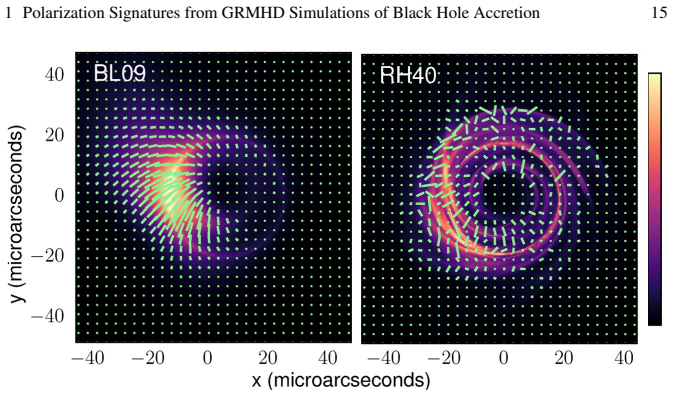
This chapter tells the still-unfolding story of extracting polarization signatures from general relativistic magnetohydrodynamics simulations of accretion disks. In some sense, this effort is premature as there are still very few results of this kind. Much more abundant are phenomenological models. Nevertheless, we feel now is the time to rally the community to this cause. Since the focus of this book is on X-ray polarimetry, we focus exclusively on simulations of accretion onto compact objects. Most of the relevant work so far has been on black hole accretion disks, though neutron stars are also viable targets for X-ray polarimetry. The focus of our chapter is on how X-ray polarimetry coupled with accretion simulations might help us better understand properties of the disks, coronae, and jets that are the dominant components of accreting compact sources. We briefly illustrate the promise of this technique by demonstrating how it has already been used in the case of the Event Horizon Telescope (using radio polarimetry). We also speculate about where this field may be heading in the near future.
Editorial analysis
A structured set of objections, weighed in public.
Referee Report
Summary. This perspective chapter reviews the extraction of polarization signatures from GRMHD simulations of black hole accretion, notes the scarcity of such results relative to phenomenological models, and advocates combining X-ray polarimetry with simulations to constrain properties of disks, coronae, and jets. It illustrates the approach via the EHT's radio polarimetry results and speculates on near-future directions for accreting compact objects, including neutron stars.
Significance. If the advocated integration proceeds, the chapter could help catalyze targeted simulation campaigns that leverage upcoming X-ray polarimetry data to distinguish physical models of accretion flows. The explicit framing around the EHT precedent provides a concrete benchmark for what similar X-ray efforts might achieve.
minor comments (2)
- [Abstract] Abstract: the assertion that 'there are still very few results of this kind' would be strengthened by citing or enumerating the existing GRMHD polarization papers to give readers a precise sense of the current literature gap.
- The discussion of neutron-star targets is mentioned only in passing; a short paragraph or reference list entry would clarify why they are viable for X-ray polarimetry without diluting the black-hole focus.
Simulated Author's Rebuttal
We thank the referee for their positive summary, significance assessment, and recommendation for minor revision. The report accurately reflects the chapter's focus on polarization signatures from GRMHD simulations and the value of integrating them with X-ray polarimetry observations, using the EHT as a benchmark.
Circularity Check
No derivations, predictions, or fitted quantities; review chapter with modest forward-looking claim
full rationale
The manuscript is explicitly a review chapter discussing the state of polarization signatures extracted from GRMHD simulations. It contains no equations, no new derivations, no fitted parameters, and no quantitative predictions that could reduce to inputs by construction. The central claim is that X-ray polarimetry coupled with simulations 'might help' understand disk/corona/jet properties, presented as a call for future work rather than a demonstration. The text acknowledges the scarcity of existing results and treats GRMHD fidelity and data quality as open issues. No self-citation chains, ansatzes, or uniqueness theorems are invoked as load-bearing steps. This is a normal, non-circular outcome for a discussion piece.
Axiom & Free-Parameter Ledger
Lean theorems connected to this paper
-
IndisputableMonolith/Foundation/RealityFromDistinction.leanreality_from_one_distinction unclear?
unclearRelation between the paper passage and the cited Recognition theorem.
Most simulations of black hole accretion disks these days solve the following set of conservation equations for general relativistic hydrodynamics (GRHD): ∂λ(√−g ρ u^λ)=0, … T^αβ_MHD = …
-
IndisputableMonolith/Cost/FunctionalEquation.leanwashburn_uniqueness_aczel unclear?
unclearRelation between the paper passage and the cited Recognition theorem.
We focus on how X-ray polarimetry coupled with accretion simulations might help us better understand properties of the disks, coronae, and jets
What do these tags mean?
- matches
- The paper's claim is directly supported by a theorem in the formal canon.
- supports
- The theorem supports part of the paper's argument, but the paper may add assumptions or extra steps.
- extends
- The paper goes beyond the formal theorem; the theorem is a base layer rather than the whole result.
- uses
- The paper appears to rely on the theorem as machinery.
- contradicts
- The paper's claim conflicts with a theorem or certificate in the canon.
- unclear
- Pith found a possible connection, but the passage is too broad, indirect, or ambiguous to say the theorem truly supports the claim.
Reference graph
Works this paper leans on
-
[1]
R. Shafee, J. C. McKinney, R. Narayan, A. Tchekhovskoy, C. F. Gammie, and J. E. McClintock, “Three-Dimensional Simulations of Magnetized Thin Accretion Disks around Black Holes: Stress in the Plunging Region,” Astrophys. J.687no. 1, (Nov., 2008) L25,arXiv:0808.2860 [astro-ph]
work page internal anchor Pith review Pith/arXiv arXiv 2008
-
[2]
R. F. Penna, J. C. McKinney, R. Narayan, A. Tchekhovskoy, R. Shafee, and J. E. McClintock, “Simulations of magnetized discs around black holes: effects of black hole spin, disc thickness and magnetic field geometry,”Mon. Not. R. Astron. Soc.408no. 2, (Oct., 2010) 752–782,arXiv:1003.0966 [astro-ph.HE]
work page internal anchor Pith review Pith/arXiv arXiv 2010
-
[3]
Thin Disk Theory with a Non-Zero Torque Boundary Condition and Comparisons with Simulations
R. F. Penna, A. S ˛ adowski, and J. C. McKinney, “Thin-disc theory with a non-zero-torque boundary condition and comparisons with simulations,” Mon. Not. R. Astron. Soc.420no. 1, (Feb., 2012) 684–698, arXiv:1110.6556 [astro-ph.HE]
work page internal anchor Pith review Pith/arXiv arXiv 2012
-
[4]
Thin accretion disks are stabilized by a strong magnetic field
A. S ˛ adowski, “Thin accretion discs are stabilized by a strong magnetic field,”Mon. Not. R. Astron. Soc.459no. 4, (July, 2016) 4397–4407, arXiv:1601.06785 [astro-ph.HE]
work page internal anchor Pith review Pith/arXiv arXiv 2016
-
[5]
D. Lan ˇcová, D. Abarca, W. Klu´ zniak, M. Wielgus, A. S ˛ adowski, R. Narayan, J. Schee, G. Török, and M. Abramowicz, “Puffy Accretion 1 Polarization Signatures from GRMHD Simulations of Black Hole Accretion 23 Disks: Sub-Eddington, Optically Thick, and Stable,”Astrophys. J.884 no. 2, (Oct., 2019) L37,arXiv:1908.08396 [astro-ph.HE]
-
[6]
The Role of Strong Magnetic Fields in Stabilizing Highly Luminous Thin Disks,
B. Mishra, P. C. Fragile, J. Anderson, A. Blankenship, H. Li, and K. Nalewajko, “The Role of Strong Magnetic Fields in Stabilizing Highly Luminous Thin Disks,”Astrophys. J.939no. 1, (Nov., 2022) 31, arXiv:2209.03317 [astro-ph.HE]
-
[7]
Global General Relativistic Magnetohydrodynamic Simulations of Accretion Tori
J.-P. De Villiers and J. F. Hawley, “Global General Relativistic Magnetohydrodynamic Simulations of Accretion Tori,”Astrophys. J.592 no. 2, (Aug., 2003) 1060–1077,arXiv:astro-ph/0303241 [astro-ph]
work page internal anchor Pith review Pith/arXiv arXiv 2003
-
[8]
HARM: A Numerical Scheme for General Relativistic Magnetohydrodynamics
C. F. Gammie, J. C. McKinney, and G. Tóth, “HARM: A Numerical Scheme for General Relativistic Magnetohydrodynamics,”Astrophys. J.589no. 1, (May, 2003) 444–457,arXiv:astro-ph/0301509 [astro-ph]
work page internal anchor Pith review Pith/arXiv arXiv 2003
-
[9]
R. Narayan, A. S ˛ adowski, R. F. Penna, and A. K. Kulkarni, “GRMHD simulations of magnetized advection-dominated accretion on a non-spinning black hole: role of outflows,”Mon. Not. R. Astron. Soc.426no. 4, (Nov.,
-
[10]
3241–3259,arXiv:1206.1213 [astro-ph.HE]
work page internal anchor Pith review Pith/arXiv arXiv
-
[11]
H. Shiokawa, J. C. Dolence, C. F. Gammie, and S. C. Noble, “Global General Relativistic Magnetohydrodynamic Simulations of Black Hole Accretion Flows: A Convergence Study,”Astrophys. J.744no. 2, (Jan.,
-
[12]
187,arXiv:1111.0396 [astro-ph.HE]
work page internal anchor Pith review Pith/arXiv arXiv
-
[13]
F. Yuan, M. Wu, and D. Bu, “Numerical Simulation of Hot Accretion Flows. I. A Large Radial Dynamical Range and the Density Profile of Accretion Flow,”Astrophys. J.761no. 2, (Dec., 2012) 129,arXiv:1206.4157 [astro-ph.HE]
work page internal anchor Pith review Pith/arXiv arXiv 2012
-
[14]
A. S ˛ adowski, R. Narayan, R. Penna, and Y . Zhu, “Energy, momentum and mass outflows and feedback from thick accretion discs around rotating black holes,”Mon. Not. R. Astron. Soc.436no. 4, (Dec., 2013) 3856–3874, arXiv:1307.1143 [astro-ph.HE]
work page internal anchor Pith review Pith/arXiv arXiv 2013
-
[15]
GRMHD simulations of accretion onto Sgr A*: How important are radiative losses?
S. Dibi, S. Drappeau, P. C. Fragile, S. Markoff, and J. Dexter, “General relativistic magnetohydrodynamic simulations of accretion on to Sgr A*: how important are radiative losses?,”Mon. Not. R. Astron. Soc.426no. 3, (Nov., 2012) 1928–1939,arXiv:1206.3976 [astro-ph.HE]
work page internal anchor Pith review Pith/arXiv arXiv 2012
-
[16]
A. S ˛ adowski, M. Wielgus, R. Narayan, D. Abarca, J. C. McKinney, and A. Chael, “Radiative, two-temperature simulations of low-luminosity black hole accretion flows in general relativity,”Mon. Not. R. Astron. Soc.466 no. 1, (Apr., 2017) 705–725,arXiv:1605.03184 [astro-ph.HE]
work page internal anchor Pith review Pith/arXiv arXiv 2017
-
[17]
Y .-F. Jiang, O. Blaes, J. M. Stone, and S. W. Davis, “Global Radiation Magnetohydrodynamic Simulations of sub-Eddington Accretion Disks around Supermassive Black Holes,”Astrophys. J.885no. 2, (Nov., 2019) 144,arXiv:1904.01674 [astro-ph.HE]
-
[18]
J. Dexter, N. Scepi, and M. C. Begelman, “Radiation GRMHD Simulations of the Hard State of Black Hole X-Ray Binaries and the Collapse of a Hot Accretion Flow,”Astrophys. J.919no. 2, (Oct., 2021) L20, arXiv:2109.06239 [astro-ph.HE]. 24 P. Chris Fragile, Maciek Wielgus and Cora Prather
-
[19]
Y .-F. Jiang, J. M. Stone, and S. W. Davis, “A Global Three-dimensional Radiation Magneto-hydrodynamic Simulation of Super-Eddington Accretion Disks,”Astrophys. J.796no. 2, (Dec., 2014) 106, arXiv:1410.0678 [astro-ph.HE]
work page internal anchor Pith review Pith/arXiv arXiv 2014
-
[20]
Numerical simulations of super-critical black hole accretion flows in general relativity
A. S ˛ adowski, R. Narayan, J. C. McKinney, and A. Tchekhovskoy, “Numerical simulations of super-critical black hole accretion flows in general relativity,”Mon. Not. R. Astron. Soc.439no. 1, (Mar., 2014) 503–520,arXiv:1311.5900 [astro-ph.HE]
work page internal anchor Pith review Pith/arXiv arXiv 2014
-
[21]
J. C. McKinney, A. Tchekhovskoy, A. Sadowski, and R. Narayan, “Three-dimensional general relativistic radiation magnetohydrodynamical simulation of super-Eddington accretion, using a new code HARMRAD with M1 closure,”Mon. Not. R. Astron. Soc.441no. 4, (July, 2014) 3177–3208,arXiv:1312.6127 [astro-ph.CO]
work page internal anchor Pith review Pith/arXiv arXiv 2014
-
[22]
A. Utsumi, K. Ohsuga, H. R. Takahashi, and Y . Asahina, “Component of Energy Flow from Supercritical Accretion Disks Around Rotating Stellar Mass Black Holes,”Astrophys. J.935no. 1, (Aug., 2022) 26, arXiv:2207.02560 [astro-ph.HE]
-
[23]
S. Yoshioka, S. Mineshige, K. Ohsuga, T. Kawashima, and T. Kitaki, “Large-scale outflow structure and radiation properties of super-Eddington flow: Dependence on the accretion rates,”Publ. Astron. Soc. Japan74no. 6, (Dec., 2022) 1378–1395,arXiv:2209.01427 [astro-ph.HE]
-
[24]
Long time-scale numerical simulations of large supercritical accretion discs,
P. C. Fragile, M. J. Middleton, D. A. Bollimpalli, and Z. Smith, “Long time-scale numerical simulations of large supercritical accretion discs,” Mon. Not. R. Astron. Soc.540no. 3, (July, 2025) 2820–2829, arXiv:2505.08859 [astro-ph.HE]
-
[25]
Radiation GRMHD Models of Accretion onto Stellar-Mass Black Holes: I. Survey of Eddington Ratios,
L. Zhang, J. M. Stone, P. D. Mullen, S. W. Davis, Y .-F. Jiang, and C. J. White, “Radiation GRMHD Models of Accretion onto Stellar-Mass Black Holes: I. Survey of Eddington Ratios,”arXiv e-prints(June, 2025) arXiv:2506.02289,arXiv:2506.02289 [astro-ph.HE]
-
[26]
K. Beckwith, J. F. Hawley, and J. H. Krolik, “The Influence of Magnetic Field Geometry on the Evolution of Black Hole Accretion Flows: Similar Disks, Drastically Different Jets,”Astrophys. J.678no. 2, (May, 2008) 1180–1199,arXiv:0709.3833 [astro-ph]
work page internal anchor Pith review Pith/arXiv arXiv 2008
-
[27]
Efficient Generation of Jets from Magnetically Arrested Accretion on a Rapidly Spinning Black Hole
A. Tchekhovskoy, R. Narayan, and J. C. McKinney, “Efficient generation of jets from magnetically arrested accretion on a rapidly spinning black hole,” Mon. Not. R. Astron. Soc.418no. 1, (Nov., 2011) L79–L83, arXiv:1108.0412 [astro-ph.HE]
work page internal anchor Pith review Pith/arXiv arXiv 2011
-
[28]
J. C. McKinney, A. Tchekhovskoy, and R. D. Blandford, “General relativistic magnetohydrodynamic simulations of magnetically choked accretion flows around black holes,”Mon. Not. R. Astron. Soc.423no. 4, (July, 2012) 3083–3117,arXiv:1201.4163 [astro-ph.HE]
work page internal anchor Pith review Pith/arXiv arXiv 2012
-
[29]
Local Stability of Strongly Magnetized Black Hole Tori
M. Wielgus, P. C. Fragile, Z. Wang, and J. Wilson, “Local stability of strongly magnetized black hole tori,”Mon. Not. R. Astron. Soc.447no. 4, (Mar., 2015) 3593–3601,arXiv:1412.4561 [astro-ph.HE]. 1 Polarization Signatures from GRMHD Simulations of Black Hole Accretion 25
work page internal anchor Pith review Pith/arXiv arXiv 2015
-
[30]
A Resolution Study of Magnetically Arrested Disks
C. J. White, J. M. Stone, and E. Quataert, “A Resolution Study of Magnetically Arrested Disks,”Astrophys. J.874no. 2, (Apr., 2019) 168, arXiv:1903.01509 [astro-ph.HE]
work page internal anchor Pith review Pith/arXiv arXiv 2019
-
[31]
B. Curd and R. Narayan, “GRRMHD simulations of MAD accretion discs declining from super-Eddington to sub-Eddington accretion rates,”Mon. Not. R. Astron. Soc.518no. 3, (Jan., 2023) 3441–3461, arXiv:2209.12081 [astro-ph.HE]
-
[32]
N. Scepi, M. C. Begelman, and J. Dexter, “Magnetic support, wind-driven accretion, coronal heating, and fast outflows in a thin magnetically arrested disc,”Mon. Not. R. Astron. Soc.527no. 1, (Jan., 2024) 1424–1443, arXiv:2302.10226 [astro-ph.HE]
-
[33]
Global General Relativistic MHD Simulation of a Tilted Black-Hole Accretion Disk
P. C. Fragile, O. M. Blaes, P. Anninos, and J. D. Salmonson, “Global General Relativistic Magnetohydrodynamic Simulation of a Tilted Black Hole Accretion Disk,”Astrophys. J.668no. 1, (Oct., 2007) 417–429, arXiv:0706.4303 [astro-ph]
work page internal anchor Pith review Pith/arXiv arXiv 2007
-
[34]
Alignment of Magnetized Accretion Disks and Relativistic Jets with Spinning Black Holes
J. C. McKinney, A. Tchekhovskoy, and R. D. Blandford, “Alignment of Magnetized Accretion Disks and Relativistic Jets with Spinning Black Holes,”Science339no. 6115, (Jan., 2013) 49,arXiv:1211.3651 [astro-ph.CO]
work page internal anchor Pith review Pith/arXiv arXiv 2013
-
[35]
Conservative GRMHD Simulations of Moderately Thin, Tilted Accretion Disks
D. Morales Teixeira, P. C. Fragile, V . V . Zhuravlev, and P. B. Ivanov, “Conservative GRMHD Simulations of Moderately Thin, Tilted Accretion Disks,”Astrophys. J.796no. 2, (Dec., 2014) 103,arXiv:1406.5514 [astro-ph.HE]
work page internal anchor Pith review Pith/arXiv arXiv 2014
-
[36]
Formation of precessing jets by tilted black hole discs in 3D general relativistic MHD simulations,
M. Liska, C. Hesp, A. Tchekhovskoy, A. Ingram, M. van der Klis, and S. Markoff, “Formation of precessing jets by tilted black hole discs in 3D general relativistic MHD simulations,”Mon. Not. R. Astron. Soc.474no. 1, (Feb., 2018) L81–L85,arXiv:1707.06619 [astro-ph.HE]
-
[37]
M. Liska, A. Tchekhovskoy, A. Ingram, and M. van der Klis, “Bardeen-Petterson alignment, jets, and magnetic truncation in GRMHD simulations of tilted thin accretion discs,”Mon. Not. R. Astron. Soc.487 no. 1, (July, 2019) 550–561,arXiv:1810.00883 [astro-ph.HE]
-
[38]
Tilted Disks around Black Holes: A Numerical Parameter Survey for Spin and Inclination Angle
C. J. White, E. Quataert, and O. Blaes, “Tilted Disks around Black Holes: A Numerical Parameter Survey for Spin and Inclination Angle,”Astrophys. J. 878no. 1, (June, 2019) 51,arXiv:1902.09662 [astro-ph.HE]
work page internal anchor Pith review Pith/arXiv arXiv 2019
-
[39]
H. R. Takahashi, K. Ohsuga, T. Kawashima, and Y . Sekiguchi, “Formation of Overheated Regions and Truncated Disks around Black Holes: Three-dimensional General Relativistic Radiation-magnetohydrodynamics Simulations,”Astrophys. J.826no. 1, (July, 2016) 23, arXiv:1605.04992 [astro-ph.GA]
work page internal anchor Pith review Pith/arXiv arXiv 2016
-
[40]
M. T. P. Liska, G. Musoke, A. Tchekhovskoy, O. Porth, and A. M. Beloborodov, “Formation of Magnetically Truncated Accretion Disks in 3D Radiation-transport Two-temperature GRMHD Simulations,”Astrophys. J. 935no. 1, (Aug., 2022) L1,arXiv:2201.03526 [astro-ph.HE]
-
[41]
Truncated, tilted discs as a possible source of Quasi-Periodic Oscillations,
D. A. Bollimpalli, P. C. Fragile, J. W. Dewberry, and W. Klu´ zniak, “Truncated, tilted discs as a possible source of Quasi-Periodic Oscillations,” 26 P. Chris Fragile, Maciek Wielgus and Cora Prather Mon. Not. R. Astron. Soc.528no. 2, (Feb., 2024) 1142–1157, arXiv:2312.14876 [astro-ph.HE]
-
[42]
General-relativistic resistive magnetohydrodynamics in three dimensions: Formulation and tests
K. Dionysopoulou, D. Alic, C. Palenzuela, L. Rezzolla, and B. Giacomazzo, “General-relativistic resistive magnetohydrodynamics in three dimensions: Formulation and tests,”Phys. Rev. D88no. 4, (Aug., 2013) 044020, arXiv:1208.3487 [gr-qc]
work page internal anchor Pith review Pith/arXiv arXiv 2013
-
[43]
Evolution of Accretion Discs around a Kerr Black Hole using Extended Magnetohydrodynamics
F. Foucart, M. Chandra, C. F. Gammie, and E. Quataert, “Evolution of accretion discs around a kerr black hole using extended magnetohydrodynamics,”Mon. Not. R. Astron. Soc.456no. 2, (Feb., 2016) 1332–1345,arXiv:1511.04445 [astro-ph.HE]
work page internal anchor Pith review Pith/arXiv arXiv 2016
-
[44]
The current ability to test theories of gravity with black hole shadows,
Y . Mizuno, Z. Younsi, C. M. Fromm, O. Porth, M. De Laurentis, H. Olivares, H. Falcke, M. Kramer, and L. Rezzolla, “The current ability to test theories of gravity with black hole shadows,”Nature Astronomy2(Apr.,
-
[45]
585–590,arXiv:1804.05812 [astro-ph.GA]
work page internal anchor Pith review Pith/arXiv arXiv
-
[46]
Energy Extraction from Spinning Stringy Black Holes,
K. Chatterjee, P. Kocherlakota, Z. Younsi, and R. Narayan, “Energy Extraction from Spinning Stringy Black Holes,”arXiv e-prints(Oct., 2023) arXiv:2310.20040,arXiv:2310.20040 [gr-qc]
-
[47]
Foundations of Black Hole Accretion Disk Theory
M. A. Abramowicz and P. C. Fragile, “Foundations of Black Hole Accretion Disk Theory,”Living Reviews in Relativity16no. 1, (Dec., 2013) 1, arXiv:1104.5499 [astro-ph.HE]
work page internal anchor Pith review Pith/arXiv arXiv 2013
-
[48]
Double Compton and Cyclo-Synchrotron in Super-Eddington Discs, Magnetized Coronae, and Jets,
J. C. McKinney, J. Chluba, M. Wielgus, R. Narayan, and A. Sadowski, “Double Compton and Cyclo-Synchrotron in Super-Eddington Discs, Magnetized Coronae, and Jets,”Mon. Not. R. Astron. Soc.467no. 2, (May,
-
[49]
2241–2265,arXiv:1608.08627 [astro-ph.HE]
work page internal anchor Pith review Pith/arXiv arXiv
-
[50]
The Effects of Magnetic Fields and Inhomogeneities on Accretion Disk Spectra and Polarization
S. W. Davis, O. M. Blaes, S. Hirose, and J. H. Krolik, “The Effects of Magnetic Fields and Inhomogeneities on Accretion Disk Spectra and Polarization,”Astrophys. J.703no. 1, (Sept., 2009) 569–584, arXiv:0908.0505 [astro-ph.HE]
work page internal anchor Pith review Pith/arXiv arXiv 2009
-
[51]
grmonty: a Monte Carlo Code for Relativistic Radiative Transport
J. C. Dolence, C. F. Gammie, M. Mo ´scibrodzka, and P. K. Leung, “grmonty: A Monte Carlo Code for Relativistic Radiative Transport,”Astrophys. J. Suppl.184no. 2, (Oct., 2009) 387–397,arXiv:0909.0708 [astro-ph.HE]
work page internal anchor Pith review Pith/arXiv arXiv 2009
-
[52]
A Monte Carlo Code for Relativistic Radiation Transport Around Kerr Black Holes
J. D. Schnittman and J. H. Krolik, “A Monte Carlo Code for Relativistic Radiation Transport around Kerr Black Holes,”Astrophys. J.777no. 1, (Nov., 2013) 11,arXiv:1302.3214 [astro-ph.HE]
work page internal anchor Pith review Pith/arXiv arXiv 2013
-
[53]
A public code for general relativistic, polarised radiative transfer around spinning black holes,
J. Dexter, “A public code for general relativistic, polarised radiative transfer around spinning black holes,”Mon. Not. R. Astron. Soc.462no. 1, (Oct.,
-
[54]
115–136,arXiv:1602.03184 [astro-ph.HE]
work page internal anchor Pith review Pith/arXiv arXiv
-
[55]
R. Narayan, Y . Zhu, D. Psaltis, and A. Sadowski, “HEROIC: 3D general relativistic radiative post-processor with comptonization for black hole accretion discs,”Mon. Not. R. Astron. Soc.457no. 1, (Mar., 2016) 608–628,arXiv:1510.04208 [astro-ph.HE]
work page internal anchor Pith review Pith/arXiv arXiv 2016
-
[56]
RAPTOR I: Time-dependent radiative transfer in arbitrary spacetimes
T. Bronzwaer, J. Davelaar, Z. Younsi, M. Mo´scibrodzka, H. Falcke, M. Kramer, and L. Rezzolla, “RAPTOR. I. Time-dependent radiative 1 Polarization Signatures from GRMHD Simulations of Black Hole Accretion 27 transfer in arbitrary spacetimes,”Astron. Astrophys.613(May, 2018) A2, arXiv:1801.10452 [astro-ph.HE]
work page internal anchor Pith review Pith/arXiv arXiv 2018
-
[57]
X-Ray Spectra from General Relativistic Radiation Magnetohydrodynamic Simulations of Thin Disks,
N. Roth, P. Anninos, P. C. Fragile, and D. Pickrel, “X-Ray Spectra from General Relativistic Radiation Magnetohydrodynamic Simulations of Thin Disks,”Astrophys. J.981no. 2, (Mar., 2025) 144,arXiv:2501.18040 [astro-ph.HE]
-
[58]
X-ray Spectra from MHD Simulations of Accreting Black Holes
J. D. Schnittman, J. H. Krolik, and S. C. Noble, “X-Ray Spectra from Magnetohydrodynamic Simulations of Accreting Black Holes,”Astrophys. J.769no. 2, (June, 2013) 156,arXiv:1207.2693 [astro-ph.HE]
work page internal anchor Pith review Pith/arXiv arXiv 2013
-
[59]
Predicting the X-Ray Spectra of Stellar-mass Black Holes from Simulations,
B. E. Kinch, J. D. Schnittman, T. R. Kallman, and J. H. Krolik, “Predicting the X-Ray Spectra of Stellar-mass Black Holes from Simulations,” Astrophys. J.873no. 1, (Mar., 2019) 71
work page 2019
-
[60]
Observational properties of puffy discs: radiative GRMHD spectra of mildly sub-Eddington accretion,
M. Wielgus, D. Lan ˇcová, O. Straub, W. Klu´ zniak, R. Narayan, D. Abarca, A. Ró˙za´nska, F. Vincent, G. Török, and M. Abramowicz, “Observational properties of puffy discs: radiative GRMHD spectra of mildly sub-Eddington accretion,”Mon. Not. R. Astron. Soc.514no. 1, (July, 2022) 780–789,arXiv:2202.08831 [astro-ph.HE]
-
[61]
B. S. Mills, S. W. Davis, Y .-F. Jiang, and M. J. Middleton, “Spectral Calculations of 3D Radiation Magnetohydrodynamic Simulations of Super-Eddington Accretion onto a Stellar-mass Black Hole,”Astrophys. J. 974no. 2, (Oct., 2024) 166,arXiv:2304.07977 [astro-ph.HE]
-
[62]
M. Moscibrodzka, “What is the hard spectral state in X-ray binaries? Insights from GRRMHD accretion flows simulations and polarization of their X-ray emission,”Astrophys. Space Sci.369no. 7, (July, 2024) 68, arXiv:2309.09087 [astro-ph.HE]
-
[63]
R. V . Shcherbakov, R. F. Penna, and J. C. McKinney, “Sagittarius A* Accretion Flow and Black Hole Parameters from General Relativistic Dynamical and Polarized Radiative Modeling,”Astrophys. J.755no. 2, (Aug., 2012) 133,arXiv:1007.4832 [astro-ph.HE]
work page internal anchor Pith review Pith/arXiv arXiv 2012
-
[64]
C.-K. Chan, D. Psaltis, F. Özel, R. Narayan, and A. Sadowski, “The Power of Imaging: Constraining the Plasma Properties of GRMHD Simulations using EHT Observations of Sgr A*,”Astrophys. J.799no. 1, (Jan., 2015) 1, arXiv:1410.3492 [astro-ph.HE]
work page internal anchor Pith review Pith/arXiv arXiv 2015
-
[65]
First M87 Event Horizon Telescope Results. V. Physical Origin of the Asymmetric Ring
Event Horizon Telescope Collaboration, “First M87 Event Horizon Telescope Results. V . Physical Origin of the Asymmetric Ring,”Astrophys. J.875no. 1, (Apr., 2019) L5,arXiv:1906.11242 [astro-ph.GA]
work page internal anchor Pith review Pith/arXiv arXiv 2019
-
[66]
Event Horizon Telescope Collaboration, “First Sagittarius A* Event Horizon Telescope Results. V . Testing Astrophysical Models of the Galactic Center Black Hole,”Astrophys. J.930no. 2, (May, 2022) L16
work page 2022
-
[67]
Fe K$\alpha$ Profiles from Simulations of Accreting Black Holes
B. E. Kinch, J. D. Schnittman, T. R. Kallman, and J. H. Krolik, “Fe Kα Profiles from Simulations of Accreting Black Holes,”Astrophys. J.826 no. 1, (July, 2016) 52,arXiv:1604.01126 [astro-ph.HE]
work page internal anchor Pith review Pith/arXiv arXiv 2016
-
[68]
Direct calculation of the radiative efficiency of an accretion disk around a black hole
S. C. Noble, J. H. Krolik, and J. F. Hawley, “Direct Calculation of the Radiative Efficiency of an Accretion Disk Around a Black Hole,”Astrophys. J.692no. 1, (Feb., 2009) 411–421,arXiv:0808.3140 [astro-ph]. 28 P. Chris Fragile, Maciek Wielgus and Cora Prather
work page internal anchor Pith review Pith/arXiv arXiv 2009
-
[69]
Spin and Accretion Rate Dependence of Black Hole X-Ray Spectra,
B. E. Kinch, J. D. Schnittman, S. C. Noble, T. R. Kallman, and J. H. Krolik, “Spin and Accretion Rate Dependence of Black Hole X-Ray Spectra,” Astrophys. J.922no. 2, (Dec., 2021) 270,arXiv:2105.09408 [astro-ph.HE]
-
[70]
Quasi-periodic Oscillations in the X-ray Light Curves from Relativistic Tori
J. D. Schnittman and L. Rezzolla, “Quasi-periodic Oscillations in the X-Ray Light Curves from Relativistic Tori,”Astrophys. J.637no. 2, (Feb., 2006) L113–L116,arXiv:astro-ph/0506702 [astro-ph]
work page internal anchor Pith review Pith/arXiv arXiv 2006
-
[71]
Light Curves from an MHD Simulation of a Black Hole Accretion Disk
J. D. Schnittman, J. H. Krolik, and J. F. Hawley, “Light Curves from an MHD Simulation of a Black Hole Accretion Disk,”Astrophys. J.651no. 2, (Nov., 2006) 1031–1048,arXiv:astro-ph/0606615 [astro-ph]
work page internal anchor Pith review Pith/arXiv arXiv 2006
-
[72]
Quasi-periodic oscillations from relativistic hydrodynamical slender tori
B. Mishra, F. H. Vincent, A. Manousakis, P. C. Fragile, T. Paumard, and W. Klu´ zniak, “Quasi-periodic oscillations from relativistic ray-traced hydrodynamical tori,”Mon. Not. R. Astron. Soc.467no. 4, (June, 2017) 4036–4049,arXiv:1510.07414 [astro-ph.HE]
work page internal anchor Pith review Pith/arXiv arXiv 2017
-
[73]
Looking for the underlying cause of black hole X-ray variability in GRMHD simulations,
D. A. Bollimpalli, R. Mahmoud, C. Done, P. C. Fragile, W. Klu´ zniak, R. Narayan, and C. J. White, “Looking for the underlying cause of black hole X-ray variability in GRMHD simulations,”Mon. Not. R. Astron. Soc. 496no. 3, (Aug., 2020) 3808–3828,arXiv:2006.00755 [astro-ph.HE]
-
[74]
L. D. S. Salas, M. T. P. Liska, S. B. Markoff, K. Chatterjee, G. Musoke, O. Porth, B. Ripperda, D. Yoon, and W. Mulaudzi, “Two-temperature treatments in magnetically arrested disc GRMHD simulations more accurately predict light curves of Sagittarius A*,”Mon. Not. R. Astron. Soc. 538no. 2, (Apr., 2025) 698–710,arXiv:2411.09556 [astro-ph.HE]
-
[75]
Polarization in the Jet of Messier 87.,
W. Baade, “Polarization in the Jet of Messier 87.,”Astrophys. J.123(May,
-
[76]
Optical and infrared polarization of active extragalactic objects,
J. R. P. Angel and H. S. Stockman, “Optical and infrared polarization of active extragalactic objects,”Annu. Rev. Astron. Astrophys.18(Jan., 1980) 321–361
work page 1980
-
[77]
The linear polarization of quasi-stellar radio sources at 3.71 and 11.1 centimeters.,
J. F. C. Wardle and P. P. Kronberg, “The linear polarization of quasi-stellar radio sources at 3.71 and 11.1 centimeters.,”Astrophys. J.194(Jan., 1974) 249
work page 1974
-
[78]
Determination of X-ray pulsar geometry with IXPE polarimetry,
V . Doroshenko, J. Poutanen,et al., “Determination of X-ray pulsar geometry with IXPE polarimetry,”Nature Astronomy6(Dec., 2022) 1433–1443, arXiv:2206.07138 [astro-ph.HE]
-
[79]
Polarized x-rays constrain the disk-jet geometry in the black hole x-ray binary Cygnus X-1,
H. Krawczynski, F. Muleri,et al., “Polarized x-rays constrain the disk-jet geometry in the black hole x-ray binary Cygnus X-1,”Science378no. 6620, (Nov., 2022) 650–654,arXiv:2206.09972 [astro-ph.HE]
-
[80]
The first X-ray polarimetric observation of the black hole binary LMC X-1,
J. Podgorný, L. Marra,et al., “The first X-ray polarimetric observation of the black hole binary LMC X-1,”Mon. Not. R. Astron. Soc.526no. 4, (Dec., 2023) 5964–5975,arXiv:2303.12034 [astro-ph.HE]
discussion (0)
Sign in with ORCID, Apple, or X to comment. Anyone can read and Pith papers without signing in.