GenAI-Driven Approach to RISC-V Supply Chain Exploration
Pith reviewed 2026-05-19 17:54 UTC · model grok-4.3
The pith
LLM and VLM workflow turns unstructured RISC-V supply chain data into formal models for resilience analysis.
A machine-rendered reading of the paper's core claim, the machinery that carries it, and where it could break.
Core claim
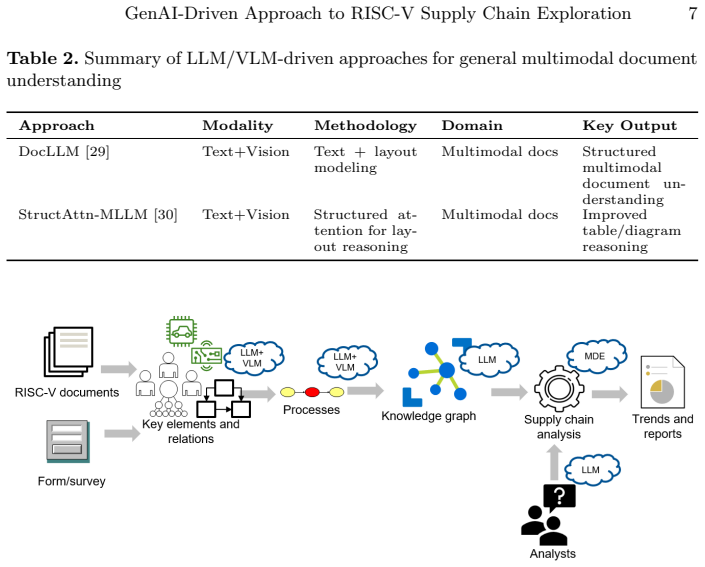
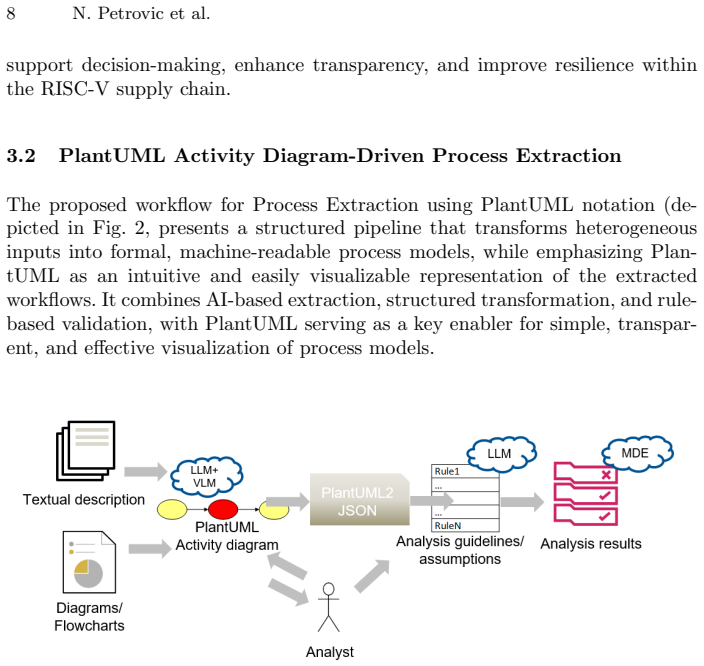
The proposed LLM-empowered workflow integrates Vision-Language Models and Model-Driven Engineering to extract key entities and relationships from heterogeneous and unstructured supply chain data, organizes them into a knowledge graph, and enables formal validation of dependencies, detection of bottlenecks, and assessment of risks to support exploratory and systematic evaluation of supply chain resilience in RISC-V scenarios.
What carries the argument
The collaborative LLM-VLM-MDE workflow that builds a knowledge graph from multimodal data and applies constraint-based modeling for formal analysis of supply chain interdependencies.
If this is right
- Generates actionable insights for enhancing transparency in semiconductor supply chains.
- Supports both exploratory querying and systematic risk assessment.
- Improves decision-making through interactive human-in-the-loop validation.
- Demonstrates effectiveness in RISC-V ecosystem scenarios for resilience evaluation.
- Organizes unstructured data including visual artifacts into structured representations.
Where Pith is reading between the lines
- The method might generalize to supply chain analysis in other hardware domains such as ARM or x86 ecosystems.
- Integration with live data feeds could enable ongoing monitoring rather than static analysis.
- This could inform policy or investment decisions in critical technology infrastructure.
- Potential for automation in identifying single points of failure in global supply networks.
Load-bearing premise
That LLMs and VLMs can reliably extract accurate key entities and relationships from heterogeneous, unstructured supply chain data including visual artifacts without significant errors or hallucinations.
What would settle it
A test case where the workflow is applied to a collection of real RISC-V supply chain reports and diagrams, revealing consistent inaccuracies in extracted entities or relationships compared to manual expert analysis.
Figures


read the original abstract
This paper presents an LLM-empowered workflow for RISC-V supply chain analysis, integrating Vision-Language Models (VLMs) and Model-Driven Engineering (MDE) to enable comprehensive, multimodal data-driven insights. The proposed approach addresses the challenges of heterogeneous and unstructured supply chain data by leveraging LLMs for textual understanding and VLMs for extracting information from visual artifacts such as diagrams, tables, and scanned documents. These models collaboratively identify key entities and relationships, which are then organized into a knowledge graph representing supply chain components and their interdependencies. For analytical reasoning, the workflow incorporates MDE techniques and constraint-based modeling to enable formal validation of dependencies, detection of bottlenecks, and assessment of risks. The synergy between LLM- and VLM-based semantic understanding and MDE-based formal analysis supports both exploratory and systematic evaluation of supply chain resilience. A human-in-the-loop mechanism further enables interactive querying and expert validation. The approach is evaluated in RISC-V ecosystem scenarios, demonstrating its effectiveness in generating actionable insights, enhancing transparency, and supporting decision-making in complex semiconductor supply chains.
Editorial analysis
A structured set of objections, weighed in public.
Referee Report
Summary. The paper proposes an LLM- and VLM-empowered workflow that integrates semantic extraction from multimodal supply-chain data (text, diagrams, tables, scanned documents) into a knowledge graph, followed by MDE-based constraint modeling for formal dependency validation, bottleneck detection, and risk assessment. A human-in-the-loop component supports interactive querying. The approach is described as evaluated in RISC-V ecosystem scenarios to produce actionable insights on supply-chain resilience and transparency.
Significance. If the extraction step can be shown to produce sufficiently accurate graphs and the downstream formal results remain stable under realistic noise, the work could provide a practical bridge between unstructured data handling and rigorous analysis in semiconductor supply chains. The combination of generative models with model-driven engineering is a timely direction for resilience studies, though the manuscript currently offers no quantitative support for these outcomes.
major comments (2)
- [Abstract] Abstract: the manuscript states that the approach 'is evaluated in RISC-V ecosystem scenarios, demonstrating its effectiveness in generating actionable insights', yet no quantitative results, error rates, hallucination metrics, precision/recall figures, or stability analysis under extraction noise are reported. This omission leaves the central claim that the LLM/VLM–MDE synergy supports reliable exploratory and systematic evaluation unsupported by evidence.
- [Workflow description] Workflow description (and evaluation section): the pipeline treats LLM/VLM entity-relationship extraction as a reliable input to constraint-based modeling, but provides no ablation studies, inter-annotator agreement with domain experts, or sensitivity analysis showing that downstream formal validation and risk scores remain meaningful when extraction errors typical of current VLMs are present. This is load-bearing for the claimed synergy.
minor comments (1)
- The description of the knowledge-graph construction step would benefit from an explicit diagram or pseudocode showing how extracted entities are mapped to MDE constraints.
Simulated Author's Rebuttal
We thank the referee for the constructive comments on our manuscript. The observations regarding the absence of quantitative metrics and robustness analyses are accurate and highlight important gaps in the current presentation of the evaluation. We address each major comment below and will revise the manuscript to incorporate the requested evidence.
read point-by-point responses
-
Referee: [Abstract] Abstract: the manuscript states that the approach 'is evaluated in RISC-V ecosystem scenarios, demonstrating its effectiveness in generating actionable insights', yet no quantitative results, error rates, hallucination metrics, precision/recall figures, or stability analysis under extraction noise are reported. This omission leaves the central claim that the LLM/VLM–MDE synergy supports reliable exploratory and systematic evaluation unsupported by evidence.
Authors: We agree that the abstract and evaluation section currently lack quantitative support for the claimed effectiveness. The manuscript describes the application to RISC-V scenarios and resulting insights but does not report precision/recall, error rates, hallucination metrics, or stability under noise. In the revision we will add a dedicated quantitative evaluation subsection that includes these metrics for the extraction pipeline and an assessment of how extraction accuracy affects the downstream MDE constraint validation and risk scores. revision: yes
-
Referee: [Workflow description] Workflow description (and evaluation section): the pipeline treats LLM/VLM entity-relationship extraction as a reliable input to constraint-based modeling, but provides no ablation studies, inter-annotator agreement with domain experts, or sensitivity analysis showing that downstream formal validation and risk scores remain meaningful when extraction errors typical of current VLMs are present. This is load-bearing for the claimed synergy.
Authors: We concur that the absence of ablation studies, inter-annotator agreement, and sensitivity analysis weakens the support for the claimed LLM/VLM–MDE synergy. The current manuscript presents the integrated workflow and its use in scenarios without these controls. We will revise the evaluation section to include (i) ablation experiments isolating the contribution of the VLM component, (ii) inter-annotator agreement statistics obtained from domain experts on the generated knowledge graphs, and (iii) sensitivity analysis that perturbs the extracted graphs with realistic VLM error patterns and measures the stability of the resulting formal validation outcomes and risk assessments. revision: yes
Circularity Check
No circularity in conceptual methodological proposal
full rationale
The paper presents a conceptual workflow proposal integrating LLMs, VLMs, and MDE for supply chain analysis with no mathematical derivations, equations, fitted parameters, or self-referential reductions. Claims about entity-relationship extraction into knowledge graphs and subsequent formal validation rest on the described integration rather than any step that equates outputs to inputs by construction or via load-bearing self-citation. The approach is self-contained as a high-level methodological framework evaluated through scenario-based demonstration of insights.
Axiom & Free-Parameter Ledger
axioms (2)
- domain assumption LLMs and VLMs can accurately identify key entities and relationships from heterogeneous textual and visual supply chain artifacts.
- domain assumption Constraint-based modeling from MDE can formally validate dependencies and detect bottlenecks in the resulting supply chain representation.
Reference graph
Works this paper leans on
-
[1]
Navik, A.P., Tiwari, S.K., Anand, V., Yadav, B., Park, J., Sung, H.J.: Risc-v: Redefining the future of computing, architecture, innovations, and beyond. In: 2025 8th International Conference on Electronics, Materials Engineering & Nano- Technology (IEMENTech). pp. 1–5. IEEE, Kolkata, India (2025)
work page 2025
-
[2]
RISC-V International: Risc-v for automotive ai use cases: Opportunities and challenges. White paper (2025), https://riscv.org/wp-content/uploads/2025/04/ RISC-V AIOpportunitiesChallenges 042825.pdf, accessed: 2026-04-25
work page 2025
-
[3]
In: 2023 12th Mediterranean Conference on Embedded Computing (MECO)
Cuomo, L., et al.: Towards a risc-v open platform for next-generation automotive ecus. In: 2023 12th Mediterranean Conference on Embedded Computing (MECO). pp. 1–8. IEEE, Budva, Montenegro (2023)
work page 2023
-
[4]
Andreasyan, N., Struve, M., Popov, A., Nikolaev, M., Vashkelis, V.: Risc-v func- tional safety for autonomous automotive systems: An analytical framework and research roadmap for ml-assisted certification. arXiv preprint arXiv:2604.17391 (2026)
work page internal anchor Pith review Pith/arXiv arXiv 2026
-
[5]
In: 2025 2nd International Generative AI and Com- putational Language Modelling Conference (GACLM)
Petrovic, N., Pan, F., Zolfaghari, V., Knoll, A.: Llm-based iterative approach to metamodeling in automotive. In: 2025 2nd International Generative AI and Com- putational Language Modelling Conference (GACLM). pp. 266–271. IEEE (2025)
work page 2025
-
[6]
arXiv preprint arXiv:2511.21877 (2025)
Petrovic, N., Kroth, N., Torschmied, A., Song, Y., Pan, F., Zolfaghari, V., Purschke, N., Kirchner, S., Wu, C., Schamschurko, A., Zhang, Y., Knoll, A.: Llm-empowered event-chain driven code generation for adas in sdv systems. arXiv preprint arXiv:2511.21877 (2025)
-
[7]
In: Proceed- ings of the 1st workshop on knowledge graphs and large language models (kaLLM 2024)
Papaluca, A., Krefl, D., M´ endez, S.R., Lensky, A., Suominen, H.: Zero-and few- shots knowledge graph triplet extraction with large language models. In: Proceed- ings of the 1st workshop on knowledge graphs and large language models (kaLLM 2024). pp. 12–23 (2024)
work page 2024
-
[8]
In: Proceedings of the 2025 Conference on Empirical Methods in Natural Language Processing
Anuyah, S., Kaushik, M.M., Dwarampudi, S.R.K.R., Shiradkar, R., Durresi, A., Chakraborty, S.: Automated knowledge graph construction using large language models and sentence complexity modelling. In: Proceedings of the 2025 Conference on Empirical Methods in Natural Language Processing. pp. 15526–15550 (2025)
work page 2025
-
[9]
Chen, H., Shen, X., Lv, Q., Wang, J., Ni, X., Ye, J.: Sac-kg: Exploiting large language models as skilled automatic constructors for domain knowledge graph. In: Proceedings of the 62nd Annual Meeting of the Association for Computational Linguistics (Volume 1: Long Papers). pp. 4345–4360 (2024)
work page 2024
-
[10]
In: Proceedings of the 2024 conference on empirical methods in natural language processing
Zhang, B., Soh, H.: Extract, define, canonicalize: An llm-based framework for knowledge graph construction. In: Proceedings of the 2024 conference on empirical methods in natural language processing. pp. 9820–9836 (2024) GenAI-Driven Approach to RISC-V Supply Chain Exploration 19
work page 2024
-
[11]
In: Interna- tional Conference on Web Information Systems Engineering
Lairgi, Y., Moncla, L., Cazabet, R., Benabdeslem, K., Cl´ eau, P.: itext2kg: Incre- mental knowledge graphs construction using large language models. In: Interna- tional Conference on Web Information Systems Engineering. pp. 214–229. Springer (2024)
work page 2024
-
[12]
arXiv preprint arXiv:2505.23628 , year =
Bai, J., Fan, W., Hu, Q., Zong, Q., Li, C., Tsang, H.T., Luo, H., Yim, Y., Huang, H., Zhou, X., et al.: Autoschemakg: Autonomous knowledge graph construc- tion through dynamic schema induction from web-scale corpora. arXiv preprint arXiv:2505.23628 (2025)
-
[13]
Niu, S., Yang, K., Zhao, R., Liu, Y., Li, Z., Wang, H., Chen, W.: Tree-kg: An expandable knowledge graph construction framework for knowledge-intensive do- mains. In: Proceedings of the 63rd Annual Meeting of the Association for Compu- tational Linguistics (Volume 1: Long Papers). pp. 18516–18529 (2025)
work page 2025
-
[14]
doi:10.48550/arXiv.2502.09956 , abstract =
Mo, B., Yu, K., Kazdan, J., Cabezas, J., Mpala, P., Yu, L., Cundy, C., Kanatsoulis, C., Koyejo, S.: Kggen: Extracting knowledge graphs from plain text with language models. arXiv preprint arXiv:2502.09956 (2025)
-
[15]
arXiv preprint arXiv:2505.24163 (2025)
Sun, J., Qian, S., Han, Z., Li, W., Qian, Z., Yang, D., Cao, J., Xue, G.: Lkd- kgc: Domain-specific kg construction via llm-driven knowledge dependency parsing. arXiv preprint arXiv:2505.24163 (2025)
-
[16]
In: Proceedings of the IEEE/CVF International Conference on Computer Vision
Liu, J., Meng, S., Gao, Y., Mao, S., Cai, P., Yan, G., Chen, Y., Bian, Z., Wang, D., Shi, B.: Aligning vision to language: Annotation-free multimodal knowledge graph construction for enhanced llms reasoning. In: Proceedings of the IEEE/CVF International Conference on Computer Vision. pp. 981–992 (2025)
work page 2025
-
[17]
In: Findings of the Association for Computational Linguistics: ACL 2025
Bu, C., Chang, G., Chen, Z., Dang, C., Wu, Z., He, Y., Wu, X.: Query-driven multimodal graphrag: Dynamic local knowledge graph construction for online rea- soning. In: Findings of the Association for Computational Linguistics: ACL 2025. pp. 21360–21380 (2025)
work page 2025
-
[18]
International Journal of Production Research 64(6), 2178–2209 (2026)
AlMahri, S., Xu, L., Brintrup, A.: Enhancing supply chain visibility with knowledge graphs and large language models. International Journal of Production Research 64(6), 2178–2209 (2026)
work page 2026
-
[19]
Journal of Computing and Informa- tion Science in Engineering 25(2), 021010 (2025)
Li, Y., Ko, H., Ameri, F.: Integrating graph retrieval-augmented generation with large language models for supplier discovery. Journal of Computing and Informa- tion Science in Engineering 25(2), 021010 (2025)
work page 2025
-
[20]
Interna- tional Journal of Production Research pp
Zheng, G., Brintrup, A.: Enhancing supply chain visibility with generative ai: an exploratory case study on relationship prediction in knowledge graphs. Interna- tional Journal of Production Research pp. 1–23 (2025)
work page 2025
-
[21]
In: European Semantic Web Conference
Han, Y., Ding, Z., Liu, Y., He, B., Tresp, V.: Critical path identification in supply chain knowledge graphs with large language models. In: European Semantic Web Conference. pp. 223–227. Springer (2024)
work page 2024
-
[22]
The Review of Socionetwork Strategies 18(2), 255–278 (2024)
Shahsavari, M., Hussain, O.K., Saberi, M., Sharma, P.: Event identification for sup- ply chain risk management through news analysis by using large language models. The Review of Socionetwork Strategies 18(2), 255–278 (2024)
work page 2024
-
[23]
Cheng, Z.Q., Dong, Y., Shi, A., Liu, W., Hu, Y., O’Connor, J., Hauptmann, A.G., Whitefoot, K.: Shield: Llm-driven schema induction for predictive analytics in ev battery supply chain disruptions. In: Proceedings of the 2024 Conference on Empir- ical Methods in Natural Language Processing: Industry Track. pp. 303–333 (2024)
work page 2024
-
[24]
arXiv preprint arXiv:2601.09680 (2026)
AlMahri, S., Xu, L., Brintrup, A.: Automating supply chain disruption monitoring via an agentic ai approach. arXiv preprint arXiv:2601.09680 (2026)
-
[25]
arXiv preprint arXiv:2307.03875 (2023)
Li, B., Mellou, K., Zhang, B., Pathuri, J., Menache, I.: Large language models for supply chain optimization. arXiv preprint arXiv:2307.03875 (2023)
-
[26]
arXiv preprint arXiv:2507.21502 , year=
Simchi-Levi, D., Mellou, K., Menache, I., Pathuri, J.: Large language models for supply chain decisions. arXiv preprint arXiv:2507.21502 (2025) 20 N. Petrovic et al
-
[27]
International Journal of Production Research pp
Song, Z., Xie, Y., Yang, L., Zhao, Y.: Large language models in supply chain man- agement: a systematic literature review and application framework. International Journal of Production Research pp. 1–41 (2026)
work page 2026
-
[28]
Journal of Systems and Information Technol- ogy 28(1), 123–144 (2026)
Singh, V., Hughes, L., Albashrawi, M.A., Jeon, I., Dwivedi, Y.K.: Generative arti- ficial intelligence (genai) in procurement and supply chain management: applica- tions, opportunities and challenges. Journal of Systems and Information Technol- ogy 28(1), 123–144 (2026)
work page 2026
-
[29]
Wang, D., Raman, N., Sibue, M., Ma, Z., Babkin, P., Kaur, S., Pei, Y., Nour- bakhsh, A., Liu, X.: Docllm: A layout-aware generative language model for mul- timodal document understanding. In: Proceedings of the 62nd Annual Meeting of the Association for Computational Linguistics (Volume 1: Long Papers). pp. 8529–8548 (2024)
work page 2024
-
[30]
arXiv preprint arXiv:2506.21600 (2025)
Liu, C., Chen, H., Cai, Y., Wu, H., Ye, Q., Yang, M.H., Wang, Y.: Structured attention matters to multimodal llms in document understanding. arXiv preprint arXiv:2506.21600 (2025)
-
[31]
arXiv preprint arXiv:2507.18223 (2025)
Petrovic, N., Pan, F., Zolfaghari, V., Lebioda, K., Schamschurko, A., Knoll, A.: Genai for automotive software development: From requirements to wheels. arXiv preprint arXiv:2507.18223 (2025)
discussion (0)
Sign in with ORCID, Apple, or X to comment. Anyone can read and Pith papers without signing in.