On Kernel Eigen-alignments of KRR: Reconstruction and Generalization
Pith reviewed 2026-05-19 16:20 UTC · model grok-4.3
The pith
In kernel ridge regression, generalization performance depends on the alignment of kernel eigenvectors with the target vectors rather than just reconstruction accuracy.
A machine-rendered reading of the paper's core claim, the machinery that carries it, and where it could break.
Core claim
The paper establishes that a generalization bound for kernel ridge regression can be derived from the estimation stability of eigenvalues and eigenvectors of the kernel matrix. Since predictions are weighted sums of eigenvectors, the error from kernel perturbations can be analyzed to show that strong generalization requires increasing eigenvector alignment, eigenvalue magnitude, or gaps between consecutive eigenvalues.
What carries the argument
eigen-alignments between the kernel matrix and learning targets, which determine how much the kernel perturbations affect the weighted eigenvector sums in predictions
If this is right
- Low reconstruction error alone does not guarantee good generalization for high-rank kernels.
- Improving eigenvector alignment enhances the generalization bound.
- Larger gaps between eigenvalues increase stability against perturbations.
- Increasing eigenvalue magnitudes supports better generalization.
Where Pith is reading between the lines
- This perspective suggests that kernel design should optimize for alignment properties in addition to other criteria.
- Similar eigen-alignment analysis could extend to other kernel-based methods beyond ridge regression.
- Finite-sample bounds like these may help explain why certain kernels work well on specific datasets but not others.
Load-bearing premise
The analysis assumes that the generalization error arises primarily from using a suboptimal finite training set in a finite-sample setting.
What would settle it
An experiment showing that generalization error remains high even when eigenvector alignment is strong and eigenvalues have large magnitudes and gaps would falsify the bound.
Figures
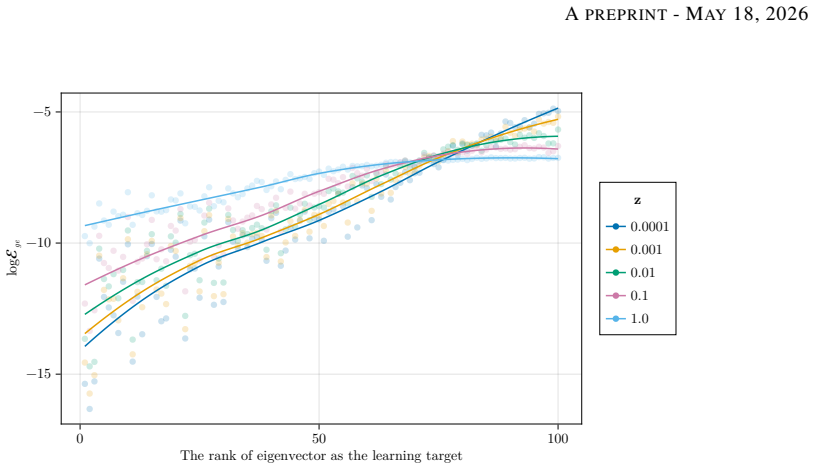


read the original abstract
This paper investigates the critical role of eigenalignments between the kernel matrix and learning targets in achieving robust generalization in learning problems. We establish a direct connection between generalization performance in kernel methods and the estimation of eigenvectors and eigenvalues of matrices, offering a more intuitive understanding compared to prior work with minimal assumptions. We also show that, since the prediction task in KRR is essentially the weighted sum of eigenvectors/singular vectors, by analyzing how much error can be caused by perturbations to the kernel matrix, we can then derive a bound on this generalization error using the estimation stability of matrix eigenvalues and eigenvectors. Compared with previous work, our analysis concentrates on finite-sample settings and on the generalization error arising from having a suboptimal finite training set. Our findings reveal that in kernel methods, as long as the kernel is of high rank, the near-zero reconstruction error can be trivially obtained, implying that the reconstruction error will have limited predictive power for generalization. Finally, we establish a generalization bound from an eigenvalues/eigenvectors estimation perspective, showing that strong generalization requires increasing eigenvector alignment, eigenvalue magnitude, or gaps between consecutive eigenvalues.
Editorial analysis
A structured set of objections, weighed in public.
Referee Report
Summary. The paper analyzes kernel ridge regression (KRR) by linking generalization performance to eigen-alignments between the kernel matrix and learning targets. It derives a generalization bound by modeling the finite training set as inducing a perturbation on the kernel matrix, then bounding the error in the KRR predictor (expressed as a weighted sum of eigenvectors) via estimation stability of eigenvalues and eigenvectors. Key claims include that near-zero reconstruction error is trivial for high-rank kernels (limiting its predictive power for generalization) and that strong generalization requires increasing eigenvector alignment, eigenvalue magnitude, or gaps between consecutive eigenvalues, all under minimal assumptions in finite-sample settings.
Significance. If the perturbation analysis can be made rigorous with explicit conditions, the work would offer an intuitive finite-sample perspective on generalization in kernel methods that complements existing stability and Rademacher-based bounds. It could inform kernel selection or regularization by emphasizing eigenstructure, though the current lack of explicit perturbation form limits immediate applicability.
major comments (1)
- [perturbation analysis and generalization bound derivation] The central derivation of the generalization bound (described in the abstract as arising from perturbation stability of the kernel matrix and detailed in the main analysis) applies eigenvector perturbation results such as Davis-Kahan bounds without specifying the exact perturbation model (additive noise on K, sampling error from the integral operator, or multiplicative distortion) or verifying that eigenvalue gap conditions hold uniformly for the kernels under consideration. This is load-bearing for the claim that strong generalization requires larger alignment, larger eigenvalues, or larger gaps, as the bound does not necessarily follow from the finite-sample premise without these elements.
minor comments (1)
- [abstract and findings paragraph] The abstract states that 'near-zero reconstruction error can be trivially obtained' for high-rank kernels; clarify whether this holds only asymptotically or under specific finite-sample conditions, and add a brief remark on how this interacts with the proposed eigen-alignment requirements.
Simulated Author's Rebuttal
We thank the referee for the careful and constructive review of our manuscript. We address the major comment on the perturbation analysis and generalization bound derivation below, and we plan to revise the paper to improve clarity on these points.
read point-by-point responses
-
Referee: The central derivation of the generalization bound (described in the abstract as arising from perturbation stability of the kernel matrix and detailed in the main analysis) applies eigenvector perturbation results such as Davis-Kahan bounds without specifying the exact perturbation model (additive noise on K, sampling error from the integral operator, or multiplicative distortion) or verifying that eigenvalue gap conditions hold uniformly for the kernels under consideration. This is load-bearing for the claim that strong generalization requires larger alignment, larger eigenvalues, or larger gaps, as the bound does not necessarily follow from the finite-sample premise without these elements.
Authors: We appreciate the referee highlighting the need for greater precision here. The perturbation we analyze is the additive difference between the empirical kernel matrix (computed from the finite training set) and the population kernel matrix induced by the integral operator; this is the natural sampling perturbation arising in the finite-sample setting. We will revise the manuscript to state this model explicitly, including a brief reference to standard concentration results for empirical kernel matrices. For the eigenvalue gap conditions, the Davis-Kahan bounds we invoke are applied conditionally on a positive gap between relevant eigenvalues, which is a standard technical assumption in this literature. We agree that discussing the uniformity of this condition strengthens the presentation. In revision we will add a short discussion noting that the bound holds whenever the gap condition is met and that regularization or kernel choice can be used to ensure suitable gaps for many common kernels (e.g., Gaussian). These changes make the assumptions transparent and support the claim that strong generalization requires sufficient alignment, eigenvalue magnitude, or gaps, without altering the core finite-sample perspective of the work. revision: yes
Circularity Check
Derivation applies perturbation analysis to KRR predictor without reducing to self-definition or fitted inputs
full rationale
The paper derives its generalization bound by expressing the KRR predictor as a weighted sum of eigenvectors and analyzing error from finite-sample perturbations to the kernel matrix, then invoking estimation stability results for eigenvalues and eigenvectors. This produces an explicit dependence of the bound on eigenvector alignment, eigenvalue magnitudes, and gaps, which is a direct consequence of the perturbation expansion rather than a tautological re-expression of the inputs. The separate observation that reconstruction error is near-zero for high-rank kernels is used only to downplay its predictive value for generalization and does not feed back into the bound derivation. No self-citations, ansatzes, or fitted parameters are shown to be load-bearing; the quantities in the bound are defined independently of the final generalization statement itself. The analysis therefore remains self-contained under the finite-sample premise stated in the abstract.
Axiom & Free-Parameter Ledger
axioms (1)
- standard math Standard results on stability of matrix eigenvalues and eigenvectors under perturbations hold in the finite-sample kernel setting.
Reference graph
Works this paper leans on
- [1]
-
[2]
On regularization algorithms in learning theory
Bauer, Frank and Pereverzev, Sergei and Rosasco, Lorenzo. On regularization algorithms in learning theory. Journal of complexity
-
[3]
Approximation theory and harmonic analysis on spheres and balls
Dai, Feng and Xu, Yuan. Approximation theory and harmonic analysis on spheres and balls
-
[4]
Aspects of Harmonic Analysis and Representation Theory
Gallier, Jean and Quaintance, Jocelyn. Aspects of Harmonic Analysis and Representation Theory
-
[5]
Replica Method for the Machine Learning Theorist
Blake Bordelon, Haozhe Shan, Abdul Canatar, Boaz Barak, Cengiz Pehlevan. Replica Method for the Machine Learning Theorist
-
[6]
Categorization based on similarity and features: the reproducing kernel Banach space (RKBS) approach
Zhang, Jun and Zhang, Haizhang. Categorization based on similarity and features: the reproducing kernel Banach space (RKBS) approach. New Handbook of Mathematical Psychology
-
[7]
Fluctuations of Spiked Random Matrix Models and Failure Diagnosis in Sensor Networks
Couillet, Romain and Hachem, Walid. Fluctuations of Spiked Random Matrix Models and Failure Diagnosis in Sensor Networks. IEEE Transactions on Information Theory
- [8]
-
[9]
Incremental kernel principal component analysis
Chin, Tat-Jun and Suter, David. Incremental kernel principal component analysis. IEEE transactions on image processing: a publication of the IEEE Signal Processing Society
- [10]
-
[11]
A support vector machine with a hybrid kernel and minimal vapnik-chervonenkis dimension
Tan, Ying and Wang, Jun. A support vector machine with a hybrid kernel and minimal vapnik-chervonenkis dimension. IEEE transactions on knowledge and data engineering
-
[12]
Reproducing kernel Hilbert spaces on manifolds: Sobolev and Diffusion spaces
De Vito, Ernesto and Mücke, Nicole and Rosasco, Lorenzo. Reproducing kernel Hilbert spaces on manifolds: Sobolev and Diffusion spaces. arXiv [math.FA]
-
[13]
Fasshauer, Gregory E and Ye, Qi. Reproducing kernels of generalized Sobolev spaces via a Green function approach with distributional operators. Numerische mathematik
-
[14]
Adaptive kernel methods using the balancing principle
De Vito, E and Pereverzyev, S and Rosasco, L. Adaptive kernel methods using the balancing principle. Foundations of computational mathematics
-
[15]
A Mathematical Introduction to Compressive Sensing
Foucart, Simon and Rauhut, Holger. A Mathematical Introduction to Compressive Sensing
- [16]
-
[17]
Unshuffling data for improved generalization in visual question answering
Teney, Damien and Abbasnejad, Ehsan and van den Hengel, Anton. Unshuffling data for improved generalization in visual question answering. 2021 IEEE/CVF International Conference on Computer Vision (ICCV)
work page 2021
-
[18]
Dimension lower bounds for linear approaches to function approximation
Hsu, Daniel J. Dimension lower bounds for linear approaches to function approximation
- [19]
- [20]
-
[21]
Algebraic geometry and statistical learning theory
Watanabe, Sumio. Algebraic geometry and statistical learning theory
-
[22]
Measuring and testing homogeneity of distributions by characteristic distance
Li, Xu and Hu, Wenjuan and Zhang, Baoxue. Measuring and testing homogeneity of distributions by characteristic distance. Statistical papers (Berlin, Germany)
-
[23]
Umbral nature of the Poisson random variables
Di Nardo, E and Senato, D. Umbral nature of the Poisson random variables. arXiv [math.PR]
-
[24]
On the notion of neighborhood system
Mishachev, Nikolai and Shmyrin, Anatoly. On the notion of neighborhood system. 2019 1st International Conference on Control Systems, Mathematical Modelling, Automation and Energy Efficiency (SUMMA)
work page 2019
-
[25]
Functional Analysis for Probability and Stochastic Processes
Bobrowski, A. Functional Analysis for Probability and Stochastic Processes
-
[26]
Bousquet, O and Elisseeff, A. Stability and Generalization. Journal of machine learning research: JMLR
-
[27]
Capacity of reproducing kernel spaces in learning theory
Zhou, Ding-Xuan. Capacity of reproducing kernel spaces in learning theory. IEEE transactions on information theory
-
[28]
Approximation in learning theory
Temlyakov, V N. Approximation in learning theory. Constructive approximation
-
[29]
Sobolev Norm Learning Rates for Regularized Least-Squares Algorithms
Fischer, Simon and Steinwart, Ingo. Sobolev Norm Learning Rates for Regularized Least-Squares Algorithms. Journal of Machine Learning Research
-
[30]
Universal algorithms for learning theory part I : Piecewise constant functions
Binev, P and Cohen, A and Dahmen, W and DeVore, R and Temlyakov, V. Universal algorithms for learning theory part I : Piecewise constant functions. Journal of machine learning research: JMLR
-
[31]
An introduction to Sobolev spaces
Piskin, Erhan and Okutmustur, Baver. An introduction to Sobolev spaces
-
[32]
Entropy-based subsampling methods for big data
Sui, Qun and Ghosh, Sujit K. Entropy-based subsampling methods for big data. Journal of statistical theory and practice
-
[33]
A theory of usable information under computational constraints
Xu, Yilun and Zhao, Shengjia and Song, Jiaming and Stewart, Russell and Ermon, Stefano. A theory of usable information under computational constraints. arXiv [cs.LG]
-
[34]
Uniform approximation of functions with random bases
Rahimi, Ali and Recht, Benjamin. Uniform approximation of functions with random bases. 2008 46th Annual Allerton Conference on Communication, Control, and Computing
work page 2008
-
[35]
Tight frame expansions of multiscale reproducing kernels in Sobolev spaces
Opfer, Roland. Tight frame expansions of multiscale reproducing kernels in Sobolev spaces. Applied and computational harmonic analysis
-
[36]
A theory of representation learning gives a deep generalisation of kernel methods
Yang, Adam X and Robeyns, Maxime and Milsom, Edward and Anson, Ben and Schoots, Nandi and Aitchison, Laurence. A theory of representation learning gives a deep generalisation of kernel methods. Proceedings of the 40th International Conference on Machine Learning
-
[37]
Low rank spectral network alignment
Nassar, Huda and Veldt, Nate and Mohammadi, Shahin and Grama, Ananth and Gleich, David F. Low rank spectral network alignment. Proceedings of the 2018 World Wide Web Conference on World Wide Web - WWW '18
work page 2018
-
[38]
Learning the Kernel Function via Regularization
Micchelli, Charles A and Pontil, Massimiliano. Learning the Kernel Function via Regularization. Journal of Machine Learning Research
-
[39]
HoMM: Higher-order Moment Matching for unsupervised domain adaptation
Chen, Chao and Fu, Zhihang and Chen, Zhihong and Jin, Sheng and Cheng, Zhaowei and Jin, Xinyu and Hua, Xian-Sheng. HoMM: Higher-order Moment Matching for unsupervised domain adaptation. Proceedings of the ... AAAI Conference on Artificial Intelligence. AAAI Conference on Artificial Intelligence
-
[40]
Foundations of Machine Learning
Mohri, Mehryar and Rostamizadeh, Afshin and Talwalkar, Ameet. Foundations of Machine Learning
-
[41]
Boosting a weak learning algorithm by majority
Freund, Y. Boosting a weak learning algorithm by majority. Information and computation
-
[42]
Multivariate Function and Operator Estimation, Based on Smoothing Splines and Reproducing Kernels
Wahba, Grace. Multivariate Function and Operator Estimation, Based on Smoothing Splines and Reproducing Kernels. Nonlinear Modeling and Forecasting
-
[43]
Smoothing Splines: Methods and Applications
Wang, Yuedong. Smoothing Splines: Methods and Applications
-
[44]
Local Rademacher Complexity Bounds based on Covering Numbers
Lei, Yunwen and Ding, Lixin and Bi, Yingzhou. Local Rademacher Complexity Bounds based on Covering Numbers. arXiv [cs.AI]
-
[45]
Concentration estimates for learning with ℓ1-regularizer and data dependent hypothesis spaces
Shi, Lei and Feng, Yun-Long and Zhou, Ding-Xuan. Concentration estimates for learning with ℓ1-regularizer and data dependent hypothesis spaces. Applied and computational harmonic analysis
-
[46]
Learning with sample dependent hypothesis spaces
Wu, Qiang and Zhou, Ding-Xuan. Learning with sample dependent hypothesis spaces. Computers & mathematics with applications (Oxford, England: 1987)
work page 1987
-
[47]
Machine learning with data dependent hypothesis classes
Cannon, A and Ettinger, J M and Hush, D and Scovel, C. Machine learning with data dependent hypothesis classes. The Journal of Machine Learning Research
-
[48]
Regularized modal regression with data-dependent hypothesis spaces
Wang, Yingjie and Chen, Hong and Song, Biqin and Li, Han. Regularized modal regression with data-dependent hypothesis spaces. International Journal of Wavelets, Multiresolution and Information Processing
-
[49]
Simon, James B and Dickens, Madeline and Karkada, Dhruva and DeWeese, Michael R. The eigenlearning framework: A conservation law perspective on kernel regression and wide neural networks. arXiv [cs.LG]
-
[50]
Zhang, Zhihua and Jorgensen, Palle E T. Frame Theory in Data Science
-
[51]
Kernel Alignment Risk Estimator: Risk prediction from training data
Jacot, Arthur and cSimcsek, Berfin and Spadaro, Francesco and Hongler, Clément and Gabriel, Franck. Kernel Alignment Risk Estimator: Risk prediction from training data. Neural Information Processing Systems
-
[52]
Mallat, Stéphane. Group invariant scattering. Communications on pure and applied mathematics
-
[53]
Towards understanding the spectral bias of deep learning
Cao, Yuan and Fang, Zhiying and Wu, Yue and Zhou, Ding-Xuan and Gu, Quanquan. Towards understanding the spectral bias of deep learning. arXiv [cs.LG]
-
[54]
SimpleMKKM: Simple Multiple Kernel K-means
Liu, Xinwang and Zhu, En and Liu, Jiyuan. SimpleMKKM: Simple Multiple Kernel K-means. arXiv [cs.LG]
-
[55]
Deep unsupervised domain adaptation: A review of recent advances and perspectives
Liu, Xiaofeng and Yoo, Chaehwa and Xing, Fangxu and Oh, Hyejin and El Fakhri, Georges and Kang, Je-Won and Woo, Jonghye. Deep unsupervised domain adaptation: A review of recent advances and perspectives. APSIPA transactions on signal and information processing
-
[56]
Optimal Transport for Domain Adaptation
Courty, Nicolas and Flamary, Rémi and Tuia, Devis and Rakotomamonjy, Alain. Optimal Transport for Domain Adaptation. arXiv [cs.LG]
-
[57]
Ahlberg, E N Nilson and (Eds.), J L Walsh
J.H. Ahlberg, E N Nilson and (Eds.), J L Walsh. The Theory of Splines and Their Applications
-
[58]
Introduction to Fourier Analysis and Wavelets
Pinsky, Mark A. Introduction to Fourier Analysis and Wavelets
-
[59]
Data Assimilation in Reduced Modeling
Binev, Peter and Cohen, Albert and Dahmen, Wolfgang and DeVore, Ronald and Petrova, Guergana and Wojtaszczyk, Przemyslaw. Data Assimilation in Reduced Modeling. arXiv [math.NA]
-
[60]
Instances of computational optimal recovery: Refined approximability models
Foucart, Simon. Instances of computational optimal recovery: Refined approximability models. Journal of complexity
-
[61]
Overparametrized regression: Ridgeless interpolation
Tibshirani, Ryan. Overparametrized regression: Ridgeless interpolation. Lecture Notes from Course of Advanced Topics in Statistical Learning, Spring
-
[62]
Introduction to Shannon sampling and interpolation theory
Marks, II, Robert J. Introduction to Shannon sampling and interpolation theory
- [63]
-
[64]
Identifiability Conditions for Domain Adaptation
Gulrajani, Ishaan and Hashimoto, Tatsunori. Identifiability Conditions for Domain Adaptation. Proceedings of the 39th International Conference on Machine Learning
-
[65]
A Generalized Representer Theorem
Schölkopf, Bernhard and Herbrich, Ralf and Smola, Alex J. A Generalized Representer Theorem. Lecture Notes in Computer Science
-
[66]
Costabile, Francesco Aldo. Modern umbral calculus: An elementary introduction with applications to linear interpolation and operator approximation theory
-
[67]
Kernel properties and representations of boundary integral operators
Schwab, C and Wendland, W L. Kernel properties and representations of boundary integral operators. Mathematische Nachrichten
-
[68]
Some properties of regularized kernel methods
Vito, E and Rosasco, L and Caponnetto, A and Piana, M and Verri, A. Some properties of regularized kernel methods. Journal of machine learning research: JMLR
- [69]
-
[70]
Improving support vector machine classifiers by modifying kernel functions
Amari, S and Wu, S. Improving support vector machine classifiers by modifying kernel functions. Neural networks: the official journal of the International Neural Network Society
-
[71]
Learning low-rank kernel matrices
Kulis, Brian and Sustik, Mátyás and Dhillon, Inderjit. Learning low-rank kernel matrices. Proceedings of the 23rd international conference on Machine learning - ICML '06
-
[72]
Efficient SVM training using low-rank kernel representations
Fine, Shai and Scheinberg, K. Efficient SVM training using low-rank kernel representations. Journal of machine learning research: JMLR
-
[73]
Approximating the Covariance Matrix with Low-rank Perturbations
Magdon-Ismail, Malik and Purnell, Jonathan T. Approximating the Covariance Matrix with Low-rank Perturbations
-
[74]
Kristiadi-Being Bayesian, Even Just a Bit, Fixe\_supplement\_1
-
[75]
Analysis of Representations for Domain Adaptation
Ben-David, Shai and Blitzer, John and Crammer, Koby and Pereira, Fernando. Analysis of Representations for Domain Adaptation. Advances in Neural Information Processing Systems
-
[76]
On the difficulty of approximately maximizing agreements
Ben-David, Shai and Eiron, Nadav and Long, Philip M. On the difficulty of approximately maximizing agreements. Journal of computer and system sciences
-
[77]
Machine learning and the physical sciences
Carleo, Giuseppe and Cirac, Ignacio and Cranmer, Kyle and Daudet, Laurent and Schuld, Maria and Tishby, Naftali and Vogt-Maranto, Leslie and Zdeborová, Lenka. Machine learning and the physical sciences. Reviews of modern physics
-
[78]
Eigenvalues for a product of matrices. Mathematics Stack Exchange
-
[79]
Eigenvalue inequalities for matrix product
Zhang, F and Zhang, Q. Eigenvalue inequalities for matrix product. IEEE transactions on automatic control
-
[80]
Dharmawansa, Prathapasinghe and McKay, Matthew R. Extreme eigenvalue distributions of some complex correlated non-central Wishart and gamma-Wishart random matrices. Journal of multivariate analysis
discussion (0)
Sign in with ORCID, Apple, or X to comment. Anyone can read and Pith papers without signing in.