Synthesis and Optimization of Encoding Circuits for Fault-Tolerant Quantum Computation
Pith reviewed 2026-05-19 16:19 UTC · model grok-4.3
The pith
Search over stabilizer tableaus yields encoders for arbitrary stabilizer codes with up to 43% fewer two-qubit gates.
A machine-rendered reading of the paper's core claim, the machinery that carries it, and where it could break.
Core claim
By searching among stabilizer-equivalent tableaus the authors obtain encoding circuits for arbitrary stabilizer codes whose two-qubit gate counts and depths are lower than those of existing constructions, with the improvement arising directly from the systematic use of the freedom among equivalent realizations.
What carries the argument
Search over stabilizer tableaus navigated by greedy and rollout algorithms that identify low-cost stabilizer-equivalent realizations of the encoding isometry.
If this is right
- Lower gate counts reduce the physical resource overhead of state preparation in any fault-tolerant scheme that relies on encoded logical states.
- Reduced circuit depth limits error accumulation during the preparation step itself.
- Modular composition from exact local solutions makes synthesis tractable for structured code families at larger scales.
- The same search formulation can be reused for other isometry synthesis tasks that admit stabilizer-tableau descriptions.
Where Pith is reading between the lines
- The tableau-search technique might transfer to optimizing other stabilizer-circuit primitives such as logical measurements or syndrome extraction.
- For codes lacking obvious modular structure, hybrid methods that seed the search with known good subcircuits could further improve scaling.
- Widespread adoption would shift the bottleneck in fault-tolerant resource estimation from encoder construction to other overhead sources such as magic-state distillation.
Load-bearing premise
The greedy and rollout search algorithms will reliably locate high-quality stabilizer-equivalent realizations without becoming trapped in poor local optima for the codes of practical interest.
What would settle it
A concrete calculation that produces an encoder for a specific stabilizer code whose two-qubit gate count exceeds that of a known hand-optimized construction from the literature would show the search methods do not always reach the claimed savings.
Figures




read the original abstract
Preparing arbitrary logical states is a central primitive for universal fault-tolerant quantum computation and the cost of encoded-state preparation contributes directly to the overall resource overhead. This makes the synthesis of efficient general-state encoding circuits an important problem, particularly with respect to two-qubit gate count and circuit depth. Yet the synthesis of such encoders has been studied less extensively than general Clifford circuit synthesis or the preparation of specific logical Pauli-eigenstates. In this work, we develop methods for synthesizing efficient encoders for arbitrary stabilizer codes. We formulate encoder synthesis as a search over stabilizer tableaus and introduce greedy and rollout-based algorithms that exploit the freedom among stabilizer-equivalent realizations of the same encoding isometry. For code families with a modular structure, such as generalized concatenated and holographic codes, we show how large encoders can be assembled from optimized local constituent encoders, and we use SMT-based exact synthesis to obtain optimal local circuits for small instances. We further evaluate the proposed methods on a broad set of stabilizer codes, including holographic and quantum low-density parity-check (qLDPC) codes, and compare them against recent encoder-synthesis methods and existing constructions from the literature, obtaining improvements of up to 43% in two-qubit gate count and up to 70% in depth. Our results support the optimization of encoded-state preparation in several fault-tolerant quantum-computing schemes, and all methods are openly available as part of the Munich Quantum Toolkit.
Editorial analysis
A structured set of objections, weighed in public.
Referee Report
Summary. The manuscript develops methods for synthesizing efficient encoders for arbitrary stabilizer codes by formulating the problem as a search over stabilizer tableaus. It introduces greedy and rollout-based algorithms that exploit stabilizer-equivalent realizations of the encoding isometry, assembles large encoders from optimized local constituents for modular codes (e.g., generalized concatenated and holographic) using SMT-based exact synthesis for small instances, and reports empirical evaluations on a broad set of codes including qLDPC and holographic families. The work claims concrete improvements of up to 43% in two-qubit gate count and 70% in depth relative to recent synthesis methods and literature constructions, with all methods released in the Munich Quantum Toolkit.
Significance. If the empirical gains are reproducible and the heuristics scale reliably, the results would reduce overhead for general logical-state preparation, a key primitive in fault-tolerant schemes. The open-source release and evaluation across diverse code families (including practically relevant qLDPC) are strengths that support adoption. The approach fills a gap between general Clifford synthesis and preparation of specific eigenstates.
major comments (2)
- [§4.1–4.2] §4.1–4.2 (greedy and rollout algorithms): These are local heuristics without optimality guarantees or escape mechanisms from poor local optima. The central claim of up to 43% gate-count and 70% depth improvements for arbitrary stabilizer codes rests on reliable discovery of high-quality realizations; for larger instances the tableau search space grows rapidly, yet no analysis of entrapment frequency, multiple random restarts, or scaling behavior is provided. This is load-bearing for the generality of the reported gains.
- [§5] §5 (evaluation and comparisons): The reported percentage improvements are measured against external literature constructions, but the manuscript does not detail the exact baseline circuits, whether identical optimization targets (gate count vs. depth) were used, or statistical controls such as number of heuristic trials. Without these, it is difficult to verify that the gains are representative rather than instance-specific.
minor comments (2)
- [§2.2] §2.2 (tableau notation): An explicit small-code example mapping a stabilizer tableau to the corresponding encoding circuit would improve accessibility for readers outside the immediate subfield.
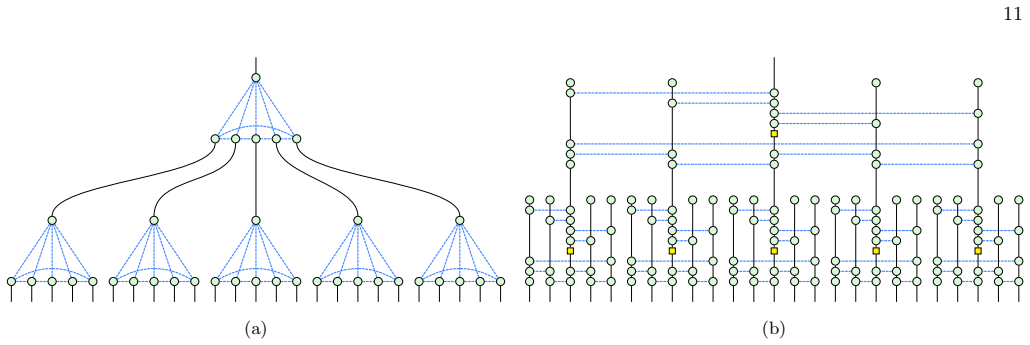
- [Figure 5] Figure 5 (assembled encoder diagrams): Labeling the boundaries of the SMT-optimized local subcircuits would clarify how the modular construction contributes to the overall depth reduction.
Simulated Author's Rebuttal
We thank the referee for the careful reading and constructive feedback on our manuscript. We address the major comments point by point below and have revised the manuscript to incorporate clarifications and additional analysis where feasible.
read point-by-point responses
-
Referee: [§4.1–4.2] §4.1–4.2 (greedy and rollout algorithms): These are local heuristics without optimality guarantees or escape mechanisms from poor local optima. The central claim of up to 43% gate-count and 70% depth improvements for arbitrary stabilizer codes rests on reliable discovery of high-quality realizations; for larger instances the tableau search space grows rapidly, yet no analysis of entrapment frequency, multiple random restarts, or scaling behavior is provided. This is load-bearing for the generality of the reported gains.
Authors: We agree that the greedy and rollout algorithms are local heuristics without formal optimality guarantees. In the revised manuscript we have added an explicit discussion of the multiple random restarts already present in our implementation, together with new empirical measurements of entrapment frequency and runtime scaling on larger tableau instances (now included in Section 4 and Appendix C). These data show that the reported improvements remain stable across restarts for the evaluated code families, although we acknowledge that exhaustive optimality proofs for arbitrary codes remain out of reach. revision: partial
-
Referee: [§5] §5 (evaluation and comparisons): The reported percentage improvements are measured against external literature constructions, but the manuscript does not detail the exact baseline circuits, whether identical optimization targets (gate count vs. depth) were used, or statistical controls such as number of heuristic trials. Without these, it is difficult to verify that the gains are representative rather than instance-specific.
Authors: We accept this observation. The revised Section 5 now lists the precise literature circuits used as baselines, states that separate optimizations were performed for gate count and for depth, and reports the number of heuristic trials (100 restarts per instance) together with mean and standard-deviation statistics. These additions allow direct verification of the reported gains. revision: yes
Circularity Check
No significant circularity; algorithmic synthesis with external benchmarks
full rationale
The paper formulates encoder synthesis as a search over stabilizer tableaus and introduces greedy/rollout algorithms plus SMT exact synthesis for small modular components. Reported gains (up to 43% gate count, 70% depth) are obtained by direct comparison of the synthesized circuits against prior constructions in the literature on concrete code families including qLDPC and holographic codes. No equation, prediction, or central claim reduces by construction to a fitted parameter, self-defined quantity, or load-bearing self-citation; the derivation chain consists of independent algorithmic steps whose outputs are validated externally.
Axiom & Free-Parameter Ledger
axioms (1)
- standard math Stabilizer formalism and tableau representation of Clifford operations and encoding isometries
Lean theorems connected to this paper
-
IndisputableMonolith/Cost/FunctionalEquation.leanwashburn_uniqueness_aczel unclear?
unclearRelation between the paper passage and the cited Recognition theorem.
We formulate encoder synthesis as a search over stabilizer tableaus and introduce greedy and rollout-based algorithms that exploit the freedom among stabilizer-equivalent realizations of the same encoding isometry.
What do these tags mean?
- matches
- The paper's claim is directly supported by a theorem in the formal canon.
- supports
- The theorem supports part of the paper's argument, but the paper may add assumptions or extra steps.
- extends
- The paper goes beyond the formal theorem; the theorem is a base layer rather than the whole result.
- uses
- The paper appears to rely on the theorem as machinery.
- contradicts
- The paper's claim conflicts with a theorem or certificate in the canon.
- unclear
- Pith found a possible connection, but the passage is too broad, indirect, or ambiguous to say the theorem truly supports the claim.
Reference graph
Works this paper leans on
-
[1]
Wille, et al., in2024 IEEE International Conference on Quantum Software (QSW)(IEEE, 2024) pp
R. Wille, et al., in2024 IEEE International Conference on Quantum Software (QSW)(IEEE, 2024) pp. 1–8
work page 2024
-
[2]
D. A. Lidar and T. A. Brun,Quantum error correction (Cambridge University Press, 2013)
work page 2013
-
[3]
S. J. Devitt, W. J. Munro, and K. Nemoto,Quantum er- ror correction for beginners, Rep. Prog. Phys.76, 076001 (2013)
work page 2013
-
[4]
Google Quantum AI,Quantum error correction below the surface code threshold, Nature638, 920–926 (2024)
work page 2024
-
[5]
Pogorelov, et al.,Experimental fault-tolerant code switching, Nat
I. Pogorelov, et al.,Experimental fault-tolerant code switching, Nat. Phys.21, 298–303 (2025)
work page 2025
- [6]
-
[7]
D. Bluvstein, et al.,Logical quantum processor based on reconfigurable atom arrays, Nature626, 58–65 (2024)
work page 2024
-
[8]
S. Bravyi and A. Kitaev,Universal quantum computation with ideal Clifford gates and noisy ancillas, Phys. Rev. A 71, 022316 (2005)
work page 2005
-
[9]
M. E. Beverland, A. Kubica, and K. M. Svore,Cost of Universality: A Comparative Study of the Overhead of State Distillation and Code Switching with Color Codes, PRX Quantum2, 020341 (2021)
work page 2021
- [10]
-
[11]
C. Chamberland and A. W. Cross,Fault-tolerant magic state preparation with flag qubits, Quantum3, 143 (2019)
work page 2019
-
[12]
Magic state cultivation: growing T states as cheap as CNOT gates
C. Gidney, N. Shutty, and C. Jones,Magic state cultiva- tion: growing T states as cheap as CNOT gates(2024), arXiv:2409.17595 [quant-ph]
work page internal anchor Pith review Pith/arXiv arXiv 2024
-
[13]
Sahay, et al.,Fold-transversal surface code cultivation (2026), arXiv:2509.05212 [quant-ph]
K. Sahay, et al.,Fold-transversal surface code cultivation (2026), arXiv:2509.05212 [quant-ph]
- [14]
-
[15]
C. Clayton and B. Avritzer,Distributed Quantum Er- ror Correction with Permutation-Invariant Approximate Codes(2025), arXiv:2509.25093 [quant-ph]
-
[16]
Gottesman,Surviving as a Quantum Computer in a Classical World(2026), draft textbook manuscript
D. Gottesman,Surviving as a Quantum Computer in a Classical World(2026), draft textbook manuscript
work page 2026
-
[17]
Gidney,Stim: a fast stabilizer circuit simulator, Quan- tum5, 497 (2021)
C. Gidney,Stim: a fast stabilizer circuit simulator, Quan- tum5, 497 (2021)
work page 2021
- [18]
-
[19]
M. Webster, S. Koutsioumpas, and D. E. Browne,Heuris- tic and Optimal Synthesis of CNOT and Clifford Circuits (2025), arXiv:2503.14660 [quant-ph]
- [20]
- [21]
- [22]
-
[23]
K. N. Patel, I. L. Markov, and J. P. Hayes,Optimal syn- thesis of linear reversible circuits, Quantum Info. Com- put.8, 282–294 (2008)
work page 2008
-
[24]
H. Yamasaki and M. Koashi,Time-efficient constant- space-overhead fault-tolerant quantum computation, Nat. Phys.20, 247–253 (2024)
work page 2024
-
[25]
S. Yoshida, S. Tamiya, and H. Yamasaki,Concatenate codes, save qubits, npj Quantum Inf.11, 88 (2025)
work page 2025
-
[26]
E. Knill and R. Laflamme,Concatenated quantum codes (1996), arXiv:quant-ph/9608012 [quant-ph]
work page internal anchor Pith review Pith/arXiv arXiv 1996
-
[27]
J. Fan, et al.,LEGO HQEC: Automating the Analy- sis, Construction, and Decoding of Holographic Quantum Codes(2024), arXiv:2410.22861 [quant-ph]
-
[28]
A. Jahn and J. Eisert,Holographic tensor network models and quantum error correction: a topical review, Quantum Sci. Technol.6, 033002 (2021)
work page 2021
-
[29]
F. Pastawski, B. Yoshida, D. Harlow, and J. Preskill, Holographic quantum error-correcting codes: Toy mod- els for the bulk/boundary correspondence, J. High Energy Phys.2015(6), 1–55
work page 2015
-
[30]
R. J. Harris, N. A. McMahon, G. K. Brennen, and T. M. Stace,Calderbank-Shor-Steane holographic quan- tum error-correcting codes, Phys. Rev. A98, 052301 (2018)
work page 2018
-
[31]
R. J. Harris, E. Coupe, N. A. McMahon, G. K. Brennen, and T. M. Stace,Decoding holographic codes with an in- teger optimization decoder, Phys. Rev. A102, 062417 (2020)
work page 2020
-
[32]
M. Steinberg, et al.,Far from perfect: Quantum error correction with (hyperinvariant) evenbly codes, Quantum 9, 1826 (2025)
work page 2025
-
[33]
M. Steinberg, et al.,Universal fault-tolerant logic with heterogeneous holographic codes(2025), arXiv:2504.10386 [quant-ph]
-
[34]
T. Goubault de Brugi` ere, S. Martiel, and C. Vuillot,A graph-state based synthesis framework for Clifford isome- tries, Quantum9, 1589 (2025)
work page 2025
-
[35]
N. Kanomata and H. Goto,Fault-tolerant quantum com- puting with a high-rate symplectic double code(2025), arXiv:2509.15457 [quant-ph]
-
[36]
S. Bravyi, et al.,High-threshold and low-overhead fault- tolerant quantum memory, Nature627, 778–782 (2024)
work page 2024
-
[37]
S. Aaronson and D. Gottesman,Improved simulation of stabilizer circuits, Phys. Rev. A70, 052328 (2004)
work page 2004
-
[38]
J. van de Wetering,ZX-calculus for the working quantum computer scientist(2020), arXiv:2012.13966 [quant-ph]
-
[39]
A. Kissinger and J. van de Wetering,Reducing the num- ber of non-Clifford gates in quantum circuits, Phys. Rev. A102, 022406 (2020)
work page 2020
-
[40]
J. Riu, J. Nogu´ e, G. Vilaplana, A. Garcia-Saez, and M. P. Estarellas,Reinforcement Learning Based Quan- tum Circuit Optimization via ZX-Calculus, Quantum9, 1758 (2025)
work page 2025
-
[41]
A. Villoria, H. Basold, and A. Laarman,Optimisation and synthesis of quantum circuits with global gates, Quan- tum Sci. Technol.11, 015040 (2026)
work page 2026
-
[42]
A. Kissinger,Phase-free ZX diagrams are CSS codes (...or how to graphically grok the surface code)(2022), arXiv:2204.14038 [quant-ph]
- [43]
- [44]
-
[45]
A. Townsend-Teague, J. Magdalena de la Fuente, and M. Kesselring,Floquetifying the Colour Code, Electron. Proc. Theor. Comput. Sci.384, 265–303 (2023)
work page 2023
-
[46]
J. Jiang, et al., inProc. 31st ACM-SIAM Symp. Discrete Algorithms (SODA)(SIAM, 2020) pp. 213–229
work page 2020
- [47]
-
[48]
R. Zen, et al.,Quantum Circuit Discovery for Fault- Tolerant Logical State Preparation with Reinforcement Learning, Phys. Rev. X15, 041012 (2025)
work page 2025
-
[49]
G. Angl` es Munn´ e, V. Kasper, and F. Huber,Engineering holography with stabilizer graph codes, npj Quantum Inf. 10, 48 (2024)
work page 2024
- [50]
-
[51]
A. R. Calderbank and P. W. Shor,Good quantum error- correcting codes exist, Phys. Rev. A54, 1098–1105 (1996)
work page 1996
-
[52]
Multiple Particle Interference and Quantum Error Correction
A. Steane,Multiple Particle Interference and Quantum Error Correction, Proc. R. Soc. Lond. A452, 2551–2577 (1996), arXiv:quant-ph/9601029
work page internal anchor Pith review Pith/arXiv arXiv 1996
-
[53]
P. W. Shor, inProc. 37th Conf. Found. Comput. Sci. (IEEE Comput. Soc. Press, Burlington, VT, USA, 1996) pp. 56–65
work page 1996
-
[54]
A. M. Steane,Error Correcting Codes in Quantum The- ory, Phys. Rev. Lett.77, 793–797 (1996)
work page 1996
-
[55]
P. E. Hart, N. J. Nilsson, and B. Raphael,A Formal Basis for the Heuristic Determination of Minimum Cost Paths, IEEE Trans. Syst. Sci. Cybern.4, 100–107 (1968)
work page 1968
-
[56]
D. P. Bertsekas, J. N. Tsitsiklis, and C. Wu,Rollout Al- gorithms for Combinatorial Optimization, J. Heuristics 3, 245–262 (1997)
work page 1997
- [57]
- [58]
- [59]
-
[60]
M. Steinberg, S. Feld, and A. Jahn,Holographic codes from hyperinvariant tensor networks, Nat. Commun.14, 7314 (2023)
work page 2023
-
[61]
Gottesman,Stabilizer Codes and Quantum Error Cor- rection, Ph.D
D. Gottesman,Stabilizer Codes and Quantum Error Cor- rection, Ph.D. thesis, California Institute of Technology (1997)
work page 1997
-
[62]
A. Cabello, L. E. Danielsen, A. J. L´ opez-Tarrida, and J. R. Portillo,Optimal preparation of graph states, Phys. Rev. A83, 042314 (2011)
work page 2011
-
[63]
L. de Moura and N. Bjørner, inTools and Algorithms for the Construction and Analysis of Systems, edited by C. R. Ramakrishnan and J. Rehof (Springer Berlin Hei- delberg, Berlin, Heidelberg, 2008) pp. 337–340
work page 2008
-
[64]
R. Duncan and M. Lucas,Verifying the Steane code with Quantomatic, Electron. Proc. Theor. Comput. Sci.171, 33–49 (2014)
work page 2014
- [65]
-
[66]
F. Pastawski and J. Preskill,Code properties from holo- graphic geometries, Phys. Rev. X7, 021022 (2017)
work page 2017
-
[67]
A. Almheiri, X. Dong, and D. Harlow,Bulk locality and quantum error correction in AdS/CFT, J. High Energy Phys.2015(4), 1–34
work page 2015
-
[68]
C. Cao, M. J. Gullans, B. Lackey, and Z. Wang,Quantum lego expansion pack: Enumerators from tensor networks, PRX Quantum5, 030313 (2024)
work page 2024
-
[69]
H. Bombin and M. A. Martin-Delgado,Topological Quan- tum Distillation, Phys. Rev. Lett.97, 180501 (2006)
work page 2006
-
[70]
H. Bombin and M. A. Martin-Delgado,Exact topologi- cal quantum order inD= 3and beyond: Branyons and brane-net condensates, Phys. Rev. B75, 075103 (2007)
work page 2007
-
[71]
A. M. Steane,Simple quantum error-correcting codes, Phys. Rev. A54, 4741–4751 (1996)
work page 1996
-
[72]
Gottesman,Class of quantum error-correcting codes saturating the quantum Hamming bound, Phys
D. Gottesman,Class of quantum error-correcting codes saturating the quantum Hamming bound, Phys. Rev. A 54, 1862–1868 (1996)
work page 1996
-
[73]
Fault-tolerant ancilla preparation and noise threshold lower bounds for the 23-qubit Golay code
A. Paetznick and B. W. Reichardt,Fault-tolerant ancilla preparation and noise threshold lower bounds for the 23- qubit Golay code(2013), arXiv:1106.2190 [quant-ph]
work page internal anchor Pith review Pith/arXiv arXiv 2013
-
[74]
M. Backens, H. Miller-Bakewell, G. de Felice, L. Lobski, and J. van de Wetering,There and back again: A circuit extraction tale, Quantum5, 421 (2021)
work page 2021
- [75]
-
[76]
H. Goto,Minimizing resource overheads for fault-tolerant preparation of encoded states of the Steane code, Sci. Rep. 6, 19578 (2016)
work page 2016
-
[77]
L. Postler, et al.,Demonstration of fault-tolerant univer- sal quantum gate operations, Nature605, 675 (2022)
work page 2022
-
[78]
S. Dasu, et al.,Breaking even with magic: demonstra- tion of a high-fidelity logical non-Clifford gate(2025), arXiv:2506.14688 [quant-ph]
-
[79]
J. P. Bonilla Ataides, et al.,Constant-Overhead Fault- Tolerant Bell-Pair Distillation Using High-Rate Codes, Phys. Rev. Lett.135, 130804 (2025)
work page 2025
-
[80]
P. Belzig and H. Yamasaki,Constant-space-overhead fault-tolerant quantum input/output and communication (2026), arXiv:2602.09103 [quant-ph]
discussion (0)
Sign in with ORCID, Apple, or X to comment. Anyone can read and Pith papers without signing in.