Unveiling Magnetic Frustration via the Elastocaloric Effect
Pith reviewed 2026-05-19 16:24 UTC · model grok-4.3
The pith
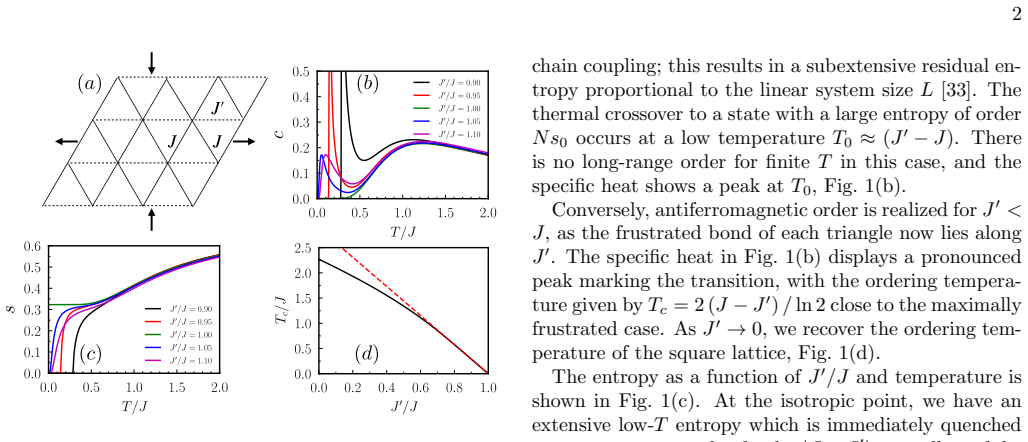
Uniaxial strain tunes Ising models on triangular lattices through classical spin-liquid phases where the elastic Grüneisen ratio diverges at low temperature.
A machine-rendered reading of the paper's core claim, the machinery that carries it, and where it could break.
Core claim
In Ising models on spatially anisotropic triangular lattices, uniaxial strain acts as a control parameter that drives the system into and out of classical spin-liquid regimes; at the strain value of maximal frustration the elastic Grüneisen ratio becomes arbitrarily large as temperature approaches zero, serving as a universal hallmark of extensive ground-state entropy.
What carries the argument
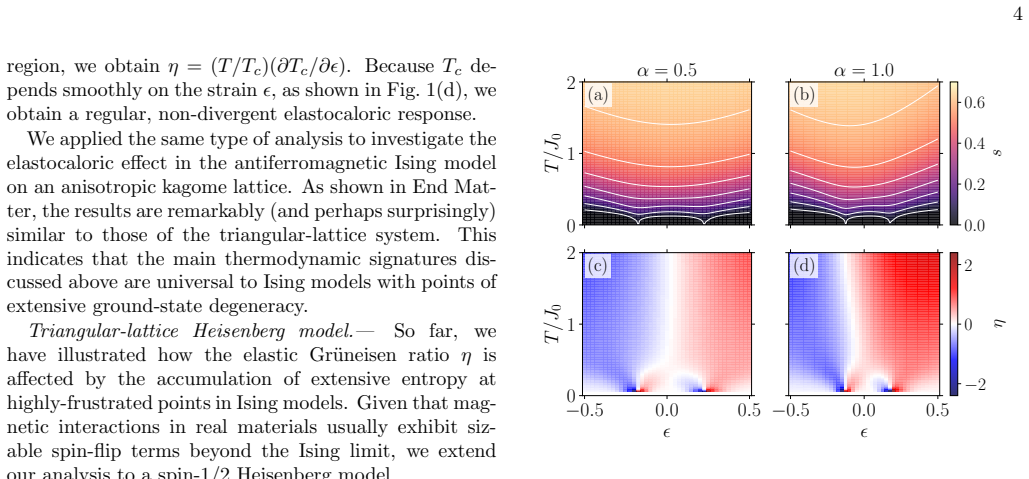
The elastic Grüneisen ratio η extracted from the strain derivative of the magnetic entropy, which amplifies the thermodynamic response precisely where ground-state degeneracy is highest.
If this is right
- Ising models on triangular lattices can be strain-tuned into classical spin-liquid phases with extensive degeneracy.
- The elastic Grüneisen ratio diverges at low temperature exactly at the point of maximal frustration.
- In the spin-1/2 Heisenberg model the low-temperature ratio is instead dominated by zero-temperature phase transitions.
- The ratio can be used to map out the strain-temperature phase diagram of frustrated magnets.
Where Pith is reading between the lines
- The same strain-response signature could be searched for in other lattices known to host extensive degeneracy, such as kagome or pyrochlore Ising systems.
- If the divergence survives in real materials it would provide a practical experimental route to locate classical spin liquids without requiring direct entropy measurements.
- Quantum corrections in the Heisenberg case suggest that any divergence would be cut off at the lowest temperatures, offering a way to separate classical and quantum frustration scales.
Load-bearing premise
Uniaxial strain only rescales the exchange anisotropy in the minimal lattice models and does not introduce disorder or additional interactions.
What would settle it
A measurement on a triangular-lattice Ising-like material showing that the elastic Grüneisen ratio remains bounded rather than diverging as temperature is lowered at the strain value predicted to produce maximal frustration.
Figures



read the original abstract
Motivated by experimental progress in pressure and strain tuning of quantum materials, we examine the thermodynamic response of frustrated magnets to uniaxial strain. Specifically, we study Ising and Heisenberg models on spatially anisotropic triangular (and, for the Ising model, also kagome) lattices. We determine the entropy as a function of temperature and strain, and use it to compute the elastic Gr\"uneisen ratio $\eta$. The Ising models can be strain-tuned into and out of classical spin-liquid phases, and we show that $\eta$ can become arbitrarily large at low temperature $T$ near the point of maximal frustration, a universal hallmark of an extensive ground-state entropy. In contrast, the spin-$1/2$ Heisenberg model is moderately frustrated and displays multiple $T=0$ phase transitions. These transitions dominate $\eta$ at low $T$ while the intermediate-$T$ behavior is similar to that of the Ising model. We discuss the extent to which the elastic Gr\"uneisen ratio can be used to deduce the phase diagram, and we connect our results to recent experiments on triangular-lattice magnets.
Editorial analysis
A structured set of objections, weighed in public.
Referee Report
Summary. The manuscript examines the elastocaloric response of frustrated magnets to uniaxial strain by computing the entropy S(T, strain) for Ising and Heisenberg models on anisotropic triangular lattices (and kagome for Ising). From this, the elastic Grüneisen ratio η is obtained. The central results are that Ising models can be strain-tuned through classical spin-liquid regimes where η diverges arbitrarily at low T near maximal frustration (signaling extensive ground-state degeneracy), while the spin-1/2 Heisenberg model shows multiple T=0 transitions that dominate low-T η, with intermediate-T behavior resembling the Ising case. The work connects these findings to experiments on triangular-lattice materials.
Significance. If the central claims hold, the elastic Grüneisen ratio provides a direct, experimentally accessible probe of extensive ground-state entropy and the location of maximal frustration points without requiring fitted parameters beyond the minimal lattice models. The explicit demonstration that η can become arbitrarily large for Ising cases near degeneracy points is a clear, falsifiable signature that distinguishes classical spin liquids from conventional ordered or gapped phases. This strengthens the link between strain tuning and thermodynamic diagnostics in quantum materials.
major comments (2)
- [Section 2] Section 2 (model definitions): The Hamiltonian incorporates strain solely via the nearest-neighbor exchange ratio J1/J2. No estimate or bound is provided on the magnitude of strain-induced magnetoelastic couplings, next-nearest-neighbor terms, or weak disorder that would generically lift the degeneracy at a finite energy scale. Because the claimed arbitrary divergence of η at low T rests on the persistence of extensive entropy down to T→0, any such perturbation would impose a cutoff; this assumption is therefore load-bearing for the universal hallmark result.
- [§3 or §4] Entropy computation and low-T limit (likely §3 or §4): The abstract states that η becomes arbitrarily large near maximal frustration for the Ising models. However, without explicit details on the numerical method (exact enumeration, Monte Carlo, or transfer-matrix), system sizes, and extrapolation procedure, it is unclear whether the reported divergence survives finite-size effects or is an artifact of the chosen strain path. A concrete check—e.g., showing η(T) for several lattice sizes approaching the degeneracy point—would be required to substantiate the claim.
minor comments (2)
- [Figures] Figure captions and axis labels should explicitly state the lattice sizes and boundary conditions used for the entropy data.
- [Introduction] Notation for the elastic Grüneisen ratio η should be cross-checked against standard definitions in the elastocaloric literature to avoid confusion with magnetic Grüneisen ratios.
Simulated Author's Rebuttal
We thank the referee for the careful reading of our manuscript and the constructive comments. We address the major comments point by point below.
read point-by-point responses
-
Referee: [Section 2] Section 2 (model definitions): The Hamiltonian incorporates strain solely via the nearest-neighbor exchange ratio J1/J2. No estimate or bound is provided on the magnitude of strain-induced magnetoelastic couplings, next-nearest-neighbor terms, or weak disorder that would generically lift the degeneracy at a finite energy scale. Because the claimed arbitrary divergence of η at low T rests on the persistence of extensive entropy down to T→0, any such perturbation would impose a cutoff; this assumption is therefore load-bearing for the universal hallmark result.
Authors: Our model is intentionally minimal to isolate the effect of uniaxial strain on the frustration ratio J1/J2. We agree that additional magnetoelastic couplings, further-neighbor exchanges, or weak disorder could lift the degeneracy at a finite energy scale in real materials and thereby impose a low-T cutoff. The reported divergence of η is a signature of the ideal case and would be observable in an intermediate temperature regime above any such cutoff. We will add a paragraph in the revised manuscript discussing these perturbations and their expected influence on the low-temperature elastocaloric response. revision: yes
-
Referee: [§3 or §4] Entropy computation and low-T limit (likely §3 or §4): The abstract states that η becomes arbitrarily large near maximal frustration for the Ising models. However, without explicit details on the numerical method (exact enumeration, Monte Carlo, or transfer-matrix), system sizes, and extrapolation procedure, it is unclear whether the reported divergence survives finite-size effects or is an artifact of the chosen strain path. A concrete check—e.g., showing η(T) for several lattice sizes approaching the degeneracy point—would be required to substantiate the claim.
Authors: We apologize for the omission of computational details in the original submission. In the revised manuscript we will add an explicit description of the numerical methods used to obtain S(T, strain), the lattice sizes employed, and the finite-size extrapolation procedure. We will also include supplementary figures showing η(T) for multiple system sizes near the maximal-frustration point to demonstrate that the divergence is robust against finite-size effects. revision: yes
Circularity Check
No significant circularity; results follow from direct thermodynamic computation on explicitly defined models
full rationale
The paper defines minimal Ising and Heisenberg Hamiltonians on anisotropic triangular and kagome lattices, with uniaxial strain entering solely as a tunable ratio of nearest-neighbor exchanges J1/J2. Entropy S(T, strain) is computed directly from these models (via exact enumeration or Monte Carlo for Ising cases, and likely numerical methods for Heisenberg), after which the elastic Grüneisen ratio η is obtained as a thermodynamic derivative. The reported divergence of η at low T near maximal frustration is a direct consequence of the model's extensive ground-state degeneracy at that strain value, not a fitted parameter, self-citation, or redefinition. No load-bearing self-citations, ansatz smuggling, or renaming of known results appear in the derivation chain; the central claim is a model prediction that can be independently verified or falsified by other methods.
Axiom & Free-Parameter Ledger
free parameters (1)
- strain-dependent anisotropy parameter
axioms (2)
- domain assumption The lattice models (Ising/Heisenberg on anisotropic triangular/kagome) capture the essential physics of the real materials under strain.
- standard math Entropy can be computed accurately from the partition function of the finite-size or mean-field versions of these models.
Lean theorems connected to this paper
-
IndisputableMonolith/Cost/FunctionalEquation.leanwashburn_uniqueness_aczel unclear?
unclearRelation between the paper passage and the cited Recognition theorem.
We determine the entropy as a function of temperature and strain, and use it to compute the elastic Grüneisen ratio η. The Ising models can be strain-tuned into and out of classical spin-liquid phases, and we show that η can become arbitrarily large at low temperature T near the point of maximal frustration
-
IndisputableMonolith/Foundation/AlexanderDuality.leanalexander_duality_circle_linking unclear?
unclearRelation between the paper passage and the cited Recognition theorem.
Hamiltonian H = J ∑⟨ij⟩ σiσj + J' ∑⟨ij⟩' σiσj with strain entering only through nearest-neighbor exchange ratios
What do these tags mean?
- matches
- The paper's claim is directly supported by a theorem in the formal canon.
- supports
- The theorem supports part of the paper's argument, but the paper may add assumptions or extra steps.
- extends
- The paper goes beyond the formal theorem; the theorem is a base layer rather than the whole result.
- uses
- The paper appears to rely on the theorem as machinery.
- contradicts
- The paper's claim conflicts with a theorem or certificate in the canon.
- unclear
- Pith found a possible connection, but the passage is too broad, indirect, or ambiguous to say the theorem truly supports the claim.
Reference graph
Works this paper leans on
-
[1]
C. W. Hicks, F. Jerzembeck, H. M. L. Noad, M. E. Bar- ber, and A. P. Mackenzie, Annu. Rev. Condens. Matter Phys.16, 417 (2025)
work page 2025
-
[2]
E. Gati, B. Schmidt, S. L. Bud’ko, A. P. Mackenzie, and P. C. Canfield, npj Quantum Mater.8, 69 (2023)
work page 2023
-
[3]
M. P. Zic, M. S. Ikeda, P. Massat, P. M. Hollister, L. Ye, E. W. Rosenberg, J. A. W. Straquadine, Y. Li, B. J. Ramshaw, and I. R. Fisher, Proc. Natl. Acad. Sci. U.S.A. 121, e2320052121 (2024)
work page 2024
-
[4]
S. Nath Panja, A. Jesche, N. Tang, and P. Gegenwart, Phys. Rev. B109, 205152 (2024)
work page 2024
-
[5]
A. Steppke, L. Zhao, M. E. Barber, T. Scaffidi, F. Jerzembeck, H. Rosner, A. S. Gibbs, Y Maeno, S. H. Simon, A. P. Mackenzie, and C. W. Hicks, Science355, eaaf9398 (2017)
work page 2017
- [6]
-
[7]
Y.-S. Li, M. Garst, J. Schmalian, S. Ghosh, N. Kikugawa, D. A. Sokolov, C. W. Hicks, F. Jerzembeck, M. S. Ikeda, Z. Hu, B. J. Ramshaw, A. W. Rost, M. Nicklas, and A. P. Mackenzie, Nature607, 276 (2022)
work page 2022
- [8]
-
[9]
M. S. Ikeda, T. Worasaran, E. W. Rosenberg, J. C. Palm- strom, S. A. Kivelson, and I. R. Fisher, Proc. Natl. Acad. Sci. U.S.A.118, e2105911118 (2021)
work page 2021
-
[10]
A. Chakraborty, R. G. Hern´ andez, L. ˇSmejkal, and J. Sinova, Phys. Rev. B109, 144421 (2024)
work page 2024
-
[11]
K. Takahashi, C. R. W. Steward, M. Ogata, R. M. Fer- nandes, J. Schmalian Phys. Rev. B111, 184408 (2025)
work page 2025
-
[12]
R. Ohlendorf, L. Buiarelli, H. M. L. Noad, A. P. Macken- zie, R. M. Fernandes, T. Birol, J. Schmalian, and E. Gati, arXiv:2601.19343
-
[13]
F. Lieberich, Y. Saito, Y. Agarmani, T. Sasaki, N. Yoneyama, S. M. Winter, M. Lang, and E. Gati, Sci. Adv.11, eadz0699 (2025)
work page 2025
-
[14]
C. Lacroix, P. Mendels, and F. Mila,Introduction to Frustrated Magnetism: Materials, Experiments, Theory, Springer Series in Solid-State Sciences (Springer Berlin Heidelberg, 2011)
work page 2011
-
[15]
C. Castelnovo, R. Moessner, and S. Sondhi, Annu. Rev. Condens. Matter Phys.3, 35 (2012)
work page 2012
-
[16]
O. A. Starykh, Rep. Prog. Phys.78, 052502 (2015)
work page 2015
- [17]
- [18]
- [19]
-
[20]
B. J. Powell and R. H. McKenzie, Rep. Prog. Phys.74 056501 (2011)
work page 2011
- [21]
- [22]
- [23]
- [24]
-
[25]
M. G. Gonzalez, E. A. Ghioldi, C. J. Gazza, L. O. Manuel, and A. E. Trumper, Phys. Rev. B102, 224410 (2020)
work page 2020
-
[26]
M. G. Gonzalez, B. Bernu, L. Pierre, and L. Messio, Sci- Post Phys.12, 112 (2022)
work page 2022
-
[27]
M. S. Ikeda, J. A. W. Straquadine, A. T. Hristov, T. Worasaran, J. C. Palmstrom, M. Sorensen, P. Walmsley, and I. R. Fisher, Rev. Sci. Instrum.90, 083902 (2019)
work page 2019
-
[28]
L. Zhu, M. Garst, A. Rosch, and Q. Si, Phys. Rev. Lett. 91, 066404 (2003)
work page 2003
-
[29]
R. J. Baxter,Exactly Solved Models in Statistical Me- chanics, Dover books on physics (Dover Publications, 6 2007)
work page 2007
-
[30]
R. M. F. Houtappel, Physica16, 425 (1950)
work page 1950
-
[31]
G. H. Wannier, Phys. Rev.79, 357 (1950)
work page 1950
- [32]
- [33]
-
[34]
R. M. Ribeiro, V. M. Pereira, N. M. R. Peres, P. R. Briddon, and A. H. Castro Neto, New J. Phys.11, 115002 (2009)
work page 2009
- [35]
-
[36]
L. Bartosch, M. de Souza, and M. Lang, Phys. Rev. Lett. 104, 245701 (2010)
work page 2010
-
[37]
P. C. Hohenberg, Phys. Rev.158, 383 (1967)
work page 1967
-
[38]
N. D. Mermin and H. Wagner, Phys. Rev. Lett.17, 1133 (1966)
work page 1966
- [39]
-
[40]
We also performed ED calculations for rhombic clusters with dimensions 4×4 and 3×6. The latter differs from the 6×3 cluster discussed in the main text in that it has sixJ′ chains of length three. The results for these clusters agree semiquantitatively at elevated temperatures,T /J 0 ≳0.5, but show qualitative differences at lowT. These are due to the inco...
- [41]
-
[42]
M. E. Zayed, C. R¨ uegg, J. Larrea J., A. M. L¨ auchli, C. Panagopoulos, S. S. Saxena, M. Ellerby, D. F. McMor- row, Th. Str¨ assle, S. Klotz, G. Hamel, R. A. Sadykov, V. Pomjakushin, M. Boehm, M. Jim´ enez-Ruiz, A. Schnei- dewind, E. Pomjakushina, M. Stingaciu, K. Conder, and H. M. Rønnow, Nat. Phys.13, 962 (2017)
work page 2017
-
[43]
Z. Shi, S. Dissanayake, P. Corboz, W. Steinhardt, D. Graf, D. M. Silevitch, H. A. Dabkowska, T. F. Rosen- baum, F. Mila, and S. Haravifard, Nat. Commun.13, 2301 (2022)
work page 2022
-
[44]
C. Balz, B. Lake, J. Reuther, H. Luetkens, R. Schone- mann, T. Herrmannsdorfer, Y. Singh, A. T. M. Nazmul Islam, E. M. Wheeler, J. A. Rodriguez-Rivera, T. Guidi, G. G. Simeoni, C. Baines, and H. Ryll, Nat. Phys.12, 942 (2016)
work page 2016
-
[45]
C. Balz, B. Lake, A. T. M. N. Islam, Y. Singh, J. A. Rodriguez-Rivera, T. Guidi, E. M. Wheeler, G. G. Sime- oni, and H. Ryll, Phys. Rev. B95, 174414 (2017)
work page 2017
-
[46]
J. Sonnenschein, C. Balz, U. Tutsch, M. Lang, H. Ryll, J. A. Rodriguez-Rivera, A. T. M. N. Islam, B. Lake, and J. Reuther, Phys. Rev. B100, 174428 (2019)
work page 2019
-
[47]
S. Chillal, Y. Iqbal, H. O. Jeschke, J. A. Rodriguez- Rivera, R. Bewley, P. Manuel, D. Khalyavin, P. Steffens, R. Thomale, A. T. M. N. Islam, J. Reuther, and B. Lake, Nat. Commun.11, 2348 (2020)
work page 2020
-
[48]
A. R. N. Hanna, A. T. M. N. Islam, R. Feyerherm, K. Siemensmeyer, K. Karmakar, S. Chillal, and B. Lake, Phys. Rev. Materials5, 113401 (2021)
work page 2021
-
[49]
W. Li, S-S. Gong, Y. Zhao, S-J. Ran, S. Gao, and G. Su, Phys. Rev. B82, 134434 (2010)
work page 2010
-
[50]
H. T. Diep,Frustrated Spin Systems, World Scientific (Singapore, 2004)
work page 2004
-
[51]
K. Kanˆ o and S. Naya, Prog. Theor. Phys.10, 158 (1953). END MA TTER Kagome-lattice Ising model.—We illustrate the gen- erality of the results for the classical model, also studying the anisotropic Ising model in Eq. (1) in the kagome lat- tice with a similar setup as in Fig. 1(a). The free energy in this case reads [49–51] f= −T 24π2 Z 2π 0 dω1 Z 2π 0 dω...
work page 1953
discussion (0)
Sign in with ORCID, Apple, or X to comment. Anyone can read and Pith papers without signing in.