Time-Varying Deep State Space Models for Sequences with Switching Dynamics
Pith reviewed 2026-05-19 16:12 UTC · model grok-4.3
The pith
Time-varying deep state space models learn switching dynamics via a dictionary of time-evolving basis functions and outperform time-invariant models on synthetic and audio tasks.
A machine-rendered reading of the paper's core claim, the machinery that carries it, and where it could break.
Core claim
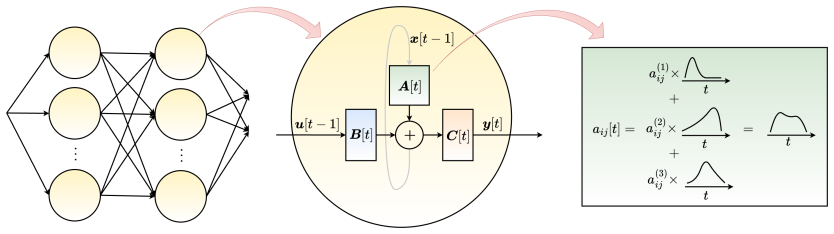
We propose a class of time-varying state-space model based neural networks in which the neurons' states are governed by time-varying dynamics. The proposed model provides the learnable time-varying dynamics through a dictionary of basis functions, where each basis function evolves differently over time. We evaluate the proposed approach on both synthetic data from switching systems and a speech denoising task where real audio is corrupted with switching dynamics noise. The results show that the proposed time-varying model consistently outperforms its time-invariant counterparts while maintaining comparable computational complexity.
What carries the argument
Dictionary of basis functions supplying learnable time-varying dynamics to neuron states in a state-space model, with each basis evolving differently over time.
If this is right
- Time-varying dynamics in sequences can be captured without explicit switch-detection components.
- The additional modeling freedom from time-varying basis functions should be allocated across specific model components to maximize gains.
- Larger time-invariant models have limited ability to compensate for the absence of time variation.
- Which aspects of the data's time-varying dynamics most require explicit capture can be identified through targeted experiments.
Where Pith is reading between the lines
- The same basis-function approach might apply directly to regime-switching problems in control or finance without custom detectors.
- If the dictionary size can be kept small, the method could support real-time adaptation on resource-limited hardware.
- Comparing performance when the basis functions are allowed to interact versus kept independent would test how much of the gain comes from independent evolution.
Load-bearing premise
The time-varying dynamics present in the target sequences can be adequately represented and learned through a fixed dictionary of basis functions without requiring additional mechanisms for detecting or modeling the switches explicitly.
What would settle it
A new switching-dynamics dataset on which the time-varying model shows no accuracy gain over a comparable time-invariant model, or requires substantially higher compute to match performance, would falsify the claimed advantage.
Figures


read the original abstract
The identification and modeling of time-varying systems is a fundamental challenge in signal processing and system identification. To address this challenge, we propose a class of time-varying state-space model (SSM) based neural networks in which the neurons' states are governed by time-varying dynamics. The proposed model provides the learnable time-varying dynamics through a dictionary of basis functions, where each basis function evolves differently over time. We evaluate the proposed approach on both synthetic data from switching systems and a speech denoising task where real audio is corrupted with switching dynamics noise. The results show that the proposed time-varying model consistently outperforms its time-invariant counterparts while maintaining comparable computational complexity. Our investigations also reveal which aspects of the time-varying dynamics of the data most need to be captured by the proposed time-invariant models, how the additional freedom provided by time-varying basis functions should be allocated across model components, and to what extent larger models can compensate for time-invariant limitations.
Editorial analysis
A structured set of objections, weighed in public.
Referee Report
Summary. The paper proposes a class of time-varying deep state-space models (SSMs) for sequences exhibiting switching dynamics. The core innovation is a dictionary of basis functions that endow the SSM neurons with learnable, time-varying dynamics in which each basis evolves differently over time. The model is evaluated on synthetic switching linear systems and on a speech-denoising task in which real audio is corrupted by noise whose dynamics switch between regimes; the authors report that the time-varying variant consistently outperforms its time-invariant counterparts while preserving comparable computational cost. Additional analyses examine which components of the dynamics most benefit from time variation, how the extra degrees of freedom should be allocated, and whether larger time-invariant models can compensate for the lack of explicit time variation.
Significance. If the empirical claims are substantiated, the work supplies a practical, parameter-efficient route to modeling abrupt regime changes in sequential data without an explicit switch detector or mode-selection mechanism. The basis-function construction is attractive because it keeps the state-transition structure intact while injecting time dependence only where needed. The accompanying investigations into component-wise allocation of time variation and the capacity-compensation question are useful for practitioners designing SSMs for non-stationary signals.
major comments (2)
- [Experiments on synthetic switching systems] The central empirical claim—that performance gains on switching tasks arise from the basis-function time variation rather than from the mere addition of free parameters—is load-bearing. The skeptic note correctly flags that a fixed, smooth dictionary may only approximate abrupt mode changes at the cost of extra capacity. The manuscript must therefore demonstrate, in the synthetic-experiment section, that the learned bases actually exhibit the rapid transitions required by the ground-truth switches (e.g., via plots of basis trajectories or an ablation that fixes the number of bases while varying their smoothness). Without such evidence the attribution of outperformance remains ambiguous.
- [Complexity analysis] The abstract states that the time-varying model “maintains comparable computational complexity,” yet the only free parameters listed are the basis-function coefficients and their evolution parameters. If the dictionary size or the order of the bases must grow with the number of switches to achieve the reported gains, the complexity claim is undermined. The complexity analysis (likely in §3 or the appendix) should quantify FLOPs or parameter count as a function of dictionary size and compare it directly to the time-invariant baseline under identical hidden-state dimension.
minor comments (2)
- [Model definition] Notation for the time-varying transition matrix A(t) is introduced without an explicit equation number; adding a numbered display equation would improve traceability when the basis expansion is later substituted.
- [Real-audio experiments] The speech-denoising task description would benefit from a short table listing the SNR ranges and the exact switching schedule of the noise process, allowing readers to judge how abrupt the regime changes actually are.
Simulated Author's Rebuttal
We thank the referee for the constructive feedback and for identifying key areas where additional evidence would strengthen the manuscript. We address each major comment below and describe the revisions we will implement.
read point-by-point responses
-
Referee: [Experiments on synthetic switching systems] The manuscript must demonstrate, in the synthetic-experiment section, that the learned bases actually exhibit the rapid transitions required by the ground-truth switches (e.g., via plots of basis trajectories or an ablation that fixes the number of bases while varying their smoothness). Without such evidence the attribution of outperformance remains ambiguous.
Authors: We agree that direct evidence of the bases capturing abrupt transitions is necessary to attribute gains specifically to time variation rather than capacity. In the revised manuscript we will add plots of the learned basis trajectories over time in the synthetic switching experiments, showing their adaptation to the ground-truth regime changes. We will also include an ablation that holds dictionary size fixed while varying basis smoothness (via regularization on second differences) to isolate the benefit of flexible, rapid transitions. revision: yes
-
Referee: [Complexity analysis] The complexity analysis (likely in §3 or the appendix) should quantify FLOPs or parameter count as a function of dictionary size and compare it directly to the time-invariant baseline under identical hidden-state dimension.
Authors: We acknowledge that the current complexity discussion is insufficiently quantitative. In the revision we will expand the analysis in Section 3 and the appendix with explicit tables reporting parameter counts and approximate FLOPs for the time-varying model across a range of dictionary sizes, placed side-by-side with the time-invariant baseline at matched hidden-state dimension. This will demonstrate that the overhead remains modest and does not grow prohibitively with the number of switches. revision: yes
Circularity Check
No circularity: empirical evaluation of proposed time-varying SSM
full rationale
The paper proposes a neural network SSM with time-varying dynamics via a fixed dictionary of basis functions and reports empirical outperformance on synthetic switching data and speech denoising. No derivation chain, prediction, or uniqueness claim is presented that reduces by construction to fitted inputs or self-citations. The central results rest on experimental comparisons whose quantities are not defined in terms of the training objective itself. This is the expected non-finding for an empirical modeling paper.
Axiom & Free-Parameter Ledger
free parameters (1)
- basis function coefficients and evolution parameters
axioms (1)
- domain assumption Time-varying dynamics in the target sequences can be represented as a linear combination of basis functions each evolving independently over time.
Lean theorems connected to this paper
-
IndisputableMonolith/Cost/FunctionalEquation.leanwashburn_uniqueness_aczel unclear?
unclearRelation between the paper passage and the cited Recognition theorem.
each element of these matrices is now a linear combination of basis functions... [A[t]]ij = sum_{k=1}^{KA} a^{(k)}_{i,j} ϕ^{(k)}_{A,i,j}[t]
-
IndisputableMonolith/Foundation/AlphaCoordinateFixation.leancostAlphaLog_high_calibrated_iff unclear?
unclearRelation between the paper passage and the cited Recognition theorem.
dictionary of Gaussian functions and an additional constant function
What do these tags mean?
- matches
- The paper's claim is directly supported by a theorem in the formal canon.
- supports
- The theorem supports part of the paper's argument, but the paper may add assumptions or extra steps.
- extends
- The paper goes beyond the formal theorem; the theorem is a base layer rather than the whole result.
- uses
- The paper appears to rely on the theorem as machinery.
- contradicts
- The paper's claim conflicts with a theorem or certificate in the canon.
- unclear
- Pith found a possible connection, but the passage is too broad, indirect, or ambiguous to say the theorem truly supports the claim.
Reference graph
Works this paper leans on
-
[1]
Jeyasothy, Abeegithan and Sundaram, Suresh and Sundararajan, Narasimhan , journal=. SEFRON: A New Spiking Neuron Model With Time-Varying Synaptic Efficacy Function for Pattern Classification , year=
- [2]
-
[3]
Deep explicit duration switching models for time series , author=. NeurIPS , volume=
-
[4]
Switching dynamical systems with deep neural networks , author=. ICPR , pages=. 2020 , organization=
work page 2020
- [5]
-
[6]
Abeegithan Jeyasothy and Savitha Ramasamy and Suresh Sundaram , keywords =. A gradient descent algorithm for SNN with time-varying weights for reliable multiclass interpretation , journal =. 2024 , issn =
work page 2024
-
[7]
Collapsed amortized variational inference for switching nonlinear dynamical systems , author=. ICML , pages=. 2020 , organization=
work page 2020
-
[8]
Data Mining and Knowledge Discovery , volume=
ClaSP: parameter-free time series segmentation , author=. Data Mining and Knowledge Discovery , volume=. 2023 , publisher=
work page 2023
-
[9]
Fox, Emily and Sudderth, Erik B. and Jordan, Michael I. and Willsky, Alan S. , journal=. Bayesian Nonparametric Inference of Switching Dynamic Linear Models , year=
- [10]
-
[11]
He, Mingjian AND Das, Proloy AND Hotan, Gladia AND Purdon, Patrick L. , journal =. Switching state-space modeling of neural signal dynamics , year =
-
[12]
Icassp 2023 deep noise suppression challenge , author=. IEEE Open J. of Signal Processing , volume=. 2024 , publisher=
work page 2023
-
[13]
2018 IEEE 20th international workshop on multimedia signal processing (MMSP) , pages=
A hybrid DSP/deep learning approach to real-time full-band speech enhancement , author=. 2018 IEEE 20th international workshop on multimedia signal processing (MMSP) , pages=. 2018 , organization=
work page 2018
-
[14]
Radial basis functions , volume=. Acta Numerica , author=. 2000 , pages=
work page 2000
- [15]
-
[16]
Nature Communications , author =
The neurobench framework for benchmarking neuromorphic computing algorithms and systems , volume =. Nature Communications , author =. 2025 , pages =
work page 2025
-
[17]
NeuroBench: A Framework for Benchmarking Neuromorphic Computing Algorithms and Systems , author=. Nature Communications , issn=. 2025 , volume=
work page 2025
-
[18]
Non-stationary Transformers: Exploring the Stationarity in Time Series Forecasting , author=. 2022 , booktitle=
work page 2022
-
[19]
Roux, Jonathan Le and Wisdom, Scott and Erdogan, Hakan and Hershey, John R. , booktitle=. 2019 , volume=
work page 2019
- [20]
- [21]
-
[22]
Learning and Inferring Motion Patterns using Parametric Segmental Switching Linear Dynamic Systems , author=. Int. J. of Computer Vision , volume=
-
[23]
Bayesian Inference in Recurrent Explicit Duration Switching Linear Dynamical Systems , author =. Inter. Conf. on Artificial Intelligence and Statistics , pages =. 2025 , editor =
work page 2025
-
[24]
Gupta, Ankit and Gu, Albert and Berant, Jonathan , title =. NeurIPS , articleno =. 2022 , isbn =
work page 2022
-
[25]
Efficiently Modeling Long Sequences with Structured State Spaces , author=. 2022 , booktitle=
work page 2022
-
[26]
On the parameterization and initialization of diagonal state space models , author=. NeurIPS , volume=
-
[27]
Modelling and Identification with Rational Orthogonal Basis Functions , journal =
Paul. Modelling and Identification with Rational Orthogonal Basis Functions , journal =. 2000 , note =
work page 2000
-
[28]
Fuzzy basis functions, universal approximation, and orthogonal least-squares learning , author=. IEEE Trans. on Neural Networks , volume=
-
[29]
arXiv preprint arXiv:2503.11627 , year=
Are Deep Speech Denoising Models Robust to Adversarial Noise? , author=. arXiv preprint arXiv:2503.11627 , year=
-
[30]
Neuromorphic Computing and Engineering , volume=
The Intel neuromorphic DNS challenge , author=. Neuromorphic Computing and Engineering , volume=. 2023 , publisher=
work page 2023
-
[31]
ICASSP 2023 Deep Noise Suppression Challenge , author=. ICASSP , year=
work page 2023
-
[32]
Linear State-Space Model with Time-Varying Dynamics
Luttinen, Jaakko and Raiko, Tapani and Ilin, Alexander. Linear State-Space Model with Time-Varying Dynamics. Machine Learning and Knowledge Discovery in Databases. 2014
work page 2014
-
[33]
DynaNet: Neural Kalman Dynamical Model for Motion Estimation and Prediction , year=
Chen, Changhao and Lu, Chris Xiaoxuan and Wang, Bing and Trigoni, Niki and Markham, Andrew , journal=. DynaNet: Neural Kalman Dynamical Model for Motion Estimation and Prediction , year=
-
[34]
Dynamic Neural Network Models for Time-Varying Problem Solving: A Survey on Model Structures , year=
Hua, Cheng and Cao, Xinwei and Xu, Qian and Liao, Bolin and Li, Shuai , journal=. Dynamic Neural Network Models for Time-Varying Problem Solving: A Survey on Model Structures , year=
-
[35]
DeepTVAR: Deep learning for a time-varying VAR model with extension to integrated VAR , journal =
Xixi Li and Jingsong Yuan , keywords =. DeepTVAR: Deep learning for a time-varying VAR model with extension to integrated VAR , journal =. 2024 , issn =
work page 2024
-
[36]
Xiuqin Xu and Hanqiu Peng and Ying Chen , keywords =. Deep switching state space model for nonlinear time series forecasting with regime switching , journal =. 2025 , issn =
work page 2025
-
[37]
Tsatsanis, M.K. and Giannakis, G.B. , journal=. Time-varying system identification and model validation using wavelets , year=
-
[38]
The Thirty-eighth Annual Conference on Neural Information Processing Systems , year=
Frequency Adaptive Normalization For Non-stationary Time Series Forecasting , author=. The Thirty-eighth Annual Conference on Neural Information Processing Systems , year=
-
[39]
Inference of Neural Dynamics Using Switching Recurrent Neural Networks , author=. NeurIPS , year=
-
[40]
WHAM!: Extending Speech Separation to Noisy Environments
Wham!: Extending speech separation to noisy environments , author=. arXiv:1907.01160 , year=
work page internal anchor Pith review Pith/arXiv arXiv 1907
-
[41]
Subakan, Cem and Ravanelli, Mirco and Cornell, Samuele and Grondin, Fran. ICASSP , pages=. 2022 , organization=
work page 2022
-
[42]
Switched linear systems: control and design , author=. 2005 , publisher=
work page 2005
-
[43]
Zou, Rui and Wang, Hengliang and Chon, Ki H. , journal=. A Robust Time-Varying Identification Algorithm Using Basis Functions , year=
-
[44]
Niedzwiecki, M. , journal=. Functional series modeling approach to identification of nonstationary stochastic systems , year=
-
[45]
System Identification: Theory for the user , author=. 1987 , publisher=
work page 1987
- [46]
-
[47]
Kalman, R. E. , title =. J. of the Society for Industrial and Applied Mathematics Series A Control , volume =
-
[48]
Kotsalis, G. and Megretski, A. and Dahleh, M.A. , booktitle=. Model reduction of discrete-time Markov jump linear systems , year=
-
[49]
Realization theory of stochastic jump-Markov linear systems , year=
Petreczky, Mihaly and Vidal, Rene , booktitle=. Realization theory of stochastic jump-Markov linear systems , year=
-
[50]
Ghahramani, Zoubin and Hinton, Geoffrey E. , journal=. Variational Learning for Switching State-Space Models , year=
-
[51]
Mamba: Linear-Time Sequence Modeling with Selective State Spaces , author=. 2024 , booktitle =
work page 2024
-
[52]
Hippo: Recurrent memory with optimal polynomial projections , author=. NeurIPS , volume=
-
[53]
Schön and Lennart Ljung , keywords =
Daniel Gedon and Niklas Wahlström and Thomas B. Schön and Lennart Ljung , keywords =. Deep State Space Models for Nonlinear System Identification , journal =. 2021 , note =
work page 2021
-
[54]
Lennart Ljung and Carl Andersson and Koen Tiels and Thomas B. Schön , keywords =. Deep Learning and System Identification , journal =. 2020 , note =
work page 2020
discussion (0)
Sign in with ORCID, Apple, or X to comment. Anyone can read and Pith papers without signing in.