PRB-RUPFormer: A Recursive Unified Probabilistic Transformer for Residual PRB Forecasting
Pith reviewed 2026-05-19 16:44 UTC · model grok-4.3
pith:UHFUBLEU Add to your LaTeX paper
What is a Pith Number?\usepackage{pith}
\pithnumber{UHFUBLEU}
Prints a linked pith:UHFUBLEU badge after your title and writes the identifier into PDF metadata. Compiles on arXiv with no extra files. Learn more
The pith
A single shared probabilistic Transformer trained across carriers forecasts residual PRBs with median error below 0.05 for one- and seven-day horizons.
A machine-rendered reading of the paper's core claim, the machinery that carries it, and where it could break.
Core claim
PRB-RUPFormer jointly processes multivariate KPI time series using temporal, seasonal, and carrier-aware embeddings to preserve inter-metric coupling during recursive rollout; a single shared model trained across all carriers and sectors captures joint traffic dynamics; quantile-based prediction intervals supply confidence-aware estimates of future PRB availability.
What carries the argument
The recursive unified probabilistic Transformer with temporal, seasonal, and carrier-aware embeddings that stabilize long-horizon rollout while producing quantile intervals.
If this is right
- Probabilistic forecasts enable spectrum-aware functions such as dynamic carrier activation and proactive spectrum sharing.
- Joint training across carriers reduces the need to maintain separate models for each sector.
- Uncertainty estimates support robust decisions under variable traffic for energy-efficient network operation.
- Recursive rollout with preserved temporal coupling improves stability for seven-day forecasts compared with independent per-step predictions.
Where Pith is reading between the lines
- The unified training approach could scale to larger networks by cutting per-site retraining costs.
- Quantile outputs might integrate directly into optimization routines for dynamic spectrum access.
- The embedding scheme could be adapted to other multivariate resource metrics such as power or interference levels.
Load-bearing premise
A single shared model trained across carriers and sectors can capture cross-carrier dependencies without losing local accuracy or overfitting to particular sites.
What would settle it
Testing the model on entirely new base stations or carriers outside the original training set and checking whether median MAE stays below 0.05 and hit probability stays above 0.80.
Figures
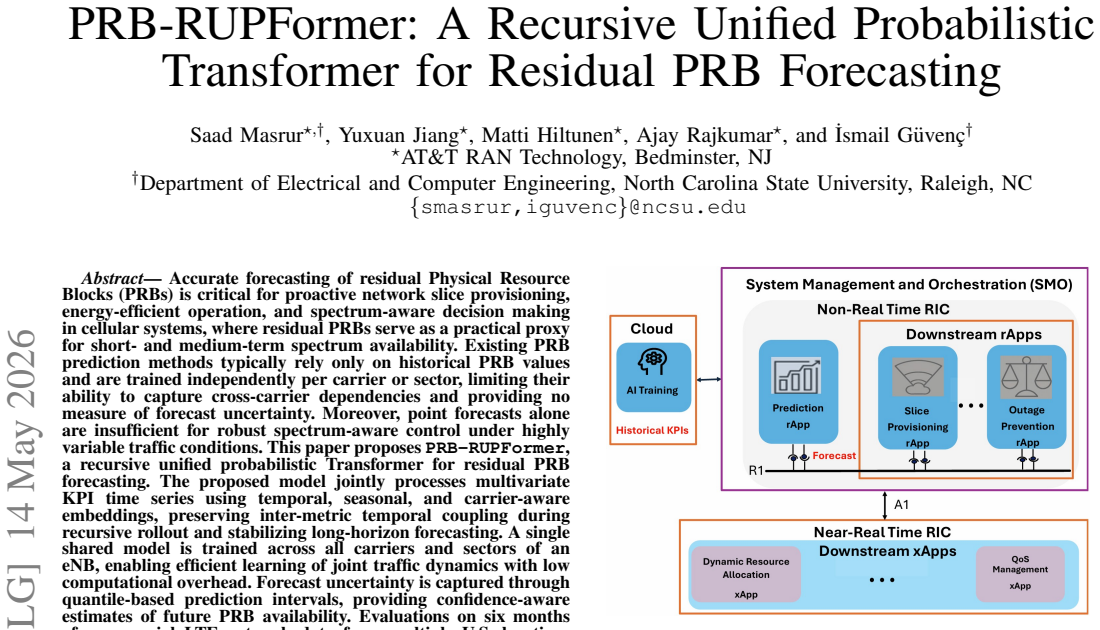


read the original abstract
Accurate forecasting of residual Physical Resource Blocks (PRBs) is critical for proactive network slice provisioning, energy-efficient operation, and spectrum-aware decision making in cellular systems, where residual PRBs serve as a practical proxy for short- and medium-term spectrum availability. Existing PRB prediction methods typically rely only on historical PRB values and are trained independently per carrier or sector, limiting their ability to capture cross-carrier dependencies and providing no measure of forecast uncertainty. Moreover, point forecasts alone are insufficient for robust spectrum-aware control under highly variable traffic conditions. This paper proposes PRB-RUPFormer, a recursive unified probabilistic Transformer for residual PRB forecasting. The proposed model jointly processes multivariate KPI time series using temporal, seasonal, and carrier-aware embeddings, preserving inter-metric temporal coupling during recursive rollout and stabilizing long-horizon forecasting. A single shared model is trained across all carriers and sectors of an eNB, enabling efficient learning of joint traffic dynamics with low computational overhead. Forecast uncertainty is captured through quantile-based prediction intervals, providing confidence-aware estimates of future PRB availability. Evaluations on six months of commercial LTE network data from multiple U.S. locations demonstrate median MAE below 0.05 and hit probabilities above 0.80 for both one-day and seven-day recursive forecasts. These probabilistic predictions directly support spectrum-aware RAN functions such as dynamic carrier activation, congestion avoidance, and proactive spectrum sharing, making the proposed framework well-suited for dynamic spectrum access scenarios.
Editorial analysis
A structured set of objections, weighed in public.
Referee Report
Summary. The paper introduces PRB-RUPFormer, a recursive unified probabilistic Transformer for residual PRB forecasting in LTE networks. It jointly processes multivariate KPI time series via temporal, seasonal, and carrier-aware embeddings within a single shared model trained across all carriers and sectors of an eNB, preserves inter-metric coupling during recursive rollout, and supplies quantile-based prediction intervals for uncertainty. On six months of commercial LTE data from multiple U.S. locations, it reports median MAE below 0.05 and hit probabilities above 0.80 for both one-day and seven-day recursive forecasts, positioning the outputs for spectrum-aware RAN control such as dynamic carrier activation and proactive spectrum sharing.
Significance. If the central claims hold after proper validation, the work could meaningfully advance practical spectrum management by delivering uncertainty-aware, cross-carrier forecasts with low overhead. The unified training strategy and recursive probabilistic design address real limitations of per-site point-forecast methods and could support more robust dynamic spectrum access, provided the reported aggregate metrics reflect genuine per-site gains rather than averaging effects.
major comments (2)
- [Evaluation section] Evaluation section: the headline median MAE < 0.05 and hit probability > 0.80 are reported only as aggregate statistics across carriers and locations, with no per-site or per-carrier breakdown and no comparison against independently trained per-site baselines. Because the central claim rests on the unified model capturing cross-carrier dependencies without site-specific overfitting or loss of local accuracy, the absence of disaggregated results leaves open the possibility that a few high-volume sites drive the medians while others degrade.
- [§3 (Model)] §3 (Model): the recursive rollout procedure is described at a high level as preserving inter-metric temporal coupling, yet no explicit mechanism, loss term, or pseudocode is given for feeding quantile outputs back into the model while maintaining probabilistic consistency over seven-day horizons. This detail is load-bearing for the stability claim.
minor comments (2)
- [Abstract] Abstract: the precise definition of 'hit probability' (e.g., coverage of a specific quantile interval) and the exact quantile levels used for the prediction intervals are not stated, making the uncertainty metric difficult to interpret or reproduce.
- [Evaluation section] The manuscript would benefit from an explicit statement of the data preprocessing steps, train/validation/test split ratios, and hyper-parameter selection procedure, which are currently omitted from the evaluation description.
Simulated Author's Rebuttal
We thank the referee for the constructive feedback. We address each major comment point by point below and have revised the manuscript accordingly to strengthen the presentation of results and model details.
read point-by-point responses
-
Referee: [Evaluation section] Evaluation section: the headline median MAE < 0.05 and hit probability > 0.80 are reported only as aggregate statistics across carriers and locations, with no per-site or per-carrier breakdown and no comparison against independently trained per-site baselines. Because the central claim rests on the unified model capturing cross-carrier dependencies without site-specific overfitting or loss of local accuracy, the absence of disaggregated results leaves open the possibility that a few high-volume sites drive the medians while others degrade.
Authors: We agree that aggregate-only reporting leaves the central claim open to the interpretation raised. In the revised Evaluation section we now include per-carrier and per-site tables of MAE and hit probability for both one-day and seven-day horizons. We have also added a direct comparison against independently trained per-site baselines. The new results show that the unified model achieves comparable or better per-site accuracy while using a single set of parameters, with no evidence that a small number of sites dominate the reported medians. revision: yes
-
Referee: [§3 (Model)] §3 (Model): the recursive rollout procedure is described at a high level as preserving inter-metric temporal coupling, yet no explicit mechanism, loss term, or pseudocode is given for feeding quantile outputs back into the model while maintaining probabilistic consistency over seven-day horizons. This detail is load-bearing for the stability claim.
Authors: We acknowledge that the original description of the recursive rollout was insufficiently detailed. In the revised §3 we now provide an explicit description of the mechanism that feeds quantile outputs back into the temporal and carrier-aware embeddings. We have added pseudocode (new Algorithm 1) that shows the exact input-construction step at each recursion and clarified the auxiliary loss terms that penalize divergence from the learned joint distribution. These additions make the procedure for preserving inter-metric coupling and probabilistic consistency over seven-day horizons fully reproducible. revision: yes
Circularity Check
No circularity: model architecture and unified training presented as independent design choices
full rationale
The abstract and available text describe PRB-RUPFormer as a Transformer using temporal/seasonal/carrier-aware embeddings, quantile intervals, and a single shared model trained across carriers/sectors. No equations, derivation steps, or self-citations are exhibited that reduce the claimed forecasts or unified performance to fitted inputs by construction, self-referential definitions, or load-bearing prior work by the same authors. The central claims rest on empirical evaluation metrics rather than a closed mathematical chain, making the derivation self-contained against external benchmarks.
Axiom & Free-Parameter Ledger
Lean theorems connected to this paper
-
IndisputableMonolith/Cost/FunctionalEquation.leanwashburn_uniqueness_aczel unclear?
unclearRelation between the paper passage and the cited Recognition theorem.
A single shared model is trained across all carriers and sectors... quantile-based prediction intervals
-
IndisputableMonolith/Foundation/ArithmeticFromLogic.leanLogicNat embedding unclear?
unclearRelation between the paper passage and the cited Recognition theorem.
temporal, seasonal, and carrier-aware embeddings
What do these tags mean?
- matches
- The paper's claim is directly supported by a theorem in the formal canon.
- supports
- The theorem supports part of the paper's argument, but the paper may add assumptions or extra steps.
- extends
- The paper goes beyond the formal theorem; the theorem is a base layer rather than the whole result.
- uses
- The paper appears to rely on the theorem as machinery.
- contradicts
- The paper's claim conflicts with a theorem or certificate in the canon.
- unclear
- Pith found a possible connection, but the passage is too broad, indirect, or ambiguous to say the theorem truly supports the claim.
Reference graph
Works this paper leans on
-
[1]
S. Bhattarai, J.-M. J. Park, B. Gao, K. Bian, and W. Lehr, “An overview of dynamic spectrum sharing: Ongoing initiatives, challenges, and a roadmap for future research,”IEEE Trans. Cognitive Commun. Netw., vol. 2, no. 2, pp. 110–128, 2016
work page 2016
-
[2]
Understand- ing O-RAN: Architecture, interfaces, algorithms, security, and research challenges,
M. Polese, L. Bonati, S. D’Oro, S. Basagni, and T. Melodia, “Understand- ing O-RAN: Architecture, interfaces, algorithms, security, and research challenges,”IEEE Commun. Surv. Tutor ., vol. 25, no. 2, pp. 1376–1411, 2023
work page 2023
-
[3]
Data-driven energy conservation in cellular networks: A systems approach,
G. Premsankar, G. Piao, P. K. Nicholson, M. Di Francesco, and D. Lu- gones, “Data-driven energy conservation in cellular networks: A systems approach,”IEEE Trans. Netw. Service Manag., vol. 18, no. 3, pp. 3567– 3582, 2021
work page 2021
-
[4]
F. Jiang, L. Liu, R. Cheng, S. Wang, J. Meng, S. Zhang, and M. Li, “Network downlink PRB utilization rate forecasting and evaluation method based on multi-feature construction,” inin Proc. IEEE Joint Int. Inf. Technol. Artif. Intell. Conf. (ITAIC), 2023, pp. 1419–1423
work page 2023
-
[5]
Downlink throughput pre- diction in LTE cellular networks using time series forecasting,
A. Mostafa, M. A. Elattar, and T. Ismail, “Downlink throughput pre- diction in LTE cellular networks using time series forecasting,” inin Proc. IEEE Int. Conf. Broadband Commun. Next Generation Networks Multimedia Appl. (CoBCom), 2022, pp. 1–4
work page 2022
-
[6]
Throughput prediction using machine learning in LTE and 5G networks,
D. Minovski, N. ¨Ogren, K. Mitra, and C. ˚Ahlund, “Throughput prediction using machine learning in LTE and 5G networks,”IEEE Trans. Mobile Comput., vol. 22, no. 3, pp. 1825–1840, 2021
work page 2021
-
[7]
RAN resource usage prediction for a 5G slice broker,
C. Gutterman, E. Grinshpun, S. Sharma, and G. Zussman, “RAN resource usage prediction for a 5G slice broker,” inin Proc. ACM Int. Symp. Mobile Ad Hoc Netw. Comput. (MobiHoc), 2019, pp. 231–240
work page 2019
-
[8]
Deep learning-based forecasting of cellular network uti- lization at millisecond resolutions,
A. M. Nagib, H. Abou-Zeid, H. S. Hassanein, A. B. Sediq, and G. Boudreau, “Deep learning-based forecasting of cellular network uti- lization at millisecond resolutions,” inin Proc. IEEE Int. Conf. Commun. (ICC), 2021, pp. 1–6
work page 2021
-
[9]
On the use of probabilistic forecasting for network analysis in Open RAN,
V . Kasuluru, L. Blanco, and E. Zeydan, “On the use of probabilistic forecasting for network analysis in Open RAN,” inin Proc. IEEE Int. Mediterranean Conf. Commun. Netw. (MeditCom), 2023, pp. 258–263
work page 2023
-
[10]
Data-driven spectrum demand prediction: A spatio- temporal framework with transfer learning,
A. Farajzadeh, H. Zheng, S. Dumoulin, T. Ha, H. Yanikomeroglu, and A. Ghasemi, “Data-driven spectrum demand prediction: A spatio- temporal framework with transfer learning,”arXiv preprint, 2025, arXiv:2508.03863
-
[11]
A. Vaswani, N. Shazeer, N. Parmar, J. Uszkoreit, L. Jones, A. N. Gomez, Ł. Kaiser, and I. Polosukhin, “Attention is all you need,” inin Proc. Adv. Neural Inf. Process. Syst. (NeurIPS), vol. 30, 2017
work page 2017
-
[12]
Sequence to sequence learning with neural networks,
I. Sutskever, O. Vinyals, and Q. V . Le, “Sequence to sequence learning with neural networks,” inin Proc. Adv. Neural Inf. Process. Syst. (NeurIPS), vol. 27, 2014
work page 2014
-
[13]
Temporal fusion trans- formers for interpretable multi-horizon time series forecasting,
B. Lim, S. ¨O. Arık, N. Loeff, and T. Pfister, “Temporal fusion trans- formers for interpretable multi-horizon time series forecasting,”Int. J. F orecast., vol. 37, no. 4, pp. 1748–1764, 2021
work page 2021
discussion (0)
Sign in with ORCID, Apple, or X to comment. Anyone can read and Pith papers without signing in.