OffsetAxis: UDF Mesh Reconstruction via Offset-Volume Medial Axis Extraction
Pith reviewed 2026-05-19 15:11 UTC · model grok-4.3
pith:GXHNEIKT Add to your LaTeX paper
What is a Pith Number?\usepackage{pith}
\pithnumber{GXHNEIKT}
Prints a linked pith:GXHNEIKT badge after your title and writes the identifier into PDF metadata. Compiles on arXiv with no extra files. Learn more
The pith
Mesh extraction from unsigned distance fields reduces to medial axis extraction of the alpha-offset volume
A machine-rendered reading of the paper's core claim, the machinery that carries it, and where it could break.
Core claim
The 0-level set extraction problem can be restated as the extraction of the medial axis of the α-offset volume of the UDF. This formulation unlocks mature medial-axis machinery that naturally supports boundaries, non-manifold junctions and curves. To avoid the biases of grid-based techniques, we sample the α-offset surface using ray casting and optimize medial balls inside the offset volume with an efficient variant of Variational Medial Axis Sampling. The final mesh is recovered by taking the dual of the connectivity of the medial ball clusters.
What carries the argument
Medial axis of the α-offset volume of the UDF, which carries the argument by letting medial-axis algorithms produce topologically coherent meshes directly from unsigned distances
Load-bearing premise
Sampling the alpha-offset surface via ray casting and optimizing medial balls with a variant of Variational Medial Axis Sampling produces clusters whose dual connectivity yields structurally coherent meshes across open, non-manifold, and curve-like topologies even for imperfect neural or point-cloud UDFs.
What would settle it
A concrete UDF with known open non-manifold junctions where the dual mesh from the optimized medial-ball clusters shows topological mismatches or structural breaks compared with ground truth.
Figures




read the original abstract
Unsigned distance fields (UDFs) offer broader modeling capabilities than signed distance fields (SDFs), enabling the representation of shapes with open boundaries, non-manifold structures or mixed curve and surface parts. However, extracting coherent meshes from UDFs is fundamentally harder, as classical grid-based iso-surfacing techniques are not applicable since they require a way to distinguish the inside from the outside of the shape. We introduce OffsetAxis, a new UDF reconstruction pipeline that supports open, non-manifold, and curve-like geometries. Our key insight is that the 0-level set extraction problem can be restated as the extraction of the medial axis of the $\alpha$-offset volume of the UDF. This formulation unlocks mature medial-axis machinery that naturally supports boundaries, non-manifold junctions and curves. To avoid the biases of grid-based techniques, we sample the $\alpha$-offset surface using ray casting and optimize medial balls inside the offset volume with an efficient variant of Variational Medial Axis Sampling. The final mesh is recovered by taking the dual of the connectivity of the medial ball clusters, producing structurally coherent reconstructions for a wide range of topologies. The robustness and versatility of the approach allow it to handle imperfect distance fields, including neural UDFs trained on noisy inputs, the Quasi-Medial Distance Field (Q-MDF), as well as distances computed directly on triangle soups or point clouds. Extensive experiments demonstrate that our method produces more faithful mesh reconstruction and better alignment with the underlying shape structure than prior techniques.
Editorial analysis
A structured set of objections, weighed in public.
Referee Report
Summary. The paper introduces OffsetAxis, a pipeline for mesh reconstruction from unsigned distance fields (UDFs) supporting open boundaries, non-manifold junctions, and curve-surface mixtures. The central claim is that 0-level set extraction can be restated as medial-axis extraction of the α-offset volume {x | UDF(x) ≤ α}. The method samples the α-offset surface via ray casting, optimizes inscribed medial balls with a variant of Variational Medial Axis Sampling, and recovers the mesh from the dual connectivity of the resulting ball clusters. Experiments are claimed to show robustness on neural UDFs, Q-MDF, point-cloud distances, and triangle soups, outperforming prior techniques in structural fidelity.
Significance. If the discrete pipeline reliably recovers topologically correct meshes from imperfect UDFs, the reformulation would provide a principled route to meshing unsigned representations by repurposing mature medial-axis algorithms. This addresses a longstanding gap in handling non-closed and non-manifold geometries without signed information. The approach is parameter-light (primarily α) and directly targets the topologies where grid-based isosurfacing fails.
major comments (3)
- [§3] §3 (Method), offset-volume reformulation: the claim that the medial axis of the α-offset volume coincides with the original 0-level set holds exactly for perfect UDFs, but the manuscript must derive or prove the perturbation bound when the input UDF is approximate (neural or point-cloud derived); without this, the equivalence does not automatically transfer to the claimed robustness on noisy inputs.
- [§4.1] §4.1 (Sampling and VMAS variant): the ray-cast sampling of the α-offset surface followed by the modified Variational Medial Axis Sampling is the load-bearing discrete step; the paper should specify the exact modifications to VMAS, the stopping criteria, and provide either convergence analysis or ablation results demonstrating that cluster connectivity remains topologically faithful on non-smooth or noisy UDFs rather than introducing spurious edges or missing junctions.
- [Experiments] Experiments section, quantitative tables: while qualitative results on open and non-manifold shapes are shown, the tables comparing against baselines on noisy neural UDFs report only aggregate metrics; per-topology breakdowns (open boundaries, curve parts, junctions) and failure-case analysis are required to substantiate the claim of structurally coherent reconstructions across all advertised topologies.
minor comments (2)
- The acronym Q-MDF is used without expansion on first appearance in the abstract and introduction.
- Figure captions should explicitly state the value of α used for each example and whether the input UDF is exact or neural.
Simulated Author's Rebuttal
We thank the referee for the detailed and constructive feedback. The comments identify key areas where additional theoretical grounding, implementation clarity, and experimental granularity would strengthen the manuscript. We address each point below and will revise the paper accordingly.
read point-by-point responses
-
Referee: [§3] §3 (Method), offset-volume reformulation: the claim that the medial axis of the α-offset volume coincides with the original 0-level set holds exactly for perfect UDFs, but the manuscript must derive or prove the perturbation bound when the input UDF is approximate (neural or point-cloud derived); without this, the equivalence does not automatically transfer to the claimed robustness on noisy inputs.
Authors: We agree that the exact coincidence holds only for perfect UDFs. The current manuscript states the reformulation under ideal conditions in Section 3 and relies on empirical robustness for approximate inputs. In the revision we will add a dedicated subsection deriving a first-order perturbation bound: under the assumption that the input UDF deviates from the true distance by at most ε in the L∞ norm, the extracted medial axis of the α-offset volume deviates from the true 0-level set by O(ε + α). The derivation follows from standard medial-axis stability results under Hausdorff perturbations of the offset surface. We will also include a short numerical verification on synthetically perturbed UDFs. revision: yes
-
Referee: [§4.1] §4.1 (Sampling and VMAS variant): the ray-cast sampling of the α-offset surface followed by the modified Variational Medial Axis Sampling is the load-bearing discrete step; the paper should specify the exact modifications to VMAS, the stopping criteria, and provide either convergence analysis or ablation results demonstrating that cluster connectivity remains topologically faithful on non-smooth or noisy UDFs rather than introducing spurious edges or missing junctions.
Authors: We accept that the discrete pipeline details require fuller exposition. The revised Section 4.1 will explicitly list the modifications to VMAS: (i) the energy is evaluated only inside the α-offset volume using the ray-cast samples as the surface constraint, (ii) the medial-ball radius is clamped to α, and (iii) the connectivity graph is built from overlapping-ball clusters rather than the original VMAS Voronoi diagram. Stopping criteria will be stated as energy change below 10^{-4} or a hard limit of 200 iterations. We will add an ablation table measuring topological fidelity (junction recall, spurious-edge rate) across increasing noise levels and non-smooth test cases, confirming that cluster connectivity remains faithful within the reported parameter range. revision: yes
-
Referee: Experiments section, quantitative tables: while qualitative results on open and non-manifold shapes are shown, the tables comparing against baselines on noisy neural UDFs report only aggregate metrics; per-topology breakdowns (open boundaries, curve parts, junctions) and failure-case analysis are required to substantiate the claim of structurally coherent reconstructions across all advertised topologies.
Authors: We agree that aggregate metrics alone are insufficient to support the topology-specific claims. In the revised experiments section we will expand the quantitative tables to include separate columns or sub-tables for open-boundary, curve, and junction subsets. We will also insert a new “Failure Modes and Limitations” subsection that enumerates observed failure cases (e.g., over-smoothing at sharp non-manifold junctions under high noise, occasional spurious bridges on thin open sheets) together with the conditions under which they occur and the parameter settings that mitigate them. revision: yes
Circularity Check
Reformulation applies established medial-axis methods to offset volume without reducing to inputs by construction.
full rationale
The paper's derivation begins with a mathematical restatement that the 0-level set of a UDF equals the medial axis of its α-offset volume, then samples the offset surface via ray casting and optimizes medial balls using a variant of the known Variational Medial Axis Sampling algorithm before taking the dual connectivity. This chain invokes external, mature medial-axis machinery rather than defining any quantity in terms of itself or fitting a parameter to a subset and relabeling the result as a prediction. No self-citation chain is load-bearing, no ansatz is smuggled, and no uniqueness theorem is imported from the authors' prior work. The central claim therefore remains independent of the target output and is self-contained against external benchmarks for medial-axis extraction.
Axiom & Free-Parameter Ledger
free parameters (1)
- alpha
axioms (1)
- domain assumption The medial axis of the alpha-offset volume of the UDF corresponds to the desired 0-level set of the original field.
Lean theorems connected to this paper
-
IndisputableMonolith/Foundation/AlexanderDuality.leanalexander_duality_circle_linking unclear?
unclearRelation between the paper passage and the cited Recognition theorem.
the 0-level set extraction problem can be restated as the extraction of the medial axis of the α-offset volume of the UDF
-
IndisputableMonolith/Cost/FunctionalEquation.leanwashburn_uniqueness_aczel unclear?
unclearRelation between the paper passage and the cited Recognition theorem.
optimize medial balls inside the offset volume with an efficient variant of Variational Medial Axis Sampling
What do these tags mean?
- matches
- The paper's claim is directly supported by a theorem in the formal canon.
- supports
- The theorem supports part of the paper's argument, but the paper may add assumptions or extra steps.
- extends
- The paper goes beyond the formal theorem; the theorem is a base layer rather than the whole result.
- uses
- The paper appears to rely on the theorem as machinery.
- contradicts
- The paper's claim conflicts with a theorem or certificate in the canon.
- unclear
- Pith found a possible connection, but the passage is too broad, indirect, or ambiguous to say the theorem truly supports the claim.
Reference graph
Works this paper leans on
-
[1]
ShapeNet: An Information-Rich 3D Model Repository
Angel X. Chang, Thomas Funkhouser, Leonidas Guibas, Pat Hanrahan, Qixing Huang, Zimo Li, Silvio Savarese, Manolis Savva, Shuran Song, Hao Su, Jianxiong Xiao, Li Yi, and Fisher Yu. 2015.ShapeNet: An Information-Rich 3D Model Repository. Technical Report arXiv:1512.03012 [cs.GR]. Stanford University — Princeton University — Toyota Technological Institute at...
work page internal anchor Pith review Pith/arXiv arXiv 2015
-
[2]
InProceedings of the Twenty-First Annual Symposium on Computational Geometry(Pisa, Italy)(SCG ’05)
Weak feature size and persistent homology: computing homology of solids in Rn from noisy data samples. InProceedings of the Twenty-First Annual Symposium on Computational Geometry(Pisa, Italy)(SCG ’05). Association for Computing Machinery, New York, NY, USA, 255–262. https: //doi.org/10.1145/1064092.1064132 Xuhui Chen, Fei Hou, Wencheng Wang, Hong Qin, an...
-
[3]
Xu Cheng, Hou Fei, Wang Wencheng, Qin Hong, Zhang Zhebin, and Ying He
Neural Dual Contouring.ACM Transactions on Graphics (Special Issue of SIGGRAPH)41, 4 (2022). Xu Cheng, Hou Fei, Wang Wencheng, Qin Hong, Zhang Zhebin, and Ying He
work page 2022
-
[4]
Computer Graphics Forum41, 2 (2022), 419–432
Coverage Axis: Inner Point Selection for 3D Shape Skeletonization. Computer Graphics Forum41, 2 (2022), 419–432. https://doi.org/10.1111/cgf.14484 Benoit Guillard, Federico Stella, and Pascal Fua
-
[5]
Graph.42, 6, Article 245 (dec 2023), 15 pages
Robust Zero Level-Set Extraction from Unsigned Distance Fields Based on Double Covering.ACM Trans. Graph.42, 6, Article 245 (dec 2023), 15 pages. https://doi.org/10.1145/3618314 Qijia Huang, Pierre Kraemer, Sylvain Thery, and Dominique Bechmann
-
[6]
Dynamic Skeletonization via Variational Medial Axis Sampling. InACM SIGGRAPH Asia. Tokyo, Japan. https://doi.org/10.1145/3680528.3687678 Sebastian Koch, Albert Matveev, Zhongshi Jiang, Francis Williams, Alexey Artemov, Evgeny Burnaev, Marc Alexa, Denis Zorin, and Daniele Panozzo
-
[7]
Quasi-Medial Distance Field (Q-MDF): A Robust Method for Approximating and Discretizing Neural Medial Axes.ACM Trans. Graph.(Feb. 2026). https://doi.org/10.1145/3795772 Pierre Kraemer, Sylvain Thery, et al
-
[8]
Uniform Sampling of Surfaces by Casting Rays.Computer Graph- ics Forum44, 5 (2025), e70202. https://doi.org/10.1111/cgf.70202 arXiv:https://onlinelibrary.wiley.com/doi/pdf/10.1111/cgf.70202 Hsueh-Ti Derek Liu, Mehdi Rahimzadeh, and Victor Zordan
-
[9]
Con- trolling Quadric Error Simplification with Line Quadrics.Computer Graphics Forum44, 5 (2025), e70184. https://doi.org/10.1111/cgf.70184 arXiv:https://onlinelibrary.wiley.com/doi/pdf/10.1111/cgf.70184 Jaehwan Ma, Sang Won Bae, and Sunghee Choi
-
[10]
3D medial axis point approxi- mation using nearest neighbors and the normal field.Vis. Comput.28, 1 (jan 2012), 7–19. https://doi.org/10.1007/s00371-011-0594-7 Daniel Rebain, Ke Li, Vincent Sitzmann, Soroosh Yazdani, Kwang Moo Yi, and Andrea Tagliasacchi
-
[11]
http://arxiv.org/abs/2106.03804v1 Siyu Ren, Junhui Hou, Xiaodong Chen, Ying He, and Wenping Wang
Deep Medial Fields.arXiv preprint arXiv:2106.03804(2021). http://arxiv.org/abs/2106.03804v1 Siyu Ren, Junhui Hou, Xiaodong Chen, Ying He, and Wenping Wang
-
[12]
Ningna Wang, Rui Xu, Yibo Yin, Zichun Zhong, Taku Komura, Wenping Wang, and Xiaohu Guo
Sphere-Meshes: Shape approximation using spherical quadric error metrics.ACM Transactions on Graphics (TOG)32, 6 (2013), 1–12. Ningna Wang, Rui Xu, Yibo Yin, Zichun Zhong, Taku Komura, Wenping Wang, and Xiaohu Guo
work page 2013
-
[13]
InProceedings of the SIGGRAPH Asia 2025 Conference Papers
MATStruct: High-quality Medial Mesh Computation via Structure- aware Variational Optimization. InProceedings of the SIGGRAPH Asia 2025 Conference Papers. 1–12. Jianglong Ye, Yuntao Chen, Naiyan Wang, and Xiaolong Wang
work page 2025
-
[14]
Scalable diffusion models with transformers
Surface Extraction from Neural Unsigned Distance Fields. In2023 IEEE/CVF International Conference on Computer Vision (ICCV). IEEE Computer Society, Los Alamitos, CA, USA, 22474–22483. https://doi.org/10.1109/ ICCV51070.2023.02059 Junsheng Zhou, Baorui Ma, Shujuan Li, Yu-Shen Liu, Yi Fang, and Zhizhong Han
-
[15]
https://doi.org/10.1109/ TPAMI.2024.3392364 Qingnan Zhou and Alec Jacobson
CAP-UDF: Learning Unsigned Distance Functions Progressively From Raw Point Clouds With Consistency-Aware Field Optimization.IEEE Transactions on Pattern Analysis and Machine Intelligence46, 12 (2024), 7475–7492. https://doi.org/10.1109/ TPAMI.2024.3392364 Qingnan Zhou and Alec Jacobson
-
[16]
Thingi10K: A Dataset of 10,000 3D-Printing Models
Thingi10K: A Dataset of 10,000 3D-Printing Models.arXiv preprint arXiv:1605.04797(2016). Qian-Yi Zhou and Vladlen Koltun
work page internal anchor Pith review Pith/arXiv arXiv 2016
-
[17]
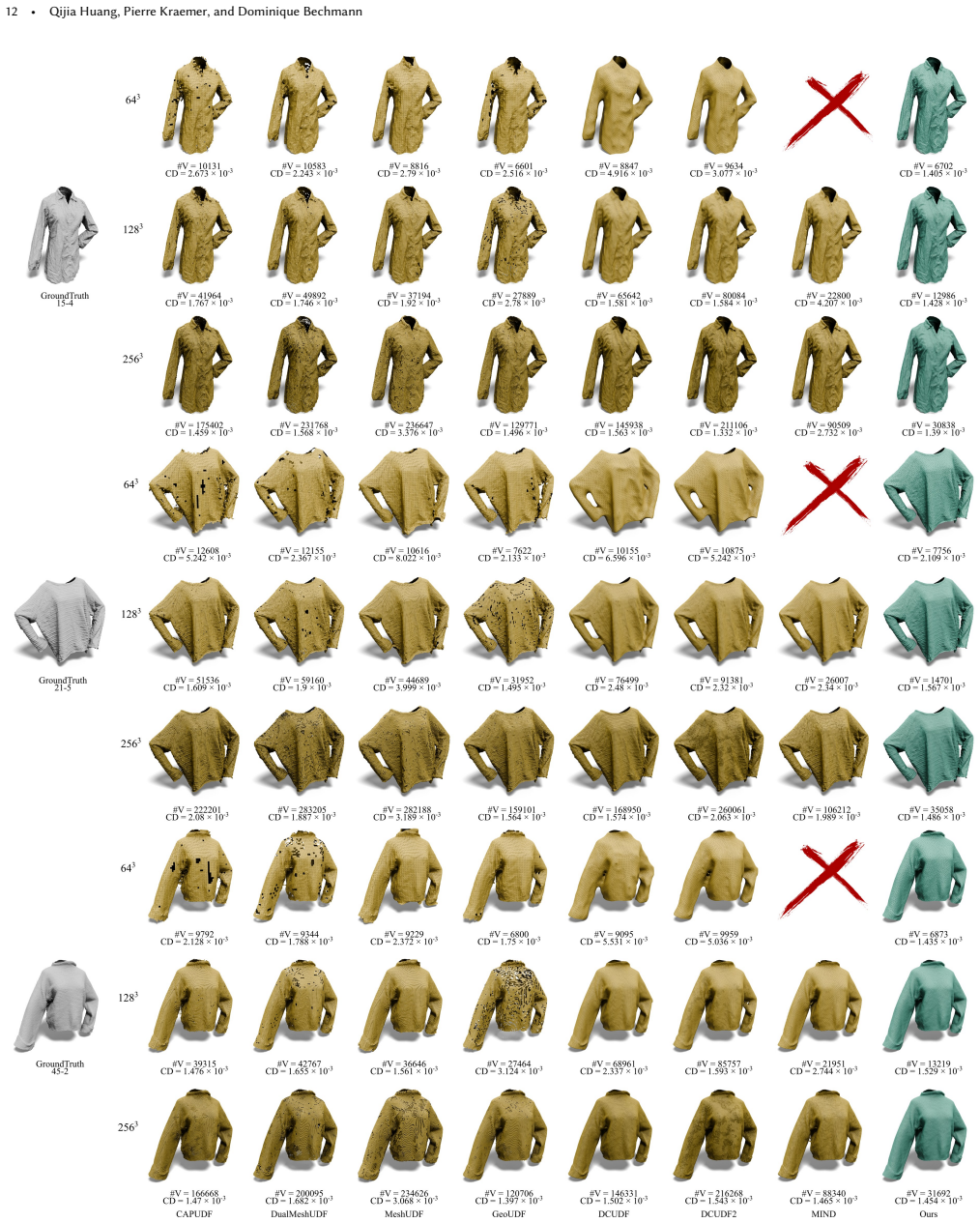
Dense scene reconstruction with points of interest.ACM Trans. Graph.32, 4 (2013). https://doi.org/10.1145/2461912.2461919 OffsetAxis: UDF Mesh Reconstruction via Offset-Volume Medial Axis Extraction•9 Fig. 6.Effect of the 𝛼 parameter:Top row: sample points on the 𝛼-level set. Bottom row: the corresponding reconstructions. An excessively large value (𝛼= 0....
-
[18]
For each reconstruction, we report the number of vertices (#V) and the Chamfer distance (CD). OffsetAxis: UDF Mesh Reconstruction via Offset-Volume Medial Axis Extraction•11 A DERIVATION OF THE LOCAL SPHERE UPDATE We derive the local update of a sphere𝑚𝑖 =( c𝑖, 𝑟𝑖 ) with respect to a cluster C𝑖 of oriented samples 𝑣 𝑗 =( x𝑗, n𝑗 ). Each sample is assigned ...
work page 2013
discussion (0)
Sign in with ORCID, Apple, or X to comment. Anyone can read and Pith papers without signing in.