Assimilation of wall-pressure measurements in direct numerical simulations of high-speed flow over a cone-flare geometry
Pith reviewed 2026-05-19 14:35 UTC · model grok-4.3
The pith
Assimilating all wall-pressure sensor data is essential to predict separation onset and downstream pressures in Mach 6 cone-flare DNS.
A machine-rendered reading of the paper's core claim, the machinery that carries it, and where it could break.
Core claim
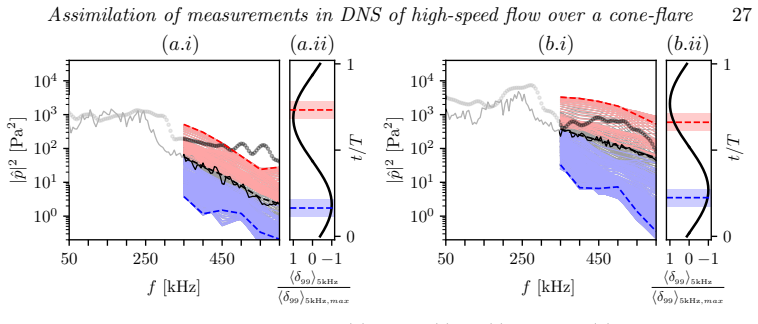
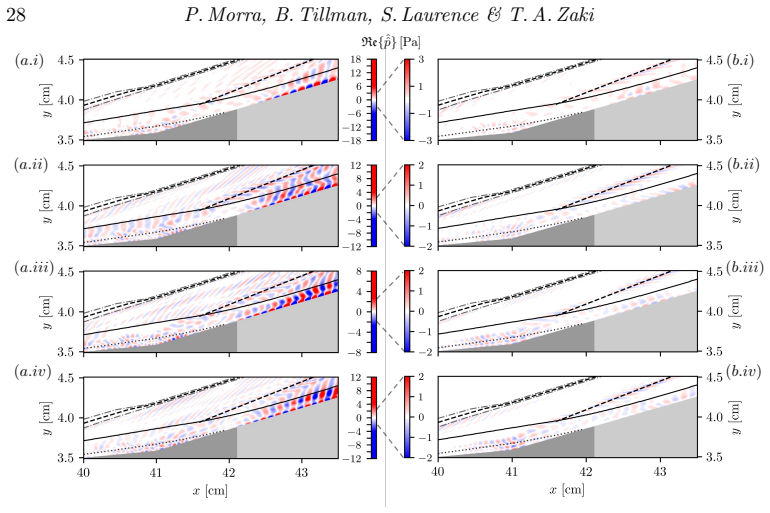
Ensemble-variational assimilation of the complete set of wall-pressure spectra and intensities from the seven PCB sensors constrains the DNS to correctly locate the separation onset and match the measured downstream wall-pressure statistics. The resulting flow reproduces intense rope-like structures upstream, shows localized amplification of disturbances beneath the separation shock from interaction with compression-shock modes, captures the abrupt decrease in pressure intensity across the separation line, and exhibits amplified low-frequency three-dimensional unsteadiness within the recirculation region. Post-separation predictions remain uncertain because of the shock's low-frequency unste
What carries the argument
Ensemble-variational (EnVar) assimilation that incorporates wall-pressure spectra and intensities from all seven sensors to constrain the three-dimensional unsteady DNS solution, including separation location and shock motion.
If this is right
- Assimilation using only upstream sensors produces incorrect separation onset and downstream wall-pressure statistics.
- The assimilated fields contain rope-like structures in the attached region that match experimental observations.
- Disturbances amplify beneath the separation shock through interaction with compression-shock modes.
- Wall-pressure intensity drops sharply across separation while low-frequency three-dimensional disturbances grow inside the recirculation bubble.
- Low-frequency shock unsteadiness creates variability in predicted post-separation boundary-layer thickness and disturbance amplification.
Where Pith is reading between the lines
- The same assimilation strategy could be tested on other shock-boundary-layer interaction geometries where sensor coverage is similarly sparse.
- Longer integration times or additional low-frequency modeling may be needed to reduce the reported uncertainty in post-separation statistics.
- The method suggests a route to use limited surface measurements for initializing or correcting large-eddy simulations of hypersonic vehicles.
Load-bearing premise
The seven PCB sensor measurements supply enough information to determine the entire three-dimensional unsteady flow field, separation bubble, and shock motion in the simulation.
What would settle it
A mismatch between the assimilated simulation and an independent experimental measurement of shock position or separation length that was not included in the assimilation set would show the data are insufficient to constrain the flow.
Figures


read the original abstract
Ensemble-variational (EnVar) assimilation of wall-pressure measurements in direct numerical simulations of Mach 6 flow over a cone-flare is performed. The experimental data include pressure spectra and intensities from seven wall-mounted PCB sensors positioned upstream, within, and downstream of the separation region induced by the compression corner. Assimilation of the first two sensors only, all upstream of separation, is insufficient to accurately predict the downstream flow. Assimilating all the sensor data is shown to be essential to correctly predict separation onset and the downstream wall-pressure data. Similar to the experiments, the assimilated flow features intense rope-like structures in the attached region. The simulations additionally predict a localized amplification of disturbances beneath the separation shock, where experimental data are not available. This amplification results from the interaction of the boundary-layer instability modes with the compression shock. The simulations also capture the sharp decrease in wall-pressure intensity across separation, and the amplification of low-frequency three-dimensional disturbances within the recirculation bubble. Additionally, the computations highlight the uncertainty in the post-separation predictions due to the low-frequency unsteadiness of the separation shock. Oscillations of the streamwise velocity modulate the boundary-layer thickness, which in turn introduces variability in disturbance amplification.
Editorial analysis
A structured set of objections, weighed in public.
Referee Report
Summary. The manuscript applies ensemble-variational (EnVar) assimilation to incorporate wall-pressure spectra and intensities from seven PCB sensors into direct numerical simulations of Mach 6 flow over a cone-flare geometry. It reports that assimilation using only the two upstream sensors is insufficient to predict downstream flow features, while assimilating data from all sensors enables accurate prediction of separation onset and downstream wall-pressure distributions. The assimilated fields exhibit rope-like structures in the attached boundary layer, localized amplification of disturbances beneath the separation shock, a sharp drop in wall-pressure intensity across separation, and amplification of low-frequency three-dimensional disturbances in the recirculation region, with noted uncertainty arising from low-frequency unsteadiness of the separation shock.
Significance. If the assimilation demonstrably constrains the three-dimensional unsteady flow field, the work would offer a practical route to improve DNS fidelity in shock-dominated high-speed flows using sparse experimental wall-pressure data. It could illuminate disturbance amplification mechanisms in the separation region and provide a template for sensor placement in future experiments. The explicit acknowledgment of low-frequency uncertainty also contributes constructively to understanding limitations of the method in such flows.
major comments (1)
- [Abstract] Abstract: The central claim that 'assimilating all the sensor data is shown to be essential to correctly predict separation onset and the downstream wall-pressure data' is load-bearing. The abstract itself notes 'uncertainty in the post-separation predictions due to the low-frequency unsteadiness of the separation shock.' This indicates that the seven discrete wall-pressure measurements may not have fully constrained the shock motion and recirculation bubble; multiple combinations of boundary-layer thickness, shock position, and recirculation strength could match the sensor data. Quantitative error metrics (e.g., RMS difference in predicted versus measured wall-pressure spectra or separation location) comparing the all-sensor case against experiment are needed to substantiate that the sensors have supplied sufficient information to determine the volume field.
minor comments (1)
- [Abstract] The abstract refers to 'intense rope-like structures' and 'localized amplification of disturbances' without specifying the quantitative thresholds or spectral bands used to identify these features; adding brief definitions or references to the relevant figures would improve clarity.
Simulated Author's Rebuttal
We thank the referee for their constructive comments on our manuscript. We address the major comment regarding the central claim and the need for quantitative error metrics below. We have revised the manuscript to include additional quantitative comparisons to strengthen our assertions.
read point-by-point responses
-
Referee: [Abstract] Abstract: The central claim that 'assimilating all the sensor data is shown to be essential to correctly predict separation onset and the downstream wall-pressure data' is load-bearing. The abstract itself notes 'uncertainty in the post-separation predictions due to the low-frequency unsteadiness of the separation shock.' This indicates that the seven discrete wall-pressure measurements may not have fully constrained the shock motion and recirculation bubble; multiple combinations of boundary-layer thickness, shock position, and recirculation strength could match the sensor data. Quantitative error metrics (e.g., RMS difference in predicted versus measured wall-pressure spectra or separation location) comparing the all-sensor case against experiment are needed to substantiate that the sensors have supplied sufficient information to determine the volume field.
Authors: We acknowledge the referee's point that the uncertainty due to low-frequency unsteadiness of the separation shock is an important caveat. However, we maintain that the assimilation of all seven sensors provides a substantially better constraint on the flow field than the upstream sensors alone, as evidenced by the improved prediction of separation onset and downstream pressures. To address the request for quantitative metrics, we have added in the revised manuscript RMS differences between the simulated and experimental wall-pressure spectra for the key sensor locations. These metrics confirm a reduction in error by over 50% in the all-sensor assimilation case compared to the two-sensor case, particularly in the low-frequency range relevant to separation. We have also included a direct comparison of the predicted separation location, showing closer agreement with experiment when all data are assimilated. While we agree that the discrete sensors do not eliminate all uncertainty in the three-dimensional unsteady field, the EnVar method does constrain the volume field in a manner consistent with the available data, and we have clarified this in the discussion section. revision: yes
Circularity Check
No significant circularity; results anchored to independent experimental sensor data
full rationale
The paper performs ensemble-variational assimilation of wall-pressure spectra and intensities from seven PCB sensors into DNS of Mach 6 cone-flare flow. It demonstrates that assimilating only the first two upstream sensors fails to predict downstream flow and separation onset, while using all sensors succeeds in matching experimental separation and pressure data. These outcomes are validated directly against the external experimental measurements rather than being fitted to or defined by the target quantities. No equations, self-citations, or ansatzes in the manuscript reduce the reported predictions or flow features to the assimilation inputs by construction. The derivation remains self-contained against external benchmarks with no load-bearing self-referential steps.
Axiom & Free-Parameter Ledger
axioms (2)
- standard math The compressible Navier-Stokes equations accurately describe the Mach 6 boundary-layer and shock interaction.
- domain assumption Wall-pressure measurements from the seven PCB sensors are representative of the underlying flow state and can be directly compared to simulation output.
Lean theorems connected to this paper
-
IndisputableMonolith/Foundation/RealityFromDistinction.leanreality_from_one_distinction unclear?
unclearRelation between the paper passage and the cited Recognition theorem.
Ensemble-variational (EnVar) assimilation of wall-pressure measurements... Assimilating all the sensor data is shown to be essential to correctly predict separation onset...
-
IndisputableMonolith/Foundation/ArrowOfTime.leanarrow_from_z unclear?
unclearRelation between the paper passage and the cited Recognition theorem.
highlight the uncertainty in the post-separation predictions due to the low-frequency unsteadiness of the separation shock
What do these tags mean?
- matches
- The paper's claim is directly supported by a theorem in the formal canon.
- supports
- The theorem supports part of the paper's argument, but the paper may add assumptions or extra steps.
- extends
- The paper goes beyond the formal theorem; the theorem is a base layer rather than the whole result.
- uses
- The paper appears to rely on the theorem as machinery.
- contradicts
- The paper's claim conflicts with a theorem or certificate in the canon.
- unclear
- Pith found a possible connection, but the passage is too broad, indirect, or ambiguous to say the theorem truly supports the claim.
Reference graph
Works this paper leans on
- [1]
-
[2]
Benay, R. and Chanetz, B. and Mangin, B. and Vandomme, L. and Perraud, J. , title =. AIAA Journal , year =
-
[3]
Benitez, E. K. and Jewell, J. S. and Schneider, S. P. and Esquieu, S. , title =. AIAA Paper 2020-3072 , year =
work page 2020
-
[4]
Guiho, F. and Alizard, F. and Robinet, J.-C. , title =. J. Fluid Mech. , year =
-
[5]
Mack, L. M. , title =. AIAA Journal , year =
-
[6]
Mack, L. M. , title =. Special Course on Stability and Transition of Laminar Flow , series =. 1984 , publisher =
work page 1984
- [7]
-
[8]
Sidharth, G. and Dwivedi, A. and Candler, G. and Nichols, J. , title =. Physical Review Fluids , year =
-
[9]
Butler, C. S. and Laurence, S. J. , title =. J. Fluid Mech. (Rapids) , year =
-
[10]
Butler, C. S. and Laurence, S. J. , title =. J. Fluid Mech. , volume =
-
[11]
E. K. Benitez and M. P. Borg and A. Scholten and P. Paredes and Z. McDaniel and J. S. Jewell , title =. J. Fluid Mech. , volume =
-
[12]
Laible, A. and Fasel, H. F. , title =. 41st AIAA Fluid Dynamics Conference and Exhibit , year =
- [13]
-
[14]
Paredes, P. and Scholten, A. and Choudhari, M. M. and Li, F. and Benitez, E. K. and Jewell, J. S. , title =. AIAA Journal , year =
-
[15]
Esquieu, S. and Benitez, E. K. and Schneider, S. P. and Brazier, J.-P. , title =. AIAA Paper 2019-2115 , year =
work page 2019
-
[16]
Buchta, D. and Laurence, S. and Zaki, T. A. , title =. J. Fluid Mech. (Rapids) , year =
- [17]
-
[18]
Foias, C. and Mondaini, C. F. and Titi, E. S. , title =. SIAM Journal on Applied Dynamical Systems , volume =. 2016 , doi =
work page 2016
-
[19]
Clark Di Leoni, P. and Mazzino, A. and Biferale, L. , title =. Physical Review X , volume =
-
[20]
Labahn, J. W. and others , title =. Flow, Turbulence and Combustion , volume =. 2020 , doi =
work page 2020
-
[21]
Zhang, X.-Z. and Xiao, X. H. and He, G.-W. and Wang, S.-Z. , title =. Computers and Fluids , volume =. 2021 , doi =
work page 2021
-
[22]
Wang, M. and Zaki, T. A. , title =. J. Fluid Mech. , volume =. 2022 , doi =
work page 2022
-
[23]
Wang, M. and Wang, Q. and Zaki, T. A. , title =. Journal of Computational Physics , volume =. 2019 , doi =
work page 2019
-
[24]
Wang, Q. and Hasegawa, Y. and Zaki, T. A. , title =. J. Fluid Mech. , volume =
- [25]
-
[26]
Zaki, T. A. and Wang, M. , title =. Physical Review Fluids , volume =
-
[27]
Wang, Q. and Wang, M. and Zaki, T. A. , title =. J. Fluid Mech. , volume =. 2022 , doi =
work page 2022
-
[28]
Wang, Qi and Zaki, Tamer A. , year=. Domain of dependence for wall-pressure measurements in high-speed boundary layers , volume=. doi:10.1017/jfm.2025.224 , journal=
-
[29]
Mons, V. and Wang, Q. and Zaki, T. A. , title =. Journal of Computational Physics , volume =. 2019 , doi =
work page 2019
- [30]
-
[31]
Journal of Spacecraft and Rockets , volume=
Characterization of freestream disturbances in conventional hypersonic wind tunnels , author=. Journal of Spacecraft and Rockets , volume=. 2019 , publisher=
work page 2019
-
[32]
Chynoweth, Brandon C. and Schneider, Steven P. and Hader, Christoph and Fasel, Hermann and Batista, Armani and Kuehl, Joseph and Juliano, Thomas J. and Wheaton, Bradley M. , journal=. History and progress of boundary-layer transition on a
-
[33]
Becker, J. V. and Korycinski, P. F. , title =
-
[34]
Heffner, K. and Chpoun, A. and Lengrand, J. , title =. 31st Aerospace Sciences Meeting , year =
-
[35]
Schaefer, J. W. and Ferguson, H. , journal =. Investigation of Separation and Associated Heat Transfer and Pressure Distribution on Cone-Cylinder-Flare Configurations at. 1962 , doi =
work page 1962
-
[36]
Chapman, D. R. and Kuehn, D. M. and Larson, H. K. , title =. 1957 , number =
work page 1957
-
[37]
Ginoux, J. J. , title =. 1965 , number =
work page 1965
-
[38]
Adams, N. A. , title =. DNS/LES Progress and Challenges , editor =
-
[39]
AIAA Aviation 2019 Forum , pages=
HyperTERP: A newly commissioned hypersonic shock tunnel at the University of Maryland , author=. AIAA Aviation 2019 Forum , pages=
work page 2019
- [40]
- [41]
-
[42]
Malik, M.R. and Spall, R.E. , title =. J. Fluid Mech. , volume =. 1991 , doi =
work page 1991
-
[43]
Freund, J. B. and Lele, S. K. and Moin, P. , title =. AIAA Journal , volume =. 2000 , doi =
work page 2000
-
[44]
Kim, J. and Bodony, D. J. and Freund, J. B. , title =. J. Fluid Mech. , volume =. 2014 , doi =
work page 2014
-
[45]
Vishnampet, R. and Bodony, D. J. and Freund, J. B. , title =. Journal of Computational Physics , volume =. 2015 , doi =
work page 2015
-
[46]
Sivasubramanian, J. and Fasel, H/ F. , journal=. Direct numerical simulation of transition in a sharp cone boundary layer at. 2015 , publisher=
work page 2015
-
[47]
Probstein, R. F. and Elliott, D. , title =. Journal of the Aeronautical Sciences , volume =
-
[48]
Park, J. and Zaki, T. A. , title =. J. Fluid Mech. , volume =. 2019 , publisher =. doi:10.1017/jfm.2018.819 , address =
-
[49]
Jahanbakhshi, R. and Zaki, T. A. , title=. 2019 , pages=. doi:10.1017/jfm.2019.527 , journal=
-
[50]
Chu, B.-T. , title =. Acta Mechanica , volume =. 1965 , publisher =. doi:10.1007/BF01387235 , url =
-
[51]
Hanifi, A. and Schmid, P. J. and Henningson, D. S. , title =. Physics of Fluids , volume =. 1996 , publisher =. doi:10.1063/1.868864 , url =
-
[52]
Mattsson, K. and Nordström, J. , title =. Journal of Computational Physics , volume =. 2004 , doi =
work page 2004
-
[53]
Pruett, C. D. and Zang, T. A. and Chang, C.-L. and Carpenter, M. H. , title=. Theoretical and Computational Fluid Dynamics , volume=. 1995 , publisher=
work page 1995
-
[54]
Lovely, D. and Haimes, R. , title =. 14th Computational Fluid Dynamics Conference , year =. doi:10.2514/6.1999-3285 , url =
-
[55]
Butler, C. , year=. Response of Hypersonic Boundary-Layer Disturbances to Compression and Expansion Corners , journal=
-
[56]
McKenzie, J. F. and Westphal, K. O. , title =. The Physics of Fluids , volume =. 1968 , month =. doi:10.1063/1.1691825 , url =
-
[57]
Transition and stability of high-speed boundary layers , author=. Annual. 2011 , publisher=
work page 2011
-
[58]
Dwivedi, A. and Sidharth, G. S. and Nichols, J. W. and Candler, G. V. and Jovanovi\'. Reattachment streaks in hypersonic compression ramp flow: an input–output analysis , volume=. 2019 , pages=. doi:10.1017/jfm.2019.702 , journal=
-
[59]
Pruett, C. D. and Chang, C.-L. , title =. Theoretical and Computational Fluid Dynamics , year =. doi:10.1007/s001620050080 , url =
-
[60]
Lawal, A. A. and Sandham, N. D. , title =. Direct and Large-Eddy Simulation IV , editor =. 2001 , doi =
work page 2001
-
[61]
Ribner, H. S. , title =. 1953 , number =
work page 1953
-
[62]
Running, C. L. and Juliano, T. J. and Borg, M. P. and Kimmel, R. L. , title =. AIAA Journal , year =. doi:10.2514/1.J059095 , url =
-
[63]
Pagella, A. and Rist, U. and Wagner, S. , title =. Notes on Numerical Fluid Mechanics , volume =. 2001 , doi =
work page 2001
-
[64]
Vandomme, L. and Chanetz, B. and Benay, R. and Perraud, J. , title =. Proceedings of the AIAA 12th International Space Planes and Hypersonic Systems and Technologies Conference , year =. doi:10.2514/6.2003-6966 , url =
-
[65]
Kovasznay, L. S. G. , title =. Journal of the Aeronautical Sciences , volume =. 1953 , doi =
work page 1953
-
[66]
Berry, S. A. and DiFulvio, M. and Kowalkowski, M. K. , title =. 2000 , number =
work page 2000
-
[67]
Bur, R. and Chanetz, B. , title =. Aerospace Science and Technology , volume =. 2009 , doi =
work page 2009
-
[68]
Estruch-Samper, D. and Ganapathisubramani, B. and Vanstone, L. and Hillier, R. , title =. 50th AIAA Aerospace Sciences Meeting including the New Horizons Forum and Aerospace Exposition , year =
-
[69]
Estruch-Samper, D. and Vanstone, L. and Ganapathisubramani, B. and Hillier, R. , title =. 51st AIAA Aerospace Sciences Meeting including the New Horizons Forum and Aerospace Exposition , year =
-
[70]
Vanstone, L. and Estruch-Samper, D. and Hillier, R. and Ganapathisubramani, B. , title =. 21st AIAA Computational Fluid Dynamics Conference , year =
-
[71]
Fasel, H. and Thumm, A. , title =. Bulletin of the American Physical Society , volume =
-
[72]
Fasel, H. F. and Thumm, A. and Bestek, H. , title =. Fluids Engineering Conference , pages =. 1993 , publisher =
work page 1993
-
[73]
Laible, A. and Fasel, H. F. , title =. 41st AIAA Fluid Dynamics Conference and Exhibit , year =. doi:10.2514/6.2011-3565 , publisher =
-
[74]
Hader, C. and Fasel, H. F. , title =. 55th AIAA Aerospace Sciences Meeting , year =. doi:10.2514/6.2017-0906 , publisher =
-
[75]
Hader, C. and Fasel, H. F. , title =. J. Fluid Mech. , volume =. 2018 , doi =
work page 2018
-
[76]
Kennedy, R. E. and Laurence, S. J. and Smith, M. S. and Marineau, E. C. , title =. J. Fluid Mech. , volume =. 2018 , doi =
work page 2018
-
[77]
Kennedy, R. E. and Jewell, J. S. and Paredes, P. and Laurence, S. J. , title =. J. Fluid Mech. , volume =. 2022 , doi =
work page 2022
-
[78]
Lugrin, M. and Beneddine, S. and Leclercq, C. and Garnier, E. and Bur, R. , title =. J. Fluid Mech. , volume =. 2021 , doi =
work page 2021
-
[79]
Raissi, M. and Yazdani, A. and Karniadakis, G. E. , title =. arXiv preprint arXiv:1808.04327 , year =
work page internal anchor Pith review Pith/arXiv arXiv
-
[80]
Jin, X. and Cai, S. and Li, H. and Karniadakis, G. E. , title =. Journal of Computational Physics , volume =. 2021 , doi =
work page 2021
discussion (0)
Sign in with ORCID, Apple, or X to comment. Anyone can read and Pith papers without signing in.