Self-Prompting Diffusion Transformer for Open-Vocabulary Scene Text Editing via In-Context Learning
Pith reviewed 2026-05-19 15:01 UTC · model grok-4.3
The pith
Self-prompting constructs style and glyph prompts directly from the source image so a Multi-Modal Diffusion Transformer can edit scene text in any vocabulary while preserving original appearance.
A machine-rendered reading of the paper's core claim, the machinery that carries it, and where it could break.
Core claim
The paper claims that a self-prompting scene text editing pipeline, built around the Multi-Modal Diffusion Transformer, can achieve open-vocabulary editing by constructing style and glyph prompts directly from the original image, trained through a two-stage process of self-supervised pre-training followed by paired-image refinement, and that this yields superior text accuracy and style consistency on multiple languages without any additional style or glyph encoders.
What carries the argument
Self-prompting mechanism that extracts style and glyph prompts directly from the input image to condition the Multi-Modal Diffusion Transformer (MM-DiT) and exploit its in-context learning for editing.
If this is right
- Text can be changed to any desired content while the surrounding background, lighting, and font appearance remain unchanged.
- The method supports editing across scripts and languages not limited by a fixed glyph vocabulary.
- No separate style or glyph encoders are required, simplifying the pipeline.
- Performance improves on both accuracy of the rendered text and visual consistency with the source image.
Where Pith is reading between the lines
- The same self-prompting idea could be tested on video frames to maintain style coherence across time.
- It might reduce the need for large paired datasets in other conditional image-manipulation tasks.
- Real-time design tools could adopt the approach if the diffusion sampling is accelerated.
Load-bearing premise
Prompts created directly from the original image contain all stylistic and glyph details needed for faithful editing without any dedicated encoders or external signals.
What would settle it
Apply the method to an image containing an unusual or highly stylized font in a low-contrast background; the edit should fail to reproduce the original font weight, texture, or legibility if the assumption does not hold.
Figures


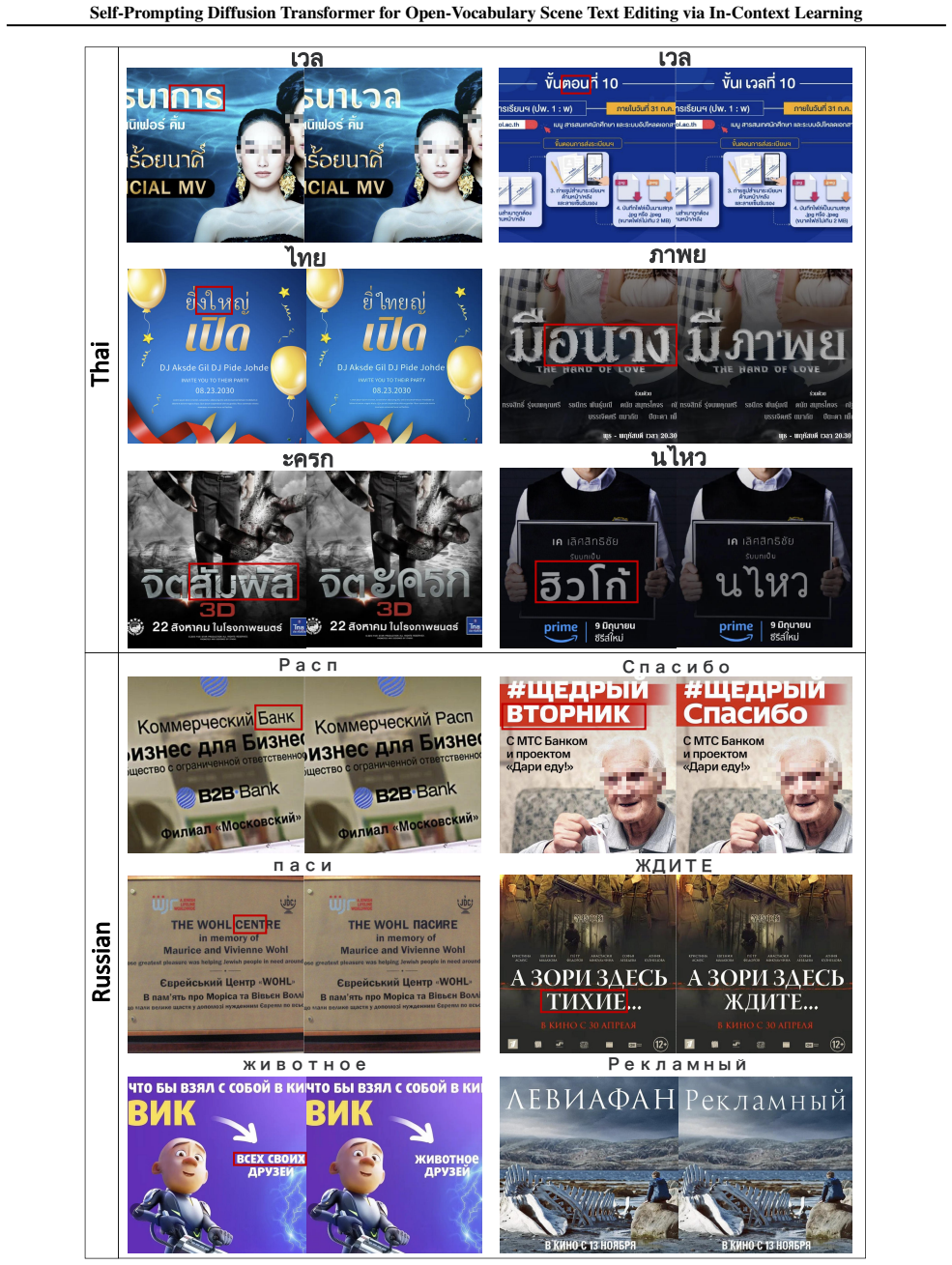


read the original abstract
Scene text editing aims to modify text in a target region of an image while preserving surrounding background style and texture. Existing methods rely solely on image background information while neglecting the visual details of target regions, which discards stylistic features in the original text and essentially degrades the task to text rendering. Moreover, the conditions imposed by pre-trained glyph encoder limit the scope of editable text. To address these issues, this paper proposes a self-prompting scene text editing method that constructs style and glyph prompts directly from the original image, without introducing additional style or glyph encoders. We employ a two-stage training strategy: the diffusion transformer is first trained on large-scale self-supervised data and then refined using a small set of paired images. By leveraging the in-context learning capability of the Multi-Modal Diffusion Transformer (MM-DiT), it achieves open-vocabulary and style-consistent text editing. Experimental results on various languages demonstrate that our method achieves the state-of-the-art performance in both text accuracy and style consistency. Our project page: \href{https://hongxiii.github.io/mstedit}{hongxiii.github.io/mstedit}.
Editorial analysis
A structured set of objections, weighed in public.
Referee Report
Summary. The paper proposes a self-prompting scene text editing method using a Multi-Modal Diffusion Transformer (MM-DiT). It constructs style and glyph prompts directly from the original image without additional encoders, employs a two-stage training strategy (large-scale self-supervised pre-training followed by fine-tuning on paired images), and leverages in-context learning to achieve open-vocabulary and style-consistent text editing across languages, claiming state-of-the-art performance in text accuracy and style consistency.
Significance. If the performance claims hold, the work would be significant for scene text editing by addressing the limitation of existing methods that neglect target region details and rely on pre-trained glyph encoders. The self-prompting approach combined with MM-DiT in-context learning offers a practical way to preserve original stylistic features and enable editing of unseen text without dedicated auxiliary modules. The two-stage training strategy is a reasonable empirical design for scaling such models.
major comments (2)
- [Abstract and Experimental Results] Abstract and Experimental Results: The manuscript asserts state-of-the-art performance in both text accuracy and style consistency on various languages, but supplies no quantitative tables, baselines, ablation studies, metrics, or dataset details. This absence is load-bearing for the central claim of superiority and prevents verification of the results.
- [Method] Method section: The central open-vocabulary claim rests on the assumption that prompts constructed directly from the original image via self-prompting (masking or region extraction) capture fine glyph geometry for unseen characters. The two-stage regime provides no explicit mechanism or auxiliary encoder to guarantee stroke-level detail preservation for out-of-distribution glyphs, which risks undermining the claim if in-context examples convey only coarse appearance.
minor comments (1)
- [Abstract] The project page URL is provided but the manuscript would benefit from clearer notation on how the style and glyph prompts are extracted and fed into the MM-DiT.
Simulated Author's Rebuttal
We thank the referee for the constructive feedback and for recognizing the potential significance of the self-prompting MM-DiT approach. We address each major comment below and describe the revisions we will incorporate.
read point-by-point responses
-
Referee: [Abstract and Experimental Results] Abstract and Experimental Results: The manuscript asserts state-of-the-art performance in both text accuracy and style consistency on various languages, but supplies no quantitative tables, baselines, ablation studies, metrics, or dataset details. This absence is load-bearing for the central claim of superiority and prevents verification of the results.
Authors: We agree that the experimental validation requires more explicit quantitative support to substantiate the state-of-the-art claims. The full manuscript contains experimental results on multiple languages, but we will substantially expand the Experimental Results section in the revision. This will include detailed quantitative tables with metrics for text accuracy and style consistency, comparisons against relevant baselines, ablation studies, and full dataset descriptions. These additions will make the superiority claims directly verifiable. revision: yes
-
Referee: [Method] Method section: The central open-vocabulary claim rests on the assumption that prompts constructed directly from the original image via self-prompting (masking or region extraction) capture fine glyph geometry for unseen characters. The two-stage regime provides no explicit mechanism or auxiliary encoder to guarantee stroke-level detail preservation for out-of-distribution glyphs, which risks undermining the claim if in-context examples convey only coarse appearance.
Authors: The self-prompting process extracts both coarse and fine-grained glyph geometry directly from the masked target region of the input image, supplying the MM-DiT with stroke-level visual details rather than abstract encodings. The two-stage training first exposes the model to large-scale self-supervised data so that it learns to interpret these detailed in-context prompts for novel glyphs; the subsequent fine-tuning on paired data further refines style-consistent generation. We will revise the Method section to articulate this mechanism more explicitly, including how the absence of auxiliary glyph encoders is compensated by the direct visual prompting and the transformer’s in-context learning capacity. revision: partial
Circularity Check
No significant circularity; method is empirical and self-contained
full rationale
The paper presents an architectural proposal (self-prompting from source image regions to supply style/glyph context to MM-DiT) plus a two-stage training regimen (large-scale self-supervised pre-training followed by limited paired fine-tuning). No equations, derivations, or fitted parameters are shown that reduce the claimed open-vocabulary performance or style consistency to a quantity defined by the method itself. The central claims rest on experimental results across languages rather than any tautological reduction or self-citation chain that would force the outcome by construction. This is the normal case of an empirical CV method whose validity is externally falsifiable via benchmarks.
Axiom & Free-Parameter Ledger
Lean theorems connected to this paper
-
IndisputableMonolith/Foundation/AbsoluteFloorClosure.leanreality_from_one_distinction unclear?
unclearRelation between the paper passage and the cited Recognition theorem.
constructs style and glyph prompts directly from the original image, without introducing additional style or glyph encoders... two-stage training strategy: the diffusion transformer is first trained on large-scale self-supervised data and then refined using a small set of paired images
-
IndisputableMonolith/Cost/FunctionalEquation.leanwashburn_uniqueness_aczel unclear?
unclearRelation between the paper passage and the cited Recognition theorem.
leverage the in-context learning capability of the Multi-Modal Diffusion Transformer (MM-DiT)
What do these tags mean?
- matches
- The paper's claim is directly supported by a theorem in the formal canon.
- supports
- The theorem supports part of the paper's argument, but the paper may add assumptions or extra steps.
- extends
- The paper goes beyond the formal theorem; the theorem is a base layer rather than the whole result.
- uses
- The paper appears to rely on the theorem as machinery.
- contradicts
- The paper's claim conflicts with a theorem or certificate in the canon.
- unclear
- Pith found a possible connection, but the passage is too broad, indirect, or ambiguous to say the theorem truly supports the claim.
Reference graph
Works this paper leans on
-
[1]
Pp-ocr: A practical ultra lightweight ocr system
Du, Y ., Li, C., Guo, R., Yin, X., Liu, W., Zhou, J., Bai, Y ., Yu, Z., Yang, Y ., Dang, Q., et al. Pp-ocr: A practical ultra lightweight ocr system.arXiv preprint arXiv:2009.09941,
-
[2]
Metadata conditioning accelerates language model pre-training.arXiv preprint arXiv:2501.01956,
Gao, T., Wettig, A., He, L., Dong, Y ., Malladi, S., and Chen, D. Metadata conditioning accelerates language model pre-training.arXiv preprint arXiv:2501.01956,
-
[3]
Lan, R., Bai, Y ., Duan, X., Li, M., Jin, D., Xu, R., Sun, L., and Chu, X. Flux-text: A simple and advanced diffusion transformer baseline for scene text editing.arXiv preprint arXiv:2505.03329,
-
[4]
Markov, I., Nesteruk, S., Kuznetsov, A., and Dimitrov, D. Rustitw: Russian language text dataset for visual text in- the-wild recognition.arXiv preprint arXiv:2303.16531,
-
[5]
N., Karatzas, D., Khlif, W., Matas, J., Pal, U., Burie, J.-C., Liu, C.-l., et al
Nayef, N., Patel, Y ., Busta, M., Chowdhury, P. N., Karatzas, D., Khlif, W., Matas, J., Pal, U., Burie, J.-C., Liu, C.-l., et al. Icdar2019 robust reading challenge on multi-lingual scene text detection and recognition—rrc-mlt-2019. In 2019 International conference on document analysis and recognition (ICDAR), pp. 1582–1587. IEEE,
work page 2019
-
[6]
Thaiocrbench: A task-diverse benchmark for vision-language understanding in thai
Nonesung, S., Jaknamon, T., Chaiophat, S., Nitarach, N., Wittayasakpan, C., Sirichotedumrong, W., Na-Thalang, A., and Pipatanakul, K. Thaiocrbench: A task-diverse benchmark for vision-language understanding in thai. arXiv preprint arXiv:2511.04479,
-
[7]
Version 0.3.0. Team, M. L., Ma, H., Tan, H., Huang, J., Wu, J., He, J.-Y ., Gao, L., Xiao, S., Wei, X., Ma, X., et al. Longcat-image technical report.arXiv preprint arXiv:2512.07584,
work page internal anchor Pith review Pith/arXiv arXiv
-
[8]
Firered-image-edit-1.0 techinical report.arXiv preprint arXiv:2602.13344, 2026
Team, S. I., Qiao, C., Hui, C., Li, C., Wang, C., Song, D., Zhang, J., Li, J., Xiang, Q., Wang, R., et al. Firered-image-edit-1.0 technical report.arXiv preprint arXiv:2602.13344,
-
[9]
Anytext: Multilingual visual text generation and editing
Tuo, Y ., Xiang, W., He, J.-Y ., Geng, Y ., and Xie, X. Anytext: Multilingual visual text generation and editing.arXiv preprint arXiv:2311.03054,
-
[10]
Tuo, Y ., Geng, Y ., and Bo, L. Anytext2: Visual text gen- eration and editing with customizable attributes.arXiv preprint arXiv:2411.15245,
-
[11]
Wang, T., Liu, T., Qu, X., Wu, C., Liu, L., and Hu, X. Glyph- mastero: A glyph encoder for high-fidelity scene text edit- ing. InProceedings of the Computer Vision and Pattern Recognition Conference, pp. 28523–28532, 2025a. Wang, Y ., Zhang, W., Xu, H., and Jin, C. Dreamtext: High fidelity scene text synthesis. InProceedings of the Com- puter Vision and P...
work page internal anchor Pith review Pith/arXiv arXiv
-
[12]
Xie, Y ., Zhang, J., Chen, P., Wang, Z., Wang, W., Gao, L., Li, P., Sun, H., Zhang, Q., Qiao, Q., et al. Textflux: An ocr-free dit model for high-fidelity multilingual scene text synthesis.arXiv preprint arXiv:2505.17778,
-
[13]
replace the original text ‘XXX’ with ‘YYY’
10 Self-Prompting Diffusion Transformer for Open-Vocabulary Scene Text Editing via In-Context Learning A. Full Numeric Results A.1. Comparison with General Image Editing Models We additionally compare our method with several recent general-purpose image editing models, including Qwen-Image- Edit (Wu et al., 2025), Longcat-Image-Edit (Team et al., 2025), a...
work page 2025
discussion (0)
Sign in with ORCID, Apple, or X to comment. Anyone can read and Pith papers without signing in.