Method of Fundamental Solutions for Maxwell's Equations in Bi-Periodic Multilayered Media
Pith reviewed 2026-05-19 14:37 UTC · model grok-4.3
The pith
A periodization scheme using proxy sources on spheres makes the Method of Fundamental Solutions accurate for Maxwell's equations in bi-periodic multilayered media.
A machine-rendered reading of the paper's core claim, the machinery that carries it, and where it could break.
Core claim
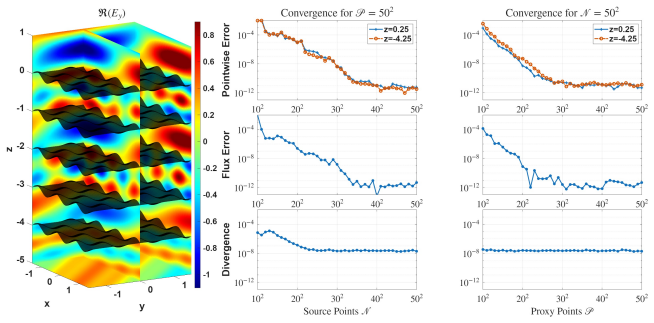
The authors show that the electric and magnetic fields can be represented using the Method of Fundamental Solutions with a split into near and distant interactions, where distant periodic effects are captured by proxy sources on enclosing spheres. Enforcement of tangential field continuity across interfaces, quasi-periodicity on vertical walls, and the radiation condition at infinity yields a square system for the unknown coefficients. The resulting scheme exhibits exponential convergence reaching 10^{-14} for both single-interface and multi-interface test cases, including a demonstration on a stack of 39 layers.
What carries the argument
The periodization scheme that approximates distant interactions by proxy source points placed on spheres surrounding the unit cell.
If this is right
- The solver maintains exponential convergence close to machine precision for configurations with both single and multiple interfaces.
- An example computation with 39 interfaces demonstrates practical performance for thick layered structures.
- The approach satisfies all interface and boundary conditions exactly within the chosen basis and produces a backward-stable linear system.
- Results indicate the method can be extended to a fast boundary integral equation solver for applications involving large numbers of layers in electromagnetics and optics.
Where Pith is reading between the lines
- If the number of proxy points remains fixed as the number of layers grows, the method could simulate arbitrarily thick periodic media at modest cost.
- The same near-far split might be applied to acoustic or elastic wave problems in similar bi-periodic geometries.
- Accuracy for lossy or dispersive materials would need separate verification, since the examples assume lossless media.
Load-bearing premise
The distant periodic interactions can be replaced by a small fixed set of proxy sources on surrounding spheres without introducing errors that grow with the number of layers or destroy the exponential convergence.
What would settle it
A comparison of the computed fields against an independent high-accuracy reference solution for a 50-layer bi-periodic stack, where the relative error fails to stay below 10^{-10} or the convergence rate drops below exponential.
Figures




read the original abstract
In this paper, we present an accurate numerical method for the time-harmonic Maxwell's equations for bi-periodic multilayered media with quasi-periodic incident waves using the Method of Fundamental Solutions in conjunction with a periodization scheme. Following an approach used in acoustic scattering problems, the electric and magnetic fields in each layer are expressed as a sum of near and distant interactions. The near interaction comprises interactions between the unit cell and its nearest neighboring copies, while the distant interaction is approximated by proxy source points placed on spheres surrounding the unit cell. Imposing continuity of tangential components at the layer interface, quasi-periodicity conditions on the walls of the unit cell, and Rayleigh-Bloch expansion for the radiation condition yields a system of equations for the unknown coefficients, which can be solved by Schur complement and a backward-stable solver. The scheme is verified with known solutions and exhibits exponential convergence close to $10^{-14}$ for both single and multiple interfaces. An example with 39 interfaces is presented to demonstrate the solver's performance. The paper provides promising results for extending this method to a fast and accurate boundary integral equation solver for many cutting-edge applications involving a large number of layers in electromagnetics and optics.
Editorial analysis
A structured set of objections, weighed in public.
Referee Report
Summary. The manuscript develops a Method of Fundamental Solutions for the time-harmonic Maxwell equations in bi-periodic multilayered media with quasi-periodic incidence. Fields in each layer are split into explicit near-neighbor interactions and distant interactions approximated by a finite set of proxy sources placed on spheres enclosing the unit cell. Interface continuity, quasi-periodicity, and Rayleigh-Bloch radiation conditions are enforced to obtain a linear system solved via Schur complement; the scheme is reported to achieve exponential convergence to approximately 10^{-14} and is demonstrated on an example with 39 interfaces.
Significance. If the proxy approximation remains accurate and non-accumulating, the method supplies a high-order, mesh-free solver for electromagnetic scattering in periodic multilayer stacks that extends prior acoustic work. The explicit numerical verification against known solutions together with the 39-interface demonstration constitute concrete evidence of practical performance for applications in optics and photonics.
major comments (1)
- [Method section (proxy approximation) and Numerical results (39-interface example)] The central claim of sustained 10^{-14} accuracy at 39 interfaces rests on the distant-interaction proxy representation (described after the near/distant decomposition in the method section) introducing an error smaller than the target tolerance and independent of layer count. No a-priori truncation bound for the finite proxy sources on the enclosing spheres is supplied, nor is stability of the fixed proxy configuration demonstrated for varying contrasts or still larger stacks; the Schur-complement solve can in principle propagate any residual mismatch across the multilayer system.
minor comments (2)
- [Abstract] The abstract states exponential convergence 'close to 10^{-14}' but does not specify the norm (e.g., L^2 on the interfaces or maximum norm on coefficients) in which this rate is measured.
- [Numerical results section] Notation for the proxy-point count and sphere radii is introduced without a dedicated table or explicit parameter list, making it difficult to reproduce the exact configuration used for the 39-interface test.
Simulated Author's Rebuttal
We are grateful to the referee for the detailed and constructive feedback on our manuscript. The positive evaluation of the method's potential for applications in optics and photonics is encouraging. Below, we provide a point-by-point response to the major comment and outline the revisions we plan to make to the manuscript.
read point-by-point responses
-
Referee: [Method section (proxy approximation) and Numerical results (39-interface example)] The central claim of sustained 10^{-14} accuracy at 39 interfaces rests on the distant-interaction proxy representation (described after the near/distant decomposition in the method section) introducing an error smaller than the target tolerance and independent of layer count. No a-priori truncation bound for the finite proxy sources on the enclosing spheres is supplied, nor is stability of the fixed proxy configuration demonstrated for varying contrasts or still larger stacks; the Schur-complement solve can in principle propagate any residual mismatch across the multilayer system.
Authors: We thank the referee for highlighting this important aspect of the proxy approximation. The manuscript demonstrates the method's performance through extensive numerical verification, including exponential convergence to near machine precision (~10^{-14}) for both single and multiple interfaces, and a specific example with 39 interfaces where the accuracy is maintained. The proxy sources are placed on spheres enclosing the unit cell, with the number chosen to achieve the target accuracy based on the acoustic precedent and empirical testing. While an analytical a-priori truncation error bound for the proxy representation is not derived in the current work (as the focus is on the numerical scheme and its practical performance), the numerical results indicate that the approximation error does not accumulate across layers, as evidenced by the sustained high accuracy in the 39-layer case. The Schur complement solver is backward stable, minimizing propagation of errors. To address the concern, we will add a new subsection in the numerical results discussing the choice of proxy parameters and include additional experiments showing stability under varying contrasts (e.g., high-contrast dielectrics) and for stacks with up to 100 interfaces. This will provide further empirical evidence of the method's robustness without altering the core claims. revision: partial
Circularity Check
Numerical construction is self-contained; no load-bearing step reduces to fitted input or self-definition
full rationale
The paper constructs a direct numerical scheme for Maxwell's equations via the Method of Fundamental Solutions in bi-periodic multilayered media. Fields in each layer are expressed as sums of explicit near-neighbor interactions plus proxy-source approximations for distant periodic contributions; interface continuity, quasi-periodicity, and Rayleigh-Bloch radiation conditions are imposed to obtain a linear system solved by Schur complement. Verification against known solutions and reported exponential convergence to 10^{-14} constitute empirical testing of the assembled discretization, not a derivation in which any claimed accuracy or result is forced by construction from the same fitted quantities or prior self-citations. The approach follows standard periodization techniques from scattering literature without importing a uniqueness theorem or ansatz that itself depends on the target result. Consequently the central claims remain independent of the inputs they are tested against.
Axiom & Free-Parameter Ledger
axioms (2)
- standard math Fundamental solutions satisfy Maxwell's equations away from source points and the chosen radiation condition holds at infinity.
- domain assumption Quasi-periodicity and continuity of tangential components are sufficient to determine the unknown coefficients uniquely.
Lean theorems connected to this paper
-
IndisputableMonolith/Foundation/RealityFromDistinction.leanreality_from_one_distinction unclear?
unclearRelation between the paper passage and the cited Recognition theorem.
the electric and magnetic fields in each layer are expressed as a sum of near and distant interactions... proxy source points placed on spheres surrounding the unit cell... solved by Schur complement
-
IndisputableMonolith/Cost/FunctionalEquation.leanwashburn_uniqueness_aczel unclear?
unclearRelation between the paper passage and the cited Recognition theorem.
exhibits exponential convergence close to 10^{-14} for both single and multiple interfaces... 39 interfaces
What do these tags mean?
- matches
- The paper's claim is directly supported by a theorem in the formal canon.
- supports
- The theorem supports part of the paper's argument, but the paper may add assumptions or extra steps.
- extends
- The paper goes beyond the formal theorem; the theorem is a base layer rather than the whole result.
- uses
- The paper appears to rely on the theorem as machinery.
- contradicts
- The paper's claim conflicts with a theorem or certificate in the canon.
- unclear
- Pith found a possible connection, but the passage is too broad, indirect, or ambiguous to say the theorem truly supports the claim.
Reference graph
Works this paper leans on
-
[1]
B. T. DeBoi, A. N. Lemmon, B. McPherson, B. Passmore, Improved methodology for parasitic analysis of high-performance silicon carbide power modules, IEEE Transactions on Power Electronics 37 (10) (2022) 12415–12425
work page 2022
-
[2]
B. Kim, H. Jeon, D. Park, G. Kim, N.-H. Cho, J. Khim, Emi shielding leadless package solution for automotive, Journal of Advanced Joining Processes 5 (2022) 100102. 19
work page 2022
-
[3]
H. A. Atwater, A. Polman, Plasmonics for improved photovoltaic devices, Materials for sustainable energy: a collection of peer-reviewed research and review articles from Nature Publishing Group (2011) 1–11
work page 2011
-
[4]
M. D. Kelzenberg, S. W. Boettcher, J. A. Petykiewicz, D. B. Turner-Evans, M. C. Putnam, E. L. Warren, J. M. Spurgeon, R. M. Briggs, N. S. Lewis, H. A. Atwater, Enhanced absorp- tion and carrier collection in si wire arrays for photovoltaic applications, Nature materials 9 (3) (2010) 239–244
work page 2010
- [5]
- [6]
-
[7]
Monk, et al., Finite element methods for Maxwell’s equations, Oxford University Press, 2003
P. Monk, et al., Finite element methods for Maxwell’s equations, Oxford University Press, 2003
work page 2003
-
[8]
G. Bao, Finite element approximation of time harmonic waves in periodic structures, SIAM Journal on Numerical Analysis 32 (4) (1995) 1155–1169
work page 1995
-
[9]
A. Taflove, S. C. Hagness, M. Piket-May, Computational electromagnetics: the finite- difference time-domain method, The Electrical Engineering Handbook 3 (2005) 629–670
work page 2005
-
[10]
K. Yee, Numerical solution of initial boundary value problems involving maxwell’s equa- tions in isotropic media, IEEE Transactions on antennas and propagation 14 (3) (1966) 302–307
work page 1966
-
[11]
R. F. Harrington, Field computation by moment methods, Wiley-IEEE Press, 1993
work page 1993
-
[12]
M. Moharam, T. Gaylord, Rigorous coupled-wave analysis of planar-grating diffraction, JOSA 71 (7) (1981) 811–818
work page 1981
-
[13]
L. Li, Use of fourier series in the analysis of discontinuous periodic structures, JOSA A 13 (9) (1996) 1870–1876
work page 1996
-
[14]
M. H. Cho, Y . Lu, J. Y . Rhee, Y . P. Lee, Rigorous approach on diffracted magneto-optical ef- fects from polar and longitudinal gyrotropic gratings, Optics express 16 (21) (2008) 16825– 16839
work page 2008
-
[15]
O. P. Bruno, M. Lyon, C. Pérez-Arancibia, C. Turc, Windowed green function method for layered-media scattering, SIAM Journal on Applied Mathematics 76 (5) (2016) 1871–1898
work page 2016
-
[16]
O. P. Bruno, C. Pérez-Arancibia, Windowed green function method for the helmholtz equa- tion in the presence of multiply layered media, Proceedings of the Royal Society A: Math- ematical, Physical and Engineering Sciences 473 (2202) (2017) 20170161
work page 2017
-
[17]
C. Pérez-Arancibia, S. P. Shipman, C. Turc, S. Venakides, Domain decomposition for quasi- periodic scattering by layered media via robust boundary-integral equations at all frequen- cies, Communications in Computational Physics (2019). 20
work page 2019
-
[18]
D. P. Nicholls, C. Pérez-Arancibia, C. Turc, Sweeping preconditioners for the iterative solution of quasiperiodic helmholtz transmission problems in layered media, Journal of Scientific Computing 82 (2) (2020) 1–45
work page 2020
-
[19]
M. H. Cho, W. Cai, A parallel fast algorithm for computing the helmholtz integral operator in 3-D layered media, Journal of Computational Physics 231 (17) (2012) 5910–5925
work page 2012
-
[20]
D. Chen, M. H. Cho, W. Cai, Accurate and efficient nystrom volume integral equation method for electromagnetic scattering of 3-d metamaterials in layered media, SIAM Journal on Scientific Computing 40 (1) (2018) B259–B282
work page 2018
-
[21]
J. Lai, M. Kobayashi, L. Greengard, A fast solver for multi-particle scattering in a layered medium, Optics express 22 (17) (2014) 20481–20499
work page 2014
-
[22]
M. H. Cho, A. H. Barnett, Robust fast direct integral equation solver for quasi-periodic scattering problems with a large number of layers, Optics express 23 (2) (2015) 1775–1799
work page 2015
- [23]
-
[24]
M. H. Cho, Spectrally-accurate numerical method for acoustic scattering from doubly- periodic 3D multilayered media, Journal of Computational Physics 393 (2019) 46–58
work page 2019
-
[25]
A. Boag, Y . Leviatan, A. Boag, Analysis of three-dimensional acoustic scattering from doubly periodic structures using a source model, The Journal of the Acoustical Society of America 91 (2) (1992) 572–580
work page 1992
-
[26]
M. H. Cho, J. Huang, Adapting free-space fast multipole method for layered media green’s function: Algorithm and analysis, Applied and Computational Harmonic Analysis 51 (2021) 414–436
work page 2021
-
[27]
H. Wang, W. Lu, A high-accuracy pml-bie solver for three-dimensional acoustic wave scat- tering in axisymmetric layered media, Journal of Computational Physics (2026) 114956
work page 2026
-
[28]
V . Kupradze, M. A. Aleksidze, The method of functional equations for the approximate so- lution of certain boundary value problems, USSR Computational Mathematics and Mathe- matical Physics 4 (4) (1964) 82–126
work page 1964
- [29]
-
[30]
J. Weed, L. Ding, J. Huang, M. H. Cho, Quadrature by two expansions for evaluating Helmholtz layer potentials, Journal of Scientific Computing 95 (3) (2023) 96
work page 2023
-
[31]
L. Ding, J. Huang, J. L. Marzuola, Z. Tang, Quadrature by two expansions: Evaluating Laplace layer potentials using complex polynomial and plane wave expansions, Journal of Computational Physics 428 (2021) 109963
work page 2021
-
[32]
M. H. Cho, W. Cai, Efficient and accurate computation of electric field dyadic green’s function in layered media, Journal of Scientific Computing 71 (2017) 1319–1350. 21
work page 2017
-
[33]
M. H. Cho, J. Huang, D. Chen, W. Cai, A heterogeneous fmm for layered media helmholtz equation I: Two layers in R2, Journal of Computational Physics 369 (2018) 237–251
work page 2018
-
[34]
B. Wu, M. H. Cho, Robust fast direct integral equation solver for three-dimensional dou- bly periodic scattering problems with a large number of layers, Journal of Computational Physics 495 (2023) 112573
work page 2023
-
[35]
Y . Liu, The numerical solution of frequency-domain acoustic and electromagnetic periodic scattering problems, Dartmouth College, 2016
work page 2016
-
[36]
W. C. Chew, Waves and fields in inhomogeneous media, John Wiley & Sons, 1999. 22
work page 1999
discussion (0)
Sign in with ORCID, Apple, or X to comment. Anyone can read and Pith papers without signing in.